Some men spend their whole lives carrying something inside them and never once give it a name. They pass by it each morning. They take their meals beside it. They lie down with it come nightfall.
And when someone asks how they’re doing, they answer fine, and they mean it the way you mean a shut door. The man I’m about to describe was that sort. He held his silence close for nearly forty years before he spoke a single word of it to me. And when he finally did, it wasn’t because I’d asked.
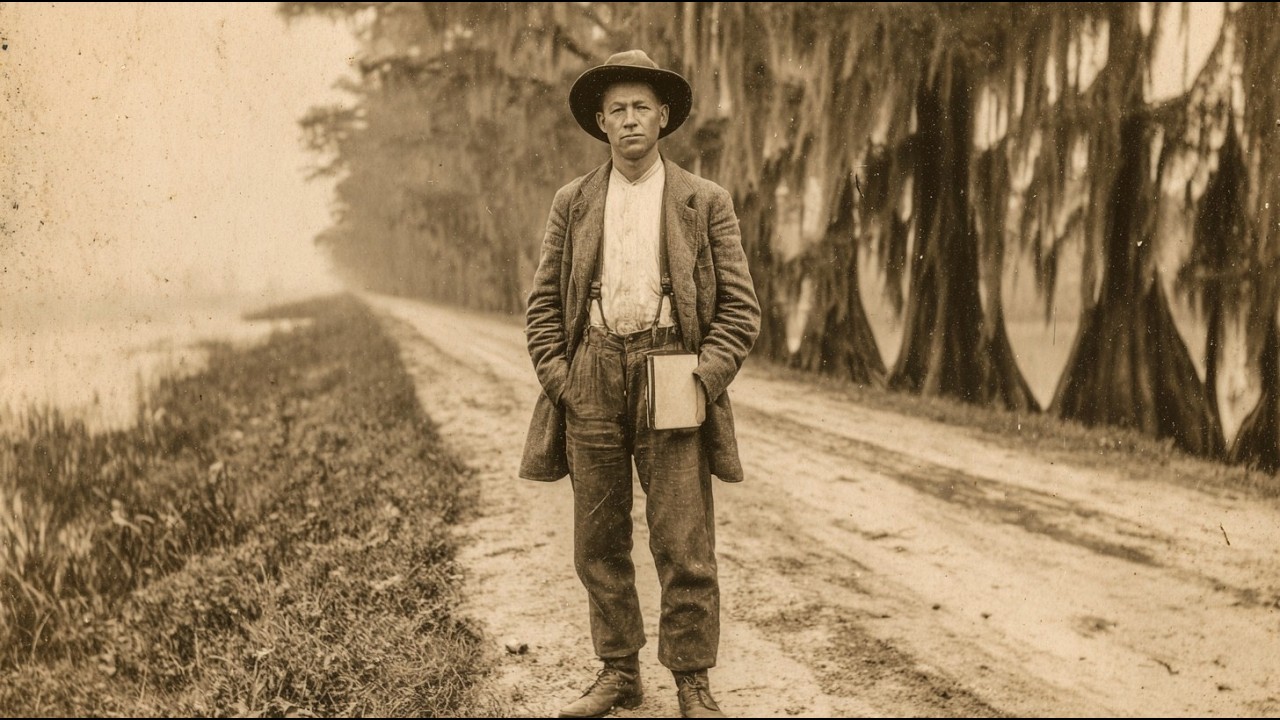
It was a smell drifting through an open window on a mild evening—riverwater, that’s what it was—and the expression that came over his face was the expression of a man who hears his own name called out from a room he believed to be empty. His name was Octave Theot. He was thirty-one in the spring of 1928, working as a levee inspector for the parish board, which meant most of his weeks were spent tramping earthen banks south of New Orleans with a notebook in his coat pocket and a long iron rod in his hand. He used the rod to probe the ground.
He used the notebook to record whatever the rod revealed. He stood a shade over six feet, lean—not slender, but the lean of a man who covered twenty miles a day. His hair was black and cropped short beneath a broad gray hat, and a thin scar ran above his left eyebrow where a horse had kicked him at twenty-two. His hands were the hands of somebody who’d handled rope and clay every day of his life.
There was no softness in them at all. He came into the world in a town called Belshassier, which won’t show up on most maps, because most maps aren’t drawn with enough care to find it. It lay at the end of a dirt road running south through canefields, then through cypress, then through nothing whatsoever. The folks there were mostly Creole and Cajun, with a handful of Anglo families who’d wandered in after the war and never wandered back out.
Octave’s mother was a Theot. His father was a subject he kept to himself. He spoke English on the job and French at home and a touch of Spanish when his temper rose, and he could manage a prayer in Latin if you set a priest before him, though he didn’t pray much. He liked to say the bayou had its own sort of church, and there was no need to kneel in it.
You only had to listen. In March of 1928, he was dispatched to a run of levee roughly eleven miles below the city, close to a river bend the old-timers called the Ostiaba. On most maps it was simply Bend 17. The parish had been receiving word that the ground there was settling faster than it ought to, and the board wanted a man to walk it and set down what he found before the high water arrived in May.
Octave didn’t want the assignment. He kept that to himself in front of his foreman. Turning down paying work in 1928 wasn’t done. Not in that parish, not with a wife at home and a child on the way.
Not a child yet—only a hope. But when his foreman passed him the work order and remarked, “And to Diablo, son, you know the country down there,” Octave felt that small cold knot in his belly that comes over a man when his life is about to turn. All he said was, “I know it.”
The foreman—Hollis Vanderlice by name, a Navy man before he’d come to the parish board—studied him a moment longer than the situation called for.
Hollis had taken Octave on nine years earlier. Hollis read his men the way a captain reads a ship, which is to say he could tell when the timber was worn and when it wasn’t. He said, “Son, if you’d rather not take it, I can hand it to Bedro.” Octave said, “Bedro’s got his back to think about.”
Hollis said, “Bedro’s back will heal. Yours might not.” Octave said, “I’ll take it.” Hollis nodded.
He added nothing further. He creased the work order and slid it across the desk. And as Octave reached for it, their hands brushed for an instant, and Hollis gripped a beat longer than he should have, the way a father lingers when he’s sending a son off somewhere he isn’t certain he ought to be sending him. Then Hollis released him, turned back to his ledger, and didn’t glance up again.
“Be back by Sunday,” he said, addressing the ledger. Octave set out on a Wednesday morning by mule. The road south of the city in those days hardly deserved the name. It was a raised ridge of packed shell and dirt, cane fields along one flank and cypress swamp along the other.
And past the parish line, there was no telegraph, no electric light, and no doctor nearer than half a day’s ride. The mule was called Felix. Felix wasn’t fond of the journey either. Octave had taken Felix down that road a dozen times before.
He knew the bend where the wild plums grew. He knew the stand of cypress where the herons nested each April. He knew the broken wooden sign reading Pellerine’s Landing in faded blue paint, pointing toward a path that no longer existed. He knew that road.
That morning, the road seemed not to know him. Octave rode most of the first day beneath a sky the color of soiled linen. The wind blew in off the gulf. It carried a smell that wasn’t quite salt and wasn’t quite anything else, and he couldn’t place it, and the failure to place it started gnawing at him within the first hour, the way a word you can’t summon starts to gnaw at you.
He kept reining in to test the air. He kept telling himself it was nothing. The mule’s ears kept swiveling. In his experience, the mule’s ears were a more reliable instrument than his own nose.
Near four in the afternoon, the cypress crowded in along both sides of the road. The light turned green. The cicadas, which had rung so loudly all morning that he’d ceased to hear them, fell silent. Simply stopped.
He drew Felix to a halt and listened. There was the faint wet sound of water moving somewhere beyond sight. There was the creak of the saddle. There was his own breathing.
There was nothing more. He’d lived in that country all his life. He knew the difference between a quiet wood and a wood that had gone quiet. This was the latter.
He stayed perfectly motionless on Felix’s back and silently counted to thirty, the way his mother had taught him to count when he was little and frightened of thunder. At twenty-two, the cicadas all began again at once, just as they had ceased together. He released a breath he had not realized he was holding. He clicked his tongue and Felix moved forward, and Octave assured himself that it had been a bird flying over.
A hawk, perhaps, and the small creatures had gone silent for the hawk and then forgotten it. He told himself that for the remainder of the afternoon. He nearly believed it. He passed that night at the home of a man by the name of Augustine Pellerine.
Augustine was old. Octave had no idea how old. He had been old when Octave was a boy fishing alongside his uncles, and he had been old when Octave’s uncles were boys themselves. And the arithmetic of it did not quite add up unless you supposed that Augustine had simply been born old and remained so.
He lived by himself in a single-room house raised on stilts at the swamp’s edge, with a cypress dock, three traps, and a yellow dog that never barked, only watched. The dog’s name was Mister. Octave had not stopped at Augustine’s place in three years. He had intended to.
He had intended to a dozen times. But the old man’s house sat half a mile off the main road, down a path that flooded in winter and became overgrown in summer. And each time Octave had ridden past the turnoff, he had told himself, “Next trip, next trip.” That afternoon, when he reached the turning, he did not say next trip.
He turned in. Augustine was on the dock when Octave rode up. He was repairing a trap. He did not stop repairing the trap.
He said only, without lifting his eyes, “You took the long way, son.” Octave said, “I did.” Augustine said, “You knew I was here.” Octave said, “I knew.”
The old man finished the knot he was tying, laid the trap aside, and stood. His knees made a noise like a small dry branch. He looked Octave up and down. He looked at Felix.
He looked at the iron rod lying across Octave’s saddle, the notebook in Octave’s coat, and the work order folded into the band of his hat. He said, “Where are they sending you?” Octave said, “Bend 17.” Augustine said nothing for a long moment.
Then he turned and walked toward his house, and the dog Mister rose from where he had been lying and followed. And the old man said over his shoulder, “You’ll stay the night.” It was not a question. Octave dismounted.
Augustine took Octave in the way old men in that country took in anyone. He fed him red beans and rice and a piece of catfish, and he poured him a small glass of something clear from an unlabeled jar. And he asked after Octave’s mother, who had been dead nine years, and he listened to the answer as though he had not known. That was his way.
He kept the dead in the present tense until you were ready to release them. After supper, with the lamp turned low and the cypress dark beyond the open door, Augustine filled his pipe. He said, “You remember what your uncle Remy used to say about that bend?” Octave said, “My uncle Remy said a lot of things.”
Augustine said, “He said, ‘The ground down there don’t keep what you put in it.'” Octave regarded the old man for a long while. The dog Mister was watching them from the doorway, and the dog did not blink. Octave said, “That’s a saying.”
Augustine said, “It is.” Octave said, “Sayings are how old men tell young men to be careful without admitting they’re scared.” The old man smiled at that. It was a small smile, and in it there was something weary that was not quite kindness.
He said, “You’re right, son. That’s exactly what they are.” He drew on his pipe. He looked out through the open door into the dark where the cypress stood, where the water moved, where the cicadas had started up loud again, as though they had something to drown out.
He said, “You’re right, and you should be scared anyway.”
Octave said, “Tell me what you know about that place.” Augustine shook his head slowly. He said, “What I know is not worth telling.”
What I know is what an old man hears from older men who heard it from older men still, and by the time a thing has come that far down the line, it is mostly water and very little fish. But there is one thing I will tell you.” Octave waited. The old man said, “My mother went down to that bend once.”
She was a young woman then. She had business with a midwife who lived on that pasture in a house that was already old in the year before the war. She walked the eleven miles down and she walked the eleven miles back the next day. She would not say what she saw.
She would not say what she heard. She would only say all her life, every time the river smell came in through the window the way it is coming in now, ‘The lid is loose tonight.'” Octave said, “The lid.” Augustine said, “The lid.”
He drew on his pipe. The smoke rose into the rafters where the light did not reach. He said, “And the night before she died, she said it twice. I went to the window and I looked out and I could smell nothing but the swamp.
But my mother had a nose for water that I did not inherit. She knew.” He said, “The next morning she was gone. And three days later the parish sent a man down to Bend 17, and the man came back and he did not file his report and he quit the parish that same week and he moved to Mobile, Alabama.
And I have not heard his name spoken in forty years.” Octave said, “Who was he?” Augustine said, “His name was Cleovas Hebert.” Octave said, “I never heard of him.”
Augustine said, “That is on purpose.”
They sat for a long time after that. Octave watched the lamp. The lamp’s flame moved very slightly, even though the door was open only a crack and there was no draft to speak of.
He watched it stir, and he thought, “The lid is loose tonight,” and he could not have said why the thought came to him. Octave slept badly. He did not so much dream as drift in and out of a half sleep, and in that drifting he heard the water lapping at the stilts beneath the house. And once, near three in the morning by his watch, he believed he heard a voice out there in the dark.
Not words. A voice. The kind of sound a voice makes when it is murmuring to itself far away, and you cannot tell what language it speaks. He sat up.
He listened. He heard only water. He lay back down. He told himself it had been the dog.
But when he glanced toward the door, the dog was awake, sitting upright, staring out into the night with his ears pressed flat against his skull, and the dog had not stirred in what might have been a long while. He left at first light. Augustine walked him to the edge of the dock. The morning was cool and gray, wrapped in that thick gulf mist that turns the world into a held breath.
The old man handed Octave a small cloth bag that smelled of dried herbs and something like sweet tobacco. He said, “Put it in your shirt pocket.” Octave said, “What’s in it?” Augustine said, “Things my mother put in her shirt pocket.”
Octave said, “Did it work for her?” Augustine said, “She lived to be ninety-two.” He did not smile when he said it. Octave put the bag in his shirt pocket.
Augustine said, “One more thing.” Octave waited. Augustine said, “If anyone speaks to you down there, you answer them once, civil. You do not answer them twice.”
Octave said, “Why?” Augustine said, “Because the second time you answer is the time they learn the sound of your voice, and after that they can use it.” Octave thought about that for a moment. He thought about asking who “they” were.
He decided he did not want to know. He said, “All right.” The old man nodded. He patted Felix’s neck.
He stepped back from the dock and raised one hand, and that was the goodbye. Octave rode out under the cypress with the cloth bag in his shirt pocket and the iron rod across his saddle, and behind him the dog Mister sat on the dock and watched him go without making a sound. He rode the last seven miles to Bend 17 alone. The cypress thinned out around midmorning, and the river opened up in front of him, brown and wide and slow, and the levee ran along its eastern bank like a long low wall of grass.
He tied Felix to a willow at the foot of the bank and climbed up with his iron rod in his hand and his notebook in his coat. From the top of the levee he could see the bend, the long lazy curve of the river, the dark line of cypress on the far side, and on his own side a stretch of low pasture that ran back maybe a quarter mile to the wall of the swamp. In the middle of that pasture stood a house. He had not expected a house.
It was a planter’s house, two stories, white once but mostly gray now, with a wraparound porch and a sagging center and a row of empty windows on the upper floor that did not catch the light the way windows should. The roof was half gone. The chimneys leaned. A fig tree had grown up through one corner of the porch and shouldered the boards apart.
There was a smell coming off it, faint at that distance, that was something like wet stone and something like old leather and something like nothing he could put a name to. The parish board had not told him about a house. He stood on the levee for a while and looked at it. He looked at the ground around it.
The ground was wrong. It was hard to say at first what was wrong about it. The pasture should have been flat. It had been pasture once.
But around the house, for maybe two hundred yards in every direction, the ground bowed inward, not all at once, in a long slow dish, as if the earth were exhaling under the house, and had been exhaling for a long time, and would keep exhaling until the house went under. He took out his notebook. He wrote, “Residence present at coordinates not previously recorded.” He wrote, “Structure approximately seven decades old, advanced decay.”
He wrote, “Ground subsidence in radial pattern, depth indeterminate, estimated dish 30 feet across by 2 feet deep at center.” He stopped writing. He looked at the house again. He had the strong sense that the house was looking back, not with the windows, with something behind the windows.
He had felt the same thing once at a wake in his cousin’s house in Huma, where the coffin had been at the far end of a long parlor, and he had been at the other end with his back to a wall. And every time he had turned away from the coffin, he had felt the eyes of his dead cousin on the back of his neck. And every time he had turned back, the coffin had been a coffin, and nothing more. The house felt like the coffin.
He climbed down off the levee and walked across the pasture toward it. The closer he got, the more the smell took on a shape. It was the smell of river water that had been standing in a closed room. It was the smell of a thing that had been wet a long time and had never been allowed to dry.
He pulled the cloth bag out of his shirt pocket and held it against his nose without thinking about it, and the dry sweet smell of the herbs cut through the wet smell of the house, and he was grateful for old Augustine’s mother for a moment without knowing why. He noticed, walking across the pasture, that there were no insects. There should have been insects. It was March in Louisiana.
The grass should have been alive with grasshoppers and small things skipping out of his boots with every step. There was nothing. The grass parted around his boots and closed behind him, and that was all. He noticed halfway across that there were no birds.
He stopped. He looked up. The sky was a clean spring blue with thin clouds moving slowly to the southeast. There were no birds in it.
Not high, not low, not on the cypress at the edge of the swamp, not on the levee behind him. He had not seen a bird since he came over the rise. He started walking again. He kept the herb bag against his face.
He stood facing the porch. He drove the iron rod into the earth at the base of the steps. The rod entered. It entered the way a rod sinks into soft mud, which is exactly how it should have gone in had the ground been saturated, but it did not stop going in.
He had carried a six-foot rod. He had used it for nine years. Never in his life had he lost a six-foot rod into soft ground. He lost it.
The rod slipped from his grip and vanished, and the earth sealed over it without a sound, and he stood there with his empty hand still bent around the shape of the handle, and he heard himself say aloud, in his own voice, “That’s not possible.” The house creaked. It was not the wind. There was no wind.
He stepped back twice from the porch. He drew out his notebook. His hand was steady. That would surprise him later.
His hand was perfectly steady. He wrote, “Ground at base of structure, saturated to depth exceeding 6 feet. Possible sinkhole. Recommend evacuation of pasture.”
He studied what he had written. He considered what to write next. He could not think of what to write next. He raised his eyes.
A woman was on the porch. She had not been there a moment earlier. Of that he was certain. He had been watching the porch when he drove the rod in.
The porch had been empty. Now she stood in the doorway of the house with her hand resting on the frame, and she looked at him the way you look at something you have waited on for a long while. She was not a young woman. She was not an old woman.
She was somewhere between, in that long gentle stretch where a woman may remain for thirty years if life treats her kindly. She wore a gray dress that might once have been white. Her hair was dark. Her feet were bare.
The hand on the doorframe was a hand that had worked. Her face was the face of a woman who had decided something long ago and never turned back from it. She said, “Are you the one they sent?” Her voice was low and clear.
It traveled across the pasture as though no air lay between them. Octave remembered very faintly, like a hand laid on his shoulder, what Augustine had told him. “You answer them once, civil. You do not answer them twice.”
He said, “I’m with the parish board.” She said, “I know.” She did not move. She stood in the doorway with her hand on the frame, and the house creaked again behind her, and Octave understood that the creak had a rhythm, that it had been creaking the entire time he had stood there in a slow, regular beat, the way a porch swing creaks, or a rocking chair, or a chest rising and falling.
He said nothing. He let her speak again. She said, “The parish records don’t show a residence at this location. You will have noticed that.”
She said it the way a teacher prompts a student. He thought, “That’s one. I have answered her once. I will not answer her again until I must.”
She tilted her head slightly, as if she had heard the thought. She said, “You are a careful man.” She said it almost approvingly, the way a woman compliments a horse for not bolting. She said, “The careful ones live longer.”
The smell of wet stone moved around them like a slow current. Somewhere out in the swamp, a frog called once and then fell quiet. She said, “You should leave.” She said it more softly now, the way you say the important thing in a long conversation.
“You should leave now.”
Octave did not leave. He told me later that he wished he had. He told me that for the rest of his life, when he was alone in a quiet room, he could hear that woman saying “You should leave now” in that low patient voice, and he could feel the cloth bag pressed against his chest, and he could feel the way the air had thickened on the porch, the way it slowed in his lungs, the way it tasted of stone, and he would think, “Why did I stay?
Why did I stay?” The answer was that he was thirty-one years old, and he had a baby coming that was not yet a baby, and he had a work order in his coat pocket signed by a man who paid him every Friday, and you do not walk away from such things in the spring of 1928. He tipped his hat to her because he had been raised to tip his hat to women. And he walked the perimeter of the house with his notebook in his hand and a hollow place where his iron rod should have been.
He walked the south side first. He kept his eyes on the ground and on the foundation, and he wrote down what he saw, which was that the foundation had no foundation. The house was resting on the dish of the earth. Where there should have been brick piers, there were only the rotted stumps of brick piers, and the house was sitting on those stumps the way a man sits on a chair he is too tired to fall out of.
He wrote, “Structure unsupported.” He wrote, “Will not survive next high water.” He wrote, “Occupant present, single woman, refuses identification.”
He walked the east side.
The fig tree had pushed up through the porch boards and into the eaves, and there were small, dark things growing in the bark that he did not look at closely. He smelled them anyway. They smelled of wet stone, like everything else, only stronger. He moved past quickly.
He walked the north side. On the north side there was a well. It was a brick well, old, with a low stone lip and a wooden cover laid loose across the top. The cover was crooked.
He could see down into the well between the boards and the lip. The well was full of water. The water was very still and very dark, and even at noon, with the sun directly overhead, the surface of it did not catch the light. He had been a levee man for nine years.
He had looked into a lot of water. This water was wrong. He could not have told you in what way. He told me when he finally told me that the water looked the way a closed eye looks.
He told me it seemed to be waiting, with all the time in the world. He told me he stood there for maybe a whole minute, his notebook open in his hand and the pencil pressed to the page, and he wrote nothing, and he did not stir, and somewhere behind him the house groaned in its slow rhythm and the porch groaned beneath no weight at all. After a while he noticed there were carvings on the well cover. They were not the kind of carvings you would spot from the far side of the pasture.
They had been cut shallow into the wood and then worn down by rain and sun and by the cover being dragged back and forth across the lip. But up close, with his eyes used to the green half-shade of the fig tree, he could make them out. They were not letters. They were not anything he knew.
They were small, painstaking marks made by a steady hand, in a pattern that ran in a circle around the rim of the cover. He counted them before he meant to. There were sixty-three of them. He thought, “My God, somebody has been counting.
” Then he heard the small sound from the well. It was the sound a hand makes when it touches water from below. Soft. Once.
He stepped back. He stepped back two paces and then three. And he turned around, and the woman was standing behind him on the grass. He had not heard her cross the pasture.
He had not heard her come down the steps. She stood about four feet from him, her bare feet on the grass, her hand at her side now, and her face had not changed. She said, “I told you to leave. ” He said, “Ma’am, what is in this well?
” He had answered her twice now. He knew he had. He had felt the instant the second answer left his mouth, the way a man feels the instant a coin leaves his hand into a fountain, gone and not coming back. He had broken Augustine’s one rule.
He had broken it because he could not bear not knowing what the sound beneath the cover had been. The woman closed her eyes for a long moment, the way a person closes their eyes when they hear a piece of bad news they have been expecting. She opened them. She said, “You have a wife.
” He said, “I do. ” She said, “She is carrying. ” He said, “Yes. ” She said, “You should not have answered me twice.
” She said it with great gentleness, the way a doctor tells a man that the leg cannot be saved. She said, “But it is done now. So I will tell you what is in the well, because you have made yourself a man who needs to know. And a man who needs to know cannot leave until he does.
”
She said, “My husband put them there a long time ago, before the war, before his war, before any war you would remember. ” She said it the way you say something you have said in your own head every day for so many years that the words have worn smooth and they come out of your mouth without effort, the way a coin comes out of a pocket. She said his name was Etienne Rocheblave. He came to this country from Santo Domingo when he was a young man after the troubles there, with a great deal of money and a smaller amount of God.
He built this house. He planted indigo in the pasture and then sugar in the pasture and then nothing at all in the pasture, because by the time he stopped planting things he had stopped wanting things to grow. She said that in his middle age he became interested in a question. She said the question was: what is the most a man can take from another man without taking his life?
She said it without any change in her voice. Octave felt the cloth bag against his chest. He pressed his hand to it. The herbs had gone warm.
She said he tried to answer his question over a period of about eleven years. He kept careful records. He was a careful man. “I was his wife.
I knew what he was doing. I did not stop him because I was a woman of my time, and there were no doors in my life that I could open by myself, and the door to that particular room was the most closed of all. I have lived with that for sixty years. I will live with it for as long as he requires me to.
” She said, “When he died in the year 1868, he asked me one last thing. He asked me to keep the lid on the well. He had put them in the well one at a time over the eleven years after he was done with his question. He had put them in alive because his question required it.
He had put the cover on after the last one. He had made the marks. And he had told me on his deathbed that they would not stay still, that they would push, that the cover would have to be sat upon and prayed over and kept. ” She said, “He made me promise, and I promised.
I have kept the lid on for sixty years. ”
Octave looked at her. He looked at her bare feet on the grass. He looked at her gray dress.
He looked at her hand, which had returned to her side and which now hung very still. He said, “Ma’am, are you alive? ” She said, “That is the third question you have asked me, and that is the one I will not answer. ” She said, “I will tell you only this.
The ground has been giving way under us for sixty years. The house is sinking. The well is sinking with it. When the well goes under, what is in it will come out into the river, and the river will carry it past your city, and your city will drink it.
Do you understand me? ” He did not. He understood the shape of it. He did not understand the thing inside the shape.
He said, “Ma’am, I have to make a report. ” She said, “You will make no report. ” He said, “The parish board. ” She said, “The parish board has sent men out here before.
Three of them in the year my husband died, and again twelve years later, and again seven years after that. None of them made a report. You will not make a report either. ” He felt the cloth bag against his chest.
It was warm now, almost hot, the way a stone is warm after a long day in the sun. He said, “What happened to those men? ” She said, “They listened to me. I told them to leave.
They went. But you have asked me twice, and now I have told you what lies in the well, and the well has heard you asking. The well holds on to voices. My husband taught it how.
You spoke into it when you spoke to me, since I am close to it, and whatever is close to it belongs to it. The well recognizes your voice now. There is just one way I can stop it from learning more. ” He said, “What way?
” She said, “You must go now. This instant. You must walk off this porch and you must not turn around. You must ride to old Augustine’s house and you must ask him to give you the second bag.
And you must carry the second bag for the rest of your life. And you must never come back to this bend. And you must never say my name out loud. And you must never say my husband’s name out loud.
And you must never, ever say the name of this place out loud. If you can do all of that, the well will forget. In time. ” She said, “Please.
“
That word nearly broke him. There was no please in her voice the way please sits in most voices. There was a please in her voice the way please sits in the voice of someone who has been holding up a heavy door for sixty years and is not asking you to help her, only asking you not to push. He said, “I will go.
” She said, “Thank you. ” He said, “But I have to come back with the board. ” She said, “They will send other men. I know.
And I will tell them what I told you. And some will listen, and some will not. And those who do not listen will go into the well, and I will put the lid back on, and the ground will keep sinking, and one day the lid will not hold. But that is not your day.
Your day is this: you can walk back across that pasture to your mule, and you can ride back up the road to your wife, and you can let the baby that is coming be born, and you can grow old somewhere far from this bend in the river. That is your day. If you take it. “
He took it.
He did not run. A man who runs in a place like that draws attention to himself the way a child draws attention to himself by holding still in a game. He walked. He walked back across the pasture the way he had come, the notebook shut under his arm and the cloth bag held against his shirt by his hand.
He walked over the long, slow dish of the sinking ground. He could feel the dish beneath him now in a way he had not felt it before. He could feel the slight inward tilt of every step. He could feel the ground listening.
He climbed the levee. He untied Felix. He mounted. He rode.
He did not look back until he was a mile up the road. And when he did look back, he could see the levee, and he could see the cypress on the far side of the river. And where the house had stood, he could see only pasture, and a faint silver dish in the green, and a single dark spot in the middle of the dish that might have been a stone, or a well, or nothing at all. He rode hard for an hour.
Then Felix stopped. Not lame exactly. Felix stopped. He stopped in the middle of the road in a stretch of cypress where the light was green and the cicadas were doing their work, and he would not move.
Octave clucked at him. He pulled the reins. He dismounted and checked the hooves. There was nothing in the hooves.
There was no thorn. There was no stone. He led Felix by the bridle, and Felix walked. But the moment Octave tried to mount Felix again, Felix went still as a wall.
Octave looked at the mule for a long time. He said, “All right. ” He led Felix the rest of the way to Augustine Pellerine’s on foot, in the slow heat of the early afternoon. It took him four hours.
He did not run. He walked the way the woman had told him to walk, with his hand on the bag against his chest and his eyes on the road and his mouth closed. He thought the whole way about the mule. He thought about it because it was something to think about that was not the well.
He thought, “The mule knows. The mule knows something about my voice that I do not know yet. The mule knows I am carrying something. The mule does not want it on his back.
“
He arrived at Augustine’s at sundown. The old man was on the dock smoking. The dog Mister was at his feet. The dog had not moved.
The old man did not turn around when Octave came up the path on foot leading the mule. He said only, “You come back early. ” Octave said, “Yes. ” Augustine said, “You got your rod.
” Octave said, “No. ” The old man nodded. He said, “You talked. ” Octave said, “Twice.
” The old man closed his eyes for a moment. He opened them. He said, “All right. Come inside.
“
He took Octave inside. He sat him at the small wooden table. He went to a shelf and he took down a tin box. He opened the box.
Inside the box was a row of small cloth bags, neatly tied, each about the size of the one Octave was already carrying. He counted them. There were nine. He picked one up.
He weighed it in his palm. He set it down. He picked up another. He weighed it.
He set it down. He went through all nine slowly, the way a man chooses a peach at a market. He chose the fifth one. He set the box aside.
He said, “This one. ” Octave said, “What’s the difference? ” Augustine said, “The one you are wearing now is for keeping a thing from finding you. This one is for keeping a thing from using your voice if it has already found you.
” Octave said, “Can it? ” Augustine said, “Can it what? ” Octave said, “Can it use my voice? ” The old man looked at him a long time.
He said, “Son, if she told you what is in that well, then yes, it can use your voice. It has heard you say words near it, and it has heard you say words to her, and she and it are very close. The bag will not change that. The bag will only make it harder.
“
“Harder is about the best you can hope for in this country,” Octave said. “What does that mean?” Augustine said, “It means for the rest of your life, when you speak, you will sometimes hear yourself say a word you did not mean to say. A small word.
A child’s word. You will think, ‘Where did that come from?’ You will go on with your day. Eventually, you will stop noticing.
That is the best you can hope for. The worst is that someone you love will hear that word, and the word will be the word that thing wanted said, and the saying of it will open a door somewhere that does not look like a door.” He said, “The bag makes the door heavier. It does not make the door gone.
” He gave Octave the second bag. He said, “Wear them both. Always. Replace the herbs in this one when they go stale, and the herbs are these and these and this.
” He wrote them down on a slip of paper. Octave folded the slip and put it in his wallet. Augustine said, “Now eat.” Octave ate.
He could not taste the food. He ate anyway because the old man had set it in front of him. After he ate, he sat on the dock with Augustine in the dark. The frogs were loud.
Mister the dog watched the path. The lamp in the house behind them threw a small yellow light onto the boards. After maybe an hour, the old man said, “You going to write the report?” Octave said, “No.
” Augustine said, “What are you going to write?” Octave thought about it for a long time. He said, “I am going to write that the levee at Bend 17 is sound and the pasture is empty, and there is no need to send men down there until after the high water.” The old man drew on his pipe.
He said, “Good.” He said, “The high water is coming in May.” Octave said, “I know.” The old man said, “The high water this year is going to be the worst high water in fifty years.
” Octave said, “I know that, too.” Augustine smoked for a while. He said, “Then your report will be true by the time anybody goes to check it.” Octave said, “Will it solve it?
” The old man took a long breath. He let it out slowly. He said, “No, son. It will not solve it.
It will only put it underwater for a while. Water is not the answer. Water is only the curtain. But the curtain will hold for as long as you are alive, and probably longer.
And that is more than your uncle Remy got, and more than my mother got, and more than Cleovas Hebert got. And you should take it, and you should be grateful for it.” Octave said, “I will.”
That was the spring of 1928.
In the April of that year, the rains came hard up the valley, and in May the river crested seven feet over the level that anyone alive had ever seen, and the levees south of the city held in some places and broke in others, and Bend 17 was one of the others. The pasture went under, the cypress went under, the road went under. Old Augustine Pellerine went up to his sister’s place in Plaquemines for the season and came back in July. And when he came back, his house was still standing because it was on stilts, but the country around it had been rearranged.
The house on the pasture was gone. There was no trace of it. No timbers, no bricks, nothing. The pasture itself was gone, too.
Where the long, slow dish had been, there was now a stretch of open water, deep and brown, that joined the river by a narrow channel. The fishermen avoided it. They said the catfish ran heavy there, but the meat tasted of something they did not like. They called it the Sink.
After a few years, they stopped calling it anything because they stopped going. Octave Theot never went back to that bend. He filed his report. He wrote what he had told Augustine he would write.
No one questioned it because by the time anyone went looking, the country was underwater and the question was moot. He stayed with the parish board for two more years, and then he took a job with the customs house in the city, and he did that until he retired, and he lived a long quiet life in a small white house off Esplanade with the wife he had ridden home to and the son who had been the hope inside her that spring. His son grew up. His son became a man.
His son had a son of his own. Octave was a grandfather by the time he was fifty-five. And he was the kind of grandfather who could sit on the front step of an evening with his grandson on his knee and listen to the streetcars. And the grandson would point at things, and Octave would name them slow and patient.
And the grandson would say the names after him. And Octave would correct his pronunciation in French and English and let it go in Spanish, because the Spanish was rare in that house and his wife had no ear for it. He was a good grandfather. He was a good husband.
He was a quiet man, and a quiet man is sometimes a hard man to live with, but his wife had grown up with quiet men, and she did not ask him for the noise he could not make. He kept the cloth bags in his shirt pocket every day of his life. There were two of them, side by side against his ribs. When the herbs went stale, he replaced them.
He carried Augustine’s slip of paper in his wallet for forty years, and when the paper finally wore through, he copied the words over onto a new slip in his own careful hand. He never told his wife what was in the bags. He never told his son. He never told his grandson.
There was a thing he did, though, that I noticed when I knew him. There was a thing he did all his life that nobody else paid attention to, but I paid attention because I am the kind of man who pays attention. When he spoke, every so often he would pause in the middle of a sentence. Not the pause a man takes to find his next word.
A different kind of pause. A pause like he had caught himself on the verge of saying something, and in the half second before it left his mouth he was weighing whether to let it out. Now and then he did let it out, and it was the word he intended. Now and then he swapped the word mid-breath, and the new word was the one he meant, but the sentence lost its rhythm, the way a song goes off when a singer changes the note at the last instant.
I asked him about it just once. I was around twenty. We were on the back porch of his house off Esplanade in the spring of 1964, and the canal was running high after a rain, and the smell of the river hung thick in the air. I said, “Mr.
Theot, why do you do that?” He said, “Do what?” I said, “That pause.” He looked at me.
He looked at me for a long while. His eyes were a faded blue. His hands lay folded in his lap. A small fleck of pipe ash sat on his vest.
He said, “Son, you are very observant. Don’t ever ask me about it again.” I never did. He told me the story two years later, on a warm evening in the spring of 1966, when the windows stood open and the smell of river water drifted in off the canal.
And he stopped in the middle of a sentence about something else entirely, and he said, “You know, I never told anybody this.” And then he told me all of it the way I have told it to you, only slower, with longer pauses, with the bag pressed against his chest under his shirt the whole time. He told it to me from beginning to end, and when he was finished, it was almost morning, and the canal was quiet, and the smell of riverwater had gone. He died two years after that, quiet in his sleep.
His wife found him in the morning with his hand at his chest, holding the cloth bags through his shirt, and she did not understand it, and she did not ask anyone what it meant, because she was a woman who had been married to a quiet man for forty years, and she had learned the shape of his silences, and she knew which ones were not to be opened. She buried him with the bags. I think about that sometimes. I think about a man holding two small bags of herbs against his chest for forty years, the way a sailor holds a coin from the country he came from, the way a soldier holds a letter, the way you hold something you do not exactly believe in, but that you cannot put down because the day you put it down might be the day you needed it.
I think about a woman in a gray dress on a sinking porch telling a young man to leave, please, because she had decided a long time ago to stay. I think about the Sink out there past the city, still there, full of slow brown water, joined to the river by a narrow channel, and the river running past the city, and the city drinking from the river, and the lid that is sometimes on and sometimes off. And how no one alive remembers anymore that the lid was ever a lid. I do not know what was in that well.
Octave did not know either. He only knew what the woman told him, and the woman told him only as much as he needed to leave. The rest she kept. She kept it the way she had kept it for sixty years before he ever rode down that road, and the way I think she is keeping it still, somewhere under the slow brown water, in a house that is not there anymore, with the porch creaking in its slow rhythm and her hand on the doorframe and her bare feet on the boards, waiting for the next man the parish sends, because the parish always sends another man eventually.
I went down there once in the summer of 1971, three years after he died. I borrowed a small boat from a man in Belshassier, and I pulled it out into the channel that joined the Sink to the river. The water was still. There were no birds.
There were no insects. The air smelled of wet stone. I sat in the boat for an hour. I did not say anything.
I had remembered the old man’s rule. After an hour, I felt something move under the boat. Not a fish. Not a current.
Something larger. Something with intent. I pulled back to the channel, and I rode back to Belshassier, and I gave the man back his boat, and I drove home, and I have not been back. I have not said the name of that place out loud since.
I am not saying it now. You will notice I have not said it in this whole story. I have called it Bend 17, which is what the parish board called it. But the parish board is gone, and the bend is gone.
And the name the old folks used, I have not said. I will not say it. Not to you, not to anyone.
