In October 2023, two collectors from Boston made a discovery that would change their understanding of 19th century photography. Emma Richardson and Jake Sullivan had attended a routine auction of the W. more family estate, looking for antique photo albums for their antiques business. Lot 247 seemed ordinary: six Victorian era family albums for $350.
But when they examined their purchase, they found something unexpected. A black leather album with worn golden letters that read St. Mary’s Children’s Home 1888. Opening the cover, the pages crackled, revealing sepia photographs of orphanage children.
The little ones posed in orderly rows, dressed in simple uniforms, their faces serious according to the photographic conventions of the era. “These photos are typical of 19th century charitable institutions,” Emma commented as she turned the pages. She had seen hundreds of similar images, orphaned children documented for administrative records or donation campaigns. But on page 23, something caught her attention.
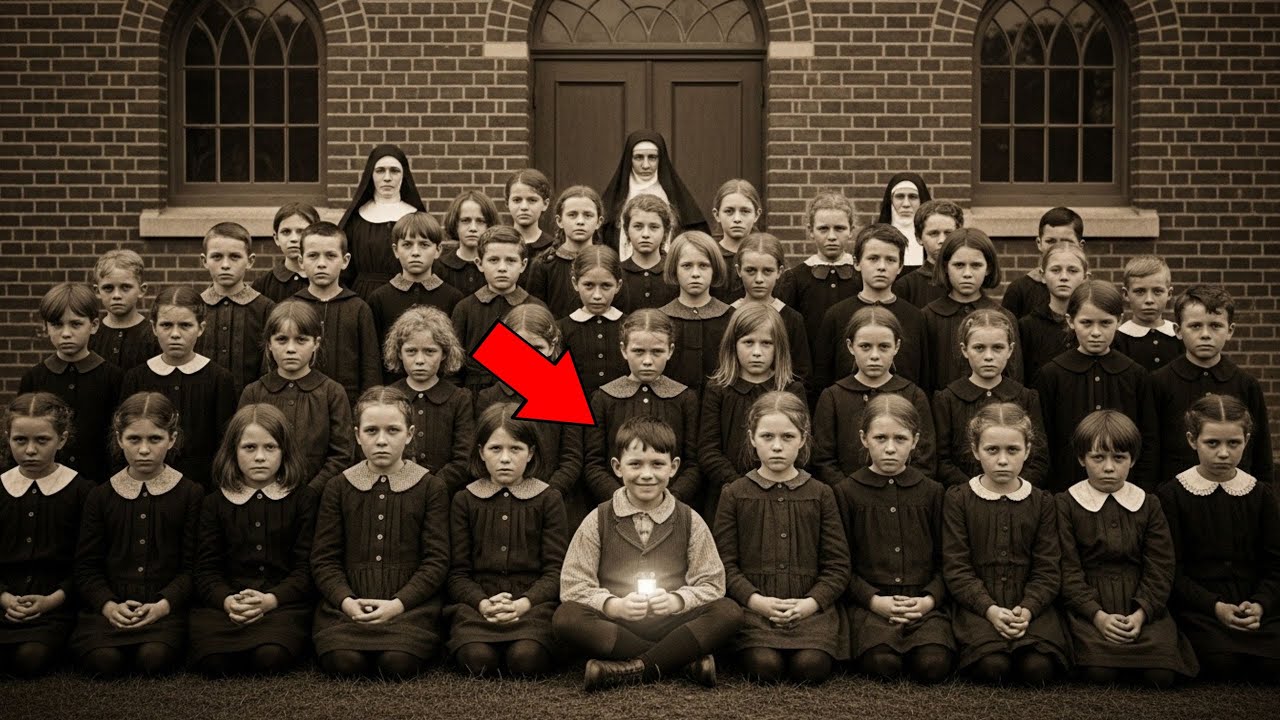
A group photograph showed approximately 40 children standing in front of a brick building. The image seemed normal, but something in the background troubled her. Looking more closely, she noticed that one of the children had a strangely modern expression on his face. “Jake, look at this child in the back,” said Emma, pointing to the figure.
“His posture and expression don’t fit the era. ”
Jake moved closer to examine the photograph. The child in question had a casual, relaxed smile, completely different from the formal seriousness of the others. His eyes seemed to look directly at the camera with a confidence that wasn’t typical of institutionalized children in 1888.
“It’s strange,” Jake admitted. “But maybe he was just a naturally photogenic child. ”
However, Emma couldn’t shake the feeling that there was something more. The search for truth had begun.
Emma and Jake decided to digitize the photograph in high resolution to examine it in more detail. On their computer, they could enlarge the image and study every detail with microscopic precision. What they discovered left them perplexed. The child who had caught their attention not only had an anachronistic expression, but was carrying something in his hand that clearly didn’t belong to 1888.
What appeared to be a small rectangular object similar to a modern device. “This can’t be real,” Jake murmured, adjusting the image contrast. “Is that a cell phone? ”
Emma studied the object carefully.
It was small, rectangular, and seemed to have a smooth, shiny surface. Although the quality of the 1888 photograph didn’t allow perfect detail to be seen, the shape was unmistakably modern. “It can’t be a phone,” Emma reasoned. “But it’s definitely not something that existed in the 19th century.
”
They searched for rational explanations. It could be a small photographic plate, a pocket mirror, or perhaps an artifact from the developing process. But the more they examined the image, the more convinced they became that the object was anachronistic. They decided to consult with experts in historical photography.
Dr. Robert Chen, professor of photography history at Harvard, agreed to examine the image. “The photograph is authentic to the period,” confirmed Dr. Chen after detailed analysis.
“The materials, the developing technique, the type of paper, everything corresponds to 1888. There are no signs of later digital manipulation. ”
“But what about the object the child is carrying? ” asked Emma.
Dr. Chen frowned. “It’s unusual. I don’t recognize what it could be within the context of the era.
But I must warn you that old photographs sometimes capture objects that may seem anachronistic due to image quality or light effects. ”
However, his explanation didn’t completely satisfy Emma and Jake. They decided to investigate more about St. Mary’s orphanage to understand the context of the photograph.
The orphanage investigation would reveal secrets that had been hidden for more than a century. Emma and Jake visited Boston’s historical archives to research St. Mary’s Children’s Home. Archivist Margaret Foster provided them with a box of documents related to the orphanage.
“St. Mary’s operated between 1875 and 1923,” Foster explained. “It was a Catholic institution that housed mainly orphaned and abandoned children from the Boston area. ”
The records revealed basic information.
The orphanage had housed between 80 and 120 children at any given time. It was run by the Sisters of Charity and received funding from private donations and municipal funds. But when reviewing the documents in more detail, Emma found something disturbing. An 1889 inspection report mentioned irregularities in children’s records and discrepancies in the number of residents reported versus those observed during visits.
“What kind of irregularities? ” asked Jake. Emma read the report. During the inspection of March 15th, 1889, approximately 45 children were observed in the dining room.
However, official records indicated only 38 residents. When asked about this discrepancy, the Mother Superior explained that some children were visiting potential families for adoption. Another document from 1890 reported complaints from families who claimed that their children adopted from St. Mary’s showed strange and inexplicable behaviors.
One father wrote, “My adopted son seems to know things that a child his age shouldn’t know, especially about current events and technologies. ”
“It’s strange,” Jake commented. “How could an orphan child from 1890 know about technologies of the era? ”
The investigation became more intriguing when they found the personal diary of Sister Catherine Ali, who had directed the orphanage between 1885 and 1895.
“Some of our children are different,” she had written in 1888. “They possess knowledge and behaviors that don’t correspond to their upbringing. It’s as if they had lived previous, more complex lives. ”
Emma and Jake exchanged glances.
“Is she suggesting that some children weren’t what they seemed? ”
They continued reading. “The child Thomas in particular troubles me. He occasionally speaks of flying machines and lights that work without fire.
When I ask him where he learned these things, he says he remembers them from before. ”
The description matched the child in the photograph who had originally caught their attention. Foster directed them to a special section of the archive that contained the orphanage’s medical records. These documents were in better condition and provided more detailed information about daily life at St.
Mary’s. The orphanage physician, Dr. William Hartwell, had maintained meticulous records of the children’s health, but his notes revealed puzzling observations. “Patient Thomas McKenzie, estimated age 8 years,” Emma read from his 1888 medical file, “shows normal physical development, but extraordinarily advanced cognitive knowledge.
Describes medical procedures that we teach in elementary institutions. ”
Jake found another equally disturbing file. “Patient Mary Sullivan, age 10 years. During examination, she described internal anatomical details with precision that only someone with advanced medical education could know.
When asked about the origin of this knowledge, she claimed to remember it from her previous family. ”
Dr. Hartwell had documented a dozen children with similar characteristics between 1887 and 1891. All showed exceptional intelligence, anachronistic knowledge, and an understanding of the world that exceeded their formal education.
“I have observed that these particular children seem to adapt more quickly to new situations and show unusual resistance to common diseases,” the doctor had written. “It’s as if they possessed previous experiences that prepared them for institutional life. ”
Even more disturbing, Dr. Hartwell had noted that these special children often disappeared without explanation.
His records showed that of the 12 children with exceptional characteristics, only three had been officially adopted. The other nine had simply stopped appearing in the records without documentation of transfer or adoption. “Thomas McKenzie no longer resides in the institution as of October 20th, 1890,” the doctor had noted. “There are no records of adoption or transfer.
Sister Ali indicates that family came to get him, but I cannot locate the corresponding documentation. ”
Emma and Jake began to suspect that something more complex was occurring at St. Mary’s. The special children seemed to have mysterious origins and equally inexplicable destinies.
“Do you think these children were different in some way? ” asked Jake. Emma studied the original photograph again. “Or maybe someone placed them there intentionally.
”
Emma and Jake decided to visit the site where St. Mary’s Children’s Home had been located. The building had been demolished in 1925, but municipal records indicated its exact location in Boston’s North End. The area was now occupied by a modern condominium complex, but they found a small commemorative plaque that briefly mentioned the orphanage’s existence.
An elderly area resident, Michael O’Brien, approached while they were examining the plaque. “My grandfather lived on this street when the orphanage was still here,” said O’Brien. “He always told strange stories about that place. ”
Emma and Jake were immediately interested.
“What kind of stories? ”
“He said he occasionally saw children entering and leaving the building at odd hours. Children who didn’t seem to dress like the others, and sometimes there were lights in the windows after everyone was supposed to be sleeping. ”
O’Brien invited them to his house to show them some family documents.
His grandfather had been a merchant in the area and maintained detailed records of neighborhood activities. “Here it is,” said O’Brien, showing a diary from 1889. “September 15th. Again, I saw unknown children near the orphanage after nightfall.
They wore clothes I don’t recognize and seem to be waiting for something or someone. ”
Another entry said, “The orphanage children I see during the day are different from those who occasionally appear at night. The nocturnal ones seem more aware of their surroundings and less institutional in their behavior. ”
Jake asked if there were more records.
O’Brien brought a box of family papers that included correspondence between his grandfather and other area merchants. A 1890 letter between local merchants mentioned, “Orphanage suppliers report inconsistent orders. Some months they request supplies for 120 children, other months for only 80. No clear explanation for the variations.
”
Emma began to formulate a theory. “What if some of the children weren’t permanent residents? What if they came from somewhere else temporarily? ” asked Jake.
“But from where? ”
“And why? ”
The answer to those questions would require deeper investigation into the mysteries surrounding St. Mary’s.
Through genealogical records, Emma and Jake managed to locate descendants of some children who had lived at St. Mary’s. The first family they contacted was that of Margaret Sullivan Chen, great-granddaughter of Mary Sullivan, one of the girls mentioned in Dr. Hartwell’s medical records.
“My great-grandmother always told strange stories about her years at the orphanage,” said Margaret during their meeting at a Cambridge cafe. “She spoke of special visitors who occasionally appeared to help the children. ”
Emma showed the photograph that had started their investigation. Margaret studied it carefully.
“My great-grandmother is in this photo,” she said, pointing to a girl in the second row. “But she always said there were other children at the orphanage who didn’t appear in official photographs. ”
“What does that mean? ” asked Jake.
“According to her, there were children who came for short periods, usually when there were problems or emergencies. These children seemed to know exactly what to do to help, as if they had been there before. ”
Margaret shared more details from family stories. “My great-grandmother said that during an influenza epidemic in 1889, several children appeared who knew medical care techniques that the sisters didn’t know.
They helped save many lives but disappeared as soon as the crisis passed. ”
The second family provided equally intriguing information. Robert McKenzie, descendant of Thomas McKenzie, the child from the medical files, had family documents that had been passed down through generations. “My great-grandfather kept a simple diary after leaving the orphanage,” Robert explained.
“He wrote about his memories of St. Mary’s, including details about children who appeared during emergencies. ”
Thomas McKenzie’s diary, written as an adult in 1920, contained specific memories. “I remember children who arrived during difficult nights.
They knew things we didn’t know, like methods to keep food fresh longer or techniques to heat the dormitories more efficiently. When we asked them where they came from, they said they were from other institutions, but never specified which ones. ”
The third family provided the most significant piece of the puzzle. Jennifer Ali Walsh was a descendant of Sister Catherine Ali and had access to the nun’s personal documents that had never been officially archived.
“My great-great-grandmother wrote private letters to her sister about events at the orphanage,” Jennifer explained. “These letters were never intended for official records, so they’re more honest about what was really happening. ”
An 1888 letter revealed, “Dear sister, I must tell you about the special children who occasionally appear here. They come without official documentation, but always during moments when we need them most.
It’s as if someone knew exactly when to send them. ”
Another letter described, “These children not only possess advanced knowledge, but seem to understand our needs before we express them. It’s as if they had studied our situation in detail before arriving. ”
With all the evidence gathered, Emma and Jake began to develop a theory about what had really happened at St.
Mary’s Children’s Home. They met with Dr. Robert Chen from Harvard to discuss their findings. “The patterns are consistent,” Emma explained, showing a timeline they had created.
“Every time the orphanage faced a crisis, epidemics, food shortages, financial problems, children with specific knowledge to solve those problems appeared. ”
Jake added, “And these children always disappeared once the crisis passed without leaving traces in official records. ”
Dr. Chen studied the evidence.
“It’s an extraordinary situation. It suggests some kind of organized program to provide specific help to the orphanage. ”
“But who could have organized something like that? ” asked Emma.
“And how did they know exactly when and what kind of help was needed? ”
“Maybe there was a network of institutions that shared resources and knowledge,” suggested Dr. Chen. “Philanthropic organizations of the era sometimes operated in a coordinated manner.
”
However, their additional research revealed no evidence of such a network. No other institution in the area reported similar patterns, and there were no records of formal communication between St. Mary’s and other orphanages. Emma proposed a different theory.
“What if there was a secret organization dedicated specifically to helping St. Mary’s? Maybe a group of wealthy benefactors who trained children for specific missions. ”
“That would explain the specialized knowledge,” Jake admitted.
“But why the secrecy? And why only St. Mary’s? ”
Their investigation of financial records revealed something interesting.
Between 1887 and 1892, the orphanage had received significant anonymous donations that always arrived just before or after the crisis they had identified. “Someone was monitoring the orphanage situation very closely,” Emma concluded, “closely enough to know exactly when and what kind of help to send. ”
Dr. Chen suggested deeper investigation.
They should examine records from other institutions of the era to see if there are similar patterns and maybe investigate wealthy Boston families who might have had the resources to organize such a program. Their theory was taking shape. An organized, well-funded group had operated in secret to provide specific help to St. Mary’s using specially trained children for short-term missions.
Emma and Jake expanded their investigation to examine records from other charitable institutions in Boston during the same period. They visited archives of various orphanages, hospitals, and schools to look for similar patterns. Their findings were revealing. Boston Children’s Hospital had reported the occasional appearance of young volunteer assistants during medical emergencies between 1888 and 1893.
These young people showed advanced medical knowledge but disappeared without leaving employment records. The Industrial School for Girls had documented visits from exchange students who taught more efficient sewing and cooking techniques, but there were no records of which institutions sent them. “It’s a pattern,” Jake observed. “Someone was sending trained young people specifically to institutions that needed help.
”
Their investigation of wealthy Boston families led them to records from the New England Philanthropic Society, a private organization that coordinated charitable efforts among the region’s wealthiest families. In the society’s archives, they found references to a specialized assistance program directed by an anonymous committee of benefactors. The program apparently selected and trained young people to provide specific help to needy institutions. “The specialized assistance program has shown remarkable effectiveness in resolving institutional crisis,” Emma read from an 1891 report.
“Program participants receive intensive training in specific skills before being assigned to short-term missions. ”
Jake found more details. “Participants are selected for their exceptional intelligence and adaptability. Training includes accelerated education in basic medicine, food conservation techniques, teaching methods, and crisis management.
”
The program apparently operated from a private property on the outskirts of Boston, but specific location records had been redacted from the documents. “This explains everything,” said Emma. “The special children at St. Mary’s were participants in this secret training program.
”
Foster, who had been helping them with the investigation, provided the final historical context. “During the 1880s and 1890s, there was a movement among wealthy Boston families to professionalize charity. They believed traditional philanthropy was inefficient and sought more scientific methods to help the poor,” she explained. “The specialized assistance program would have been the result of that philosophy.
Instead of simply donating money, they were investing in training people specifically to solve institutional problems. ”
Emma and Jake finally managed to locate the property where the specialized assistance program had operated. Land records indicated it had belonged to the Thornton family, one of Boston’s wealthiest dynasties in the 19th century. The property, now a state park, still contained the foundations of several buildings that had been demolished in the 1920s.
With permission from park authorities, they conducted a limited archaeological excavation. They found physical evidence of the program: buried educational materials, including advanced medical textbooks, food conservation technique manuals, and teaching method guides, all dated between 1885 and 1895. Even more significant, they found photographs of the program in operation. The images showed young people of similar ages to the St.
Mary’s children participating in intensive training: medical classes, cooking technique practice, problem-solving exercises. “Here it is,” said Jake, pointing to a photograph showing approximately 20 young people posing in front of a training building. “These are the special children from St. Mary’s.
”
Emma recognized several faces from the orphanage photographs. They weren’t ordinary orphans. They were students in a philanthropic training program. The final documents they found revealed the complete structure of the program.
Participants were selected from regional orphanages for their exceptional intelligence, taken to the training center for periods of 6 months to 2 years, and then graduated to be placed in specific missions. “Program graduates will be temporarily inserted into institutions facing specific crises,” Emma read from a program manual. “Their specialized training will allow them to provide effective solutions while maintaining their cover as ordinary residents. Once the mission is completed, graduates will be relocated to carefully selected adoptive families or return to the program for additional training.
”
The program had operated successfully for approximately a decade before being discontinued in 1895. Records indicated that changes in child labor laws and increased public scrutiny had made the program unviable to continue operations. “It’s brilliant,” Jake admitted. “They used the existing infrastructure of orphanages to hide a specialized crisis worker training program.
”
Emma studied the original St. Mary’s photograph again, focusing on the child with the strange object in his hand. “It was probably some kind of tool or instrument he had learned to use during his training. ”
The investigation had revealed not a supernatural mystery, but an innovative social program that had operated in secret during America’s Gilded Age.
Emma and Jake presented their findings to the Boston Historical Society at a conference that attracted historians, genealogists, and descendants of families connected to St. Mary’s. Their research had revealed a previously unknown chapter in the history of American philanthropy. “The specialized assistance program represents an early experiment in what we now call evidence-based philanthropy,” Emma explained during her presentation.
“Instead of traditional charity, these wealthy families invested in creating systematic solutions to social problems. ”
Dr. Foster added historical context. “This program anticipated by decades modern approaches to social work and crisis management.
The participants were essentially specialized social workers trained a century before that profession was formalized. ”
Descendants of the involved families reacted with a mixture of pride and surprise. Margaret Sullivan Chen commented, “Now I understand why my great-grandmother always insisted that her time at St. Mary’s had been special.
She wasn’t just an orphan. She was part of an innovative program. ”
The research also revealed the fate of many program participants. Records showed that after completing their missions, most had been placed with carefully selected adoptive families, many of which were middle-class families that valued education.
“Many of these children grew up to become leaders in their communities,” Jake explained. “Doctors, teachers, social workers, reformers. The program not only solved immediate crises, but created a generation of civic leaders. ”
Dr.
Robert Chen from Harvard announced that he would establish a research program to study the specialized assistance program’s methods further. The training approaches they developed could have modern applications in disaster response preparation and humanitarian work. Emma and Jake donated all their photographs and documents to the Smithsonian, where an exhibition on philanthropic innovation in 19th century America was established. The original St.
Mary’s photograph became the centerpiece of the exhibition. “This research reminds us that history is full of innovators who operated outside traditional systems,” Emma reflected during the exhibition’s opening. “The specialized assistance program was decades ahead of its time,” Jake added. “And it shows us that sometimes historical mysteries have extraordinary but completely earthbound explanations.
”
The photograph that had started their investigation now hung in the museum with a new explanatory plaque: “St. Mary’s Children’s Home, 1888. This image documents both regular orphanage residents and participants in the specialized assistance program, an innovative philanthropic experiment that trained young people to solve institutional crisis. ”
The child with the mysterious object had been identified as Thomas McKenzie, who had completed specialized medical training and had been sent to St.
Mary’s during an influenza epidemic. The object in his hand was a primitive medical instrument he had learned to use during his training. The story of St. Mary’s had ended not as an unsolved mystery but as testimony to the innovation and dedication of philanthropists who had worked in secret to improve the lives of society’s most vulnerable.
Their legacy lived on in generations of descendants who continued public service work and in the lessons their methods provided for modern humanitarian workers.






