Fidel Castro governed Cuba for close to five decades while maintaining one of the most tightly protected private lives of any modern head of state. The world came to know his speeches, his uniform and his public image, but not his children. Some were brought up in comfort, others in concealment. Some lived unobtrusively within the Cuban system.
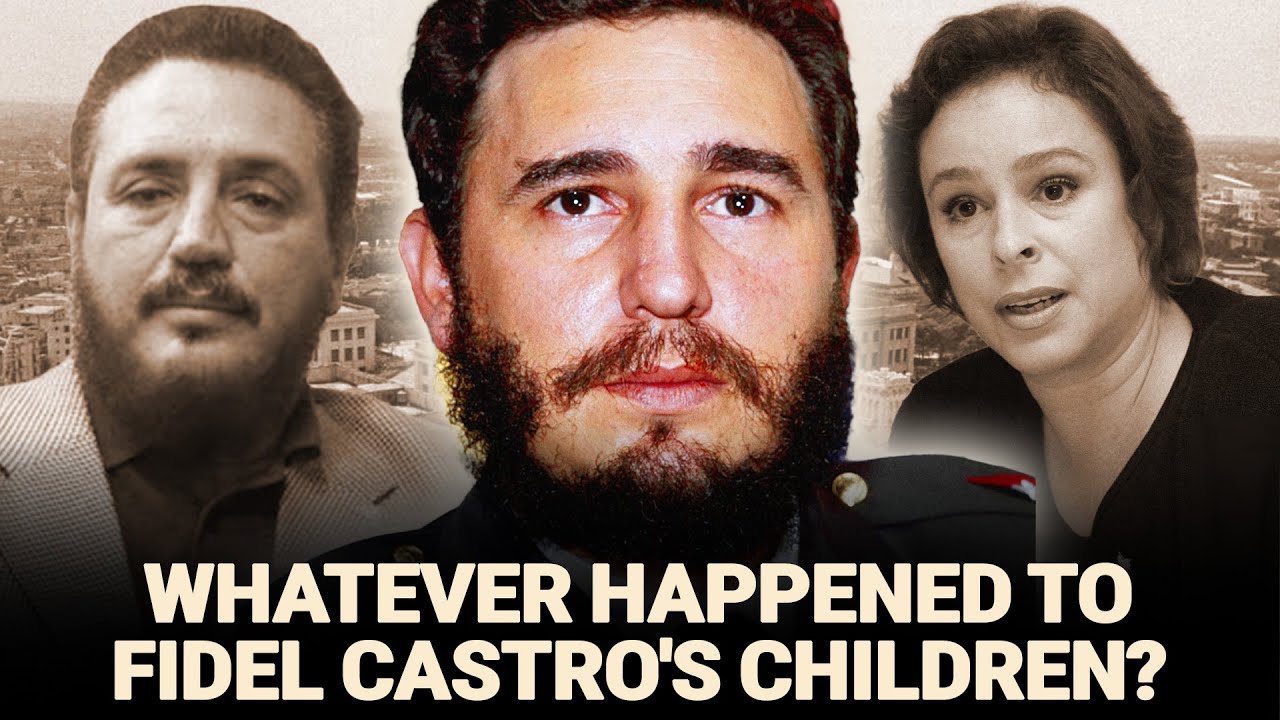
Others turned their backs on it altogether. A handful became public figures in their own right. Still others left hardly a mark in the historical record. The eldest of those children, Fidel Ángel Castro Díaz-Balart, was born on September 1, 1949, in Havana.
His mother, Mirta Díaz-Balart, belonged to a prominent Cuban political family connected to the established elite. His father was at that time a young law student with political ambitions but no power. The marriage of Fidel Castro and Mirta Díaz-Balart, solemnized in October 1948, joined two families from different social strata. The Díaz-Balarts stood for wealth and political influence, while the Castros were landowners from Oriente province with less standing in Havana circles.
Fidélito, as he would be called throughout his life, was born into relative comfort. His earliest months were passed in a Havana apartment far removed from the revolutionary activities that would soon consume his father’s life. The marriage deteriorated quickly, and by 1954, when Fidélito was five, his parents had separated. The divorce was finalized in 1955, and custody arrangements grew contentious.
Mirta Díaz-Balart initially kept custody of her son, but political developments complicated the situation. After Fidel Castro’s release from prison in 1955, following the failed Moncada barracks attack of 1953, he departed Cuba for Mexico to build his revolutionary movement. In 1956, Mirta Díaz-Balart discovered that her son had been taken to Mexico without her consent. The episode became public and demanded diplomatic intervention.
In the end, Fidélito was returned to his mother’s care. After the revolution triumphed in 1959, custody shifted once more, and he went to live with his father in Cuba, while his mother eventually departed for Spain and later the United States. Throughout the 1960s, Fidélito was the only child Fidel Castro openly acknowledged. In the 1960s, he was sent to the Soviet Union for his schooling, attending primary and secondary schools in Moscow.
He stayed there for roughly fifteen years, completing advanced studies at Moscow State University and earning a degree in nuclear physics, followed by a doctorate in the same discipline. His professional identity took root in science rather than politics. After finishing his education, Fidélito returned to Cuba in the mid-1970s and was appointed to positions within the country’s scientific establishment. In 1980, he became head of Cuba’s atomic energy commission, overseeing the development of nuclear research and Cuba’s planned nuclear power facilities.
Cuba had begun construction of a nuclear power plant at Juraguá with Soviet assistance, and Fidélito’s role placed him at the heart of the project. Yet the plant was never finished. Construction stopped in 1992 after the collapse of the Soviet Union and the end of Russian financial support. Fidélito held the position until 1992, when he was dismissed amid reported disagreements over the direction of Cuba’s nuclear program and management decisions.
He never again occupied a position of comparable prominence, though he continued to work as a scientific consultant and taught at the University of Havana. Fidélito married María Victoria Barreiras, a fellow scientist, and the couple had three children. His family life was conducted with relative privacy. After his dismissal, his relationship with his father appeared strained, though the details remained private.
On February 1, 2018, at the age of 68, Fidel Ángel Castro Díaz-Balart died in Havana. Cuban state media announced that he had taken his own life following a period of deep depression and treatment for the condition. His funeral was private, attended by family members. Another child, Francisca Pupo, was reportedly born in 1953, during the period after Fidel Castro’s separation from Mirta Díaz-Balart and before his imprisonment following the Moncada attack.
Unlike Fidélito, Francisca was never publicly acknowledged in any official capacity during Fidel Castro’s lifetime. Her existence became known mainly through investigative reporting and accounts compiled after Castro’s death. Her childhood appears to have been spent outside the advantages that came with acknowledged connection to the Castro family. There are no educational records, no interviews, no memoirs, and no documented evidence of any relationship between Francisca Pupo and Fidel Castro.
Whether she knew her father’s identity as a child or learned it later remains unclear. Whether she married, had children, or pursued any particular career cannot be established from available sources. Her life represents the extreme end of privacy among Castro’s children, so complete that even basic biographical facts remain unknown. Alina Fernández-Revuelta was born on March 19, 1956, in Havana.
Her mother was Natalia “Nacha” Revuelta, a woman from Havana’s upper middle class who had been involved in supporting the revolutionary movement. At the time of Alina’s birth, Nacha Revuelta was married to another man, Orlando Fernández, and for legal and social reasons, Alina was given his surname. Her biological father’s identity was not publicly disclosed. Fidel Castro was in Mexico organizing the expedition that would return to Cuba aboard the yacht Granma later that year.
Alina was raised mainly by her mother in Havana. She learned that Fidel Castro was her biological father when she was about ten years old, and the revelation transformed her understanding of her own identity. Her relationship with Castro during her youth involved occasional visits, which she has described as brief and formal, lacking the warmth of a traditional father-daughter relationship. She attended the University of Havana, married young, and had a daughter, Alina Fernández, in the mid-1970s.
The marriage did not last. During the 1970s and 1980s, Alina worked in various capacities within Cuba’s cultural sphere, including modeling, and lived embedded in Cuban society. In 1993, she left Cuba under dramatic circumstances, disguising herself with a wig and false identification documents and traveling to Spain on a tourist visa. Once outside Cuba, she requested asylum in the United States.
Her departure was not authorized by Cuban authorities and represented a definitive break with her father and the Cuban government. She arrived in the United States in December 1993 and settled in Miami, joining the large Cuban exile community there. After arriving in the United States, Alina established herself as a writer and public speaker. She published her memoir, “Castro’s Daughter: An Exile’s Memoir of Cuba,” in 1997, which detailed her childhood, her relationship with her father, and her reasons for leaving Cuba.
She gave interviews to major media outlets and became a sought-after commentator on Cuban affairs. She described her father as absent, cold, and authoritarian in personal relationships as well as governance, and stated that they had no contact after her departure. When Fidel Castro died in November 2016, Alina gave media interviews expressing complex emotions but did not travel to Cuba for any funeral or memorial services. Beginning in the 1960s, Fidel Castro entered into a long-term relationship with Dalia Soto del Valle, a former teacher from the central Cuban town of Trinidad.
No public record confirms that they ever wed officially, yet the union yielded five boys, each brought up mostly away from public scrutiny and concealed for many years. The family lived together in Havana, inside a residential compound designed for security and seclusion. Alexis, Alex, Alejandro, Antonio, and Ángel came of age inside that sheltered setting. Their upbringing carried advantages ordinary Cubans could not obtain, such as imported products, private schooling, and access to recreational amenities.
Those advantages, though, arrived together with the requirement of secrecy. According to reports, the boys were taught either by private tutors or at special schools attended by the offspring of other senior officials. Among the five siblings, Alex gained the widest public recognition through his photography work for Cubadebate, a Cuban state media organization. His output ranged from photojournalism to official photography covering events featuring Cuban leaders, among them his uncle Raúl Castro once he took over the presidency.
Following Castro’s death in 2016, Alex was photographed at the funeral and memorial ceremonies alongside other relatives. Alejandro carved out roles inside Cuba’s government and security structures, climbing to the rank of colonel in the country’s military and intelligence services. His assignments reportedly encompassed counterintelligence work and involvement in Cuba’s security ties with other nations. Reports also linked him to talks concerning the normalization of relations between Cuba and the United States under the Obama administration.
Antonio, born in 1974, went on to study medicine at the university level, focusing on orthopedics and sports medicine. Of all the sons born to Dalia Soto del Valle, he became the most visible, serving as a physician for Cuba’s national baseball team and other athletic programs and journeying abroad with Cuban sports delegations. Ángel, the youngest, is the least documented among the five, with no verified photographs, no accounts of his schooling or career, and no identified public appearances. Apart from these children, there have been claims of other offspring attributed to Fidel Castro, among them Abel Castro Vera, reportedly born in 1983, and children named Ciro and Jorge Ángel, cited in certain biographical works.
Verification is scarce or altogether missing, and the absence of documentation casts doubt on how accurate the reports asserting their existence really are. Fidel Castro’s children can be grouped into separate categories according to how visible they were and how far they were folded into his life. Fidélito, born before the revolution to Castro’s only legally wedded wife, was acknowledged publicly and occupied official posts. Alina, though never publicly claimed, ultimately disclosed who she was and severed ties with her father completely.
For decades the five sons born to Dalia Soto del Valle lived out of sight, their existence familiar to only a handful beyond Cuba’s innermost circles. Other reported children existed wholly outside any framework of recognition or support. When Castro died in November 2016, none of his sons took over his position. His brother Raúl had already taken the presidency in 2008, and the succession moved through institutional and party routes rather than through family bloodline.
Keeping Castro’s children out of sight suited the revolution’s official ideology. Power was meant to rest with the system, not with a family. Even so, the lives of these children also expose the personal toll of such arrangements, the distance, the secrecy, and the weight of their father’s presence that molded every facet of their existence. Some, like Alina, turned against it outright.
Others, like Fidélito, followed paths that concluded in disillusionment. Still others stay unidentified, their lives left unrecorded.
