The little girl seated on her mother’s lap pulled Jennifer Hayes back to the screen, and at first she couldn’t explain why. Jennifer had devoted fifteen years to repairing damaged photographs, and by now she recognized the patterns that age and water leave behind. This particular image had reached her Chicago studio that morning from an estate donation intended for the local historical society. It was a family portrait dated March 1930, faded and stained, its details buried beneath years of discoloration.
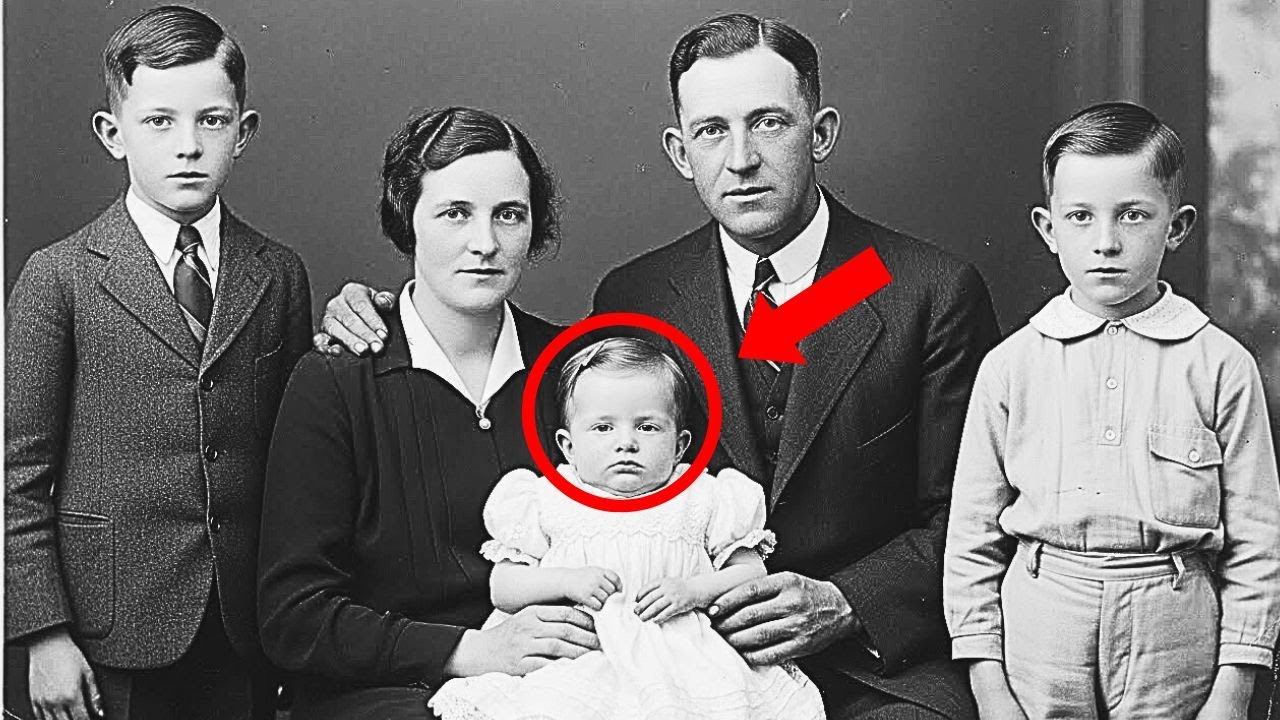
The family of five posed in the formal manner of the era: parents in their thirties, two boys about eight and ten, and a small girl of three or four settled on her mother’s lap, dressed in her finest clothes before the painted backdrop of a professional studio. On the back, in faded ink, someone had written: The Patterson family, Chicago, Illinois, March 1930. Our precious ones. Jennifer scanned the photograph at high resolution so she could work without risking the original, then started the painstaking digital process of removing stains, adjusting contrast, and recovering what time had taken.
She had restored hundreds of photographs from this period. She knew the formal poses, the serious expressions, the careful styling families used to present themselves at their best. Smiling was uncommon when exposures took time. But as she cleaned the image, corrected the color, and stripped away the yellowing, something troubled her.
The little girl looked different from the rest of the family, and she couldn’t immediately put her finger on why. She enhanced the clarity and adjusted the exposure. Subtle details emerged. The child’s complexion, even allowing for the sepia tone of an old photograph, seemed unusual.
Around her lips and fingernails there was a faint bluish-gray tinge that became more apparent as Jennifer worked. She zoomed in on the girl’s face. The expression was placid, almost too still. Her posture in her mother’s arms seemed carefully supported, as if she could not sit upright on her own.
And now that the water stains were gone, Jennifer noticed a slight swelling around the child’s ankles and wrists. She sat back from the computer, a chill running down her spine. She had seen these signs before, in medical history books. She needed to research further, but instinct told her this photograph held a story far more poignant than a simple family portrait.
Over her lunch break, Jennifer looked up the medical conditions that would produce what she was seeing. The bluish discoloration around the child’s lips and under her fingernails was cyanosis, a sign the blood was not carrying enough oxygen. In a photograph from 1930, before modern cardiac surgery, that almost certainly meant congenital heart disease. She pulled up medical texts from the 1920s and 1930s and compared clinical photographs of children with various cardiac conditions to the little girl in the Patterson portrait.
The swelling around the ankles, edema, combined with the cyanosis, suggested severe heart failure. The careful way the mother held the child now made sense. The little girl likely could not sit upright for long without exhaustion or breathlessness. She looked again at the family.
The mother’s hands held the child with unmistakable tenderness, but also with the practiced care of someone who had spent months, perhaps years, supporting a fragile child. The father’s hand rested on the mother’s shoulder, and his expression, now visible with improved clarity, carried deep sadness beneath the formal composure expected for a portrait. The two boys stood on either side of their parents, and Jennifer noticed they were not looking at the camera. They were looking at their little sister.
Their expressions held an unusual gravity for children their age. She pulled the historical society’s donation records to find out more about the Patterson family. The photograph had come from the estate of a man named David Patterson, who had died at ninety-three. The donation included several boxes of family papers, letters, and photographs spanning multiple generations.
Jennifer called the historical society’s archivist, Marcus Chen, and explained what she had discovered. “I think this little girl was very sick when this photograph was taken,” she told him. “The medical signs are subtle in the original damaged image, but they’re clear once you restore the detail. I’d like to examine the rest of the Patterson donation to learn more about this family.”
“
Marcus was intrigued. “Come by this afternoon. I’ll pull the boxes for you. The Patterson family has an interesting history in Chicago.
The father was a factory foreman, solid working-class family during the Depression. I haven’t gone through all the materials yet, but there might be something about the daughter.”
Jennifer saved her restoration work and prepared to visit the historical society, driven by a need to understand the story behind the photograph. Something about the way the family had been posed, the timing of the portrait, and the visible signs of illness suggested this was not a routine family photograph.
It was something more deliberate, more precious, and possibly more heartbreaking. Marcus had pulled three boxes of Patterson family materials and arranged them on a research table when Jennifer arrived. “I did a quick preliminary search,” he said, handing her a folder. “I found this obituary from 1930 that mentions a daughter.”
“
Jennifer read the clipping from the Chicago Tribune, dated April 1930. “Helen Rose Patterson, beloved daughter of Robert and Katherine Patterson, died April 12th, 1930, at age 3 years and 8 months. Services will be held at St. Michael’s Church.
In lieu of flowers, donations may be made to Children’s Memorial Hospital Cardiac Research Fund.”
Her throat tightened. The photograph was dated March 1930, just one month before Helen’s death. The family had known.
They had taken the portrait knowing their daughter had weeks, perhaps days, left to live. She began working through the first box, which contained family correspondence from the late 1920s and early 1930s. In a bundle of letters tied with faded ribbon, she found correspondence between Katherine Patterson and her sister Elizabeth. A letter dated January 1928 revealed Helen’s diagnosis.
“Dearest Elizabeth, I’m writing with news that has shattered our world. We took Helen to Children’s Memorial Hospital last week because she’s been so tired and breathless and her lips sometimes turn blue. The doctors examined her thoroughly and told us she has a malformation of her heart. The chambers don’t work properly and her blood isn’t getting enough oxygen.
Elizabeth, they said there’s no treatment. They said she might live a few months, maybe a year or two if we’re fortunate, but that her condition will progressively worsen.”
Jennifer read on, her eyes filling with tears. “Robert held me while I cried for hours after the appointment.
How do we tell the boys that their little sister is dying? How do we watch her fade away knowing there is nothing we can do? The doctor said to keep her comfortable, avoid exertion, and cherish whatever time we have. Time.
What a cruel word when you know it’s running out.”
Over the following two years, letter upon letter recorded Helen’s steady decline. Katherine described the good days, when Helen could sit and play softly with her dolls, and the bad ones, when breathing came hard and she had to lie still and rest. She also wrote of the boys slowly learning to treat their sister with care, grasping that she was delicate in ways other children were not.
One letter, dated December 1929, laid out the family’s money troubles. “The medical bills are more than we can bear. Robert takes every hour of overtime the factory will offer, and still it is never enough. We have sold Katherine’s mother’s silver and part of our furniture.
The boys wear hand-me-downs and do without new shoes. Yet we would surrender everything we own for more time with Helen.”
It was then that Jennifer came across the letter explaining why the Patterson family had ordered the formal portrait in March 1930. Katherine had written to Elizabeth in February 1930.
“Elizabeth, Dr. Morrison examined Helen yesterday and his face was grave. The swelling in her legs and feet has grown much worse. Her heart is giving out, and he believes she has perhaps 6 to 8 weeks left.
Robert and I talked over what to do with the time that remains. We want to make a memory, something solid we can hold on to once she is gone. So we have decided to have a family portrait taken. It will cost $5, money we can hardly spare.
But what is money weighed against a photograph of all of us together while Helen is still here? We want the boys to have this image to remember their sister by, not as she will be at the end, gasping for every breath, but as she is now, our sweet girl circled by the family who loves her.”
The letter went on with heartrending specifics. “We will have to arrange Helen carefully for the portrait.
She can no longer hold herself upright, so I will hold her on my lap and bear her weight. We will put her in her best dress, the white one with the lace collar she adores. Robert will stand behind us, strong and steady as he has been throughout this awful trial. The boys will stand at our sides.
Our family whole, one final time.”
Tucked in among the letters, Jennifer discovered the photographer’s invoice. It was a receipt from Morrison Photography Studio, dated March 15th, 1930, for one family portrait, $5. Pinned to it was a note written in a different hand.
“Mrs. Patterson, I took the liberty of making several extra prints of your family portrait at no charge. I know how precious this image is to you, and I wanted to be sure you have copies to share with family and to keep safe. Your daughter is a lovely child, and it was an honor to photograph your family.
Harold Morrison, photographer.”
A letter from Katherine to Elizabeth dated March 20th, 1930 recounted the photography session. “We visited Mr. Morrison’s studio last Saturday.
I feared Helen would not have the strength to last through the sitting, but it was a good day for her, as good as her days get now. We dressed her with care, and I held her on my lap while Mr. Morrison arranged us. He was most patient, taking his time to make sure we were all comfortable.
Helen gazed into the camera with those lovely blue eyes, and for a moment she looked almost well. The boys stood tall and proud, eager to look their best for their sister’s portrait. Robert’s hand on my shoulder was the only thing that kept me from falling apart. We all understood what this photograph meant.
The last time we would all be together, held forever in silver and paper.”
Jennifer kept reading Katherine’s letters to Elizabeth, which chronicled Helen’s final weeks. The entries grew more and more disjointed as Katherine fought to keep daily life going while nursing her dying daughter. March 25th, 1930.
“Helen is fading fast now. She sleeps through most of the day, waking only for short spells. Her breathing is heavy, and the blue tinge around her lips is there all the time now, not only when she is tired. Dr.
Morrison comes every few days, though all he can do anymore is prescribe morphine to keep her comfortable. Robert sits with her each evening after work, reading her favorite stories, even though she is usually too weak to answer.”
April 1st, 1930. “The boys asked me today whether Helen will be going to heaven soon.
I could not lie to them. I said yes, that her heart is too worn out to keep beating and that soon she will be with God, where she will not hurt anymore. Thomas, our eldest, nodded and said, ‘I’ll take care of you and David when she’s gone, Papa.’ He is only 10 years old, but this ordeal has made him old beyond his years.
“
April 5th, 1930. “Mr. Morrison brought the photographs today. And when I looked at the portrait, I wept.
Not out of sorrow, though there is plenty of that, but out of thankfulness. He caught us exactly. Helen looks at peace in my arms. The boys look strong.
And Robert and I look like what we are, parents holding their family together against unbearable loss. This photograph is a gift, proof that Helen lived, that she was loved, that our family was whole, even if only for a little while.”
Jennifer came across a diary Katherine had kept through Helen’s last days. The entries were short but shattering.
April 10th, 1930. “Helen is fighting for breath now. We have brought her bed into our room so we can stay near her always. The boys come in before school and again afterward to kiss her forehead and tell her they love her.
She can hardly answer, but I know she hears them. I know she feels how deeply she is loved.”
April 11th, 1930. “Dr.
Morrison came this evening and said it will not be much longer. Helen’s heart is failing. Her hands and feet are cold, and her breathing is shallow. Robert and I take turns holding her, singing to her, telling her it is all right to let go, that we will be fine, even though we will not be.
How do you give your own child permission to die?”
The last entry was dated April 12th, 1930. “Helen died at 3:20 this morning. She was in my arms, with Robert’s hand on her head and the boys asleep in chairs beside the bed.
Her breathing simply stopped, quiet and peaceful. She had fought so hard for 3 years and 8 months, and at last her tired heart could fight no more. Our precious girl is gone.”
Jennifer found newspaper clippings and funeral materials that recorded how the community responded.
The obituary in the Chicago Tribune was short but noted that Helen had been a brave child who met her illness with remarkable grace. The funeral program from St. Michael’s Church listed hymns chosen especially for a child’s service. Yet it was the letters of condolence that showed how Helen’s illness and death had touched not only her immediate family, but their whole community.
Jennifer uncovered dozens of letters that had been sent to Robert and Katherine in the weeks following Helen’s death. One came from a neighbor, Mrs. Adelaide Porter: “Dear Katherine and Robert, our hearts are broken for you and your boys. Little Helen was a light in our neighborhood, always smiling, even when we could see she was struggling.
She taught us all about courage and grace in the face of suffering. Please know that we are here for you in any way you need.”
Robert’s supervisor at the factory wrote: “Mr. Patterson, please accept my deepest condolences on the loss of your daughter.
I know you worked every hour of overtime available to pay for her medical care, and your dedication as a father was an inspiration to all of us. Take whatever time you need before returning to work.”
Katherine’s replies to these letters, kept among her sister’s collection, revealed a mother fighting to make sense of her grief. May 1930.
“Elizabeth, people keep telling me that Helen is in a better place, that she’s no longer suffering, that I should find comfort in knowing she’s at peace. And perhaps they’re right. But she’s not here. She’s not in my arms.
I can’t sing to her or read her stories or watch her sleep. The house feels empty without her labored breathing, without the constant vigilance we maintained for 3 years. I don’t know how to live in this silence.”
Robert’s letters to his brother revealed a man attempting to keep his family together while being swallowed by grief.
June 1930. “The boys are struggling. Thomas has nightmares about Helen dying. David, who is only eight, keeps asking when she’s coming back, as if death is something temporary.
And I don’t know how to help them because I can barely function myself. I go to work, come home, sit in Helen’s empty room, and try to understand how the world can keep turning when our daughter is gone.”
Yet Jennifer also came across proof of how the family had honored Helen’s memory. A letter from Katherine dated July 1930 referred to a donation.
“Robert and I took the money we had been saving for Helen’s medical care, about $30 that we never had to spend because she died before we could use it, and we donated it to Children’s Memorial Hospital for cardiac research. The doctor said that perhaps someday they will be able to repair hearts like Helen’s, to save children who would have died like she did. If our contribution helps even one child survive, then Helen’s suffering will have meant something.”
A letter from Katherine to Elizabeth, dated August 1930, described how much the March portrait had come to mean to the family.
“The photograph Mr. Morrison made is displayed in our parlor now, in a beautiful frame that Robert commissioned from a local craftsman. Every day I look at that image and I remember Helen as she was that day, dressed beautifully, held safely in my arms, surrounded by her father and brothers. The photograph doesn’t show her struggling to breathe or the blue tinge to her skin or how weak she had become.
It shows our family whole and together, exactly as I want to remember us. The boys look at the photograph every morning before school. Thomas told me last week that he talks to Helen in the picture, telling her about his day, about what he’s learning, about how much he misses her. Is that strange?
I don’t think so. The photograph makes her present in a way that memories alone cannot. She exists there, frozen in that moment. Eternally 3 years old, eternally our little girl.
“
The photograph had been central to how the family worked through their grief. A letter from Robert to his brother in September 1930. “My brother asked me yesterday why we keep Helen’s portrait so prominently displayed. Why we don’t put it away where it won’t cause us pain every time we see it.
But he doesn’t understand. The photograph doesn’t cause pain. It provides comfort. When I look at that image, I don’t just see Helen dying.
I see her living. I see the family we were, the love we shared, the precious time we had together, however brief it was.”
Katherine’s diary from November 1930 uncovered yet another side of the photograph’s significance. “I realize today that the portrait Mr.
Morrison made will outlive all of us. Long after Robert and I are gone, long after the boys have grown old and passed away, that photograph will remain. Future generations of our family, great-grandchildren and great-great-grandchildren we will never meet, will see Helen’s face and know that she existed, that she was loved, that she mattered. The photograph is not just a memory for us.
It is Helen’s legacy, proof that her brief life had meaning and value.”
Jennifer also found evidence that the family had given copies of the photograph to relatives. Letters from Katherine’s mother and Robert’s siblings mentioned receiving prints and how touched they were to have this image of Helen. But most notably of all, Jennifer came upon a letter from the photographer, Harold Morrison, to Katherine, dated December 1930.
“Dear Mrs. Patterson, I wanted to write to you about the portrait I made of your family last March. In my 30 years as a photographer, I’ve made thousands of portraits, but few have affected me as deeply as yours. When you came to my studio, I could see immediately that your daughter was gravely ill.
I understood what that photograph meant to you. Not just a portrait, but a farewell, a preservation of love in the face of inevitable loss.”
Jennifer finished restoring the Patterson family portrait. The contrast between the damaged original and the restored image was remarkable.
Details that had been hidden for ninety years were now plainly visible, including the subtle but unmistakable signs of Helen’s heart condition that the family had tried to downplay through careful positioning and the photographer’s skill. She put together a presentation for the historical society’s board, documenting not only the restoration work but the story she had pieced together from the Patterson family papers. When she displayed the before-and-after images and described the medical signs now visible in the restored photograph, the room went quiet. “This family knew their daughter was dying,” Jennifer said, pointing to the bluish discoloration around Helen’s lips, now clearly visible in the enhanced image.
“They commissioned this portrait in March 1930, knowing she had weeks to live. The photographer did everything he could to make Helen look healthy. Careful lighting, positioning, retouching. But the signs of her condition are there if you know what to look for.
Modern restoration technology has revealed what the family and photographer tried to hide. How sick this child really was.”
The historical society’s director, Dr. Patricia Williams, was deeply moved by the discovery.
“This isn’t just a restored photograph,” she said. “It’s a window into how families dealt with childhood illness and death during the Depression. The Pattersons couldn’t afford advanced medical care. Not that it existed in 1930 for congenital heart defects anyway.
The only things within their power were to cherish their daughter and keep her memory alive through this portrait.”
Dr. Williams suggested building an exhibition around the Patterson family’s story, with the restored photograph as its centerpiece. “We could examine several themes,” she offered, “from the history of pediatric cardiac care and how families coped with childhood illness before antibiotics, to the role of photography in preserving memory and processing grief, and the ethics of medical photography.
When should we disclose painful truths, and when should we let families hold on to the illusions they created?”
Jennifer consented to curate the exhibition, collaborating with medical historians and grief counselors to make sure the presentation was both historically accurate and emotionally sensitive. Over the following three months, she worked with researchers to build a comprehensive display. The exhibition featured the original damaged photograph next to the restored version, with detailed annotations explaining what the restoration had revealed.
Medical texts from the 1930s documented how little was understood about congenital heart disease at the time. Letters from Katherine’s correspondence revealed the family’s emotional journey through Helen’s illness and death. But the exhibition also provided modern context. Jennifer worked with pediatric cardiologists from Children’s Memorial Hospital to create a display showing how the conditions that killed Helen in 1930, likely tetralogy of Fallot or a similar defect, are now routinely corrected with surgery, allowing children to live full, healthy lives.
The local newspaper ran a feature story about the exhibition before it opened, and the response was overwhelming. The article drew the attention of someone Jennifer had never expected to hear from. Helen’s nephew, the son of Thomas Patterson, was now eighty-five years old and living in a Chicago suburb. Michael Patterson called the historical society the day after the article appeared.
“That’s my aunt in that photograph,” he told the receptionist. “My father was the older boy standing beside his parents. He died 5 years ago, but he talked about Helen his entire life. I need to see this exhibition.
”
Jennifer met Michael Patterson at the historical society two days before the public opening. He was a tall, dignified man who walked with a cane, and he carried a small box with him. When Jennifer showed him the restored photograph, he stood silently in front of it for several minutes, tears streaming down his face. “My father never got over losing her,” Michael said finally.
“He was 10 years old when she died, and he carried that grief for 83 years. He told me that Helen was the sweetest child, that even when she was sick and struggling to breathe, she would smile at him and his brother. He said watching her die taught him that life was precious and fragile, and it shaped everything about how he lived his life afterward.”
Michael opened the box he had brought.
Inside was another print of the same photograph, this one in better condition than the historical society’s copy because it had been carefully preserved in a family album. “My father kept this his entire life,” Michael explained. “It hung in his bedroom until the day he died. He would look at it every morning and every night, remembering his little sister.
”
But Michael had brought something else as well. A letter his father had written shortly before his death in 2018, addressed to whoever preserves our family’s history. “My name is Thomas Patterson. I’m the older boy in the 1930 family photograph.
I’m writing this at age 88, and I want to tell you about my sister Helen, who died when she was 3 years old and I was 10. She had a bad heart, and there was nothing the doctors could do to save her. We knew for 2 years that she was dying, and we watched her get weaker and sicker until finally her heart stopped. The photograph you see was taken about a month before she died.
My parents wanted a picture of our whole family while Helen was still with us. I remember that day. We got dressed up in our best clothes, and we went to the photography studio downtown. Helen was so weak that Mama had to hold her the whole time.
The photographer was very patient, and he took several pictures to make sure we had a good one. I want you to know that Helen was more than a sick child. She was funny and sweet. She loved having us read to her.
She loved her dolls. She loved it when Papa would carry her outside to see the flowers.”
The exhibition opened to the public on a Saturday morning in October, and the turnout exceeded everyone’s expectations. Families came to see the Patterson portrait, to read Katherine’s letters, to understand how one family had navigated unimaginable loss during an era when childhood death was far more common than today.
Jennifer stood near the restored photograph, watching visitors react. Many cried. Parents held their children closer. Medical students studied the visible signs of Helen’s cardiac condition with both clinical interest and deep empathy.
Michael Patterson attended the opening with his own children and grandchildren, Helen’s great-nieces and great-nephews who had never known her but who were moved by her story. “She’s part of our family history,” Michael’s daughter said, looking at the photograph. “We tell our children about Great-Aunt Helen, about how she fought to live even though her heart was broken, about how much she was loved.”
The exhibition included a modern component that Jennifer had insisted on: a partnership with Children’s Memorial Hospital to provide information about congenital heart defects, their treatment, and resources for families dealing with pediatric cardiac conditions.
A hospital representative was present at the opening to answer questions and provide support. Dr. Rachel Morrison, a pediatric cardiologist, no relation to the photographer, gave a brief presentation about how far cardiac medicine had advanced since 1930. “The condition that killed Helen Patterson would likely be diagnosed during pregnancy today,” she explained.
“If a baby is born with tetralogy of Fallot or a similar defect, we can perform corrective surgery in infancy. The survival rate is over 95%. Children who would have died like Helen now grow up to live completely normal lives.” She paused, looking at the photograph.
“But we can’t forget that for most of human history, families like the Pattersons had no options. They could only love their children and watch them die. This photograph is a testament to that love, and to the importance of continuing to advance medical care so that no family has to face what the Pattersons faced.”
A reporter from the Chicago Tribune interviewed Jennifer about the restoration process and what it had revealed.
“When I first saw this photograph, it was damaged and faded,” Jennifer explained. “The medical signs of Helen’s condition were barely visible, but as I restored the image, removing stains and enhancing detail, those signs became clear. The blue tinge around her lips, the swelling in her hands, the careful way her mother held her. All of it told a story that the family had tried to soften but couldn’t completely hide.
She went on: “What gives this photograph its power is that it captures a moment of love and dignity in the face of an unavoidable loss. The Pattersons understood that Helen was dying. They could have shut themselves away, concealed their sorrow, concealed their sick child. Instead, they decided to record their family, to secure Helen’s place in their history, to declare, ‘She was here, she mattered, and we loved her.
’ That is why this photograph endured for 90 years, and why it still moves people today. ”
The exhibition was on view for six months and drew more than 15,000 visitors. It sparked conversations about medical ethics, the history of pediatric care, and the ways families cope with grief and loss. A number of medical schools asked for permission to use the Patterson photograph and materials in their courses, teaching future doctors about the human side of medical conditions and the importance of supporting families through impossible circumstances.
For Jennifer, restoring the Patterson family portrait had become the most meaningful project of her career. She had uncovered not only the technical details hidden within a damaged photograph, but a deeply human story of love, loss, and the lengths families will go to preserve memory. That evening, after the exhibition opening, Jennifer went back to her studio and wrote a final entry in her project journal. “The Patterson family portrait from March 1930 looked like a simple damaged photograph when it came in for restoration.
But as I removed decades of deterioration and brought out details that had been invisible for ninety years, I found that it documented a family’s farewell to their dying daughter. Helen Patterson, age three, had a severe congenital heart defect. Her parents knew she had only weeks to live when they commissioned this portrait. They wanted a single photograph of their complete family before death separated them.
The restoration brought out medical signs that the family and photographer had tried to downplay. Cyanosis, edema, physical frailty. But it also brought out something more important. The deep love of parents holding their child one last time.
A brother standing protectively beside their little sister. A family refusing to let illness define their final memory together. This photograph survived because it mattered. The Pattersons kept it, shared it with relatives, and handed it down through generations as proof that Helen lived, that she was loved, and that her short life had meaning.
The restoration did more than recover an image. It recovered a story that deserves to be remembered and honored. ”
She shut the journal and looked one last time at the restored photograph on her screen. Helen’s face, now clear and detailed after ninety years of obscurity, seemed to gaze back at her with quiet dignity.
A child who had died before modern medicine could save her, preserved forever in her family’s love. Her story finally told to a world that had forgotten how recently childhood death was common and inevitable. Jennifer saved the file and switched off her computer, knowing that the Patterson family portrait would keep speaking to future generations, not only about loss, but about love, memory, and the lasting power of a single photograph to preserve what matters most.
