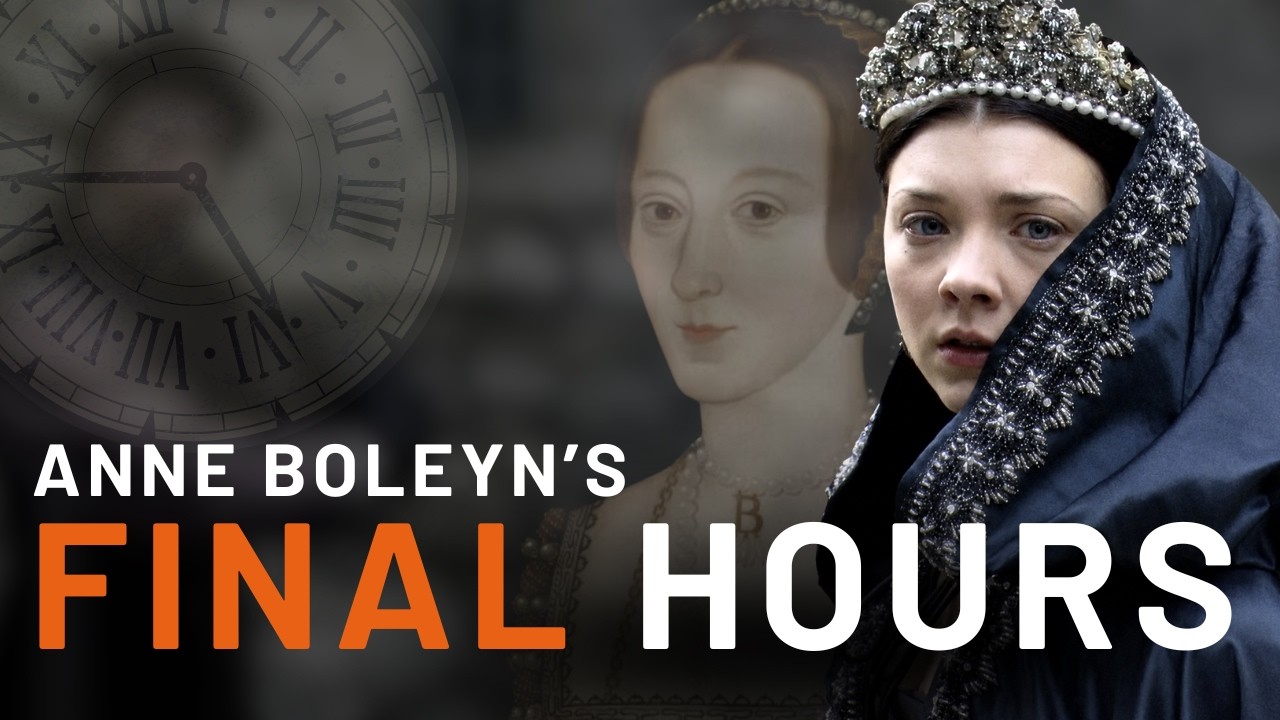
At dawn on Friday, May 19, 1536, within the walls of the Tower of London, Anne Boleyn faced the final hours of her life. Just over a thousand days earlier, she had waited in these same quarters for her coronation as Queen of England. Now she waited for her death, the first queen in English history to be condemned for treason, brought before a court, and executed. The Tower was not originally a prison.
It had begun as a royal residence, and many monarchs had stayed within its walls before their coronations, including Anne’s predecessor and rival, Catherine of Aragon. The rooms that had witnessed the most important moments of Anne’s life would later hold her daughter, Elizabeth, imprisoned there by order of her half-sister, Queen Mary, who feared she might never leave alive. Anne did not sleep during the night of May 18th into the 19th. She only prayed.
The days leading to this morning had become a waking nightmare. On May 1st, she still sat beside her husband, King Henry VIII, as queen. A day later, she was arrested. She stood trial, was condemned for treason, watched the downfall of those close to her, including her own brother, George Boleyn.
Only the day before, she had expected to die, until her execution was suddenly postponed. Waking one more day for death may have been the cruelest part of all. What occupied Anne’s mind during those final hours remains unknown. Whether she thought of Henry’s betrayal, the fate of her daughter, or clung to some fragile hope for mercy, the record does not say.
But nearly every word she spoke and every movement she made was carefully documented. The Constable of the Tower, Sir Kingston, recorded her words, and among the four women attending her, one reportedly acted as a spy, relaying details to Thomas Cromwell and to Anne’s bitter enemy, the Imperial Ambassador Eustace Chapuys. Anne spent her final morning not surrounded by close friends, but among women she complained about, saying there was much unkindness in the king to put such about me as I never loved. Her companions were Elizabeth Stoner, Mary Kingston, Margaret Coffin, and one of Anne’s paternal aunts.
When Anne complained that the women might report her conversations, her aunt answered coldly that such desire as she had for tales had brought her to this. Anne understood that some of them were watching her, and she weighed every word she spoke. Everyone who encountered Anne that morning noted her extraordinary composure. Sir Kingston later recalled that she seemed more ready to die than any creature he ever saw.
At seven o’clock, Anne received communion. Before taking it, she swore again and again that she was innocent. According to Eustace Chapuys, her sworn enemy, Anne swore upon her soul that she had never been unfaithful to the king. Standing on the edge of death, as a deeply religious woman, it remains difficult to believe she would have lied while swearing upon her own soul.
After communion, Anne was served a light breakfast. The details of her final meal are unknown, but it was likely something simple, broth, bread, perhaps wine. The expenses Henry incurred for her execution included the equivalent of nearly eleven thousand dollars in today’s money spent on food alone. After her death, Henry paid one hundred pounds to reclaim her jewels and clothing from the Tower, equal to roughly forty-four thousand dollars today.
He paid the executioner twenty-five pounds and four shillings, about ten thousand dollars in modern money, and twenty pounds in charitable donations, nearly eight thousand dollars today. In total, the cost of arranging the death of his second wife came to around seventy thousand dollars. Outside, only a few meters from her residence on Tower Green, the scaffold waited. It was covered with black cloth and strewn with straw meant to absorb the blood.
There was one unusual detail: no wooden execution block. Henry VIII had arranged a final gift for his wife. By his order, a specially trained swordsman had been brought from Calais, capable of carrying out the execution with a sword rather than an axe. Death by sword was considered less painful and was practiced far more often in France than in England.
The delay of the swordsman’s arrival is often considered the main reason Anne’s execution was postponed. Another theory suggests the delay was intentional, that Henry wanted time to clear the Tower of foreign visitors and ambassadors who had gathered hoping to witness the death and who would have written letters describing every detail to Europe’s royal courts. Among the crowd waiting beside the scaffold were many familiar faces, including Anne’s uncle, the Duke of Norfolk, her enemy Thomas Cromwell, who had orchestrated much of what had happened to her, and Henry’s illegitimate son, Henry Fitzroy. At eight o’clock, the constable informed Anne that the hour of her death was near.
Anne was already prepared. Many who saw her that day remarked not only on her composure but also on her beauty. One Portuguese witness wrote that never had the queen looked so beautiful. Anne had paid particular attention to her appearance, leaving several hidden messages within her clothing.
The ermine trimming on her gown reaffirmed her status, because in her own eyes, she was still a queen. Her petticoat was crimson, the color of martyrdom. For her headdress, she chose an English gable hood rather than the decorative French hood she had so often favored. On this final day, Anne wished to appear solemn and unmistakably English.
Accompanied by Sir Kingston, Anne made her final walk. She passed the Great Hall, moved through Cold Harbour Gate, along the western side of the White Tower, and slowly approached the scaffold. Witnesses wrote that she walked with a goodly countenance, carrying herself with dignity. Others described her appearance as possessing a devilish spirit and said she looked as gay as if she was not going to die.
Standing on the scaffold, Anne delivered a short speech. She could not speak what she truly thought. Henry held not only her fate in his hands but also Elizabeth’s, along with the lives of other members of her family. He still had the power to imprison them, to destroy them, even to order their deaths.
Anne was not willing to gamble with her daughter’s safety. Her speech was carefully measured. She confessed to no crime. Instead, she asked those present to pray for the king, calling him a gentler nor a more merciful prince there never was, and saying he had always shown her kindness.
Then Anne’s ladies removed her mantle. Anne took off her hood and carefully tucked her dark hair beneath a cap so it would not fall beneath the sword. She paid the executioner, and as was customary, he asked for her forgiveness. Anne lowered herself to her knees and began to pray, saying, Oh Christ, receive my spirit, as she waited.
The executioner had hidden his sword beneath the straw. He distracted Anne for a brief moment and then, in a single swift blow, severed her head. According to some witnesses, her lips continued to move for several seconds afterward, the final residual movements of the nervous system, which does not cease functioning instantly. Analyses have suggested Anne probably did not feel pain at the moment of execution, as the nervous system would not have had enough time to transmit the signal to the brain within those fractions of a second.
It was around 8:20 in the morning when Anne Boleyn was dead. Cannons fired from the Tower to signify her death, the sound echoing across London, the sound Henry had been waiting for. Within the next twenty-four hours, Henry and Jane Seymour would become engaged, and only eleven days later, they would marry. Anne’s ladies wrapped her head and body in white cloth and placed them into an old elm chest that had once been used to store arrows, because nothing had been prepared for her burial.
Henry and Cromwell had thought through every detail of how to rid themselves of Anne, yet they had not granted her even a proper coffin. For some time, her body remained near the scaffold before it was carried to the Chapel of St. Peter ad Vincula within the walls of the Tower. Anne Boleyn, Queen of England and mother of the future Queen Elizabeth, was buried in an unmarked grave as a traitor.
Only centuries later, during the reign of Queen Victoria in 1877, when the chapel underwent restoration, Anne’s remains were identified and reburied. At last, she received a marker at the place of her final rest, in the very place where everything for her had once begun and where everything for her had ended. Since then, every year on May 19th, the anniversary of Queen Anne Boleyn’s execution, a bouquet of red roses, said to have been her favorite flowers, is placed on her grave. For a long time, Tower staff wondered who could be sending them, until an investigation revealed that the flowers came from a family in Kent who believed themselves to be descendants of the Boleyns and had arranged an anonymous contract with a florist.
Anne Boleyn’s story remains compelling because it was never simply the story of one execution. It is the story of betrayal by someone loved, of a woman fighting against injustice, of meeting even the cruelest turns of fate with dignity and courage. That is why, nearly five centuries later, Anne Boleyn still endures in people’s hearts.






