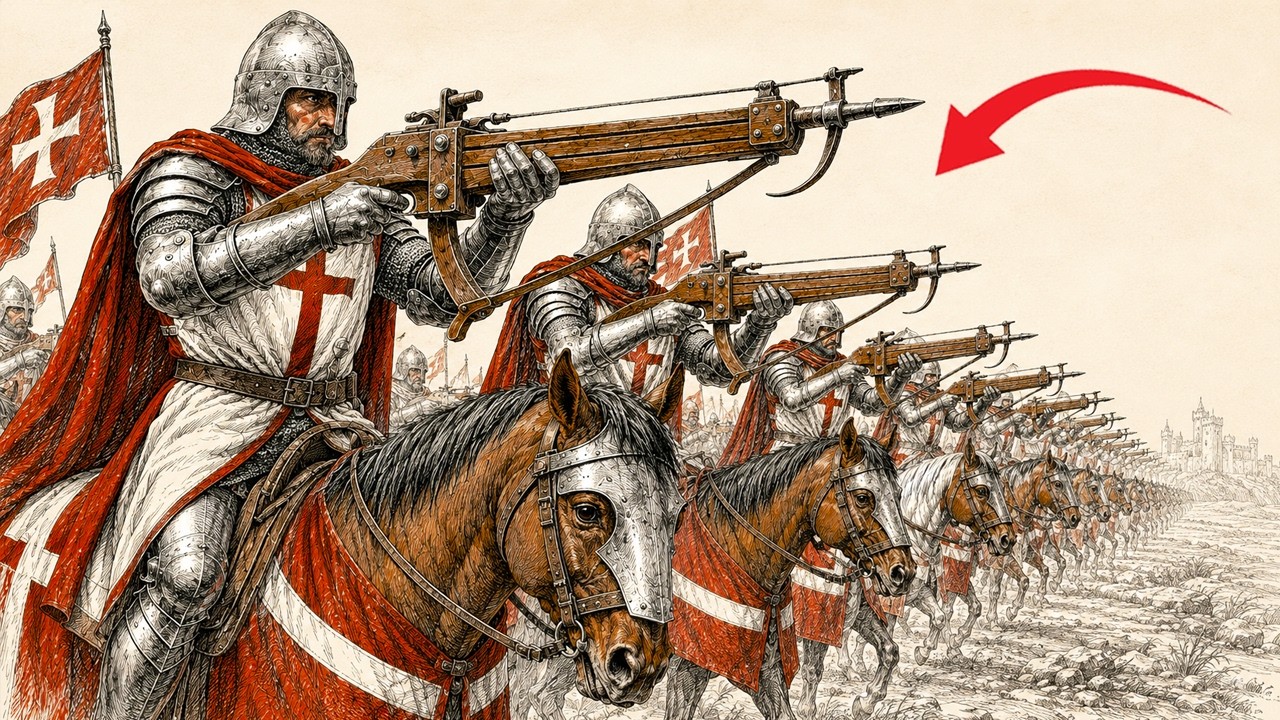
It is the year 1299, and a rider waits on a cold, clear morning on the flat brown plain outside Delhi. He wears armor and a red surcoat marked with a cross, and he is steadying something heavy across the saddle of his warhorse: a wooden crossbow the size of a child, drawn taut and ready. Behind him, a line of cavalry stretches back toward the city walls, every man carrying the same weapon. Across the plain, less than a bowshot away, the horsemen who conquered China and burned Baghdad are watching, and they do not yet understand what they are looking at.
For seventy years, the Mongols had done what no army in living memory could stop. They rode west and took Persia. They rode east and swallowed China. Now they were ten kilometers from the capital of India, and their prince, the son of the man who ruled from Samarkand to the Altai Mountains, was preparing to give the order that would end the Delhi Sultanate.
In the time it takes to watch a modern film, the balance of power on an entire continent was about to shift. And one man’s decision to disobey an order would lead to ten thousand deaths before the sun reached its peak. How does a cavalry force of one thousand men kill five thousand Mongol warriors in a single afternoon? The Persian chronicles say it happened.
The court poet who was there, a man named Amir Khusrau, wrote within a few years of the battle that the plain outside Delhi drowned in Mongol blood before the sun had fully risen. The weapon those horsemen carried, and the tactic they used, is not what history books usually remember. And why did the Sultan of Delhi, watching from atop a war elephant in the middle of his lines, refuse to move a single man to save his greatest general? Alauddin Khalji had ordered his commanders to hold their positions.
When one of them broke that order and died for it, Alauddin did nothing. Historians still argue over whether that was cowardice or the coldest calculation ever made on Indian soil. In Samarkand, a thousand miles northwest of Delhi, a ruler named Duwa Khan looked south at a map of India and decided the time had come. Duwa ruled the Chagatai Khanate, one of the four parts into which the Mongol Empire had split after the descendants of Genghis Khan stopped agreeing on anything.
He was not the Great Khan, but he ruled a portion of the world stretching from the Aral Sea to the Hindu Kush. And he wanted the land next to his. So he gave his army to his son. The son’s name was Qutlugh Khwaja.
He was young, probably in his twenties, and he had been given something no Mongol commander had ever received: a full army with orders to conquer Delhi and stay there, not to raid, not to plunder, but to rule. He turned south with tens of thousands of men behind him, every one of them believing what the Mongols had believed for three generations: that no fortified city and no crowned king had ever survived once they reached the gate. Here is what needs to be kept in mind. Since Genghis Khan had set out from Mongolia in 1206, ninety-three years earlier, Mongol armies had taken Beijing, Bukhara, Samarkand, Baghdad, Kyiv, and every major city between them.
They had destroyed the Khwarezmian Empire so thoroughly that it appears on no modern map. They had killed a caliph rolled inside a carpet. When they arrived outside Delhi in the winter of 1299, no serious observer in Asia believed the city would still be standing by the end of the year. The man they were marching against was thirty-two years old.
Alauddin Khalji had been Sultan of Delhi for three years, and he had taken the throne the same way the Mongols took cities: by killing the man who wore it before him. His uncle Jalaluddin had trusted him. Alauddin repaid that trust by assassinating him on a riverbank in 1296 and entering Delhi wearing his crown. His reign so far had been an exercise in ruthlessness.
Now the ruthlessness on which he had built his kingdom was about to be tested by something worse than itself. His best commander was a man named Hazbar-ud-Din Zafar Khan. Zafar Khan was famous inside the Delhi Sultanate for two things. He had never lost a battle, and he never waited for permission.
Those two facts, in that order, were what made him the greatest military commander in India. In the winter of 1299, in that same order, they were exactly what killed him. The men riding behind Qutlugh Khwaja were not anonymous. They were young steppe warriors from the tribes of Fergana and Transoxiana, boys raised on horseback in cold, dry mountains who had never seen an elephant in their lives.
Now they rode through unfamiliar humid heat toward a city larger than any they had known existed. By the final weeks of 1299, they had crossed the Punjab, forded the rivers, and pitched camp on a flat plain ten kilometers from the outskirts of Delhi. The place was called Kili, and Alauddin Khalji had one week to prepare. Kili lay on open ground northeast of Delhi, a dry, flat, brown plain that in the winter of 1299 was cold by day and colder by night, with the walls of the old city and the new suburb of Siri visible on the southern horizon.
There were no hills, no forests, nothing to break up cavalry formations or hide behind. If you stood on that plain and looked north, you saw the Mongol camp. If you looked south, you saw Alauddin’s camp. Between them lay ten kilometers of open ground and roughly a hundred thousand men.
Court chronicles later claimed Alauddin fielded three hundred thousand horsemen and twenty-seven hundred war elephants. That is not realistic. Modern historians, reading past the exaggerations, put the number closer to seventy or eighty thousand fighters and around seven hundred elephants. The elephants were the backbone of the army: massive animals draped in decorated armor, sometimes carrying archers or small crews in howdahs on their backs, guided by mahouts trained from childhood.
Around them stood heavy cavalry in partial metal armor armed with lances, swords, and maces. And this is the part histories tend to understate: men carrying heavy crossbows. Weapons that could punch through Mongol lamellar armor from fifty paces with force beyond anything steppe archers had ever seen. On the other side of the field, Qutlugh Khwaja’s army was smaller.
Amir Khusrau, writing within a few years, estimated it at twenty thousand horsemen. Firishta, writing later, said twelve thousand. Modern estimates settle on numbers in the tens of thousands, most likely between twenty and forty thousand mounted warriors. They were organized according to the classic Mongol decimal structure: arban of ten, jagun of a hundred, minghan of a thousand, every man a professional.
Composite bows on their backs, lamellar armor over their shoulders, remounts waiting in the lines, and a fighting philosophy older than all of them: never fight the battle your enemy wants. Qutlugh Khwaja took the center himself. On his right rode Tamur Bugha, a veteran of the steppe wars. On his left rode Hajlak.
And somewhere behind or beside the main line, invisible or barely visible from the Delhi side, lay the part of the plan that would destroy Zafar Khan: ten thousand men under a commander named Taghi. Not reserves, not reinforcements, but an ambush. The Mongols were not planning to fight the battle they were showing. They were planning to feign retreat, draw part of the Delhi army out of position, and crush it with Taghi’s hammer.
Consider the discipline that required. Ten thousand horsemen sitting motionless, holding their line, firing no arrows, raising no dust while their comrades and brothers in the main army engaged and pretended to break. They were not there to fight. They were there to be forgotten.
And the moment the enemy forgot them, they were supposed to appear like ghosts and kill everyone in sight. Alauddin arranged his men against this. He took the center himself on an elephant with his personal guards around him. On his left he placed Nusrat Khan, the man Delhi feared for tax collection, who had now proven he could hold a defensive line as firmly as he pressed merchants.
On his right he placed Zafar Khan. And behind the entire formation in reserve he placed his kinsman Ulugh Khan with fresh horsemen whose orders were simple: do not move until the Sultan commands it. Then Alauddin issued the order that would define the whole battle. He walked along his line and told every commander the same thing.
No one attacks. No one advances. No one engages the Mongols in the open, no matter what they see. Whatever provocation the Mongols offer, ignore it.
The line holds. Anyone who breaks the line dies, and the Sultan will not save him. Now imagine you are on the right wing of the Delhi army. You are Zafar Khan, sitting on your horse with a thousand of your chosen men behind you.
Your entire military career has been spent doing exactly the thing your Sultan just forbade. You have won every battle you ever fought by moving before you were asked to. You look across the plain and see them, the Mongols, not a legend, not a tale, but real men on real horses ten kilometers from Delhi, close enough that the city’s residents can hear the news and begin packing up their children and gold. You know what they did to every other city that let them reach the gates.
And you know your Sultan ordered you to stand and watch. Whether Zafar Khan spoke aloud in that moment, whether he cursed or prayed, no chronicle records. What every source records is what he did. He watched the standoff stretch through the morning.
He watched Mongol scouts probe the line and withdraw. He watched his men grow tense and restless in their saddles. And sometime between noon and midafternoon, by his own individual decision, defying a direct order from the Sultan of India, Zafar Khan drew his sword, turned to his thousand men, and ordered them to advance. Here is the dramatic irony that is meant to be felt in full.
Zafar Khan does not know what you know. He does not know ten thousand men are lurking behind the Mongol lines waiting for exactly this moment. He thinks he is charging the front of an army. In reality he is charging into an open trap, designed with precision across eighty years of Mongol warfare to catch him specifically.
The Mongol line in front of him began to move. Slowly, the horsemen in front lowered their bows and wheeled their mounts. To a man like Zafar Khan, with a thousand cavalry behind him and glory ten paces away, it looked exactly like fear. It was not fear.
It was drilled coordination. The right wing of the Delhi army left its line at a deliberate pace, then accelerated into a fast canter. A thousand horsemen in their war gear and coats, banners flying, the sound of hooves rising from a dull rumble to a roar that filled the plain. From his position in the center, atop his elephant surrounded by elite troops, Alauddin must have seen it: the dust cloud rising from his right wing, moving in exactly the direction he had forbidden.
Whether he shouted, cursed, or sat perfectly still, no source records. What every source records is that he did not move. The center held. The reserves held.
Only Zafar Khan went. The Mongol front absorbed the charge and fell back. Zafar Khan’s crossbowmen, riding in the lead, loosed a volley at close range. Heavy iron bolts punched through lamellar armor and drove into the men behind it.
Composite bows might outrange the crossbow, but at fifty paces the crossbow bolt hit with force no composite arrow could match. Mongol riders fell from their saddles. Then Delhi lances entered the fight, followed by swords. Zafar Khan was at the front doing what he always did: leading from the vanguard, cutting a gap in the line, pushing his men through it.
The Mongols in the front line did exactly as ordered. They gave ground. To a soldier in Zafar Khan’s column, this was victory. The famous Mongol horsemen, the men who had swept through Persia and China, were breaking, turning their horses, riding away.
The Delhi column of a thousand pressed harder. They were killing steadily now, cutting down those who could not turn fast enough, and the heart of the Mongol army was folding back on itself, retreating in what looked like chaos. Every rule of medieval warfare said this was the moment to attack. When your enemy flees, you kill him while he flees.
Never stop. Think about who you are chasing. The Mongols invented the feigned retreat. They practiced it as children on the steppe, hunting deer with coordinated wings that pretended to break and drew the animal into a ring of hunters.
Every Mongol boy learned this. Every Mongol commander used it. It had destroyed a Byzantine general of Roman origin at Manzikert two hundred years earlier. It had destroyed a Polish knight at Liegnitz in 1241.
It had destroyed a Hungarian king at Mohi in the same year. And on the plain outside Delhi in 1299, it was about to destroy Zafar Khan. The court poet Amir Khusrau was in Delhi during those hours. He was Alauddin’s most trusted literary man, a poet writing in Persian whose verses are still quoted seven centuries later.
He wrote about Kili within a few years of the battle in a chronicle titled Khazain-ul-Futuh. Khusrau’s account of Zafar Khan’s attack is not sober history. It was written in the style of panegyric poetry, full of lions and rivers of blood. But even through the poetry, the sequence of events is clear.
He writes that Zafar Khan entered the Mongol ranks like a lion and stained the plain with their blood. Then Khusrau writes: “The plain closed over him. ”
From the Mongol side, this was going exactly to plan. Qutlugh Khwaja, watching from the center, would have seen his front line execute the maneuver their fathers and grandfathers had taught them: retreat at a controlled pace, draw the enemy forward, keep him engaged, exhaust his horses and stretch his lines, make his connection to his own army thin with every step.
And somewhere behind that retreat, on its flank, Taghi’s ten thousand began to move. Not fast yet. Not visible yet. But moving into position to strike.
From his position, Alauddin watched a disaster unfolding. From atop his elephant, he could see exactly what was happening. His right wing had separated from the army. It was running toward the Mongol heart at full speed and getting farther away with every second.
He knew, and every commander who had ever read Mongol tactics knew, what came next. He had two options. He could push the reserves forward, send Ulugh Khan and the guard troops out to try to reach Zafar Khan before the trap closed. Or he could wait.
The next twenty minutes decided everything. Not the minutes of Zafar Khan’s attack, those were already gone. The twenty minutes Alauddin sat on his elephant and did nothing. Each of those minutes was a decision in itself.
And in each of them, Zafar Khan drove deeper into the trap. And in each of them, the man who could have saved him watched him advance without giving an order. Barani, writing decades later in the Tarikh-i-Firuz Shahi, was not forgiving on this point. He describes Alauddin’s decision as bloody and cold.
Barani suggests the Sultan made his calculations in the seconds available to him. Sending the reserve meant throwing it into the same trap. Moving the center meant breaking the formation that was holding the Mongols off Delhi itself. Waiting meant losing Zafar Khan and his thousand men.
Alauddin chose to wait. Whether he did it from anger at the disobedience or because his calculation was correct, Barani does not resolve. But the historical record documents that he did it. On the plain, Zafar Khan’s men had pushed perhaps two or three kilometers behind the original Mongol line.
They were still fighting, still killing, still winning as far as they could tell. Behind them was open ground. Ahead of them was the heart of the Mongol army, which seemed to keep collapsing. On the flanks, dust, nothing but dust.
Then, out of the dust on the left, and out of the dust on the right, ten thousand horsemen began to appear. They were not fleeing and not withdrawing. They were riding in fast military formation toward the flanks of the thousand men who had pushed in too deep. This is the moment the Battle of Kili stopped being a battle and became an execution.
To understand what happened next, the fighting that killed five thousand Mongols and killed Zafar Khan and left the son of the Chagatai Khan bleeding from a wound he would not survive, the sequence must be seen in stages. The weapon on the horse’s back, the wooden crossbow the Delhi cavalry carried to that plain, did not alone kill the Mongols outside Delhi in 1299. It was one part of a larger machine. The military system of the Delhi Sultanate under Alauddin did something steppe empires had struggled against for a generation.
It combined long-range firepower with elephants and disciplined cavalry in a single formation that could not be shattered by arrow volleys the way the Khwarezmians, Russians, or Hungarians had been. The crossbows in the front rank struck harder at close range than composite bows. The elephants in the center could not be brought down by arrows, and the reserves in the rear gave the battle depth. In the first minutes of Zafar Khan’s attack, before he fell into the trap, this system worked exactly as Alauddin’s engineers had planned.
The crossbows at the front of Zafar Khan’s column loosed a volley at fifty paces and dropped the first Mongol rank. Not wounded, but dead. A crossbow bolt at that range does not lodge in the body. It pierces through and comes out the other side to hit the man behind as well.
Contemporary observers had never seen anything like it applied at this scale from horseback. This was Delhi’s military reform in miniature. This was what Alauddin had spent three years and vast sums building. And here is the terrible irony.
The system worked. The weapon worked. The Mongols in the front lines were being killed by it. But the very success that proved the reform effective is what drove Zafar Khan deeper.
If the crossbows had failed, he would have withdrawn. Because they succeeded, he charged with everything he had. The effectiveness of Alauddin’s new army was feeding the trap in that moment. The best weapon in Asia was pulling its users into an ambush designed by men who had never seen it, but who understood perfectly how to defeat any weapon: get behind the men carrying it.
By the time a thousand Delhi soldiers had broken through the first Mongol line, killed hundreds of men, and advanced a kilometer into what looked like an enemy collapse, the crossbows were spent. Crossbows are slow to reload, maybe two bolts a minute in battle conditions. After the first two volleys, Zafar Khan’s men were fighting with lances and swords in close combat against Mongol cavalry that had stopped fleeing. And the ground under their feet no longer belonged to them.
Somewhere in the middle of the Mongol formation, several kilometers from Alauddin’s line, Zafar Khan was doing what his entire career had trained him to do. He was at the front. He was fighting and cutting his way forward. He was killing steadily and calling his men onward, and the men followed because they had always followed him.
His horse was lathered with exhaustion. His right arm was heavy. The banners of his column had shrunk from a forest of flags to a few. His crossbows were finished.
And somewhere in the dust of the battle on both his sides, a Mongol commander he had never met was giving the order for Taghi to attack. Amir Khusrau’s description of this moment leans heavily on the lion metaphor. Even behind that poetry, the sequence he recorded was precise. He writes that Zafar Khan “killed until the corpses of the infidels covered the plains, and their blood flowed like rivers.
” The number Khusrau gives here, five thousand Mongols killed in Zafar Khan’s charge, is certainly exaggerated. But even a fraction of that number killed by a force of a thousand men in a single engagement would rank as one of the most brutal exchanges ever inflicted on a Mongol army by a medieval power. Focus on one thing: his hands. Zafar Khan’s hands on the reins of a horse that had been running, turning, and charging for over an hour were trembling.
Not from fear, but from the biological exhaustion of a man wearing metal armor and wielding a heavy sword to kill armored men for that long. His fingers were numb. His grip was loose. He could no longer feel where the reins ended and the leather gloves began.
Still he kept fighting. Around him, his thousand men were dying, not all at once. That is how close-quarters medieval combat kills men: one by one, across minutes and hours, each death an event in itself. A rider falls from his horse.
A rider takes an arrow between the plates of his armor. A horse goes down, and its rider goes down with it. The line of banners shortens every time Zafar Khan looks at it. His men are still killing the Mongols in front of them.
But something is happening behind them now that they cannot see yet, because the dust on the flanks has grown thicker, and the sound of hooves now comes from three directions instead of one. Three kilometers back on the Delhi line, Alauddin still had not moved. His generals, Nusrat Khan on the left and Ulugh Khan in the rear, were watching him, waiting for the order. He gave none.
The historians who defend Alauddin argue that in that moment he had already written off Zafar Khan and his thousand men. Moving the line meant losing the battle. Holding the line meant losing only one wing. He was, by his cold calculation, saving the Sultanate by not saving his general.
The historians who criticize him argue that a bolder Sultan would have risked the entire army in one decisive strike and possibly ended the war that afternoon. Neither happened. Alauddin held. Consider that number.
Even if Khusrau’s five thousand is dismissed as poetic exaggeration and cut in half or a third, Zafar Khan’s column killed more Mongols in a single afternoon than most European kings killed in an entire campaign. The Poles at Liegnitz in 1241 did not. The Hungarians at Mohi did not. The Russians at the Kalka River did not.
Across seventy years of Mongol expansion, no one had ever achieved what a cavalry unit of a thousand men achieved by inflicting losses of this rate on a Mongol army. Taghi’s hidden ten thousand struck the Delhi right wing from the flank and rear simultaneously. The chronicles do not preserve the precise engineering of the battle formations. The Persian sources describe it in the stock language of encirclement, but the meaning is clear.
One moment, Zafar Khan’s men were fighting what was in front of them. The next, they were fighting in every direction. The dust behind them, which they had taken for the trace of their own movement, was full of charging horsemen. The Mongols in front of them, who had been retreating, suddenly stopped and wheeled to fight.
What had been an attack became a siege. What had been a siege became a killing ground. This is the answer to the second question asked at the start. Zafar Khan died with help less than half an hour’s ride away, because Alauddin refused to send it.
The Sultan of Delhi, watching from his elephant, knew exactly what was happening in the dust cloud three kilometers to his right. He knew his best general was going to die there. He knew that if he sent Ulugh Khan and the reserves to break through Taghi’s ambush and save Zafar Khan, the Mongols would counterattack the weakened Delhi center, crush it, and reach the streets of Delhi by dusk. So he held.
Whether Alauddin made this decision from cold calculation, from anger at Zafar Khan’s disobedience, from fear, or from a mixture of all three, the primary sources do not tell us. Barani, writing decades later, cannot tell us either. The men who wrote the chronicles were not inside the Sultan’s mind. What we know is what he did.
And what he did was refuse to move. On that refusal, on that silent decision to let a hero die, the survival of the Delhi Sultanate depended. Inside the encirclement, the arithmetic of medieval combat took over. A thousand men surrounded on open ground by ten thousand cannot survive.
The Mongols did not need to charge in and finish them directly. They rode around them at bow range and began to shoot. Composite bows in the hands of trained horsemen at fifty to a hundred paces, from every direction at once, sent arrows into every gap in every man’s armor. The Delhi horses were the first victims, bigger targets and less armored.
Then the men. Zafar Khan fought in the middle of the shrinking ring on foot after his horse was killed. He fought with his sword until the sword was too heavy to lift. He fought with his knife after the sword was lost.
The chronicles agree on the general shape of his death and differ on the details. Khusrau makes it a martyrdom in the register of epic poetry: Zafar Khan cutting down Mongols until his body was more arrows than flesh. Barani makes it a lesson: the brave subordinate who disobeyed the Sultan and paid with his life. Later Indian writers made him a national hero.
What all sources agree on is that he died in the encirclement. His thousand men died with him or near him. Almost none of that column survived. When the ring collapsed, Delhi’s right wing had been wiped out, but the price Taghi had paid was heavy.
The five thousand Mongols Khusrau credited to Zafar Khan, even cut in half, represented losses no previous enemy had inflicted on the Mongols at that scale. Taghi’s ambush had succeeded. Qutlugh Khwaja’s plan had succeeded, but in succeeding they had lost so many men that the tactical victory began to turn into a strategic dilemma no Mongol commander had prepared for. Destroying Zafar Khan’s wing did not end the battle.
It changed its course. Qutlugh Khwaja, after the success of his ambush, now had to execute what the ambush was supposed to enable: break the main Delhi line and take the city. Here the Mongol plan failed. The heart of Alauddin’s army was intact.
The elephants were still in position. The crossbows behind them had been reloaded. And the Delhi cavalry, seeing their right wing annihilated, did not collapse at the sight. They burned with rage.
Every man on the Delhi line now understood what had happened, and understood that the Mongols who had killed Zafar Khan were still in front of them. The Mongols advanced. Qutlugh Khwaja pushed his center and remaining wings against Alauddin’s line, expecting the Delhi army to break the way every army broke before the Mongols. It did not break.
The elephants held their ground. The crossbows fired at close range. The heavy Delhi cavalry countercharged in disciplined formations. The ground in front of Alauddin’s line began to fill with dead Mongol horses and men.
This was not the quick collapse the Mongols were used to inflicting. It was something they had never faced: an even fight. Somewhere in this second phase, fighting near the heart of the Delhi army, an arrow, a lance, or a sword struck Qutlugh Khwaja himself. The chronicles do not agree on how.
Some say he was personally leading the assault against Alauddin’s line. Some say he was wounded trying to rally his center after the elephants held. What all sources agree on is that the son of Duwa Khan, the prince sent from Samarkand to take Delhi, left the battlefield wounded. A wound so serious it would kill him before he reached home.
As the sun set, both armies withdrew. The Mongols did not break; they were too disciplined for that, and their commanders still controlled their ranks. But they did not attack again. They pulled back to their camp near Kili with their wounded prince and thousands of dead, lit their fires, and began to assess what had happened.
On the Delhi side, Alauddin reorganized his ranks and held his position. He did not pursue. His army had held. His commander-in-chief was dead.
His right wing was gone. And that evening, the son of the man who ruled from Samarkand to the Altai Mountains lay in a Mongol tent, dying slowly from a wound taken on the plain outside Delhi. The next morning, the plain outside Delhi was silent, but not empty. The Mongol camp was still there, ten kilometers from the city, still a theoretical threat, but something had changed overnight and everyone on both sides knew it.
The Mongols did not line up for another day of fighting. They stayed in camp treating their wounded, trying to figure out how to sustain an army so far from home in a land that had denied them the quick victory their entire plan required. Their prince lay in a tent bleeding through his bandages, no longer able to issue orders that reached the whole army. Over the next three days, the sources compress the timeline and the exact duration is not preserved.
The two armies sat watching each other. Small skirmishes almost certainly occurred; the chronicles mention them without detail. But there was no second day of decisive battle. The Mongols could not attack.
Alauddin did not want to attack. Delhi remained behind its walls, its people still poised to flee, watching the plain from the towers. And inside the Mongol camp, the debate that always followed a bad day in Mongol camps was building. Do we retreat or press on?
The Mongols retreated. On a day the chronicles do not name, in the first weeks of 1300 or the last of 1299, Qutlugh Khwaja’s army struck camp at Kili and began the long march north, back through the Punjab, back across the rivers, back toward the mountain passes and Central Asia. They carried their wounded prince on a litter or in a cart; the sources are vague on that. All sources agree that Qutlugh Khwaja never reached home.
Somewhere on the return road, days or weeks after the battle, his wounds killed him. The prince who never returned home died on his way out of India. Picture that road: weeks of dry Indian winter turning into the cold high passes of the Hindu Kush, tens of thousands of horsemen who had ridden south to occupy a capital riding north with a smaller army and a dying prince. Every mile of that road was proof of what had happened at Kili.
And every night around the campfire on the retreat, someone told the story of Zafar Khan’s charge, Taghi’s ambush, the elephants that held, and the wound that struck the prince. That story returned with them to Samarkand. And that story was one of the reasons the Mongols thought twice and three times before trying to attack Delhi again. The full casualty count of the Battle of Kili was never precisely recorded.
Zafar Khan’s force of roughly a thousand was annihilated. Elsewhere on the Delhi lines, losses were heavy but not decisive. For the Mongols, Khusrau’s five thousand dead from Zafar Khan’s charge alone is certainly exaggerated, but even conservative modern estimates put total Mongol dead in the low thousands, a painful loss for an army of twenty to forty thousand. Combined with the wounding and death of Qutlugh Khwaja, the strategic damage to Chagatai ambitions in India was so great that no comparable invasion was attempted for years.
Barani, writing decades later, delivers the judgment that shaped the battle’s memory in Delhi ever since. He describes Zafar Khan as brave and disobedient in the same sentence. He describes Alauddin as cautious and cold in the same sentence as well. He fully praises neither man.
And he closes his account of Kili with a note that became the accepted explanation: the Delhi Sultanate survived not because it won the open battle, but because it did not lose the battle by trying to win it recklessly. Zafar Khan’s body was recovered from the field, though the chronicles do not describe the recovery in detail. In Delhi, he became a martyr almost immediately. The people passed on the story of his charge exactly as Khusrau wrote it: the story of the lion, the plain of blood, and the thousand who killed five thousand.
Alauddin notably did not join in this celebration. Some sources suggest the Sultan was wary of celebrating a commander whose most famous act was disobeying his orders. Zafar Khan’s shrine and memory became the city’s more than the throne’s. But Alauddin used Kili differently.
He used it to justify tightening everything he was already doing. Within months of the battle, he tightened his intelligence networks, expanded his ban on unauthorized noble gatherings, and moved further toward complete centralization of the Sultanate under his personal authority. The Mongol invasion proved to him that the state must be the instrument of a single man’s will. Kili was not just a military event; it was the argument he used to make his system what it became.
In Samarkand, news of Qutlugh Khwaja’s death reached Duwa Khan some time after his son died on the road. Duwa continued to send raids into India in the years that followed, the Battle of Amroha in 1305 and other clashes, but never again on the scale of Kili. The generation of large-scale Chagatai attempts to invade India ended with the death of the prince Duwa sent, somewhere between Delhi and the Hindu Kush. And from 1300 onward, Alauddin’s reputation was that of the Sultan who threw back the Mongols.
But the end of the battle was only the beginning of the story of what Kili came to mean, and what has been quietly misremembered in ways that have shaped everything just heard. In the seven centuries since Kili, the battle has been remembered inside India as a defensive triumph: the moment Delhi refused to fall the way Baghdad fell forty years earlier, Samarkand eighty years earlier, Beijing a century before. That memory is accurate in its core. The Delhi Sultanate did survive.
The Mongols did retreat. Alauddin’s regime was strengthened by the victory, and India remained one of the few great civilizations of Asia never fully absorbed into the Mongol imperial system. Around that accurate core, a legend grew. Zafar Khan is remembered as a hero without reference to his disobedience.
Alauddin is remembered as a defender without reference to his cold calculations. The Mongols are remembered as hordes that appeared and were repelled, rather than a professional army whose defeat required a particular combination of weapons, tactics, and decisions that had not existed in India a generation earlier. That legend is not entirely false. It is just tidier than what actually happened.
Here is the part of Kili that changes the picture. The weapons and tactics that get most of the credit in the popular story, the heavy crossbow, the elephant, the disciplined line, did not save Delhi by themselves. What saved Delhi was Alauddin’s refusal to use them the way Zafar Khan wanted him to. The battle was not decided by the attack.
It was decided because the attack was not followed by a second attack. The Delhi Sultanate’s real weapon at the decisive moment was the Sultan’s willingness to let his best commander die alone in an ambush three kilometers away. That is not a weapon found in an inventory. It is not something you can point to in a chronicle.
But without it, the arrows and elephants would have followed Zafar Khan into the trap, and the Delhi Sultanate would have died with them. From the Mongol side, Kili quietly reshaped how the Chagatai thought about India. The raids continued, but the era of full army invasions aimed at the capital effectively ended with the death of Qutlugh Khwaja on that road. India joined the small category of civilizations that survived direct confrontation with the Mongols without being conquered.
In that period, the category held Japan, the Mamluk Sultanate of Egypt, and the particular structure Alauddin built in Delhi. That is the club into which Khalji put India. It is a small club. So on that barren brown plain outside Delhi in the winter of 1299, the image with which this story began, the rider in his plates and red-crossed surcoat, the wooden crossbow drawn across his saddle, the disciplined ranks stretching toward the city walls, was only half of what achieved the victory.
The other half was a Sultan on an elephant three kilometers away, watching his best commander die and refusing to move. The battle everyone remembers was decided by a move everyone forgets. The Battle of Kili is one of the rare battles in which a hero’s disobedience and a king’s coldness, each in its own way, saved a civilization.






