Before dawn broke on June 6th, 1944, the English Channel had already turned into a graveyard of steel and flesh. Twenty-four thousand airborne troops had disappeared into the darkness over France. Now, in the dim light before sunrise, the first assault boats churned toward a shoreline packed with more explosives per square mile than any other place in human history. And in the lead boat of the entire Fourth Infantry Division, a fifty-six-year-old man with a wooden cane and a shattered knee was about to do something that military textbooks said should have gotten him killed.
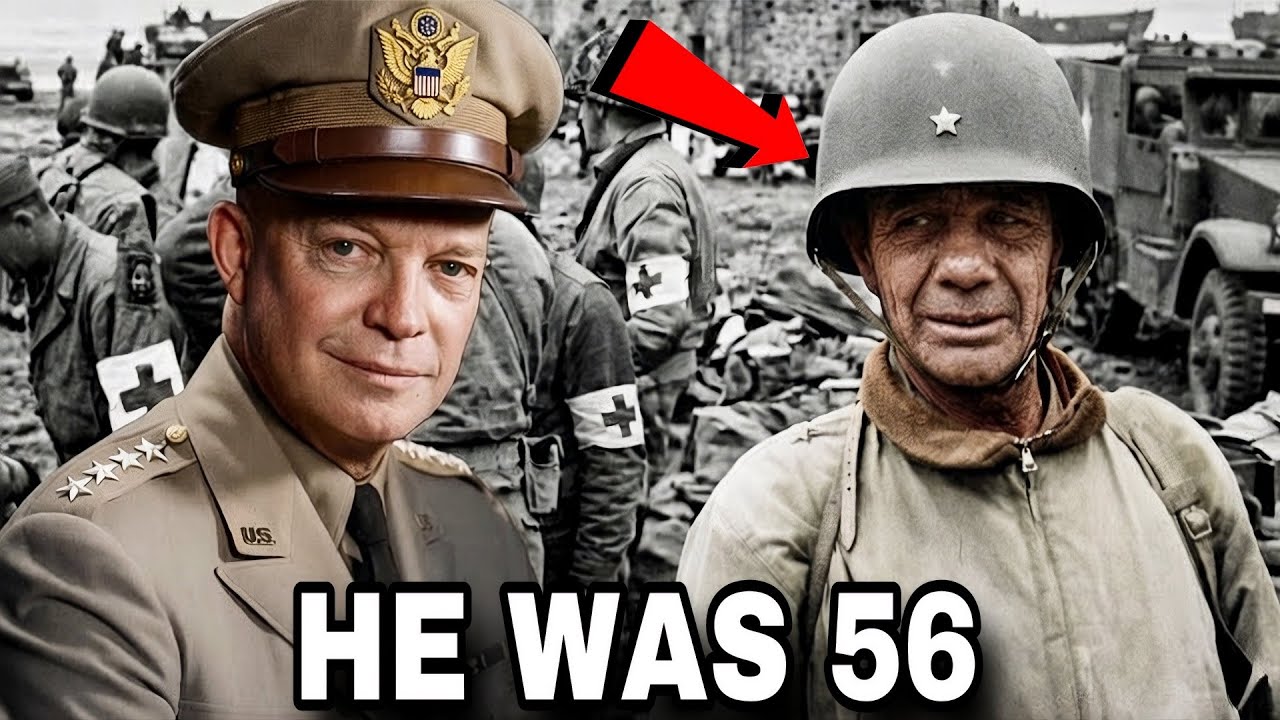
His name was Brigadier General Theodore Roosevelt, Jr. What he did next would lead General Dwight Eisenhower to say something about one officer that he never said about any other man in the whole war. Before dawn on June 5th, while the invasion fleet was still fighting through unprecedented gale-force winds, Eisenhower had already written Roosevelt’s eulogy. The Supreme Commander of Operation Overlord had sat down and composed words for a funeral because he was absolutely certain this man would be dead within twenty-four hours.
Roosevelt was not supposed to be there. Every regulation in the United States Army’s command structure said he should have been in England, sipping coffee from a metal cup, waiting for radio reports. But Roosevelt had done something that infuriated his superiors, then won their respect, then terrified them. He had insisted on landing with the first wave.
His commanding officer, Major General Raymond Barton, said no twice. Verbal requests were denied flatly. Barton pointed to the arthritis that had swollen Roosevelt’s hands and feet. He pointed to the cane.
He pointed to the bullet wound from the First World War that had never fully healed. He pointed to the fact that Roosevelt was the oldest man in the entire division, and that the average life expectancy for a first wave officer on Utah Beach was measured in minutes. Roosevelt listened to every objection. Then he submitted a written request.
No verbatim transcript of that conversation survives, but every account agrees on the essence of what he said. He told Barton, and the message traveled up to Eisenhower himself, that the men landing on Utah Beach had never seen combat. They were going to hit sand under machine gun fire with artillery shells dropping around them. They needed to see a face.
Not a face on a poster, not a name in a letter—a real face attached to a real rank, walking beside them through the bullets. Roosevelt argued that his physical condition did not matter, because leadership was not about running faster than the enemy. Leadership was about being seen when everything else was invisible. Eisenhower understood something that morning that most staff officers never grasped.
Sometimes the most valuable asset on a battlefield is not a weapon. It is a symbol. The invasion plan for Utah Beach was elegant on paper. The Fourth Infantry Division would land at a specific grid coordinate designated as Tare Green and Uncle Red.
Three hours of naval bombardment would soften the defenses. Engineers would blow gaps in the underwater obstacles. The first wave would secure the causeways leading inland, and within six hours the beachhead would be firmly established. That was the plan.
But war does not care about plans. The English Channel had other ideas. A tidal current running faster than any pre-invasion calculation predicted caught the landing craft and pushed them south—not a little south, but two thousand yards, nearly a mile and a half from where they were supposed to be. When the ramp dropped and Roosevelt stepped into the surf, the water was cold enough to stop a younger man’s heart.
He was carrying a pistol in one hand and his cane in the other. The German defenders on the bluffs above had not yet realized the invasion was happening, because the naval bombardment was still falling further north. That gave Roosevelt approximately thirty seconds of relative quiet before the machine guns opened up. He used those thirty seconds to look around and realize something that would have broken a less experienced commander.
There were no landmarks. No causeways. No recognizable terrain features. He was not on the beach he was supposed to be on.
Here was the moment where the entire invasion of Utah Beach hung in the balance. A lesser commander would have frozen. A by-the-book officer would have tried to reorient, to march his men two thousand yards north through enemy territory to reach the intended landing zone. That would have taken hours.
Those hours would have given the German 91st Infantry Division time to rush reinforcements to the exact spot where the Americans were supposed to be. The casualties would have been catastrophic. But Roosevelt did not freeze, and he did not panic. According to multiple eyewitness accounts, he looked at the terrain, assessed the German defensive positions, and made a declaration that has become the stuff of military legend.
The words were recorded by multiple soldiers who heard them: “We’ll start the war right here. “
He was not asking permission. He was not consulting a manual. He was not radioing back to the fleet for instructions.
He was making a command decision in real time, under fire, based on nothing but his own experience and his own eyes. And that decision changed everything. Because the beach where they had landed—the wrong beach—was actually less heavily defended than the intended objective. The Germans had concentrated their fortifications to the north, expecting the main assault there.
Roosevelt had stumbled onto the weak point of the entire Utah Beach defensive sector, simply because the English Channel had pushed him there. But recognizing an opportunity and exploiting it are two different things. Roosevelt could have pointed inland and told his men to advance. Instead, he did something that no officer of his rank had ever done on any amphibious assault in history.
He walked back and forth across the beach, under direct fire, and personally directed every company as it landed. He would lead one group across the seawall, establish them in a defensive position, then return to the beach to find another group pinned down. He would lead that group forward, then return again. He repeated this action multiple times throughout the morning.
Consider the physical toll of what he was doing. This was a man who needed a cane to walk on flat ground. The beach was uneven sand mixed with shingle and mud. The seawall was several feet high.
Behind the seawall was open ground crisscrossed by drainage ditches and hedgerows. Through all of that, under machine gun fire and mortar shells, Roosevelt moved like a man half his age. Not because his body could handle it, but because his will refused to break. One soldier who watched him that morning later said that seeing the general limp past while bullets kicked up sand around his feet made every other fear seem small.
The strategic effect of Roosevelt’s leadership emerges in figures that paint a startling picture. Out of the 21,000 soldiers who came ashore at Utah Beach on June 6th, just 197 lost their lives. That works out to a casualty rate under one percent. Set that beside Omaha Beach, where the casualty rate climbed toward ten percent.
Set it beside the British landing at Gold Beach, where the toll was considerably heavier. Utah Beach was meant to be a slaughter. The German 709th Infantry Division had devoted two years to strengthening that shoreline. Yet because Roosevelt chose to accept the wrong beach, and because he personally spearheaded the assault, the Fourth Infantry Division swept around the German defenses and rolled them up from the flank rather than striking them head-on.
For eighty years, military historians have argued over whether any other officer would have made the same call. Most likely not. Confronted with a navigation error of nearly two miles, the majority of commanders would have tried to fix it. They would have radioed the fleet, asked for clarification, and sat tight awaiting orders.
Those minutes of waiting would have handed German artillery spotters the time to zero in. The first waves would have been cut down on the sand while senior officers argued over the next move. Roosevelt did not argue. He acted.
By late morning, the situation at Utah Beach had turned from looming catastrophe into operational triumph. The Fourth Infantry Division had driven more than a mile inland. They had seized the coastal villages that were meant to be their first-day objectives. They had joined forces with airborne troops from the 82nd and 101st Airborne Divisions who had jumped behind enemy lines hours before.
And Roosevelt, still leaning on his cane, still shuttling from unit to unit, was on his third or fourth return trip to the beach to bring more men forward. When the command staff who had stayed behind in England finally reached the beach that afternoon, they braced for chaos. They expected to find senior officers dead or wounded. They expected to have to reconstruct what had happened from scattered radio reports.
What they found instead was Roosevelt standing calmly on the sand, resting on his cane, with a complete operational report ready for them. He had organized the beach. He had marked the landing zones. He had set up the supply dumps.
He had performed the work of a full division staff while simultaneously leading the assault. The men who served under Roosevelt that day never forgot what they saw. One soldier from the 8th Infantry Regiment later wrote that watching the general limp past while everyone else was scrambling for cover made him ashamed of his own fear. Another said that Roosevelt’s utter disregard for his own safety was the most powerful lesson in leadership he ever received.
These were not professional soldiers penning propaganda. These were farm boys and factory workers who had been drafted, trained and hurled into the greatest amphibious assault in history. They needed someone to show them that courage was possible. Roosevelt showed them.
Consider what did not happen. In the alternate reality where Roosevelt follows protocol, where he radios the fleet and waits for instructions, the first wave of the Fourth Infantry Division spends thirty critical minutes pinned down on the wrong beach. German artillery observers use those thirty minutes to fine-tune their fire. The second wave lands straight into a killing zone.
The third wave stacks up behind them. By noon, Utah Beach resembles Omaha Beach. By nightfall, the surviving American forces have barely carved out a foothold. The whole right flank of the Normandy invasion falls apart.
The German 91st Infantry Division counterattacks through the breach. That is the disaster that never came to pass, because one man made one decision in one instant. Roosevelt’s story does not finish on the beach. It finishes thirty-six days later, in a farmhouse in Normandy, with a heart that finally gave out beneath the weight of all it had borne.
July 12th, 1944. The Allies had broken out of the beachhead. Roosevelt had been promoted to assistant division commander of the 90th Infantry Division, a unit that had faltered in the early weeks of the campaign and needed his steadying hand. He had been sleeping in a Jeep, eating cold rations, and walking miles every day with that cane.
One month of combat at fifty-six years old, and his body simply could not keep up. Word of his death struck the Fourth Infantry Division like a physical blow. These were men who had watched him limp across Utah Beach while bullets snapped past his ears. They had followed him over the seawall and through the hedgerows.
They had believed, because he made them believe, that the invasion would succeed. And now he was gone—not from a German bullet or artillery shell, but from the simple failure of a heart that had beaten too hard for too long. Roosevelt was first buried in a temporary cemetery at Sainte-Mère-Église, the town liberated by paratroopers in the opening hours of D-Day. Later, his family asked that his remains be moved to the Normandy American Cemetery overlooking Omaha Beach.
Today he lies there among nearly ten thousand other American soldiers. But here is the detail that troubles military historians. Roosevelt never got the promotion everyone felt was coming. He died a Brigadier General.
One star. While less capable officers who never heard a shot fired in anger collected their second and third stars, Roosevelt stayed where he was. Promotion is a political game, and Roosevelt had never played it. He had asked to land on the beach when he could have stayed safe.
He had walked through machine gun fire when he could have directed from behind. He had made decisions in seconds when other officers needed hours. Those are not the actions of a man who cared about stars on his collar. General Dwight Eisenhower, once he learned the full story of what had happened at Utah Beach, delivered a verdict that no historian since has dared to challenge.
He said Roosevelt alone made the beach a success. Not the naval bombardment. Not the air support. Not the engineers or the paratroopers.
Roosevelt alone. Those are remarkable words from a man who commanded millions. Eisenhower never said that of any other officer in any other battle of the entire war. The supreme commander of Operation Overlord, the man responsible for the largest amphibious invasion in history, examined the results and concluded that one individual had tipped the balance between success and failure.
A misconception has lingered for decades. Many people assume Roosevelt was awarded the Medal of Honor right after D-Day. He was not. The award was approved posthumously, nearly three months after his death, and it did not come without controversy.
Certain officers contended that while his conduct was indeed heroic, it fell short of the rigid standards required for the country’s highest military honor, since he held the rank of general officer and generals were supposed to lead. The review board dismissed that reasoning, yet the postponement meant Roosevelt went to his grave unaware he had been granted the Medal of Honor. He died believing his service had been recognized, though not elevated. When the citation at last arrived, it described Roosevelt’s deeds in words worth studying closely.
It stated that he displayed gallantry and intrepidity at the risk of his life above and beyond the call of duty. It recorded that he led groups from the beach over the seawall again and again. It observed that his calm and unwavering leadership under fire inspired the troops. Yet the citation omitted the most extraordinary detail of all.
It made no mention of his age. It made no mention of the cane. It made no mention of the arthritis or the World War I bullet that had shattered his knee. The official record merely stated that a brigadier general came ashore with the first wave and led the assault.
The rest was left for history to uncover. The question that every leadership course in the United States military has wrestled with since 1944 is why Roosevelt did it. He was fifty-six years old. He had already served as Assistant Secretary of the Navy, Governor of Puerto Rico, and Governor-General of the Philippines.
He had nothing left to prove. His father had been President of the United States. His name by itself secured him a place in the history books. Nobody would have questioned him had he stayed in England.
Nobody would have branded him a coward. He could have sat out the war in comfort and come home to a hero’s welcome resting on his name alone. But he did not stay. He went.
The answer, according to the men who served beneath him, was simple. Roosevelt held that rank was a burden, not a privilege. He held that the men carrying rifles deserved to see the men giving orders sharing the same risks. He held that a general who asked soldiers to die for a cause ought to be willing to die for that cause himself.
Those convictions cost him his life. His heart attack on July 12th was almost certainly worsened by the physical strain of the Normandy campaign. The cold water. The sleepless nights.
The endless walking on a damaged knee. The unrelenting pressure of command under fire. His body paid the price for his principles. There is another layer to this story that seldom gets told.
Roosevelt was not just any general. He was the son of a president who had charged up San Juan Hill. He had grown up in the shadow of American heroism, forever measured against a father who had won both the Medal of Honor and the White House. Some men broken by that weight would have withdrawn into comfortable mediocrity.
Roosevelt did the reverse. He spent his whole life striving to earn a legacy he already held by birth. And on June 6th, 1944, on a beach in Normandy, amid machine gun fire and artillery shells, he finally achieved it. He stepped out of his father’s shadow for good.
The tactical lessons of Utah Beach have been examined by every military academy on earth. Decentralized command. Initiative at the point of attack. The value of leadership by example.
But the human lesson is simpler and harder to teach. Roosevelt succeeded because he was present. He was there. He did not run the battle from a command ship with a map and a radio.
He stood in the surf. He climbed the seawall. He walked through the bullets. And because he was there, his men followed.
One month after D-Day, the Fourth Infantry Division held a memorial service for their general. They had taken their objectives. They had broken through the German defenses. They had done everything he had asked of them, but they did it without him.
The man who had limped ashore first was gone. Soldiers who had watched him walk through fire stood in formation and recalled what he had shown them. Courage was not the absence of fear. Courage was doing the job anyway.
Theodore Roosevelt, Jr. rests today in the Normandy American Cemetery, overlooking the beach where he made his stand. His grave is marked by a simple white cross, identical to the thousands surrounding him. No special monument.
No larger marker. Just his name, his rank, and the date of his death. But visitors to the cemetery notice something about that grave. There are nearly always flowers there, even when no official ceremony is scheduled.
Veterans leave them. Families leave them. Complete strangers leave them. Because somehow, eighty years later, people still grasp what Roosevelt grasped on that June morning.
Some debts cannot be repaid. They can only be remembered. Eisenhower’s words about Roosevelt have echoed down the decades because they capture something essential about war and leadership. One man made a beach successful.
Not the plan. Not the firepower. Not the numbers. One man with a cane and a pistol and a knee that should have kept him home stood on the sand and decided that the war would start right there.
And because he decided, the war started. And because the war started, the Allies won. And because the Allies won, the world changed.
All of it traces back to one moment, one decision, one man who refused to stay safe.
