The clothes had waited in that evidence box for forty-five years. No one had opened it, not because Kathy Holly had been forgotten, but because the technology to read what was on the fabric did not exist. When it finally did, the result pointed to one man with a statistical certainty of 9. 4 trillion to one.
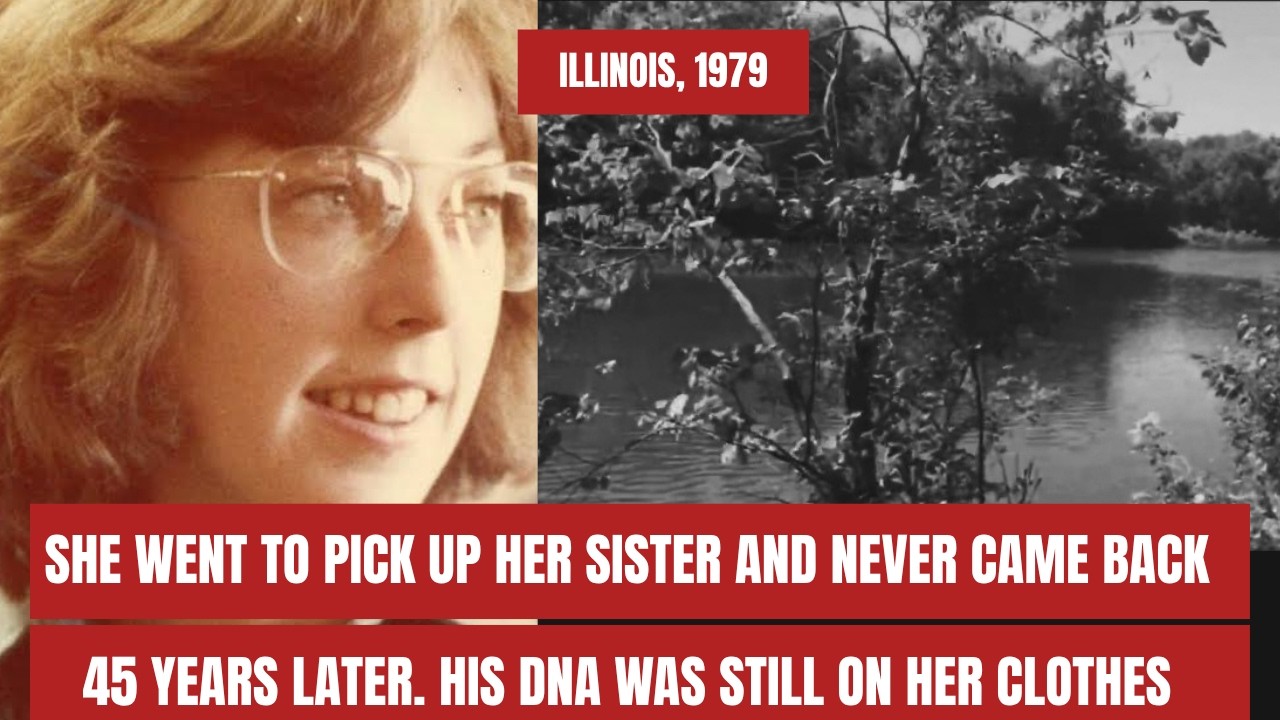
The only problem was that he had been dead since 1981. It began on a Thursday afternoon, March 29th, 1979, in North Aurora, Illinois. Kathy Holly was nineteen years old. She lived on Volk’s Court with her boyfriend and worked retail at the Northgate Shopping Center in Aurora.
Her world was small in the best way, built inside a few square miles, inside the circle of people who loved her. Her parents lived about a mile away. Her sister worked at the same shopping center she did. That Thursday afternoon, Kathy left her apartment to pick up her sister at the end of her shift.
It was a normal drive, a few minutes down the road. She never arrived. When Kathy did not show up, her sister called home. By that evening, her family had reported her missing.
Investigators found her car in the parking lot of her own apartment complex. It had been moved. The keys were in a different spot, behind the driver’s seat. There was a large pool of blood.
Someone else had driven that car back to the lot. Whatever happened to Kathy had started right there, at her own home. The search expanded across Kane County and into neighboring DuPage County. Officers checked roads, parking lots, and the corridor of the Fox River that ran through both counties.
Tips came in, and every one of them was followed. Kathy’s family spent the next twenty-six days not knowing. They waited by phones. They drove the streets.
They talked to anyone who would listen. On April 24th, 1979, a twelve-year-old boy fishing on the Fox River spotted her body floating in the water. The Kane County coroner could not determine an exact cause of death from the condition of the remains. Three weeks in a cold, fast-moving river had washed away most of what an investigation needed.
Between the blood in her car and the state of her body, it was ruled a homicide. Investigators collected her clothing and sealed it into evidence storage at the North Aurora Police Department. In 1979, DNA testing did not exist. There was no technology anywhere in the world that could read whatever was on that fabric.
The clothing went into a box and stayed there. The North Aurora Police Department was small, fewer than twenty officers covering a village of a few thousand people. They brought in the Illinois State Police. Together they worked through everyone in Kathy’s life: her boyfriend, her co-workers, her neighbors.
Polygraphs, criminal records, vehicle registrations. Her boyfriend had a solid alibi. Her co-workers had no criminal history. Everyone she knew checked out.
They contacted the FBI for a behavioral profile, which concluded that the attacker knew the area well, had likely done this before, and was familiar with the river and its access points. Nobody fit. This was a stranger abduction, and in 1979 that was a wall. No CODIS, no genetic genealogy, no national DNA databases.
Blood found in her car could be typed by blood group, but it could not be matched to a specific person. The evidence was there. The technology to read it was not. By the end of 1979 every lead had been run.
Nothing came back. The case went cold. The file was never closed. At least six different officers reviewed it between 1980 and 2024.
Each new police chief reminded incoming detectives that the Holly case was still active. In 2000 the department ran DNA testing on some of the evidence; the profile was not strong enough. In 2020 a forensics lab found a mixture of two people’s DNA on the evidence, but the sample was too degraded to identify anyone. Another dead end.
Forty-five years, the same wall. Then, in September 2019, police in the neighboring suburb of Lisle solved a cold case that had sat untouched for forty-three years. In January 1976, three years before Kathy disappeared, a sixteen-year-old girl named Pamela Maurer left a friend’s house in Lisle to buy a soda at a nearby McDonald’s. She never came back.
Her body was found the next morning, strangled and sexually assaulted. In 2019 the Lisle Police Department submitted biological evidence for advanced genetic genealogy testing. A lab built a male DNA profile and ran it through consumer ancestry databases. Distant relatives appeared.
Genealogists built the family tree outward, and it pointed to a man born in 1953 in St. Charles, Illinois, a town on the Fox River in the same corridor as North Aurora. His name was Bruce Everett Lindahl. He had been dead since 1981.
Investigators obtained a court order and dug up his body from the cemetery, where it had lain for thirty-eight years. The DNA from his exhumed remains matched the Maurer crime scene perfectly. After forty-three years, Pamela Maurer’s murder was solved. It was the first case in Illinois resolved using genetic genealogy.
And the moment that name came out of the ground, it opened a string of cold cases that had been sitting in filing cabinets across three counties for decades. Lindahl was not just one murder. Once investigators had his name, they started pulling cold case files from Kane, DuPage, and Kendall counties. He had committed at least a dozen violent attacks on women and girls across the western suburbs of Chicago.
By trade he was an electrician: overalls, a toolbox, a uniform. He looked like a worker, not a threat. He drove between job sites through the same towns where his victims lived and worked. The job gave him a reason to be anywhere at any time, investigators who studied his cases later said.
He would park in shopping center lots and wait, watching for a young woman alone. He knew the roads. He knew the river. He knew which spots along the Fox River were quiet enough to stop a car without anyone seeing.
He had a pattern of getting arrested for lesser crimes and posting bail. Minor charges, nothing that stuck. In March 1979, the same month Kathy disappeared, he lured a twenty-year-old woman named Annette Lazar into his home and raped her. She reported it.
Her testimony was discounted because the house where the assault happened belonged to a friend of Lindahl’s who was a police officer. No charges were filed. In 1980 he kidnapped a twenty-five-year-old woman named Deborah Collander from the Northgate Shopping Center in Aurora, the same center where Kathy had worked, where she had been heading the afternoon she vanished. He forced Collander into his apartment and raped her.
She escaped when he fell asleep, ran naked to a neighbor’s house in the middle of the night, called the police, went straight to the station, and identified Lindahl. He was arrested and charged with aggravated sexual assault, then posted bail and walked right back out into the same communities where his victims lived and worked. Months later, Collander disappeared. She was the one person alive who could identify him in court.
Her body was found in a cornfield in Kendall County. Two years later, too decomposed to determine a cause of death. The system had let him go, and he had silenced the one witness who could have stopped him. On April 4th, 1981, Lindahl broke into an apartment in Naperville and attacked an eighteen-year-old man named Charles Huber.
He stabbed Huber with a kitchen knife. Huber fought back. During the struggle, the knife cut Lindahl’s femoral artery. Police found both of them dead.
Lindahl was twenty-eight years old. He died committing his final crime, killed by his own weapon. He was never arrested for any murder, never charged with any homicide while he was alive. His apartment held an entire archive of what he had done.
Polaroid photographs of young women nobody could identify. Pieces of jewelry that did not belong to him. Photographs of a missing sixteen-year-old girl from Downers Grove named Debra McCall were found among his things. Items that could have been the first link connecting him to missing women across three counties.
But Lindahl was dead. There was no one to charge. The photographs and the jewelry were logged as evidence in a closed case, and the women they belonged to stayed missing from the record. The moment Lindahl was identified in 2019, the Kathy Holly file was one of the first cases investigators pulled.
The geography matched. The victim profile matched. The timeline matched. He had grown up in St.
Charles, right on the Fox River, in the same corridor as North Aurora. In December 2022, North Aurora detectives found a box of evidence stored in Naperville showing Lindahl had direct ties to the Northgate Shopping Center, the same place Kathy worked, where she was heading the afternoon she disappeared. Detective Ryan Peet of the North Aurora Police Department took the lead on the reinvestigation. He had worked the Holly file before, read the same pages every other detective had read, gone through the same evidence logs, looked at the same photos from 1979.
But now there was a name, and there was technology nobody had tried on Kathy’s clothing yet. In 2022 Peet attended a training seminar where forensic scientists showed him a DNA collection system called the M-Vac. It uses a pressurized sterile solution to pull cells out of fabric that regular swabs cannot reach, then vacuums the solution back up for extraction. It was built for exactly the kind of evidence Peet had sitting in his department’s storage room: clothing that had spent three weeks in a river, fabric sealed in a box for more than four decades.
Peet reached out to Season of Justice, a nonprofit that pays for DNA testing in cold cases when departments cannot cover the cost. The grant came through in May 2023. The clothing was shipped to DNA Labs International in Florida. Technicians applied the M-Vac to the seams and folds of Kathy’s shirt, the places where biological material gets trapped in fabric and can survive even after years of degradation.
They recovered enough cellular material to build a usable profile from twenty genetic markers. The profile was compared against Bruce Lindahl’s DNA from his exhumed remains. An independent crime lab verified the comparison separately. In August 2024 the match was officially confirmed.
The DNA on Kathy’s clothing was 9. 4 trillion times more likely to have come from Lindahl than from any other person on Earth. After forty-five years, the man who killed her finally had his name on her case file. Peet said later: “There was no reason we should have gotten that strong of a profile from a victim 45 years old who’d been sitting in the Fox River being washed for 3 weeks.
It was an amazing outcome. ” The original investigators in 1979 had packaged the clothing in a way that preserved the DNA without knowing that was what they were doing. Nobody then understood what DNA was or why it mattered. They just sealed the clothing properly.
That one decision, made by people who had no idea what it would mean decades later, was the reason the case was solved. On October 23rd, 2024, Kane County State’s Attorney Jamie Mosser and the North Aurora Police Department held a press conference. The forty-five-year-old case was solved. Kathy’s family was there.
They had asked reporters not to contact them directly. Deputy Chief Joe Gorski read a statement on their behalf: “While revisiting this case has been incredibly difficult for our family, we are deeply grateful to finally have closure after 45 long years. ”
Mosser told the room that if Lindahl were still alive, her office would have authorized first-degree murder charges and proceeded to trial. The DNA evidence, combined with his documented pattern of violence, left no doubt.
Peet stood beside her. “It doesn’t save Kathy,” he said. “It doesn’t hold any justice for Bruce, but it’s the pride that we’re able to bring closure to the family. That was really important to us.
”
Kathy Holly was nineteen years old. She worked retail at the Northgate Shopping Center. She lived on Volk’s Court with her boyfriend. She called home regularly.
She came back for Sunday dinners. She was on her way to pick up her sister at the end of her shift when a man who knew the roads and the river took her out of that parking lot and put her in the water. Her parents were in their forties when she disappeared. They were in their eighties when they finally heard the name of the man who took their daughter.
Forty-five years, one box of evidence, sealed by investigators who did not know what DNA was and opened by a detective who refused to let her stay unsolved. Her family got a name. It does not bring her back, but after forty-five years, Kathy Holly’s case is no longer cold. Lindahl had photos of women nobody ever identified.
Some of them are still missing from the record.






