By the summer of 2024, Patricia Mendez had been running the composting station at the largest trailhead access point in the Staten Island Greenbelt for six years, and every one of those years she had been losing her war with the rats. The compost bins had been reinforced. The concrete surrounding them was repaired annually. A contracted extermination company serviced the bait stations monthly, filing reports that described the level of activity with words like “continuous” and “persistent” used interchangeably.
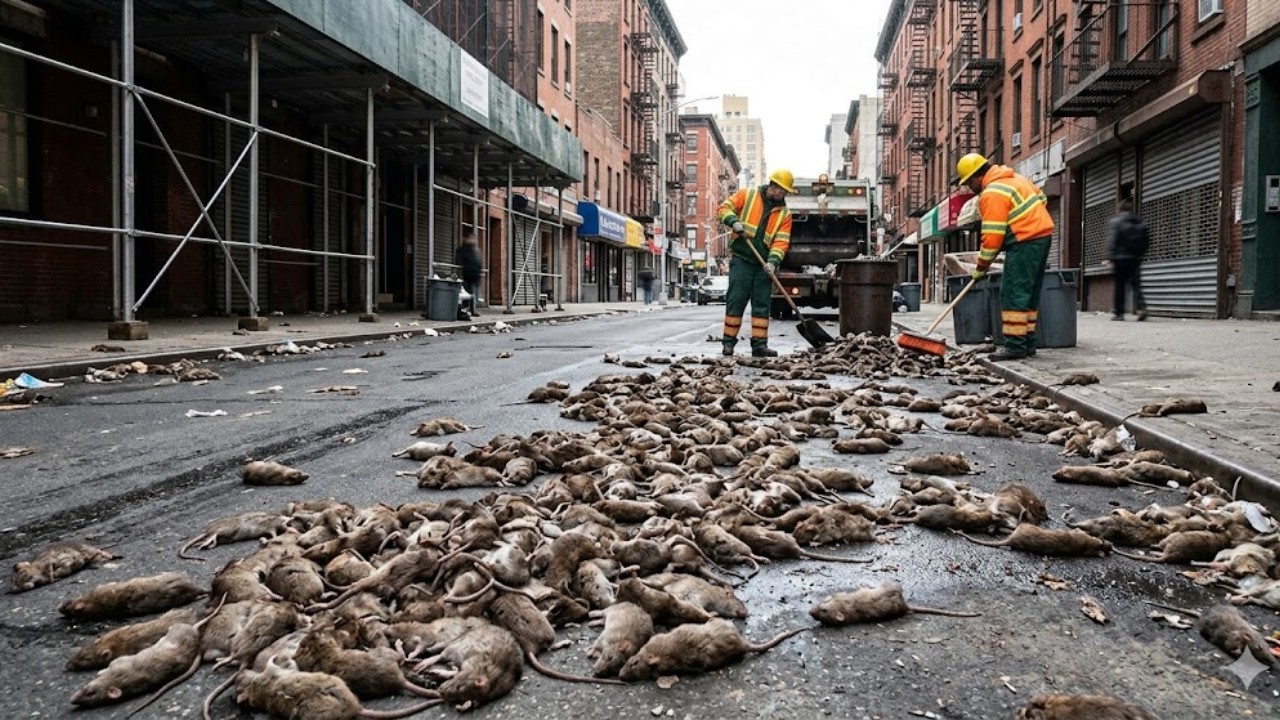
That summer, the activity level changed. Not in the language of the reports. In the actual behavior of the rats on the site. Patricia noticed it first in the nighttime footage from the security camera mounted above the compost shed.
The rats were still there. But they were checking the perimeter before entering the open area instead of moving across it freely. And in the northeastern corner of the frame, at the edge of the tree line where the compost yard met the interior of the greenbelt, something was watching them do it. It was not a pet, and it was not a stray.
Pointed ears, long legs, and a movement posture that covered distance with an economy of effort no domestic animal possesses in the wild. Patricia sent the footage to the Urban Wildlife Program at the Staten Island Museum without any comment. The reply came within four hours. The animal in the footage was a coyote.
It was the second confirmed individual in that specific section of the greenbelt that year. And based on the behavior of the rats in the same footage, it had been there long enough for the rats to know it in advance. The rat problem in New York’s outer boroughs is structurally different from the one that makes headlines in Manhattan. The stories that lead the news come from crowded midtown sidewalks, packed subway stations, and the restaurant blocks of Lower Manhattan, where rat sightings create media cycles.
The rat populations of the outer boroughs operate differently. They are rooted in the marginal zones between residential neighborhoods and the city’s park system: in drainage corridors, brush edges, and the perimeters of community gardens that connect the urban fabric of Queens, Brooklyn, Staten Island, and the Bronx to the larger green spaces those boroughs contain. These are ground-level populations spread across terrain that is less visible to city monitoring and harder to reach with conventional extermination infrastructure. Pelham Bay Park in the northeast Bronx, at 2,772 acres, is the city’s largest park.
It contains wetlands, forests, and a three-mile path along the Bronx River. Van Cortlandt Park, at 1,146 acres, holds the city’s oldest public golf course and the second-largest forested area in the five boroughs. The Staten Island Greenbelt, at 2,800 acres, is the most wooded urban park on the East Coast between Boston and Washington. The Jamaica Bay Wildlife Refuge in Queens sits where New York Harbor meets the tidal marshes of the Rockaway Peninsula.
Each of these areas maintains permanent rat populations that no management program has ever meaningfully reduced. And beginning around 2018, accelerating through 2022 and 2023, each of them began receiving new residents of a species no one had been tasked with managing, and no one expected to find in significant numbers inside the five boroughs. The city’s rat-control efforts have a history long enough to count as a feature of its municipal character, measurable in the escalating financial commitments that produce the same result under every administration that adopts them. Mayor Rudy Giuliani launched a rat-reduction initiative in the 1990s.
Mayor Michael Bloomberg intensified surveillance and enforcement during the 2000s. Mayor Bill de Blasio devoted significant resources to reducing rat presence in neighborhoods within targeted zones. Mayor Eric Adams declared war on rats, appointing Kathleen Corradi as the city’s first official rat czar in April 2023, backing the role with $32 million in funding. The rat czar program implemented targeted neighborhood interventions across twelve pilot zones.
The methodology involved mapping 311 complaints, source-reduction outreach, intensified bait stations, and sanitation coordination between building owners and city agencies. A follow-up evaluation conducted twelve months after the program launched found no statistically significant reduction in rat complaint rates in any of the twelve pilot zones attributable to the program, compared to baseline variation in the complaint data. Mayor Zoran Mamdani then announced the Empire Bins waste containment program in April 2026, allocating hundreds of millions of dollars to replace black bags with sealed containers across all five boroughs by 2031. Two mayors, two programs, and cumulative expenditures approaching and likely exceeding $300 million across the full span of successive mayoral rat-control initiatives since the 1990s.
The rats have absorbed each of these programs the same way they have absorbed everything the city has thrown at them over two and a half centuries of cohabitation: by continuing to do exactly what rats do under whatever conditions the city imposes, and the new conditions have proven no more difficult than the ones before them. Dr. James Whitfield had been conducting surveys of urban wildlife corridors for Fordham University’s Department of Biological Sciences since 2015, using networks of remote cameras distributed across the four major park systems of the outer boroughs to track mammal movement patterns through the green corridors linking those parks to surrounding neighborhoods. His primary subjects were white-tailed deer, raccoons, Virginia opossums, and red foxes.
In 2019, his cameras in the Van Cortlandt Park corridor captured the first confirmed coyote in Bronx camera records, aside from a brief sighting in 2018 near the park’s southern border. By 2021, his network confirmed three separate coyotes regularly using the Van Cortlandt corridor. By 2023, the number had reached nine confirmed individuals across the Bronx camera network, with five documented making regular trips from the park edges into adjacent residential and commercial blocks during nighttime hours. The prey-monitoring data for those residential incursion trips was dominated by a single prey type: the Norway rat.
The coyote in New York City is not in the same ecological context as the coyote in rural Pennsylvania or suburban New Jersey. The urban coyote differs behaviorally from its rural counterpart in ways documented in long-term studies of coyote populations in Chicago and Los Angeles, and now in New York City. Urban coyotes are nocturnal to a degree rural coyotes are not, compressing most of their activity into the hours after midnight when human presence declines. The signal-to-noise ratio of the urban environment changes enough to allow this medium-sized animal to move without triggering the defensive reactions daylight exposure might provoke.
They navigate human infrastructure with a skill that requires behavior learned over multiple generations of urban residence. They suppress their vocalizations in areas of intense human activity, and they develop prey preferences that reflect the actual composition of the prey base available in the environment they occupy. In New York City, the most abundant prey available to a coyote hunting at the park edge and adjacent residential corridor at 2 a. m.
is not deer, not rabbit, and not a pet. It is the Norway rat: abundant, ground-dwelling, fully active during the same hours the urban coyote hunts, and occupying the same terrain the coyote crosses on its nightly trips from inside the park to the neighborhood edge and back. Whitfield’s prey identification data from residential incursion trips, compiled from direct observation, scat analysis, and camera footage at hunting sites, showed Norway rat remains in 61% of documented coyote feeding events across the outer borough network between 2021 and 2024. The coyotes were not merely supplementing their diet with rats.
They organized their nightly movement patterns around rat availability, exactly as a successful urban predator organizes its movements around whatever prey the urban environment provides most reliably. In the Van Cortlandt corridor, nighttime cameras showed the highest frequency of coyote crossings in a narrow drainage strip running between the park’s southern tree line and a cluster of residential buildings whose rat complaint rate had been among the highest in that part of the Bronx for the past decade. The coyotes were moving through the drainage corridor. The rat complaint rate in the adjacent buildings was declining.
No exterminator had changed his service schedule. No bait station had been updated. No government rat-control initiative had targeted that residential block. The coyotes had found the highest rat density in their territory and were working it at night without a budget allocated to any part of the operation.
The red fox added the second ground-level layer. Red foxes have been documented in New York City’s outer borough park systems for decades, but resident population data from Whitfield’s camera network revealed a pattern previous studies could not identify with sufficient temporal precision. Red foxes in Van Cortlandt Park, Pelham Bay Park, and the Staten Island Greenbelt show peak activity in the hours immediately preceding the increase in coyote activity in the same spaces. The fox does not directly compete with the coyote in the rat-hunting window.
It occupies a different shift in the same corridor. Foxes are at peak activity in a roughly 90-minute window from 11 p. m. to 12:30 a.
m. , a period when rat foraging activity is high, while coyote presence in the residential margins has not yet peaked. The fox hunts the same drainage corridors and vegetated margins where the coyotes work later. Its prey composition in those locations mirrors the coyote data.
Rat remains appear in the majority of fox scat samples from residential margin areas across the three major park systems Whitfield’s network covers. Two canid predators, two distinct hunting windows. Continuous suppression in the corridors where rats move between the park edge and residential food sources. The great horned owl provided the aerial coverage.
Documented in all four major outer borough park systems, the great horned owl is a confirmed nocturnal rat predator across multiple urban wildlife studies. Whitfield’s network includes acoustic monitoring at identified nesting sites in Van Cortlandt and Pelham Bay, and pellet data from those sites shows Norway rat remains in the vast majority of identifiable samples. The owls hunt from above in the same drainage corridors where foxes and coyotes work at ground level. The three-layer nocturnal suppression mechanism in the outer borough park margins covers aerial hunting, terrestrial canid hunting, and understory hunting across the same habitat areas and nocturnal operating windows, with a consistent preference for the same prey species in all three cases.
The city’s rodent management programs operate during official working hours. The predator alliance of the three species operates from 11 p. m. until dawn.
These programs do not overlap with each other. Patricia Mendez extracted twelve months of nighttime footage from the composting station camera in the Greenbelt, after the museum responded to her initial clip. What the extended footage showed over that twelve-month period was not a single coyote visit. It was a documented pattern of coyote presence averaging four nights per week around the perimeter of the composting station, with a marked decline in rat activity at the station during the final months of the sample compared to the early months.
She had not changed her composting protocol. She had not changed the bait station schedule. She had not called any government agency about the coyote’s presence, because she was not sure whether the city would consider a coyote actively hunting in a public park an administrative problem requiring removal, or an environmental resource requiring protection, and she did not want to trigger a response that would eliminate the only thing that had ever reduced the numbers at her site while everything else failed. The coyote had arrived on its own, established a hunting pattern that included the perimeter of her composting station as a regular destination, and was achieving a result four decades of extermination had not achieved during her entire tenure managing the site.
She was not sure what she was supposed to report. She was sure of what the footage showed. No one had hired the coyotes to work the outer borough park margins for rat control. No one had funded the red fox hunts in the Van Cortlandt drainage corridor.
No one had placed great horned owls in the trees above rat movement areas in Pelham Bay. The Fordham camera network had been built to track deer and raccoons. The rat suppression data was a byproduct of measuring something else in a system where that “something else” turned out to be the most significant ecological process in the corridor. The coyote reestablished itself in the five boroughs because the eastern coyote population expanded its range in the absence of gray wolf competition and found urban food resources more reliable than rural ones.
The red fox was never eliminated from the outer borough parks. The great horned owl colonized urban green spaces as tree cover matured and the populations of the rodents it hunts expanded to fill the space. None of these animals was managed for this purpose. None appears in any rat management budget document submitted by any administration over the past thirty years of pest control spending.
No one planned it. No one funded it. It is already working.






