In the first days of June 1872, a saloon proprietor in Sioux City, Iowa, made his customers a promise that seemed to mock every expectation of frontier life. Lobster salad was set out next to oyster soup, deviled ham, and fish in egg sauce. Pickled oysters, salmon, tongue, pickles, lettuce, and radishes crowded the bar. The spread cost nothing.
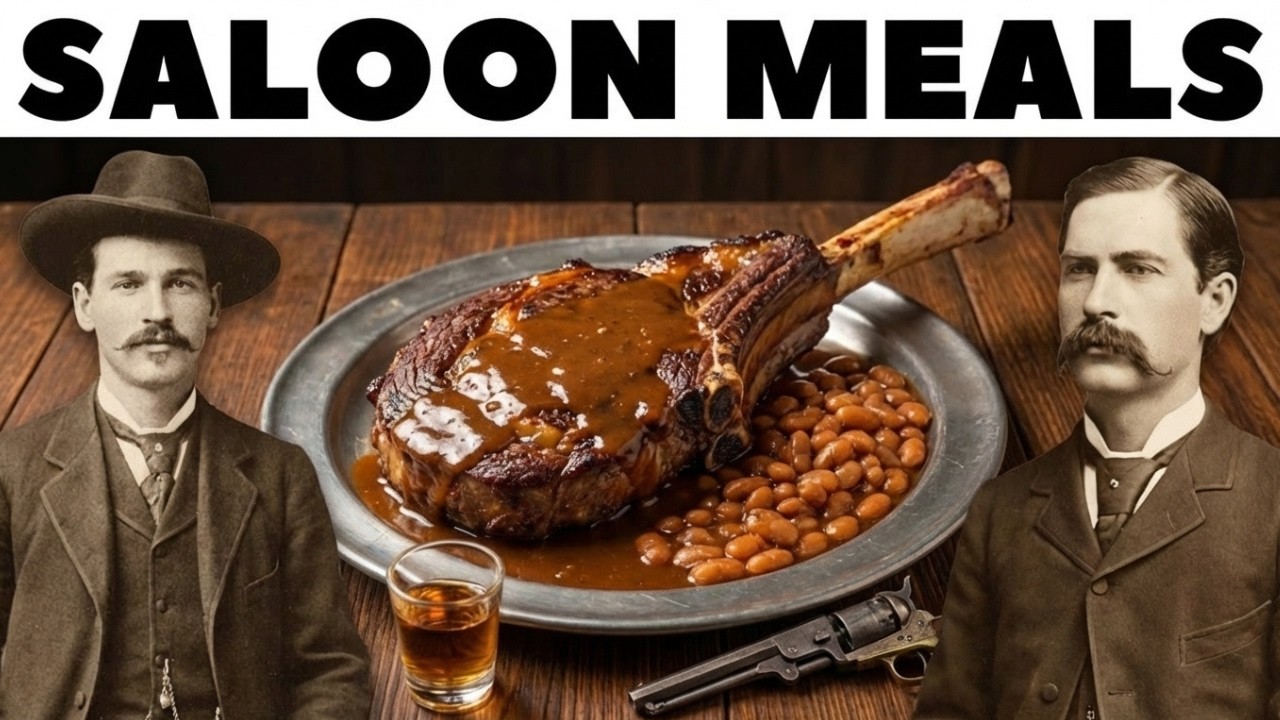
A man needed only to purchase a single drink—a julep or a Roman punch, poured beginning at nine in the morning—and avoid getting shot before he reached dessert. The fare inside America’s most infamous saloons was more extravagant than any gunfight Hollywood ever put on film. Yet to grasp how a free lobster salad could be served five hundred miles from the nearest ocean in a frontier bar, you must first understand the institution that made it possible: the free lunch. Starting in the 1830s, saloons nationwide began offering full meals to anyone who bought one drink.
In the humblest dives from New York’s Bowery to the mining camps of Nevada, the basic version was a plate of soda crackers and a slab of sharp yellow cheese, cut thick and left on the bar beneath a wire mesh cover to keep flies away. The cheese was deliberately salty. Each bite made a man thirstier, and each sip of five-cent beer led to the next. Barkeeps called it rat trap cheese, because it was cheap enough to use as vermin bait.
A single block cost a few pennies and held up for days in the heat. Cowboys, miners, and drifters packed shoulder to shoulder at sticky counters, seizing crackers with the same unwashed hands that had just been shuffling cards or shoveling ore. No one grumbled. In a town where a meal at a proper restaurant ran twenty-five cents and a day’s pay in a silver mine was three dollars, free cheese and crackers were not charity.
They were a means of survival. Just behind the crackers sat a cloudy glass jar in nearly every dangerous saloon from Deadwood to Dodge City. It held hard-boiled eggs suspended in vinegar brine, weeks or occasionally months old, slowly pickling in a mix of salt, vinegar, and whatever spices the barkeep had available. Beet juice dyed them purple.
Cayenne turned them into a penance. A single egg cost nothing as long as you were drinking, and they carried enough salt to keep a man ordering whiskey all night. In rougher establishments, the jar served a second purpose as a weapon. More than one brawl ended with pickled egg brine flung across somebody’s face.
The eggs themselves were nearly indestructible, preserved far beyond what any modern health inspector would permit. But in a frontier saloon where the nearest doctor was fifty miles off and the bartender kept a shotgun beneath the counter, food safety was hardly a concern. In mining camp saloons throughout California and Colorado, sourdough flapjacks were turned out morning, noon, and midnight for whoever wandered through the door. The batter came from wild cultured starters that cooks guarded like gold dust.
Some of those starters had been kept alive for months, carried in tins strapped to saddlebags across hundreds of miles of open country. The flapjacks were thick, sour, and chewy, fried in enough bacon grease to make them shine, served with molasses or pork drippings, sometimes canned fruit if the saloon was near a rail line. Cowboys called them sinkers because they landed in your stomach like a stone. That was the point.
One stack could keep a man in the saddle from dawn to dusk. In the rowdiest saloons, a cook working behind a plank counter flipped flapjacks while gunfights broke out ten feet away. The griddle never went cold. No dish defined the American saloon like pork and beans.
Salt pork, a fatty preserved cut cured in heavy brine, could last for months in barrels without refrigeration. Saloon cooks sliced it thick, fried it in its own fat until browned and crisp, then spooned it over beans that had been simmering for hours over a low fire. Pinto beans, navy beans, whatever the supply wagon delivered. Molasses, onions, and lard went in if supplies allowed.
If not, you got pork grease and beans, and you were thankful for it. Add a chunk of day-old sourdough or a square of cornbread, and you had the meal that built the West. In Abilene, Dodge City, and every cattle town in between, beans were served by the bowl, the plate, or straight from the cast-iron skillet. For a nickel or for nothing at all, a cowboy fresh off a three-month cattle drive could fill his belly before gambling away his wages at the faro table.
In the crowded gaslit saloons of 1880s Chicago, where Irish gangs and German immigrants drank side by side, the free lunch counter sagged under smoked herring, dark rye bread, liver sausage, strong mustard, and sauerkraut. Chicago spreads were seldom elegant, but they were enormous. Along a four-mile stretch of a single major street in the 1890s, there were 115 saloons offering free lunches, but only five ten-cent restaurants. The breweries bought food in bulk and supplied it to their tied saloons at cost.
The herring was fiercely salty, the mustard hot enough to clear your sinuses, and the rye bread dense as a brick. Working men ate standing up, no tipping required, no ceremony involved. Fights erupted nightly, but the food kept men coming back, and the beer flowed because the herring demanded it. Alongside the sauerkraut and the smoked fish, the cheapest saloons kept vats of peppery hot frankfurters steaming on the bar.
A soiled tablecloth, a bowl of baked beans, forks standing in a glass of water as the only gesture toward sanitation. The franks cost the saloon owner almost nothing, and they moved beer like nothing else. In the roughest joints, where the waiters wore tattoos and could bend a horseshoe with their bare hands, freeloaders who tried to eat without buying a drink risked more than embarrassment. Bouncers were hired specifically to protect the free buffet.
In San Francisco during the aftermath of the Gold Rush, an 1886 account called the free lunch feed the only landmark of the past, claiming that without the free lunch system, half the idle men in the city would starve. The real capital of the free lunch was New Orleans. There, saloons served spreads that would put a modern restaurant to shame. Mock turtle soup.
Sliced roast beef weighing nearly forty pounds on a single platter. Buffalo tongue, thinly sliced and highly flavored, laid out alongside dressed salads. By 1875, a New York Times reporter counted thousands of men in New Orleans living entirely on free saloon meals. The price of admission was one drink at fifteen cents.
Punches, cobblers, champagne, and ale all cost the same. The buffalo tongue was a delicacy even in rough establishments, its rich smoky flavor a reminder that the great herds were vanishing from the plains. Men who had hunted bison for a living now ate the last of their tongues at a bar counter, pushing and scrambling to be served a second time. The reporter noted that a free lunch counter was a great leveler of classes.
Wealthy and destitute alike crowded shoulder to shoulder, all pretense of refinement gone, hands stretched toward the very same platter. Not every item on the free lunch counter carried such a respectable reputation. Son of a gun stew ranked as the frontier’s foremost never-ask-what’s-in-it dish, and it was honestly dished out in drinking houses throughout cattle towns from Dodge City to Abilene. The label was merely a cleaned-up rendering of what cowboys really called the stuff.
The dish brought together organ meats—tripe, heart, liver, marrow, gut, sweetbreads, and on occasion brains—all stewed in a heavy, peppery broth with potatoes, onions, and wild herbs. Its roots reached back to cattle drives, when cowboys slaughtered beeves on the trail and put every portion of the animal to use from necessity rather than sentiment. In certain areas, emptying an entire bowl counted as a rite of passage. A cowboy’s grit was gauged not by the speed of his draw, but by whether he could get the whole serving down.
Cattle towns perched at the rim of civilization had no prime cuts to draw on, yet they possessed guts, fire, and cast iron. To men worn out from the trail, a steaming bowl signified survival. Certain luxuries looked utterly impossible given the places that served them. Oysters turned up in parched, dusty mining camps hundreds of miles from any shore, made possible by new rail lines and canning techniques.
Even isolated outposts such as Cerro Gordo, California, could get hold of them. At the Occidental Saloon in Tombstone, Arizona, the Sunday spread paired oysters with chicken giblet soup, leg of lamb, fricassee chicken, plum pudding, and custard. Cowboys and miners regarded oysters as a luxury, a taste of civilization in the middle of nowhere. Saloons promoted a fried oyster, a clam, or a hard-boiled egg with each drink.
The canned kind endured the lengthy freight wagon hauls. Fresh ones came packed in ice, shipped by rail from the coast, and consumed within hours of arrival. That a man could sit in a town where gunfights broke out weekly and slurp down an oyster said everything about the contradictions of frontier existence. In the most far-flung outposts, even coffee was a deception.
What passed for coffee was a concoction brewed from brown bread, acorns, dandelion roots, barley, and occasionally even snuff. European travelers shrank back in disgust, yet miners, trappers, and fugitives drank it without protest, since the only alternative was creek water that might finish you off quicker than any outlaw’s bullet. The brew was thick, bitter, and faintly medicinal, poured into tin cups beside whatever food the saloon could scrape together. It was the fuel that kept men awake through long poker sessions and even longer nights.
In saloons where the barkeep also served as the town’s lone authority figure, that cup of counterfeit coffee was at times the only warm thing a man would take in all day. From the drinking houses of Memphis to the gambling dens of Natchez, biscuits and red eye gravy formed the backbone of the southern frontier table. The biscuits were built from lard and flour, dense enough to stop a bullet, served split and smothered in gravy made from ham drippings and black coffee. The name derived from the red eye of grease drifting at the center of the pan.
A plate ran a nickel in most saloons and could keep a riverboat gambler on his feet through a twelve-hour card game. In the rough taverns along the Mississippi, where knife fights outnumbered handshakes, biscuits and gravy stood for the single moment of calm in an otherwise violent evening. The cook would bellow that the food was ready, and for a few minutes even the orneriest characters at the bar set aside their grudges and reached for a fork. The whiskey poured in many of the most dangerous saloons was a blend of raw alcohol, burnt sugar, and chewing tobacco.
Barkeepers stretched it with turpentine, ammonia, gunpowder, or cayenne. It answered to names like tanglefoot, 40 rod, tarantula juice, Taos lightning, red eye, and coffin varnish. Cactus wine was a mixture of tequila and peyote tea. Mule skinner combined whiskey with blackberry liquor.
The house rotgut was frequently a proof, and every salty dish on this list served a single purpose: to keep men drinking that poison as quickly as the barkeep could pour it. The food was never charity. It was the oldest trick in American business. Feed them salt, and they will buy your whiskey.
In saloons throughout Wyoming, Montana, and Colorado, lamb fries and Rocky Mountain oysters counted as a true delicacy. To many greenhorns, these were plainly animal testicles, lightly seared in a hot pan or roasted in campfire ashes until they burst. They arrived on tin plates to men who devoured them with gusto and washed them down with rotgut. Cowboys and sheep ranchers swore by the flavor, somewhere between sweetbreads and liver, mild and tender when cooked properly.
In ranch country saloons, ordering them was an act of belonging. Turning them down branded you a city man. The dish turned up in some of the most violent establishments in the West, places where the bartender kept a sawed-off shotgun beneath the bar, and the piano player knew to quit playing when hands moved toward holsters. In the desert saloons of Arizona, New Mexico, and West Texas, rattlesnake was no novelty but a real food source.
The meat was reputed to taste like the white meat of chicken, and it was fried, stewed, or jerked, and plated next to beans and cornbread. In places like Tombstone and Tucson, where scorpions crept across the floor and the mercury climbed past 110, a rattlesnake killed behind the saloon might land on a plate within the hour. Some saloon owners kept live snakes in cages for amusement, taking bets on which customer would dare reach inside. The meat itself was lean, mildly flavored, and surprisingly tender.
For men living at the boundary of the known world, eating what tried to kill you was not bravado. It was dinner. In the wooded saloons of the Pacific Northwest and the mountain towns of Colorado, venison was the standard protein. Deer were abundant, beef was costly, and a capable hunter could keep a saloon stocked with fresh game in exchange for a cut of the bar’s profits.
The steaks were sliced thick and seared fast over an open flame, served rare with only salt and a dash of whiskey for sauce. In places like Deadwood, South Dakota, where Wild Bill Hickok was shot dead in Saloon Number 10 while holding aces and eights, venison was the final meal many men ate before their luck ran out. The smell of charring meat mingled with cigar smoke and kerosene lamplight—that combination was the authentic perfume of the Old West. In the rough cantinas along the Texas-Mexico border, chili con carne reigned supreme.
Chunks of beef simmered with dried chilies, cumin, garlic, and oregano until the mixture deepened to a brick red. No beans, no tomatoes, just meat and fire. San Antonio’s chili queens dished it out from open-air stalls in the plazas, and the saloons close by did the same. A bowl went for a dime, and it burned on the way down and burned on the way back up.
In the border saloons where outlaws slipped across jurisdictions and lawmen paused at the river, chili was the great leveler. Bandits and Texas Rangers ate from the same recipe, occasionally in the same room, pretending not to know each other until the meal was done. The violence inside these saloons shaped everything about how food was served. At Campbell and Hatch’s billiard parlor and saloon in Tombstone, Morgan Earp was shot and killed while playing pool.
At Saloon Number 10 in Deadwood, Wild Bill Hickok took a bullet to the back of the head during a poker game. His hand, aces and eights, became the dead man’s hand. Bob Ford, the man who killed Jesse James, was shot down in his own tent saloon in Creede, Colorado. John Wesley Hardin was gunned down from behind in an El Paso saloon.
Men ate their dinners with one hand and kept the other close to their holster. The food had to be quick. It had to be filling, and it had to be finished before the next round of trouble came through those swinging doors. The saloon owner in Sioux City who laid out that 1872 spread was competing in a contest so fierce that owners bankrupted themselves trying to outdo each other’s free lunch offerings.
A lobster salad five hundred miles from the nearest coast, served before noon in a frontier saloon, might be the most American meal ever conceived. Excess, ambition, and absolute disregard for common sense, all on one plate. In the rougher saloons of the cattle trail towns, mutton stew was the working man’s dinner. Cheap, greasy, and filling.
Sheep ranchers were despised by cattlemen, and the range wars between them left dozens dead across Wyoming and Montana. But mutton was cheaper than beef, and a saloon owner who could save a nickel on ingredients could pour another free drink. The stew simmered all day in cast-iron pots, the meat falling apart into potatoes and onions, the broth thick with rendered fat. In saloons where cattlemen and sheep herders drank on opposite sides of the room, ordering mutton was a statement.
Eating it peacefully was an achievement. The most remote saloons in Alaska, the Dakota Territory, and the deep mountain mining camps survived on canned goods. Sardines packed in oil were shelf-stable, protein-rich, and required no cooking. Pilot bread, the rock-hard ship biscuit also known as hardtack, could last years without spoiling.
Together they formed a meal that required nothing but a knife to open the tin and teeth strong enough to crack the bread. In saloons where supply wagons came once a month, if the weather held, this was the only food available between deliveries. Men ate sardines and pilot bread in silence, staring at the same four walls, waiting for spring, or gold, or trouble, whichever came first. In the saloons of the Rocky Mountain mining towns, bear meat showed up on the menu when a hunter brought one in.
The steaks were dark, rich, and strongly flavored, served alongside wild onions and whatever root vegetables could be dug from the frozen ground. Grizzly bear was tougher than black bear. Both required slow cooking or a very hot fire. In places like Leadville, Colorado, where the population exploded from a few hundred to tens of thousands during the silver boom, saloons served whatever walked out of the woods.
The hunter who brought in a bear was treated to free drinks for the night. The rest of the bar ate his kill. It was the frontier economy in its purest form. In the Southwest, dried pale beans earned the sarcastic nickname Arizona strawberries because they were often the only vegetable available for months.
Besides corn and squash, beans were it. Saloons served them boiled, baked, fried, and refried. They appeared at breakfast, lunch, and dinner. They were the foundation of nearly every meal west of the Mississippi River, and cowboys ate them with such frequency that the campfire jokes practically wrote themselves.
A pound of dried beans cost almost nothing. Soaked overnight and simmered the next day, they could feed a dozen men. In the most dangerous saloons, where the cook was often an ex-convict or a wanted man hiding in plain sight, beans were the one thing he could not mess up badly enough to cause a riot. Above all, the free lunch featured salted food.
Pretzels, salted peanuts, potato chips, dill pickles, and smoked fish. The theory was simple, and it was brilliant. A couple of drinks produced appetite. The salty food produced a mighty thirst.
The chain reaction of drinking and nibbling, nibbling and drinking, could go on for hours. Saloon owners understood addiction science a century before anyone gave it a name. In the most violent saloons in America, from the Five Points in New York to the Barbary Coast in San Francisco, that bowl of salted peanuts on the bar generated more profit than the poker table in the back room. The food was never the product.
You were. Judge Roy Bean ran his combination saloon and courtroom in Langtry, Texas, dispensing both whiskey and justice from the same bar. He called himself the law west of the Pecos and held trials between drink orders. The food in his saloon was as rough as his rulings.
Beans, bacon, and whatever a traveling peddler happened to sell from his wagon. A man could be found guilty, sentenced, and fed lunch all without leaving his bar stool. Downieville, California, had a saloon that doubled as the office of the local justice of the peace. In Hays City, Kansas, the first church services were held in Tommy Drum’s saloon.
These were places where food, law, religion, and violence all shared the same roof. From the 1860s onward, food in the remote saloons became grimly standardized. Breakfast was a tin cup of coffee, a slab of salt pork, bread, and syrup. Lunch and dinner were bread and steak.
The steaks were universally overcooked and hard as stone. Travelers described sawing through beef that had been charred beyond recognition, served on tin plates with no seasoning beyond whatever ash had settled on it from the cookfire. The reason was practical. In a frontier saloon, the cook had no thermometer, no timer, and no training.
He had a fire and a skillet. Overcooking killed whatever parasites and bacteria the meat carried. In a world without antibiotics, a well-done steak was not a culinary crime but a medical decision. Men ate it because the alternative was raw meat in a town with no doctor.
Not every saloon was a dirt-floor shack with sawdust soaking up the blood. The Oriental Saloon in Tombstone, Arizona, was a multi-story palace with chandeliers, velvet curtains, and a mirrored bar. Wyatt Earp held a quarter interest in its faro concession. Sunday dinner featured chicken giblet soup, leg of lamb with oysters, fricassee chicken, and desserts like plum pudding and custard.
Champagne turned up in Wild West saloons more often than you might expect. Even in out-of-the-way towns, bottles were uncorked, since champagne couldn’t be counterfeited the way whiskey could. A popping cork told you that what you were drinking was genuine. In an era when the whiskey in your glass might be cut with turpentine and gunpowder, that assurance counted for something.
The 1800s even brought a French restaurant to Death Valley. Such upscale fare was dished out in rooms where professional gamblers such as Doc Holliday dealt cards, while the Earp brothers kept order with revolvers holstered at their hips. The most extraordinary meal in the annals of American saloons wasn’t a single dish. It was the whole arrangement.
From the 1830s onward, saloons nationwide began serving complete meals—at times on par with hotel dining rooms—to anyone who purchased a single drink. In New Orleans, the custom grew to ridiculous proportions. A reporter in 1875 recounted a spread of sliced white bread, lettuce salad, oyster soup, potatoes, stewed mutton and tomatoes, plus a round of beef weighing close to forty pounds, all free with one fifteen-cent drink. In Chicago during the 1890s, saloon keepers fed an estimated 60,000 people every day.
Through the depression of 1893, the free lunch system fed more hungry people than all the religious, charitable, and municipal agencies put together. Temperance advocates pushed to outlaw it, since it kept men drinking. Saloon owners sought to abolish it, since freeloaders devoured their profits. Neither side managed to kill it.
The free lunch was America’s first social safety net, concealed within its most dangerous institutions. It survived until Prohibition wiped out the saloons themselves in 1920. The saying “there is no such thing as a free lunch” was born right there, in those blood-stained, smoke-filled, bullet-riddled rooms where the most dangerous men in American history sat down, ate a meal they hadn’t paid for, and drank until the trouble started up again. It was more than just food.
It was the taste of a country under construction, one dangerous saloon at a time.
