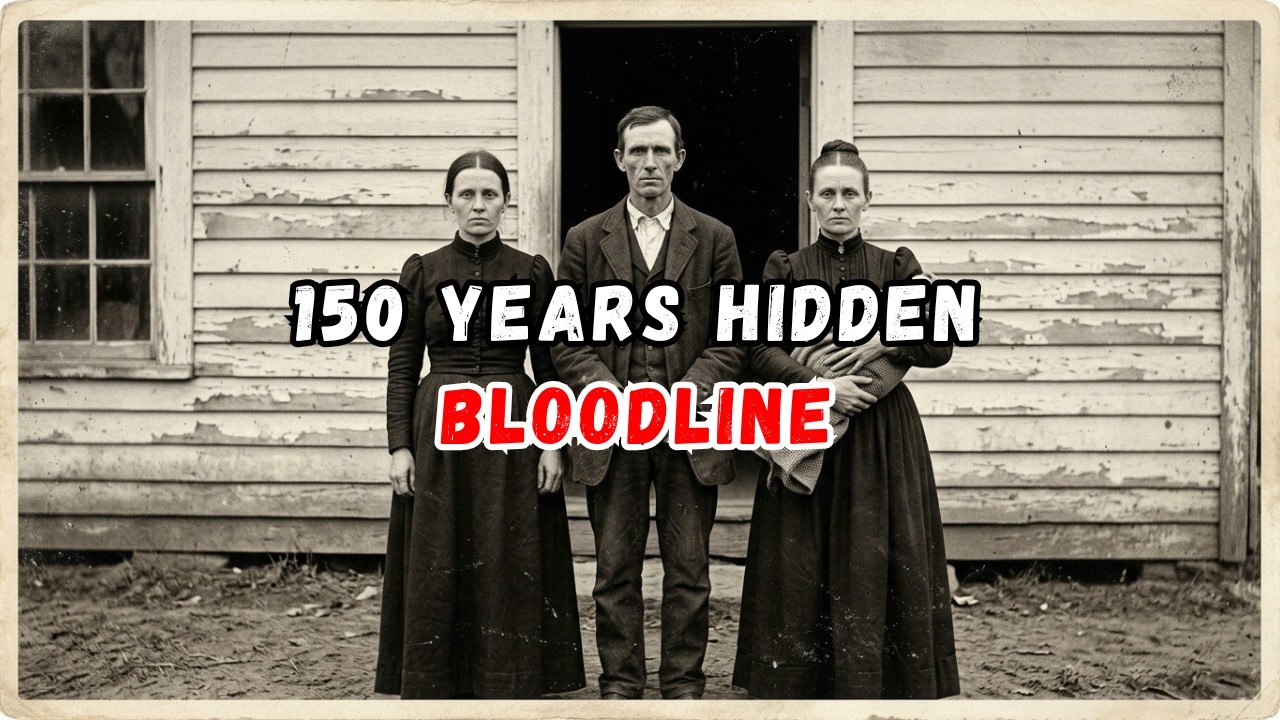
Around 1820, a young French orphan named Martin Fugate came into the hills of eastern Kentucky and stopped along a narrow, twisting waterway called Troublesome Creek. It was one of the most isolated corners of the eastern United States, a place so remote that the families who settled there stayed for generations, marrying their neighbors because there was no one else to marry. Martin made his home there, married a local woman named Elizabeth Smith, described as fair-skinned and red-haired, and settled into the ordinary life of the valley. But Martin and Elizabeth each carried a hidden passenger in their blood: a single faulty copy of a recessive gene.
By itself, the gene did nothing. Martin was not blue. Elizabeth was not blue. The gene only woke up when a child inherited two broken copies, one from each parent.
In the wider world, the odds of two carriers meeting were vanishingly small. On Troublesome Creek, the odds had just collapsed. Martin and Elizabeth had seven children, and four of them were born blue, a deep, saturated blue across their lips and under their fingernails. They were not sick.
They were not dying. They grew up strong, worked the land, married, and lived long lives, and the blue continued down the bloodline for 150 years. For generations, the blue people of Troublesome Creek remained healthy. The color did not shorten their lives or cause them pain.
What caused them suffering was the eyes of the outside world. Traveling preachers flinched. Peddlers crossed themselves. Outsiders who saw a blue face in a cabin doorway carried stories down the mountain, twisted further with every retelling, until the lowlanders spoke of the blue people as something out of a folk tale.
The families learned to protect themselves with silence. They kept the blue children close, kept them up the hollow, and when strangers came, the blue ones did not come to the door. The secret stayed hidden, and the blue kept coming, and no one who could explain it ever got close enough to try. In 1958, the blue walked out of the hollows on its own two feet.
A Fugate woman came into a rural health clinic in the Kentucky hills, not because of her color, but for some ordinary reason. The nurse on duty, Ruth Pendergrass, saw her and was stunned. The woman was blue, not faintly, but the color of a glacier lake, blue as the waters of Lake Louise in Canada. Pendergrass assumed the woman was dying, that her blood was failing to carry oxygen.
But the woman was calm and healthy, and the blue was not why she had come. Pendergrass wrote down what she saw, and she talked about it. The story moved through the small world of rural Kentucky medicine, passed from nurse to nurse, doctor to doctor, mostly dismissed as a mountain tall tale. But it reached a young hematologist at the University of Kentucky Medical Center named Dr.
Madison Cawein the Third. Cawein did not think tall tale. He thought hemoglobin. There was a rare, barely known condition in the medical literature that could turn a person blue and leave them otherwise perfectly well.
To find a whole family of it, six generations of it, in one isolated Kentucky county seemed impossible. Cawein decided to go and see for himself. In the early 1960s, Cawein drove up the winding mountain roads toward Hazard, Kentucky, carrying a theory almost no one believed. The Fugates and their kin had every reason to distrust another outsider asking about the blue.
Outsiders had only ever brought them stares and whispers. Cawein had to be patient, had to earn trust slowly, but he was different. He did not recoil. He looked at a blue face and saw a patient, not a monster.
He tracked the family tree backward through the census records, the county marriages, births, and deaths, and found every blue person named and documented, all the way back to Martin Fugate and Elizabeth Smith in 1820. He drew their blood, ran his tests, and the diagnosis was exact. The condition was methemoglobinemia. Hemoglobin carries oxygen through the blood, and iron at the heart of each molecule binds that oxygen and gives blood its red color.
But iron can shift into a slightly altered state, and when it does, it can no longer carry oxygen. Hemoglobin in that altered state is called methemoglobin, and it is dark, brownish-blue. Everyone produces a small amount of methemoglobin all the time, and the body has an enzyme that converts it back. The blue people of Troublesome Creek had inherited two broken copies of the gene that built that enzyme, one from each parent.
Their repair crew was understaffed, so methemoglobin accumulated in their blood, staining their skin a permanent blue. They were not starved of oxygen. They still had enough working hemoglobin to live full, vigorous lives. They were simply blue.
Cawein also knew how to fix it. There was a compound that could do the work of the missing enzyme, a chemical shortcut that would convert methemoglobin back to normal hemoglobin. That compound was a dye called methylene blue, an ordinary medical dye used in laboratories and hospitals. The cure for the blue people was itself blue.
Cawein went back up the creek with his syringe. He asked the family to trust him, to roll up a sleeve and let him inject a stranger’s dye into their veins. The injection went in, and within minutes, the blue began to leave. The methemoglobin broke down, the blood ran red again, and across skin that had been blue since birth, the color changed in real time.
Pink rose up from underneath, and for the first time, the blue people saw themselves the way the world saw everyone else. Cawein could not give them a permanent cure, because the missing enzyme was written into their genes. But he left them tablets of methylene blue they could take by mouth, a workaround that allowed them to hold the color at bay, to choose what shade they walked through the world. There was one small price: the body cleared the dye through urine, which turned a brilliant blue.
The color did not vanish entirely, it simply moved somewhere more private. Cawein published his findings in the mid-1960s in the Archives of Internal Medicine, laying out the entire chain of the story, the isolated creek, the recessive gene, the concentration through generations, the methemoglobin, the methylene blue. It became a nearly perfect illustration of recessive inheritance, a textbook case come to life. But the gene was still out there, still capable of surfacing when two carriers happened to marry.
In 1975, it surfaced one last documented time. In a hospital nursery in Hazard, Kentucky, a young woman gave birth to a boy who came out blue. The nurses checked his oxygen, checked his heart, found nothing wrong, but prepared for the worst, talking of transfusions and airlifts, because a baby this blue should have been dying. Then the boy’s grandmother spoke up.
She was an older mountain woman, unhurried, and she told the room, “It runs in the family. There have been blue people in our family for a long time. It is nothing new. ” The boy was named Benjamin Stacy, called Benji.
He was descended straight down the family tree from Martin Fugate and Elizabeth Smith, and he was healthy. As he grew, the deep blue faded, softening and retreating the way it had for many of his ancestors. By the time he was a boy, he looked like any other child in the county, except in certain moments, when he was cold or angry or exerted, a faint blue would rise again in his lips and fingertips, a ghost of the creek showing through. Benji Stacy grew up and lived a normal life.
He was the last documented blue descendant of Martin Fugate, the last child of Troublesome Creek born the color of deep water. The gene is not gone. It is still out there, folded into the blood of an unknown number of descendants scattered far beyond the creek, waiting for a coincidence that grows less likely every year. But the isolation that made the blue people is gone.
The roads came, the hollows opened, the families married outward, and the tight closed circle that had concentrated the gene for six generations finally broke apart. The blue people of Troublesome Creek were not a legend. The census counted them, the county filed their marriages, the university kept their medical files, and the newspapers wrote them up as the strange true thing they were. The real darkness of the story was never in their blood.
They were healthy, strong people who lived long lives and raised families. The only thing wrong with them was a color, and a color harms no one. Their suffering came from the flinch of strangers, the whispers, the instinct to look at a person who is different and decide that different must mean cursed or wrong. The methylene blue could wash the color from their skin in minutes, but the shame took 150 years and a doctor’s kindness to lift.
The creek is still there, still running narrow and twisting through the crowded green hills, and somewhere in the blood of its scattered descendants, the old passenger still rides, quiet, patient, and blue.






