In the spring of 1871, a Vermont farmer stooped over soggy earth that had just given up yet another harvest of stones. He had cleared this field once already. So had his father before him. And still they surfaced, heaved up by the frost through the winter, lying in wait for him like an obligation the land would never stop demanding.
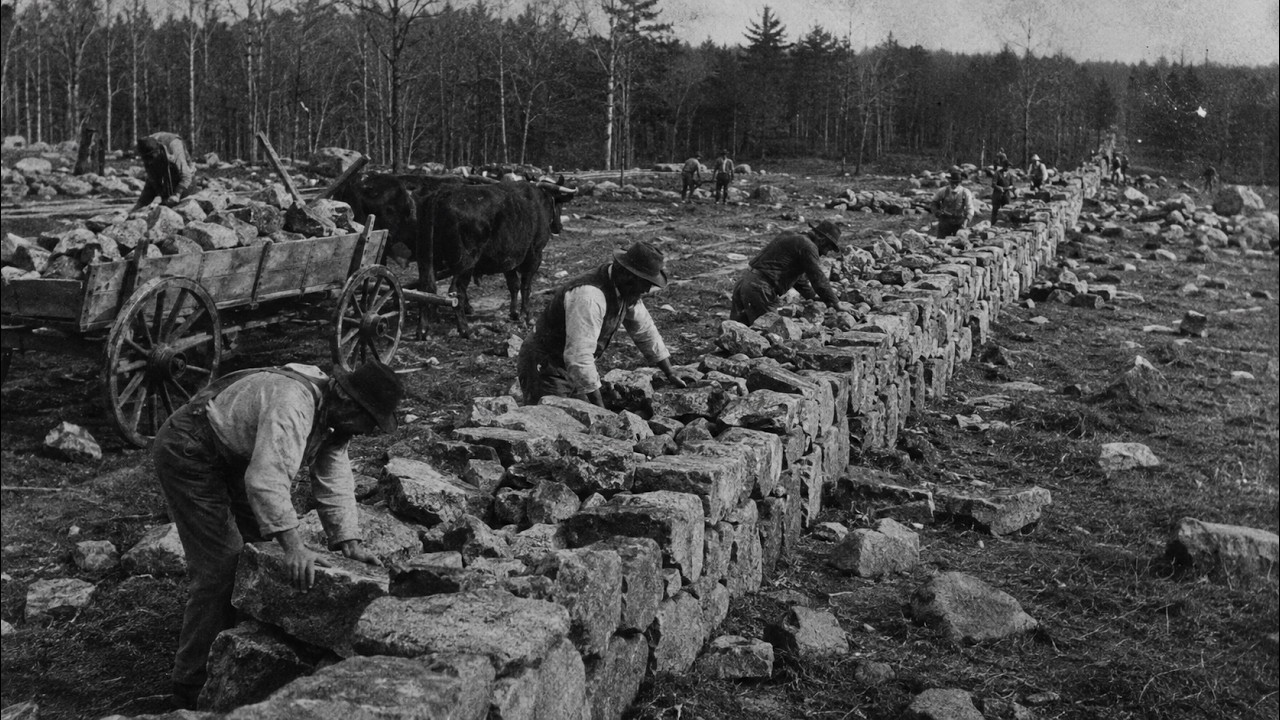
He was just one of tens of thousands that season, in the same corner of the country, driven by the same necessity: the field had to be sown, and the rocks had to be removed. That year, a survey by the United States Department of Agriculture tallied up what all those generations of stooping and hoisting had produced. It found 252,539 miles of stone wall spanning New England and Eastern New York. Enough to girdle the planet ten times over.
Enough to stretch from Boston to California and back again, again and again. Every mile of it raised by hand, without mortar, without machinery, without architects or kings. Farmers, farmers’ wives, hired laborers, ox teams, and children with numb fingers and aching backs. And the greater part of it still stands.
The builders of those walls were wrestling every spring with the same impossible problem. The earth kept producing stones. That sounds like an old saying until you wander into the woods of Vermont, Massachusetts, Connecticut, New Hampshire, or Maine and come upon a wall cutting straight through the trees with no road, no barn, no chimney, and no field anywhere in sight. I have tracked walls into forests for half a mile, across roots, through ferns, past maples and hemlocks, and the question is always the same: how did this end up here?
The answer is at once simple and staggering. These walls were never built in the forest. They were built in open fields. A family once lived here.
They labored. They departed. The wall remained. For any of that to happen, an entire landscape first had to be rendered farmable.
Which meant confronting the stones. Twenty thousand years ago, the Laurentide ice sheet bore down on New England with a weight almost impossible to imagine. It gouged bedrock. It shattered ledges.
It gathered up fragments of granite, gneiss, schist, quartz, and trap rock, hauled them along inside its frozen mass, smoothed some, split others into sharp edges, and strewed them about as the ice withdrew. When it melted, it left no tidy rows. It left a rocky legacy. The first trees grew up over it.
Leaves dropped for thousands of years. Soil accumulated. Roots bound the topmost ground together. By the time Europeans started clearing New England for farmland in the 1600s, many of those stones lay hidden beneath forest soil, resting just under the plow’s reach, waiting.
The earliest farmers believed they were felling forests. In truth they were unlocking a stone field. A man could swing an axe and watch progress happen. A tree came down.
A stump was burned. Light poured into the clearing. Corn could go in. Hay could be cut.
Cattle could be driven in. For a short while it must have felt like triumph. Then winter arrived. Water seeped into the soil.
The ground froze. Ice swelled. The soil heaved. The stones shifted.
When the spring thaw arrived, the earth sank back down, but the stones did not always settle where they had been. Frost heave pushed them upward, an inch here, two inches there, year after year. A farmer cleared a field in October, returned in April, and discovered fresh stones awaiting him. That is the impossible part.
The adversary was not some single boulder. It was not one ruined acre. It was a whole region where the very soil seemed to fight the plow. Each spring, just as the farmer needed to plant, the ground handed him more work.
And that work could not wait. A stone in a field could snap a wooden plow. It could cripple a horse. It could trip an ox.
It could wreck a scythe. It could turn a planting day into a repair day. For a family living near the edge of hunger, a broken tool was no minor annoyance. It was a danger.
So the farmer bent down. He picked up the small stones with his hands. He worked the big ones free with wood or iron. He rolled the round ones.
He hauled the stubborn ones. He cursed a few and kept a few, and he stacked them all somewhere out of the way. And here lies the great paradox running through the entire story. The stone wall was never the objective.
The field was the objective. The wall was what was left over. The earliest walls were crude. Many were hardly walls at all, at least not in the beginning.
They were dumps: long stone heaps along field edges, next to wooden rail fences, beside roads, along property lines, or at the boundary between pasture and mowing land. Farmers called some of them disposal walls, since that is precisely what they were—places to get rid of the stones the land kept returning. But a heap has a way of turning into a structure. A farmer who set one stone down carefully spared himself grief later on.
A stone laid flat held better than one tossed loose. Two stones leaning together could support a third. Big stones could anchor the base. Smaller ones could plug the gaps.
Long stones could span the top. No one needed a blueprint. The wall instructed the builder as it grew. A wall raised without mortar ought not to look permanent.
No cement, no poured footing, no steel, and in many cases no survey crew. Only field stone, muscle, and judgment. Yet gravity has a language all its own, and farmers learned to speak it. A well-made dry stone wall is not a heap of random rocks.
It is a balance of forces. Every stone leans, presses, locks, or settles into its neighbor. The weight that would crush a careless wall is the very weight that holds a careful one together. The builder had to think like the wall, sense where the pressure would travel, know which stone belonged at the base, which in the middle, and which should be kept for the top.
That knowledge was not learned from books. It came from lifting. A boy learned by hauling small stones. He learned which ones fit a gap and which would roll out.
He learned not to squander a flat stone where a round one would serve. He learned that a handsome face on the outside counted for nothing if the center was hollow. He learned that a wall run too straight without a battered lean could collapse, and that a wall built too loosely would invite frost, roots, and cattle. The fathers did not have to lecture much.
The stones set the children right. By the 1700s, New England farms were pushing inland. Timber fences still counted, since wood was abundant at first. Split rails could be cut from the forest that had just been felled.
Zigzag fences could be shifted. Brush could be heaped. But as farms matured, the problem shifted. The old growth forest was gone.
Fields had to be kept up year in and year out. Fencing timber grew harder to come by in many areas. And still the stones kept rising to the surface. So the line of the old wooden fence became the obvious spot to lay the stone.
With the passing years, the stone heap propped up the fence. Then it took the place of sections of it. Then, across many places, the wall itself became the fence. A man without a spare dollar could still build from whatever his field handed him.
That was the hard-edged beauty of it. The material cost nothing. The bill came due in sweat. A mile of stone wall is difficult to picture, and the distance is not the reason.
A mile runs 5,280 feet. Even at only waist height, that amounts to thousands upon thousands of stones. One stone might weigh five pounds. The next might weigh fifty.
A stubborn fieldstone might tip the scales at two hundred. Some could be shifted only by two men, a pry bar, an ox team, and patience. And the labor had to fit after the morning chores, after milking, after feeding the stock, after cutting wood, after mending harness, after fixing tools, after breaking ice from the water trough. The wall went up in spare time, which is simply another way of saying there was no spare time.
The seasons governed all of it. Spring uncovered stones, but spring was also planting season. Summer meant haying, weeding, grazing, and repairs. Autumn brought harvest, slaughter, cider, wood, and readiness for the cold.
Winter was when the fields rested, but the people did not. That was the stretch when many farmers dragged the larger stones over frozen ground. Winter made the job possible. A heavy stone that would swallow a cartwheel in mud could glide on snow.
Ice hardened poor roads into firm tracks. Oxen hauled a stone boat, a low wooden sled built close to the ground, over a frozen field with less effort than a wagon in summer. The stone boat was among the plainest tools on any farm and among the most essential. It was not handsome.
It never needed to be. It sat low so the load did not have to be hoisted high. A man could pry a stone onto it or roll it with a lever. The oxen pressed into the yoke.
The chain drew tight. The sled ground forward. A stone that had lain in the field since the glacier could creep slowly toward the wall. That is the sort of engineering that never earns a monument.
No patent office, no inventor’s likeness, no factory mark stamped on the side. Only a sled, a team, and the knowledge that if the stone could not be lifted, it could still be dragged. The tools stayed simple because they had to be. Wooden pry bars came first in many places, cut from tough hardwood.
In time, iron bars made prying easier, though it was never easy. A sledgehammer could split or nudge. A crowbar could loosen. Chains could pull.
Wedges could coax. Hands did the remainder. The farmer did not defeat the stone in one stroke. He bargained with it.
A stone too big for the wall might become a corner. A flat slab might serve as a cap. A long stone might bind two faces together. A boulder too heavy to budge might stay in the field, and the wall might curve around it.
The completed line was sometimes straight because the boundary was straight. Other times it meandered because the work followed the land. That is why old walls seem alive. They preserve decisions.
A single notch means a ledge stood in the way. A single bulge means a large stone refused to go farther. A sudden turn means an old lane, a vanished pasture, or a property line whose deed may be lost. A gap may once have held a gate.
A heap may mark the spot where a farmer at last lost patience and dumped what remained. Not every wall was alike. The simplest were single-stack walls, often one stone thick, quick to raise by local standards, serviceable for sheep, and sufficient where the strain was not too heavy. Sheep are determined, but they do not lean against a wall the way cattle do.
A single-stack wall could mark a field edge and hold a flock given enough height, enough roughness, and enough support from brush or rail. But cattle are another matter. A cow is a living engine of trouble. It rubs, it shoves, it leans, it finds gaps.
Cattle demanded sturdier barriers. That is where double-stack walls came in. A double-stack wall has two outer faces, one on either side, with smaller stones packing the middle. The best builders bound the two faces together with long stones that reached deep into the wall.
This made the structure steadier, wider at the base, and better able to endure frost, animals, and time. A good double wall is not merely stronger. It is more honest. The labor shows in it.
Every side had to be faced. Every gap had to be packed. If the wall leaned outward, it would fail. If the core sat loose, it would settle badly.
If the large stones were spent too high up, the base would pay for it. The wall judged the builder. Then came lace walls. A lace wall is the kind that makes a walker stop.
Tall, open, careful, almost airy in spots, built with stones set so the gaps between them lend the wall a lightness that seems impossible for rock. These were often raised around houses, lanes, or special places where appearance counted as much as function. They called for better stone and better hands. A farmer could toss up a disposal wall because the field demanded it.
A lace wall asked for pride. You can tell when someone cared. Not because the wall is flawless, but because it is deliberate. The stones stand, lean, and lock with attention.
The wall has rhythm. It has a face. It bears the mark of someone who had done this long enough to make rough material obey. Estate walls were a different matter.
These were the more ordered, decorative, formal walls of wealth, raised around larger properties, village houses, institutions, and later country estates. They could be taller, smoother, and more architectural. Sometimes specialists were hired. Sometimes quarried stone was used.
Mortar entered the work. These walls speak a different language. They say ownership, display, permanence. But the core of the New England story is the farm wall, the unmortared field wall.
The wall built because the cow needed containing, the sheep needed pasture, and the plow needed a clear path. Robert Thorson, a geologist at the University of Connecticut and one of the leading modern scholars of New England stone walls, grasped that better than almost anyone who has written about them. His book, Stone by Stone, helped many people see these walls not as quaint rural clutter, but as records of geology, farm labor, and regional memory. He also helped build the Stone Wall Initiative, a public resource devoted to studying and protecting them.
What Thorson contributed to the topic was uncommon. He recognized the stone as belonging to both nature and history at once. A wall was more than a fence. It was the final stage of a journey that started in old mountains, passed through glacial ice, lay dormant beneath forest soil, surfaced with the frost, met a farmer’s hand, and then sat waiting under trees for someone to take notice.
That is why a stone wall deep in the woods can seem implausible. It is not a single story. It is a stack of several stories together. Geology underneath, farming on top, labor in the middle, memory over everything.
Henry David Thoreau watched that memory take shape while the farm world was still living. Born in Concord, Massachusetts in 1817, he is recalled as a writer, naturalist, walker, and noticer of ordinary things that others hurried past. In the 1840s, in and around Concord, he walked the fields, roads, wood lots, and walls of a town where farming and thinking existed side by side. Thoreau also earned his living as a surveyor, and that fact is significant.
He did not merely view Concord through a poet’s eyes. He measured it. He worked among property lines, wood lots, pastures, and boundaries. He grasped that a wall could be a legal marker, a practical obstacle, and a remnant of human toil all at the same time.
In his journal, Thoreau asked himself how the labor of ancestors could stay so visible while the people themselves grew so fleeting. That is the sorrow buried within these walls. The stones endure. The hands are gone.
Yet before the sorrow came pride. A farmer who raised a wall had accomplished something that held. Not in theory, not on paper. In weather, against animals, against frost, against debt, against hunger.
A wall that lasted a single winter had proven itself. A wall that lasted a generation had grown into part of the farm. And then, in the early 1800s, the wall-building boom came. Its cause wore wool on its back.
William Jarvis was no poor hill farmer. He was a Boston-born merchant, a diplomat, and the United States Consul to Portugal. He possessed European connections, money, and a talent for spotting opportunity. During the wars surrounding Napoleon’s Spain, the old Spanish grip on Merino sheep loosened.
Merinos were valued for their fine wool. Jarvis helped bring them into the United States around 1810, and he later turned Weathersfield, Vermont, into one of the hubs of the new sheep economy. This transformed the New England hills. Merino sheep could graze rough ground, rocky ground, thin ground.
Land that treated wheat harshly could still support sheep. Wool prices climbed. New England textile mills wanted fiber. Farmers glanced at their stony pastures and saw money on four legs.
From 1810 to 1840, the Merino sheep boom fueled much of the wall construction that is remembered today. Sheep required boundaries. Pastures had to be fenced in. Flocks had to be kept apart.
Neighbors had to know whose animals belonged to whom. A farm that once required a few walls now required many more. A hill that once looked too rugged for crops could be cleared for grazing. The sheep did not construct the walls, but they gave farmers a reason to keep at it.
In Vermont, by the late 1830s, sheep counts climbed beyond one million. In certain places, sheep appeared to outnumber people so heavily that the joke barely sounded like one. The hills were cleared. The pastures spread wider.
Stone walls split the slopes. Woodlots dwindled. The countryside looked more open than most Americans today can picture. This is the part people tend to invert.
They picture old New England as dense forest, forever forest, primeval forest, with stone walls resting naturally among the trees. But in 1830, Massachusetts was about 60 percent cleared land. Open, worked, cut, grazed. Hayfields, pasture, orchards, lanes, barns, cellar holes, and stone walls beneath a wide sky.
The trees that now shade many of those walls were absent. The walls stood in sunlight. Sheep moved alongside them. Cattle leaned against them.
Men repaired them. Boys climbed over them. Women crossed at barways on their way to gardens, wells, neighbors, and church roads. By 1840, the sheep boom had already started to fracture.
Markets shifted. Tariffs shifted. Wool prices dropped. Western competition mounted.
Farmers farther west could raise animals on land that was flatter, bigger, less rocky, and cheaper to work. New England farmers were caught by the very soil they had struggled so hard to improve. Their walls were fine. Their land was difficult.
That is a harsh pairing. A family might devote generations to clearing stones from a hillside farm only to watch a western farm yield more with fewer hands. Ohio, New York beyond the Hudson, Michigan, Illinois, and eventually more distant states offered deeper soil and broader fields. The Erie Canal and the railroads reshaped distance.
Grain and wool could travel. The old hill farm no longer competed only with the neighboring town. It competed with the entire continent. So the great abandonment started.
From 1860 to 1910, many New England farms were deserted. Not all at once, not in a single dramatic departure. A son headed west. A daughter married into a mill town.
A family sold off. A barn roof gave way. A pasture filled with brush. A cellar hole filled with leaves.
A lane fell out of use. Taxes went unpaid. The stone walls endured, because stone has no reason to depart. Wooden houses slumped.
Barns fell in. Fences decayed. Apple trees grew wild. But the walls held.
Here the story shifts from pride to grief. Not grief as spectacle, not horror. Only the quiet grief of forgotten people. The names erased from memory.
The men buried beneath tilting headstones. The women whose labor never entered the farm account books. The children who hauled the small stones and grew old before anyone thought to record what they had done. A wall does not reveal the builder’s name.
It reveals his reach. It reveals how far he could carry. It reveals where he halted. It reveals what he judged worth doing well.
But it does not reveal whether his back ached when he rose in the morning. It does not reveal whether he lost a child that winter. It does not reveal whether the farm saved the family or broke it. It does not reveal whether the woman of the house stood in the doorway and watched the oxen haul another stone boat through the snow, wondering if the land would ever give back more than it took.
The records can tally miles. They cannot tally that. The 1871 survey counted 252,539 miles of stone wall. The figure is so vast it nearly loses its meaning.
But a mile is a finer unit for respect. One mile of wall is estimated at roughly five hundred man-hours of labor. That means 250,000 miles amounts to about 125 million man-hours. One hundred twenty-five million hours.
That equals roughly fourteen thousand years of human labor. Not machine labor. Human labor. Hands on stone.
Boots in mud. Shoulders under strain. Oxen breathing steam in winter. Children carrying cobbles.
Men setting stones once the daily chores were done. Women holding the farms together while wall work stole hours from everything else. Fourteen thousand years reaches back further than farming itself in many corners of the globe. And New England poured that much effort into walls that countless people today walk past without a glance.
The walls went up mainly between 1650 and 1860. Yet the biggest push arrived later than most assume. The familiar picture is colonial: buckled shoes, primitive cabins, the first settlements. A few walls do stretch back that far.
But a great deal of the wall building belonged to the late 1700s and early 1800s, once farms had matured, forests had been cut back, wooden fencing had grown less practical, and sheep lent the labor fresh urgency. This counts, because it pulls the builders out of legend. They were not faceless forebears in some storybook yesterday. They were early Americans at work in a young republic.
Some had survived the Revolution. Some had sons fighting in the War of 1812. Some read newspapers by candlelight. Some lived to see railroads arrive.
Some watched mills sprout in river towns. Some caught wind of western lands and quietly understood that their children might not remain. Still they kept building. Because a farmer does the work set before him.
That line may come as close to the whole story as anything can. The work set before him was stone. Season after season, stones rose out of the ground. A farmer was free to grumble, and surely he did.
But he still had to move them. He did not have to cherish the wall. He needed the field. So the wall went up.
In this fashion, the walls turned into monuments by accident. No one designed a regional memorial to farm labor. No one cast a vote for a stone record of New England endurance. No one rose at a town meeting to propose a project that would wrap the earth ten times over.
And yet that is precisely what came to pass. One farm at a time. One boundary at a time. One cartload at a time.
One stone boat at a time. That is why the sheer scale feels unreal. Grand works usually have a center. A pyramid has a king.
A canal has a charter. A railroad has investors. A mill has owners. The stone walls had no single master plan.
They had thousands of small necessities, repeated until they grew enormous. A man cleared his north field. His neighbor cleared the south pasture. A town widened a road.
A family penned in sheep. A father split land among his sons. A hired hand rebuilt a fallen stretch. A child stacked stones too small for the base.
Multiply that across decades, counties, states, and seasons, and the ordinary turns nearly impossible to credit. The work had methods of its own. When stones surfaced in spring, the smallest might be carried in baskets, in aprons, or by hand. Medium stones could go into a cart if the ground permitted.
Larger stones waited for a better day. A farmer might mark them, pry around them, and return once he had help. Two-man teams counted for heavy stones, since one could pry while the other blocked, rolled, or steered. The safest lift was frequently no lift at all.
Better to roll, better to drag, better to slide. Oxen were patient power. A good ox team did not rush. It leaned into the load, it listened, it knew the voice commands.
It hauled sledges, carts, logs, and stone boats. Horses had their uses, but oxen were steady, strong, and built for slow farm work. A pair of oxen could make an impossible stone movable. The sound must have filled the winter air.
Wooden runners gliding over packed snow. Chains drawing tight. Men calling out to oxen. Stone scraping against stone.
A sledge ringing off a stubborn edge. Breath in the cold air. Then the hollow thud of one more rock settling into the wall. And after all of that, spring could still undo part of it.
Frost heave did not just lift stones in the fields. It shifted walls as well. Water worked into the gaps. Ice swelled.
Stones moved. A wall that looked solid in October might bulge by April. Hunters, livestock, tree roots, and time brought their own damage. That is why walls had to be mended.
Building was one job. Holding it upright was another. A wall was never finished for good. It was finished for now.
That is one more old lesson we have almost lost. Modern shortcuts promise final answers. Pour it, seal it, bolt it, replace it, buy another. The farmers of New England lived nearer the truth that gate, roof, harness, wall, ditch, and road all demanded attention.
A farm endured because small failures were dealt with before they grew into large ones. A gap in a wall was not a symbol. It was a sheep problem. A loose stone was not rustic charm.
It was tomorrow’s repair. There is dignity in that sort of attention. It does not ask to be admired. It simply heads off trouble.
Tom Wessels, in Reading the Forested Landscape, taught many walkers to read old woods for human traces: not only walls, but cellar holes, wolf trees, old roads, charcoal sites, pasture juniper, barbed wire swallowed by bark, and the shapes of trees growing where fields once lay. His work helped people grasp that a forest can be young even when it feels ancient, and that the ground beneath your boots may have been a farm not so long ago. That is what New England does so well. It hides history in plain sight.
A stone wall beneath maples looks eternal. But the forest around it may be second growth. The wall may be older than most of the trees. The trees may be growing because the farm failed.
The roots now forcing the wall apart belong to the forest that came back after the people left. In 1830, Massachusetts was roughly 60 percent cleared. Today it is about 64 percent forested. That reversal is not merely a statistic.
It is a change you can walk through. A field turns to brush. Brush turns to saplings. Saplings turn to woods.
Pines come up first in many old fields. Hardwoods follow. Stone walls that once split sunlit pasture become shadow lines beneath leaves. Ferns blanket the lanes.
Cellars fill in. The old orchard drops sour apples for deer. By the early 20th century, many old farms had turned back into woodland. Some were bought for timber.
Some became estates. Some became town forests. Some became state land. Some were simply forgotten behind newer roads and houses.
In the 1900s, people began to romanticize the walls. Artists painted them. Writers praised them. Homeowners rebuilt them.
Suburban builders borrowed the look. But the old farm walls were not built for romance. They were built because the land demanded an answer. That answer still shapes the region.
Drive a back road in New England and you may see stone walls running along both sides, slipping under leaves, broken by driveways, disappearing behind houses, rising again near an old cemetery. Walk behind a school, a church, a town hall, a conservation trail, or a patch of roadside woods and you may find them. They are nearly everywhere in forested New England once you learn how to look. Some are mossy and low.
A few have collapsed into jumbles, looking more like mounds than walls. A few still reach a person’s chest. A few vanish into the sides of hills. A few meet a wetland and simply halt.
Some rise up inclines no tractor would ever attempt. Some cut across modern property boundaries that had no meaning when the stones were laid. Some run near cellar holes where lilac bushes continue to flower. Those lilacs can break your heart.
A wall by itself speaks of labor. A cellar hole speaks of a home. A lilac speaks of someone who wanted beauty in that place. This is where the story makes its final turn.
The walls are engineering, yes, but they are also proof of feeling. A farm family did not survive on stone alone. They planted gardens. They raised children.
They buried parents. They quarreled with neighbors about boundary lines. They borrowed tools. They attended meeting.
They heard sheep in the dark. They knew which stretch of wall always gave way. They knew which field stayed too wet, which pasture was poor, which ox was stubborn, which child could be counted on to stack the small stones neatly. History tends to preserve the names of men like William Jarvis, because he altered markets.
It preserves Henry David Thoreau, because he altered American writing. It preserves Robert Thorson, because he gave the walls a scientific and cultural voice in our own era. But the people who built the walls are mostly unnamed. That does not make them matter less.
It makes the walls matter more. Because the wall is the record they left behind when the paper record paid them no attention. A census might list a farmer’s household. A deed might mark a boundary.
A town book might note a tax. A church might note a marriage. But none of those records tell you the exact weight of the stone he lifted after dinner. Or the way his daughter stacked the small ones because her hands were fast.
Or how the oxen found the route to the north pasture with hardly a command. The wall tells you that someone did the work. Not who, but someone. And sometimes that is enough to earn respect.
The farmers who raised these walls were not flawless figures out of a spotless past. They were people in a harsh world, caught up in settlement, displacement, property making, and the heavy reshaping of the land. Their farms came after indigenous homelands had been seized and remade. Their walls marked ownership in a fashion earlier peoples had not employed in the same way.
To honor labor honestly, we need not pretend the past was simple. It was not simple. But the work was real. The stones were real.
The effort persists. That is why the walls warrant a serious look. They are not merely quaint. They are not merely old-time decoration.
They are among the largest handmade structures in North America, spread out not as a single monument, but as a web of work across farms, towns, and woods. And they were built largely without mortar. That detail still stops me. No mortar means no glue.
No binder. No chemical promise. The wall relies on placement. It relies on the builder’s eye and the stone’s own weight.
Set the wrong stone in the wrong spot and the wall remembers. Set the right stone in the right spot and it may outlast the house. There is a lesson in that, though it should not be polished too much. Old work endured because it had to answer to weather.
A farmer could deceive a neighbor for a week with a bad wall. He could not deceive January. He could not deceive the April thaw. He could not deceive a bored cow.
The wall either held or it did not. Every season audited the work. That kind of judgment is severe. It is also fair.
The wall does not care what a man intended. It cares what he built. By the close of the 19th century, when many farms were emptying, the walls had already started their second life. They were no longer merely fences.
They were relics. Thoreau had sensed it. Later writers deepened it. Robert Frost would make a New Hampshire wall famous in the early 20th century through poetry.
But the walls did not need poetry to matter. They already carried the memory of work. Today, a walker may step over one without a thought. A deer may follow one as a trail.
A chipmunk may live inside it. A snake may warm itself on it. Moss may soften it. Roots may loosen it.
Rain may wash soil into it. But the wall still draws a line. Not always a legal line anymore. A human line.
A line between forest and field, past and present, memory and forgetting. When you stand beside one of these walls in the woods, you stand beside a decision repeated thousands of times. Pick up the stone. Move it.
Place it. Go back. Pick up another. Do that until the field can be planted.
Do that until the pasture is enclosed. Do that until daylight fades. Do that every year the ground gives you more. It is easy to admire the final number.
252,539 miles. But the number can grow too grand. It can float away from the body. Bring it back down to one stone.
One stone lifted from wet soil. One stone cold enough to hurt the fingers. One stone rolled with a boot. One stone pried loose by a tired man who still had animals to feed.
One stone carried by a child who did not know that two hundred years later strangers would call it heritage. One stone placed by someone who expected nothing more than a better field. That is where the awe belongs. Not only in the mileage, but in the repetition.
The quiet repeated act is what built the impossible thing. A pyramid rises because a ruler commands it. A cathedral rises because a church funds it. A railroad rises because investors expect return.
New England stone walls rose because thousands of families faced the same stubborn ground and reached the same practical answer. Move the stones to the edge. Stack them. Keep going.
That is why they outlast everyone. The farmers who built them are gone. William Jarvis is gone. Thoreau is gone.
The sheep boom is gone. Many of the farmhouses are gone. Many of the barns are gone. The open hills returned to trees.
The wooden rails rotted. The lanes vanished. The hand tools rusted away. Even the names of the builders in many places have slipped beyond recovery.
But the walls remain. At the end of a long walk, when the light drops and the trees turn dark, an old wall can appear almost by accident. A low line of stone, green with moss, half collapsed, still moving through the woods with a purpose no modern map explains. I have put my hand on those stones and felt the strange closeness of it.
Not because I knew the man who placed them, I did not. Not because the wall was grand, it was not. But because the work was still there. A human hand had lifted that stone.
Now another human hand rested on it. Between those two touches lay winters, wars, railroads, mills, farms left behind, woods growing back, paved roads, electric lights, chainsaws, satellites, and every clamor of modern life. Through all of it the stone had waited. So the next time you walk New England woods and spot a stone wall threading between the trees, don’t take it for scenery.
Take it for a field edge. Picture a farmer in spring, finding stones where stones had already been cleared. Picture frost heaving up the ancient glacial rock. Picture oxen hauling a stone boat over winter snow.
Picture children piling up the small ones. Picture sheep leaning on a single-stack wall. Cattle testing a double-stack wall. A carefully laid lace wall close to a house.
And a mortared estate wall straining to look finer than the labor underneath it. Picture 1830, when open ground stretched where trees now stand. Picture 1871, when surveyors tallied enough wall to girdle the earth ten times over. Picture 125 million hours.
Picture fifteen thousand years of work. Then look at the wall again. It is not abandoned, not truly. It is still doing what the finest old work does.
It reminds us that people came before us. That their lives were heavy with toil. That their names may be lost. And that what they made by hand can still bring us to a stop.
The men who raised them are gone. The women who held those farms together are gone. The children who carried the small stones are gone. The fields turned to forest.
The forest concealed the walls. But the walls outlast everyone.
