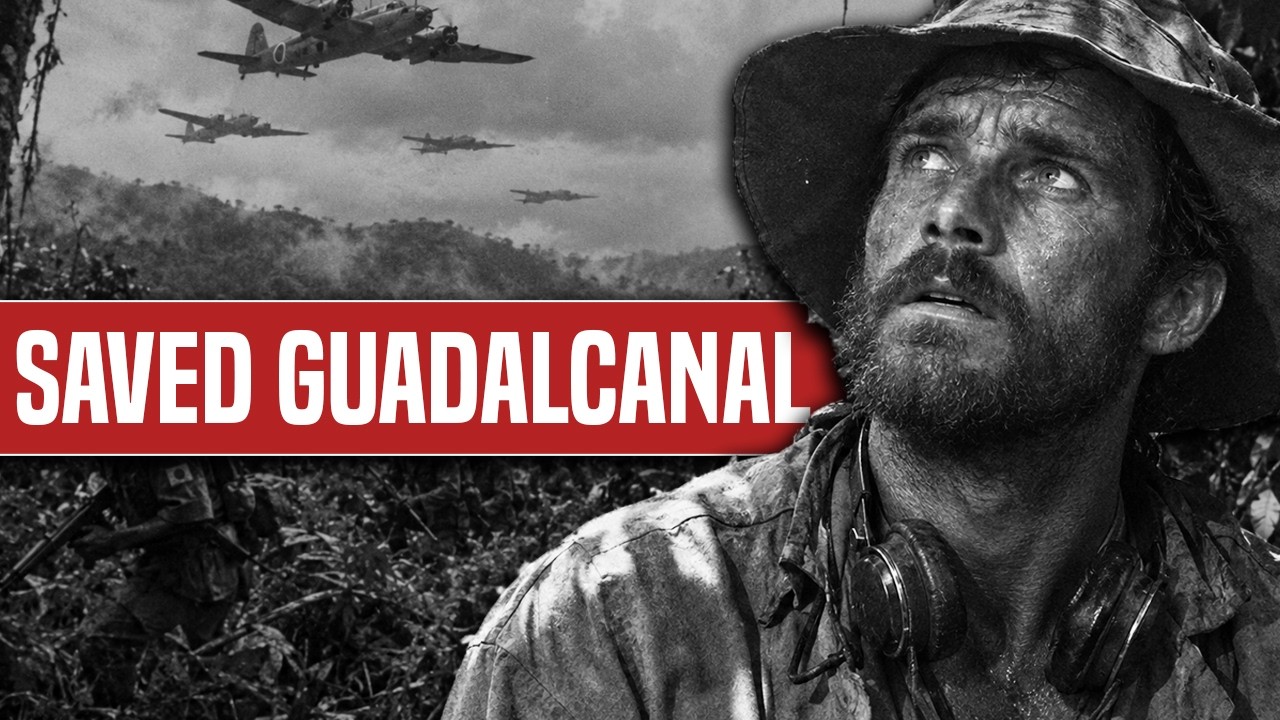
The warning came in plain English, crackling out of radios aboard the invasion fleet off Guadalcanal on the morning of August 7, 1942. A voice read off a count of Japanese bombers still more than three hundred miles away. The message had been keyed by a man hiding on a jungle hilltop on Bougainville, an island deep behind enemy lines, and it arrived with enough time for the American carriers to launch their fighters and for the transports to prepare to maneuver. The raid came in hours later, and the bombers dropped their loads wide of the transports.
The Australian official history later measured the value of that single warning in a single line: without it, American naval air strength would have been considerably reduced. The man on the hill was Paul Mason, one of dozens of coast watchers scattered across the islands north and east of Australia. The network was the creation of Lieutenant Commander Eric Feld, who ran it from Townsville and gave it the code name Ferdinand, after the children’s story about the bull who would not fight and preferred to sit under a tree. The name was the doctrine.
A coast watcher’s duty was to sit out of sight, gather information, and never draw attention to himself by fighting. The planters, plantation managers, district officers, and missionaries who made up the network each had a radio, a code book, and a stretch of coast or sky to watch. The Navy handed them reserve commissions in the hope that a uniform might count for something under the Geneva Convention if they were caught. By August 1942, the Japanese were hunting them with dogs and killing the ones they caught.
The reason had two halves. The first was the Japanese army’s reading of the law. A European hiding behind its lines with a transmitter counted as a spy, and spies were shot. In March, troops on Buka had executed an elderly planter named Percy Good after a Melbourne press release gave him away.
In June on New Ireland, a young coast watcher named Khan Page signaled that he was hunted by dogs, natives, and machine guns. They had him within a week. The second half of the reason was what the transmitter did. An air raid reported long before it arrives has lost the one advantage a raid depends on.
No day of the war showed that better than the 7th of August. Mason and another coast watcher, Jack Reed, sat at opposite ends of Bougainville, a mountainous island roughly 120 miles long. Reed watched Buka Passage from a lookout at Pora in the north. Mason watched the sea and sky around Buin from a camp on Malabita Hill in the south, with the Shortland Islands spread out below him.
Both had spent weeks hiding in the jungle with their sets silent until an order on the 5th of August sent them back to their lookouts, because something big was about to happen far to the south. Each camp had a Teleradio, a civilian set built in three metal boxes, run on car batteries that had to be recharged with a small petrol engine. Moving one took anywhere from six to sixteen carriers, depending on whose account is followed. Feld later counted about a thousand islanders in the network beside some four hundred Europeans.
That morning, the day opened with a message in the opposite direction. At about half past four, Japanese Eighth Fleet headquarters at Rabaul picked up a signal saying that Tulagi in the Solomons was under heavy bombardment from air and sea. Commander Toshikazu Ohmae, one of the staff officers roused from sleep, wrote afterwards that the situation looked most discouraging. American Marines were coming ashore at Tulagi and on the north coast of Guadalcanal, where the Japanese had almost finished an airfield.
Rabaul had aircraft ready, though not for this. The 25th Air Flotilla had spent the previous days preparing a raid on Milne Bay in New Guinea. That morning the field held 32 twin-engine Bettys, 16 dive bombers, and 34 Zero fighters. The staff dropped Milne Bay, and at about nine o’clock, 27 of the Bettys took off for Guadalcanal with 17 fighters for cover.
One later account says they carried bombs instead of torpedoes so the strike could get away sooner. Their course ran down the chain of the Solomons, and the first big island under it was Bougainville. The reporting arrangements for that day had been settled in advance. Ordinary Ferdinand traffic went out in a modified Playfair cipher through a chain of stations, with a woman named Ruby Boye keeping a backup link on Vanikoro.
For this operation, Mason and Reed had orders to report aircraft in plain language on a frequency given to the Americans, so that any ship listening could hear them with no code book at all. A second channel ran the long way round from Port Moresby to Townsville to Canberra to Pearl Harbor, where a powerful transmitter could put a message out across the Pacific. At about twenty to twelve, the formation passed over southern Bougainville. Mason counted it and keyed his set.
Off Guadalcanal and Tulagi, radio operators in the invasion fleet heard a voice in plain English: from STO, 24 bombers headed yours. The Japanese aircraft were still some 320 miles away. That was the first time the fleet heard the warning. A little under half an hour later, the same report reached the ships again, broadcast this time from Pearl Harbor after traveling from a hill on Bougainville to New Guinea to Queensland to the Australian capital and out to Hawaii.
One planter’s sentence had gone round half the Pacific through two navies and four stations and still arrived well ahead of the aircraft it described. The ships off Guadalcanal had more than an hour and a half to get ready. The fighters had time to climb. At about a quarter past one, the call of Tallyho came over the radio as Wildcats met the Japanese some fifteen miles west of Savo Island.
Soon afterwards, roughly eighteen of the Bettys in tight formation with Zeros still alongside them reached the ships. Captain Harold Farncomb of the heavy cruiser Australia watched the formation leader flash a bright light to signal bomb release. The bombs fell well to the northwest of the transports, and Farncomb, unimpressed, called it rather a poor shot. The afternoon went worse for the attackers.
At around three o’clock, a small force of dive bombers, nine by the Japanese count, came in and hit the destroyer Mugford, killing 22 of her crew, and five of the nine never got home. The American fighters paid as well, with nine Wildcats lost that day by one count. Over Guadalcanal, the Zero pilot Saburo Sakai, already one of the best known aces in his navy, was hit in the head and flew the long route back to Rabaul with the sight gone from one eye. At four in the afternoon, the strike force landed back at its base, five bombers and two fighters short.
The next morning it was Reed’s turn. From the north end of the island he reported a big formation heading southeast, 40 heavy bombers in one version of his signal and 45 dive bombers in another. They were in fact torpedo planes, and they came in low over Florida Island at about noon. The cruiser Australia opened fire with everything she had, eight-inch guns included.
The Japanese later admitted losing 17 torpedo planes. The destroyer Jarvis was torpedoed and later went down with all 247 men aboard, and the troop ship George F. Elliott burned. By one account, only eight Japanese aircraft passed back over Reed’s lookout on the way home.
One thing on the eighth got past Mason. Admiral Gunichi Mikawa’s cruisers were steaming south through Bougainville Strait that afternoon, about forty miles east of where Mason could see. Ohmae was aboard, and he remembered a dead calm sea, visibility that was, if anything, too good. He remembered the strike aircraft returning toward Rabaul by twos and threes with no formation left, and the men on the bridge watching them with grateful eyes.
That night the same cruisers sank four Allied heavy cruisers off Savo Island, the Australian Canberra among them. There is some doubt about Mason’s warning itself. The Australian official history gives his words as 24 bombers. Other sources give torpedo planes, or 18 of them, or 27 heading southeast, and the Marine Corps history puts the time at about eleven rather than twenty to twelve.
Part of the trouble is the clocks, because Rabaul kept Tokyo time two hours behind the Allied fleet, and every writer since has had to translate between them, not always the same way. The famous sentence is the one the Australian historian took from the files, and it may not be word for word what Mason said. After that, the hunt grew harder. On Guadalcanal, a Solomon Islands police sergeant named Jacob Vouza, scouting for the Marines, fell into Japanese hands around the 18th or 20th of August.
By one account, they found a small American flag on him. He would not tell them anything. In a letter written in his own words, he said they bayoneted him twice in the chest with a long sword and once through the throat, and that the blade cut the side of his tongue. They left him for dead.
He crawled back to the American lines and went on to receive the Silver Star and the George Medal. On Bougainville, the Japanese sent specialists in October. By the stories that come down from Feld, tracking dogs arrived at Buin and went into cages ready to be put on Mason’s trail. A Catalina flying boat dropped a bomb that killed every one of them.
No Japanese paper has turned up to confirm it. By December, a party of about forty troops and some sixty local men working for the Japanese, known to the Australians as the Black Dogs, was out after Mason’s group. Their political officer was a man named Tashiro, a Christian convert who had spent the 1930s on Bougainville and had once been Mason’s friend. Reed thought Tashiro could have caught them if he had really wanted to.
In June of the following year, Mason’s party was ambushed and got away over a plateau 5,000 feet high. In July, the American submarine Guardfish came into the coast and took off the coast watchers, their scouts, and the police who had stayed with them. Mason and Reed had each received the American Distinguished Service Cross back in October 1942. Feld wrote about all of this nearly twenty years later, and one of his conclusions runs against the idea that Tokyo understood what it was hunting.
The Japanese, he wrote, never realized the important role of the coast watchers, and that was mainly because the watchers used the air no more than they had to. The dogs, the executions, and the patrols were real enough. By Feld’s reading, though, the Japanese thought they were chasing spies and never quite saw that they were chasing the reason their raids kept arriving to a waiting audience. The tally left behind is long.
By the figures the Australian Veterans Department gives, coast watchers helped bring out 75 prisoners of war, 321 airmen, and 280 sailors, along with missionaries and other civilians numbering in the hundreds. One of the best known rescues came in August 1943, after a Japanese destroyer cut an American torpedo boat in half in Blackett Strait. Two scouts working for the coast watcher Reg Evans, Biuku Gasa and Eroni Kumana, found the survivors, and their skipper, a young lieutenant named John Kennedy, scratched a message on a coconut husk for the scouts to carry back. The cost will not reduce to one number.
The Veterans Department gives 36 coast watchers dead on one page and 38 on another. Feld counted 37 Europeans and 50 islanders. Another history counts 27 of the watchers and 20 islanders killed, with more taken prisoner. Far to the east on Taroa in the Gilbert Islands, Japanese troops beheaded 17 men of New Zealand’s own coast watching service and five European civilians.
In October 1942, after an American attack on the atoll, Admiral Halsey is credited with the line most often quoted about them, that the coast watchers saved Guadalcanal and Guadalcanal saved the South Pacific, though nobody has found the page where he first said it. In the American Pacific Command’s preliminary report on the landings, dated the 23rd of August 1942, there is one sentence about the man on Malabita Hill. The warning from this coast watcher, it says, was of the greatest value.






