On the night of January 18, 1567, King Philip II of Spain walked calmly to his son’s chambers in the royal palace of Madrid, accompanied by a handful of trusted men. Hours earlier, father and son had attended Mass together, and afterward the king had gone about the ordinary business of the realm, careful not to raise any suspicion. Now, with the prince already in his rooms for the night, Philip gave the signal. His men burst into the room, seized the young man before he could react, and disarmed him.
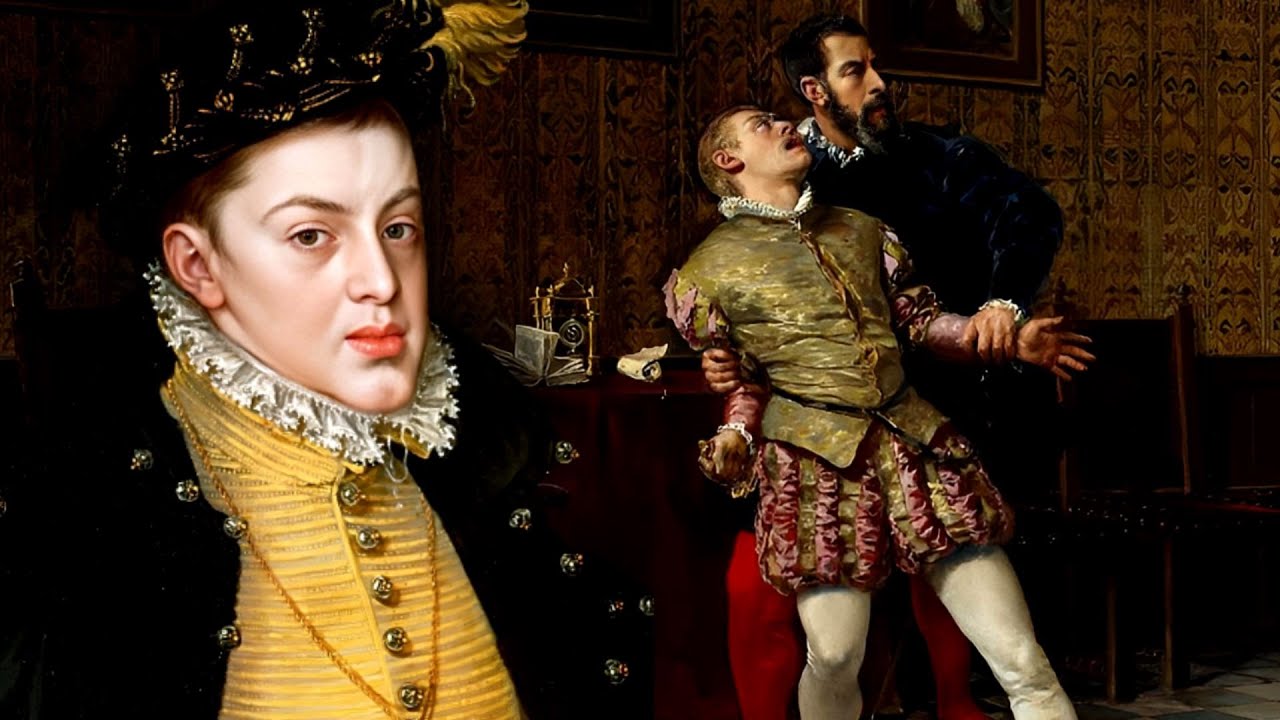
Guards stepped forward and nailed the doors and windows shut. The message delivered to the prince was simple: he would remain confined to his apartments until further notice. The prisoner was Charles of Austria, Prince of Asturias, heir to the Spanish crown. He was twenty-one years old.
His father, the most powerful monarch in Europe, had just ordered his own son’s arrest because he feared that if Charles ever took the throne, the kingdom itself would be destroyed. Charles of Austria and Aviz was born on July 8, 1545, in the city of Valladolid, the only child of Philip II and his first wife, Princess Maria Manuela of Portugal. His mother died the day after his birth, carried off by puerperal fever. From the start, Charles was a sickly child marked by physical deformities.
He walked with a stoop and a limp, and his facial features were coarse and oversized. Despite these flaws, he appeared to develop normally, and those close to him suspected his condition was the consequence of the inbreeding practiced relentlessly by his family. The blood relation between his parents was so close that Charles might as well have been the child of a brother and sister. He grew up in near-total absence of his parents.
His mother was gone before he knew her, and his father remained away from Spain for years, governing the empire’s far-flung territories. During that period the king of Spain was still Charles’s grandfather, the aging Emperor Charles V. The boy’s affection came from his paternal aunts, Princesses Maria and Juana, especially Juana. She was only ten years old when Charles was born, yet she behaved like a mother to him, a child far too mature for her age.
Aunt and nephew lived together in Aranda del Duero in Burgos, extremely close. Juana spoiled her nephew, and when he did not get what he wanted, he threw enormous tantrums. In 1551, however, Juana became engaged to Prince John Manuel of Portugal. She left her nephew to marry, and their farewell was bitter.
Charles took his aunt’s departure harder than almost anything else in his young life. He was left effectively abandoned, an unhappy and capricious child, looked after by nurses and tutors who gave him little warmth. When his father finally returned to Spain, there was some contact between them, but in 1554 Philip left again, this time to marry Queen Mary Tudor of England. Once more, Charles was alone.
He had always been mischievous and restless, and a poor student, but gradually his behavior crossed into territory that no one could call normal. He liked to hurt animals. He skinned several horses in the stables and roasted live hares he caught in traps, turning his childish pranks into genuinely sadistic games. In 1556, Charles met his grandfather for the first time.
The emperor had been away for years on journeys and affairs of state, and the moment he chose for the meeting was historic: he was abdicating in favor of his son, who would reign as Philip II. It is said that Emperor Charles was deeply disappointed in the boy. His appearance was not what the old monarch had expected, and Charles suffered from speech problems and an inability to concentrate. He stuttered badly and struggled to express himself or follow a conversation.
When Philip II returned to Spain, he decided his son should study at the University of Alcalá de Henares, alongside his relatives, Prince John of Austria and Prince Fernando de Farnesio. Charles proved an extremely difficult student who paid no attention to his lessons. He remained sadistic, going so far as to order a young woman flogged in front of him for his own amusement. At the time, the prince was just eleven years old.
He was punished and forced to compensate the woman. Around this period, Charles contracted malaria. The illness left him badly weakened and produced lasting effects, including episodes of extremely high fever throughout his life with no apparent cause. In 1558, Charles was betrothed to the French princess Elisabeth de Valois.
He was reportedly thrilled and excited about the marriage, having heard that his bride was very beautiful. But that same year, his father’s second wife, Queen Mary Tudor, died. Philip decided to marry his son’s promised bride himself. Elisabeth de Valois became Charles’s stepmother instead of his wife.
The disappointment changed him. Charles turned to heavy drinking, overeating, and women. He became a combative young man, always looking for a fight with anyone. In 1560, he was finally and formally recognized as heir to the Spanish crown, receiving the title Prince of Asturias, though some members of the court viewed the recognition with alarm because of his behavior.
Even his own father was deeply worried about his son and the future of the kingdom. Around this time, Charles was reunited with his beloved aunt Juana, who had returned to Spain years earlier after the death of her husband, Prince John Manuel of Portugal. Juana overlooked her nephew’s bad behavior, loving him as if he were her own son. Charles also formed a genuine friendship with Elisabeth de Valois.
They were the same age and became close friends. Philip decided it was time to marry off his heir and began searching urgently for a bride. The leading candidates were Princess Margaret de Valois, Elisabeth’s younger sister, and Archduchess Anna of Austria, Philip’s own niece. Those negotiations came to nothing.
Knowing how difficult it would be to find a bride for such a troubled young man, Philip considered marrying Charles to his aunt Juana. She accepted the arrangement gladly, adoring her nephew and seeing the match as a chance to become queen consort of Spain one day. Charles refused outright. He loved his aunt dearly, but she had been married before and was no longer a virgin.
He demanded a princess who had never been touched by any man and who had a virginal appearance. For years, false rumors had circulated that aunt and nephew were involved in an incestuous relationship because of how close they were. When Charles rejected the marriage, Juana distanced herself from him, becoming cold and deeply hurt. Charles had become a womanizer who visited Madrid’s brothels frequently.
In 1561, his health deteriorated so badly that his doctors advised him not to leave the city of Alcalá de Henares. That hardly restrained him; he simply kept the company of different courtesans. One day, he chased a young woman through the corridors of his residence, tripped, and fell down the stairs, striking his head hard. The fall caused severe brain injuries.
He lost his sight for days, and at one point his life was in danger. Philip II was desperate over his son’s condition. He summoned a renowned Morisco physician. He also had the idea of placing the mummy of Saint Diego de Alcalá in the prince’s bed, believing Charles would be cured miraculously through the saint’s intercession.
Fearing he might lose his only male heir, the king called in the famous Flemish anatomist Andreas Vesalius, who performed a trepanation on the prince. Charles recovered quickly from the surgery and regained his sight shortly afterward. But no one anticipated the change that followed. Charles had always been strange and somewhat sadistic, but after the fall and the surgery, he began to suffer violent mood swings and became even more cruel and violent.
He developed into a rebellious, aggressive, deeply unstable young man who showed no consideration for anyone and insulted all those around him. His excesses became monstrous. He threw a page out of a window for disobeying him. He tried to throw another servant out of a different window because the servant had not brought him the clothes he wanted to wear that day; the man survived only because his screams drew people who came to his rescue.
Charles continued to frequent the brothels of Madrid, but his encounters turned violent, and women who were with him in private were forced and beaten. On one occasion, as Charles walked through Madrid, someone threw dirty water from a house into the street, splashing the prince. He ordered the house burned down. Another time, he commissioned a pair of shoes from a cobbler, and when the shoes came out too small, he forced the man to eat them in front of him.
His behavior weighed heavily on Philip. The king wondered whether his son’s actions were the result of too much idle time, and he decided to give Charles a seat on the Royal Council, hoping responsibility would settle him. It turned out to be a terrible idea. Charles took part in some affairs of the kingdom, and his father thought it was time for the prince to begin his formation as a future monarch—but Philip soon regretted the decision.
Father and son began having fierce arguments because of the prince’s ill manners. Charles threatened other council members with a dagger during meetings and heaped insults on them. In 1562, a possible marriage was considered between Charles and Mary, Queen of Scots. Philip ultimately declined to pursue it.
He knew his son was too unstable, and with Charles so far away, the king could not control him; he feared the prince might do something mad. Charles came to hate his father deeply, even reproaching him for having fathered him so young. The prince wanted to sit on the throne and chafed at having to wait for his father to die. Philip was a sickly man, but his health was still better than his son’s, and this tormented Charles, who knew he was more likely to die first.
He even began to consider murdering his father. The prince explored plans to travel to the Low Countries, where the Dutch provinces were in open rebellion against Spanish rule. He intended to stage a coup and proclaim himself king there. Charles made contact with the principal leaders of the uprising against the Spanish crown, and it was even said that he converted to Protestantism.
He attempted once to stab the Duke of Alba, Fernando Álvarez de Toledo y Pimentel, his father’s right-hand man, because the duke had fought against the rebels in the Low Countries. Charles wanted to escape the palace and launch his enterprise, but he could not do it alone. He turned to his uncle, Prince John of Austria. The two were close friends and former classmates.
Charles confessed his intention to flee to the Low Countries and promised that if John helped him, he would hand over the crown of Naples. John seemed interested and said he would think it over. Instead, he went straight to his half-brother, King Philip II, and reported everything the prince had said. When Charles learned that his uncle had betrayed him, he summoned John to his chambers.
There the prince attacked his uncle with a sword. But John of Austria was an expert swordsman and deflected the attack. The commotion in the prince’s room brought courtiers and servants running, and they subdued Charles, who appeared to have lost his mind completely. In the face of his heir’s horrific behavior, Philip decided that Charles had to be shut away in his apartments because of his obvious mental problems.
The arrest on the night of January 18, 1567, was carried out with care, as a normal day so as not to arouse suspicion. When the prince was confined, he threatened to kill himself if he remained locked in his room, so his father ordered every dangerous object removed from the chambers. The confinement devastated Philip, though he kept his grief private. Across the courts of Europe, rumors spread accusing the king of being a cruel father, feeding the false black legend about the Spanish monarch.
Philip was reserved about his family troubles, and only those closest to him knew the real situation facing the crown. He had to endure the daily pleas of his wife, Elisabeth de Valois, and his sister Juana, both begging him to release the prince. The king refused every time, convinced that his son was a genuine danger to everyone. After several days in his apartments, Charles was moved to the towers of the Alcázar of Madrid.
During his stay there, letters were discovered proving that the prince had been planning to assassinate his father. Charles remained imprisoned in that tower for six months, just as his great-grandmother Juana the Mad had been confined in her time. There he suffered the high fevers that had plagued him all his life. He was bitterly cold through the winter, and when summer came, his room turned into an oven.
That summer was especially hot, and the windows were bricked up to prevent escape, leaving the chamber with almost no ventilation. Like his great-grandmother before him, Charles decided to go on a hunger strike, hoping to attract his father’s attention. Instead, he only grew terribly weak. Knowing his end was near, Charles asked to see his father and to receive his forgiveness.
When Philip learned of his son’s condition, he came at once. Entering the room, he found Charles lying on the bed, emaciated. The king did not approach, afraid his son might suffer an attack of madness and assault him, so he stayed next to the armed guards who accompanied him. Philip granted his forgiveness, but his coldness in that moment discouraged the prince deeply.
Charles of Austria died on July 24, 1568, at the age of twenty-three, from the extreme weakness caused by malnutrition and dehydration. His remains rest in the Pantheon of the Infantes at the Royal Monastery of El Escorial in Madrid. Charles had been a prince with serious mental problems, some of it inherited, some of it the result of the brain damage caused by his fall down the stairs, which made him lose his mind completely. His story damaged his father not only emotionally but also in reputation.
For many years, Philip was cast as the great villain of the tale, but it has been shown that he set his son aside because he genuinely considered Charles a grave danger to the people around him and to the kingdom itself.






