At 12:30 on the afternoon of August 9th, 1864, Lieutenant General Ulysses S. Grant sat at a portable field desk on an eighty-foot bluff overlooking the confluence of the James and Appomattox rivers. Below him, along the waterfront of City Point, Virginia, a column of dark smoke rose thousands of feet into the summer air. Across the riverbank, the timber wharves had been shattered into matchwood, and the ribs of submerged transport barges were caught in the current.
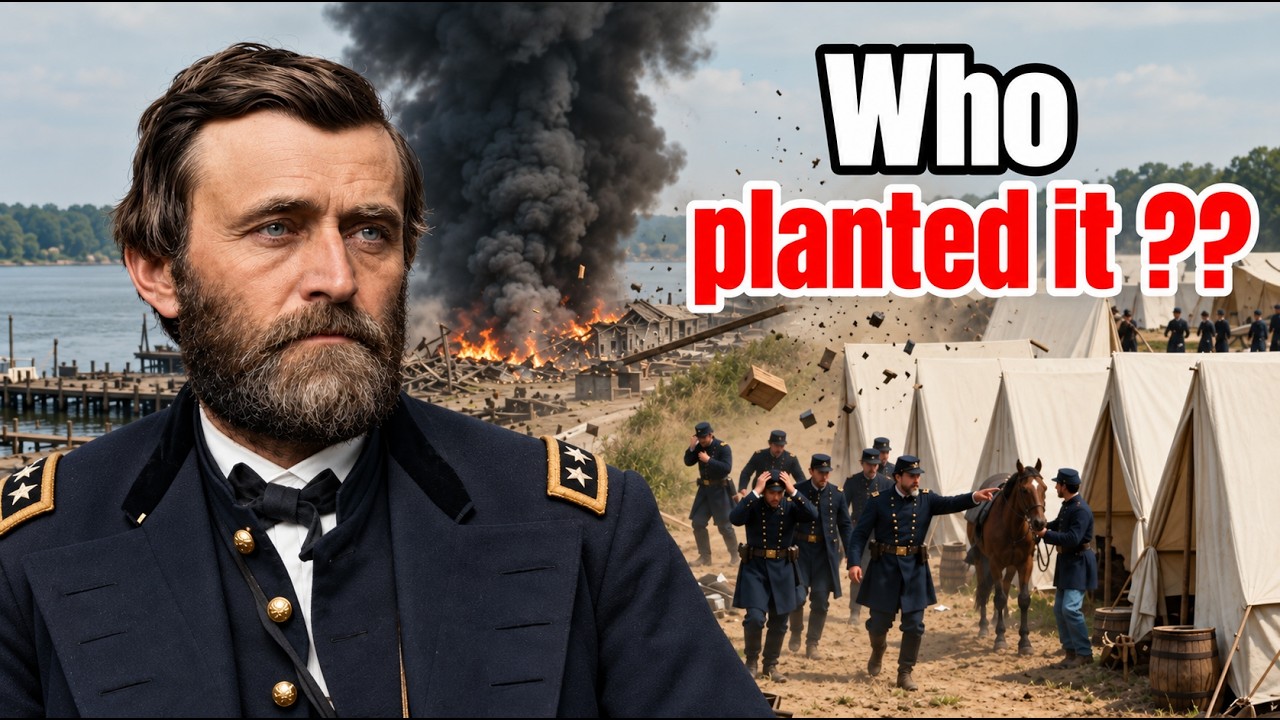
Less than an hour earlier, 75,000 pounds of gunpowder and 30,000 live artillery shells had detonated in a single blast. The concussion ripped across the water, leveled two waterfront warehouses, and sent a shower of iron projectiles and heavy timber crashing into the headquarters camp where Grant and his staff were stationed. A mounted orderly in the headquarters escort, Private John Vance, was crushed to death beside his horse. Grant’s military aide, Colonel George Babcock, was struck and bleeding from a hand wound, and unexploded twelve-pounder shells were embedded in the dirt mere paces from the general’s canvas wall tent.
Yet, with smoke still drifting across the bluff, Grant drafted a short telegram to Major General Henry Halleck in Washington. “Five minutes before 12 a. m. today, a terrific explosion took place in the ordnance boat, destroying two barges passing through into the wharf and destroying warehouse and considerable property.
It is supposed to have occurred through the negligence of some of the parties handling ammunition. Damage to wharf and buildings is large. Some five or six vessels were more or less injured. The loss of life is confined to the laborers, some few being killed and several wounded.
Everything will be running as usual again tomorrow. ”
Grant had diagnosed the catastrophe within fifty minutes of the blast. Before recovery teams had pulled the first bodies from the river, the general-in-chief had defined the narrative. It was an industrial accident caused by careless dock hands handling black powder.
Operations would resume by morning. Northern newspapers printed the telegram verbatim. The War Department accepted the explanation, and the incident was largely dismissed as an unfortunate dockside mishap. The official story closed the case, but the paper trail left behind reveals that nearly every detail of that initial explanation was wrong.
City Point was not an ordinary military camp. Following the stalemate at Cold Harbor in June 1864, Grant had moved the Army of the Potomac and the Army of the James south of the river to besiege the rail hub of Petersburg. To sustain more than 100,000 soldiers and 60,000 horses, Chief Quartermaster Rufus Ingalls transformed the quiet Virginia landing into the second busiest port in the country. Ingalls directed the construction of nearly a mile of deep-water wharves along the James.
Engineers laid tracks for the United States Military Railroad, running supply trains directly from the docks to the frontline trenches eight miles away. Every day, dozens of steam transports, schooners, and barges discharged tons of rations, clothing, forage, and munitions. The most sensitive area in the entire complex was the ordnance wharf. Deep-draft barges were moored together in open water, their holds packed with the combined ammunition reserves of the Union armies.
Sentries from the Veteran Reserve Corps guarded the approaches, and regulations prohibited commercial traffic from mooring alongside the powder fleet. If the ordnance supply at City Point were destroyed, the artillery fire along the Petersburg lines would stall within days. Across the lines in Richmond, the Confederate high command understood this vulnerability. By August, the Confederacy was running out of conventional options.
The Overland campaign had cost Grant over 50,000 men, but he had pinned Robert E. Lee’s Army of Northern Virginia into fixed earthworks. Lee could neither withdraw nor risk an open battle. Richmond’s political hope lay in the upcoming Northern election.
If the Confederate armies could sustain the deadlock through November, growing anti-war sentiment in the North might defeat Abraham Lincoln and force a negotiated peace. The political strain on Washington was real. On August 23rd, Lincoln wrote his private memorandum acknowledging the probability that his administration would not be reelected. For Confederate authorities, any blow that disrupted Grant’s logistical rear and signaled to the Northern public that the war was dragging on had enormous strategic value.
Because Union gunboats controlled the James River and infantry pickets secured the land approaches, a conventional attack on City Point was impossible. The strike had to be asymmetric. The weapon had already been built in the workshops of Richmond under the direction of Brigadier General Gabriel J. Rains.
An 1827 West Point graduate, Rains was an experienced military engineer who had spent years developing explosive booby traps, landmines, and underwater torpedoes. While many nineteenth-century military officers viewed concealed mechanical explosives as contrary to the accepted codes of war, the Confederate War Department institutionalized the practice in June 1864 by placing Rains in command of the newly formed Torpedo Bureau. Among Rains’ designs was the horological torpedo, an early mechanical time bomb. It consisted of a brass clockwork mechanism adapted from a commercial timepiece and connected to a spring-loaded striker.
When the timer wound down, the spring released, driving a striker into a chemical friction primer to detonate a surrounding charge of roughly twelve pounds of black powder. The device could be set hours in advance, packed into a small container, and carried behind enemy lines. On July 26th, 1864, Captain Zedekiah McDaniel of the Confederate Secret Service and Torpedo Bureau issued field orders to a civilian operative named John Maxwell. Maxwell was given a twelve-pound horological torpedo and instructed to operate against Union shipping along the James River corridor.
Maxwell chose as his partner a scout named R. K. Dillingham. To conceal the weapon, Maxwell placed the explosive mechanism and the clockwork inside an ordinary pine grocery crate roughly eighteen inches long, stenciled on the side with the word “candles.
” Maxwell and Dillingham wore worn civilian work clothes. They carried no military commissions, no uniforms, and no identifying papers. Under the rules of war, operating behind enemy lines out of uniform meant they faced summary execution by hanging if captured. Moving through the woods and swamps south of the James River, they slipped past Union cavalry pickets and approached City Point on the morning of August 9th.
On paper, City Point was a closed military zone. Provost Marshal General Marsena Patrick had established a passport system requiring written passes for anyone entering the lines. But the depot was overwhelmed by thousands of civilians, sutlers, mechanics, teamsters, sailors, and formerly enslaved African-American contrabands hired by the Quartermaster’s Department to haul freight and unload cargo. Maxwell and Dillingham exploited this traffic.
They did not present forged documents at the main checkpoints. They walked along the waterfront, blending in with the laborers working along the docks. By mid-morning, they were standing on the ordnance wharf beside two ammunition barges, the *Kendrick Sun* and the *J. G.
Powell*. Observing that the captain of the *Kendrick Sun* had gone ashore, Maxwell noticed only a single deckhand on duty. Dillingham stepped onto the gangplank and struck up a casual conversation, keeping the watchman’s attention fixed on the river. While they spoke, Maxwell walked aboard carrying the candle box, descended the cargo hatch, and entered the hold.
Surrounded by crates of small-arms ammunition and artillery projectiles, Maxwell positioned the box between the stacks, cocked the mechanism, and set the timer for roughly forty-five minutes. He climbed back to the deck, rejoined Dillingham, and the two men walked off the wharf. They passed through the perimeter, crossed the Appomattox River, and took up a position in the timbered bluffs on the opposite bank to observe the depot. At 11:40 a.
m. , the timer struck the primer. The twelve-pound charge tore through the hold, rupturing the adjacent ammunition crates. Within milliseconds, 75,000 pounds of gunpowder and 30,000 artillery shells ignited.
The *Kendrick Sun* was obliterated. The *J. G. Powell* was torn open and sank.
Over 180 feet of the wharf vanished. Warehouse walls collapsed, and a cloud of smoke and pulverized timber rose into the air. On the bluff above, solid cannon shot and fragments of wood pelted the headquarters circle. Private Vance was killed instantly.
Colonel Babcock was struck in the hand, and shells buried themselves in the ground around Grant’s tent. Grant remained seated, waited for the debris to settle, and then directed staff officers to organize medical details, fight the warehouse fires, and secure the remaining shipping. An investigation began almost immediately. Colonel Babcock and depot officers were tasked with explaining how the army’s central ammunition supply had exploded under the general-in-chief’s feet inside a secure perimeter.
Within forty-eight hours, Babcock submitted his findings to Chief Quartermaster Ingalls. The report concluded that the disaster was entirely an industrial accident. Babcock stated that African-American contraband laborers unloading munitions in the hold of the *J. G.
Powell* had carelessly dropped a crate of friction primers or struck an open ammunition box with an iron tool, igniting the cargo. The explanation settled the matter within the military command. It relied on prevailing nineteenth-century racial stereotypes that portrayed formerly enslaved laborers as careless and untrained. It also protected the Provost Marshal’s office and depot sentries from charges of negligence.
Because the laborers in the hold had been killed in the blast, no witnesses remained to contradict the finding. Yet the physical record contains sharp contradictions. The first appears in the casualty records. Grant had assured Halleck that the loss of life was confined to a few laborers.
But surviving ledgers from the City Point Depot field hospital, preserved in the National Archives, tell an entirely different story. Forty-three men were killed instantly. Another 126 were hospitalized with serious blast injuries, severe burns, and compound fractures. Over the following week, at least fifteen more died of their wounds, bringing the death toll past sixty.
The casualties included civilian ship crews, quartermaster clerks, white infantrymen from the Veteran Reserve Corps and the 18th New Hampshire Volunteers, and headquarters cavalrymen. Dozens of black laborers were listed on hospital rolls simply as “unknown,” their remains buried without formal identification near the river. Grant’s decision to minimize the casualties was an act of wartime crisis management. In August 1864, with public morale fragile and the administration under heavy political pressure, reporting that sixty men were dead and the army’s primary supply base was in ruins would have provided Richmond with an immense propaganda victory.
The second contradiction is forensic. The 1861 U. S. Army Ordnance Manual mandated strict packing standards for munitions.
Percussion caps and artillery primers were packed in sawdust inside sealed tin canisters, which were then placed inside heavy wooden boxes fastened with copper or brass screws to prevent sparks. Even if an entire box had been dropped, the resulting flash could not have generated the sustained heat or concussive force required to penetrate sealed, waterproofed oak powder barrels, let alone trigger a simultaneous detonation across multiple vessels. An external accidental spark could not account for the destruction. The blast originated from an internal high explosive.
For eight months, the official verdict stood. The truth emerged only when Richmond fell. On April 3rd, 1865, Union troops entered the evacuated Confederate capital. Intelligence officers from the Bureau of Military Information moved through government buildings to secure surviving archives.
In the offices of the Confederate Secret Service, they uncovered a classified file marked “Chapter 9, File 17. ” Inside was a handwritten report dated December 16th, 1864, addressed to Captain McDaniel, and signed by John Maxwell. “Captain, I have the honor to report that in obedience to your order, and with the means and equipment furnished me by you, I started from this city on the 26th of July last for the line of the James River, provided with the horological torpedo and its accompaniment to act against the enemy’s vessels on that stream. ”
Maxwell detailed the entire operation: carrying the candle box, boarding the *Kendrick Sun*, having Dillingham distract the watchman, placing the bomb in the hold, and watching the explosion from across the river.
The document proved that the disaster was not an industrial accident but a state-sponsored covert bombing. Yet it also dismantled a post-war myth that was already gaining traction: that the bomb was an intentional assassination attempt against Ulysses S. Grant. Across the four pages of his after-action report, Maxwell never mentions Grant.
He does not mention the headquarters tent on the bluff. His focus was entirely logistical. As he wrote to McDaniel, “I considered the ordnance barges the best point to place the torpedo to produce the most destructive effect. ” Maxwell targeted the ammunition barges to disable the supply line.
He placed the device at the waterline, unaware of the specific occupants of the bluff 800 feet away. Grant’s brush with death was circumstantial, the consequence of pitching his headquarters tent above the army’s central powder reserve. Despite the destruction, Maxwell’s mission failed to alter the course of the war. The explosion caused nearly four million dollars in property damage, but it did not break the supply chain.
Before sunset on August 9th, Rufus Ingalls had wired requisitions for replacement ammunition and materials to Fort Monroe, Washington, and New York. Within forty-eight hours, fresh transport vessels were docking at City Point. Military construction battalions worked through the night clearing debris and laying new track. Within eight days, the wharves and rail yards were operating at capacity, and ammunition trains were running to the front as scheduled.
The artillery fire at Petersburg never stopped. After filing his December report, Maxwell collected his expenses from the Secret Service Fund and drifted into civilian life, following the war faded from the historical record, leaving no memoirs. Dillingham’s post-war life remains unknown. Today, the bluffs of City Point are part of Richmond National Battlefield Park.
The manicured lawn of Appomattox Manor overlooks a quiet tidal river; the timber wharves and rail yards long gone. For over a century, the explosion of August 9th was remembered primarily as a character study in Grant’s personal bravery: a portrait of a stoic commander sitting unbothered while shells burst around him. The primary sources document a different reality. They show an army that buried an intelligence failure behind the convenient scapegoating of its most vulnerable laborers.
And they record the appearance of modern asymmetric warfare: mechanical time bombs, covert operatives targeting logistical infrastructure, and governments managing the flow of battlefield information under the pressure of war.






