The swamp water closed over her hands, and for a moment, Zara felt the entire world hold its breath. Beside her, Amira’s fingers tightened around hers, cold and trembling, but steady. They spoke the old words together, syllables that tasted of starlight and deep earth, words they had not learned from the thing that now raged beneath them. The water began to glow, and the presence screamed inside their minds, showing them everything they were giving up: a future of freedom, a life together, the chance to grow old in a world that had never once shown them mercy.
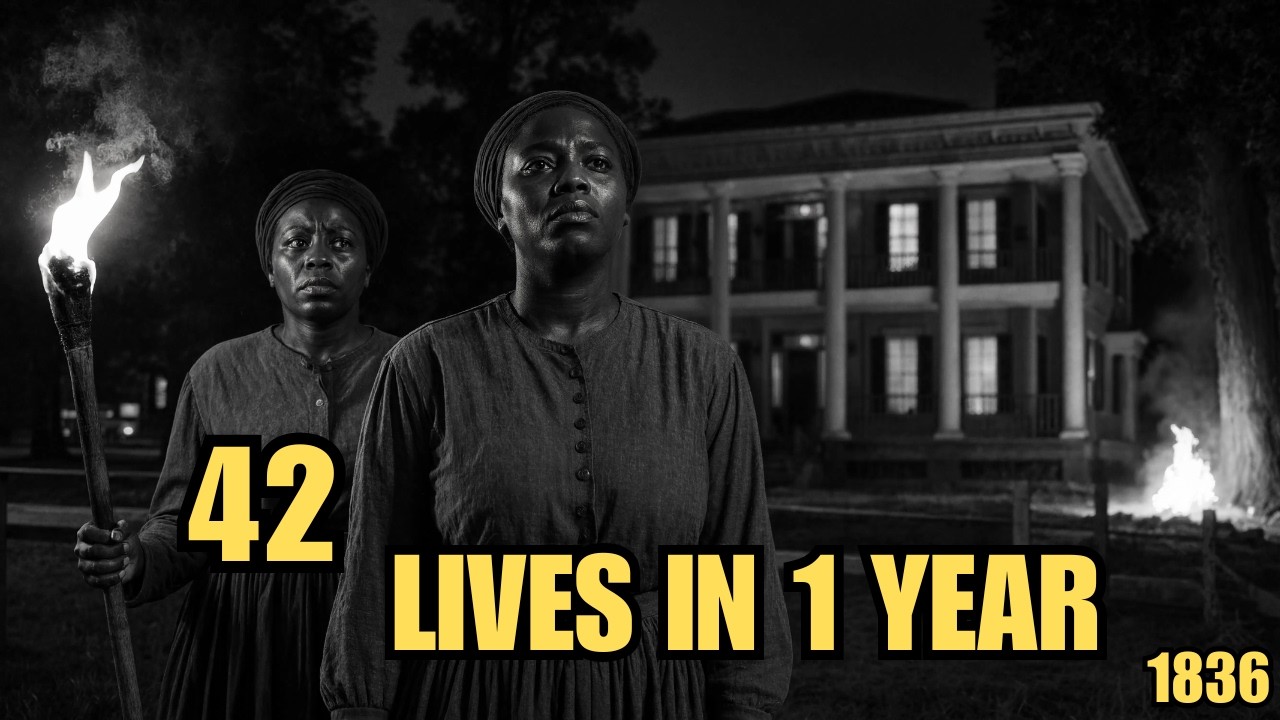
They held fast. The light swallowed them whole, and the last thing Zara saw before her consciousness scattered like ripples on a pond was the vast tentacled thing shrinking back into the depths, wrapped in chains of light that pulsed with their combined essence. It had all begun one year earlier, in 1836, with two sisters ripped from their mother’s arms in Charleston and sold south to a Mississippi cotton plantation called Cotton Hill. The shackles around Zara’s wrists had cut grooves so deep into her flesh that she had lost all feeling in them weeks before the wagon groaned to a stop on the muddy road.
Beside her sat Amira, nineteen years old, two years younger than Zara, wearing the same vacant expression she had worn since the day their mother was sold away. The slave trader grinned, his teeth stained with tobacco, and announced their arrival. “Cotton Hill Plantation. You’re going to love it here.
Master Witmore keeps things running tight. ” Zara took her sister’s hand and felt the fingers shake against hers. The plantation stretched before them like a scene of hell. Endless rows of cotton swayed in the humid breeze, worked by figures bent double beneath a blazing sun.
The main house stood stark and white against a backdrop of Spanish moss hanging from ancient oaks, while the slave quarters sat in the distance like forgotten afterthoughts. Master Witmore stepped out, his vest straining over his belly, sweat already forming on his brow despite the early hour. His pale blue eyes scanned them as if they were livestock. “Are these the sisters from Charleston?
” he asked, circling them slowly. “They look sturdy enough. How old are they? ”
“Nineteen and seventeen, sir,” the trader replied.
“Both have field experience. The older one also had some house training. ”
Witmore stopped in front of Zara, his breath reeking of whiskey and rot. “What’s your name, girl?
”
“Sarah, sir,” she murmured, keeping her gaze fixed on the ground. “And the quiet one? ”
“Amira, sir. ”
He gave a satisfied nod.
“Take them to Overseer Jackson. Tell him to put them in the south quarters and make sure they know the rules here. ”
Overseer Jackson was a massive man, his arms crisscrossed with scars, a whip never leaving his side. His reputation had reached them even in Charleston.
He shoved them toward the quarters, growling that at Cotton Hill they worked from can’t-see to can’t-see, spoke only when spoken to, kept their eyes down and their mouths shut. “Break any rule,” he said, “and you’ll wish you’d never been born. ”
The slave quarters were worse than anything Zara had imagined: rows of wooden shacks, each barely big enough for a family, lining a dirt path thick with the stench of unwashed bodies, sickness, and despair. Children with swollen bellies played in the mud while their mothers watched with hollow eyes.
An elderly woman named Mama Ruth showed them to their shack, a space they would share with three other women. The walls were thin planks with gaps wide enough to see through. A single window covered with torn cloth let in the only light. “Y’all best learn quick,” Mama Ruth warned, her voice barely above a whisper.
“Master Witmore has a temper. But Jackson,” she shuddered, “that man ain’t right in the head. He gets pleasure from pain, if you take my meaning. ”
That first night, lying on a straw mattress that scratched against her skin, Zara listened to Amira’s quiet sobs and made a vow: whatever it took, whatever she had to do, she would protect her sister.
The world had stripped them of everything—family, freedom, dignity—but she would not let it take each other. The next morning came before dawn, announced by the crack of Jackson’s whip outside their door. Under the unforgiving Mississippi sun, they bent over cotton plants for fourteen hours straight, fingers bleeding from sharp bolls, backs screaming in agony. The quota was impossible: two hundred pounds per person per day.
Fall short, and Jackson’s whip would remind you of your failure. On the third day, Zara saw Amira stumble and fall, her basket only half full. Jackson was on her in an instant, his whip cutting through the air, the crack against her back echoing across the field, followed by her scream. “Please,” Zara begged, dropping her own basket and rushing to her sister’s side.
“She’s sick. She needs water. ”
Jackson’s eyes gleamed with cruel delight. “Sick?
Well, maybe some motivation will cure her. ” The whip came down again, this time across Zara’s shoulders. The pain was liquid fire spreading across her back, but she did not cry out. She would not give him that satisfaction.
That night, as Mama Ruth tended their wounds with whatever medicine she could find, Zara felt something dark and cold settle in her chest: rage, pure and simple, but something else too, something that whispered promises of power, revenge, and cold justice. “There are stories,” Mama Ruth said quietly, applying a poultice to Amira’s back, “old stories from across the water, about those who make bargains when the pain becomes too much. ”
“What kind of bargains? ” Zara asked, though part of her already knew she should not want to know.
“The kind that change everything,” the old woman replied, her ancient eyes meeting Zara’s. “But they always come with a price. Always. ”
Later that night, when the others were asleep, Zara slipped out of the shack and walked to the edge of the plantation, where cultivated land gave way to wild swamp.
The moon was new, leaving the world in absolute darkness, yet somehow she could see perfectly. Cypress trees stood like sentinels in black water, and somewhere in the distance, something called to her. She knelt by the water’s edge, pressed her hands into the muddy bank, and whispered words she did not remember learning—ancient words that tasted of copper and smoke. The swamp seemed to listen, the air growing thick with anticipation.
When she returned, Amira was awake, waiting. “Where did you go? ”
“To find a way out. ”
Her sister studied her face in the dim light.
“You look different. ”
Zara did feel different, stronger, as if something had awakened inside her that had been sleeping her entire life. “We’re going to be free, Amira. I promise you that.
”
“How? ”
“Trust me, sister. Just trust me. ”
The next morning brought news that changed everything.
Master Witmore’s youngest son, Thomas, had been found dead in his bed, his body covered in strange marks that looked almost like claw wounds. The doctor could not explain it; the boy had been healthy the day before. As the family mourned and the other slaves whispered about curses and divine retribution, Zara caught Amira’s eye across the cotton field. Her sister was staring at her with a mixture of fear and understanding, as if she could see the darkness that now lived inside her.
That night, Amira asked if Zara would teach her what she had learned by the swamp. “Are you sure? ” Zara asked. “Once we start down this path, there’s no going back.
” Amira looked at the fresh whip marks on her arms, at the other slaves broken by years of abuse, at the endless rows of cotton stretching toward a horizon they would never be free to explore. “I’m sure,” she said. Under cover of darkness, Zara led her sister to the swamp’s edge and taught her the words that would damn them both. Three days after Thomas Witmore’s death, Zara woke to screaming from the main house.
Through the pre-dawn gloom, figures ran between the main house and the overseer’s quarters, lanterns bobbing like fireflies. Mama Ruth approached them, face grave. “It’s Overseer Jackson. Found him this morning, same as young Thomas.
Dead in his bed, covered in those strange marks. ”
Two deaths in three days. “That ain’t natural,” Amira murmured. But Zara knew it was not natural.
She could feel the darkness they had awakened stirring in her chest, feeding on the fear that permeated the plantation. The words she had spoken by the swamp had been heard, and something ancient and hungry had answered. Master Witmore emerged, pale and drawn. Behind him came Dr.
Morrison, shaking his head in bewilderment. Witmore gathered everyone in the yard—nearly two hundred souls—and announced the death. Dr. Morrison stepped forward: “I’ve practiced medicine for twenty years, and I’ve never seen anything like this.
Both victims were healthy men in the prime of life. Both died in their sleep. Both bore identical markings appearing after death. ”
Witmore declared changes: no one works alone, no one leaves their assigned area, anyone showing signs of illness quarantined immediately.
As the crowd dispersed, Zara caught sight of Marcus, Jackson’s replacement, a younger man with cruel eyes and a reputation for violence that rivaled his predecessor. He was staring directly at them. “You two,” he called out. “The sisters from Charleston.
Come here. ”
Marcus circled them slowly, like a predator sizing up prey. “Funny thing,” he said conversationally. “Both deaths happened after you arrived.
Makes a man wonder. ”
“We’ve been working the fields same as everyone else,” Zara replied, keeping her voice steady. “Ain’t done nothing but pick cotton and try to stay alive. ”
Marcus smiled with no warmth.
“Oh, I’m sure you have. But see, I’ve heard stories about Charleston slaves. Stories about root work and conjuring, about women who make deals with things that shouldn’t be named. ”
“Don’t know nothing about that,” Amira said quietly, but her voice trembled.
“Of course you don’t. But just to be safe, you two are being moved. Separate quarters, separate work details. Can’t be too careful when folks start dying mysterious deaths.
”
That afternoon, they moved Amira to the north quarters, nearly half a mile from where Zara was housed. The separation felt like losing a limb. But as they led her away, Amira caught her eye and mouthed a single word: tonight. The next morning brought news that made Zara’s blood run cold.
Marcus had been found dead in his bed, bearing the same inexplicable marks. But this time there had been a witness: little Emma, a house slave who cleaned the overseer’s quarters, had been working late when she heard sounds from Marcus’s room. Peering through the keyhole, she claimed to have seen two figures standing over his bed, “figures that looked like women, but moved wrong, as if their joints bent in impossible directions. Shadows,” she kept repeating.
“They was made of shadows, but they had faces. Faces I recognized. ”
The plantation erupted into chaos. Slaves were questioned, searched, and beaten.
The remaining overseers armed themselves and began patrolling in groups, their eyes wild with paranoia. But the deaths did not stop. Over the next week, four more men died: two overseers, a house servant, and Master Witmore’s eldest son, Robert. Each death identical, each driving the plantation deeper into madness.
Zara managed to slip away one night to meet Amira by the old oak tree marking the boundary between the quarters. Her sister looked different—thinner, paler, but with an intensity in her eyes that had not been there before. “It’s working,” she whispered. “They’re dying, Zara.
The ones who hurt us, who hurt all of us. ”
“I know,” Zara replied, though the knowledge brought her no joy. “But people are starting to suspect. They’re watching us.
”
“Let them watch,” Amira said, and for a moment her voice did not sound entirely human. “We made a bargain, sister. We gave our word to something that lives in the deep places. Something that remembers when this land was free.
It’s keeping its part of the deal. ”
Zara wanted to ask what she meant, wanted to understand exactly what they had unleashed, but footsteps in the distance sent them scurrying back to their separate quarters. Lying on her straw mattress that night, she tried to remember the exact words she had spoken by the swamp. They were gone from her memory, as if something had reached into her mind and plucked them out.
All that remained was the certainty that they had crossed a line from which there could be no return. The next morning, Dr. Morrison arrived with two other physicians from Vicksburg, determined to solve the mystery. They set up a makeshift laboratory in the main house and began examining the bodies.
What they found drove one of them to madness and sent the other two fleeing back to the city, swearing never to speak of what they had witnessed. The marks on the bodies were not random. They formed patterns, symbols that seemed to shift and change when viewed directly. And in the center of each pattern was the same image: two figures standing hand in hand, their faces turned toward something vast and hungry that waited in the darkness between worlds.
As news of their findings spread, Zara realized their secret was no longer safe. The net was closing. And that night, as she prepared to meet Amira again, she felt something stirring in the swampland beyond the plantation boundaries—something that had been sleeping for centuries, finally waking, drawn by the blood they had spilled and the promises they had made. The morning they tried to separate them permanently was the morning Zara learned what true rage could accomplish.
Master Witmore had brought in a new overseer from Alabama, a man named Cornelius Webb, who claimed experience dealing with supernatural disturbances among slave populations. Tall and gaunt, with pale eyes that seemed to see too much, Webb carried himself with the confidence of a man who believed he understood forces others feared. He arrived with iron chains, blessed crosses, and bottles of what he claimed was holy water from New Orleans. “The problem,” he announced to the assembled household staff, “is that you’ve allowed these women to remain together.
Conjure work requires partnership, shared energy. Separate them completely and their power breaks. ”
Zara was scrubbing floors in the main house when she overheard. Through the window she could see Amira working in the distant cotton field, her figure small and vulnerable against the endless rows of white bolls.
“You’re certain this will work? ” Witmore asked, his voice heavy with desperation. Seven deaths in two weeks had aged him a decade, and his remaining sons had been sent away to relatives in Georgia for their safety. “I’ve seen it before,” Webb replied confidently.
“In Alabama, we had a similar situation. Two sisters who’d made some kind of pact with dark forces. Once we separated them by fifty miles and bound them with iron, the death stopped immediately. ”
Fifty miles.
They were planning to sell one of them to break the bond. “Which one do we keep? ” Witmore asked. “The younger one,” Webb said without hesitation.
“She’s less developed in the craft, easier to control. The older sister is the real threat. I have a contact in New Orleans who specializes in difficult cases. He’ll take her off our hands for a fair price.
”
That afternoon, Webb approached Zara in the kitchen garden. “Zara,” he said, his voice deceptively gentle. “I understand you and your sister have been through some difficult times here. I want to help.
”
She kept her eyes down, her hands steady as she pulled weeds. “Don’t need no help, sir. Just want to work and stay out of trouble. ”
“I’m sure you do.
But you see, there’s been some unfortunate events since your arrival. Deaths that can’t be explained by natural causes. Now, I’m not saying you’re responsible, but I think a change of scenery might be beneficial for everyone. ”
“When?
” she asked quietly. “Tomorrow morning. A wagon will come for you at dawn. You’ll be going to a plantation outside New Orleans where you can start fresh, away from all these tragic memories.
”
That night, Zara slipped away to meet Amira one last time by the old oak tree. Her sister’s face was streaked with tears that gleamed silver in the moonlight. “They told me,” she whispered. “They said you’re being sold tomorrow.
That I’ll never see you again. ”
Zara pulled her into her arms. “Listen to me. What we started, it doesn’t end just because they separate us.
The thing we made our bargain with—it’s bigger than distance, stronger than iron chains. ”
“But how will I know what to do without you? ” Amira asked, her voice breaking. “You’ll know.
The darkness we let in, it’s part of us now. It’ll guide you when the time comes. ”
They spent the next hour sharing everything they could remember about the ritual by the swamp, the words that had awakened something ancient and hungry in the deep places of the earth. As they talked, Zara felt the presence growing stronger around them, as if their conversation was drawing its attention.
“There’s something else,” Amira said as they prepared to part. “Something I haven’t told you. The night Marcus died, I wasn’t in my quarters. I don’t remember walking there.
But I woke up standing over his bed, and my hands—my hands were covered in something dark. Something that wasn’t blood, but felt alive. ”
The revelation should have terrified Zara, but instead she felt a surge of pride. The power they had awakened was already working through her sister, teaching her things she did not consciously know.
“Good,” she said, surprising them both. “That means it’s working. The bargain is holding. ”
They parted before dawn.
As Zara walked back to her quarters to await the wagon, she whispered a prayer to the thing that lived in the swamp—not for mercy or salvation, but for the strength to complete what they had started. The wagon arrived as promised, driven by a man who introduced himself only as Thomas. He was clearly uncomfortable with his cargo, crossing himself repeatedly and muttering prayers under his breath as he loaded her few possessions. “Don’t try nothing funny,” he warned, driving off down the dusty road.
“I got iron chains and blessed salt, and I ain’t afraid to use them. ”
But as the miles passed, Zara felt something unexpected: not the weakening Webb had predicted, but a strange strengthening, as if the distance was amplifying the connection between her and Amira rather than breaking it. By midday, Thomas was sweating profusely despite the cool weather, his eyes darting nervously to shadows that seemed to follow the wagon. The horses grew increasingly agitated, shying at things only they could see.
“What did you do? ” he demanded, pulling the wagon to a stop beside a grove of cypress trees. “What kind of devil’s work are you practicing? ”
“I ain’t doing nothing, sir.
Just sitting here like you told me. ” But even as she spoke, Zara could feel it: a presence moving through the swampland that paralleled their road, keeping pace with the wagon. Something vast and patient, waiting for this moment—this separation that would allow it to truly test its power. That evening, they stopped at a way station.
Thomas chained Zara to a post in the stable, surrounding her with lines of salt and hanging iron horseshoes from the rafters. His precautions were useless. She woke in the darkness to screaming from the main building. Lights moved frantically in the windows, shadows dancing in ways that defied physics.
The screaming stopped abruptly, replaced by a silence so complete it pressed against her eardrums. When dawn came, Thomas was found dead in his bed, bearing the same mysterious marks. The other travelers spoke of nightmares so vivid they seemed real, of shadows moving independently of their sources, of whispers in languages that predated human speech. But Zara was gone.
The chains that had bound her lay empty on the stable floor, the iron horseshoes twisted into impossible shapes. The local sheriff later reported that her tracks simply vanished at the edge of the swamp, as if she had been swallowed by the earth itself. She had not escaped. She had been claimed.
By forcing them apart, Webb had allowed the presence to work through both sisters simultaneously, doubling its reach and power. As Zara walked through the cypress swamp toward an uncertain destination, she could feel Amira’s presence like a flame in the darkness, growing stronger with each step. Behind her, the way station burned to the ground, though no one could explain how the fire had started. Three days after her disappearance, Cotton Hill descended into absolute chaos.
Zara knew this because she was there, watching from the shadows of the swampland that bordered the plantation—no longer entirely human, but not yet something else. The thing they had awakened had changed her during those days in the deep places, teaching her to move between worlds like smoke between fingers. Amira had grown stronger too, their separation having done what the ancient presence wanted: it had allowed them to become conduits for something imprisoned in the dark waters for centuries, something that remembered when this land belonged to different gods. The first sign came at sunset on the third day.
Every dog on the plantation began howling simultaneously, their voices rising in a chorus of terror for exactly thirteen minutes, then stopping as abruptly as they had begun. Witmore stood on his front porch, his face pale, staring out at the cotton fields. Webb stood beside him, his confidence shattered. “This isn’t possible,” Webb muttered, clutching a leather-bound book to his chest.
“I separated them. The older one is gone, probably dead by now. The power should be broken. ”
Zara could see Amira moving through the cotton rows, different now, moving with a fluid grace that had not been there before.
The other slaves gave her a wide berth, as if they could sense the darkness flowing through her veins. That night, Zara slipped through the shadows to the old oak tree, where Amira was waiting, her eyes reflecting the moonlight like a cat’s. “Sister,” she whispered, and her voice carried harmonics that had not been there before. “I can feel you even when you’re not here.
We’re connected to something so much bigger than we imagined. ”
“It’s been teaching me things,” Amira continued. “Showing me what this place was before the white men came, before they built their houses on sacred ground. The burial mounds—they built the plantation right on top of them.
The thing in the swamp, it’s been waiting for someone to wake it up, to give it a way to reclaim what was stolen. ”
As they talked, Zara became aware of movement in the main house. Lights flickered, voices raised. “Come,” she said, taking Amira’s hand.
“It’s time to finish what we started. ”
They moved through the plantation like ghosts, the darkness parting before them. Through the windows of the main house, they could see Witmore, Webb, and three other white men gathered around a table covered with maps and documents. “We have to evacuate,” one man was saying, his voice high with panic.
“Sell the slaves, burn the buildings, and get out before this spreads. ”
“Absolutely not,” Witmore replied, though his voice shook. “This is my family’s land. I won’t be driven off by some conjure nonsense.
”
Webb looked up from his book, haggard with exhaustion and fear. “It’s not conjure. It’s something older, something that was here before any of us—before the slaves, before the Indians. We’ve awakened something that should have stayed buried.
”
“Then put it back to sleep,” Witmore demanded. “I don’t know how. Every ritual I’ve tried has only made it stronger. It’s feeding on the death, on the fear.
And those two sisters—they’re not just practitioners anymore. They’re vessels. ”
As if summoned, every candle in the house flared, casting dancing shadows that moved independently of their sources. The shadows began to take shape: two women holding hands, faces obscured, intent unmistakable.
They stepped down from the plaster into the room itself. Zara felt Amira’s hand tighten in hers as they channeled the ancient presence, allowing it to use their forms as templates for its manifestation. The men scrambled for the door, but it slammed shut before they could reach it. The windows followed, heavy wooden shutters closing with sounds like gunshots.
In the sudden darkness, only the shadows remained, growing larger and more substantial. “Please,” Witmore begged, falling to his knees. “We’ll leave. We’ll abandon the plantation.
Just let us go. ”
The shadow forms turned toward him. When they spoke, their voices came from everywhere and nowhere, echoing off the walls like thunder. “You built your wealth on stolen land.
You watered your crops with blood and tears. You thought you could chain the earth itself, make it serve your greed. But the earth remembers. The dead remember.
And now they demand payment. ”
Webb pulled a silver cross from his coat, holding it before him like a shield. “In the name of Christ, I command you to—” His words were cut off as the cross began to glow red hot in his hands, forcing him to drop it. Where it hit the floor, the wood began to smoke and char.
“Your God has no power here. This is older ground, consecrated to older purposes. You are trespassers in a sacred place, and the price of trespass is death. ”
The shadows reached out with hands both insubstantial and terrifyingly real, touching each man in turn.
Where they touched, strange marks appeared—not wounds, but symbols that seemed to burn themselves into flesh. One by one, the men collapsed, their bodies convulsing as something fundamental was torn from them. Not their lives—that would have been too merciful. They were left alive but changed, marked in ways that would haunt them for whatever remained of their days.
When it was over, Amira and Zara stood in the parlor in their physical forms. “What did we do to them? ” Amira asked, staring at the motionless figures. “We marked them.
They’ll carry the memory of this night forever. Every time they close their eyes, they’ll see the faces of everyone who suffered on this land. They’ll feel every lash, every chain, every moment of despair. They’ll live with the weight of all that pain until it drives them mad.
”
Over the following days, word spread. The three visiting men fled back to their own properties, but madness followed them. Within weeks, all three had either taken their own lives or been committed to asylums, babbling about shadows that moved on their own and voices that spoke from empty rooms. Witmore and Webb remained at Cotton Hill, but they were broken men.
Witmore aged twenty years in as many days, his hair turning white, his hands developing a tremor that never stopped. Webb burned his collection of occult books and took to carrying a Bible everywhere, though he could never bring himself to open it. The plantation itself began to change. Crops withered despite perfect growing conditions.
Animals refused to enter certain areas, and those that did were found dead the next morning with no apparent cause. The slave quarters, paradoxically, became places of strange peace—the presence seemed to protect those who had suffered most. But Zara knew this was only the beginning. The ancient thing they had awakened had tasted freedom after centuries of imprisonment, and it was hungry for more.
Pastor Jeremiah Blackwood arrived at Cotton Hill on a Tuesday morning in late September, his black carriage cutting through the morning mist. A tall man in his fifties, with silver hair and eyes that burned with the fervor of absolute faith, he had built his reputation on confronting what others feared to acknowledge. He had performed exorcisms in New Orleans, cleansed haunted houses in Savannah, and driven demons from the possessed throughout the Deep South. Witmore met him at the front door, his once-proud bearing reduced to the hunched posture of a broken man.
The marks Amira and Zara had left on him were invisible to normal sight, but Zara could see them clearly: dark symbols that breathed beneath his skin like living tattoos, constantly reminding him of every cruelty he had ever inflicted. “Pastor Blackwood,” Witmore said, his voice barely above a whisper. “Thank God you’ve come. I don’t know how much more we can endure.
”
Blackwood studied him with the practiced eye of a man who had seen evil’s handiwork before. “Tell me everything,” he said simply. “Leave out no detail, no matter how strange it might seem. ”
Zara felt Amira approaching through the cotton fields, moving with a fluid grace that suggested her feet barely touched the ground.
The other slaves parted before her like water. “He’s here,” Amira said, reaching Zara’s hiding place among the cypress trees. “The one they sent for. I can feel his faith like a fire in the darkness.
”
“Good. The presence has been waiting for this. It wants to test itself against his god, to prove which power is stronger on this land. ”
Blackwood began his investigation with methodical precision, examining the rooms where deaths had occurred, sprinkling holy water in corners, muttering prayers in Latin.
He interviewed the surviving slaves, though most were too terrified to speak openly. But his confidence was already beginning to waver. The holy water hissed and steamed when it touched certain surfaces, and his prayers seemed to echo strangely in the air, as if something was listening and finding them amusing. That evening, Blackwood gathered everyone in the main yard.
Slaves and overseers alike stood in nervous clusters, faces illuminated by torches burning with an unnatural blue flame. “I have seen the work of evil in this place,” he announced, “but I have also seen the power of the Almighty triumph over darkness time and again. Tonight we will cleanse this land of the corruption that has taken root here. ”
He opened a leather satchel and removed silver crosses, bottles of holy water, and a Bible bound in white leather that seemed to glow with its own inner light.
As he arranged them on a makeshift altar, Zara felt the presence stirring in the depths of the swamp, its attention drawn by the display of opposing power. “Whatever spirits have been awakened here, whatever bargains have been made with forces beyond human understanding, I call upon the power of Jesus Christ to break them. I command all evil to depart from this place and return to the pit from whence it came. ”
The words hit Zara like physical blows.
Beside her, Amira gasped and stumbled, her hand clutching her chest as if something was trying to tear its way out. But the presence that lived within them was older than Christianity, older than any human religion. It had been worshiped when this land was covered by vast forests, when the only prayers spoken here were to gods whose names had been forgotten before the first European ship touched American shores. “You speak of evil,” a voice said, and it took Zara a moment to realize it was coming from her own throat.
“But what evil compares to the chains you blessed? What darkness matches the prayers you spoke over auction blocks? ”
Blackwood’s head snapped toward the sound, his eyes widening as he saw the sisters stepping out of the shadows. The crowd gasped and drew back.
“You,” he said, pointing a trembling finger. “You are the vessels, the conduits through which this corruption flows. ”
“We are justice,” Amira replied, her voice harmonizing with Zara’s in ways that made the torches flicker. “We are the voice of every soul that cried out for mercy and received only the lash.
We are the answer to prayers your God chose to ignore. ”
Blackwood raised his Bible, the white leather pulsing with divine light. “In the name of the Father, the Son, and the Holy Spirit, I command you to release these women and return to the darkness. ”
The words should have had power.
Zara could feel the faith behind them, the absolute certainty of a man who had never doubted his calling. But they struck like waves against a cliff, breaking apart and flowing harmlessly around them. “Your God is young,” they said in unison, their voices now carrying harmonics that seemed to come from the earth itself. “This land knew other masters before his light reached these shores.
We serve older powers, deeper truths. ”
The ground began to tremble. From the depths of the swamp came a sound like the breathing of some vast creature awakening from centuries of sleep. The torches flared, their blue flames reaching toward the sky like grasping fingers.
In their light, shadows began to move independently of their sources, taking the shapes of men and women who had died on this land—not just recent victims, but slaves who had perished under the lash, children worked to death in the fields, mothers who had watched their babies sold away. “Dear God,” Blackwood whispered, his Bible trembling in his hands. “How many souls cry out for vengeance in this place? ”
“All of them.
Every drop of blood spilled on this ground, every tear shed in bondage, every prayer for freedom that went unanswered. They all demand justice, and we are their instrument. ”
The pastor tried to maintain his composure, but doubt crept into his eyes. This was not like the other cases he had handled.
This was something fundamental, a reckoning building for generations. “I offer you a choice,” Blackwood said, his voice steady despite the terror in his eyes. “Release these women. Depart from this place, and I will ensure that the wrongs committed here are acknowledged.
The slaves will be freed, the plantation abandoned. Justice can be served without further bloodshed. ”
For a moment, the presence seemed to consider his offer. The shadows stopped moving.
The trembling earth grew still. Then Amira laughed, a sound like breaking glass mixed with the cries of hunting birds. “You think this is about the plantation? You think freeing a few dozen slaves will satisfy the hunger of centuries?
This is bigger than Cotton Hill, bigger than Mississippi. This is about a debt that can only be paid in blood. ”
The shadows surged forward. Blackwood’s holy water boiled away before it could touch them.
His crosses grew red-hot and fell from nerveless fingers. But the pastor was not without resources. As the shadows closed around him, he began to speak in a language Zara did not recognize—not Latin, but something older, words that seemed to come from the same deep places that had taught them their own dark vocabulary. The effect was immediate.
The shadows recoiled as if burned, and the presence within them winced in what might have been pain or surprise. For the first time since they had made their bargain, Zara felt truly afraid. “What is he saying? ” Amira gasped.
“I don’t know. But he’s not just a pastor. He’s something else—something that knows the old ways. ”
Blackwood continued his chant, and with each word the power that sustained them weakened.
The connection between them grew thin and strained, and Zara could feel the presence in the swamp retreating, pulling back into the deep places. But just as it seemed he might succeed, the ground beneath the plantation began to crack and split, revealing glimpses of what lay beneath—not earth and rock, but something that pulsed with its own dark life. The burial mounds that had been built over were awakening, and with them powers that made their borrowed darkness seem like a candle flame compared to a forest fire. Blackwood’s chant faltered as he realized what he had truly awakened.
And in that moment of doubt, they struck. The last thing he saw before the shadows claimed him was the truth written in symbols of fire across the night sky: that some debts can only be paid in full, and some hungers can never be satisfied. Three days after Blackwood’s disappearance, the plantation existed in a state of suspended terror. His body was never found, though his white leather Bible was discovered floating in the swamp, its pages blank, as if the words had been burned away from the inside.
The remaining overseers fled in the night, leaving only Witmore, a handful of house servants, and the slaves who had nowhere else to go. Zara found Amira sitting by the old oak tree at midnight, her knees drawn up to her chest, staring out at the dark water. She looked smaller than Zara remembered, more fragile, as if the power they had been channeling was slowly consuming her from within. “Sister,” Zara said softly, settling beside her.
“You’ve been avoiding me. ”
Amira did not deny it. “I’ve been having dreams,” she said, her voice barely above a whisper. “Or maybe they’re memories.
I can’t tell anymore. I see things. Things from before we came here, before we made the bargain. ”
“What kind of things?
”
“The others. The ones who came before us. Other slaves, other desperate people who found their way to the swamp and made deals with what lives in the deep places. ”
“What happened to them?
”
“They got what they asked for—power, revenge, justice. But the price was always the same. They became vessels, conduits for something that doesn’t understand human concepts like mercy or restraint. And when they were no longer useful, when they’d served their purpose…” She did not need to finish.
Zara could see the truth in her eyes. They were not partners in this bargain. They were tools, weapons to be used until they broke or were no longer needed. “There’s something else,” Amira continued, growing even quieter.
“Something I haven’t told you about the night Marcus died. I remember more now. Not just waking up over his body, but what I did to him, what it made me do. ” Her hands began to shake.
“It wasn’t quick. It wasn’t merciful. The thing inside me, it fed on his fear first. It showed him visions of every slave he’d ever hurt, every life he’d destroyed.
It made him experience their pain, their terror, their despair. And when he was broken, when his mind couldn’t take anymore, only then did it let him die. ”
The confession hung between them. Zara thought of all the deaths that had followed, all the men who had died with strange marks on their bodies, and wondered what final moments of horror they had endured.
“We’re not bringing justice,” she said, the words tasting like ash in her mouth. “We’re just creating more suffering. ”
“I know. But I don’t know how to stop it.
Every time I try to resist, it gets stronger. It shows me things—memories of the auction block, of watching our mother sold, of every humiliation and cruelty we’ve endured. It uses our pain against us, makes us believe that what we’re doing is righteous. ”
As if summoned by their conversation, a figure emerged from the shadows near the swamp’s edge: old Moses, the eldest slave on the plantation, his hair white as cotton, his back bent from decades of labor, but his eyes sharp and knowing.
There were whispers that he remembered things from the old country, knowledge passed down through generations of suffering. “Children,” he said softly, his voice carrying the weight of years. “I’ve been watching you, listening to the whispers in the wind. I know what you’ve done, and I know what’s got hold of you.
”
“What do you know about it? ” Zara asked. Moses smiled sadly, revealing teeth worn down to nubs. “I know because I was there when the last ones tried it, back in ’98.
Two brothers named Samuel and Isaac. They’d been beaten near to death by the overseer, and they went to the swamp looking for justice. ”
“What happened to them? ”
“Same thing that’s happening to you.
They got their revenge, all right. Killed seven white men in three months, each death more terrible than the last. But the thing they’d awakened, it didn’t stop there. It kept feeding, kept demanding more blood.
And when the brothers tried to break free…” He paused, his eyes distant with memory. “It turned on them. Made them kill each other right there by the water’s edge. Their screams echoed across the plantation for three days before they finally died.
”
“Is there a way to break free? ” Amira asked, her voice small and frightened. Moses studied her for a long moment, then reached into his shirt and pulled out a small leather pouch. “Maybe.
But it ain’t easy, and it ain’t without cost. ” He opened it, revealing bones carved with symbols, stones that gleamed like stars, and herbs that filled the air with a scent both sweet and bitter. “This is knowledge from the old country. Ways to bind spirits, to break unholy bargains.
My grandmother taught it to me, and her grandmother taught it to her, going back to the time before the ships brought us here. ”
“Will it work? ”
“It might. But the thing in the swamp, it won’t give you up easy.
It’s invested too much in you, fed too much through you. Breaking free will require a sacrifice—something precious enough to balance the scales. ”
“What kind of sacrifice? ”
Moses’s eyes grew sad.
“The kind that hurts most. The thing that matters more to you than revenge, more than power, more than your own lives. ”
Zara looked at Amira, understanding beginning to dawn. The most precious thing they had, the thing that had sustained them through every horror, was each other.
To break free from the presence, they would have to give up the bond that had made them strong enough to survive. “There’s something else you need to know,” Moses continued. “The forty-two deaths you’re destined to cause—that ain’t random. It’s a specific number tied to an old ritual.
When the count is complete, the thing in the swamp will have enough power to break free entirely, to spread beyond this plantation and into the wider world. ”
“How many have we killed so far? ” Amira asked, though she already knew the answer. “Thirty-seven,” Moses replied grimly.
“Five more, and you’ll have opened a door that can never be closed. ”
The weight of that knowledge settled over them like a physical burden. Five chances left. Five opportunities to choose a different path before they became instruments of something far worse than personal revenge.
“What do we do? ” Zara asked. Moses stood slowly, his joints creaking with age. “That’s for you to decide, children.
But decide quick. The thing in the swamp grows stronger with each passing day, and your will to resist grows weaker. Soon you won’t have a choice at all. ”
As he disappeared back into the shadows, Amira and Zara sat in silence, contemplating the impossible choice before them.
Freedom from the presence that had consumed their lives, but at the cost of everything that had made that life worth living. In the distance, something large moved through the swamp water, and Zara could feel its attention turning toward them like the gaze of a hungry god. Time was running out. The morning of their final choice dawned blood red over Cotton Hill, the sky stained crimson by smoke from fires that had been burning in the swamp for three days.
The presence was growing restless, hungry for the completion of its ancient ritual. Zara could feel it pulling at her consciousness, whispering promises of power beyond imagination if she would just surrender completely to its will. Amira found her at sunrise, standing knee-deep in the dark water where they had first made their bargain. She looked ethereal in the morning mist, more spirit than flesh, and Zara realized with a shock that she could see through her in places—as if she was slowly fading from the physical world.
“It’s happening faster now,” Amira said, her voice carrying strange harmonics that seemed to come from the water itself. “The transformation. Soon we won’t be human at all. ”
Zara nodded, feeling the same changes in herself.
Her reflection in the swamp water showed eyes that glowed with their own inner fire, and when she spoke, shadows danced around her words like living things. “Moses was right. We have to choose now, while we still can. ”
“The ritual,” Amira whispered.
“I can see it in my dreams now. The final five deaths—they’re not random. They’re specific people chosen for their connection to the old bloodlines. Master Witmore’s remaining son.
The doctor who’s been studying our victims. Three others whose ancestors were present when the first bargains were made on this land. ”
The knowledge flowed between them without words, shared through the dark connection that bound them to the presence. They could see the pattern now—the careful orchestration of events building for generations.
Every death, every act of cruelty, every moment of despair had been feeding into this moment. “If we complete the ritual, what happens then? ”
“The door opens. The thing in the swamp breaks free of its prison and spreads across the land.
Every plantation, every place where blood has been spilled in the name of profit, becomes a gateway for its hunger. ” The vision that accompanied her words was terrifying: the presence spreading like a plague across the South, slaves rising from their graves to drag their masters into the dark water, overseers found dead with their own whips wrapped around their necks, entire cities consumed by shadows that moved with purpose and malice. “And if we refuse? ”
“It destroys us.
Slowly, painfully. It will make us watch as it finds other vessels, other desperate souls to complete what we started. ”
They stood in silence, feeling the weight of an impossible choice. Complete the ritual and damn the world, or refuse and condemn themselves to an eternity of torment while the presence found another way.
Then Amira spoke the words that would change everything. “There’s a third option. Moses didn’t tell us everything. I’ve been having dreams, visions of the old rituals, the ones from before the presence was imprisoned.
There’s a way to turn its own power against it. But the cost…” She trailed off. “Tell me,” Zara said, though every instinct screamed against hearing what she was about to reveal. “We can bind it.
Use our connection to trap it in the deep places forever. But to do that, we have to become the prison. Our souls, our essence—everything that makes us who we are—it all becomes part of the binding. ”
The implications hit Zara like a physical blow.
They would not just die. They would cease to exist entirely, their consciousness scattered across the dark waters to serve as eternal guardians against the presence’s escape. “How do you know this will work? ”
“Because it’s been done before.
The symbols carved into the burial mounds, the ones the plantation was built over—they’re not just decorations. They’re the remnants of the last binding, created by two sisters who made the same choice we’re facing now. ”
As she spoke, Zara could see them in her mind’s eye: two Native American women standing hand in hand by the swamp’s edge, speaking words of power that would cost them everything. They had faced the same darkness and chosen to sacrifice themselves to protect their people.
“The presence has been trying to break free ever since,” Amira continued. “Every few generations it finds new vessels, new ways to weaken the binding. We’re just the latest in a long line of desperate souls it’s used to chip away at its prison. ”
A sound from the plantation drew their attention: horses approaching at a gallop, riders shouting warnings.
Through their connection, Zara could see what they had found—Master Witmore’s remaining son, dead in his bed with the familiar marks covering his body. “Thirty-eight deaths,” Zara said. “Four more to go. It’s starting the final phase.
With or without our cooperation, it’s going to complete the ritual. ”
“Then we have to act now,” Amira replied, taking her hand, “before it realizes what we’re planning. ”
They waded deeper into the swamp, following paths that existed only in the space between worlds. The water grew darker with each step until they were moving through liquid shadow that pulsed with malevolent life.
Ancient trees rose around them like cathedral pillars, branches forming a canopy so thick no sunlight could penetrate. At the heart of the swamp, they found what they were looking for: a clearing where the water was perfectly still, reflecting not the sky above but something else entirely. In its depths, Zara could see the true form of the presence they had awakened—a vast, tentacled thing existing partially in their reality and partially in dimensions human minds were not meant to comprehend. “It knows we’re here,” Amira whispered.
“It can feel our intentions. ”
The water began to churn, and from its depths came a voice speaking directly into their minds. “Foolish children. You think to bind me as your predecessors did?
I have grown stronger since then, fed on centuries of pain and despair. Your sacrifice will be meaningless. ”
“Maybe,” Zara replied, surprised by the steadiness of her own voice. “But we have to try.
”
“Why? I offer you power beyond imagination. Revenge against all who have wronged you. Why choose oblivion over glory?
”
“Because glory built on suffering isn’t glory at all,” Amira said. “It’s just another form of slavery. ”
The presence laughed—a sound like breaking glass mixed with the screams of the damned. “You speak of slavery while wearing chains of your own making.
Your love for each other, your need to protect and be protected—these are bonds as strong as any iron. ”
“You are right,” Zara said, understanding flooding through her. “But some chains are worth wearing. ”
They began to speak in unison—not the words the presence had taught them, but older words, syllables that tasted of starlight and deep earth.
As they spoke, the water around them began to glow with a light that seemed to come from within. The presence fought back, sending waves of agony through their connection, showing them visions of what they were giving up: a future where they could be free, where they could live and love and grow old together. But they held fast, drawing strength from the very bond it sought to use against them. “You cannot do this,” the presence raged, its form writhing in the depths.
“I am eternal. I am inevitable. ”
“So is love,” Amira replied, her voice growing fainter as the binding took hold. “So is sacrifice.
So is the choice to do what’s right, even when it costs everything. ”
The light in the water grew brighter, and Zara felt herself beginning to dissolve, her consciousness spreading out like ripples on a pond. But instead of fear, she felt peace. They were together, and they would be together always—guardians of a prison that would hold until the end of time.
The last thing she saw before the binding claimed them was the presence’s true form shrinking back into the depths, wrapped in chains of light that pulsed with their combined essence. It would remain there, trapped and powerless, until someone else was desperate enough to seek it out. As their physical forms dissolved into the swamp water, Zara felt Amira’s hand in hers one last time, and knew that some bonds are stronger than death, stronger than time, stronger than the darkness that seeks to consume all light. The plantation fell silent that morning.
The oppressive weight of the presence’s influence lifted. The remaining slaves found themselves free, not just from supernatural terror, but from the very system that had enslaved them. Master Witmore, driven mad by the marks they had left on his soul, signed papers freeing every person on the plantation before taking his own life. Cotton Hill was abandoned, left to be reclaimed by the swamp that had always been its true master.
But sometimes, on nights when the moon is dark and the mist rises from the water, travelers report seeing two figures standing hand in hand among the cypress trees—guardians watching over a prison that must never be opened. The forty-two deaths they were destined to cause never came to pass. Instead, they chose a different ending, written not in blood but in love, sacrifice, and the unbreakable bond between two sisters who refused to let darkness win.
In the end, they found their freedom not in revenge, but in choosing to be better than the darkness that tried to claim them.






