The woman knelt on packed earth, scraping a staked deerhide with a bone blade worn smooth from years of the same motion. Her forearms were streaked to the elbow. Her knees had not straightened since before dawn. The skin across her knuckles was split in two places, and she had not stopped to look at either one.
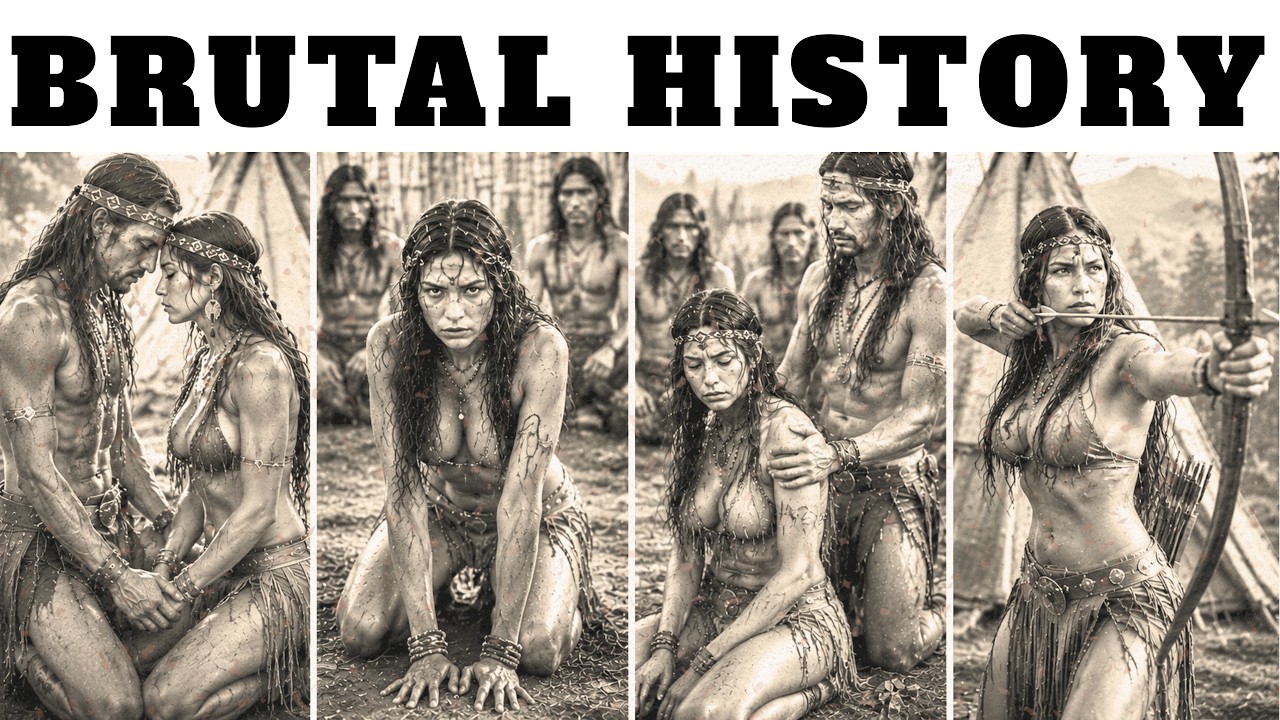
There was no wall between her and the rest of the camp. There was no record anywhere that carried her name. She was not a symbol. She lived here, in a wikiup in the Chiricahua foothills, built from bent willow poles lashed tight and covered in brush and animal hide stretched against the wind.
The ceiling was low enough that a woman could not stand without bending at the neck. The air smelled like juniper smoke and dried venison and the fine dust that never fully lifted. What it cost her body to survive in a world that never once bothered to write her story down began with what she did first every morning, before anyone else in the rancheria was awake. The slow, quiet labor of keeping her own body clean in a landscape that fought her at every step, in a place where water was scarce and time was never her own and privacy was something the land itself did not offer.
She cleaned her teeth every morning with fibrous twigs stripped from juniper or willow. She chewed the end until the fibers splayed into a rough brush and worked it across her teeth and gums. Morris Opler recorded this among the Chiricahua as unremarkable routine, as ordinary as building the morning fire. Hollywood gave the frontier a reputation for rotting teeth and blackened smiles, and for many white settlers that was the truth.
Scurvy, raw sugar, and no dentistry saw to it. But the women in the Apache camps had a daily system that worked. The plant fibers scrubbed. The natural oils in the wood held the gums firm.
A woman who cleaned her teeth every morning kept them. A man who never did lost them by forty. The difference was that simple. She washed her hair with the crushed root of the yucca plant.
Worked in water, that root produced a rich, heavy lather. The saponins inside it were a natural cleanser, and modern chemistry could explain exactly why it worked. But the women who used it did not need a laboratory. Among the Chiricahua, hair was never just appearance.
Its condition told you about a woman’s health and her standing. Cutting it short was a visible act of mourning that the whole band could read. Opler documented specific customs around how hair was kept and what it meant. The movies showed Apache women with loose dark hair blowing in the wind, a costume choice for the camera.
In life, the way a woman washed and wore her hair was a language every person in camp understood without a word being spoken. Skin protection was where the army’s own reports got interesting. Apache women applied mixtures of animal tallow and mineral pigments to their skin. Red ochre, fine clay, not in the theatrical streaks of a movie poster, but evenly and carefully, the way you would apply a balm.
The result blocked the sun in open desert where shade was a luxury. It kept biting insects off the skin near water in summer. It held moisture against wind that could strip a woman’s face raw in a single afternoon of hard travel. John C.
Cremony described these markings in his journals and called them war paint. He was wrong. They were protection. A woman crossing the Chiricahua mountains in July with bare skin and no barrier would blister before she reached the next camp.
The officers, sunburned and peeling inside their wool uniforms, never thought to ask what they were actually looking at. They saw color on skin and assumed ceremony. They missed the science underneath it. Lice were a fact of life on the frontier.
Every army camp was crawling with them. A trooper in the field could go weeks in the same shirt, and the lice settled in by the hundreds. The difference was not the problem. It was the response.
Apache women practiced regular, deliberate delousing as a daily habit, not a reaction to an outbreak, a discipline as automatic as eating. Bedding was aired and shaken. Aromatic plants were rubbed into hides and clothing. Opler described personal cleanliness among the Chiricahua not as a virtue but as a baseline.
It was expected the way silence on a night march was expected. Jason Betzinez, remembering his childhood among the Warm Springs people, recalled the order of camp life as something no one remarked on because it never stopped. The old image of native people as unwashed and crawling with vermin was not just wrong. It was the exact reverse of what the sources said.
The people who carried lice by the thousand were the soldiers in their damp wool. Apache women were the primary healers in camp. They gathered creosote bush from the desert floor and made washes for open wounds. They collected yerba mansa near springs and pressed it into poultices.
These plants contained compounds with real ability to fight infection. Modern laboratories could name those compounds and measure exactly how they worked. The women who used them did not need the chemistry. They had centuries of watching what healed and what did not.
During the same years, army field surgeons were cutting off limbs with saws they had not cleaned since the last patient. They probed wounds with bare fingers. They watched men die of blood poisoning at rates that would end a career today. Germ theory was still fighting for acceptance in American hospitals while Apache women in a desert camp were already practicing its conclusions.
Apache women bathed in cold running water. Streams, rivers, desert springs, not once a week, not when convenient, but as a habit every morning, as constant as building the cook fire, even in cold weather, even when the camps were moving. Cremony observed it again and again across his years in Arizona Territory and wrote about it plainly. The women were clean.
The camps were ordered. The people the United States government classified as savages in official documents washed every single morning. The troopers riding out to hunt them had not touched water in weeks. Water in the Chiricahua homeland was not a convenience.
It was the difference between living and dying in two days. And the vessel that carried it was made entirely by women. The tus was a basket jug woven tight from sumac or willow shoots, then sealed inside and out with heated pitch from the piñon pine. A woman gathered the pitch, melted it over coals, and worked it into the weave by hand.
A well-made tus held water without losing a drop across twenty miles of hard trail. It could last for years. She made it. She repaired it when the pitch cracked in the heat.
She carried it on her back through some of the worst terrain on the continent. And she decided when water was drawn, how much was used, and when the band had to move toward the next source. Today, the average American uses about eighty gallons of water a day and never thinks about where it comes from. An Apache woman carried every drop her family needed on her own back in a jug she built with her own hands.
When a Chiricahua woman gave birth, she did not deliver in the family wikiup. She moved to a separate structure built for that single purpose. The ground was prepared. Herbal teas were made in advance, some for pain, some for cleansing.
Experienced women from the band attended her. The birth position was upright or kneeling, supported by the women at her sides. Modern obstetrics has only recently admitted that these positions are more effective than lying flat on a table. After delivery, both mother and child passed through a defined period of rest and purification before they returned to the main camp.
Opler documented these customs among the Chiricahua in careful detail. Now consider what a white settler woman experienced in the same years. She gave birth in the only bed the family owned, in a cabin where meals were cooked and dirt was tracked in from outside. A neighbor whose hands had been in the garden an hour before held her through the delivery.
Childbed fever killed frontier women at staggering rates. The people Hollywood called primitive had a birth system that was cleaner and safer than anything available to most white women west of the Mississippi. During her monthly cycle, a woman moved to a small separate shelter set apart from the main camp. This was not punishment and not exile.
It was structure. She used absorbent materials prepared from soft inner bark, from cattail down, and from dried grasses. There were dietary guidelines and expectations for rest. The whole system was built around cleanliness and practical management of a biological reality that every human society has had to address.
When a Chiricahua girl had her first cycle, the band stopped everything. They gave her four days. A woman of proven character was chosen as her godmother to guide her through what came next. The girl was bathed from head to foot.
Her hair was washed with yucca root until it shone. Cattail pollen was pressed to her face and body. She wore clothing sewn and prepared for the single occasion. At dawn on the first morning, she ran east toward the rising sun.
Through the nights, she danced. The singers sang. The whole community gathered. She was tested in body, in endurance, in spirit, in front of every person she had ever known.
The ceremony demanded weeks of preparation and real resources from the entire band. It required a level of ritual cleanliness that had no equal anywhere in white America, not in the churches, not in the parlors, not in the frontier towns. It was the most elaborate rite of passage on the continent. And it was not a relic buried in a museum case.
Apache families still hold the sunrise ceremony today. It survived the forced marches. It survived imprisonment at Fort Marion in Florida. It survived a century of Hollywood pretending it never existed.
This was not the whole story. The body she tended still belonged to a life she did not fully control. There was no wedding ceremony the way you imagine one. No priest standing at the front of a room.
No vows repeated after someone. No single sacred moment where two people stood before a crowd and swore forever. The marriage was a process. It unfolded in stages.
Negotiation between the families came first, then a formal exchange of gifts, then a feast prepared by the women of both camps. And then quietly, the groom simply moved to the bride’s camp and began his new life there. Opler documented that the transition could stretch out over weeks, almost business-like in its patience. Courtship did not begin with a glance across a campfire.
A young man who wanted a woman did not approach her directly. He would not have dared. Instead, he sent an intermediary. Often a female relative, an aunt or an older sister, walked to the bride’s family camp and made the case on his behalf.
The family deliberated among themselves. They weighed the young man’s reputation, his family standing, and his ability to provide. And the woman herself could refuse, and the whole thing ended right there. No argument, no appeal.
Goodwin and Opler both recorded cases where the woman said no and the courtship was finished that same day. The real courtship started with a conversation the man was not even part of. The courting flute was real, and it was nothing like what the movies suggest. Young men played a wooden flute outside the family’s wikiup after dark.
The music was not random. Specific melodies carried specific meanings understood by the young woman inside. If she came outside, she was interested in hearing more. If she stayed in, the answer was no, and no words needed to be spoken.
The rejection was silent and it was final. Betzinez mentioned this practice among the Warm Springs people. The actual sound of Apache courtship was a single handmade flute played softly in the dark while a young man sat alone outside a wikiup and waited. Relations before marriage were more openly tolerated than white America ever wanted to admit.
Opler documented that among the Chiricahua, young people were given a degree of physical freedom that horrified every Victorian observer who encountered it. Cremony, writing in 1868 after years of living near Apache bands, acknowledged it plainly but framed it as evidence of what he called savagery. Meanwhile, the exact same behavior in white frontier communities was thoroughly documented in bastardy records, shotgun marriage entries, and church disciplinary minutes across every American territory from Kansas to Oregon. The behavior was identical.
The difference was never the act itself. It was the honesty about it. Marriage was not a union between two people. It was a contract between two extended families.
The bond tied kinship networks into mutual obligation that touched every part of daily life, economic, military, social. When a hunt was organized, married alliances determined who rode together. When a camp moved, the family networks moved as a unit. A marriage that failed was not a private heartbreak between a man and a woman.
It was a diplomatic rupture between entire clans. The bride price was not a purchase. The groom’s family presented horses, blankets, weapons, and goods to the bride’s family before the union could proceed. Opler was direct about this.
It was a demonstration of capability, not a commercial transaction. The groom’s family was proving they could provide, and the bride’s family gave back gifts of equal or greater value in return. It was a mutual exchange, a pledge of investment from both sides. The phrase bought and sold belonged to the colonial writers who imposed their own assumptions onto something they refused to understand.
A man could have more than one wife, but the preferred form followed a strict logic that no western film has ever shown. It was called sororal polygyny. Sisters married to the same husband. Opler explained the reasoning plainly.
Sisters already knew how to share labor and living space. They had grown up in the same wikiup and learned the same rhythms of work. The household ran more smoothly when the women inside it already trusted each other. A man who wanted a second wife from an unrelated family faced real scrutiny and open resistance from both camps.
The movies showed polygyny as unchecked appetite. The Apache practiced it as deliberate household engineering, and the women’s families had veto power over every step of it. If a wife died, her family was expected to offer a sister or close female relative as a replacement wife. This was the sororate.
It was not a suggestion. It was a binding social obligation designed to preserve the alliance between the two families and to keep the dead woman’s children inside the same kinship network they were born into. If a husband died, his brother was expected to step forward and marry the widow. This was the levirate, the mirror of the sororate.
The purpose was the same. The alliance between the two families had to hold. The brother did not choose this. He might already have a wife and children of his own.
The duty came first. Mourning before remarriage was enforced, and you could see it on the body. A widow cut her hair short. She gave away or destroyed every possession her dead husband had owned.
In some bands, she smeared her face and body with ash or white clay so that everyone in the camp could see she was in mourning and know not to approach her with talk of a new match. Remarrying before the mourning period ended, often a full year or longer, brought severe public censure from the entire community. The movies skipped straight from the death scene to the next romance. The Apache made you wear your grief where no one could miss it.
Sometimes the family said no, and sometimes the young couple ran anyway. Betzinez described elopement among the Warm Springs band as something that happened but never without cost. Running was not a love story. It was a crisis.
Elopement shamed both families publicly. It ruptured kinship ties that had taken years to build. And in most cases, the groom’s family had to pay a sharply increased bride price after the fact just to begin repairing the damage. The debt could hang over a young couple for years.
Running away together was not freedom. It was a bill that followed you home and grew larger the longer you waited to pay it. A man who hit his wife answered to her brothers, her uncles, her father, every male relative she had. Opler documented clearly that the wife’s family held both the right and the expectation of physical intervention against an abusive husband.
They did not wait for a complaint to be filed. In extreme cases, the man was beaten and expelled from the camp entirely. He was, after all, living in her world. The wikiup was hers.
The camp was her family’s. He was the guest. Now hold that against American common law in the exact same century. In most states, a husband’s legal right to what the courts called moderate correction of his wife was formally recognized.
A man could strike his wife and the law would look away. Adultery carried consequences, but they were not the same for both sides. A husband who discovered his wife’s infidelity could, in the older custom, cut the tip of her nose. Cremony recorded this in detail.
Opler confirmed the practice existed but noted it was already declining even before the reservation era. The punishment was visible and permanent. But a wife who caught her husband in the same act had her own tools. She could divorce him immediately.
She could shame him in front of the entire camp. And she had the full backing of her armed male relatives if he protested. Both sides faced consequences. That alone set it apart from most legal systems of the same era.
The sunrise ceremony was the gate that made marriage possible. No girl was considered ready for marriage until she had completed it. The United States government banned it. Christian missionaries suppressed it on every reservation they reached, calling it pagan and dangerous.
It survived anyway, whispered from grandmother to granddaughter when no one with authority was listening. It is still performed today at Mescalero in the open with the whole community watching. A man could not look at his wife’s mother. Could not speak to her.
Could not sit in the same space or share the same fire. If she walked toward him on a path, he turned his face away or left the trail entirely. This was the mother-in-law avoidance taboo, and it was absolute. Violation brought genuine spiritual dread and lasting social ruin.
Opler devoted page after page to it. Goodwin confirmed it across every western Apache band he studied. It shaped the physical layout of entire camps. It dictated who could eat together, who could enter which dwelling, who had to leave the fire when another person arrived.
The groom did not ride home with the bride sitting behind him on the horse. He did the opposite. He left his own family and moved to her camp. Matrilocal residence.
The most basic structural fact of Apache marriage and the single fact most completely absent from the popular imagination. He built a new wikiup near her mother’s dwelling. He hunted for her parents. He performed bride service, months or sometimes years of labor for her family, before the community fully recognized the marriage as settled.
In every practical sense, the man was on probation in his wife’s world. The image of the warrior sweeping the woman onto his horse and riding back to his camp was the exact opposite of what actually happened. The wikiup belonged to the wife. She built it with her own hands or directed its construction.
She owned every object stored inside it. The food she gathered through the seasons, acorns, mescal hearts, berries, wild seeds, all of it was hers. The household economy ran through the woman. The man contributed game from the hunt, but the home itself and everything kept within its walls was her property alone.
If she decided he no longer belonged there, he did not. A Chiricahua woman could end her marriage by placing her husband’s belongings outside the wikiup door. No filing with an authority, no hearing before a council, no waiting period. She gathered his things, set them on the ground outside, and the marriage was dissolved.
He went back to his mother’s camp. She kept the home. She kept the children. She kept the household property.
Opler recorded multiple accounts of this from Chiricahua informants who saw it happen or experienced it themselves. Now set that beside American law in the same decade. In most states during the 1850s and 1860s, a white woman could not divorce her husband without first proving extreme cruelty or total abandonment before a judge. The legal process could drag on for years.
It could cost more money than she would earn in a lifetime. And even if she won, she might still lose her children at the end of it. When a marriage ended, the children stayed with the mother. There was no argument about it.
Clan membership among the Apache was matrilineal. A child belonged to the mother’s clan from the moment of birth, not the father’s. In the event of divorce, there was no custody hearing, no petition. The children remained with the woman as a simple matter of course.
In the same century, English and American common law treated children as the legal property of the father. The tender years doctrine, the idea that young children belonged with their mother, did not gain broad legal ground until decades later. The Apache system protected the mother’s bond as the unquestioned default. The system the settlers brought with them severed it.
Add it up. The right to own the home. The right to keep everything she gathered and built with her own hands. The right to divorce without a petition, without a court, without anyone’s permission.
The right to keep her children when the marriage ended. The backing of armed male relatives against any husband who raised his hand to her. She carried what wifehood demanded of her, and she carried it in the body she had just fought to keep clean. The same hands that crushed yucca root at the creek were the hands that cooked and hauled and bore weight and tended children through fever and drought and seasons that offered no rest.
She bore it in silence because silence was the only thing the arrangement left room for. But this was only half the story. The frontier had another woman, the settler wife, and her experience was built on a different set of rules entirely. Lydia Allen Rudd crossed the plains in 1852 and kept a diary every day.
She described weevils in the flour as ordinary. Meat turning green within hours. Cooking over buffalo chip fires that flavored everything with the taste of dung smoke. There was no refrigeration.
A slaughtered hog drew flies within minutes in summer heat. A frontier wife skimmed maggots from the salt pork barrel and served what was underneath because the other option was nothing at all. Amelia Stewart Knight, crossing the plains pregnant with her eighth child in 1853, recorded feeding seven children from a wagon bed in the rain. The fuel was too wet to burn.
The food was half raw. She served it anyway. Her teeth were falling out of her head. Every pregnancy leached calcium from a woman’s bones and teeth.
A woman who bore six or eight children could lose a tooth with each one. By forty, many frontier wives had few teeth left at all. The old saying was not folklore. A tooth for every child.
Dr. Bethenia Owens-Adair, one of the first licensed female physicians in Oregon, described pulling teeth from her own patients with blacksmith pliers and no anesthesia. No frontier dentist was coming. A husband or a neighbor held her down and pulled.
Katherine Haun crossed the plains in 1849 and is one of the only diarists who referenced menstruation at all. She described the difficulty of managing what she called the monthly trouble on the trail. No privacy, no clean water, no product of any kind. Commercial menstrual products did not reach the American market until the 1890s.
For fifty years of frontier settlement, women used rags, scraps of worn out clothing, or nothing. They did this while hauling water, walking fifteen miles beside a wagon, plowing sod, and nursing infants. Molly Dorsey Sanford kept a diary through the late 1850s in Nebraska Territory. She described bed bugs falling from the sod ceiling onto sleeping faces in the dark.
Snakes nesting inside the dirt walls. Centipedes dropping into the cookpot. A sod house was not built. It was cut from the earth and roofed with grass.
It was also a living habitat. Lice, fleas, bed bugs, and rattlesnakes lived in the walls and the ceiling. When it rained, the roof turned to mud and dripped insects and filth into the food, the bedding, and the children’s hair. A wife could sweep and scrub and boil the linens from dawn to dark.
And by nightfall, the vermin were back. She fought that war every single day. She never once won. No indoor plumbing reached most rural homes until well into the twentieth century.
A chamber pot sat beside the bed. An outhouse stood forty or fifty yards from the house. In winter on the northern plains, the walk to the privy was through knee-deep snow and below-zero wind. A wife emptied and scrubbed that pot for every member of the family every morning with cold water and bare hands.
At frontier army posts like Fort Laramie, officers’ wives wrote letters home describing the stench of the post privies as inescapable in the summer heat. Those were the privileged women. The homestead wife had no one but herself. Wash day was the hardest labor she did all week.
Monday, every week without exception. Haul water from the well or the creek. At eight pounds per gallon, a single wash for a family of six required roughly fifty gallons. That is four hundred pounds of water carried by hand before the first garment touched the washboard.
Heat it over an open fire. Shave soap from a block of lye made from wood ash and rendered animal fat. Scrub every piece on a ridged board until the dirt broke loose. Wring it by hand.
Hang it. Start again. Ten to twelve hours. The lye soap cleaned the cloth.
It also ate skin. A washerwoman’s hands were cracked raw and bleeding by evening. Amelia Stewart Knight gave birth to her eighth child on September 17, 1853, the day after her wagon reached the Columbia River in Oregon. She had walked and ridden across the entire continent for five months, pregnant, caring for seven children.
Her diary entry for the birth is two sentences long. Before germ theory reached common practice in the 1880s, childbed fever killed roughly one woman in every eight births in some frontier counties. The 1850 through 1870 census mortality schedules recorded it as a leading cause of death for women of childbearing age in western territories. There was no hospital.
Often no midwife, no trained doctor within a hundred miles. If the birth went wrong, a breach, a hemorrhage, there was no intervention. She lived or she did not. Dr.
Owens-Adair was married at fourteen and bore a child at fifteen in a remote Oregon cabin. She nearly died. Years later, she became a physician specifically because of what she survived. She was not a person under the law.
William Blackstone wrote it into English common law, and every American territory carried it forward. By marriage, the husband and wife are one person in law. That is, the very being or legal existence of the woman is suspended during the marriage. That is the doctrine of coverture word for word.
A married woman in the territories could not own property in her own name. Could not sign a contract. Could not keep her own wages. Could not sue or be sued.
Could not retain custody of her own children if the marriage ended. Her husband owned her labor, her earnings, her inheritance. In legal terms, her body. She buried her own children, and then she did it again.
The 1850 through 1880 census mortality schedules tell the story in numbers. Child mortality under the age of five ran between one in four and one in three across many frontier counties. Cholera, dysentery, measles, diphtheria, scarlet fever. A scratch that became an infection with no medicine to fight it.
A woman on the trail writes a single line. The baby died this morning. The next day’s entry records the miles traveled. A mother sewed the burial clothes from her own scraps of fabric.
A father dug the grave if he was there. If he was not, she dug it herself. On the trail, the grave was beside the road, unmarked or marked with a board that would not last a single season. She walked away from it and kept moving west because the wagon train did not stop for grief.
She was almost always pregnant with the next child while burying the last. No birth control existed. No legal right to refuse her husband under coverture. This was the world that met the Apache woman when her own world was taken from her.
She lost the wikiup. She lost the ranchería. She lost the grinding stone and the creek and the hide she had been scraping that morning. She lost the structure that had confined her and discovered that what replaced it was worse.
Apache women were not bystanders. They were the operating system of every band in the Southwest. Morris Opler recorded it from Chiricahua elders in the 1930s. The women built and owned the wikiups.
They processed every pound of dried meat, every pouch of mesquite flour. They made the tools, the baskets, the cradle boards, the clothing. They decided when a camp moved and how the march was organized. Cremony put it plainly.
A band without its women was finished. When the army captured Apache women, it was not taking hostages. It was pulling the engine out of an entire people. Captured Apache women were not quietly led away.
They were displayed. Mexican military dispatches from Sonora and Chihuahua described captives marched through town plazas. The governor watching from a balcony. The townspeople lining the street.
Territorial newspapers in Tucson and Santa Fe printed the arrivals the way a stock report lists cattle. A living Apache woman in chains through the plaza of Arispe was worth more to a general’s career than any written dispatch. Mexico ran an open market in Apache captives for the better part of a century. The evidence sits in parish churches along the northern frontier.
Baptismal ledgers in Janos, Bavispe, and Chihuahua City record Apache children appearing under Spanish names assigned to Mexican households on the same page where their Apache identities vanish. A child seized from a ranchería in the Sierra Madre could be kneeling at a font with a new name before the month was through. The practice was legal under Mexican law. One entry in a leather-bound book, a few words of Latin, and a family line stretching back generations was snapped in two.
The scalp bounty system put a cash price on the hair of Apache women and children. Governor Ángel Trías of Chihuahua published the schedule in 1849. A warrior’s scalp brought two hundred pesos. A woman’s brought one hundred fifty.
A child’s brought one hundred. The American hunter James Kirker built a career on these contracts. A woman’s hair dried and stretched on a willow hoop was legal tender at the treasury window in Chihuahua City. The receipts were signed, the payments logged.
It was government policy, and the paper trail is intact. The war that defined a generation began over the bodies of a mother, a wife, and three small children outside a Mexican town. In 1851, near Janos in Chihuahua, Mexican soldiers under Colonel José María Carrasco attacked an Apache trading camp while the men were in town. A young warrior returned to find his mother, his wife Alope, and his three children dead on the ground.
His name was Goyahkla. He said later that in that moment, he had no purpose left. The world would know him as Geronimo. He dictated the memory to S.
M. Barrett in 1906. Forty years of war followed. It did not start on a battlefield.
It started in the dirt outside Janos. The Camp Grant Massacre was designed to kill Apache families in their sleep. April 30, 1871. A vigilante force out of Tucson, Americans, Mexicans, and Tohono O’odham fighters, attacked a sleeping camp on Aravaipa Creek at dawn.
The men were away. Between one hundred and one hundred fifty people were killed, nearly all of them mothers, grandmothers, and young ones. Lieutenant Royal Whitman, the army officer who had accepted these Apache as peaceful, arrived too late. Twenty-nine children were pulled alive from the wreckage and carried south into Sonora.
They were handed over to Mexican households. President Grant called it purely murder. One hundred four men stood trial in Tucson. The jury took less than nineteen minutes.
Every defendant walked free. Apache children were sent to the Carlisle Indian School in Pennsylvania, and some were buried there. Richard Henry Pratt founded Carlisle in 1879 on a public philosophy. Kill the Indian, save the man.
Chiricahua children pulled from the prison camps were among the first students. Their clothing was taken, their hair was cut, their names were replaced on enrollment cards that survive today. Tuberculosis moved through the dormitories. There is a cemetery at Carlisle where Apache students lie under white stones a thousand miles from the desert they were born in.
When Geronimo surrendered in September of 1886, the army imprisoned every Chiricahua Apache it could reach. General Nelson Miles ordered four hundred ninety-eight people loaded onto trains at Holbrook, Arizona, and shipped to Fort Marion, Florida. Among them were families of scouts who had served the army against Geronimo. A scout named Chatto, who had ridden with American soldiers through the Sierra Madre, watched his wife and children loaded onto the same rail cars as the people he helped capture.
He had received a silver medal in Washington. He had been promised protection. He received a prison sentence with no charge and no end date. Fort Marion was a Spanish coastal fortress built to repel warships.
It was never meant for families. Constructed beginning in 1672 as the Castillo de San Marcos, it was coquina stone, low casemates, and damp corridors open to Atlantic salt air. Post surgeons documented overcrowding in rooms built for cannon powder, standing water on the floors, tropical humidity pressing into lungs that had spent a lifetime in thin desert air above six thousand feet. Apache women cooked over open fires in chambers with no ventilation.
Their children slept on damp stone. The sickness started within weeks. The army split families by three hundred miles of open water and called it security. The men, Geronimo and Naiche among them, went to Fort Pickens on Santa Rosa Island near Pensacola.
The women stayed at Fort Marion in St. Augustine with every child in the band. No letters, no visits, no reunion date. Army correspondence confirms it was deliberate.
The family stayed apart for over a year. Not one word was written by an Apache woman. What the women thought and felt survives only in oral histories their descendants shared long after the camps were closed. In 1888, the prisoners were moved to Mount Vernon Barracks in Alabama.
It was supposed to be better. The dying got worse. The barracks sat on low, swampy ground with poor drainage. Mosquitoes bred in every ditch.
Malaria joined tuberculosis and dysentery. Approximately one in four Chiricahua prisoners died during the Florida and Alabama years. The army’s own medical records set the floor. At Mount Vernon Barracks, Apache mothers buried their children in Alabama red clay they had never chosen and could not leave.
The post cemetery holds the names. Small graves marked with Apache names spelled by clerks who could not speak the language. Missionary women arrived in the camps with Bibles and sewing kits, and attendance was compulsory. Apache women at Mount Vernon Barracks and later Fort Sill were required to sit through classes in English, sewing, and Christianity.
Their own spiritual practices were discouraged or forbidden. A woman who had managed the movement of an entire band across a thousand miles of desert was expected to sit in a chair and learn to hem an apron on schedule. Apache women were also put to work making goods for sale, and the government called it training. They sewed military garments and crafted items sold to tourists who came to gawk at the famous prisoners.
They did not volunteer. They were not paid a wage they controlled. A woman stitching government cloth under armed guard is not learning a trade. She is serving a sentence no court ever handed down.
Her name was Lozen. She may have been the most remarkable Apache figure of the nineteenth century, and almost no one has heard of her. She was the sister of Victorio, chief of the Warm Springs band. Warriors described her as a gifted fighter, a strategist, and a healer who could sense the direction of an enemy by the feeling in her hands.
She rode with Victorio and later with Geronimo. After the 1886 surrender, she was shipped to Mount Vernon Barracks. She died there of tuberculosis around 1889. No confirmed photograph of her exists.
No army clerk marked her death with more than a line in a ledger. We know her name only because James Kaywaykla told her story to Eve Ball when he was an old man and she was willing to listen. Children born inside the camps had never seen the land their mothers described to them. Born at Mount Vernon Barracks, born at Fort Sill.
Army records list them by name. Prisoners of war from their first breath. They had taken no side. They had committed no act.
They were held because of who their mothers were. Today, roughly ten thousand people are enrolled in the Fort Sill Apache tribe. Many trace their ancestry directly to the women who survived those camps. The Chiricahua were held as prisoners of war for twenty-seven years, 1886 to 1913.
No trial, no conviction, no individual charge against any woman, child, or elder. When they were finally released, they were not allowed home. They could take land near Fort Sill or move to the Mescalero reservation in New Mexico. Arizona was not an option.
Twenty-seven years without due process. It is the longest imprisonment of any group in United States history. The women who helped the army were punished the same as the women who fought it. The wives of every scout who tracked Geronimo at the army’s request.
They chose the American side. Their reward was identical to the punishment. The same trains, the same stone fortress, the same Alabama barracks, the same tuberculosis, the same graves. Army paperwork shows no distinction was ever drawn between the families of allies and enemies.
More Apache women and children died of disease in government custody than were killed in battle during the entire Apache Wars. The Camp Grant dead, the Fort Marion and Mount Vernon dead, the students who never walked out of Carlisle. Set them against every battlefield casualty across four decades of conflict. The comparison is not close.
The slow death in custody dwarfs the combat toll. Army surgeon reports documented it in quarterly tables. Post burial records survive in government archives and have been there for more than a century. The twenty-nine Apache children taken from Camp Grant were sold into Mexican households.
The United States government never brought them home. On that April morning in 1871, at Aravaipa Creek, the vigilantes pulled twenty-nine children from the wreckage. Most were under ten. They were taken across the border into Sonora and given to Mexican families within weeks.
They were baptized under Spanish names in parish churches. Their Apache names went unrecorded. Whitman filed his report. Grant demanded action.
Diplomatic letters went south. Mexico did not comply. The children had been baptized. Under Mexican law, they were now citizens of another country.
With new names and new families, the United States could have pressed harder. It did not. The file was closed. The children were never recovered.
Their ages were in army files. Their location was not a mystery. They were findable. And nobody went to find them.
Every one of these truths lived in the same body on the same day. The woman who split yucca root into a lather before dawn was the same woman who bore children inside a marriage she did not negotiate and was marched barefoot across ground she had once known as home into a life no one had a name for. What we have separated into separate chapters was for her a single life lived whole and without rest, in a body the myth could not afford to show. The wikiup is gone now.
The willow poles have bent back into the hillside, and the brush and hide coverings rotted into the soil decades ago. The grinding stone is half buried where she left it. No film crew ever came to this clearing. No studio ever sent a camera to record what she carried in her hands and in her body.
The land still holds what the record would not. She was real. The myth was the invention.






