The evening of November 14th, 1983, Floyd Tacket came back to the main farmhouse to return a set of fence pliers he had borrowed from his father’s shop. He was tired, cold, and irritated, having spent three hours tracking a heifer that had gotten through a fence into the timber along the north boundary. His father, Jean, was sitting at the kitchen table with a cup of coffee. His mother, Connie, was at the stove heating soup.
Floyd sat down because his feet hurt and because his mother’s soup was better than whatever his wife Fay had planned. Then his father looked at him across the table with an expression Floyd had never seen on his face. It was not worry exactly. It was the look of a man who had been holding something back for a long time and had decided, for reasons of his own, that the holding was done.
“Clyde, how far into the north timber did you go today? ” Jean asked. Floyd told him he had gone about a mile past the fence, following the heifer’s tracks up the first ridge and down into the hollow where Piney Branch forks into two smaller creeks. His father nodded slowly and asked if he had noticed anything while he was in there.
Floyd said he had noticed it was steep and cold and full of deadfalls. His father asked if he had seen any tracks. Floyd said he had seen the heifer tracks and a lot of deer tracks and what he thought was a bear track near the lower fork. “Not a bear,” his father said.
“What you saw was not a bear. ”
Then Jean told him. He told him about sweet potatoes disappearing from the root cellar starting in about 1958, five or six at a time, maybe ten pounds total, taken at intervals of a week or two during the fall and early winter. The door was never forced, the latch never broken, but the pin would be pulled and the door left slightly ajar.
He told him about the footprints he found in the soft ground outside the door, bare footprints, humanlike in shape, with five distinct toes and an arch and a heel strike pressed deep into the mud. Jean measured one with a stick he marked and later held against a yardstick. It was sixteen and a half inches long. Jean told no one.
He bought a heavier latch in Berryville, one that required lifting a metal bar and sliding it sideways through a bracket. The theft stopped for about three months. Then it resumed, and when he checked the new latch, it had been operated correctly. The bar had been lifted, slid sideways, the door opened, the sweet potatoes taken, and the door closed again, though the bar had not been replaced.
Whatever was taking his sweet potatoes understood how a latch worked. Jean carried it alone for a quarter century. He told his wife Connie at some point in the early sixties, and her response was to start leaving extra sweet potatoes near the root cellar door so that whatever was coming would not need to go inside. The system worked.
She would set out a wooden crate near the root cellar door in the evenings, loaded with sweet potatoes, sometimes supplemented with windfall apples or corn left on the stalk past its prime. In the morning, the crate would be empty, the root cellar undisturbed. The arrangement was maintained in total silence by both parties for over twenty years. Then Jean told Floyd the thing he had been sitting on for three years.
In the fall of 1980, Jean had been checking the fence line along the north boundary at dusk. He heard a sound from the timber, a low hum that rose in pitch and then dropped again, held for four or five seconds like someone running a bow across the lowest string of a bass fiddle. It came from uphill, maybe two hundred yards into the forest, and it was answered almost immediately by a second sound from deeper in the drainage. The two sounds went back and forth three times.
Jean said he felt like he had walked into a room where two people had been talking about him and stopped when he entered. Observed, assessed, known about. After the sound stopped, he turned to walk back toward the barn and saw something standing at the edge of the timber about a hundred and fifty yards north of the fence. It was standing upright between two large white oaks, and it was tall enough that the lowest branch of the nearer oak, which Jean had trimmed to eight feet the previous spring because it hung over the fence, was below the level of its head.
Jean estimated its height at between seven and a half and eight feet. It was broad across the chest and shoulders, covered in dark hair, with arms that hung well past where a human’s arms would end, hands open at its sides, fingers spread. It was looking at him, at his face, with an intentionality that Jean said felt like being read. They stood there for maybe thirty seconds.
Then it turned, a fluid and deliberate turn involving the coordinated rotation of shoulders and hips, and walked into the timber. A thing that size, moving through dry October leaves and down branches, and the forest barely registered its passage. Jean went home. He did not tell Connie until that night in bed.
She listened and said, “Well, I figured it was something like that. ” A woman who had been feeding an unknown being for over twenty years, filing it under the same mental category as feeding the barn cats. There was a hungry mouth out there. You fed it.
You did not need to understand it to accommodate it. Jean finished his story and looked at his son. “I am telling you this because Leland is walking now, and Daryl will be soon, and they are going to play in those fields the same way you did, and you need to know what is in the timber beyond the north fence. It has never come past the fence.
It has never threatened me or your mother or any of the stock, but it is there, and it has been there longer than we have, and I believe it has been watching this family for as long as this family has been on this land. ”
Floyd ate his soup. He drove home to Fay and the boys. He did not sleep.
At around two in the morning, he put on his boots and his coat and walked out to the north pasture and stood at the fence line and looked at the timber. The November sky was clear, the moon about three-quarters full, the woods silver and black. He stood there in the cold and listened. For about twenty minutes, he heard nothing but the ordinary sounds of a farm at night.
The cattle shifting in the lot near the barn. A barred owl calling somewhere east. The creak of a fence post as a gust of wind pushed against the wire. Then he heard it.
The sound his father had described. A low, steady vocalization from the timber directly ahead of him, maybe three hundred yards up the first ridge. It lasted about five seconds, rose slightly in the middle, and faded at the end like a note held on an organ and then released. It was answered from farther away, higher up the ridge, by a second voice slightly higher in pitch and shorter in duration.
The two sounds repeated twice more, and then the forest went silent again. Floyd stood at that fence for another half hour. Nothing else happened. He went home, sat at his kitchen table, and wrote down everything his father had told him and everything he had heard.
He dated the entry November 15th, 1983, and put it in a spiral-bound notebook he kept in his nightstand drawer. That notebook is now one of seven, forty-one years of entries. The decision to start feeding them himself came about three weeks later. His parents had maintained the crate system for decades, but it was passive.
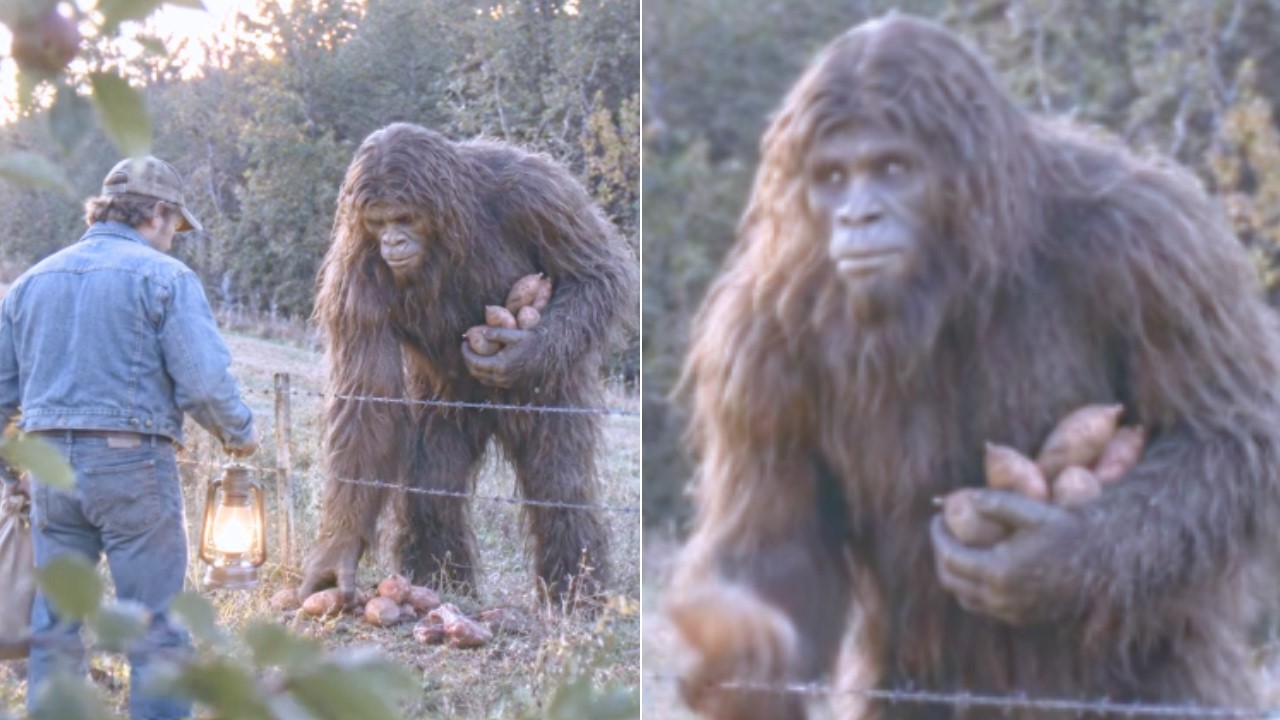
Floyd wanted more. In early December of 1983, he began taking food to the north fence line in the evening around dusk, leaving it on the ground on the forest side of the fence. Sweet potatoes, usually eight or ten at a time. Apples from the cold storage in the barn.
Venison from the deer he had taken that season, trimmed and wrapped in butcher paper. Field corn, dried and still on the cob. He also brought a wool blanket he no longer needed, folded and placed beside the fence post. In the morning it was gone.
A week later, he found it in the timber fifty yards past the fence, draped over a low-hanging cedar branch, held down with stones at the corners. It had been used. The wool was matted and carried the heavy musk he had come to associate with the primary male. For the first eleven nights, nothing happened while he was there.
On the twelfth night, December 21st, the winter solstice, he was standing at the fence at about 5:45 in the evening with a pile of sweet potatoes and a hind quarter section of venison at his feet on the forest side, and he heard movement. Heavy, bipedal, coming from directly ahead of him. It was not trying to be quiet. It was walking toward him at a normal walking pace, a cadence of two beats, left, right, left, right, spaced at intervals that suggested a stride length far exceeding his own.
He wanted to run. Every lesson about self-preservation was screaming at him to turn and walk fast back toward the barn and the lights in the house where Fay was putting the boys to bed. But his feet did not move. Something understood that running would end the relationship before it started.
It stopped about sixty feet from him. He could hear it breathing, deep, slow, rhythmic exhalations that produced small clouds of vapor in the cold air. He could smell it, a scent heavy and organic like fresh-turned earth mixed with the musk of a large mammal, with a sweetness underneath that was not unpleasant. He spoke.
He did not remember deciding to speak. The words just came. “I brought you some food. Sweet potatoes, and some venison.
It is cold tonight. You take what you need. ”
The breathing stopped for about three seconds. Then it resumed, and he heard a soft tonal exhalation, shorter than the vocalizations he had heard from a distance, more controlled, directed at him.
It lasted about two seconds, with a pitch that rose slightly at the end. He interpreted it, rightly or wrongly, as acknowledgment. Then it moved, not toward him, laterally along the tree line, angling toward the pile of food. He heard the rustle of butcher paper being handled, a pause, the sound of sweet potatoes being gathered several at once, and the creak of its weight shifting as it lifted the load.
It walked away uphill, and within thirty seconds the sound of its passage faded into the ordinary noise of the forest at night. Floyd stood at the fence for another ten minutes, breathing hard, his hands cramped from gripping the wire. Then he walked home and wrote in his notebook: “December 21st, 1983. Made first direct contact.
It came within 60 ft. It took the food while I was present. It responded to my voice with a vocalization I have not heard before. I believe it understood that I was not a threat.
I believe I was not afraid. ” That last sentence was a lie. He was terrified. The days after that were the strangest of his life.
The ordinary world felt like a painted backdrop. Behind it was a truth so large it crowded out everything else. There was a family of beings living in his timber that were not human and not any known species and stood eight feet tall and understood how a latch worked and communicated with structured vocalizations. Fay noticed.
She did not say what she noticed, but she started putting a thermos of coffee in the canvas bag with the evening food. She started leaving the porch light on until he came home. She started sitting up in bed reading when he got back at nine or ten at night, even though she had to be up at five to start the school bus route she was driving that year. About two weeks after the sighting, he told her everything.
Fay listened with her hands wrapped around her coffee mug and her eyes on the table, and she did not interrupt. When he finished, she was quiet for a full minute. Then she looked up and said, “How many portions of cornbread should I be wrapping? ”
Every night through the rest of that winter, he went back.
By the end of January, the distance between them at feeding time had closed from sixty feet to about thirty. By March, it was coming to within fifteen feet of the fence. By the following autumn, it was taking food from the ground less than ten feet from where he stood. He had not yet seen it clearly.
Every encounter happened in near darkness after sunset. He could see the shape of it, a massive silhouette taller and broader than any person he had ever stood near. He could see the movement of its arms as it gathered the food. He could see occasionally the reflection of ambient light in its eyes, a brief flash of reddish gold.
But the details of its face were hidden by the dark. That changed on a night in October of 1984, almost exactly a year after his father’s kitchen table confession. Floyd had begun bringing a small kerosene lantern to the fence line, turned down to its lowest setting. He had introduced it gradually, and each escalation in light had been met with a longer retreat distance from the subject, followed by a gradual return to its previous proximity over subsequent nights.
On this night, the food was placed at the edge of the circle of amber light, half in light and half in shadow. The shape appeared at the tree line and stopped farther back than usual, maybe forty feet, assessing the light. It came forward slowly, its footsteps deliberate and evenly spaced. It entered the lantern light at the edge where the glow was dim enough to preserve most of the darkness.
And for the first time in eleven months of nightly contact, Floyd saw it. The height registered first. Just over eight feet tall, shoulders roughly four feet across. The hair was not dark as he had expected.
In the amber kerosene light, it was a deep tawny brown, the color of late-season oak leaves before they dry out and darken, dense and uniform, covering the chest, arms, shoulders, and upper legs. The face was partially covered with shorter hair along the jaw and cheeks, with a bare region around the eyes and nose that was dark skin, almost charcoal colored. The brow was heavy, deeper and more prominent than any human brow, casting the eyes into shadow even in direct lamplight. The nose was broad and flat with nostrils that flared visibly as it sampled the air between them.
The mouth was wide, the lips thinner than a human mouth, clearly defined and closed. The jaw was massive, heavy bone. But the eyes were the thing that separated what he was looking at from anything he could file under a known species. They were brown, dark, set deep under that brow ridge.
And they were looking at him with the expression of someone who was processing information rapidly, evaluating risk, calculating outcomes, making decisions in real time. The expression of a mind at work. They stood there looking at each other. It might have been thirty seconds.
It might have been three minutes. At some point during their mutual observation, it blinked. A slow, deliberate blink, both eyes closing and opening in a way that felt intentional rather than reflexive. The effect on Floyd was immediate and physical.
The tension in his shoulders released. His grip on the fence wire loosened. His breathing slowed. It reached down and picked up the sweet potatoes, one at a time, placing them in the crook of its left arm the way a person carries firewood.
Its hands were enormous, easily twelve inches across the palm, with fingers that were thick and long and moved with a dexterity that surprised him. The hands were bare of hair and deeply creased. Working hands. It picked up the last sweet potato, shifted the load, looked at him one more time, and walked back into the timber.
Floyd drove home at fifteen miles an hour on the county road because his hands were shaking too badly to steer at any higher speed. He sat in his truck in the driveway for twenty minutes before going inside. He told Fay the full truth. She asked three questions.
Was it dangerous? Had it ever come onto the part of the property where the house and barn were? Was he planning to stop feeding it? He said he did not believe it was dangerous, it had never been seen south of the north fence, and no, he was not planning to stop.
She was quiet for a while. Then she said, “You are going to need more sweet potatoes. ”
Fay became as integral to the feeding operation as he was. She expanded the sweet potato patch by a quarter acre.
She started saving kitchen scraps, organ meat from butchering, overripe fruit from the orchard. She packed the evening loads in canvas bags, and she never once asked to come with him. The winter of 1984 into 85 was the first full winter of direct feeding. Floyd missed four nights total, all of them during an ice storm in late January that made the pasture impassable and dropped branches across the road.
On the fifth night, when he returned to the fence with a double load of food to compensate, the food from the ice storm nights had already been replaced. Sitting on his side of the fence, lined up neatly on the ground, were three items. A piece of quartz crystal about the size of his thumb, smooth and clear. A cluster of wild grapes, dried, arranged on a piece of bark.
And a rabbit, freshly killed, still warm, with a single clean wound to the base of the skull that suggested it had been dispatched with a blow from a stone or a piece of hardwood. This was not a wild creature taking food from a reliable source. This was reciprocity. A being that understood the concept of exchange, of obligation, of gift.
The rabbit was practical. The quartz and the dried grapes were not. They were offerings, the kind of thing you bring when you want to maintain a relationship, not just a feeding schedule. Floyd took the rabbit home and ate it.
Fay asked where he got it. He told her it was a gift. She seasoned it with salt and pepper and put it in the oven and did not ask any further questions. That winter, Floyd started walking the north timber every Saturday morning, not looking for them, looking at what they left behind.
He measured over thirty individual bare footprints in the creek mud that winter, average length sixteen inches, stride between prints on flat ground measuring between four and a half and five feet. A human male of average height has a stride of about two and a half feet. He found stripped bark on tulip poplars, peeled in vertical strips starting at about seven feet and extending to nine or ten, with horizontal scrape marks that looked like fingernail grooves. He found deer remains wedged into the forks of trees at heights no coyote or bobcat could reach.
He found rest sites, patches of forest floor where the leaf litter had been swept aside and compressed into shallow depressions, each large enough for a body considerably bigger than his. Three of these sites were clustered together in a hollow about a quarter mile north of the fence, and the depressions were warm to the touch when he found them early on a January morning. He was standing in their bedroom. He stepped back and retraced his path out of the hollow without touching anything else.
He told his father about the evidence. Jean said he had found similar signs for years but had not cataloged them. He said his mother had once found a pile of sorted acorns near the root cellar, separated by size into three distinct groups with the largest on one side and the smallest on the other. “Well,” she had said, “somebody is organized.
”
Over the next two years, the relationship deepened. By the summer of 1986, the primary male was standing within arm’s reach of Floyd on the forest side of the fence while he placed food on the ground. Floyd could feel the heat radiating from its body. He could differentiate its scent from the general forest smell the way you can differentiate one cow from another in a herd by its markings.
During this period, he realized there was more than one. He detected a second scent, lighter and slightly sweeter, and began hearing vocalizations from closer to the fence that were higher in pitch. One evening in August of 1986, he caught a glimpse of a second shape in the timber behind the primary male, smaller by at least a foot, with hair that was lighter, more of a chestnut shade. The second individual was female.
He reached this conclusion based on her smaller size, her lighter coloring, and the way the primary male positioned himself between her and the fence during every encounter. He was shielding her, placing his body between her and the potential threat. Floyd recognized the behavior because he had seen it in his bull. The two were bonded.
They were a pair. In the fall of 1987, Floyd confirmed that the pair had produced offspring. He heard sounds from the timber that were higher pitched, shorter, less controlled, with a wavering quality that reminded him of a toddler trying to imitate adult speech. He never saw the juvenile during that first year, but he found small handprints in the mud near the feeding site, five to six inches long, with proportions that matched the adult prints in miniature.
A family was raising a child within a mile of the fence where he stood every evening. He adjusted the food supply, increasing quantities and diversifying offerings. Fay, without being asked, started baking cornbread in large batches, wrapping individual portions in wax paper. The portions of cornbread were always taken first before the raw foods.
On one occasion, Floyd found the wax paper wrappers arranged in a line on a flat rock near the fence, smoothed out and weighted with pebbles, as if the paper itself had been considered worth examining. By 1989, the family at the fence line had grown to include at least three individuals in addition to the primary male: the female, a juvenile he estimated at roughly four years old based on the progression of its handprints, and a second smaller juvenile whose prints first appeared in the spring of that year. Floyd was clear about what the arrangement was and was not. It was not domestication.
They were not becoming dependent on him. The food he provided was supplemental, a fraction of what they consumed. He found evidence throughout the property of their own foraging, kills of deer and feral hogs, berry patches stripped, nut caches buried along the creek banks. What he provided was a bonus, a reliable caloric supplement that reduced the risk and effort of foraging during the leanest months.
But the food was also a language. Every night he stood at that fence with food in his hands, he was saying, “I am here. I mean you no harm. I have something to give you.
” And every night the primary male walked out of the timber and accepted what he offered. In the spring of 1990, the primary male brought the female to the fence, not lurking in the background fifty feet back in the timber, but walking beside him, and the two of them stopped together within ten feet of where Floyd stood. The lantern was burning low. His face was familiar.
Hers was different, narrower through the jaw, finer in the features, with lighter, softer-looking hair, almost chestnut. Her eyes were not brown. They were a grayish amber color that caught the lantern light differently, and they held an expression that Floyd could only describe as weary hope. She wanted to trust him.
She was not there yet, but she was trying. The primary male looked at her and made a short vocalization, a single soft tone Floyd had not heard before. The female stepped forward and picked up an apple. She held it in both hands and turned it over, examining it, and then she bit into it.
The sound of her teeth breaking the skin of that apple is one of the clearest audio memories Floyd has. She ate it standing there three feet from his outstretched hand. When she was done, she looked at him and blinked, the same slow, deliberate blink the male had given him on the night he first saw his face. The next evening, Floyd brought double the usual amount of food, spreading it along a wider section of the fence.
He brought more fruit, less raw meat, and honey in a jar with the lid off so the scent would carry. The female came forward with less hesitation than he expected. She stayed a half step behind the male, her left hand resting against his forearm. She picked up a sweet potato, turned it over, smelled the skin, and set it aside.
She picked up an apple, bit into it, and ate it in four deliberate bites, holding the core in her hand when she was done and examining it as if the architecture of seeds and chambers was worth studying. She picked up the jar of honey. She sniffed the opening. She tilted it slightly and watched the honey move thick and slow in the cold air.
Then she dipped two fingers into the jar and put them in her mouth and her eyes closed. Not a blink. Her eyes closed and stayed closed for three full seconds. Her shoulders dropped and her body relaxed in a way Floyd had never seen in either of them.
She had tasted honey before. The recognition in her response was too immediate to be a first experience. She finished the jar. She set it on the ground upright with the opening facing up, and she looked at Floyd and made a sound he had not heard from either of them.
A short, soft vocalization with a falling pitch, almost musical, that felt like the vocal equivalent of a nod. Floyd brought honey every night after that. Fay started buying it by the gallon from Willard Hensley, who kept bees on the War Eagle Creek bottom south of Huntsville. Willard asked why they were going through so much honey.
Fay told him she was making preserves. She was supplying the only customer Floyd has ever had who paid for goods with quartz crystals and vine rings and the occasional freshly killed rabbit. From that night on, the female came to every feeding session. The two of them would stand at the fence together and eat and watch Floyd and occasionally exchange vocalizations that he strained to interpret.
The sounds were complex, not random grunts or growls, but structured sequences with varying pitch, duration, and intensity that repeated consistently in specific contexts. A rising two-tone call that seemed to mean “all clear” or “safe. ” A rapid series of clicks that preceded any sudden movement, as if to telegraph intention before acting. A low continuous hum that both of them produced when they were relaxed and eating, a sound Floyd felt in his chest more than heard with his ears, like the purring of an enormous cat.
He began keeping a separate notebook for the vocalizations, drawing crude diagrams showing the pitch contour of each sound, labeling them with the context in which they occurred, tracking their frequency over time. He is not a linguist. He is a farmer who barely finished one year of college. But he applied the same skills he used on his livestock to the beings at his fence line, and over the years he built a rudimentary understanding of their vocal system.
The year 1992 brought the first appearance of the juveniles at the fence. Both of them. The older stood maybe four feet tall with a stocky build and hair that was darker than either parent, a deep sable color that looked almost black in the low light. The younger was about three feet tall, lighter in color, closer to the mother’s chestnut, and it moved with the unsteady energy of a human toddler.
Both stayed close to the female and watched Floyd with eyes that held none of the weariness he saw in the adults. Pure curiosity. The older juvenile picked up a sweet potato and smelled it slowly, carefully, with nostrils flaring and head tilted slightly to one side. Then it put the sweet potato down, picked up a piece of cornbread still wrapped in wax paper, unwrapped it with its small, thick fingers, and ate it in three bites.
It looked up at Floyd and made a short, bright vocalization that rose at the end like a question. Its mother responded with a soft hum, and the juvenile looked at her, then back at Floyd, and made the sound again. It was asking for more. Floyd reached into the canvas bag at his feet, pulled out another portion, and held it out.
The juvenile stepped forward, and its small hand touched his fingers as it took the cornbread from his grip. That was the first physical contact. October of 1992, nine years after he started the nightly feedings. The hand was warm, warmer than a human hand by a significant margin.
The skin was calloused and rough, but the fingers were agile, the grip firm enough to take the cornbread without dropping it, but not so hard that he felt threatened. The contact lasted less than a second. Floyd’s fingers tingled for twenty minutes after the encounter ended, not from cold, from the residual heat. He went home and told Fay.
She asked what the child’s hand felt like. He told her it felt like holding a warm biscuit wrapped in leather. Fay smiled and said, “Well, I suppose that is about right for a child raised on cornbread. ”
The 1990s were the years of deepening.
By 1995, there were at least five individuals visiting the fence regularly. The older juveniles were growing fast. The firstborn, the one Floyd had come to think of as the dark one because of its sable-colored hair, was approaching six feet tall at what he estimated was eight or nine years of age, its body filling out with muscle, its face developing the heavy brow ridge and wide jaw that characterized the adult male. The younger of the original pair was different, smaller, finer boned, with the mother’s lighter coloring and a rounder face.
This one, Floyd suspected, was female. The third juvenile, the youngest, was the most curious. It examined the fence wire, running its small hands along the barbs and pulling back sharply when it pricked itself, looking at the drop of blood on its finger with an expression of indignation that was so human it made Floyd laugh. It discovered that if it pressed its face against the wire and breathed outward, the vapor of its breath would pass through the fence and reach him, and this discovery produced a series of vocalizations that Floyd interpreted as delight.
He began bringing items that were not food but were interesting: a metal spoon, a piece of rope, a ball of yarn. The spoon was the biggest hit. The youngest held it up and caught the lantern light on the polished surface, tilting it back and forth, watching the reflection move across its face, making a soft, open-mouthed exhalation that carried a tonal quality like the beginning of a song. The primary male watched these interactions from a few feet away.
His tolerance of them told Floyd something crucial. He trusted Floyd enough to let his youngest child play at his fence. The late 1990s brought a development Floyd had been hoping for and dreading in equal measure. The communication between them became reciprocal.
Not that he learned their language, not that any of them learned English. Over the fifteen years of nightly contact, Floyd had unconsciously developed a set of vocalizations of his own. A low hum he produced when placing food. A two-note call, rising then falling, that he used to announce his presence.
A clicking sound he made when offering something novel. What he realized in the late nineties was that they were responding to his sounds with specific vocalizations of their own, consistent and context dependent. When he produced his arrival call, the primary male answered with a particular rising tone he heard at no other time. When he hummed during food placement, the female often hummed back, matching his pitch.
When he clicked for attention, the juveniles produced a rapid series of clicks in return. Over fifteen years, they had developed a shared set of signals that allowed basic communication. Not conversation, but communication in its most fundamental form. I am here.
I see you. I mean no harm. I have something for you. I am leaving now.
The significance of this did not fully register until an evening in 1998. It was a night in early March, late winter in the Ozarks, cold and raw, with the kind of wind that gets into your collar and under your hat. Floyd was at the fence with the usual load of food and the family was present, all five of them gathered in their customary arrangement. He was placing food on the ground and humming his usual signal when the primary male did something he had never done before.
He sat down. Not crouched, not squatted. He sat, lowering his massive body to the ground in a smooth, controlled descent that brought his head to about the height of Floyd’s chest, legs folded under him, hands resting on his thighs. He looked at Floyd from this lowered position with an expression Floyd recognized instantly because he had seen it on the face of every person who has ever sat down across from another person at a table to have a conversation they had been putting off for too long.
He looked like a man preparing to speak. The female sat down behind him. The juveniles settled around her. The family arranged itself on the forest floor in a semicircle facing him, and the primary male produced a vocalization Floyd had never heard.
It was long, unbroken, complex, modulated through at least five distinct pitch changes, and it was directed at him with an intensity that made him grip the fence wire for balance. He was speaking. Floyd does not know another word for it. He spoke for what felt like ninety seconds.
Then he stopped and looked at Floyd. The silence that followed was not empty. It was expectant. He was waiting for a response.
Floyd did the only thing he could think of. He sat down on his side of the fence, lowering himself to the cold ground of the pasture, folding his legs the way the primary male had folded his. He looked at him from this new, lower, more equal position and said out loud in English, “I am listening. I do not understand you yet, but I am listening.
”
The primary male studied him for a long time. Then he raised his right hand slowly and extended it toward the fence. His arm was long enough to reach across the three-foot gap, and his open palm came to rest against the fence wire between two barbs, fingers spread, palm facing Floyd. The hand was enormous, wider than Floyd’s face, the skin dark and creased with deep lines.
He held it there motionless, and Floyd understood with a certainty that bypassed his rational mind that he was offering his hand. Floyd reached through the fence and pressed his palm against his. The hand was hot. Not warm, hot.
The skin felt like it had been held near a fire, the texture rough, calloused, thick, like the pad of a working dog’s foot, but on a scale that dwarfed anything Floyd had touched. His hand fit inside the other’s the way a child’s hand fits inside a man’s. The fingers curled slightly around the edges of his palm, not gripping, just enclosing, and the heat soaked into his skin with an intensity that was almost painful. They held that position for about thirty seconds.
Then the primary male withdrew his hand and Floyd withdrew his. The moment passed. He stood and gathered the food, and the family walked back into the timber. Floyd sat on the cold ground of his pasture in the dark for a long time after they left.
His right hand was still hot. What had just happened was not the behavior of a wild thing accepting food from a convenient source. It was an act of intention, of decision, of conscious communication. He had sat down to make himself less imposing.
He had spoken in his language, knowing Floyd would not understand the words, but hoping he would understand the gesture. And he had offered his hand as a bridge across a fence that had separated their families for forty years. That handshake was the beginning of the phase in which they told him why they fear humans. It happened over the next eight years, from 1998 to 2006, through hundreds of nights at the fence, through a slow accumulation of shared gestures, vocalizations, demonstrations, and what Floyd can only call teaching.
The primary male was teaching him history. Their history. The history of his kind and their relationship with ours, told through a medium that combined sound, gesture, emotion, and what Floyd suspects was a form of empathy so acute that it transmitted feeling directly from his mind to his across the narrow gap between their outstretched hands. The hand contact became a regular feature of their meetings.
Not every night, but frequently, perhaps two or three times a week. During those contacts, Floyd experienced a sensation he has never been able to fully describe: not telepathy in the science fiction sense, no words or sentences or pictures projected into his mind, but feelings, emotional states of such clarity and intensity that they carried information the way a photograph carries information. The first consistent impression he received was fear. Not the primary male’s current fear, not the situational anxiety of standing near a human at a fence line.
This was a deeper, older, more pervasive fear, a fear that lived in his body below conscious thought, woven into reflexes and automatic responses. The fear of something that had happened, not something that might happen. A fear that was carried, maintained, inherited, passed from parent to child across generations. Over the months and years, the emotional content became more specific.
The fear was targeted. It was fear of humans. Specifically, fear of what humans do when they encounter something they cannot categorize. The impressions were of a history, a long history, a memory passed down through so many generations that its origins were impossible to date.
But its emotional content was vivid and immediate. They remembered being hunted. Not hunted the way game is hunted for food or sport, but hunted the way an enemy is hunted, with intent, with organization, with the goal of extermination. The emotional content carried a quality of systematic pursuit.
They remembered being found, being surrounded, being driven from places they had lived for generations. Being killed not because they were dangerous, but because they were different, because their existence was inconvenient, incompatible with the story the dominant species told itself about the world. And the dominant emotion in those exchanges was not anger, not hatred, not vengeance. It was sadness.
A grief so old and so deep that it had become part of the structure of their being. They did not fear humans because they hated us. They feared us because they remembered loving the places we took from them and mourning the family members we killed and fleeing into the deepest, most inaccessible terrain they could find and staying there for so long that their children’s children’s children were born with the fear already in their blood. The first full narrative impression came on a night in April of 1999.
The contact lasted close to four minutes, and during those four minutes Floyd felt weight, the weight of carrying something heavy across a long distance, the weight of necessity, of moving because staying was not possible. The impression carried a direction, downhill, away from open ground into dense cover. And it carried a sense of multiplicity, many individuals moving together, a group, a community, traveling through difficult terrain with an urgency that was not panic but was close to panic’s edge. Controlled flight, organized retreat.
Behind the retreating group, a second presence, smaller in number, but generating a disproportionate amount of fear. This second presence was producing sounds, sharp, loud, percussive sounds that Floyd did not recognize from his own experience, but that the impression coded with the emotional signature of danger and death. The retreating group was moving away, and the sounds were getting closer. The impression faded.
Floyd sat on the cold ground, sweating despite the forty-degree air, his heart rate elevated, his stomach clenched. He went home that night and wrote in his notebook with a hand that shook badly enough to make the words barely legible: “April 19, 1999. Extended contact. Received impression of group flight.
Many individuals moving through forest. Direction downhill into heavy cover. Pursued by smaller group, pursuing group producing sharp sounds. Impression heavily coded with fear and loss.
I believe he is telling me about something that happened to his people. Something old, a hunting, a driving out. ”
Over the next seven years, the narrative impressions continued, coming in episodes separated by weeks or months, each episode adding detail to a coherent historical account. The primary male was telling him the history of his species in the order he wanted it received.
Here is what Floyd received, assembled from around forty contact sessions spanning seven years. They were here first. That was the foundational impression, a sense of primacy, of belonging, of having been in these forests since before the forest took their current form. The emotional signature attached to this impression was not pride.
It was identity. They lived in larger groups once. The retreating community was not a small family unit but a substantial group, dozens of individuals organized into extended family clusters. There were leaders, teachers, individuals whose role was specifically oriented around the young, individuals who ranged widely as scouts or foragers.
The overall impression was of a society, small by human standards, but a society all the same. The encounter with humans came gradually, not as a sudden invasion, but as a slow encroachment. The impression carried a sense of first contact that was not hostile. Curiosity on both sides, observation, cautious proximity.
The emotional signature of this phase was hopeful, tinged with weariness. Two intelligent species trying to determine whether coexistence was possible. Then the tone shifted. The humans multiplied.
They cleared the forest. They brought animals that consumed the understory. They brought tools that felled the old growth. As the habitat contracted, the encounters became less cautious and more confrontational.
The humans responded to the presence of the ancestors with fear, and the fear manifested as violence. The sharp sounds, the percussive sounds the retreating group was fleeing from, Floyd interpreted as gunfire. This interpretation was reinforced by subsequent impressions that included the smell of smoke, not wood smoke, a different smoke, acrid and chemical, associated with the sharp sounds and with the falling of individuals who had been upright and moving and were suddenly on the ground and still. The ancestors were being shot.
The retreat was not a single event. It was a process that occurred across many generations. The groups that survived did so by going deeper, higher into the mountains, further into the hollows, into places where the terrain was too steep, the forest too dense for human settlement to follow. They fragmented.
The large community groups broke into smaller units, family clusters that could move more quietly, hide more effectively. The social structure that had defined their existence collapsed under the pressure of persecution. And what replaced it was what Floyd observed at his fence line. A single family, isolated, cautious, surviving in the margins of a territory that humans had claimed.
The primary male communicated a distinction that Floyd found startling in its clarity. His people did not fear all humans equally. They feared groups of humans more than individuals. They feared humans with tools more than humans without tools.
They feared humans who were searching for something more than humans who were passing through. And they feared humans who had discovered evidence of their existence more than any other category, because discovery was what preceded the violence. Discovery meant attention. Attention meant hunting.
Hunting meant death. This framework explained everything Floyd had observed over twenty years. They avoided groups. They avoided roads and trails.
They were most active at night. They selected terrain that was physically difficult for humans to access. They moved frequently, never staying in one location long enough to accumulate evidence a systematic searcher could follow. And the fear was not instinct.
It was culture. The central organizing principle of their society. Do not let them see you. Do not let them know you are here.
Do not make the mistake your ancestors made. Stay hidden. Stay alive. The primary male’s decision to make contact with Floyd’s family, to allow himself to be seen, to bring his mate and his children to a fence where a human stood with food and a lantern, was in the context of his people’s history an act of defiant courage.
It violated the most fundamental rule his culture possessed. He had decided, based on decades of observing Floyd’s parents’ behavior and then years of observing Floyd’s, that this particular human on this particular farm could be trusted enough to risk what his people feared most: discovery. And the reason he told Floyd their history was not to frighten him or to accuse him. It was to explain.
Why, even after forty years of nightly feeding and hand contact, his mate still stood slightly behind him at the fence. Why his children were taught to retreat at the sound of an engine. Why the family vanished for weeks if a stranger’s vehicle appeared on the county road. Why, on the one occasion when a surveyor from the state highway department walked the fence line to measure an easement, the family did not appear at the feeding site for twenty-three consecutive nights.
Floyd is aware of how this sounds. He has considered the possibility that he was projecting his own historical knowledge onto ambiguous sensory experiences. He rejected it not because he is certain he is right, but because the alternative, that the primary male was spending years of patient effort to communicate random nonsense through a medium he had carefully cultivated, makes less sense than the straightforward interpretation. He was telling Floyd something specific.
What happened was that his people were systematically pushed out of their homeland by humans who feared them and killed them. The primary male is gone now. He stopped coming to the fence in 2015. It was not sudden.
Over the course of a year, his visits grew less frequent, dropping from every night to four times a week, then twice, then once. His behavior at the fence did not change when he was present. The tawny hair that Floyd had first seen in the kerosene lamplight of 1984 had turned mostly silver, but his body moved with the same fluid coordination. He was not weakened.
He was shifting. The last time Floyd saw him was in September of 2015. He came to the fence alone, which was unusual. He stood at the fence and Floyd stood at the fence, and then he sat, and Floyd sat.
He put his hand against the wire, and Floyd pressed his palm to his. The heat was the same as it had always been, that deep furnace warmth that soaked through Floyd’s skin and settled into the bones of his hand. The contact lasted longer than any previous contact, maybe two full minutes. What Floyd received during those two minutes was not fear or sadness or history.
It was gratitude. A simple, overwhelming, uncomplicated gratitude. Thank you for the food, for the patience, for the trust, for the decades of standing at this fence in the dark and being a good neighbor. He withdrew his hand.
He stood. He turned and walked into the timber, heading north, deeper into the drainage than his usual route, toward the high ridges where the old growth has never been cut. Floyd never saw him again. He does not know where he went.
He does not know if he is still alive somewhere in the deep timber fifty miles north. What he knows is that he was not sick. He was not failing. He was present and whole and powerful the last time Floyd saw him, and then he was gone.
But his family is still here. The dark one, the firstborn, has taken over as the primary contact. He comes to the fence. He brings the others, including his own offspring, a new generation that Floyd first heard in the summer of 2017.
The dark one’s style is different from his father’s. Where the primary male was cautious and deliberate, approaching the relationship with the patience of a diplomat, the dark one is more direct. He grew up with the arrangement. He was born into a world where the man at the fence was a constant, as much a part of his environment as the oaks and the creek.
He did not have to build trust from nothing the way his father did. He inherited it. The dark one has also expanded the scope of their interactions in ways his father never attempted. In the spring of 2016, he began leaving items at the fence that were not food.
A section of white oak branch about eighteen inches long with one end whittled to a flat edge. A round piece of limestone, smooth on one side, with a shallow concavity that could hold water. A bundle of dried blackberry vines woven into a loose ring about eight inches in diameter. Floyd examined these items.
They were made things, objects selected, modified, and placed with intention. The limestone piece was a vessel, shaped by patient grinding. The woven vine ring was the one he struggled with until Fay picked it up, turned it over in her hands, and said, “It is a wreath, like the ones I put on the door at Christmas. ” It was decorative.
It served no practical function. It was art. The dark one was showing him what his people could do. Tool making.
Problem solving. Aesthetic creation. We are more than you assume. And here is the proof.
Floyd began reciprocating. A hand-carved wooden bowl he spent three evenings making in his shop. A piece of rope braided from three colors of twine. A jar of sourwood honey from a beekeeper in Berryville.
Each item he left was taken, and each disappearance was followed by a new item left in return, until they had established a trade relationship, a system of reciprocal gift-giving that functioned as an ongoing dialogue. The most significant item was a photograph. In the fall of 2017, Floyd brought a Polaroid camera to the fence. He did not photograph the family.
What he did was photograph his own: Fay and Leland and Daryl and Daryl’s wife Connie and their two children standing in front of the farmhouse on a Sunday afternoon. He placed the developed image on the fence post, propped against the wire. The dark one picked it up. He held it close to his face, turning it in the lantern light, studying each face for what felt like a very long time.
Then he looked at Floyd, and Floyd understood that he was mapping the faces in the image to the scents and sounds he had been cataloging his entire life. The photograph was not introducing his family to him. It was confirming what he already knew. He kept the photograph.
He carried it with him when the family withdrew into the timber, held carefully in one massive hand, flat against his chest, the way a person holds a treasure. The most recent development has been the involvement of the next generation. The dark one’s offspring, first heard in 2017, are now old enough to accompany the family to the fence. There are three of them.
Two are large, approaching five feet at what Floyd estimates is seven or eight years of age, with the dark sable hair that characterizes their father. The third is smaller, lighter, with the chestnut tones of the grandmother who first bit into an apple at this fence line in 1990. These grandchildren are the most relaxed around Floyd of any individuals he has encountered. They approach the fence without the cautious assessment their father displays.
They take food from his hands without hesitation. And the smallest, the chestnut one, has developed a habit Floyd finds both moving and alarming. It reaches through the fence and touches his hands while he is placing food. Not grabbing, not taking, touching, running its small, hot, calloused fingers over his knuckles and wrists with an exploratory gentleness motivated by pure curiosity about the texture and temperature of human skin.
Daryl has witnessed this and says the same child does it to him, though less frequently. The child has been taught that the humans at the fence are safe, that touching them is permitted, that the relationship is not danger but alliance. Floyd does not use the word alliance lightly. He uses it because he believes it is accurate.
What exists between his family and the family in the timber is not a feeding arrangement. It is not a research project. It is an alliance, a compact between two families from two different species, maintained across four decades and three generations on both sides, founded on mutual provision, mutual trust, and the shared understanding that they are better off knowing each other than fearing each other. His father started it, or maybe his mother did, with a crate of sweet potatoes left outside a root cellar door in the late 1950s.
His parents maintained it through twenty-five years of quiet accommodation. Floyd formalized it in 1983 with the nightly feedings and the first words spoken into the dark. His sons are carrying it forward. And the family in the timber has maintained it on their side with equal constancy, generation after generation, the trust passed down from parent to child alongside the fear, a counterweight to the ancient memory, proof that what humans can also do is stand at a fence in the cold with food in their hands and no weapon and no demand and say, I am here.
I mean no harm. Floyd knows the question that will be asked. Why did he never call a researcher? Why did he never contact the BFRO or any of the organizations that investigate such things?
Why did he never try to get a photograph, a hair sample, a plaster cast of a print? The answer is simple. Because they asked him not to. Not in words, but in every other way available to them.
The family at the fence communicated consistently and unmistakably that concealment was the condition of the relationship. The primary male’s entire history lesson was at its core an explanation of why concealment mattered: discovery leads to attention. Attention leads to hunting. Hunting leads to death.
The implicit message was clear. If you violate our concealment, you violate our trust, and the relationship ends, and we disappear into the deep forest as our ancestors did, and your grandchildren will never know us and ours will never know you, and four decades of bridge-building will collapse into the same silence that has defined our existence for millennia. Floyd was not willing to risk that. The relationship is worth more than the evidence.
The trust is worth more than the proof. Fay agrees. When Leland, in a moment of youthful enthusiasm in 2002, suggested bringing a camera with a night vision lens to the fence, Fay shut the idea down with a single sentence. “Those people trust us with their lives, and you will not repay that trust with a snapshot.
” Leland has never raised the subject again. The last impression Floyd received came three weeks ago, in mid-September of this year. It was a warm evening, the kind of September night in the Ozarks where the air still holds the heat of summer but the angle of the light says autumn is coming. Floyd was at the fence with the usual load.
The dark one came forward with his mate and two of the three grandchildren. The chestnut one was not present, which was unusual. The dark one sat. Floyd sat.
They pressed their palms together through the wire, and Floyd received an impression that was different from any he had experienced before. It was not fear. It was not history. It was not sadness.
It was hope. A cautious, carefully contained, hard-won hope, directed not at Floyd specifically, but at the situation, at the arrangement, at the fact that two families from two species had been sitting at this fence for four decades and nothing bad had happened. That the children of both families were healthy and fed and growing up with an awareness of each other that their great-grandparents could not have imagined. The impression carried a sense of possibility.
A future in which the fence was not necessary. In which the darkness was not required. In which two kinds of people could share a stretch of earth without the ancient fear dictating every interaction. Floyd wept.
He is not a man who weeps easily. He has buried his parents, endured drought years that nearly bankrupted the farm, watched friends die of cancer and accidents and the slow erosion of age. He has faced loss and hardship with the stoicism that Ozark farming culture demands of its men. But he sat on the ground at his north fence line on a September evening and wept because a being he had known since he was a child, whose hand he had first touched through a fence thirty years ago, was telling him that he hoped for something better.
That despite everything, despite the generational memory of hunting and death and exile carried in their blood, he still hoped. He still believed that it was possible for his kind and Floyd’s to find a way to exist together that did not require hiding. Floyd is 69 years old. His knees are not what they were.
The walk across the north pasture that used to take twelve minutes now takes twenty. On cold nights, the arthritis in his hands makes it hard to grip the fence wire when the dark one offers his palm. But he will keep going. He will keep going because what this farm has produced across four generations of Tockets is proof.
Proof that the fear is not the final word. Proof that two species can bridge the distance between their worlds with patience and constancy and the simplest possible offering. Here, I brought you something. Take it.
I am not going to hurt you. I will be here tomorrow. The dark one will be at the fence tonight. His mate will be beside him.
His children will be behind them, small shapes in the lamplight with hot hands and curious eyes. And Floyd will be on the other side as he has been every night for forty-one years, with food in his arms and nothing in his heart but the hope that the next forty-one years will see the beginning of the change they remember was once possible before the fear. The mountains are listening.
They always have been.






