The choir photograph from Natchez, Mississippi, 1898, shows twenty-three men and women in their Sunday finest, arranged in three tiers against the whitewashed interior wall of the First African Baptist Church. Their postures are formal, their expressions composed. At the center of the front row stands the music director, a tall man in a dark suit with a white collar, chin slightly raised, looking directly at the camera with the steady authority of someone who has organized this moment with care. Every one of the twenty-three singers holds a sheet of music.
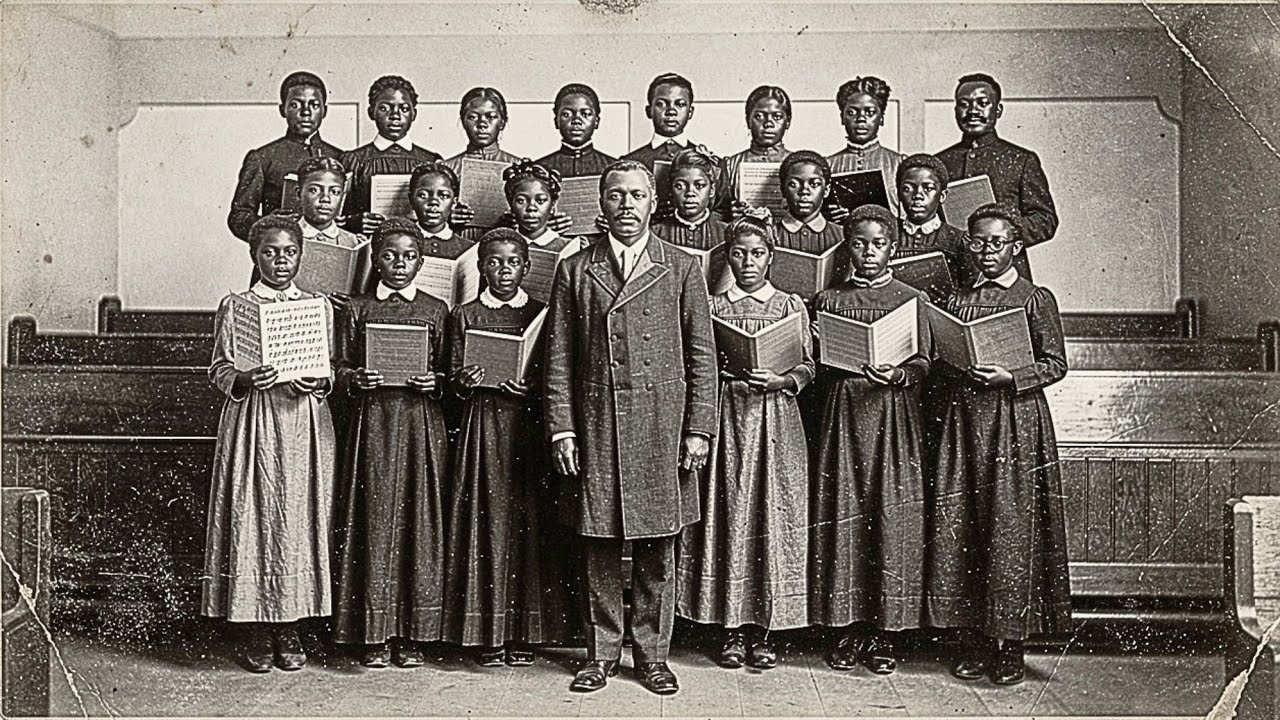
At first glance, this is unremarkable. Choir photographs from the late nineteenth century frequently showed singers with their music, a visual shorthand for what they did and who they were—a professional detail, an assertion of competence and refinement, the community’s declaration that this was not just singing but craft. But when Dr. Vivian Okafor placed the photograph on her light table in the spring of 2022 and began a high-resolution scan, she noticed something about the sheet music held by the third singer in the second row—a woman of about thirty, her posture precise, her expression perfectly still—that made her stop everything she was doing and look again.
The music on that sheet was not like any other piece visible in the photograph. Every other singer held what appeared to be a standard hymn arrangement, the familiar notational shorthand of late nineteenth-century sacred music. Even at low resolution, it had a recognizable visual rhythm. But this woman’s sheet had a different density.
The notation was more tightly packed. The markings were more varied. And across the bottom margin of the visible page, in a hand smaller than the printed notation above it, were annotations that had no business appearing on a hymn sheet. What Dr.
Okafor and her colleague Dr. Thomas Reeves would spend the next seven months unraveling had been sitting in a photograph in a university archive for over a century: a cipher embedded in musical notation, designed to carry information that in 1898 Mississippi could not be spoken aloud, could not be written plainly, and could not be trusted to any medium that might fall into the wrong hands—except, perhaps, a choir photograph, which no one with the power to cause harm would ever think to examine closely. Vivian Okafor held a chair in musicology at Howard University, where she had spent seventeen years studying African American sacred music—not as aesthetic history, though that was part of it, but as social history, as survival history, as the documented record of a community that had used music to do things other communication systems could not safely do: carry meaning across space and time, transmit urgent information in public settings without detection, preserve knowledge that formal records would never hold. She had written two books on the tradition of coded communication in the African American spiritual.
The first documented the historical evidence for songs like “Follow the Drinking Gourd,” “Wade in the Water,” and “Steal Away to Jesus” as encoded directional and operational signals on the Underground Railroad. Her second, more controversial work, published in 2019, argued that the tradition had not ended with the formal abolition of slavery in 1865 but had continued in adapted forms through Reconstruction, its collapse, and the rising tide of Jim Crow legislation, into the early twentieth century, as Black communities developed new systems to address new dangers. The choir photograph had come to her through an unusual route. A graduate student at Howard, working on a dissertation about the documented history of Black churches in the Mississippi Delta between 1880 and 1920, had acquired a digitized collection from the Mississippi Department of Archives and History: approximately three hundred photographs from the estate of a Natchez photographer named Samuel Whitmore, who had operated a studio on Main Street from 1889 until his death in 1921.
Whitmore had been unusual among white commercial photographers of his era in that he had actively sought business from Black clients and from the city’s Black churches and civic organizations. His collection was one of the most extensive photographic records of Black community life in the Mississippi Delta from that period anywhere in an American archive. The graduate student had flagged the choir photograph for Vivian because of its unusual level of preservation and the quality of Whitmore’s glass plate technique, which had produced an image with exceptional sharpness even at high resolution. Most photographs from this period and region showed too much grain and softness to read individual documents held by subjects.
This one was different. Vivian placed it on the light table on a Tuesday morning in March 2022, planning to include it in the visual appendix of a journal article she was working on. She had been scanning for eight minutes when she stopped. She zoomed in on the second row, third singer from the left: a woman in a white blouse and dark skirt, her hair pinned up, her posture ramrod straight, the sheet of music held in both hands at approximately chest height.
Vivian noticed, with a slight outward tilt, as if positioning it for visibility—not for the photographer. The tilt was wrong for the camera angle. It was positioned as if to be read by someone behind the photographer, or in front of it, by someone who already knew what to look for. Vivian zoomed in until the sheet filled her monitor.
The printed portion of the music appeared to be a standard hymn arrangement. She could make out enough of the notation to recognize the visual structure of a four-part choral arrangement in the style of the 1890s. But the margins were different. Along the left margin, running vertically, were a series of small symbols—not standard musical notation, but not random either.
They had a regularity that suggested system. And across the bottom of the visible page, in tight careful handwriting, was a series of notations that mixed alphabetical characters with numerical sequences in a pattern Vivian had not seen in any piece of sheet music in seventeen years of working in this field. She photographed the detail at maximum resolution, extracted it into its own file, and sent it to Dr. Thomas Reeves with three words in the subject line: “Tell me what this is.
”
Thomas Reeves was a music historian at Yale University whose secondary specialty—the one that made his name in a small but devoted corner of academic research—was the history of musical cryptography. Not the modern field of using music as encryption software, but the much older and largely forgotten practice of embedding non-musical information inside musical notation. Medieval monks had used Gregorian chant notation to encode manuscript locations. Seventeenth-century composers had embedded political commentary in harmonic structures that surface analysis would never reveal.
The practice was well established, historically documented, and largely invisible to everyone except the small community of specialists who studied it. Thomas Reeves had been waiting his entire career for someone to send him an image like the one Vivian Okafor sent him on that Tuesday in March 2022. He called her back in four hours. “Where did you find this?
”
She explained. He listened without interrupting until she was finished. “I need the highest resolution image you can produce from that glass plate. And I need any other photographs from Whitmore’s collection that show sheet music held by choir members.
Can you get me everything from the First African Baptist Church? ”
She sent him eleven photographs from the Whitmore collection that featured choir or congregation members holding sheet music. Eight showed standard hymn arrangements, nothing unusual at maximum resolution. Three showed the same type of marginalia: the same system of symbols along the left edge, the same bottom margin notations.
Thomas worked for three weeks before calling Vivian back with his first substantive analysis. “It’s a substitution system,” he said. “But it’s not a simple letter substitution. Whoever built this understood musical notation at a sophisticated level and used that understanding to create a cipher that would be completely invisible to someone who read music casually, but deeply embedded in the structure for someone who knew the key.
”
He walked her through the mechanics. The primary cipher was based on pitch values within the C major scale, the most common key for nineteenth-century church music. Each scale degree corresponded to a specific letter: C corresponded to the most common letters of the alphabet, D to the next most common, in a frequency distribution designed to make the cipher resistant to simple frequency analysis. The notations in the bottom margin encoded specific information types—what Thomas’s analysis identified as location markers, time references, and a category of symbol he initially could not classify.
The left margin symbols were what he had spent the most time on. They were the element that revealed the cipher’s full sophistication. Rather than encoding alphabetic information, they used a secondary system based on the dynamic markings of standard musical notation—pianissimo, piano, mezzo-piano, mezzo-forte, forte, fortissimo—to encode a categorical index. A location encoded by the pitch cipher could be qualified by a dynamic marker that indicated whether it was safe, unsafe, unknown, active, or temporarily suspended.
It was not just a message. It was a structured intelligence format. “This isn’t improvised,” Thomas told Vivian during one of their nightly calls. “This isn’t someone who decided one day to hide a message in a piece of sheet music.
This is a system. It was designed to be used repeatedly, to be taught to multiple users, and to carry multiple types of information simultaneously. Someone spent a long time building this. ”
Vivian had already been thinking about who that someone might have been.
The music director visible in the center of the choir photograph—the tall man with the white collar and the steady authority—was identified by a handwritten caption on the reverse of the original glass plate as Reverend Elijah Monroe. She searched the historical records of the First African Baptist Church of Natchez and found him almost immediately. Elijah Monroe had served as the church’s pastor and music director from 1891 until 1904, when the historical record went abruptly silent about him. No death record in Natchez.
No relocation notice in church records. He simply stopped appearing. The date he disappeared from the record was September 1904. Vivian pulled the newspaper archives for Adams County, Mississippi, for the autumn of 1904.
She found what she was looking for in the Natchez Democrat of September 18th, 1904: a brief item, three paragraphs buried on an inside page. A report of a fire at the First African Baptist Church. The building had been partially damaged. The cause had not been determined.
No injuries were reported. No injuries. But Elijah Monroe had never appeared in any record after that date. She searched the digitized archives of the Southwestern Christian Advocate, a Black-owned Methodist newspaper that had extensive coverage of Mississippi church communities throughout this period, and found a single reference.
In a November 1904 issue, a notice that Reverend E. Monroe, formerly of Natchez, had arrived safely in Chicago and taken a position at a church on the South Side. Arrived safely. Not “moved to.
” Not “relocated to. ” Arrived safely—the language of someone for whom arrival was not guaranteed. Thomas decoded the three photographs in full over the following six weeks. Two contained location information: specific addresses and landmarks in the Adams County area, encoded in the pitch cipher with dynamic markers indicating their operational status as of the date the photographs were taken.
The third contained something that made both of them go quiet when Thomas read it to Vivian over the phone. Encoded in the musical notation of a piece of sheet music held by a choir member in an 1898 church photograph was a list of names. Fourteen names, each encoded in the cipher system, each qualified by a dynamic marker. The markers on twelve of the names indicated the category Thomas had not been able to classify in his initial analysis.
He had now classified it. In danger. Needs passage. Twelve people, encoded in a song sheet held up in a choir photograph in 1898 Mississippi.
To understand what Reverend Elijah Monroe had built inside the music of his choir, you have to understand what Natchez, Mississippi was in 1898. The 1890s were the deadliest decade for Black Americans since the Civil War. Between 1892 and 1901, there were more than 1,400 documented lynchings of Black people across the South. The actual number—accounting for killings never reported, killings in rural areas where no record was kept, killings deliberately obscured by local authorities—was certainly higher.
Natchez was not exempt from this terror. Adams County had a documented history of racial violence throughout the Reconstruction era and into the 1890s. The collapse of Reconstruction in 1877 had removed federal protection from Black communities across the South, and what followed in Mississippi was a systematic retrenchment of white supremacist power that used economic coercion, political disenfranchisement, and physical violence as parallel tools. Black men could be killed for economic success deemed threatening, for political activity, for failing to show sufficient deference, for accusations that required no evidence and no trial.
The legal system was not a protection. In many cases, it was a participant—the county sheriff, the local judge, the local newspaper were often part of the same community that produced the violence. In 1892, a young Black journalist named Ida B. Wells published Southern Horrors: Lynch Law in All Its Phases, a meticulous statistical and narrative documentation of lynching in America—the first systematic attempt to expose the practice to national and international attention.
Her own newspaper office in Memphis had been burned after its publication. She had been forced to flee the South. The response to her work had itself been a demonstration of the danger she was documenting. Into this world, Elijah Monroe had built something extraordinary.
Vivian and Thomas spent two months after the decipherment working to understand the full scope of what Monroe had created. It was not, they concluded, a single-use system invented for a specific emergency. The sophistication of the design—the frequency distribution analysis, the categorical dynamic markers, the structural coherence of the notation—indicated a system that had been in development over a period of years. The three photographs from the Whitmore collection that contained the cipher were dated across a span of four years, from 1895 to 1899, and the cipher system in each was consistent: same design, updated content.
Monroe had been maintaining and operating this system for at least four years that they could document photographically. The church was the center of the operation. This made complete sense historically. In post-Reconstruction Black communities across the South, the church was the one institution that was simultaneously the most protected and the most accessible.
It was protected because attacking a church required a level of public acknowledgement of violence that even the most aggressive white supremacist communities sometimes sought to avoid in the name of maintaining the fiction of civilized Southern order. It was accessible because everyone in the community attended; because its activities—choir practice, Sunday services, Bible study, community meetings—provided constant cover for gatherings that served other purposes; and because the materials that moved through it—Bibles, hymnals, sheet music, printed programs—could carry information without attracting suspicion. Monroe had understood all of this and built accordingly. The sheet music functioned as a distribution medium.
A cipher key held by the choir director could encode new information onto a printed piece of music in minutes. The sheets were distributed at rehearsal to choir members who knew the system. They were held up at services, where community members in the congregation who could read the cipher—and who had come knowing where to look—could capture the information visually. After the service, the sheets were collected.
None of the operational information ever existed in a permanent physical form that could be found, read, and used against the network. Except, as it turned out, in a photograph. Samuel Whitmore had photographed the choir on multiple occasions. He had no way of knowing what the sheet music contained.
He had been a photographer, not a code breaker. He had been doing his job: producing a high-quality record of a community that wanted to be documented, wanted the dignity of a professional portrait, wanted to exist in the permanent record. In doing so, he had accidentally preserved evidence of the cipher for 124 years. Thomas studied the list of fourteen names encoded in the third photograph.
Twelve individuals marked as in danger and in need of passage. Two individuals whose dynamic markers he interpreted as indicating contact persons—people already embedded in the network at the destination point, presumably Chicago or another northern city, who could receive the arriving individuals and help them establish themselves. He could not decode the names fully. The personal name encoding required a key they did not have.
What they had were encoded designations rather than the full names of specific people. But the existence of the list was itself profoundly significant. In 1898, Reverend Elijah Monroe had a list of people in his community who needed to leave Mississippi for their safety. He had encoded that list in a song sheet.
And he had placed it in the hands of a choir member and had it photographed by a white commercial photographer who had no idea what he was capturing. The audacity of it was almost incomprehensible. And yet it was completely rational. The photograph, once taken, would not be read by anyone who posed a threat.
It would sit in a studio, or in a family collection, or in an archive. The dangerous information it contained was only dangerous to the people it named—if someone who meant them harm could also read a cipher they had never seen and had no reason to look for. Monroe had understood that the safer a photograph appeared, the safer its contents were. And a choir photograph full of dignified Black Mississippians in their Sunday clothes holding their sheet music looked like exactly what everyone expected it to be.
Nothing to see here. Finding living descendants connected to the First African Baptist Church of Natchez and to Reverend Monroe took Vivian five months after the decipherment was complete. Monroe himself had left Natchez in the autumn of 1904 and had surfaced in Chicago, as documented by the Southwestern Christian Advocate notice. Chicago city records from 1905 showed an Elijah Monroe registered as a minister at a Baptist church on the South Side.
The 1910 and 1920 censuses confirmed his continued presence in Chicago, where he had a wife and two sons. He died in 1931. His obituary in the Chicago Defender—the most important Black newspaper in America during that period—described him as a minister of great community dedication who had given years of distinguished service to congregations in both Mississippi and Illinois. No mention of Natchez.
No mention of 1904. The obituary had been written by someone who knew to be careful. Tracing Monroe’s descendants through the Chicago records forward into the present eventually led Vivian to Dr. Celestine Monroe Washington, a sixty-three-year-old retired physician in Evanston, Illinois, Monroe’s great-granddaughter.
Celestine had known about Elijah Monroe all her life. He had been a family legend: the great-grandfather who had been a minister in Mississippi, who had come north in 1904 under circumstances the family described vaguely as “trouble” and never fully elaborated. The family had understood that the trouble was racial—that much was always implicit in every telling. What the trouble specifically was had been lost.
Vivian called her on a Friday evening. She explained everything carefully: the choir photograph, the cipher, the sheet music, the decipherment, the list of names, the fire in September 1904, and Monroe’s flight to Chicago. Celestine listened without speaking for a very long time after Vivian finished. “There was a box,” she finally said.
“My grandmother kept a wooden box. She passed it to my mother, and my mother passed it to me. We were always told it was Elijah’s, that it had come with him from Mississippi. Inside there are some papers.
Some old sheet music. I always assumed it was just hymns. ”
The following week, Celestine drove to Vivian’s office at Howard with the wooden box. Inside were eleven pieces of aged sheet music, carefully folded and preserved without any explicit understanding of their importance.
The outer sheets were standard hymn arrangements, nothing unusual. But the fourth sheet in the stack, when Vivian unfolded it and laid it on her light table, showed the same tight marginalia—the same left margin symbols, the same bottom row notation—as the sheets visible in the choir photographs. She called Thomas that night. He drove from New Haven the next morning.
The sheet in the box contained new information—information that had not appeared in any of the three photographed sheets. It was dated in Monroe’s handwriting at the top margin: September 3rd, 1904. Eleven days before the church fire. The pitch cipher encoded what appeared to be a route.
A sequence of locations from Natchez heading north. Waypoints. Safe house addresses. Contact names.
Distances. A complete passage route laid out in musical notation on a piece of choir sheet music, written eleven days before someone tried to burn down the church and forced Elijah Monroe to use that route himself. He had written the escape plan. And then he had needed it.
Celestine held the sheet for a long time, very carefully, the way you hold something that has just revealed itself to be irreplaceable. “He made a map,” she said. “He made a map and hid it in music. And when they came for him, he already knew the way out—because he had spent years making sure other people could find it.
”
She looked at Vivian. “How many people do you think used this? ”
“We can’t know precisely,” Vivian said. The network was designed not to leave records.
That was the entire point. But the operational period the photographs documented—at least four years, probably more—and the level of infrastructure the cipher implied suggested that this was not a system for individual use. This served a community. Celestine nodded slowly.
She looked at the sheet music in her hands. “He never told his children,” she said. “My grandmother—his daughter-in-law—said he never talked about Mississippi. Never.
When she asked him once, he said only that he had helped some people find their way north, and that was all there was to say about it. ”
She paused. “He was being modest,” she said quietly. “He was being very modest.
”
Vivian also located a second living connection to the photograph through a genealogical DNA database, which connected her to a woman in Jackson, Mississippi named Ruth Eaton, whose great-great-grandmother had been identified through the records of the Natchez church as a member of the choir in 1898. Ruth had known her great-great-grandmother only through family stories. She had a photograph of her own—a separate portrait, not from Whitmore’s collection—showing a woman in a white blouse and dark skirt, her hair pinned up, her posture ramrod straight. When Ruth saw the choir photograph, she recognized her great-great-grandmother immediately.
“Third row, second from the right,” she told Vivian. “She sang in the choir for years. My grandmother said she had a beautiful voice. She said she was serious about the music.
Very serious about it. ”
Vivian looked at the photograph on her monitor. The woman in the second row, third from the left, her sheet tilted outward at that specific angle. “She was serious,” Vivian agreed.
More serious about it than anyone realized. Vivian and Thomas published their findings in the Journal of the American Musicological Society in October 2023. The paper, “A Musical Cipher in a Post-Reconstruction Context: Decoding a Community Safety Network in 1898 Natchez, Mississippi,” ran to sixty pages and included full reproductions of the three choir photographs, large details of the cipher-bearing sheet music, Thomas’s complete cryptographic analysis, and Vivian’s historical contextual framework. The academic response was significant and sustained.
It confirmed and extended the existing scholarly literature on coded communication in African American sacred music while providing the first documented example of a photographic record of a post-Reconstruction coded music system in operational use. It also contributed a new dimension to the historical understanding of what Black churches in the Jim Crow era were actually doing inside the protected space of their walls: not just worshiping and organizing, but running operational intelligence and safety networks with a sophistication that the white institutions surrounding them had completely failed to detect. The Mississippi Department of Archives and History arranged a special exhibition around the Whitmore collection in the spring of 2024, with the choir photograph as its centerpiece. The exhibition was titled “What the Music Said: Elijah Monroe and the First African Baptist Church Cipher Network.
”
Celestine Monroe Washington attended the opening. She stood before the large-scale reproduction of the 1898 choir photograph for a long time. Twenty-three people in three rows. Her great-grandfather at the center.
Twenty-two choir members around him. Several of them holding the evidence of something that had taken 124 years for the world to be able to read. Ruth Eaton attended the same opening. She and Celestine met for the first time in front of the photograph.
They stood side by side, looking at the woman in the white blouse and the man in the dark suit who had built something together in a church in Natchez in 1898, and trusted that if they put it in a photograph, it would be safe—until someone came along who knew how to look at it. The wooden box with Elijah Monroe’s eleven sheets of music was donated to the Smithsonian’s National Museum of African American History and Culture by Celestine Monroe Washington. The September 3rd, 1904 sheet—the route—is displayed in its own case, framed and preserved, its notation visible in full to any visitor who cares to stand before it. Most cannot read the cipher.
But the exhibition panel beside it tells them what it says. Note by note, marker by marker: every waypoint on the road north, every safe house, every contact name—the complete map of a journey that Elijah Monroe had encoded in music so that others could make it, and that he had eventually had to make himself. Vivian stood before the display on the day it opened, thinking about everything it had taken to produce this moment: the glass plate, the Whitmore collection, the graduate student who had flagged the photograph, the Tuesday morning when she had put it on the light table, the three weeks of Thomas’s analysis, the phone calls and the archives, the Southwestern Christian Advocate notice, the wooden box, Celestine, Ruth. She thought about the choir member in the second row, third from the left, whose name they still did not know, whose family might someday find this research and recognize her holding her sheet music at that specific outward tilt—not for the camera, but for whoever in the congregation, or beyond it, already knew where to look.
She had been singing. She had also been speaking. And she had known that the two things were not separate. That in the right hands, with the right key, a piece of music could carry everything that mattered—and show nothing to anyone who hadn’t earned the right to hear it.
The music had always been more than music. For as long as it needed to be.
