Martha Jane Cannary was already a problem the morning the army surgeon spotted her. It was May of 1875, and the man walking across the parade ground at Fort Laramie carried the improbable name of Valentine McGillicuddy. What caught his eye was a woman strutting past the barracks in spurs, chaps, and a sombrero, dressed like nothing the post usually saw. Curious, he asked around.
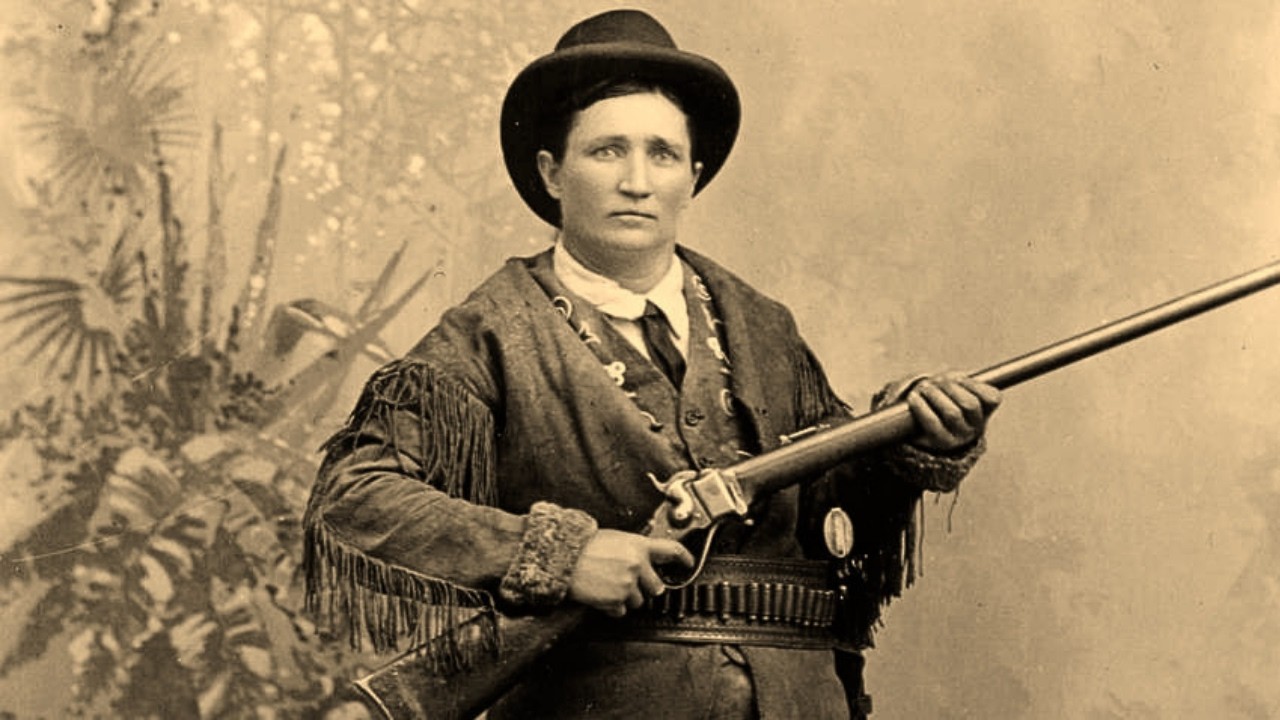
Lieutenant Colonel Richard Irving Dodge supplied the answer: she was, in his words, a regimental mascot who didn’t know the meaning of the word morals. What Dodge failed to mention was that in a matter of weeks, that same woman would be following his column into the Black Hills, wearing the uniform of a United States soldier, and that her presence would produce the first known record of the nickname that would follow her to the grave. By then, Martha Jane Cannary had already lived a life almost entirely undocumented and largely of her own invention. She was born near Princeton, Missouri, sometime around 1856, though she would later insist on May 1st, 1852, a date contradicted by the 1860 census.
It would not be the last time her version of events failed to match the paperwork. Her father, Robert, farmed and gambled and drank. Her mother, Charlotte, had married Robert up in Iowa at fifteen and had three children by the time she was twenty, Martha Jane being the oldest. The family joined the great westward movement in 1865, bound for the gold diggings.
Somewhere near the mining town of Blackfoot, Montana, Charlotte died of pneumonia. Robert drifted south with the children into Utah, where he likely followed his wife to an early grave the next year. Likely, because there is no death certificate, no burial record, nothing at all to say precisely when or where Robert Cannary died. What is certain is that by the time she reached puberty, Martha Jane Cannary was an orphan with five younger siblings and not a dime.
By 1869 she had turned up in Piedmont, Carter County, Wyoming, which was then a railroad town. We know this only because she appears on the territorial census. What she was doing there, or who she lived with, no record says. Then the trail goes cold for nearly five years.
When she reappears, she is working as a camp follower, the polite term of the era for anyone who earned a living traveling with the army: cook, nurse, seamstress, and sometimes something else entirely. Historian Richard Etulain found no hard evidence that she engaged in sex work, but the men she traveled with treated her as available, and some of the places where she worked, including a Hog Ranch outside Fort Laramie, were known whorehouses. Clement Lounsberry, who knew her around that same period, described her as a prostitute. Ben Arnold remembered her among the Union Pacific towns differently, writing that she became a follower of the freighting teams and learned to be a good driver.
Historian James McLaird, in his book on Jane, struck the balance: her work as a dance hall girl and prostitute in the hog ranches near Fort Laramie probably mirrored her early life along the Union Pacific, but she was not a regular occupant of a house of prostitution. Sometimes she worked intermittently. Often she roamed freely. Occasionally she established lengthy relationships with her male companions.
The legend proper began in the summer of 1875. That season, Dodge and his soldiers took part in the Newton-Jenney Expedition, a scientific mission into the Black Hills to determine how much gold actually lay up there. A few days out, someone noticed an unaccounted-for young private trailing the column. It was Jane.
She had attached herself to the civilian teamsters, dressed head to toe in a soldier’s uniform. One of the expedition’s surgeons, a man named J. K. Lane, was moonlighting as a correspondent for the Chicago Tribune.
In a dispatch filed not long afterward, he called her Calam. “Calam is dressed in a suit of soldier’s blue,” he wrote, “and straddles a mule equal to any professional black snake swinger in the army. ”
That is the first known written reference to the nickname Calamity. How she actually came by it is a matter of conflicting testimony.
In her own autobiography, Jane claimed she rescued a Captain Egan from hostiles in Wyoming, and that when she hauled the wounded officer onto her horse, he proclaimed her Calamity Jane, heroine of the plains. No evidence whatsoever suggests this ever happened. Her longtime friend George Hascher, who would later serve as a pallbearer at her funeral, told the Washington Post in 1906 a rather different story. According to Hascher, she picked up the name in Cheyenne around 1875 by being a walking disaster.
If she rented a buggy, she wrecked it. If she climbed onto a fence rail, the rail bucked her off. The editor of the Cheyenne Daily Sun, a man named Poulton, started calling her Calamity Jane, and it stuck. The same autobiography that produced the Egan story also had Jane scouting for General Custer and riding for the Pony Express, neither of which survives even slight scrutiny.
She claimed to have joined Custer at Fort Russell in 1870; Custer was never stationed there. Like nearly every memoir to come out of the Old West, hers was tall on legend and short on facts. About a year after the expedition, Jane returned to the Black Hills aboard a wagon train out of Fort Laramie. The story of how she got on that train is entirely on brand.
According to Joseph White I. Anderson, who was traveling with the wagons, an army officer at Fort Laramie personally asked the train to take Jane with them. She had been on a hell of a bender and wound up locked in the post guard house, in Anderson’s words, “very drunk and near naked. ” The army wanted her gone, and the wagon train happened to be leaving.
Two birds, one cup. As fate would have it, Wild Bill Hickok was also on that wagon train. The supposed great love of Jane’s life, the man beside whom she would one day be buried, met her for the first time because an army garrison had grown tired of her nonsense. And the relationship itself was no more romantic than the introduction.
Hickok was newly married, having wed a circus proprietor named Agnes Lake in Cheyenne only a few months before. Contemporary accounts show genuine affection between Bill and Agnes. Hickok seems to have regarded Jane, at best, as a traveling companion, and at worst as an embarrassment. A few weeks later, he was dead in Deadwood.
They had known each other perhaps a month and a half, tops. Jane would spend the next twenty-seven years claiming a closeness to Hickok that the people who actually knew him denied. The most elaborate of those claims surfaced long after her death. On Mother’s Day, 1941, a woman calling herself Jean Hickok Burkhardt McCormick appeared on a national radio program called We the People and announced that she was the secret daughter of Wild Bill and Calamity Jane.
She had the receipts: a diary and a packet of letters supposedly written by Jane to her long-lost daughter, including details of an alleged 1873 marriage. The story was sensational, the documents looked plausible, and writers and Hollywood filmmakers ran with it for fifty years. It was completely fabricated. It took researchers, including James McLaird, until the 1990s to take the diary apart piece by piece.
The letters were very well written, odd, given that the real Jane Cannary was essentially illiterate. Even better, the diary described Jane meeting Jesse James after his death, and according to it, she even saw Jesse sing a song at his own funeral. There was no secret marriage. Jean McCormick was not the daughter of Calamity and Wild Bill.
The real Jane did have at least one child, a daughter named Jessie, born in October 1887. She did legally marry in Ohio in 1888, to a railroad brakeman named William Steers. It was anything but a high point. Steers beat her often, and Jane had him jailed on at least three occasions for abuse.
The marriage did not last a full year. No divorce is on record; Steers simply faded out of the picture. In the years that followed, Jane lived with several other men, including one Clinton Burke. She carried Burke’s name for the rest of her life, though no official marriage record exists.
Burke himself disappeared from history after robbing his employer in Deadwood and skipping town. So what did Calamity Jane actually do for a living? Whatever she could. Over the course of her life she worked as a bullwhacker, a cook, a waitress, a laundress, an ox team driver, and a dance hall girl.
In Deadwood, almost certainly, she brushed shoulders with Al Swearengen, the saloon keeper played in the HBO series as her antagonist. In real life, she worked for him. According to McLaird, some accounts identify Swearengen’s Gem as the establishment where Martha initially danced in Deadwood. That summer, the summer of 1876, he had only three women available for dancing: Mrs.
Swearengen, Kitty Arnold, and Calamity Jane. Beyond dancing, Jane helped recruit talent, and at one point she did the same for the Bella Union. By the 1890s she was running her own restaurant in Castle City, Montana. Later still, she lived off her own name, performing in museums and selling photographs.
Whatever work was available, usually for however long it took her to save up for the next bender. Jessie was not Jane’s first child. In November 1882, while living with a rancher named Frank King near Miles City, Jane gave birth to a boy the local papers dubbed Little Calamity. A local freighter recalled watching Jane smother the baby in kisses, calling him “Muzzy’s widdle snuzzy darling.
” Little Calamity is believed to have died in infancy. Jessie survived. For the first decade of her life, Jane dragged her all over the West. In 1895, Jane came to Deadwood saying she needed money to enroll Jessie in a convent school in Sturgis.
Her old friends threw a benefit on her behalf, and by all accounts it was a success, at least until Jane started buying drinks for the crowd. By the end of the night, most of the money was gone, and Jane was roaring drunk. Still, she scraped together enough to get Jessie enrolled by January 1896. It was around that same time that the writer M.
L. Fox interviewed Jane and met little Jessie, describing her as neatly dressed and shy, with a bright face and good manners. Jane told Fox, “She’s all I got to live for. She’s my only comfort.
”
The relationship did not last. Jessie bounced in and out of school and in and out of Jane’s custody until 1899, when a cowboy named Robert Dorsett, the last of Jane’s so-called husbands, took the girl to live with his mother in Lewiston, Montana. They were briefly reunited in early 1903, but on her deathbed Jane would admit that she and Jessie had become estranged. Jessie grew up so disconnected from her mother that for a while she actually believed Calamity Jane was her grandmother.
Later, likely at the urging of the fraudster Jean McCormick, she claimed that Jane and Belle Starr were her aunts, neither of which was true. When she died in California in 1980, her death certificate did correctly list her mother’s maiden name as Cannary. It was not all drunken binges and bad marriages. At least one part of the legend holds up: Jane was extremely generous.
When a smallpox epidemic tore through Deadwood in 1878, most residents would not go near the sick, but Jane did. She nursed prospectors through the worst of it with little in the way of thanks or compensation, and the good people of Deadwood never forgot it. Years later, when she was finally buried, the man who closed the lid on her coffin was one of her former patients. Two years before her death, when a miner named Jack McCarthy broke his leg and lay alone in a cabin between Central City and Lead, Jane went through the dance halls asking patrons to give her money instead of buying her drinks.
She used the cash to purchase supplies, rode out, and nursed McCarthy back to health. The writer Lewis Freeman, who spent time with Jane near the end of her life, put it plainly: “Hers was the sunniest of souls and the most generous. She was poor all of her life from giving things away, and I have heard her last illness was contracted in nursing some poor sot that she found in the gutter. ”
There is at least a chance that Calamity Jane’s final illness came from one last act of charity.
The last two decades of her life were mostly a slow decline into the bottle, punctuated by brief flashes of celebrity. By the 1890s she was scraping by selling copies of her autobiography and photographs. In 1901, a newspaper writer named Josephine Brake tracked Jane down in Montana and hauled her east to appear at the Pan-American Exposition in Buffalo. On paper it sounded like a rescue; in reality it was closer to a shakedown.
Brake was clearing twenty-five dollars a week off the arrangement, while Jane received about thirty cents. Jane did what Calamity Jane always did: she drank up her wages, jumped ship to a rival outfit known as the Indian Congress, which also featured the great Geronimo, and then got herself arrested for public drunkenness. When Buffalo Bill Cody’s Wild West Show came to town, a desperate Jane burst into the showman’s tent. “They’ve got me buffaloed.
I want to go back. There’s no place for me in the East. Stake me a railroad ticket and the price of meals and send me home. ”
Contrary to popular belief, Jane never actually performed in Buffalo Bill’s Wild West Show.
But the two went back a ways. Just a few months earlier, when the papers reported that a sick and destitute Calamity Jane had landed in a Montana poorhouse, Cody was among those who mailed donations to get her back on her feet. Now he reached into his own pocket once more: train fare, meal money, the whole nine yards. He later remarked that she was no more tired of Buffalo than the Buffalo police were tired of her.
As for the meal money, Jane allegedly drank it up before she even made it out of Chicago. By 1903 she had drifted back to the Dakotas, where an old friend took her in: Dora DuFran, one of the most successful madams in the history of the Black Hills. DuFran put Jane to work in Belle Fourche, cooking and doing laundry for the soiled doves. By all accounts, it was the most stable stretch of her final decade.
A roof over her head, regular meals, and somebody who actually gave a damn. It did not last long. On August 1st, 1903, in a hotel room in the little mining town of Terry, South Dakota, a few miles outside Deadwood, Martha Jane Cannary died at around forty-six years of age. Contemporary reports blamed inflammation of the bowels and pneumonia, but what really killed her was almost certainly three decades of hard drinking.
And if Freeman was correct, and the final illness really did come from nursing one last stranger, it was still the whiskey that left her with nothing to fight it with. Which brings up the famous burial. Yes, Calamity Jane really is buried beside Wild Bill Hickok at Mount Moriah Cemetery, overlooking the town of Deadwood. No, this was not in fulfillment of some dying frontier romance.
According to statements from four of the very men who planned her funeral, Hickok had no use for her whatsoever, and burying her next to him for all eternity struck them as a fitting prank. One of the most romanticized grave sites in the American West is, in all likelihood, a practical joke. Whether the joke is on Hickok or on Cannary depends on your sense of humor. Captain Jack Crawford, who actually scouted for the army under General Crook and personally knew Jane, summed her up to the Anaconda Standard in April 1904.
She never scouted for anybody. She never fought Indians. She was simply a notorious character, dissolute and devilish, but one who possessed a generous streak that made her popular. Dora DuFran later said that Cannary knew better than anyone where she made her mistakes, and she didn’t rate her virtues as highly as her friends did.
The myth turned her into a buckskin heroine. The evidence makes her something far more interesting: a real flesh-and-blood human being, with all the contradictions that implies. Drunk and illiterate. Generous and kind.
Abused and at times abusive. Brave when it didn’t much matter and absent when it did. She was not Joan of Arc, not Florence Nightingale, and certainly not Wild Bill’s secret bride.
She was Martha Jane Cannary from Princeton, Missouri, a little girl who got dealt about the worst hand imaginable at eleven years of age, and then played it out for another thirty-five years with a whole lot more nerve than sense.






