The Queen Mother wrote the date herself, in her own hand, to the man who paid her bills. Early August 1952, six months a widow, fifty-one years old. She told Sir Arthur Penn, her treasurer, that while staying in Caithness she had passed a dear little castle down by the sea. It was going to be sold for nothing, she wrote, just the value of the lead on the roof.
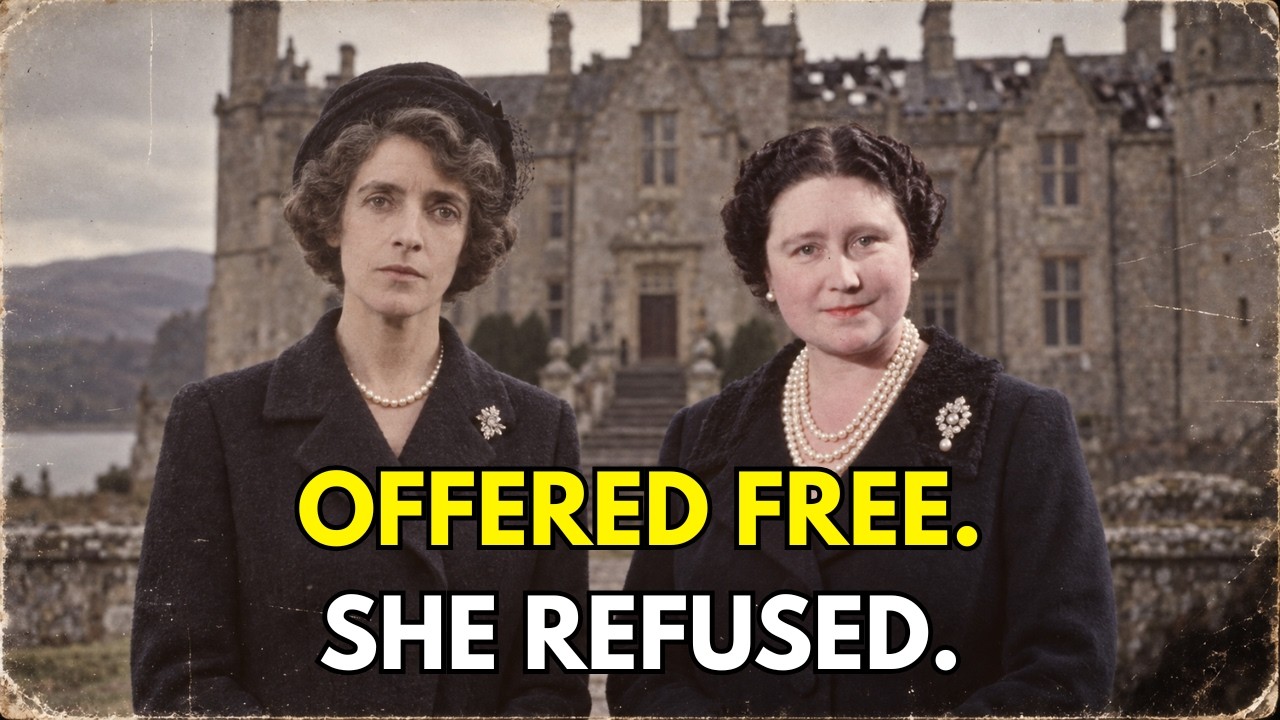
She thought she would buy it and escape there occasionally when life becomes hideous. Then she told him about the old man who had lived there a long time. He had been very anxious to give it to me, she wrote. She had resisted the kind gesture, and he had now offered it to her for £100.
That is where the famous price comes from. It is her own figure, in her own letter, written after turning down a gift. The castle stood about 400 yards back from the sea, six miles west of John O’ Groats, facing north across the Pentland Firth towards Orkney. A gale that January had taken part of its roof.
It had never had electric light. Its name was Barrogill. In June 1952, twelve months earlier, she had been staying with Commander and Lady Doris Viner at the House of the Northern Gate on Dunnet Head. By one later account, she spotted the ruin from a car on the coast road.
The castle’s own trust names her hosts in a single line: she saw the castle while staying with Commander and Lady Doris Viner. Lady Doris was a duke’s daughter and a friend of thirty years’ standing. She was also a mother who had lost two of her three children in less than three years. Doris Hilda Gordon Lennox was born in Dublin on the 6th of September 1896.
Her father, Charles Henry Gordon Lennox, was then heir to the Dukedom of Richmond and would later succeed as the eighth Duke. Her mother was Hilda Meline Brassey. On the 4th of August 1900, Elizabeth Bowes-Lyon was born, and the two girls grew up in the same small world of great houses and titled families, a long way in those years from anybody’s throne. The first fixed point in the friendship is a photographic plate.
On the 28th of February 1922, Princess Mary married in Westminster Abbey. Among her bridesmaids stood two young women side by side. One was Lady Doris Gordon Lennox, twenty-five, the elder of the two by three years and eleven months. The other was Lady Elizabeth Bowes-Lyon, twenty-one.
The studio of Vandyk made plates of the wedding party, and the National Portrait Gallery, which holds them, lists Doris by name. It is a thin foundation for a friendship, an archive caption. But it is also the right kind: a name, a date, and a place that somebody wrote down at the time. What the plates record is a position.
Two women placed together in public as bridesmaids at somebody else’s wedding, a little over a year before either of them married. Thirteen months later, Doris went first. On the 10th of April 1923, at twenty-six, she married Lieutenant Commander Clare George Viner, twenty-nine, a naval officer who had arrived at his own surname by paperwork. He had been born Clare George Compton in Chelsea on the 31st of March 1894 and became a Viner by royal license on the 30th of March 1912, one day short of his eighteenth birthday.
Sixteen days after Doris’s wedding, on the 26th of April 1923, Lady Elizabeth Bowes-Lyon married the Duke of York in Westminster Abbey. The two bridesmaids of 1922 were both married inside the same April. This is the place where the internet usually gets Doris wrong. When the Queen Mother died in 2002, the Northern Echo remembered Doris as her friend and bridesmaid.
That phrase has been copied from article to article ever since. Elizabeth had eight bridesmaids that April, and the list is documented. Gordon Lennox is not on it. Doris did stand with her at a royal wedding, but it was Princess Mary’s, fourteen months earlier.
Two weddings were folded into one, and a friend became a bridesmaid by compression. That small error shows how this woman has been handled. Each retelling moves Doris one step nearer the queen. From a bridesmaid at someone else’s wedding to a bridesmaid at the royal one.
From the friend whose house the widow was staying in to the friend who talked the widow into a castle. What the retellings drop on the way is the part of her life documented in detail: Ipswich in 1942 and Rangoon in 1945. The Viners made their home in Yorkshire, at Studley Royal and Fountains Hall near Ripon, and the new Duchess of York came north to them. The Yorkshire Post later recorded that she stayed often at Studley Royal.
The friendship now had an address. Doris also had a new name. From 1923 she was Lady Doris Viner. She was Lady as a duke’s daughter.
Her husband was not a peer. Marrying Clare did not make her a peeress. Nothing about any of it moved her one place towards the line of succession. She was close to the royal family and not of it, a position with no power in it whatever and a great deal of access.
Access is what the next thirty years of this story are made of. Who stays in whose house? Who is asked to stand beside whom? Whose name goes on whose child?
The first child came in 1924, a daughter born in London. Doris asked the Duchess of York to stand godmother, and the baby was named Elizabeth after her. It is the only request of Doris’s to her friend that the record keeps. A son, Charles De Vries Viner, followed in London on the 21st of January 1926, and a second son, Henry, on the 20th of April 1932.
Three children, a Yorkshire home, and a godmother who by the time the girl was grown would be queen. Elizabeth Viner was old enough to serve in the Second World War, and she did. She joined the Women’s Royal Naval Service. On the 3rd of June 1942, at Ipswich, she died on active service.
She was eighteen. The Yorkshire Post reported it on the 6th of June, noting that she had died as a result of illness and that the funeral was held under service auspices. The paper recorded that she had been named after the queen and described Lady Doris as a close friend of Her Majesty. The historian Gareth Russell, writing much later, gives the illness as meningitis.
The godmother wrote to the mother. It was a private letter from a queen of forty-one to a friend of forty-five. Russell quotes only a fragment: I can only say I am thinking of you all the time. The word all is underlined.
Charles De Vries Viner served as a sub-lieutenant in the Royal Naval Volunteer Reserve. On the 2nd of May 1945, near Rangoon, he was killed on active service. He was nineteen. Between June 1942 and May 1945, Doris Viner lost her daughter and her elder son.
She was forty-eight when the second death came. Two years and eleven months separated the two dates. The one child left to her, Henry, was thirteen. The godmother who had written in 1942 was, in May 1945, forty-four.
In 1948, Commander and Lady Doris Viner bought the House of the Northern Gate on Dunnet Head in Caithness. The family that had been rooted at Studley and Fountains through the war now had a second address at the far northern edge of the country. On the 6th of February 1952, George VI died. He was fifty-six.
His widow was fifty-one, and Doris was fifty-five. The dead king’s daughter was now queen, and the widow took the style Queen Elizabeth, the Queen Mother by announcement and by usage. Style is a form of words. It carried no land with it and no house.
Four months later, she was a guest on Dunnet Head. The castle she saw from that coast had a much longer paper trail than her visit. Barrogill was built between 1566 and 1572 on a Z-plan, and the trust that runs it calls it the most northerly castle on the British mainland. It stands about six miles west of John O’ Groats and about fifteen miles east of Thurso, some four and a half hours by road from Balmoral.
Historic Environment Scotland lists it in category A. In 1929, it had been bought by Captain Frederick B. Imbert-Terry, born on the 10th of February 1885 and High Sheriff of Devon in 1928. In the Second World War, the house served as a rest home for officers.
In 1950, the farms and crofts were sold off. In January 1952, a gale took part of the roof. By the summer of 1952, what was left was a sixteenth-century house on a reduced estate with about thirty acres of grounds, a hole in its top, and no electricity inside. How close it came to disappearing is harder to fix.
The Scotsman in 2009 printed a line she wrote later: The next day we discovered it was going to be pulled down. That is her recollection, set down after the fact. The online retellings go much further. They call Imbert-Terry bankrupt and have the castle sold for scrap within the week.
The record shows something plainer: a house in poor condition, its farms gone, its roof broken by a storm, and an owner ready to let it go. Television got to Doris Viner before most historians did. In The Crown, the Viners are on screen. The widow is under their roof, and the castle is found and settled in the space of a single episode.
The retellings that followed go further still. In those, Doris talks her grieving friend into the purchase as grief therapy. In some versions the widow turns to her and asks whether the place would suit her. That dialogue, that question, the staging, and the one-day sale were all written afterwards.
No diary entry of any such conversation has ever been published. Against all of that stands one sentence from the castle’s own trust, on its website in one form or another since at least 2008: She saw the castle while staying with Commander and Lady Doris Viner. That is the Viners’ documented part in June 1952. They were the hosts.
The trust does not credit Doris with pointing the ruin out, recommending it, or bargaining for it. There is one further act the family is credited with, and it is practical. According to the Scotsman’s 2009 account, the Viners arranged more of the coastal land at £300, said to yield £30 a year in grazing. The most famous line in the whole story does not even belong to the friend.
It is put in the widow’s mouth. Looking at the ruin, the story goes, she said, How sad it looks, just like me. It turns up in later features in Town and Country, in television documentaries, and in the Scottish Daily Express in 2024. The royal biographer Sally Bedell Smith, drawing on the recollections of Margaret Rhodes, gives the mood it belongs to: later accounts say she remarked that the castle looked as sad as she did.
The line is not in the 1952 letter. The nobler line the castle’s early website gave her in its visitor copy around 2007 is not in the letter either: Never. It’s part of Scotland’s heritage. I’ll save it.
That is banner copy written in the voice heritage sites use for their founders. The widow of the legend has been given two speeches. The widow of the record wrote neither. The letter itself is worth hearing line by line as it has been printed from the authorized quarry of her correspondence, William Shawcross’s official biography and the selected letters published in 2012.
She tells Penn that while staying in Caithness she passed a dear little castle down by the sea. It was going to be sold for nothing, just the value of the lead on the roof. She thought she would buy it and escape there occasionally when life becomes hideous. Then comes the sentence about the old man who had lived there a long time, the gift she had resisted, and the £100.
The old man, for the record, was sixty-seven. She was fifty-one, and she was the one being called Queen Mother. Then the letter turns practical. Part of the roof, she reports, was blown off in the great gale last January.
She will have to put in electric light. And the grid runs past the door, luckily. And then, to the man who keeps her accounts, a question: Do you think me mad? It is a wonderful letter, and part of what makes it wonderful is how little of it is tragic.
The grief is there in one word, hideous, her word, not a biographer’s. But the woman writing it has also found out where the electricity comes from. Note the price she quotes for the alternative: the value of the lead on the roof. In the same letter that reports part of that roof blown away in January.
By August, there was less lead up there to sell than there had been at Christmas. What did the £100 actually pay for? On her own account, a house its owner would have handed her for nothing, at a figure he named once she had refused the gift. The letter is not a deed.
It reports a negotiation as she understood it. The conveyance from Imbert-Terry went through that year in August, by the better-aligned accounts, as an ordinary private sale of Scottish property. The price clause as it was registered has not been published. Buying it needed no vote of Parliament.
It was her own house, later described as the only house she owned outright. The phrase makes sense only beside the houses she did not own. Barrogill was not Crown Estate. It was not a grace-and-favour house.
It was not Balmoral, which is private to the monarch. It was not Holyroodhouse, which is an official residence. It was ordinary Scottish heritable property bought on her own initiative, and it did not become royal land because of the rank of the woman who bought it. Of all the roofs in her life, this was the one that was simply hers.
As for the version in which she paid a single pound, her own letter says £100 after she refused a gift. The pound-note story is later rounding. In today’s money, the £100 comes to about £3,000, depending which year you ask the Bank of England’s calculator. The Scotsman adds that the old furniture came for £124, which means that on those figures, the Queen Mother paid more for the contents of the castle than for the castle.
Captain Imbert-Terry died on the 9th of October 1962, ten years after the sale. Eight months after that letter, she was in Yorkshire. On the 9th of April 1953, at Fountains Hall, the Viners’ house, the Queen Mother unveiled a memorial to two of Doris Viner’s children. There is a stained glass window and there is stone.
The window and the stone are for Elizabeth Viner, who died on the 3rd of June 1942 aged eighteen, and for Charles De Vries Viner, killed near Rangoon on the 2nd of May 1945 aged nineteen. The woman unveiling them is the girl’s godmother, eighteen years a godmother, nearly eleven years a mourner. The Yorkshire press reported her there. A carved stone plaque on the steps leading down from the house carries both names and both ages.
His line does not say killed. It says missing. The memorial carries an inscription: When you go home, tell them of us and say, For your tomorrows, we gave our today. In date order, the friendship does not read like a society calendar.
June 1942, a goddaughter dead at eighteen and a letter with one word underlined. May 1945, a son dead at nineteen. February 1952, a husband dead at fifty-six. June 1952, the widow in the mother’s house.
April 1953, the widow in front of the children’s glass. The documents that give this friendship its weight were each written or made after a death that came before its turn. The castle belongs on that list, and it is the only item on it with a price. The castle, meanwhile, still had a hole in its roof.
The main work ran from 1953 to 1955, with some architectural summaries carrying work on the west wing on to 1960. The castle and about thirty acres of grounds were restored. Main water was brought in, and electricity arrived for the first time in the building’s history, which means the grid she had spotted running past the door in 1952 finally came through it. The old name went back on as well.
Barrogill became the Castle of Mey again, and the great wall of Mey, twelve feet high, stood between the garden and the salt gales. Renaming the house was a private owner’s choice, not a royal style. Who paid for it is the one money question in this story that stays open. She told Penn she was taking the house on.
Sally Bedell Smith writes that her daughter funded an extensive renovation. Popular accounts say the Queen Mother used her own money. No ledger for the 1953 to 1955 works has been published, and the two claims stand side by side with their authors’ names on them. Penn at least was keeping an eye on the sums.
On the 13th of September 1954, after he had been through the accounts, she wrote to him again: I don’t think that Mey will be very heavy. And then, in the same letter: Perhaps an old person will leave me a million. What fun we’d have. Two years earlier, she had turned down a castle offered to her for nothing.
Now she was hoping on paper for an old person with a million. From 1955, when she was fifty-five, the pattern settled into something close to clockwork. She came for about the last three weeks of August and about ten days in October. She kept that up for roughly forty-six seasons, the first at fifty-five and the last at one hundred and one.
The Glasgow Herald carried a notice of her visit on the 11th of June 1956. That clockwork matters, because the legend has her fleeing to the ends of Britain to live alone with her grief. She did not live at Mey. Her principal home remained Clarence House in London, and Caithness was two short seasons a year.
Country Life in 2019 repeated the story that she slept better there than anywhere else in the world. That story is told of her rather than by her. On the 17th of August 1956, Lord Buchan-Hepburn, the Minister of Works, was told that the master of Sinclair herry had telephoned. Water was leaking through the walls at Mey.
Within forty-eight hours, a works party had flown to Wick. The inspection they carried out was limited to one wing: her sitting room and bedroom, the lady-in-waiting’s room, and the maid’s bedroom. Their report found defective pointing and patch repairs it judged unsatisfactory, which is the ministry’s way of saying that the builders of 1953 to 1955 had not done a very good job. The papers were kept for about sixty years, and when the Times reported them in April 2014, its headline voice called it a national emergency.
The ministry’s papers do not use the phrase. What they do show is a minister of the Crown told about the damp in a widow’s bedroom wall in Caithness, which is its own kind of distinction. The friendship that brought her to that coast did not end with the purchase. A local photograph identified in the John O’ Groat Journal in 2021 shows the Queen Mother, a lady-in-waiting, and Commander and Lady Doris Viner boarding the fishing boat Primula at Harrow Harbour for a picnic on the island of Stroma sometime in the 1950s.
The year is not pinned. The passengers are. In the years after she found the castle from the Viners’ house, the Viners were still in the boat. In 1958, she bought Longo Farm.
There is a report from much later that she had considered a second house of her own. In 2002, the later owner of a Mowbray House at Kirkby Malzeard, Major Jeffrey Bray, told the Northern Echo that he had confirmed with her private secretary, Lieutenant Colonel Sir Martin Gilliat, that she had considered the house after 1952 and that the Home Office had blocked it on security grounds. That is his account of a conversation. Whatever the Home Office thought of Mowbray, it did not stop her owning Mey.
Her younger daughter’s opinion of Mey has also passed into legend. Princess Margaret, the story runs, called it Mummy’s drafty castle and a horrible place. Later writers and castle guides repeat that. The Scotsman, the Sun, the Mirror, Tatler, and the Mail have all printed it, and none of them gives a dated first source for the remark.
What is real is a bedroom at Mey named for her, and the guides’ account that she preferred not to sleep in it. In Yorkshire, the Viners’ world was shrinking. In 1966, the Studley Royal Estate, where the Duchess of York had once stayed often, was sold to the county council, and in 1983 it passed to the National Trust. The Times, in its 2026 obituary of Henry Viner’s first wife, Margaret, attributed the sale to Henry’s gambling debts.
If you have been waiting for Doris to step forward in the second half of this story, this is the shape the record gives her. She is in a boat off Caithness, and then she is gone. Lady Doris Viner died in Mayfair on the 8th of February 1980, at eighty-three. She was cremated at Putney Vale three days later.
She had been a duke’s daughter, a bridesmaid at someone else’s royal wedding, a wife, the mother of three children, and the hostess of a famous house-hunting stay. The friendship had run for at least fifty-eight years, from the abbey in 1922 to that February. Her husband, Commander Clare Viner, outlived her by nine years and died at Ullapool on the 29th of October 1989, aged ninety-five. As of September 2026, the House of the Northern Gate, where the castle story began, is let as a private holiday house, in other hands since 2018.
The Queen Mother went on coming north. On the 12th of August 1993, the Defence Secretary’s office wrote about a special protection arrangement for low-flying military aircraft while she was in residence, which was usually in August. As later quoted in the Daily Mail, the letter said there could be no guarantee that aircraft are not seen, but that the arrangement should ensure that Her Majesty is not disturbed. The ministry could not promise she would never see an aircraft.
It could only promise she would not be bothered by one. Related Ministry of Defence records were reported released in 2022. It was a courtesy restriction for the weeks she was there, not a permanent prohibited area and not a rule for civilian flying. The same paper in 2024 added the colour that made the story travel: that she liked to rest in the afternoon after a drink of one part gin to two parts fortified wine.
That detail comes from an unnamed member of staff, not from the ministry’s letter. Henry Viner, the one child who had come through the war, the boy who had been thirteen in May 1945, died on the 19th of January 1996 at sixty-three. Five months later, on the 11th of June 1996, the Queen Mother signed a deed of trust. She gave the Castle of Mey, its grounds, and its farm, with an endowment, to a charitable trust, the Queen Elizabeth Castle of Mey Trust, registered as a Scottish charity.
Its purposes were to preserve the building, to advance historical and architectural education, to develop native Aberdeen Angus and Cheviot stock, and to benefit the local community. It needed no letters patent. A deed was enough. It is often said that Prince Charles inherited Mey in 2002.
He did not. She gave it to a trust in 1996, and from the 1st of January 2019 his foundation became the trustee. That is stewardship of a charity, not a private inheritance. Her last stay was in October 2001.
She was one hundred and one. She died on the 30th of March 2002. The trust opened the castle to visitors seasonally, and a visitor centre followed in 2007. In 2014, the Times reported the restored castle was let for £50,000 for a long weekend.
As of September 2026, on the trust’s calendar, the castle opens from about the 1st of May to the end of September, and it closes for about ten days at the turn of July and August for the King’s short stay on his way to Balmoral. What stands for her is her own paperwork. A gift refused, a sum written down and owned up to, a frank question to her treasurer, and a deed that handed the house to a charity nearly six years before she died. The owner who had been very anxious to give it to her was refused.
Forty-four years later, the woman who refused him gave the castle away herself, and paid for the privilege with an endowment. In 1952 she wrote down £100. In 2014, a long weekend in the same house was let for £50,000. The friend Doris Viner had already lost two of her children when the widow came to stay, and the widow who had unveiled their glass outlived all three of them.
Outlived Clare and outlived Doris by twenty-two years. The guest outlasted the entire household that had taken her in. In October 2001, a woman of one hundred and one left the house she had first seen from a friend’s stretch of coast, forty-nine years before, and did not come back. Offered to her for nothing.
Offered again at £100. Given away in 1996, with money to keep its roof on.






