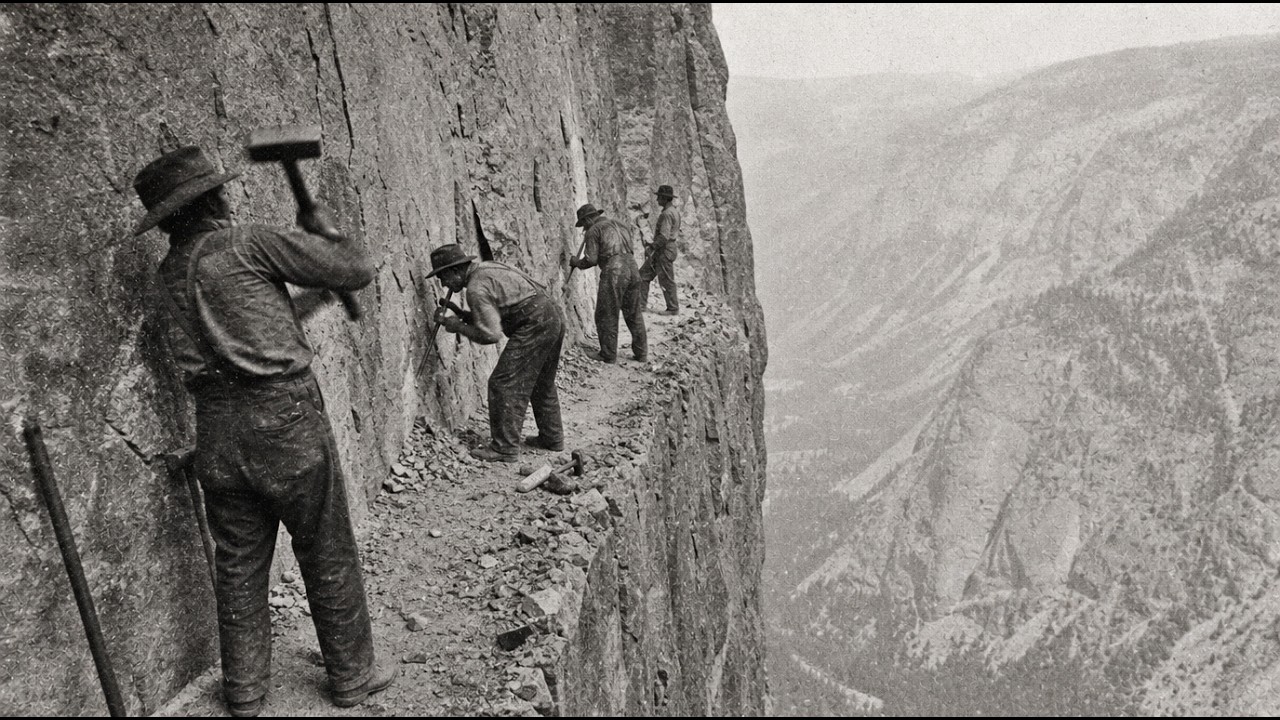
In the summer of 1865, high in the Sierra Nevada of California, men stood on the face of a sheer granite cliff, chipping at the rock with hand drills and hammers while others packed black powder into holes bored by hand. When the fuses were lit, they had only seconds to press their bodies against the stone before the blast. Behind them was a vertical drop of more than a thousand feet to the American River below. There were no machines, no engines, no bulldozers, because the bulldozer had not yet been invented and would not exist for another sixty years.
There was only rock, muscle, black powder, and a fatal fall for any man who slipped. Yet somehow, along that cliff, they would build a railroad. The Sierra Nevada had long stood as the reason a transcontinental railroad seemed impossible. For years, Americans dreamed of a line connecting the settled East to the Pacific coast, but between California and the rest of the nation rose a wall of stone.
The mountains stretched for hundreds of miles, climbed thousands of feet, and lay buried under snow for half the year. A railroad could not climb like a man. It needed a gentle, steady grade, one that did not rise sharply, or locomotives could not haul their loads. Finding such a route across a range that rose almost vertically, then carving it into solid rock, was a problem so immense that most rational engineers pronounced it impossible.
In an era before any kind of earth-moving machinery, the only way to move a mountain was one man, one hammer, and one hole at a time. The man who found the way through those mountains was Theodore Judah. Born in 1826, he was a gifted railroad engineer in the East before moving to California in 1854. From the moment he arrived, he devoted himself to a single idea: finding a way to run a railroad across the Sierra Nevada.
People mocked him, calling him Crazy Judah for his insistence on a dream that seemed impossible. But Judah spent years exploring the mountains, and in 1860 he found what he was looking for: a route through Donner Pass, the least impossible passage across the range. His route required fifteen separate tunnels, each carved through the hard granite of the Sierra. Judah mapped the exact path the rails would take, but he never saw a single inch of it built.
In 1863, the same year construction began, he traveled to New York to raise funds, contracted yellow fever on the way, and died. The route was his, but the mountain would be conquered by other hands. The Central Pacific Railroad, run by four Sacramento merchants who would become among the richest men in America, adopted his plan. But money alone was not enough to cut through the Sierra.
What they needed was labor: thousands of men willing to take on the most dangerous work on the continent. There were not enough men in California prepared for the job, so the railroad turned to the one group capable of doing it. They began hiring Chinese immigrants, first in the hundreds, then in the thousands, until at the peak of construction the great majority of the force cutting through these mountains, more than ten thousand men, were Chinese laborers. They were paid less than white workers, assigned the hardest and most dangerous tasks, and their hands more than anyone else carved the railroad into the rock.
The most extraordinary part of the work came at a place called Cape Horn, east of the town of Colfax. Here the mountainside dropped sharply for over a thousand feet to the river below, and the railroad had to cross directly across its face. There was no ledge to build on, so the workers had to make one. Clinging to the rock, they drilled holes into the granite by hand, filled them with black powder, lit the fuses, and blasted the cliff face foot by foot until they had carved out a narrow shelf barely wide enough for a train.
On the busiest days, crews detonated more than five hundred barrels of black powder. The section they carved stretched for nearly three miles around the shoulder of the mountain and took most of a year to complete. A year of standing on a strip of rock with a deadly void behind them, drilling, filling, blasting, and then repeating the process a few feet further along. A famous legend holds that workers were lowered from the edge in woven baskets to plant their explosives.
Historians still disagree on whether that happened literally, but the work itself is beyond dispute. Men hung on the side of a cliff a thousand feet high and carved a railroad into it with their bare hands and powder. Then there were the fifteen tunnels, the greatest of which was Summit Tunnel near the top of Donner Pass, 1,659 feet long, bored directly through the heart of the mountain. To dig it, workers used a method unchanged since ancient times.
One man held a steel drill against the rock while two others struck the head of the drill with heavy sledges in alternating blows. After each strike, the man holding the drill turned it slightly, and so, blow by blow, the steel sank into the stone. When the hole was deep enough, they filled it with black powder, or later with nitroglycerin, a liquid explosive so dangerous it killed men without warning, then blasted the shattered rock loose. Afterward, they cleared the rubble and began again.
The work ran six days a week, around the clock, in three shifts, so the digging never stopped. Crews advanced through the granite at the rate of a very few inches per day, not feet, inches. Summit Tunnel alone took nearly three years to complete. To speed the process, the crews did something extraordinary.
Instead of digging only from the two ends, they sank a deep vertical shaft into the mountain from directly above the tunnel line. Then they lowered men and tools to the bottom and began digging outward from the middle in both directions. Now the tunnel was being carved from four rock faces at once, all creeping toward one another inch by inch deep inside the mountain. There was another problem just as strange.
The tracks on the far side of the summit could not be reached until the tunnels were finished. But the company did not have the luxury of waiting. So they took locomotives, complete iron engines weighing many tons, hauled them to the top of the mountain on sledges made of logs, pulled by teams of oxen through the snow, then lowered them down the other side so the track could be laid beyond the summit while the tunnels were still being dug. The blasting grew more dangerous as the work deepened.
Black powder was slow, so the Central Pacific turned to nitroglycerin, a newly invented liquid explosive far more powerful than powder and far more lethal. It was so unstable that the railroad mixed it on site in the mountains because it was considered too dangerous to transport long distances. A jar of it could explode from an electric shock, a spark, or for no reason anyone could explain. It killed men in the tunnels without warning and tore apart the crews who handled it.
Fear of it became so great that its use was eventually reduced. But while it lasted, it broke the granite as nothing else could, and the workers paid for that speed with their lives. Then came winter, and winter was the true killer. The Sierra Nevada receives some of the deepest snowfall in North America, and the workers, most of them Chinese laborers who had crossed the ocean for this job, could not stop because of it.
To keep digging through the frozen months, they excavated tunnels and chambers beneath the snow itself, living and working underground in a frozen world lit by lamps. Above them, on the exposed slopes, snow piled into huge unstable masses. Sometimes, without warning, it collapsed. Avalanches swept down the mountain flanks and carried away entire work camps, burying men alive under tons of snow and ice.
Some of the dead were not found until spring, when the drifts finally melted and revealed the bodies, still clutching the tools they had been holding when the mountain came down on them. The snow was such a fierce enemy that the railroad eventually had to roof itself to survive. On the highest and most exposed stretches of the line, crews built miles of snow sheds, enormous timber structures erected directly over the track. Trains ran beneath these long wooden tunnels while avalanches thundered overhead without damaging the roofs.
Tens of millions of board feet of timber were used, the equivalent of an entire second phase of construction, simply to keep the completed railroad from being buried every winter. The mountain did not surrender when the last rail was laid; it had to be fought off year after year. The blasting killed men as well, through premature explosions, falling rock, and the treacherous nitroglycerin that could detonate at a touch. The Central Pacific did not keep accurate records of the workers who died building its line across the mountains.
Most of the dead were Chinese, paid less than white workers, and their deaths were rarely recorded. Estimates of the casualty count have been debated ever since, and the truth is that no one knows the real number. Whatever it was, it was certainly higher than anything recorded in official documents. Tens of thousands of Chinese laborers built the most difficult sections of the transcontinental railroad, and many of them never returned home from the mountains.
In the spring of 1868, the last section of granite finally collapsed. Summit Tunnel was opened, and the rails ran down the eastern slope of the Sierra toward Nevada. A little over a year later, in May 1869, the Central Pacific met the Union Pacific at Promontory, Utah, and a railroad joined the two halves of the continent for the first time. The mountains Theodore Judah had walked, blasted by thousands of workers with their hands, had been conquered.
Before the railroad, crossing the country was a journey of months. A traveler could spend half a year creeping west in a wagon through deserts and mountains, risking death along the way, or take a long sea voyage around the tip of South America. After the railroad, the same journey took about a week. A continent that had been measured in months of hardship was suddenly measured in days of travel.
Goods, mail, people, and news moved from ocean to ocean at speeds no one had imagined, all of it passing through that blasted granite cliff, through those hand-carved tunnels, along a line supported in places by the bodies of the men who built it. It would never be that difficult again. Within a few decades, steam shovels and electric drills began doing the work that had cost so many lives, and by the middle of the next century, a bulldozer and mechanical excavator could cut a road through a mountain in a fraction of the time and at a fraction of the danger. What had taken these crews a year of blasting and death to accomplish could suddenly be done in days.
The age of moving mountains by hand was over. The cliff at Cape Horn still stands. Trains still run along it today, on that shelf carved into the face of the mountain, more than a thousand feet above the American River, exactly where the workers cut it from the granite more than 150 years ago. Most passengers crossing it have no idea what they are seeing or what it cost.
They cannot see the men who once hung on that cliff with hammer and drill, or those buried by avalanches, or those whose names were never recorded. But the railway itself is their monument, carved by hand into the side of a mountain everyone said could not be crossed. They had no machines, no bulldozers. They had powder, steel, strength, and courage.
With those things alone, they cut a path for the modern world straight into the face of a thousand-foot cliff.






