The day before the four hunters went up, Mary Lisbeth Brether walked to the front of the general store where the men were loading their mules and stood there for a moment. Then she walked toward Malan Brather, whom she had known since he was a boy, and put her hand on his sleeve. She said, “Don’t go past the old mill wheel. ” She said it once only.
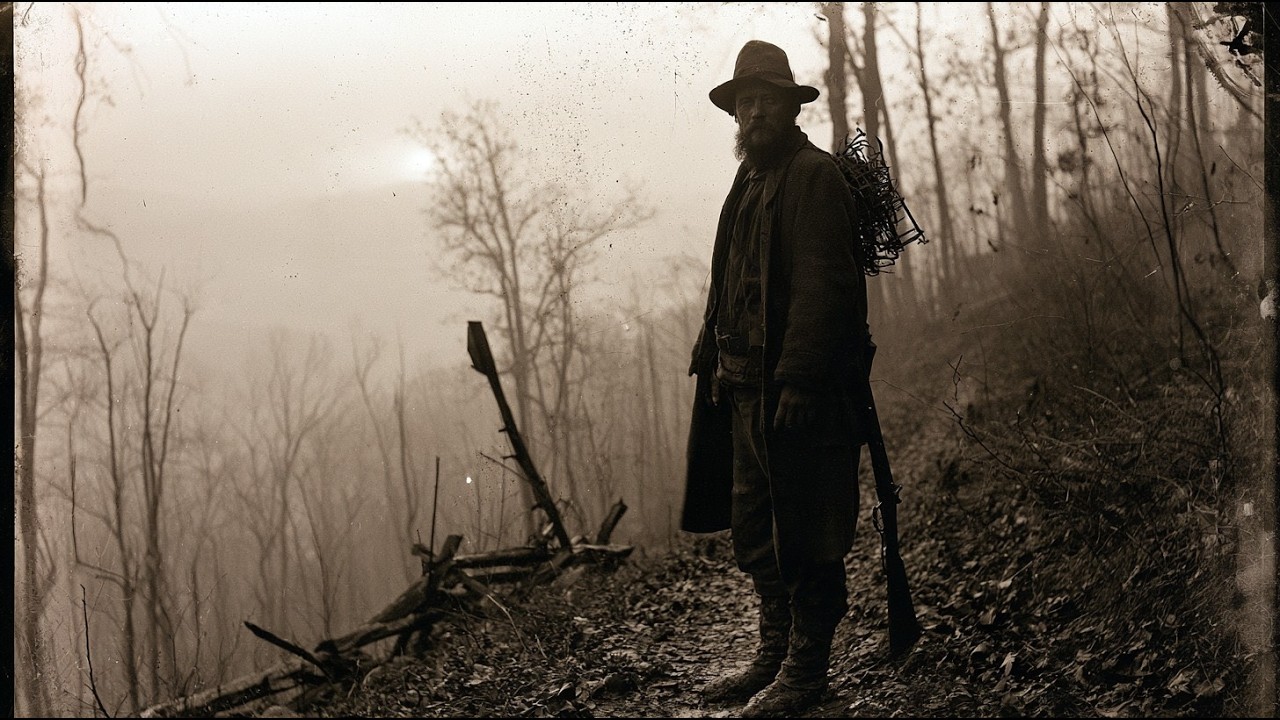
She looked at him when she said it, the way an aunt tells a nephew something plain and true. He looked at her, thanked her, and said they would be careful. She said nothing else. She went home and closed her front door.
Malan Brather was the sort of man who told his friends about the small strange things that happened to him. So by the time the four of them camped that first night at the foot of the branch, they all knew what Mary Lisbeth Brether had said. Mostly, they did not think about it. Or they thought they mostly did not think about it.
Ephraim thought about it. They left Larkin at first light on the sixth of October, 1902. Ephraim Lorsch was forty-seven that autumn, a trapper by practice and by habit, a tall quiet man with a beard the color of iron and hands worn older than the rest of him. His wife Sarah had died six years earlier of a fever nobody in Larkin had a proper name for, and he had not remarried and did not speak of her.
He walked the hills and creek bottoms with his rifle over his back and traps on a mule, returning to town every eight or ten days with hides and with stories he never told. He was not a cheerful man. But no one in Larkin ever said there was a trace of badness in Ephraim Lorsch. The other three were Malon Bresnal, fifty-two, a former mine foreman with a bad hip and a good rifle, whose wife Deborah had died of consumption in 1891; Cleitus Dorn, thirty-four, a blacksmith who ran a trap line in the off-season for extra money, married with no living children, a man known in Larkin for laughing at his own jokes before he told them; and Wilkes Farrell, thirty-nine, a widower who had come from Virginia the year before with two mules and no definite plan, quiet the way a man is quiet when he has left a place he does not want to be asked about.
Cleitus’s wife Nell had asked him not to go on this particular trip. She could not explain why, only that she had woken from a dream she could not remember and had felt all through breakfast that something was going to happen. Cleitus kissed her forehead and told her a bad dream and a dry morning were poor companions for travel, and went anyway. Nell Dorn lived forty-one more years after her husband disappeared.
She remarried in 1910. For all those decades she never spent a single night in her cabin without a lamp burning. The day before they left, Malon Bresnal went to his wife’s grave in the small Baptist cemetery at the edge of town. He sat for a while beside the stone and told a man passing by that he did not know why he had come there that day.
He had not visited the grave in nearly a year. Something had reminded him of Deborah the night before, and he had wanted to pay his respects while she was on his mind. The passerby was Holland Whitmore, the retired blacksmith, one of the only two people in Larkin who remembered the Corvin family before they left. He did not tell Malon what he heard in that sentence.
He went home and did not sleep well that night or the next, and said later, when Sheriff Driney came to speak with him, that he knew in his bones the moment Malon said those words that Malon was already gone in his mind, and that whatever had reminded Malon of Deborah the night before had not happened by accident. The plan was to spend eight days beyond the old mill wheel at the head of the branch, go up the Corvin trace to the second bend, then west along the ridges to a timbered area Malon said had been good to him twenty years before and might still be. They took enough salt pork and cornmeal for ten days. They took two mules.
They took no dogs. Ephraim would say later, in the sheriff’s front room, that not taking the dogs was the first thing he would change if he could go back and change one thing, because dogs know. Whatever you can say about dogs, dogs know. A tied dog that stiffens and stares into the dark at the wrong hour of the wrong night had saved more men in that country than the owners of those dogs would ever know.
The first night they camped in a hollow at the base of the branch, a good distance short of the Corvin place. The fire was cheerful. Wilkes had a harmonica and played for a while, an old tune from Grayson County that Ephraim half remembered from his boyhood. Ephraim allowed himself to think for a minute that this would be a good trip.
He would remember that minute. Cleitus told a story about a horse in Harlan that only obeyed one blacksmith and kicked any white man who tried to touch him, and told it as if it were a joke. Ephraim did not laugh, but he did not object either. Malon spoke of Deborah, eleven years dead, and said he still dreamed of her once or twice a month, and that in the dreams she never spoke a word, only stood at the door and looked at him.
Wilkes said his wife too came in his dreams, always trying to tell him something he could not hear over the sound of running water. Ephraim listened. He did not offer any of his own dreams. He dreamed of Sarah.
He dreamed of her often. He did not tell people that. The stars came out. The mules were quiet.
They slept, or three of them slept. Ephraim said later he lay awake a long time that first night looking through the treetops at the sky and thinking about Mary Lisbeth Brether. He said the sentence she had used had a quality he could not forget. It was not an ordinary warning.
It was the kind of sentence a person uses when she has already said all the other sentences and no one listened. So this sentence had to carry everything. Don’t go past the old mill wheel. Ephraim said later that lying under the stars that first night, he had already half decided he would turn the others back at the mill wheel and take the loss of the winter.
He said that half decision was not enough. He said a man in his position should have gotten up then, in the dark, and walked back to Larkin and let the others think whatever they wanted. He did not. He gave in to sleep instead.
And dreamed of Sarah. Sarah stood at the door looking at him. She said nothing. On the second morning they broke camp early.
There was the first bite of cold in the air. They went up the branch and past the old mill wheel, which had sat half sunk in the pool below the falls since longer than anyone remembered. Ephraim slowed at the mill wheel. The others did not notice.
He stood there a moment with his hand on its wet iron rim and looked up the trace. He would say later he heard Mary Elizabeth’s voice in his head as clearly as if she stood beside him at the wheel. Don’t go up. He nearly spoke the words aloud to the others.
Then Wilkes called out cheerfully, “Come on, then. We’re wasting daylight. ” Ephraim took his hand off the iron rim and walked up the trace. After that point the ground grew narrower.
The trees turned to hemlock and old white oak, and the light fell through them in scattered pieces, and the sound of their boots seemed to carry farther than it should. Cleitus set the first row of traps in a pass where Ephraim had caught foxes the winter before. Wilkes worked ahead humming to himself. It was Wilkes who came back to the others in the afternoon and said, in a voice that tried to sound light and did not quite manage it, that he wanted them to come see something.
What he had found was a set of marks on a beech trunk, chest high: four parallel scratches in the bark, and the wood inside still pale and fresh. Cleitus said “bear” without looking closely. Wilkes shook his head. He said a bear’s claws were not that even, and these were not claws.
These looked like something a man had drawn with a knife, wanting them to look like claw marks but not getting the spacing right. Ephraim looked at the marks a long time. He looked at the ground under the tree, which was undisturbed. He looked at the branches above, which were undisturbed.
He looked at the beeches on either side of the marked tree, which had no marks at all. Whatever had made those scratches had come to that particular tree at that particular height, left no trace, and had not bothered to approach any other tree. Ephraim said only, “We’ll camp a little farther on tonight. ” He did not answer when Wilkes asked why.
They walked on, and the trace after the beach was quieter than the trace before it, if a man could weigh such a thing. The birds thinned and then stopped entirely. The mules began to hesitate in places where there was nothing to hesitate about. Wilkes stopped humming.
On the third morning they checked the trap line they had set the day before. Every trap was sprung. Every trap was empty. That was not the strange part.
A sprung trap happens. The strange part was that the bait was gone, all of it, and not one trap had been pulled, and there were no tracks in the soft ground around them except their own from the day before. Ephraim knelt at the third trap and picked up its pan and turned it in his hand and said nothing. Wilkes wanted to laugh at it.
Cleitus wanted to laugh at it. Malon did not want to laugh at it. Malon had gone completely silent. He was staring downhill in the direction they had come from, frowning, the kind of frown that comes over a man’s face when he is trying to disbelieve something he has just seen.
When Ephraim asked what was the matter, Malon said only that he thought he had seen his brother Coleman pass between two trees. Coleman Bresnal had been killed at Chickamauga in 1863, when Malon was thirteen. Malon said he passed between the two trees, plain as day, wearing the same coat they had buried an empty box for, and Coleman had turned his head a little, the way he did when he was thinking. Then he went on his way.
Ephraim said nothing for a long moment. Then he said they ought to turn back, and had already begun to turn to gather the mules when Wilkes said no, he was not going back down. He had come here to make his winter, and he was not going back down over a few scratches on a tree and a man seeing a dead relative in the woods. Wilkes said it was just hardship.
The hardship and the dry weather and old grief and a bad breakfast. By tomorrow they would all be laughing about it. Cleitus agreed. Malon said nothing at all.
Ephraim stayed. He was not in charge of anyone but himself. He would say later that staying was the third thing he would change if he could go back and change three things. By then it was too late, because the mountain already had them.
It just had not told them so yet. That was the second night. That night the fire would not stay lit. There was no wind, or so they thought, but the flame kept sinking and trembling as if something pressed down on it from above.
Ephraim relit it twice, and both times it faded to a thin blue thread that gave neither light nor warmth. Wilkes made a joke about wet wood, though the wood was dry as bone. Cleitus made no joke about anything. The mules did not settle.
They stood at the picket with ears back, staring in the same direction, and that direction was not the source of any sound Ephraim could hear. Cleitus said something was moving on the far bank of the creek. Wilkes said no, there was nothing on the far bank of the creek. They were both right, because whatever was moving over there made no sound enough to count as movement, and yet by the end of the second hour they all felt it there.
Ephraim slept sitting up, his rifle across his knees. Though “slept” is not the truest word for what he did. He would say later that late in the night he half woke because he thought he heard Sarah call his name, not from a distance but from just outside the edge of the firelight, and not urgently, the way she used to say it when he was late for supper. She had a particular way of saying it when he was late, a two-beat rhythm, the “Ay” and the “frum” with a small rise between them, as if the second syllable were a question and the first had already asked it.
No one had said his name that way in six years. He did not answer her. He would say later that not answering was one of two or three things he did right in his life. He wanted to answer.
He wanted to answer the way a thirsty man wants water. When he opened his eyes fully, the woods had gone quiet again. Malon was awake too. Malon was staring at something over Ephraim’s shoulder, his mouth slightly open, and he did not look away for at least a full minute.
Ephraim did not turn to see what he was looking at. He would say later that this was the second thing he did right. Cleitus said in the morning he had woken once and thought he saw a woman standing at the tree line watching them, and that he had blinked and she was gone, and he put it down to a dream. Ephraim did not tell him it was not a dream.
Ephraim said only that they should pack up. The morning brought a fog they had not expected. The nights were cold and the days warm, and there was no reason in the weather for this fog. It lay in the hollows white and thick, and it did not lift when the sun came over the ridge, and it did not lift by noon.
They packed in silence. Even Wilkes was quiet. They started back the way they had come, and after about an hour of it, Ephraim realized he did not recognize any of the trees. That was the sentence he would use later at Verna Halsey’s kitchen table while Sheriff Driney sat across from him.
“I didn’t recognize a single tree, and I’ve walked that trace every fall for twenty-eight years. Not one of them was familiar to me. ” They stopped. They checked the sun’s position, or tried to through the fog.
They checked the moss on the trunks. They checked the creek, which ought to have been running east, and the water was indeed running east. And still the trace was not the trace. Wilkes said he would walk ahead a hundred paces and take a look, and he would call out so they could follow his voice.
Ephraim said not to. Ephraim said the rule in fog was to stay together. Wilkes said that rule was for men who did not know their country, and this was his country now as much as anyone’s, and he would go a hundred paces and no farther. He went.
They heard his boots for a while. They heard him call that he could see the branch through the trees. They heard him call again, a little farther off, that there was something strange about the shape of the branch. And then they did not hear him again, not that evening, not that night, not ever.
Wilkes was gone, and Ephraim and Malon and Cleitus stood in the fog on a trace that was not the right trace and called Wilkes’s name until their voices gave out. Nothing answered. The fog did not carry sound the way sound was supposed to carry. It swallowed their voices and gave nothing back, not even the silent quality that usually follows a shout into the woods.
Ephraim would say later the fog itself was unnatural in a way he could not precisely describe. The light in it moved strangely, and when he waved his hand in front of his face, the shadow of his hand seemed to arrive a half beat late, as if the fog had to think about it before agreeing to be blocked. The fog was warmer than it should have been, and drier than it should have been, and it smelled faintly of a room that had been shut up a long time. Not a bad smell.
A smell of enclosure. Cleitus was the first to say aloud what all three were already thinking: that they were in a place that did not want to let them go. Ephraim gave the order, though he had never been anyone’s leader, that they should sit where they were. He said if they were on the wrong trace, walking on would only lose them further.
They would wait for the fog to clear, fix their direction by the sun, and then continue. Malon sat. Cleitus sat for about a quarter of an hour, then stood and said he could not sit still. He said he could hear Wilkes calling from down the slope, faintly.
Ephraim said he heard nothing of the sort. Cleitus said he would go only a short way, just to check. Ephraim asked him not to. He asked him plainly.
He told him that if he went, he would not come back. Cleitus gave a small tight laugh and said Ephraim was starting to sound like a senile old man. Ephraim did not answer, because there was nothing left to answer with. Cleitus was already walking away.
Ephraim watched him go about thirty feet into the fog, and then he could not see him anymore. He could hear his boots for a while. Then he could not hear his boots. Then after some minutes he could hear Cleitus’s voice calling that he had found something, and they should come, and everything was fine.
Ephraim did not move. Malon did not move. Ephraim would say later that Cleitus’s voice had been almost right but not quite right. It carried the right words, but it lacked the right feeling behind them.
It was as if someone had learned to say Cleitus’s sentences without ever being Cleitus, and had learned them well but not perfectly, so that a person who had known Cleitus for years could tell, if he were listening closely, that something was wrong with the emphases. Then the voice that had learned Cleitus’s sentences called again from farther off and called Ephraim by his given name. Then it was quiet again. That was the middle of the afternoon of the third day.
Have you ever known, without anyone telling you, that the thing calling your name is not the person you loved? Have you ever heard your name and known at once, in a place deeper than the mind, that answering it would be the last thing you ever did? Ephraim and Malon spent that night back to back on a rise above the trace, the mules tied close and rifles across their knees. Neither slept.
Neither spoke for the first hours. Then Malon said, in a low voice as if in church, that he could see Deborah standing twenty paces off. He said she stood in the fog with her hands clasped in front of her, the way she always did, and she was looking at him and smiling a little and waiting. Ephraim asked him, without turning, not to look at her.
Malon said he was trying not to. He said it was very hard. He said she looked so tired and so patient. He had not seen her in eleven years, and he did not know what he was supposed to do about that.
Ephraim said, “Whatever you do, don’t stand up. ” Malon said he knew that. After a while Malon said she was speaking to him now. Ephraim said, “Don’t listen.
” Malon said he was trying not to. After a longer while Malon said she was telling him she had been here all along. She had stayed here eleven years waiting for him. It was not bad here, only lonely.
And now he had come. And it did not have to be lonely anymore. Ephraim said, “That is not your wife. ” Malon said, “I know it is not my wife.
” Malon was crying quietly, without sound, and Ephraim could feel it in the trembling of Malon’s back against his own. Ephraim would say later, in the sheriff’s front room, that he had never felt such pity for another human being as he felt for Malon Bresnal that night, and that if he could have traded places with him he would have, God forgive him. But he was glad he did not have to. Just before dawn Ephraim felt Malon’s back go slack against his own.
He turned. Malon was not there. The rifle was there, set carefully on the log where Malon had been sitting. Malon’s coat was there, slumped where his shoulders had been.
His hat was there on the coat. There were no footprints leading away from the spot where he had been sitting, though the ground was soft enough that Ephraim’s own boots left prints when he stood. Not one track leading out. Not one.
Ephraim would say later that in that moment he understood something he had not wanted to understand: that what lived in Corvin Gap did not need to carry you away to have you. It only needed to cut you off by the shortest distance, which was the distance between believing what you saw and not believing it. Once you crossed that distance, you were gone, and it did not matter where your body stood. Malon had crossed it.
Malon had listened in the small hours of the night to a voice he knew was not his wife’s, and had let himself believe it was hers, because after eleven years of dreams in which she never spoke, a voice was a voice. Ephraim did not stand until full light. When he stood, he did not call out. He did not look at where Deborah had stood, or the thing that had learned to be Deborah.
He did not touch Malon’s coat. He did not touch Malon’s rifle. He would say later he had a feeling, though he could not have said why, that any of those things might be a door. He gathered his rifle and one of the mules.
The other was gone by then as well. He began to walk. He did not say later that he chose the direction because he saw something ahead of him. He said only that he closed his eyes for a moment and said the only prayer he had left, which was Sarah’s name, once.
And when he opened his eyes, there was a parting in the fog in a certain direction, and he walked toward it and did not look behind him. He walked without stopping for what he thought was a few hours, but turned out to be nearly two full days. He did not remember eating. He remembered drinking once from a creek that tasted of iron.
He remembered stumbling once and putting out a hand to balance against a tree, and feeling the warmth of the tree like the warmth of a living thing, and pulling his hand away and never looking at that tree. He remembered hearing once a fiddle playing in the woods to the south of him, a tune he half knew from childhood, and he did not turn his head toward the fiddle, though it was very hard not to. He remembered seeing once a light between the trees ahead of him that looked like a kerosene lantern set on a porch, and forcing himself not to walk toward that light because he did not know whose porch it was. He remembered hearing Sarah call his name twice from the left, once near and once farther, and not answering her, though not answering the second time nearly broke his back.
He did not remember anything else about that walk, and then he found himself standing at the edge of a plowed field, and a woman he did not know was staring at him from the porch of a cabin he did not know, holding an ax handle in both hands the way a person holds something she has not yet decided what to do with. Her name was Verna Halsey. She was thirty-six that autumn. Her husband, Ambrose, had gone to Barbourville the day before for supplies and would not be back for two days.
She had a farm on the western edge of what people still called the Corvin land, though it had not been Corvin land for more than twenty years. She saw a man come out of the tree line into her lower pasture at about four in the afternoon on the ninth of October, and at first she did not believe it was a man at all. She said later, when the sheriff came, that at two hundred yards he was not moving properly. His legs moved forward and his shoulders moved forward, but the rest of his body seemed to be somewhere behind, as if he were dragging himself along.
When he came closer she saw the rifle. When he came closer still she saw the beard gone gray and rough, and the face inside the beard, and she knew Ephraim Lorsch because she had seen him at the Larkin market the previous winter. She set the ax handle aside. She called out to him.
She did not use his first name. Verna Halsey was a careful woman by nature, so she called only “Lorsch. ” Later, when Ephraim was able to speak, he thanked her for that, though she did not know at the time why he was thanking her. Ephraim did not answer her call regardless.
He walked past her without looking at her, went up onto the porch, sat down on the top step, put his hands over his face, and did not move for two hours. Verna Halsey did the sensible things. She brought a blanket. She brought a cup of water and set it beside him.
She put the mule in her barn. She asked him no questions. She had grown up in that country. She had seen a man come out of the woods with that particular kind of stillness once before in her life, when she was a girl and her uncle Talbot came home three days late from a hunting trip alone, without his two brothers.
Her uncle Talbot lived twenty more years after that day and never spoke of what happened, and never went into the mountains again, and died in 1911 in the same chair on the same porch he had been sitting in the day he came home. Verna Halsey knew what that kind of stillness meant. She left Ephraim alone. Sheriff Roswell Driney was fifty-four in the autumn of 1902, a large man with a slow way of speaking.
He had been sheriff of that county since 1891, and before that a scout in the Union army in the last months of the war, though he did not speak of that either. He knew the Corvin family. He knew Ephraim Lorsch’s father, who had died in a mining accident in Roland Number Three in 1888. He rode out to the Halsey farm on the morning of the tenth of October with a young deputy named Pearl Marshbanks.
Pearl Marshbanks was twenty-two, and this was the first disappearance case in the mountains he had ever gone out on, and he would remember that trip for the rest of his life, though he lived to be eighty-nine. Verna Halsey met them at the gate and told them in as few words as possible what had come out of her tree line the day before. She told them Ephraim had spoken exactly three sentences in the seventeen hours he had been under her roof. The first was to ask her not to light a candle after dark.
The second was to ask whether there was anyone on the ridge she could not account for. The third was to say, quietly, without opening his eyes, that the other three would not be coming back. Driney listened to all of this without interrupting. When she finished, he asked to see Ephraim.
Verna Halsey brought him inside. Driney went in alone. He did not want the young deputy in the room. Pearl Marshbanks would say later that it was not fitting for a young man to hear a broken man tell something like that for the first time, because a young man does not yet know how to listen to it without laughing, and laughing at the wrong time can destroy a man who is telling the truth.
Pearl Marshbanks remembered that advice more clearly than any other advice Driney ever gave him. The interview took place at the Halsey kitchen table. Ephraim sat with a cup of coffee in front of him that he did not touch. He looked, as Driney would later write in his notes, ten years older than the last time Driney had seen him.
He was not shaking. He was not crying. He was calm the way a man is calm after the important thing has already happened to him, and there is nothing left inside him to happen to. Driney sat across from him.
Driney took off his hat and set it on the table. Driney said, “Tell me what happened up there and I’ll believe you. ” Ephraim looked at him a long time before he began. Then he told him.
He did not tell it beautifully. He did not tell it the way a man tells a story around a stove in a better year. He told it plainly and in the order it had happened, in the voice of a man reading a shopping list. He told him about Mary Elizabeth and the general store.
He told him about the mill wheel and the hand on the iron. He told him about the marks on the beech. He told him about the empty traps with no tracks around them. He told him about Malon seeing his brother Coleman between the trees.
He told him about the fire that refused to stay lit, and the voice at the edge of the firelight that sounded like Sarah. He told him about Wilkes going first, Cleitus second, and Malon last, and how none of them had made a sound as they went. He told him about the voice that had learned Cleitus’s sentences without ever being Cleitus. He told him about Deborah waiting in the fog, and Malon crying without sound, and the slumped coat with no one inside it.
He told him about the absence of Malon’s footprints. When he finished, Sheriff Driney was quiet for a long time. Then he said, plainly and without emotion, “Do you know how that will look in the report? ” Ephraim said, plainly and without emotion, “Yes, sir.
I know exactly how it will look. ” Driney said, “Is there another version you’d like to tell me? Something involving a bear, say, or a fever, or a fall. Something the coroner in Frankfort can sign.
” Ephraim looked at him for a long moment and said, “No, sir. There isn’t. ” Driney nodded once, put his hat back on the table, and said, “All right, then. ”
Driney did what he was supposed to do.
He organized two search parties. He went up himself with the first party on the eleventh of October, guided reluctantly by Ephraim, and they reached as far as the second bend of the Corvin trace. They found no camp, no mules, no rifles, no sign that any human being had passed that way, except for one set of tracks heading down, which Driney later recorded in his notebook as belonging to a man’s boot by size and pattern. But they were the tracks of one man only, and in one direction only.
Driney also recorded in that notebook that the entire party had felt the same thing at the second bend. He described it in his notes as a feeling of being counted, not watched. Counted. As if something were counting them, and would let them go this time because the count did not yet require more.
Driney turned the party at the second bend. He did not tell the men why. He said only that they had gone far enough and would come back in better weather. The men did not argue.
Some of them said on the way down that they had felt something too, though none of them could name it. One of them, a man named Hurley Beebe, gave up trapping after that trip and never went into the deep woods again, and lived to be eighty-one without ever explaining why. The second search party went up on the thirteenth with a pack of dogs from a man named Elias Corbin, who trained bear hounds in Bell County. The dogs refused to go past the old mill wheel.
Not one of them. They sat together at the pool below the falls and would not move for any reason. One of them, a good red hound that had never shown fear of anything in its life, whined and lay down and would not lift its head. Elias Corbin said later, in his own words, that he had run dogs in every kind of country a man could run dogs, from the Smokies to the Alleghenies, and he had never seen a pack sit down at the same moment on the same ground for the same reason.
He would say the reason was in the ground. That was how he put it. In the ground. The searchers went up without the dogs and came back at nightfall having found nothing, just like the first party.
On the seventeenth of October a letter reached Sheriff Driney from a lawyer in Lexington. The lawyer had read of the disappearances in a small item in a Louisville paper, and wrote to say that his firm had handled a private matter years before concerning the Corvin family, and that during that matter he had come into possession of certain documents the sheriff might find worth his attention, which he would not send by mail, but which he was willing to discuss in person if the sheriff cared to come to Lexington. Sheriff Driney went. He did not take his deputy.
He did not take Ephraim. What was said in that lawyer’s office, Driney never wrote into the official record, never told his wife, and told only one person, Ephraim, three months later. What he told Ephraim, in a letter Ephraim kept in a tin box under his bed until the day he died, was that the Corvin family had not left their land in 1879 because they wanted to. They left because the oldest son, Jeptha Corvin, had gone up that autumn into the hills above the mill wheel with two hired hands, and Jeptha had come back alone.
And what Jeptha Corvin told his father on the night he came back made the father sell the land at a loss within the month, move the whole family to Alabama, and forbid any of them ever to speak the words “Corvin Gap” in his house again. Two of the Corvin daughters later broke that oath in their old age, in interviews with a folklore researcher from Nashville named Miss Emery Kell. Both said the same thing about what Jeptha had told their father, and it was very close to what Ephraim Lorsch had told Sheriff Roswell Driney at Verna Halsey’s kitchen table twenty-three years later. What Jeptha Corvin told his father in 1879 was that his mother had been waiting for him up in the hills, though his mother had been dead nine years by then.
She had known his name and the names of the hired hands, and she had spoken to Jeptha in a voice that was like his mother’s voice but not quite his mother’s voice. The two hired hands had gone with her. Jeptha had not gone, because Jeptha heard something in that nearness of the voice that told him she was not his mother. He turned and walked back down and did not look behind him, and it took him two full days to get down.
Driney wrote in a private notebook, not meant for the official record, that he had come to believe there were places in the mountains that were not haunted exactly the way a house might be haunted, but rather were accustomed to a particular kind of hunger, and that this hunger was old, older than the men who had lived in Corvin Gap, older than the men who came before them, and that it wore the faces of those you loved because those were the faces you were least likely to run from. He wrote that in his opinion the mountain did not want you dead. It wanted you convinced. Convinced of what?
He did not say. Perhaps he did not know himself. He wrote later in the same notebook that he had come to see it as a kind of bargain. The mountain gave you your dead, or something wearing the form of your dead, and asked in return that you take the last few steps toward them.
And most men, in most situations, would have come. That was what frightened him. The mountain was not hungry. It was patient, and it had been right for a very long time about what most men would do.
Driney lived until 1922 and never led another party above the mill wheel. He quietly advised any hunter who asked that the Corvin Gap country was not worth the trouble for fur. In the winter of 1908 a young Baptist minister named Reverend Ossian Meigs passed through Larkin on his way to a posting in West Virginia, and when he heard the story he went up carrying a Bible and a lantern to perform a rite at the place. He came back at dawn without the lantern and with a small strange burn on the back of his left hand he could not explain, and he never preached in the mountains again in his later career.
He told a Louisville paper years later, when a reporter asked, that one should not confuse a place with a house, because the rites that cleanse a house are not the rites that cleanse a place, and the rites that cleanse a place, if they existed, he did not know them. Ephraim Lorsch lived sixteen more years. He never trapped again. He moved into Larkin itself and worked as a hostler, a job he had never done and was not good at, though no one in Larkin ever said so to his face.
He slept with a lamp burning every night, asked his landlady, a widow named Cordie Meekin, to keep the outer door bolted from the inside, and never once, in all those sixteen years, allowed himself to be called by his first name after dark. If someone called “Ephraim” in the yard at dusk, he did not turn. He waited to be called by his family name or not called at all. He explained this once to a young priest passing through Larkin in 1915, Father Callum Rood, who was on his way to a parish in Ohio and kept a journal for a book he never finished.
The priest asked Ephraim why. Ephraim said that on that last night on the ridge, the thing that came to the edge of the firelight had known his first name, and he was not going to give it a second chance to call that name in this life. The priest wrote in his journal that Ephraim Lorsch was not a religious man in the usual sense, but he was one of the few men the priest had met in his life who, in the priest’s words, had been in the presence of something real, and afterward knew the difference between the real thing and the story told about it, and spent every day after that trying to hold on to that difference without letting it drive him mad. Ephraim Lorsch died in the winter of 1918 of the influenza that swept the mountains at the end of that year, taking more souls from Larkin than the mines ever had.
He died in his bed with the lamp burning, and Cordie Meekin was beside him in his final moments, sitting in a chair by the bed reading her Bible in a low voice. His last words, according to Cordie Meekin, were not Sarah’s name, not a prayer, not anything anyone in the room could understand at the time. She said only that he spoke them looking at the doorway, and in the way a man speaks when he has already made his decision not to go with the one who has come for him. Cordie Meekin thought about those last words for the rest of her life.
She wrote down the sounds as she heard them at the end of her Bible, and once showed them to her granddaughter, who copied them into a notebook, and from that notebook came what is known now. Though no one could say what language the words belonged to, or whether they were a language at all, or a name, or the refusal of a name. The granddaughter, whose name was Ada Meekin, sent a copy of those sounds in a letter to a professor of linguistics at the University of Kentucky in 1947. The professor replied with a short, polite letter saying he could not place them in any language he knew.
He noted in passing that the second and third sounds appeared to be a repeated pair, and that some old folk traditions in the eastern hills believed that repeating a pair of sounds at the moment of death was a refusal of the name of the thing that had come to take the soul. He did not say in his letter whether he believed that tradition. But he noted that the letter had disturbed him more than he expected, and he asked Ada Meekin not to write to him again on the subject. She did not.
Corvin Gap is still there. The old mill wheel is not. The pool below the falls has silted in a little over the years. Hikers now sometimes pass through that country, knowing none of the names in this story, and go up past the place of the old mill, and most of them come back down without any trouble at all.
If you ask them, they will tell you it is a beautiful forest, and they cannot understand why anyone would say otherwise. But a few of them do not come back. The county sheriff’s office keeps no precise records of that, because most of those who do not come back were transients from other counties or states, and their families do not know they should ask about Corvin Gap. Records like that are not usually kept.
And of those who do come back, some come back changed a little. Not much. Not enough to be noticed at first. A hiker from Cincinnati, a man named Loren Ashe, came out of that country in the summer of 1943 and asked in a Larkin diner what year they were in.
Not because he had been lost for a long time. He had spent only one night there. He asked the year because, he said, the light on the ridges had made him unsure. They told him the year.
He nodded. He drove home. He never told his wife about it. When he died in 1961 of an ordinary heart condition, his wife found among his papers a single sheet of paper with three sentences in his handwriting that he had never spoken aloud in his life.
The first was: I heard my mother’s voice on the ridge above the mill. The second was: My mother has been dead for twenty-two years. The third was: I did not answer her.
And I have thought every day since then about the thing I did not answer, and whether it is still there waiting for me to try again.






