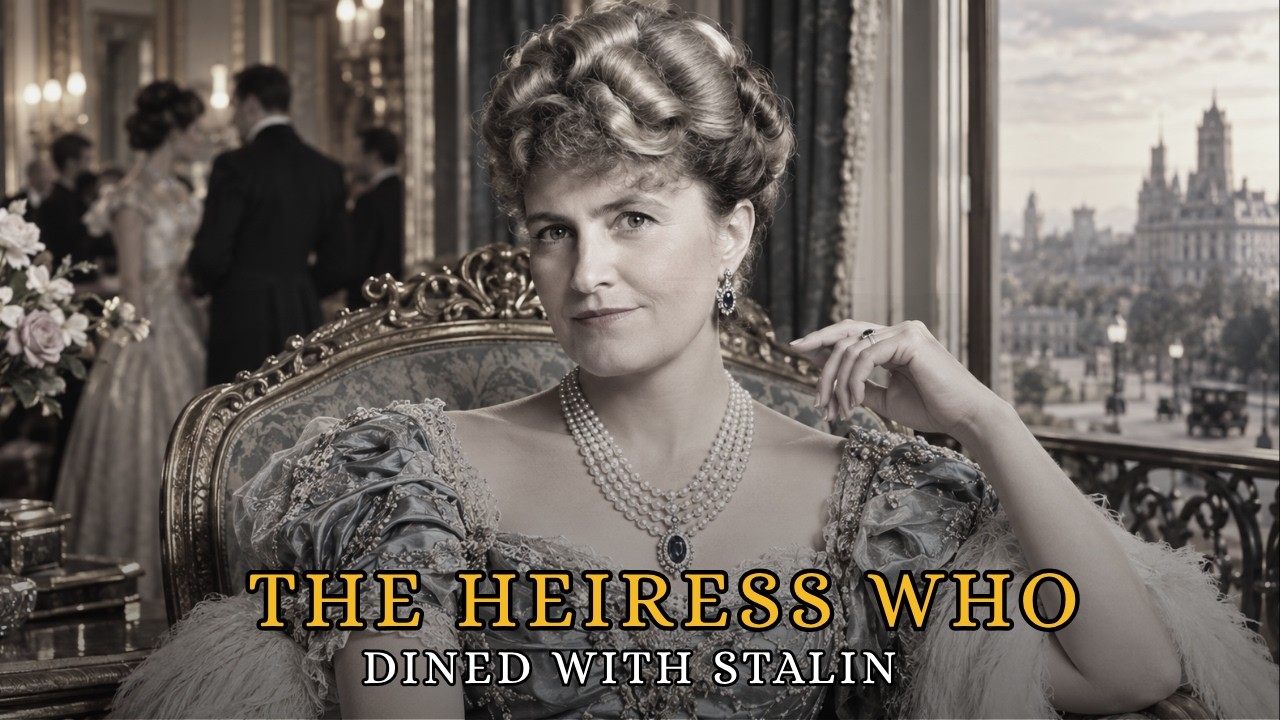
In the winter of 1937, as Joseph Stalin’s secret police executed hundreds of thousands across the Soviet Union, an American woman sat across from the dictator at his own table, dressed in diamonds and smiling. Marjorie Merriweather Post, the richest self-made woman in America and the driving force behind the General Foods empire, had stepped into the most dangerous diplomatic post of the era. While foreign diplomats whispered in fear inside their own embassies, she was quietly doing what no one else dared: buying up the confiscated treasures of the murdered Romanov dynasty and smuggling them out from under the noses of the NKVD. Her path to Stalin’s dinner table began with her father, Charles William Post.
In the early 1890s, he arrived in Battle Creek, Michigan, broke, frail, and suffering from severe gastrointestinal illness. After seeking treatment at the famous sanitarium run by Dr. John Harvey Kellogg, he became fascinated with the commercial potential of grain-based health foods. Experimenting in a modest barn with a secondhand stove and a coffee grinder, he perfected a roasted cereal beverage called Postum, followed by Grape Nuts, a shelf-stable wheat and barley cereal.
Unlike competitors who relied on local distribution, C. W. Post was a marketing genius who flooded national newspapers with bold advertisements, transforming the Postum Cereal Company into a multi-million-dollar industrial enterprise within a decade. Born in 1887, Marjorie was his only surviving child, and he raised her not as a delicate Victorian daughter but as his corporate successor.
From age ten, she accompanied him to board meetings and factory inspections, learning to read balance sheets, audit supply chains, and manage thousands of workers. When her father took his own life in 1914 following years of abdominal pain, she inherited an empire worth over twenty million dollars in gold-backed capital. Wall Street expected her to sell. Instead, Marjorie stepped directly into his shoes, attending every board meeting, auditing expenditures, and vetoing ill-advised expansion plans, proving that a young woman could command one of the nation’s largest food manufacturers with absolute discipline.
In 1920, she married Wall Street financier Edward F. Hutton and formed a formidable business partnership. The turning point came when Marjorie witnessed a demonstration of a revolutionary quick-freezing process invented by marine biologist Clarence Birdseye. While others dismissed frozen food as a gimmick, she recognized its potential to transform the global food supply.
She persuaded her husband to acquire Birdseye’s patents for the staggering sum of twenty-two million dollars, and in 1929 she reorganized the conglomerate as General Foods, absorbing iconic brands like Jell-O, Maxwell House Coffee, and Baker’s Chocolate. By integrating frozen food technology with refrigerated railroad cars, General Foods established a monopoly over the modern supermarket aisle, making Marjorie one of the wealthiest self-made women in history. Her wealth built palatial estates, including Mar-a-Lago in Palm Beach, a 128-room Spanish-Moorish mansion with gold-leafed ballrooms, and Hillwood in Washington, D. C.
She also commissioned the Sea Cloud, the largest private sailing vessel ever constructed, a floating palace with marble baths and communication systems that let her monitor Wall Street while cruising the Mediterranean. Yet she viewed her splendor not as vanity but as diplomatic soft power, funding hospitals, orchestras, and humanitarian relief during the Great Depression. In late 1936, her life took a dramatic turn. After divorcing Hutton, she married Joseph E.
Davies, a Washington attorney and trusted confidant of President Franklin D. Roosevelt. Roosevelt appointed Davies ambassador to the Soviet Union, and Marjorie accepted the role of ambassador’s wife, abandoning the sun-drenched corridors of Mar-a-Lago for the bleak, paranoid reality of Stalinist Moscow. Arriving in January 1937, the couple took up residence at Spaso House, a neglected neoclassical mansion where every servant was an NKVD agent and microphones were hidden in the walls.
Rather than surrender to fear, Marjorie brought her organizational genius to bear. She filled ship holds with twenty thousand pounds of frozen prime beef, cream, poultry, and canned goods, installing commercial refrigeration units in an embassy operating with absolute self-sufficiency amidst a starving city. Draped in priceless sables and flashing emeralds, she presented an unshakable image of Western economic supremacy that mesmerized the Bolshevik hierarchy. Behind the white tablecloths lay terror.
As Stalin’s purges decimated the political, military, and intellectual leadership of the Soviet Union, the Moscow show trials unfolded, where former revolutionary heroes confessed to absurd charges before facing execution. Foreign embassies were isolated, and old contacts vanished overnight. Yet Stalin, recognizing the United States as a counterweight to Nazi Germany and Imperial Japan, ordered that the American couple be treated with deference. Marjorie and Davies were granted private audiences with Stalin, Foreign Minister Vyacheslav Molotov, and NKVD chief Nikolai Yezhov.
At Kremlin banquets, Marjorie sat across from Stalin, noting the chilling contrast between his modest military tunic and the terror he projected over his inner circle. She engaged Soviet ministers in sophisticated conversations about industrial infrastructure and food preservation technology, astonishing men accustomed to viewing Western women as ornaments. When Molotov’s wife visited, Marjorie formed a rare personal friendship, gathering unscripted intelligence about the regime’s inner workings. While she dined on fine porcelain, thousands were dragged from their beds each night, and she recognized that the officials who toasted her health could be executed by morning.
Amidst this terror, Marjorie discovered a quiet economic campaign unfolding behind the scenes. Driven by the desperate need for hard currency to fund Stalin’s Five-Year Plans, the Soviet government established state-run commission shops designed to sell off the confiscated artistic heritage of the Romanov dynasty. Thousands of priceless treasures from imperial palaces, cathedrals, and aristocratic estates were piled into dusty warehouses waiting for foreign buyers. Marjorie moved with the precision of an experienced corporate buyer, exploring government storerooms and bank basements off-limits to the public.
While Soviet clerks saw only meltable precious metals, Marjorie recognized masterworks of imperial craftsmanship. Using dollars from her private accounts, she purchased hundreds of items for pennies on the dollar: gold chalices, diamond-encrusted snuff boxes, imperial porcelain services, and ancient silk tapestries. Among her most breathtaking acquisitions were two Fabergé eggs, including the Catherine the Great Egg, and sacred Orthodox icons encased in silver-gilt covers that Soviet authorities were preparing to melt down. She paid full asking prices, secured official export permits, and meticulously cataloged every purchase, transforming Spaso House into a temporary private museum filled with glittering gems and imperial porcelain.
She also transformed the embassy into a center of soft power diplomacy. Her state dinners, featuring solid gold table service and five-course meals prepared with American ingredients, melted the paranoid reserve of Soviet officials. Representatives from Britain, France, Germany, and Japan frequented her receptions, recognizing Spaso House as the most reliable intelligence clearing house in the city. The social intelligence she gathered was integrated into Davies’s official dispatches to Roosevelt, providing Washington with an unvarnished assessment of Soviet military preparedness on the eve of war.
In the summer of 1938, as Davies completed his assignment, Marjorie faced the monumental task of evacuating her collection from a continent on the brink of war. She ordered the Sea Cloud to navigate European sea lanes, loading hundreds of custom-built crates lined with oilcloth into its reinforced holds. When war erupted in September 1939, she ordered the yacht to cross the Atlantic, bringing her Romanov treasures safely to American shores long before Nazi occupation forces began plundering European collections. She later chartered the Sea Cloud to the U.
S. Coast Guard for one dollar a year, where it was repainted slate gray and deployed as a weather patrol ship guarding Allied convoys. After the war, Marjorie transformed Hillwood into a permanent museum, curating the most comprehensive assemblage of Russian decorative arts outside the former Soviet Union. Icons, Fabergé treasures, and imperial porcelain filled its galleries, while she hosted legendary receptions for presidents, monarchs, and diplomats through the tensest decades of the Cold War.
She established a private endowment to ensure Hillwood would never be forced to sell its assets. When Marjorie Merriweather Post passed away peacefully at Hillwood on September 12, 1973, at the age of eighty-six, the world mourned the end of a historical era. She was laid to rest in a rose garden mausoleum on the estate’s grounds, beneath a monument bearing her coat of arms and the Latin motto, “All my hopes in God.
” Today, visitors walking through Hillwood’s sunlit galleries encounter the legacy of a woman who built an industrial empire, dined with Stalin, and single-handedly saved the artistic soul of a fallen empire from total destruction.






