In March 1947, Christie’s auction house put the life of a dead prince on public sale, piece by piece, from silver and furniture to photographs and snuff boxes, carted out of Belgrave Square and sold to strangers. The public knew him as Prince George, Duke of Kent, the handsome prince with the elegant marriage, the member of the royal family killed on active service in 1942. But what the auction catalogue proved was something simpler. He never owned the money behind any of those possessions.
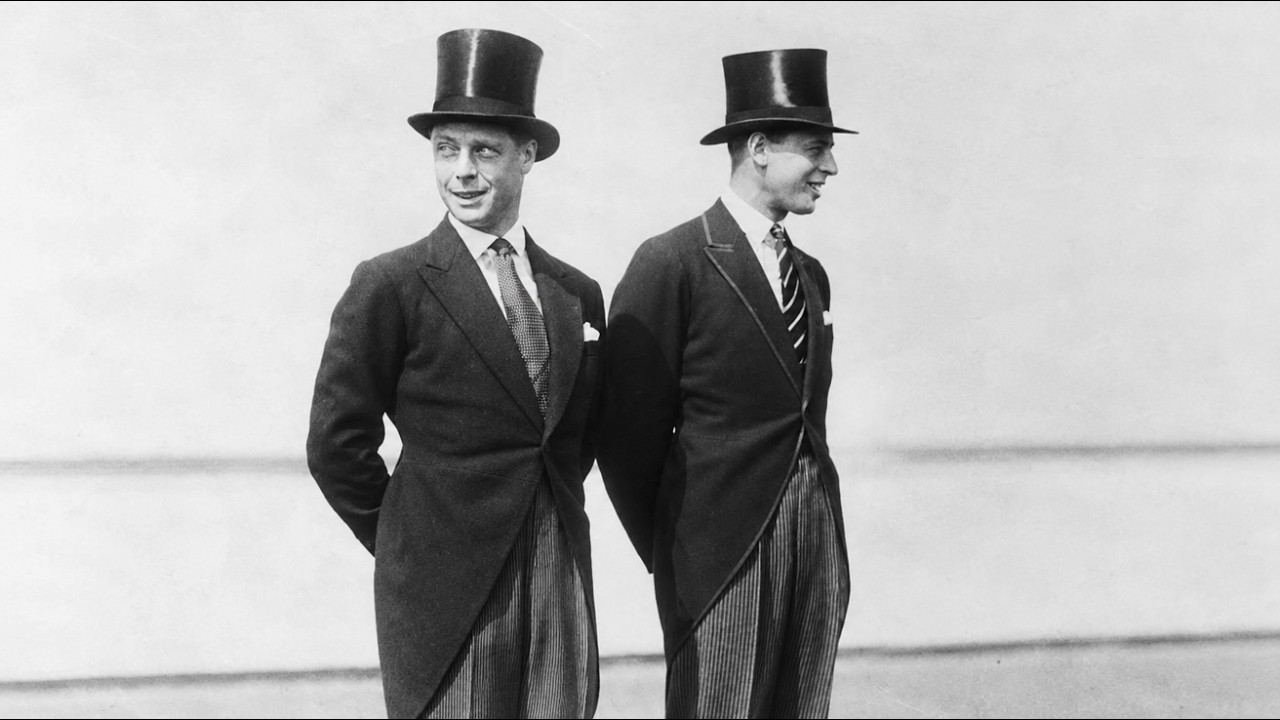
His widow needed the money. His heir, an eleven-year-old boy, was at school while his father’s rooms were priced and scattered. The boy kept the title and the house. Someone else decided who his father actually was.
This auction is the starting point of the story, because it explains something that turns the headline on its head. Prince George did not despise his son. There is no letter, no diary entry, no servant’s memory, no contemporary record showing coldness, cruelty, rejection, or disinheritance toward the boy who became the present Duke of Kent. What exists instead is a photographic record of a father who seemed to love having children around him, and a documented domestic routine at Coppins that included them.
The hostility in this family was real and brutal, and it ran in the opposite direction, from George V down to his sons, including the one in question. Prince George grew up under a father who ran his household like a warship and treated affection as a disciplinary risk. He spent his entire adult life trying to escape that machine. Then he died at thirty-nine, and his six-year-old heir inherited the machine anyway, without the one person who could have explained it to him.
So the estrangement is real. The cause is not hatred. The cause is that by the time the boy was old enough to ask who his father really was, the answer had already been edited, classified, indexed, and sold. Here is the sequence that matters.
On 25 August 1942, a Short Sunderland flying boat, serial number W4026, lifted off from Invergordon on the Cromarty Firth, carrying the Duke of Kent toward Iceland. About half an hour later it struck the side of a hill at Eagles Rock in Caithness. Fourteen of the fifteen men aboard were killed. The telegram reached Coppins, the house in Buckinghamshire that was the only property the Kents ever genuinely owned.
Princess Marina had given birth to their third child seven weeks earlier. The eldest, Edward, was six years and ten months old, and in that moment he became Duke of Kent. A title, a matter of income, and a set of public obligations were dropped onto a child who had not yet lost his baby teeth. Five years later, his father’s possessions went up for auction.
Contemporary reports treated the Christie’s sale as a dignified necessity for a war widow, which it was, in the narrow financial sense. It is also the most revealing document in this entire story, for what it shows about the marriage that produced those rooms in the first place. Everything in that catalogue had been bought with income granted by Parliament, not inherited wealth or private money, but an annuity voted by the House of Commons that could be reduced, and was, the moment the person receiving it ceased to exist. Look at who ended up owning what.
Marina kept Coppins because it had come to George by inheritance from his aunt, Princess Victoria, who died in December 1935. It was the only asset in the marriage that no committee controlled. Belgrave Square was lost. The collection was lost.
What remained in the world of the children was a house, a widow, and whatever version of their father she chose to give them. That is the real question of power behind all of this, and it is worth stating clearly before going back fifteen years. Who owned Prince George? The Crown paid for him.
His elder brother rescued him repeatedly. His wife made him respectable. And after 25 August 1942, his widow was the only surviving adult who decided what he actually was. To understand why a prince of the United Kingdom arrived at marriage with no private money and a reputation that needed urgent cleaning, you have to understand what his father had done to him first.
George V had four sons who reached adulthood, and by the testimony of everyone who watched the family closely, he bullied all of them. Kenneth Rose, working from the royal archives for his biography of the king, found a ruler who was genuinely affectionate on paper but wounding in reality, a man who corrected his sons’ clothes, their posture, their spending, and their friends. The naval instinct ran through everything. Three of the four sons were pushed toward the sea, whether it suited them or not.
It did not suit Prince George. He was sent to the Royal Naval College at Osborne and then Dartmouth, served there, and reports indicate he was miserable and suffered constant seasickness, leaving in 1929. For a royal son in that period, leaving the Navy was not a quiet career adjustment. It was a public admission that the family’s preferred way of occupying its spare princes had failed with him.
What happened next shows how incapable the system was of knowing what to do with him. He was given a stint at the Foreign Office. Then in the 1930s he took a Home Office-linked post involving factory inspection, a role that sounds almost comical until you grasp its reality. A prince given a ministerial bag to keep him in view, busy, and out of the newspapers.
He performed the role, by several accounts, with genuine interest. He was also, among his brothers, the only one with real artistic taste. He collected furniture, porcelain, silver, and paintings. He knew what he was looking at, and it was not a pose.
His grandmother, the formidable Queen Mary, who collected obsessively and gave her approval grudgingly, treated him as a fellow enthusiast. The problem was that a prince with refined taste and no fortune is a prince spending money he does not have. George’s income in his twenties came from the civil list allowances granted to the younger sons of George V when they turned twenty-one, and it was not enough for the life he lived. Debts accumulated.
And worse accumulated with them. This is the part that must be handled honestly with the sources, because it is the most repeated claim about him and the least documented. Many biographers, relying heavily on recollections gathered decades later and from the circle around his elder brother, concluded that in the late twenties, Prince George became addicted to drugs, often described as morphine and cocaine, and that his brother Edward, then Prince of Wales, removed him from view and kept him under supervision until he recovered. The woman usually cited as the source of supply was an American socialite named Kiki Preston, who earned a nickname in London gossip that repeated itself for decades afterward.
The contemporary record of all this is almost nonexistent in public documents, the vivid details vary from book to book, and the story was told with more enthusiasm by people who had reasons to make the Prince of Wales look like a hero. What is more solid is the shape of the story. In 1928 and 1929, Prince George vanished from public life for stretches. His brother’s intervention in his affairs was intense and unusual, and everyone around the family in later years regarded something serious as having been contained.
Contained. That is the family’s core verb. Because the same years produced something else, and this is better supported. Prince George wanted to marry a young woman named Poppy Baring, from a banking family, but the match was blocked, not by her, but by his parents.
The king and queen decided she was unsuitable, and that was the end of it, and the episode entered court gossip as early evidence that this particular son would be allowed no private life except on approved terms. Put the two things side by side. By 1930, the fourth son of the King of England had no private wealth, a failed naval record, debts, a broken engagement, and a health crisis the family had worked hard to bury. He was charming, beloved, and clearly intelligent about the arts, and entirely dependent on his father’s approval, his brother’s rescue, and Parliament’s annual vote.
He was, in the literal sense, a problem waiting for a solution. The solution the system came up with was the oldest in the dynasty’s toolbox. They married him off. Publicly and expensively, to someone unobjectionable, and let the wedding do the work that no amount of factory inspection had done.
In 1934, a candidate appeared who was unobjectionable in exactly the required sense, and available for a reason no one in Buckingham Palace would say aloud. Princess Marina of Greece and Denmark had impeccable lineage and little else. Her family had been driven out of Greece when the monarchy collapsed there. Her father, Prince Nicholas, had been reduced to teaching and selling his paintings in Paris.
She had grown up in exile in flats, not palaces. What she had was blood, five languages, a stunning ability to present herself, and a taste in elegance that was being commercially exploited within weeks of her engagement. She needed a life near a throne. He needed a wife no one could object to.
And here is the detail that keeps this from being merely a cynical story. Many who knew them insisted the attraction was real. They had met before. European royalty was a small, intermarried community, and Marina was a cousin of Prince Philip’s father and a distant relation of George himself.
But the courtship intensified in 1934, and quickly. By August they were in Bohinj, in what was then Yugoslavia, staying with Marina’s elder sister Olga, who was married to Prince Paul. The engagement happened there. It is worth pausing at that geography because it carries meaning.
The future of a British prince was not settled at Sandringham or Balmoral, but at a lake in the Julian Alps, in the house of a displaced Greek princess married into a Balkan regency. Marina’s family were no longer influential. They were well connected and broke. Photographs from late that summer show two people who seem pleased with each other, and letters cited by biographers point the same way.
Marina wrote about him with evident warmth. He seems to have genuinely admired her intelligence and boldness. No sane person argues this was a cold arrangement between strangers. It was also a business deal, and the paperwork proves it.
On 12 October 1934, seven weeks before the wedding, King George V granted his son the titles Duke of Kent, Earl of St Andrews, and Baron Downpatrick. The title came first, then the money. Under the existing civil list settlement, the king’s younger sons received allowances that increased substantially upon marriage. In George’s case, the amount rose to £25,000 a year, a vast fortune in 1934, and a political burden in the depths of the Great Depression.
The debates in the House of Commons were not friendly. Several MPs stood and asked, with varying degrees of tact, why a country with two million unemployed should vote a large income to a prince who had never earned anything. The grant was approved. It always was.
But the record of that debate is the clearest surviving evidence of what this marriage actually bought. Marriage made him solvent. Not his work, not family wealth, not inheritance. A vote.
That is the arrangement behind everything that follows. The wedding took place on 29 November 1934 on a scale the family had never attempted for a son who was fourth in line to the throne and slipping. Westminster Abbey was packed with the surviving royal houses of Europe, including a large number of Marina’s exiled relatives who had come to see one of their own return to a working throne. Then, immediately after, a second ceremony was held according to Greek Orthodox rites in the private chapel at Buckingham Palace.
That double wedding was a concession, and concessions in this family were rare and significant. The bride was not asked to renounce the church of a country that had expelled her family. The crowds were enormous. The BBC broadcast it.
And the dress did something no one had planned. Edward Molyneux, the couturier Marina had used in Paris when she had little money, made her a gown of silver and white brocade. Her going-away outfit and her overall sense of color produced a shade the press named “Marina blue. ” Within weeks it decorated shop fronts across Britain.
A bride with no money had just become a commercial force. Department stores copied her, hat shapes followed her, and for the next thirty years she was the family member people actually looked to for clothes. Think about what that meant inside the marriage. He brought the title, the annuity, and the family name.
She brought the one thing the House of Windsor could not manufacture. She was pleasant to look at, and people wanted to imitate her, and within a year the public had decided the Kents were the most glamorous. That reputation belonged to her far more than to him, and it was the first asset in the relationship that was entirely hers. They spent their honeymoon in the Caribbean on a borrowed yacht, the Rosaura, owned by Lord Moyne, which tells you something else about the nature of their life.
Even at the height of celebration, the boat belonged to someone else. Then London, Three Belgrave Square, a townhouse in one of the finest squares in the city, filled with the furniture and paintings George had been collecting since his twenties. This was where the collection lived. This was the inventory that would end up at Christie’s thirteen years later.
He arranged the rooms himself. Multiple accounts describe him as the eye, placing objects, searching for them, happiest in auction rooms. Marina had taste too, sharper and more modern, and by everyone’s account they enjoyed this together. That was the part of the marriage that was unambiguously theirs.
On 9 October 1935, Marina gave birth to a son at Belgrave Square, Edward George Nicholas Paul Patrick. He was given the courtesy title of his grandfather, Earl of St Andrews, and for almost six years he was simply a boy with a father. Two months later, the family acquired the only real property they ever owned. Princess Victoria, the unmarried sister of King George V, died on 3 December 1935 at Coppins, her house in Iver, Buckinghamshire.
She left it to her nephew, not to the Crown, not to the duchy, not in trust, but to George personally, with its contents. Coppins was not architecturally distinguished. But it was private. It was outside London, modest enough to run without a grand establishment, and no official body had authority over it.
The king died seven weeks after his sister. George V, who had spent thirty years berating his sons for their failings, was gone on 20 January 1936. And the elder brother who had pulled Prince George out of his worst years became Edward VIII. For about eleven months, the Kents were the most influential couple in Britain.
The new king was unmarried, childless, and devoted to this particular brother. George was closer to David than to anyone else. The 1929 rescue, whatever its details, had bound them. Marina’s position was secure.
Her clothes were news. Her son was in the line of succession, and her allowance had been voted. Then Edward VIII decided to marry Wallis Simpson, and every relationship in that family changed within a year. The abdication crisis is a story told amply elsewhere, so take only the part that affected this marriage.
When Edward left, the throne passed to Bertie, the shy, stammering second brother, who became George VI. The new king had two small daughters and no sons, which pushed Prince George forward in the succession into a position of real institutional importance. The brilliant, capable, publicly adored younger brother of a king who was, at that moment, widely doubted. It also cost him the brother closest to him.
Edward left the country in December 1936 and became a permanent embarrassment. The family’s rules about him hardened quickly. He was to be contained, not embraced. Marina’s role in that containment is where the sources go hazy, and caution is warranted.
It has been said for decades, and repeated in biographies, court memoirs, and gossip, that Marina was among the most severe of royal women toward the Duchess of Windsor, that she refused to receive her and considered the whole affair a failure of duty. Some accounts soften this, and defenders have argued the hostility was exaggerated and passed from writer to writer. What is beyond dispute is the practical result. The Kents did not step out of line.
Whatever private affection George retained for his elder brother, and there is reason to believe he retained a great deal, he stayed inside. That decision defined the rest of his life. He had been the brother with the flexible reputation. He became the trusted brother.
On Christmas Day 1936, two weeks after the abdication, Marina gave birth to a daughter at Belgrave Square. They named her Alexandra. A new reign, a new baby, a family photograph, and a public that now looked at the Kents as the warm, attractive, fashionable branch of a monarchy that had just frightened itself. Watch how quickly the dividend doubled.
In 1934 he had been a liability to be married off. By 1937 he was a national asset, and that asset rested on a woman the British public had decided to adore. The system that formed around them in those years is what most accounts miss, and it was where control actually lived. There was the household, the private secretary, the equerries, the ladies-in-waiting, the nursery staff.
There were the patronages handed down from above, which determined where they went and whom they met. There was the palace press apparatus, in full form, deciding which picture got circulated. There was Queen Mary, now a widow and more formidable than ever, who loved George, approved of the collecting, and operated as the family’s arbiter of standards in everything, from clothing to who could be invited. And there was the annuity, renewed by a Parliament that could, in principle, form an opinion about it.
None of that was theirs. They merely occupied it. The one place this machine stopped at the gate was Coppins. The Kents increasingly used it as a real home, the house where the children and dogs were, where guests came who would never have fitted in at a Belgrave Square dinner.
Noël Coward was a family friend and a permanent member of their circle. So were people from the theater and the arts, unusual for a royal household at the time, and part of why London was interested in them. Here the record requires a pause, because of a claim that has stuck to Prince George and will not go away. For years it has been asserted, in print and online, that there was an affair between him and Coward.
There are also old claims about other men and about a broader bisexual private life in the 1920s. Some of this appears in serious books. None of it appears in any contemporary document presented to public examination. Coward himself, in his published memoirs and letters, never mentions it.
The claim mostly surfaces in later interviews, secondhand memories, and the general liberty writers have taken with a dead prince once everyone who could sue was gone. The honest position is that he moved in circles where such relationships existed, that rumors followed him in his lifetime, and that the evidentiary basis for these specific allegations is thin. What the documented record shows is a man of extravagant taste, a dependent income, a wife who had become more attractive to the public than he was, and a new reign that had just made him necessary. In 1938 and 1939, the Kents were sent on official visits abroad, and the institution decided it had found a better use for him after that.
There was work coming, big work, on the other side of the world, and it would be announced as a promotion. On 10 October 1938, the appointment was announced. The Duke of Kent would become Governor-General of Australia, taking up the post in the autumn of 1939. It was the highest office any of George V’s sons had held outside Britain.
Australia had asked for a royal. There had been years of pressure from Australian governments wanting the prestige of a prince at Yarralumla. The British government and the king agreed. The press reported it as an honor, and it was.
It was also an exile, and people close to the family knew it. Consider what the post actually required. It meant leaving England for at least five years. It meant taking a three-year-old boy and a two-year-old girl twelve thousand miles away from their grandmother, their cousins, and the only court they belonged to.
It meant giving up Belgrave Square and closing Coppins. It meant that the brother closest to the exiled Duke of Windsor, still corresponding with him, would be on the other side of the planet while the new reign consolidated. Many biographers have made exactly this argument, that the Australian appointment solved more than one problem for Buckingham Palace, and that solving the smaller problem was the primary aim. No memorandum says this explicitly.
What exists is the shape and form of the decision. A charming, popular, slightly unpredictable prince with a hidden medical history and an embarrassing favorite brother is offered a magnificent job that will keep him out of the country for most of a decade. Marina’s position in all this is the part worth watching, because it reveals how little either of them could refuse. She had been in Britain barely four years.
Her sister Olga was in Belgrade, her parents in Paris, her entire network on the European continent. Australia meant starting over as a vicereine in a country she had never seen, under protocol stricter than anything in London. She prepared to go. Staff were hired.
Departure was set for November 1939. Then Germany invaded Poland, and on 3 September 1939, the appointment evaporated. It was announced the Duke would not take up the post. A governor-general in wartime could not be a man needed for service at home.
Lord Gowrie stayed in office. This cancellation is one of the hinge moments of this marriage, and almost no one treats it that way. In one stroke, the Kents lost that independent position which would have made George a head of state in his own right, with his own residence, his own household, his own authority, and an entire continent of distance from the family system. He never got another chance at autonomy.
Everything after September 1939 happened inside the machine. He put on uniform. He was initially appointed a rear admiral, then, significantly, took a lower rank to serve effectively in the RAF, becoming an air commodore in the welfare branch of the Inspector General’s staff. This was not a sinecure.
It meant constant travel, visits to aircraft factories, training stations, bomber bases, air-sea rescue units, and hospitals. He went to Canada and the United States in 1941 to inspect the Empire Air Training Scheme. By the testimony of the men he visited, he was good at the job, engaged, unpretentious, and genuinely curious about machinery. He was also, from late 1939 onward, mostly away from home.
Here the public and private timelines begin to diverge in a way that changes the course of the story. Through 1940 and 1941, the Kents appeared in newsreels and photographs as the perfect wartime couple. The Duke in RAF uniform at an airfield, the Duchess in uniform as commandant of the Women’s Royal Naval Service, visiting hospitals and naval establishments. They were photographed arriving at bombed streets.
They were used, usefully, as proof that the family shared the war. What the photographs do not show is the family’s finances. Belgrave Square was effectively closed. Coppins became the permanent home, and in 1940 Marina was there for long stretches with her two small children, a reduced staff, and a husband coming and going on a schedule set by the Air Ministry.
Her sister Olga’s position in Yugoslavia collapsed in 1941 when Prince Paul’s regency ended in a coup, and the British government interned the family in Kenya. Marina’s parents were in occupied Paris. Her mother’s Russian relatives had been gone for twenty years. The Greek royal house was in exile again.
She was a foreign-born princess in wartime Britain whose sister had been arrested by her husband’s own government. There were whispers about her origins, as there were about anyone with relatives on the continent. The only unassailable thing she owned was the popular affection she had built since 1934, on nothing but gifts and clothes. That was the moment the balance in the marriage quietly shifted.
He had the rank, the uniform, and the income. She had the one thing no committee could withdraw. The country loved her. In the autumn of 1941, Marina was pregnant again.
The third child was due in the summer of 1942. Against the war, this was an ordinary domestic fact. Against everything else, it is the detail that makes reading the following August painful. Prince Michael was born at Coppins on 4 July 1942.
The date was noticed in Washington. Roosevelt had been photographed with the Duke during the 1941 North American tour. The christening at Windsor on 4 August 1942 included the President of the United States among the godparents, with the child given the names George Franklin. A royal baby was being used, intelligently and deliberately, as an Anglo-American gesture at a stage of the war when that mattered enormously.
Look at the family at the beginning of August 1942. Three children, the youngest one month old. A home of their own. A husband doing work he seemed to love.
A marriage that began as a rescue operation and had produced, by every external measure, exactly what it was supposed to produce. Three weeks later it was all over. On 25 August 1942, the Duke left Coppins heading north. He was flying to Iceland to inspect RAF installations.
The aircraft was a Short Sunderland Mark III of No. 228 Squadron, carrying the serial number W4026, and took off from Invergordon on the Cromarty Firth in the early afternoon. The weather over the Scottish Highlands was bad, with low cloud over high terrain. About half an hour after takeoff, the aircraft struck the side of a hill near Eagles Rock above Berriedale in Caithness at roughly 700 feet and caught fire.
Fourteen of the fifteen men aboard were killed, the Duke among them. One man, the rear gunner, Flight Sergeant Andrew Jack, was thrown clear and survived with burns. He walked for hours before reaching help. The news reached Coppins that same night.
Marina was thirty-five. Michael was seven weeks old. Edward, the new Duke of Kent, was one month short of his seventh birthday. The official investigation report was issued within weeks, and its conclusion was stark.
The aircraft had not been flying the course its crew had been told to follow. The finding blamed the captain for changing course and descending in conditions that did not permit it. A short statement to that effect was made in the Commons. The full papers went into the Air Ministry files and were eventually released to the National Archives.
Because this is the part of the story the internet has fed on for eighty years, it deserves directness. An entire industry has grown up around the premise that something mysterious happened at Eagles Rock. The theories vary: the Duke was on a secret peace mission, Rudolf Hess was aboard, the Duke was flying the aircraft, there was an extra unidentified corpse, the plane was sabotaged, the investigation was a cover-up. These claims have appeared in books and newspaper articles since the 1980s onward, often based on local memories collected forty years after the crash, on the fact that some wartime records stayed closed for decades, and on the genuine oddity that a Sunderland flying a coastal route had ended up inland over the moors.
The evidence-based answer is not exciting. Wartime flying killed enormous numbers of experienced crews in exactly this way, deliberate contact with the ground in cloud over hills, with navigation dependent on seeing the ground. The official finding of deviation from the assigned route is not a cover story. It is an accusation against the dead captain, precisely the kind an institution does not fabricate against one of its own without reason.
The surviving gunner’s account, given while he recovered, described no conspiracy. Historians who have worked the files have found no viable alternative. The more mundane truth is worse than the conspiracy, and here is why. A conspiracy would mean he was important enough to be killed.
What actually happened is that the fourth son of a king, a man whose life had been arranged, rescued, financed, and directed by other people since he was thirteen, was killed by bad weather and a wrong turn thirty minutes into a routine inspection flight to a country he had been sent to because the better job had been cancelled by the war. The funeral was held in St George’s Chapel at Windsor Castle on 29 August. He was buried there initially. His remains were later moved to the royal burial ground at Frogmore, where Marina eventually joined him.
The newspapers published photographs of the three royal brothers at the grave. The Duke of Windsor, who was in the Bahamas, was not there. Then came the practical questions, quickly, and they were about money. The Duke of Kent had been granted an annuity of £25,000 a year for life.
It stopped at his death. What Marina received was the widow’s allowance, a much smaller sum, plus the position of a dowager duchess with three children, one of whom held a dukedom with no property attached to it. There was no inherited land for the Kent family. The title had been created in 1934 and carried only precedence.
Coppins became hers, since George had left it to her in his will, with its contents and his collection. The will was published, and the estate was valued at the time at about £160,000 before taxes. A substantial sum, but not a fortune capable of maintaining two houses, running a household, educating three children, and performing a public role for decades. She was now the sole adult with authority over everything he had owned.
The first thing she did was withdraw. For most of 1943 and 1944, Marina reduced her public engagements, stayed at Coppins, and raised the children there. The routine continued. The glamour faded.
Photographs from those years show a woman in black, then in quiet half-mourning colors, standing slightly apart at family occasions. The second thing she did was begin making decisions about the property, decisions that shaped what the present Duke of Kent knows about his father to this day. Belgrave Square was given up. No London house was kept where George had arranged his rooms, where Edward and Alexandra had been born.
There was no practical way to keep it. It was expensive, war-damaged and dispersed, and the income that had covered it no longer existed. Which left the contents. Fifteen years of one man’s collections were boxed and stored, owned by a widow who needed money and three children too young to be consulted.
The sale was arranged for March 1947 at Christie’s in King Street, and lasted several days. It is worth understanding the nature of that catalogue as a document. An auction catalogue is an inventory made by strangers. Every object is reduced to a lot number, a line of description, a measurement, sometimes a provenance.
It does not record why a man bought a thing, or in which room he placed it, or which pieces he kept rearranging, or which ones he had searched for over years. It records only what the thing was and what it might fetch. For fifteen years Prince George had been buying with an eye the London trade genuinely respected. Furniture, silver, porcelain, pictures, antiques.
He was a constant presence in auction rooms. Queen Mary, the most relentless collector in the family, treated him as an equal in this one activity, the only field in which that formidable woman seems to have considered a son or grandson her peer rather than a subject of instruction. In March 1947, all of it went onto the same rostrum he had bid from. The press covered the sale respectfully as a financial necessity, which it was.
Postwar Britain was broke. Death duties were real, and a widow with three children and a reduced income made the decision any competent trustee would have made. No one acted in bad faith. That is what makes it the right place to begin this story rather than the crash site.
Because of what it did to the children. Edward, Duke of Kent, was eleven and at prep school. Alexandra was ten. Michael was four and had no memory of his father at all, not one.
Everything those three would know about the man would come from photographs, from their mother, from relatives, and from objects. The objects left the house. There is no evidence Marina intended an erasure, and it would be unfair to suggest it. She kept the papers, the personal effects, the photographs, the family portraits, the house itself.
But the scale of the dispersal meant that the richest record of her husband’s real personality, the only part of his life that was unquestionably his own choice rather than a task assigned by his father or a committee, was converted into cash and distributed across the London art market within a week. The father the boy inherited was a title, a grave at Frogmore, a set of newsreels in RAF uniform, and his mother’s account. She controlled that account for the next twenty-one years, and she did it with great skill. The first thing to say is that Marina was not a passive widow who faded into shadow.
She rebuilt her public position from zero, and she did it by reclaiming the only assets that were truly hers. In 1947 she traveled to Athens for the wedding in the family circle of her nephew King Paul. More importantly, she began to appear again as herself, not merely as a widow. Within a few years she was back on the pages she had always belonged on.
Best-dressed lists, photographs, front rows. She became president of the All England Club at Wimbledon in 1969, having been associated with the championship for years before. She became chancellor of the University of Kent at Canterbury in 1963, the first woman to hold such an office in Britain. She represented the Queen at the independence celebrations of Ghana in 1957 and Botswana in 1966.
She went to the Soviet Union in 1965, the first member of the British royal family to visit since the revolution that had destroyed her mother’s family, a decision heavy with personal meaning that she handled without a word of complaint in public. None of these positions came with land or capital. They were all honorific. Watch what she was doing.
A woman whose entire financial security had been voted away by Parliament on 25 August 1942 rebuilt a public role through institutions: a tennis club, a university, official visits, things no civil list review could strip from her. She had done exactly once before, in 1934, when an impoverished princess arrived in London and made herself indispensable with a dress. She was also, by multiple accounts, running a very frugal household on limited means. Stories circulated for years about the austerity measures at Coppins.
She gave up the London arrangements and kept the one asset that had come to the family outside the system. Keep that house in mind. Coppins is the quiet hero of this entire story. It came from Princess Victoria in 1935, a bequest from a spinster aunt, not a grant from the state.
It was where the three children actually grew up. It was where the telegram arrived in 1942. It was the only address in the Kent family’s life that no official body controlled. And because of that, it was the only place where a private version of the family could be preserved.
The present Duke of Kent grew up there as a boy holding a dukedom. That is an odd situation and worth pausing over. Since the age of six, he had been addressed by a title his father had held for less than eight years. He carried the rank without ever seeing it performed.
He was head of a house consisting of his mother, his sister, and his infant brother. What he did with it is the quietest turn in the story. He joined the army. Not the ceremonial version, but Sandhurst, then a commission in the Royal Scots Greys, and real military service that included a tour in Hong Kong and later duties in Northern Ireland and Germany.
He stayed in service for over twenty years and retired as a major general. His father had been pulled out of the Navy because he hated it, then moved between departments to keep him busy. The son chose a service and stayed in it. In 1961 he married Katharine Worsley, the daughter of a Yorkshire baronet, at York Minster.
The marriage required a certain amount of family negotiation. She was a commoner, from a country family rather than a royal house. The contrast with 1934 was telling. His father had been prevented from marrying a banker’s daughter, then steered toward a princess whose main qualification was that no one could object to her.
His son married the woman he chose. Marina, by the available accounts, was not entirely enthusiastic about the marriage in its early years. The sources differ on the scale of the disagreements, and most of the detail comes from later recollections, so it should be treated with caution. What is documented is that the wedding was held in Yorkshire, the bride’s county, with every member of the royal family in Britain present.
Then came that part of the Kent inheritance that is hard to look at, and it is essential to this story because it shows what the family system did to the next generation of wives. Katharine, Duchess of Kent, suffered a stillbirth in 1977 and severe depression afterward. In the 1990s she did something no one in that family had done. She spoke about it publicly, in interviews, in plain and direct language.
She converted to Roman Catholicism in 1994, the first member of the royal family to do so since the seventeenth-century legislation that made it constitutionally sensitive. She stopped using the title Her Royal Highness in 2002, and taught music at a state primary school in Hull for thirteen years as Mrs. Kent, with the school keeping her secret. These are three generations of the same struggle.
George V ran his sons’ lives by reprimand and correction, and there was no escape. Prince George tried to leave, but was reeled back in again and again, and the one job that would have given him autonomy was cancelled by the war. The son’s wife simply stepped out of the ceremonial machine and went to work, and the family let her do it. Marina died on 27 August 1968 at Kensington Palace of a brain tumor, aged sixty-one.
The date fell one day short of the twenty-sixth anniversary of the week her husband was buried. She had been a widow longer than she had been a wife. Her decisions about her estate completed this pattern. Coppins passed to her eldest son.
He kept it for a few years, then in the early seventies, sold it. The house left the family. So by the mid-1970s, the situation was this. The art collection had been dispersed in 1947.
The London house had been given up in the 1940s. Coppins had been sold. The annuity had ended in 1942. Of everything Prince George, Duke of Kent, had owned or occupied, the single thing his son kept was the title.
The only asset created by a decree from his grandfather seven weeks before the wedding, which cost nothing to maintain because it was just paper. He has held it for eighty-three years. He still holds it. And through all that time, the present Duke of Kent has said almost nothing in public about his father.
This is not a gap in the record caused by lack of opportunity. He has given interviews over six decades about the army, Wimbledon, the Freemasons, his regiment, the Scouts. He has been photographed hundreds of times. He is one of the most regularly working members of the family, with a documented schedule of engagements going back to the 1950s.
The silence is specific and confined to one subject. What he has done instead is go to Caithness. There is a memorial at Eagles Rock, a granite cross erected by the Duke’s mother’s family and local bodies, standing on an open hillside above Berriedale, reachable only on foot across rough ground. It lists the names of the fourteen men who died, not just the Prince.
It has been there since the 1940s. The Duke of Kent has made the walk. He went in 1985 on the anniversary, and has been associated with the memorial and its upkeep ever since. There are photographs of an elderly man in a raincoat on a Scottish hillside standing at a stone in a place where there is nothing else.
No house, no church, no visitor center, no crowds. This is the only part of his father that was never sold, never dispersed, never given up. Look at what he chose. Not the title, which he had no say in.
Not the collection, which was gone before he could form an opinion of it. A slab of granite in an empty field in the far north of Scotland marking the place where a flying boat full of airmen hit a hill in bad weather. The place that turned a six-year-old boy into a duke. There is something else about that memorial that changes how you read everything before it.
It does not belong to him alone. The inscription lists the crew: the captain, the navigator, the flight engineer, the wireless operators, the gunners, the Duke’s private secretary, and his valet who were traveling with him. Fourteen names on one stone. In a family whose organizing principle was precedence, whose weddings were seating plans, whose funerals were processions ordered by rank, the only permanent marker his son continues to visit is the one place where Prince George, Duke of Kent, is listed as a victim among others.
That is the closest this story comes to an answer about affection, and it is indirect, because indirect is all the evidence allows. So let it be stated plainly what the surviving records actually support about the marriage, and then about the father and son whom the narrative accused of hatred. The marriage worked. That is the first finding, and it resists a cynical reading.
George and Marina chose each other in 1934 for reasons that included money, rescue, respectability, and dynastic interest. The affection visible in letters and photographs appears genuine, and both things remained true simultaneously for eight years. Neither of them considered those categories to be in conflict. She wanted a life with solid ground after watching her family lose theirs.
He wanted a wife his parents could not object to, and got one who turned out to be the most publicly appealing personality in the family. They collected together. They raised three children. They were photographed constantly, and in those photographs they look like people who love each other.
The marriage did not fail. It was cut off, then liquidated. That distinction is the whole story. Most power marriages fall apart through betrayals, separations, settlements, humiliations, the slow transfer of influence from one partner to another as the relationship rots.
This marriage never got the chance. The transfer of power happened in a single afternoon by accident on a hillside, and it was total. On 24 August 1942, Prince George held the rank, the uniform, the parliamentary income, and the name. On 26 August, his widow held everything that was left, because everything he had held was granted, not owned, and grants end.
Think about what she inherited and what she did not. She did not inherit money, or land, or a seat, or a company, or wealth, or any of the things that usually make a widow powerful. She inherited a house that came from a spinster aunt, a large stock of furniture, and a public reputation she had built herself with a Molyneux dress and thirty years of knowing exactly how to stand in photographs. She converted the furniture into liquidity and kept the reputation.
It was the right decision, and it was also a permanent decision for her children, which brings us back to the catalogue. Open it again in your mind the way an eleven-year-old was never given the chance to. Page after page of one man’s choices. The pieces he bid on in his twenties when he was deep in debt and should not have been bidding.
The things he bought in the years when his brother was king and the Kents were the most elegant couple in London. The things he arranged in the rooms at Belgrave Square where two of his children were born. The collector’s record is a personality written on paper. It shows what one looked at, what one could not resist, what one kept returning to.
In March 1947, that personality was broken into lots and sold at auction. The public narrative about this family has always been that Prince George was the handsome brother who died a hero, and that his son grew up to be that dutiful, reserved royal who turns up to events and says little. Both are partly true. What the catalogue proves is the hidden mechanism: that he never owned the life he lived, that the money came from a vote, that the house came from an aunt, that the title came from a warrant signed seven weeks before his wedding because the wedding was required to make the money legal, and that when he was gone, the whole apparatus simply stopped, leaving a woman and three children in a Buckinghamshire house full of antiques and no income to maintain them.
The headline says the father despised the son. He did not. There is no document, no witness, no contemporary account that even suggests it. The truth is that the son grew up estranged from his father in the only way that mattered.
He never knew him, and then the evidence of who he was was sold before he was old enough to study it. Michael, the baby at the christening named for Roosevelt, has no memory at all. Alexandra was five. Edward’s memories, from the few things he has said over the decades, are fragments any six-year-old would keep.
The rupture in this family was made by circumstance, then completed by an auction house. That is less dramatic than hatred, and far harder to repair. The hostility the headline is looking for does exist in this lineage. It is just one generation further back.
George V made his sons genuinely miserable. The record on that is overwhelming, from Rose’s work in the royal archives to the testimony of courtiers and the behavior of the sons themselves, each of whom developed an escape strategy. The eldest abdicated. The second stammered through a reign he never wanted.
The fourth left the Navy, got into trouble, had to be rescued, was prevented from marrying whom he wanted, was married off to solve the problem, and then was offered a governor-generalship on the other side of the world. And he accepted it. That is the detail that should stop you. A British prince offered five years in Canberra with two small children said yes, because it came with a residence of his own, a household of his own, and twelve thousand miles between him and Buckingham Palace.
The war cancelled it, and he died in uniform three years later. That was the end of the only lifeline he was ever offered. Now consider what happened to the escape instinct in the next generation, because this is where the story turns. His son got out, with difficulty, and legally.
Twenty-one years in the Royal Scots Greys, a marriage to a baronet’s daughter in Yorkshire, a choice rather than an arrangement. A wife who eventually stepped entirely outside the royal pattern, spending thirteen years teaching music at a primary school in Hull under a name the children there did not recognize. A brother, Michael, who married a Catholic divorcée in 1978 and gave up his place in the line of succession to do it. The same kind of marriage that had been impossible for his father’s generation.
Every door that had been closed to Prince George, his sons opened, and he was not alive to see any of it. The final question is the one that has hovered in the background since the beginning. Who owned him? The Crown paid his expenses and could stop.
His father managed his affairs and could veto his marriage. His elder brother rescued him, then became a permanent embarrassment he had to disown. His wife made him respectable and gave him the public love he could not earn alone. His widow outlived him by twenty-six years, kept the house, sold the collection, raised the children, rebuilt her standing through a tennis club and a university chancellorship, and died in 1968, having been the sole keeper of his memory for longer than she had been married to him.
Everything his children know about their father, they know because she told them, or because she kept the photograph, or because she decided not to. Then she died, and Coppins was sold, and the last physical trace of him was gone. What the present Duke of Kent has done with that legacy is the final turn, almost invisible, and perhaps that is the point. He has spent more than seventy years working.
Wimbledon, the Scouts, the regiment, the Freemasons, hundreds of engagements a year, even past eighty. A man photographed thousands of times handing trophies to tennis players. He has never written his memoirs. He has never sat for a confessional interview.
He has never corrected a rumor about his father, including the drug stories, the cowardice claims, and the conspiracy industry that has grown up around Eagles Rock and has been selling books since the 1980s. The silence, in a family that has always managed its problems by containment, is an inherited technique. George V contained his sons. The palace contained the 1929 crisis.
The family contained the Duke of Windsor. The widow contained the memory. Her son has kept it for eighty-three years. So look at the catalogue one last time, because its meaning has changed.
In March 1947 it looked like a practical necessity for a widow. A sad, sensible liquidation, noted by the press in a paragraph or two while it was busy with the rationing crisis. It can still be read that way, and nothing here suggests otherwise. But it is also the only complete inventory of Prince George, Duke of Kent, that was ever made.
Not the title, which his grandfather invented. Not the annuity, which Parliament granted and then withdrew. Not the uniform, which the Air Ministry issued. Not the governor-generalship, which the war reclaimed.
The collection was the only part of that life he chose himself, and it was catalogued, measured, priced, and sold while his heir was at school learning Latin. The boy kept the dukedom because the dukedom was free. He kept the house for a few years and then let it go. He kept his mother’s account because there was no other account.
He has kept climbing, now and then, up a hill in Caithness to a granite cross bearing fourteen names, to stand in the one place where no one could sell his father, or inherit him, or vote on him, or grant him, or arrange him, or improve him. That is the real reason the Duke of Kent has nothing to say about his father. He was never given the chance to find out who he was.
The only man who could have told him hit a hill in bad weather thirty minutes after leaving Invergordon, and five years later the rest of the answer went under the hammer at Christie’s, at whatever price the postwar market would bear.






