The log measured twenty feet across. It lay on a bed of brush and bark the crew had spent days building beneath it, a long cushion meant to keep the trunk from shattering when it finally came down. It had taken those days to bring the tree to the ground. Now a man walked up to the side of the fallen trunk carrying an auger longer than he was tall.
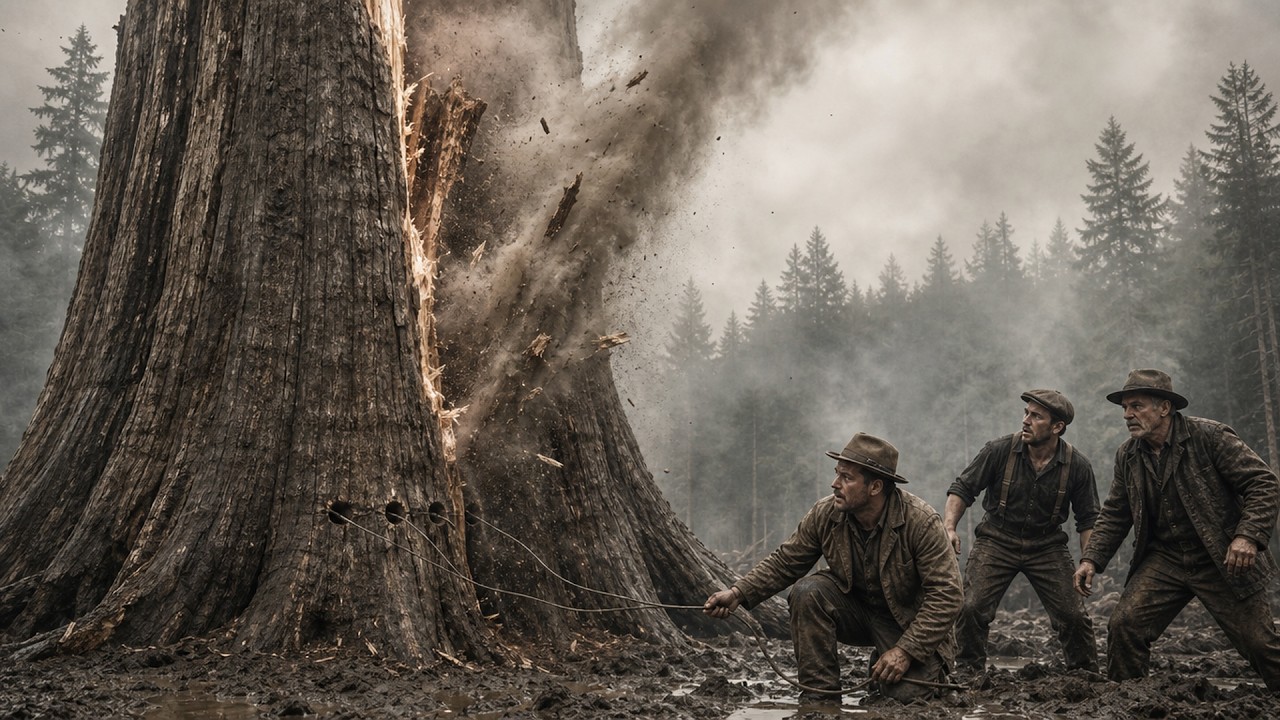
He bored into the wood and kept boring until the hole ran past the center of the log. Then he slid a cartridge down the hole, and every man on the crew walked away. The records of the Redwood camps of Humboldt County, California, describe what happened next in a single dry sentence. Logs sixteen to twenty feet in diameter were quartered by blasting.
Almost nobody asks why. Why would men who had just spent days felling a tree weighing well over one hundred tons turn around and blow it apart just to move it? The answer runs through every part of how the Redwood country worked, from the stump to the mill. It starts with a problem no logger in the East had ever faced.
The trees were too big for the tools. A white pine in Maine or Michigan came down, got cut into lengths, and went to the river. The men who came west to California in the 1850s brought that whole system with them. They brought the axe and the crosscut saw, the ox team and the skid road, and the idea that one log was one load.
Then they met the coast redwood. The average redwood log in these camps was four and a half feet across. Seven feet was the most common size to send to the saw. Logs over ten feet in diameter came out of the woods regularly, and the biggest trees put logs on the ground that were sixteen, eighteen, even twenty feet through.
The size shaped everything that followed, starting with how the tree came down. Before a single cut was made, the crew chose where the tree would land and built a bed there. Then they built a staging around the base, because the roots flared out so badly that the cut had to be made six to ten feet up the trunk. The men who did the felling were the choppers, and they were the aristocrats of the woods.
In the 1880s, a good chopper was paid up to one hundred and twenty-five dollars a month. A pair of them could spend days on a single big tree, chopping from the staging, cutting the undercut deep enough to steer the fall onto the bed. When it was down, the peelers went to work. They cut through the bark with axes at the points the sawyer marked, then drove long steel bars under it, flattened at one end, and pried it off in slabs.
A peeler in the last quarter of the nineteenth century earned fifty dollars a month and his board. The underbrush and the bark were stacked and burned. Then came the bucking. The tree was cut into logs with a saw eight feet long worked by one man.
The standard lengths were fourteen, sixteen, eighteen, twenty, twenty-four, and thirty-two feet. But redwood was rarely cut into anything longer than twenty. Now do the arithmetic on one of those logs. Take a butt log twenty feet across and only sixteen feet long.
That is about five thousand cubic feet of wood. The Forest Products Laboratory put freshly cut redwood at fifty-five pounds to the cubic foot. Even figured a good deal lighter than that, one log comes out well over one hundred tons. A small house lying on its side in the mud, still soaking wet.
And somebody had to move it. The way a log moved in the 1880s was the skid road. A skid road was a track built out of the forest itself. The crews laid small round timbers crossways on a graded bed, each one twelve feet long, set six feet apart, and barked smooth so a log would slide across them rather than catch.
Over that road went the bull team. Eight to twelve oxen in pairs, and in some camps six, eight, or ten heavy draft horses instead. The logs were chained together nose to tail into a train, and the team dragged the whole train down the skids to a landing by the water or the rail line. It took more men than the team suggests.
Ahead of every load walked the water packer, whose only job was to keep the road generously sprinkled with water in front of the logs so that wood slid on wet wood. At the steep pitches, barrels of water stood ready, because on the trip down everything was done with a rush. The most important man in the camp, after the cook, was the one who drove the oxen. The bull puncher earned one hundred and fifty to two hundred dollars a month with his bunk thrown in.
Nobody else in the woods came close to that. He did it with his voice and a goad stick, and with a pair of lungs the whole canyon could hear. Around him worked the men who handled the rigging, the chain men and the block tenders. In the 1880s and nineties, they were paid thirty to fifty dollars a month and their board.
That was a quarter of what the man with the goad stick earned for standing closer to the logs than anyone. A landing at the end of the road held twenty to thirty logs. That was the system, and it had limits. A twenty-foot log sat far outside all of them.
It was not only the oxen. The chain had to wrap it, the skids had to bear it. And at the far end there was a sawmill, and the mills of the 1850s were built for Eastern timber. A three-and-a-half-foot log was the largest the gang saws of the day could cut.
When the mills set one circular saw above another to reach higher, they could handle a log four feet across. Four feet. The tree on the ground was twenty. The mills would grow over the decades that followed.
The trees were never going to get any smaller. So the log had to get smaller. And there were only two ways to make it smaller in the woods. You could cut it, or you could split it.
Sawing a log lengthwise by hand twenty feet through was out of the question in the woods. So the camps split them. The rule that came down through the records is simple. Logs over ten feet in diameter were usually split.
Logs of sixteen to twenty feet were quartered by blasting. The blasting itself sounds reckless. It turns out to be the most careful work in the woods. It began with the auger, a long auger bored into the side of the log by hand and driven until the hole ran past the center.
The reason for going that deep is plain physics. A charge sitting near the surface spends itself blowing a crater out of the near side. A charge set past the middle pushes on the wood from the inside, and the log gives way along its own grain. Then the cartridge went in down the full length of the hole.
Redwood suited that. It is straight-grained, and it splits so readily that the same wood was being riven by hand into shakes, posts, and grape stakes all over the Redwood country. Charged from the center, the log opened along its length into sections. On the logs over ten feet, halves.
On the logs of sixteen to twenty, quarters. Each one running the full length of the cut. Think what that did to the numbers. A log of well over one hundred tons became four pieces, each a quarter of the weight.
A shape that could not be rolled became four wedges with a flat face and a curved back. Each one small enough to chain and to skid. Even quartered, though, those pieces were not light. A quarter of a log that size still weighed somewhere around thirty tons.
It lay on a slope, on a bed of broken brush. The men walked up to it as soon as the smoke cleared, because now it had to be turned, chained, and started down the hill. Which brings in the most ordinary tool in the redwood country, and the one that did the most work. The jack screw.
A jack screw was a heavy threaded screw set in an iron base with a crank on top. One man turned the crank, the screw rose, and whatever was sitting on the head of it rose with it, an inch at a time. It gave a single worker the force to lift and shove weights that no crew of men could move with their hands. It was a very old logging tool.
Crews all the way up the coast into Washington used it on heavy logs. In the woods, it set them in position for the oxen and later for the steam engines. In the yards, it rolled them where they had to go. Photographs from the 1890s show the jack screw men posing with their screws the way other crews posed with saws.
In the redwood woods, the jack screw went everywhere the logs went. When a split section lay wrong for the chain, the jack men set their screws under one side and cranked it over. When a train of logs stopped dead on the skid road and the oxen could not start it, the camps did not bring in more oxen. They called in the men with jack screws to get the logs moving again, inch by inch, until the team could take the weight.
At the landing, the logs went on to railroad cars the same way. The cars were spotted alongside the landing, and the men posted there rolled each log onto a car with a jack screw operated by a crank. At the mill, it happened again. As the log was fed through the saw, it was moved on the carriage by jack screws handled by one man.
Loading was its own small science. A log rolled onto a flat car had nothing to stop it rolling straight off the far side. So the crews set chocks on the bunks on the opposite side of the car before the jack men started cranking. Then the loaded trains ran for the mill at about fifteen miles an hour.
And at the mill pond landings, the logs were hauled up an incline on a low iron car pulled by a huge chain. The whole industry, from the forest to the saw blade, rested on a hand-cranked screw. And it did not go away quickly. Hobbs, Wall and Company, one of the big firms up the coast in Del Norte County, was still using jack screws to unload its log cars into the mill pond until 1912.
What finally changed the woods started with an accident. At William Carson’s mill on Humboldt Bay, an unusually high tide lifted a batch of logs out of the mill pond and floated them off into the bay. A man named H. N.
Mercer was working a pile driver at the edge of the pond, and the pile driver ran on a small steam engine. Carson suggested he run a line from that engine out to the logs and pull them back in. It worked. And Carson’s partner, John Dolbeer, saw what it meant.
Dolbeer built a steam engine made for the woods, an upright boiler and a winding drum on a heavy sled built to snake logs out to the skid road and couple them up for the oxen. It went into service at Salmon Creek in 1882. Within a year, he had a geared version that could pull a train of logs and load them onto cars as well. By 1888, more than a hundred of Dolbeer’s donkeys were at work in Humboldt County alone.
The donkey could drag itself uphill. It was chained to a stump, ran its cable out through blocks tied to other stumps and trees, and winched itself forward. Where a bull team needed a graded road, a donkey needed an anchor. Then, in 1892, a man named David Evans built something bigger.
He called it the bull donkey, and it was made to haul whole trains of logs along the skid roads, the job the oxen had always done. The bull donkey gathered logs from all over the cutting with its cables, strung them into a train, and hauled the train down the skid road to the landing. Its main cable could be five miles long, wound onto an enormous drum, with a smaller line paying out at the same time to haul the empty cable back up the hill. A single bull donkey pulled a train of ten logs down the skid road in one run.
The crews splashed crude oil on the skids to cut the friction, and the engine dragged the logs over them by brute force until the timbers wore a groove. It was so successful that a number were soon at work in Del Norte County. And by the 1920s, the engines had replaced the oxen. Then the high line arrived.
Powered by a bull donkey, it lifted the logs off the ground and carried them to the landing at the railroad instead of dragging them there. None of that made the logs any smaller. A donkey could pull harder than oxen, and a high line could lift what a team could not. But a twenty-foot log was still a twenty-foot log at the other end of the cable, and it still had to go onto a railroad car and through a saw.
Steam changed how hard the woods could be worked. It did not change the arithmetic of the tree. Through all of it, the work stayed long and the pay stayed thin at the bottom. In 1903, after a strike in the Redwood country, the settlement set a minimum wage of forty dollars a month for unskilled labor.
Skilled blacksmiths and carpenters were to be paid eighty dollars a month for a ten-hour day. Those were the men who kept the donkeys running and forged the chains the logs were hung from. What ended it came in stages. In 1925, the first caterpillar tractors went to work in the redwoods at Klamath Bluff.
Power saws followed in the early 1930s, and by 1936, they were in general use. And after the Second World War came bulldozers to cut roads straight into the timber, and trucks and trailers to run the logs out to the mills. By then, the biggest trees were gone. By the time Redwood National Park was created in 1968, nearly ninety percent of the original redwood forest had been logged.
What is left in the woods today is the other end of those trees. Walk through the second growth anywhere in Humboldt or Del Norte County, and every so often there is a stump so wide that a dozen people could stand on it. Some of them still carry the square notches where the fallers set their staging six or ten feet up. The young trees grow in a ring around the edge.
The logs that came off those stumps are gone, sawn into boards and shipped out a century and more ago. Nothing marks where they lay. But every one of them went the same way.
A crew stood over a tree they had spent days bringing down, and a man bored a hole into it past the center, and set a cartridge, and walked away, so that four pieces of it could go where the whole of it never would.






