The co-driver of a Sherman tank climbed back onto the turret of his immobilized vehicle while German fire tore through the air around him. He was a twenty-four-year-old Englishman serving in the Irish Guards, and his name was Edward Charlton. His tank had just been hit. The rest of the crew had bailed out, dazed or wounded, and were making their way rearward.
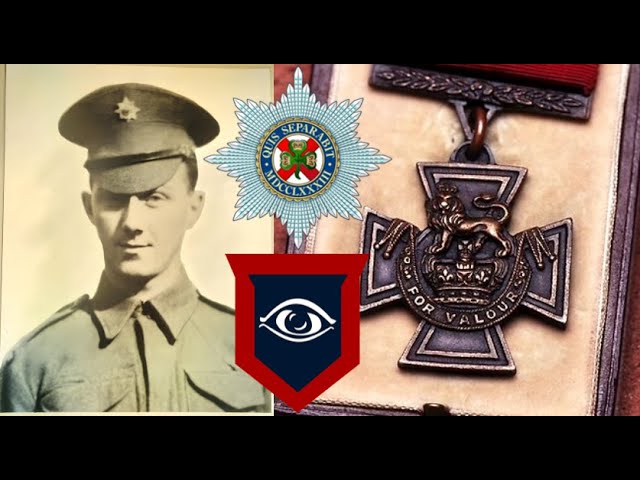
Charlton could see that his fellow guardsmen were on the verge of being overrun by dozens of German infantry pressing toward the village. In that moment, possessed perhaps by an angry, bloody-minded determination, he decided he was not finished. He unfastened the Browning . 30 caliber machine gun from the turret, hauled along a couple of boxes of ammunition belts, and walked out into the road in full view of the enemy.
He opened up, firing from the hip. The village of Vishet had been just another small German settlement standing in the path of the British army’s advance in late April 1945. The objective beyond it was the great port city of Hamburg, the last German city of importance on the western front still unoccupied. Leading the advance was the redoubtable Guards Armoured Division, a formation that had been in the vanguard since the Battle of Normandy, had liberated Brussels, and had led XXX Corps into the doomed Operation Market Garden in the Netherlands the previous summer.
It was the first British unit to cross the Siegfried Line on the German frontier, and in March 1945 its units had advanced deep into northwest Germany. The division had been formed in 1941 by converting the king’s personal household troops from infantry to armour. Each of the five famous regiments of foot guards was represented in the new formation: the Grenadier, Coldstream, Scots, Irish, and Welsh Guards. Today those names are more familiar for public ceremonial duties in London and at Windsor, alongside the Household Cavalry Regiment.
But then, as now, each guards battalion was a regular fighting unit of the British Army, rotating between ceremonial, combat, and training duties, having most recently seen active service in Afghanistan. By late April 1945, XXX Corps, including the Guards Armoured Division, was advancing very rapidly across northern Germany. The German army was no longer able to mount a coordinated defense. Only local counterattacks and stands in small towns and villages blocked the British path.
XXX Corps had two objectives: Bremen, a very important German U-boat base, and the greater prize of Hamburg, further north. The 2nd Battalion Irish Guards was given the task of cutting the autobahn between Bremen and Hamburg in order to prevent German reinforcements from reaching either city. The place chosen to cut the motorway was the village of Vishet. On the 20th of April 1945, Hitler’s fifty-sixth and last birthday, Number One Squadron of the 2nd Irish Guards advanced and cleared the road near the settlements of Elldorf and Sittensen.
A troop pushed forward to Vishet, but it was clear that the enemy held the village in strength, and the Irish Guards temporarily withdrew. The following morning, Number One Squadron and a platoon of infantry attempted to capture and occupy Vishet. The village was held by a fairly powerful German force, including elements of two battalions of the 115th Panzergrenadier Regiment of the 15th Panzergrenadier Division, with its own integral armored support. What happened next was a story of extreme gallantry that became legendary.
Charlton, born in 1920 in Rowlands Gill in County Durham in the north of England, was in fact English, though serving in the Irish Guards. At first light on the 21st of April 1945, a troop of four Shermans of Number One Squadron set off for Vishet. On approaching the village, they found a considerable number of German soldiers in occupation, well armed, particularly with Panzerfaust anti-tank rockets. A flanking movement along the autobahn was conducted by Number Three Squadron in support.
The squadron commander, Major Pat O’Callaghan, had a narrow escape when a Panzerfaust rocket actually glanced off his tank’s turret. The two Irish Guards squadrons then mopped up the German infantry. But ten minutes later, Number One Squadron reported a German self-propelled gun advancing from the west down a lane. Before the guards could retreat, the self-propelled gun knocked out a Bren gun carrier belonging to the 3rd Battalion.
Both squadrons managed to find suitable firing positions, but the German self-propelled gun fired at anything that moved. Major O’Callaghan dispatched Lieutenant Neil Walford-Edwards and his troop along the autobahn to try to outflank the German gun. Walford-Edwards spotted it, but also two others lying in ambush positions close by, and was unable to score any hits. The German guns withdrew.
Those self-propelled guns then opened fire on Number One Squadron at some range, battering the Shermans for an hour or so. The British responded with a heavy artillery barrage. The Germans, however, had now decided on a counterattack. It would be made on Vishet with two battalions of panzergrenadiers, supported by artillery, mortars, and the aforementioned self-propelled guns.
In Vishet, the situation soon became very serious. All the Shermans in the village were hit, and the accompanying infantry was severely outnumbered and in real danger of being overrun. That was the moment when German confidence was shattered by the extreme courage of one Irish Guardsman who made a one-man counterattack. When Charlton’s tank was hit, he abandoned it along with the rest of the crew.
But instead of making good his escape rearwards, he saw his fellow Irish Guards on the verge of being overrun. He clambered back onto the turret of his immobilized tank under considerable German fire, managed to unfasten the Browning, loaded the weapon, and walked out into the road. He opened up, firing from the hip. Hip-firing a .
30 caliber machine gun is difficult. It is very heavy and, of course, belt-fed. But drills did exist, as contemporary US Army training films of the period show. The light machine gun could be fired from the battle-fire position when necessary: grasp the pistol grip in the right hand, place it on the inside of the thigh, extend the left arm rigidly as when firing the rifle.
In this position, surprising accuracy was possible. The leading German company was shot to pieces, with dozens killed or wounded by the lone British soldier and his tank machine gun. Charlton’s action brought the German attack to a complete halt and gave his fellow infantrymen and tank crewmen time to reorganize themselves and begin withdrawing. Charlton, still under heavy fire, displaced to a garden fence and propped the Browning on it, resuming fire at the Germans despite being wounded in the left arm.
He kept up a withering fire, completely exposed to enemy fire himself, for an astounding ten minutes, until a second German bullet hit him in his already wounded left arm and he lost all use of it. Somehow, bleeding profusely, Charlton managed to keep the machine gun in action upon the fence, loading and firing it with just his right hand. Belt after belt went through the gun, taking a heavy toll on the Germans, until finally Charlton was shot for a third time and collapsed at his position, mortally wounded. Once Charlton was down, the German infantry swarmed forward.
But his one-man stand had bought enough time for his comrades to withdraw to safety. Charlton himself was taken prisoner by the Germans, who treated him correctly, but he succumbed to his wounds later. Incredibly, the German officers who had witnessed Charlton’s stand would, following their own capture over the next few days, bring his heroism to the attention of the Irish Guards. It was partly due to their accounts that Charlton received the posthumous award of Great Britain’s preeminent medal for valor, the Victoria Cross, in February 1946.
In the days following Charlton’s VC action, the much weakened German forces were progressively ejected from Vishet and the surrounding villages, beginning a general withdrawal toward Bremen. Charlton’s actions had contributed greatly to whittling down the German forces, particularly their infantry. The Victoria Cross awarded to Edward Charlton was the last Victoria Cross awarded on the Western Front in World War II. Today it is proudly displayed at the Irish Guards’ regimental headquarters at Wellington Barracks, beside Buckingham Palace.
Charlton himself is buried at Becklingen War Cemetery in Germany.






