The young Senonian farmer stood on the slope and stared at something that should not have existed. It was a cold morning in late September, and before him stretched a wall of wood and earth, taller than three men, running away to his left and right until it vanished into the mist. Behind that wall, he could see another one. And beyond it, on the crest of the hill, lay the town they had come to save.
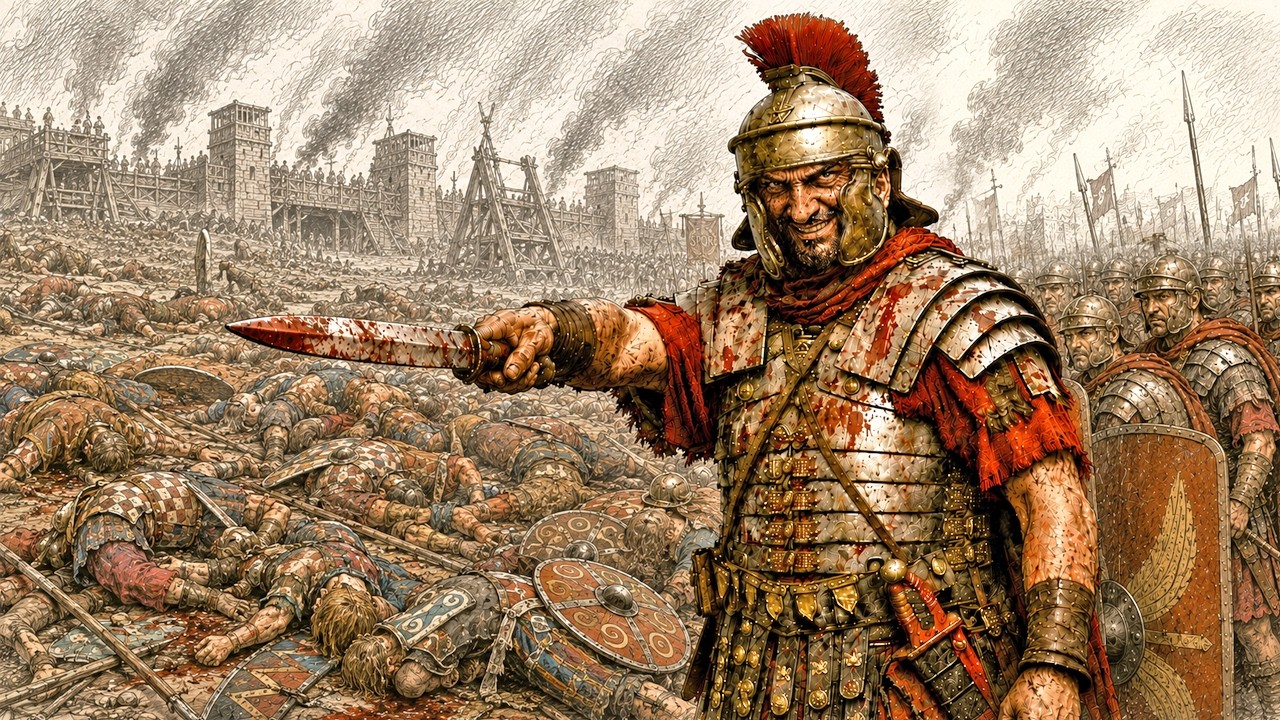
Between him and that town ran twenty miles of Roman engineering built to destroy him. Around him, a quarter of a million warriors from the Gallic relief army were forming up for the largest coordinated attack in the history of the Celtic world. Inside the hilltop town of Alesia, eighty thousand more warriors and their leader, Vercingetorix, were preparing to strike from the other side. And between those two armies stood fifty thousand Romans and a middle-aged politician from an aristocratic family in Rome who had decided that he would not lose today.
One Roman army, surrounded, trapped at the heart of the greatest siege of the ancient world, with an enemy inside its inner walls and a larger enemy outside its outer ones. Within the span of roughly the time it takes to read a novel, that Roman army would commit an act that historians still argue about two thousand years later. Before the decisive battle began, the Gauls inside the city made a decision that was forgotten for two thousand years. They pushed their women, their children, and their elderly out through the gates, into the no-man’s-land between themselves and the Romans.
What happened to those people stands among the most disturbing episodes in the history of ancient warfare. And when the outer Roman wall was breached, and the Gallic warriors poured through, and the entire Roman position was on the verge of collapse, what Julius Caesar personally did to turn certain defeat into overwhelming victory was not a brilliant strategy. It was something far stranger and far more human. The man who had nearly pulled it off was named Vercingetorix.
He was in his late twenties, a nobleman of the Arverni tribe who carried a personal wound that shaped everything he would do in his life. His father, Celtillus, had been executed, not by Romans, but by his own tribe. The charge was that Celtillus had tried to make himself king of the Arverni, and the Gallic nobles had killed him for it. The boy grew up in the shadow of that execution, watching his people divided by tribal jealousy while Julius Caesar, four hundred miles away, conquered the country tribe by tribe.
By early 52 BC, Vercingetorix had achieved what no one had thought possible. He had united the Arverni, the Aedui, the Senones, and the Parisii, tribes that had hated each other for generations, under a single command. He had a plan. Caesar records him telling his countrymen to burn all the towns they could not defend, so that the Romans would be deprived of shelter and supplies.
Burn everything to starve Rome out. The strategy worked for a time. On the other side of this war stood a fifty-year-old Roman nobleman who had spent the previous six years quietly turning Gaul into a killing ground. Julius Caesar was not young.
He was drowning in debt, politically weak in Rome, and had staked his entire future on this campaign. He promoted the image of the civilizer bringing order to barbarians. In reality, he was running one of the largest operations of human enslavement in Roman history. Accompanying Caesar was a thirty-year-old officer named Marcus Antonius.
Not yet the man who would destroy himself for an Egyptian queen, not yet a rival to Augustus, just a reckless, battle-hardened cavalry commander with a gift for winning the loyalty of soldiers. Behind Vercingetorix stood more than chiefs and nobles. There were farmers, blacksmiths, and sixteen-year-old boys carrying spears made by their fathers. Warriors who had marched from villages two hundred miles away because a messenger had arrived on a worn-out horse and spoken a single word: Alesia.
By late summer, Vercingetorix was exhausted. The scorched-earth strategy had failed. Caesar had adapted, obtaining grain from friendly tribes, and the war had entered a new phase. Vercingetorix withdrew his army to what he believed was the safest ground in Gaul: a hilltop town called Alesia.
It was the worst decision he would ever make. Vercingetorix reached Alesia in late summer of 52 BC with, by Caesar’s account, eighty thousand infantry and twelve thousand cavalry. Those numbers come from Caesar, who wrote his Commentaries as political propaganda for the Roman Senate, and modern historians argue that he exaggerated them. But even by the lowest academic estimates, this was sixty to eighty thousand warriors, plus the town’s civilian population: thousands of women, children, elderly artisans, and traders.
Opposing them, Caesar commanded ten Roman legions, roughly forty to fifty thousand professional soldiers hardened by six years of campaigning in Gaul, plus auxiliary light infantry from allied tribes and, most importantly, Germanic cavalry who had been paid, fed, and turned into some of the most effective mounted troops in the ancient world. The full Roman force numbered between fifty and sixty thousand men. Among his officers was thirty-year-old Marcus Antonius. Alesia sat on Mont Auxois in what is now Burgundy in central France, a steep, rugged hill rising from a plain, with two rivers at its base.
Caesar himself wrote that the hill on which the town stood was towering and surrounded on all sides by very steep and rough ground. From the summit, the fortress overlooked approaches that would defeat any conventional attack. That was why Vercingetorix chose it. But there was a problem he had not noticed.
Alesia was high, defensible, and fixed. A man who had spent months urging his tribes to burn their towns and refuse open battle had now committed his entire army to defending one hill against the most skilled siege engineers in history. Caesar looked at Alesia and did not attack. He did something worse.
He was an engineer above all else. In the years before Alesia, his men had built a bridge across the Rhine in ten days, so imposing that the Germanic tribes on the far bank fled at the sight of it. When Caesar looked at Alesia, he did not see a battle. He saw a construction project.
He gathered his officers. He told them, in words he later published for the Roman Senate, that the town could not be taken by assault without heavy losses of life. Therefore he had decided to build circumvallation and contravallation lines. In human language, this meant: they would not attack the hill.
They would build a wall around it, and keep building until the men on top starved to death. Some of his officers must have objected. Soldiers were soldiers, not diggers. A relief force, which everyone knew would come from every tribe still resisting Roman rule, would arrive eventually, and then Caesar would face two enemies at once.
His answer was the boldest engineering decision in the history of ancient warfare. He would not build one wall. He would build two. An inner wall, sixteen kilometers long, facing Alesia, to confine Vercingetorix.
An outer wall, twenty-one kilometers long, facing outward, to stop the relief army when it came. Two rings of fortifications with a Roman army between them. The specifications alone were terrifying. Two parallel trenches, each fifteen feet wide and equally deep.
The nearer trench was flooded by diverting local rivers into an artificial moat. Behind it rose an earth rampart topped with a wooden palisade and battlements. Wooden watchtowers stood every twenty-four meters, and twenty-three fortified camps linked the fortifications. In the killing field before the walls lay three layers of hidden terror.
First came the fosse, pits three feet deep with sharpened stakes fixed at the bottom and covered with branches. Next came the stimuli, rows of sharpened stakes driven into the ground. Then came the tribuli, small iron caltrops designed to pierce the feet of any man running toward the wall. Miles of this were not built by machines.
Men built it with shovels. Forty thousand Roman soldiers worked in shifts, digging night and day for weeks. The forests around Alesia were stripped of timber. River courses were changed.
Two thousand years later, archaeologists would find on Mont Auxois the remains of those trenches, the trap fields, and those iron caltrops still lying there. While the Romans dug, Vercingetorix made his decision. He would send his twelve thousand cavalry out at night, to pave the way for the largest army ever assembled on Gallic soil. From the walls of Alesia, he watched a ring of wood and earth close around him hour by hour, day by day, and began to realize something terrible.
The food inside Alesia had been calculated for a defense, not a siege, not with eighty thousand warriors, twelve thousand horses, and a civilian population all consuming grain at once. The numbers ran not to victory, but to weeks. He called a council of chiefs inside the oppidum, and there they made the decision that would shape the rest of the battle. They could not break out with the whole army; the terrain and the Roman positions made that impossible.
But their cavalry could get through. Twelve thousand horsemen mounted up not to fight, but to escape, to scatter across Gaul and summon every allied tribe. That night, the Gallic cavalry slipped out of Alesia through unfinished sectors of the Roman line. Caesar’s description of their escape was uncharacteristically brief, which shows how much it pained him.
Without his cavalry, Vercingetorix faced the decision that would haunt Alesia for two thousand years. The food supply, already thin, now had to feed a population that included civilians unable to fight or defend the walls. He began rationing grain strictly, then more strictly. Caesar’s text notes, without much emotion, that civilians suffered before the warriors.
Here is where the story becomes human. Mothers watched their children lose weight. Old men who had lived through decades of Arverni history sat in dark rooms in silence, knowing they were being kept alive at the cost of grain that could feed a warrior on the wall. Then Vercingetorix made his choice.
Somewhere during those weeks, the civilians of Alesia, old and young, women and children from families who had lived on that hill for generations, were sent out through the gates toward the Romans. And the Romans did not let them through. Julius Caesar, great civilizer of Rome, issued orders: these people were not to enter the Roman lines. They were not to be fed.
They were not to be enslaved. They were not to be killed. They were simply left. Meanwhile, hundreds of miles from Alesia, Gaul was witnessing something it had never seen before: unity.
The twelve thousand horsemen had ridden for weeks. They went to the Aedui, once Rome’s closest allies, now on the verge of revolt. They went to the Sequani in the east, the Senones in the north, the Parisii on the Seine, and dozens of smaller tribes. Everywhere, the message was the same: Alesia was dying.
Vercingetorix was besieged. Bring every man you can muster. Caesar recorded the relief force at about two hundred fifty thousand infantry and eight thousand cavalry. Some popular accounts inflate this to half a million warriors.
Modern historians argue that Caesar’s own numbers were exaggerated for propaganda purposes. But even if this number is cut in half, this was still the largest army ever assembled in the Celtic world. Villages were emptied. Farmers left their fields unharvested.
Blacksmiths left their forges cold. Chiefs led columns of thousands, with grain wagons, horses, spears, and shields painted in the colors of tribes that, within living memory, had been fighting each other. They came to save Alesia because they understood something Caesar had understood first. This was not a battle.
This was the last chance. By late September, the relief army began arriving on the plain behind the Roman outer wall. Caesar, sitting at the center of what he had built, watched them come. He had known they were coming since the moment the Gallic cavalry escaped.
That was why the second wall existed. His entire strategy assumed that a huge Gallic army would eventually appear and try to crush him. When the relief force finally arrived, it was not a surprise. It was walking into the trap he had spent three weeks preparing.
The relief commanders, several of them, since tribal politics allowed no single leader, did not attack immediately. They surveyed the outer Roman wall, examined it, walked along it looking for weaknesses. What they saw must have stunned them. Twenty-one kilometers of continuous fortifications, facing outward, bristling with towers and ditches and hidden trap fields whose full extent they could not yet see.
It was a wall built specifically to stop an army approaching from exactly where they stood. Vercingetorix, watching from the walls of Alesia, saw the campfires of the relief army on the horizon. For the first time in weeks, a gleam of hope must have touched the fort. He prepared his men with siege equipment: ladders, bundles of branches and wood to fill the Roman trenches, grappling hooks.
The plan was simple: attack from both directions at once and grind the Romans down until they collapsed. Somewhere along those thirty-seven kilometers of fortifications, a section would give. Once one section gave, the rest would follow. At dawn on the day the attack began, no Roman soldier standing on those walls knew whether he would live to see nightfall.
From the plain behind the outer wall, the relief army advanced in disciplined formations. Tribes fought side by side: Aedui next to Arverni, Senones next to Parisii. Long spears, painted shields, tribal horns, and drums formed a wall of sound that could be heard to the summit of Alesia. Inside the oppidum, Vercingetorix’s warriors surged toward the inner Roman wall.
Faces were thrown into the ditches. Ladders were slapped against the palisade. The sortie was meant to coincide with the external attack, and for the most part it did. Then the Gauls reached the trap fields.
A young warrior of the Senones, the composite figure we began with, carried a ladder on his shoulder. The ground looked empty. It was not. His foot broke through a thin layer of brush and he dropped three feet into a pit lined with sharpened stakes.
His leg was pierced. He could not get out. Around him, dozens, then hundreds of warriors did the same. Some fell into the pits.
Others hit long rows of sharp stakes hidden in the undergrowth. Others caught their feet on small iron caltrops that pierced leather and drove into their feet. Caesar, watching from horseback behind his lines, noted what happened next in one of the most vivid passages of his military writing. Missiles rained on them from the fortifications and towers on all sides, so that they could not hold their ground.
From the towers, every twenty-four meters along the walls, Roman artillery crews fired continuously. Scorpions launched heavy bolts. Ballistae hurled stones. Archers on the walls fired lead shots capable of shattering a human skull from a hundred meters.
Legionaries hurled javelins into the masses below, then bent and picked up another. But then came the first setback. The Gauls did not collapse. They came back again and again, wave after wave, over the bodies of their brothers.
The first day of the attack ended with a Gallic withdrawal, not a defeat, a withdrawal. As darkness fell, the relief army pulled back to its camps to regroup, treat the wounded, and prepare a second attempt. Inside Alesia, Vercingetorix’s sortie also broke off. The Romans, exhausted but holding, spent the night repairing sections of the wall and repositioning reserves.
That night, the relief commanders made a crucial decision. They had learned something from the first attack. There must be a weak point somewhere along the twenty-one-kilometer outer wall, a section where the terrain had made construction difficult, where the fortifications were unfinished, where the Roman garrison was thinner. Their scouts found it: a sector on rough, sloping ground where the outer wall met terrain the Romans had not been able to fully develop.
Here they would concentrate their next assault. At dawn the next day, the second attack began. It was different: more organized, more focused. The Gauls threw their strongest forces at the weak sector.
Inside Alesia, Vercingetorix launched his coordinated attack on the corresponding section of the inner wall. Now it is necessary to stop thinking of Alesia as a static siege and start thinking of it as a crushing between two sides. A Roman soldier in the strip of land between the walls: behind him, Vercingetorix’s warriors pouring down the hill and striking the inner wall. Ahead of him, a hundred fifty thousand troops hammering the outer wall.
Crushed in a hydraulic press made of men, his only shield the wood and earth and the discipline of the man beside him. Roman cohorts moved between the walls at speed. Units were pulled from quieter sectors to the weak point. Thirty-year-old Marcus Antonius, with unexpected calm, moved units to the threatened sector.
Reserves ran out, and still the Gauls kept coming. Then, in the middle of the afternoon of that second day, the outer wall collapsed. The breach was catastrophic. Gallic warriors poured over a section of the outer wall or through a gap where fascines had filled the ditch.
Roman defenders were being killed in hand-to-hand combat inside the corridor. Reports raced along the line to Caesar’s command post: a fortification on the right flank had been broken. The enemy was inside the fortifications. If the gap widened, the entire Roman position would collapse.
Once the Gallic warriors flooded into the corridor between the walls, they would attack the inner wall from behind while Vercingetorix’s men attacked it from the front. Fifty thousand Romans would be caught on both sides by a force outnumbering them perhaps five to one. What Caesar did next has divided historians for centuries. He did not send an officer.
He did not delegate. He himself walked along the lines, pulling cohorts from every position that could spare them, gathering, by modern estimates, around sixty-five hundred men into an improvised reserve. Then, according to later Roman accounts, he did something a commander of his rank was not supposed to do. He picked up a shield, placed himself at the front of that reserve, and led them to the breach.
His red cloak, the uniform of the Roman commander, which Caesar deliberately wore so that his soldiers could always see him, was visible in the thick of the fighting. The soldiers on the verge of breaking saw their fifty-year-old commander standing in their midst. The line held, and then it advanced. Whether Caesar actually wielded a sword that day, or simply stood in the front rank, cannot be established.
Roman tradition depicts him as physically engaged. What is beyond dispute is that his personal appearance at the breach stopped the Gallic breakthrough long enough for what happened next. While his improvised infantry plugged the gap, Caesar ordered his Germanic cavalry, his best-equipped force, to ride around his fortifications. They appeared behind the Gallic relief army, still pressing against the wall, and attacked it from the rear.
Here was the decisive moment. The relief army, a hundred fifty thousand men or more, pinned against the outer Roman wall, hammering it by the thousands, believing it was about to break. Then they heard behind them the horns of the Germanic cavalry, turned, and saw Roman horsemen among them. There was no line to fall back to.
The relief army collapsed. In the moment it collapsed, Alesia was finished. Warriors from a dozen tribes fled. Some threw down their weapons.
Others tried to organize a fighting retreat but were cut down by pursuing Roman and Germanic cavalry. Caesar’s horsemen chased them across the plain for miles, capturing and overwhelming them. The Romans overran the relief camps. The grain wagons, the food meant to save Alesia, fell into their hands.
From the walls of Alesia, Vercingetorix watched. He could see the plain. He could see the fires of what had been the relief army’s camps, now being looted. He could see his cousins, his allies, his last hope, dying or fleeing in every direction.
His sortie against the inner wall faltered as news spread. Warriors on the ladders stopped, looked at the relief force dissolving on the horizon, and understood. The men coming for them were not coming. They would never come.
The relief force, gathered from every tribe in Gaul, collapsed within hours. Vercingetorix pulled his men back inside the fort. The gates were closed. The great alliance was destroyed.
And a young Arverni nobleman, not yet thirty, sat inside the walls of a town that could no longer feed itself, surrounded by warriors unable to fight, looking at what remained of the greatest confederation Gaul had ever known. Nothing. The battle of Alesia ended on the day the outer wall held. The siege of Alesia would end six days later in a strangely quiet scene.
For several days after the failed attack, Alesia held out, not because it could fight, but because there was nothing else to do. The relief army was gone. The food was gone. The cavalry sent weeks earlier to recruit that vanished army would not return in sufficient numbers.
The abandoned people between the walls were gone forever. Vercingetorix called his final council. The chiefs discussed three options: fight to the last man in a desperate battle, take their own lives to avoid Roman capture, or surrender. Surrender was Vercingetorix’s decision.
Modern sources place the date at October 3, 52 BC. In the account passed down through Roman tradition, and later through nineteenth-century French paintings and statues, Vercingetorix did not surrender in an ordinary way. He rode out of the gates of Alesia in full armor, alone or nearly alone, and went directly to Caesar’s command post. He dismounted, removed his weapons, sword, shield, and helmet, and laid them at Caesar’s feet.
Not a single word of his has survived. There is no recorded speech. Only the image described by later Roman writers who were not present, and who had their own reasons for depicting the scene as they did: a proud, humiliated Gaul, a young man surrendering his country to a fifty-year-old Roman. Caesar did not embrace him.
He did not offer clemency. He ordered him bound. The scale of what happened at Alesia must be stated plainly. Caesar’s own writings tell us that among the Gallic warriors captured after the surrender, every Roman soldier was entitled to take one captive as a personal slave.
That single statistic shows the scale of enslavement. Some forty to fifty thousand men were sold or distributed as slaves to Caesar’s soldiers alone. Thousands more Gallic warriors were killed, either in the attacks following the collapse of the relief army or in the days that followed. The relief army, a coalition of more than a hundred fifty thousand fighters at its peak, ceased to exist.
The surviving warriors returned to villages that had lost fathers, sons, and brothers. Some tribes lost entire generations of men. Caesar routinely downplayed Roman losses in his account, but modern estimates place the number of Roman dead over the entire siege at several thousand, with many times that number wounded. Vercingetorix, the young Arverni noble who had briefly united Gaul, was taken to Rome.
He was held in the Tullianum, a stone chamber beneath the Capitoline Hill used for high-status prisoners. He remained there for six years. In 46 BC, Julius Caesar, now dictator of Rome, celebrated his triumph over Gaul and marched Vercingetorix through the streets of Rome in chains. On that same day, after the triumph, in the darkness of the Tullianum, a Roman executioner ended his life.
He was probably still in his thirties. Julius Caesar returned to Rome as the most famous general in the history of the Republic. Alesia became the centerpiece of his political propaganda. His Commentaries, including the entire seventh book devoted to the campaign, circulated among the Roman elite as proof of his unique ability to lead Rome.
Three years after Alesia, he crossed the Rubicon and plunged Rome into civil war. Six years later, in 44 BC, he was assassinated in the Senate by men who feared the power Alesia had given him. Marcus Antonius, the thirty-year-old officer who had helped hold Alesia, spent the next decade rising in Roman politics on the strength of his connection to Caesar. After Caesar’s assassination, he struggled for control of Rome and lost to the young Octavian, whom history remembers as Augustus.
He died in Egypt in 30 BC with Cleopatra at his side. But the reputation he built in places like Alesia was the foundation of everything he became. News of Alesia reached Rome by messenger: dispatches to the Senate, reports to Caesar’s political allies, rumors spreading through the corridors of the city. The Senate voted twenty days of public thanksgiving, the longest in Roman history up to that time, in honor of Caesar’s victory.
Traditional Roman religious celebrations were extended, statues commissioned, speeches delivered. Throughout Gaul, the news spread slowly and painfully, village by village. Alesia had fallen. Vercingetorix had surrendered.
The great alliance was destroyed. Entire regions on the verge of open revolt submitted quietly. There was nothing left to fight for. Everything we know about the abandoned civilians of Alesia, the trap fields, the breach, the sixty-five hundred men, we know because Julius Caesar wrote it down.
Or more precisely, because he wrote down what he wanted us to know. The fall of Alesia effectively ended organized resistance to Rome. The following years saw scattered unrest, a raid here, a rebellion there, but nothing approaching the scale of the coalition that had fought at Alesia. Within a generation, Gaul was a Roman province.
Within a century, it was fully Latinized. The tribes that marched to Alesia, the Aedui, the Arverni, the Senones, the Parisii, became names of Roman administrative districts. Paris, the capital of modern France, takes its name from the Parisii. What Caesar accomplished at Alesia was not merely a military victory.
It was the absorption of a civilization, which was a kind of destruction in itself. In the centuries that followed, the story of Alesia was told and retold for Roman readers, proving Caesar’s genius. For medieval French scholars, it was only a curiosity from Latin schoolbooks. Then in the nineteenth century, something changed.
Napoleon III, Emperor of France, seeking to build a national myth, ordered excavations at Mont Auxois and placed a statue of Vercingetorix on the site. The Arverni noble was reborn as the first French national hero, the founder of French resistance to foreign invasion. The tragedy of the abandoned people was buried beneath a bronze statue of a mustachioed warrior who did not resemble the real man. Here is what most people who know the story of Alesia still do not know.
The famous figure of half a million warriors, repeated in most popular accounts, is probably wrong. Caesar himself claimed two hundred fifty thousand infantry and eight thousand cavalry in the relief force. Modern historians argue that his numbers were inflated for political purposes. The actual relief force was probably closer to a hundred thousand to a hundred fifty thousand men.
But here is the deeper correction: archaeological work at Mont Auxois has confirmed the physical reality of Caesar’s fortifications. The double wall, the trap fields, the ditches: all of it existed exactly as he described. Caesar exaggerated the numbers, but he did not lie about the engineering. And there is one more thing systematically cut from the story.
The people who died in that strip of land between the walls, the women, children, and elderly of Alesia, do not appear in the Roman monuments. They do not appear in the French statues. They do not appear in the popular accounts of the battle. But they were there.
They died between two civilizations fighting over the inheritance of the land. Neither civilization remembered them. Think again of the young farmer from the Senones with whom this story began, standing in the mist, staring at a wall that should not have existed. He was not fighting for a nation.
There was no French nation. He was fighting for a hilltop, its people, and the memory of tribes that would live for one more generation before Rome swallowed them whole. Perhaps he died in those trap fields. Perhaps he has no descendants who know his name.
But you know his story now. Julius Caesar built two walls at Alesia. One held off the assault of an empire. The other held back its final breath.
And the empty space between the walls is where history is made.






