On the morning of September 27, 1941, the SS Patrick Henry slid down the launching ways at the Bethlehem-Fairfield shipyard in Baltimore and entered the waters of the Patapsco River for the first time. President Roosevelt was there. He named the ship “Liberty Ship,” borrowing the phrase from Patrick Henry himself, and the name stuck. She was 441 feet long, built of welded steel, driven by a triple-expansion steam engine capable of pushing her through open water at 11 knots.
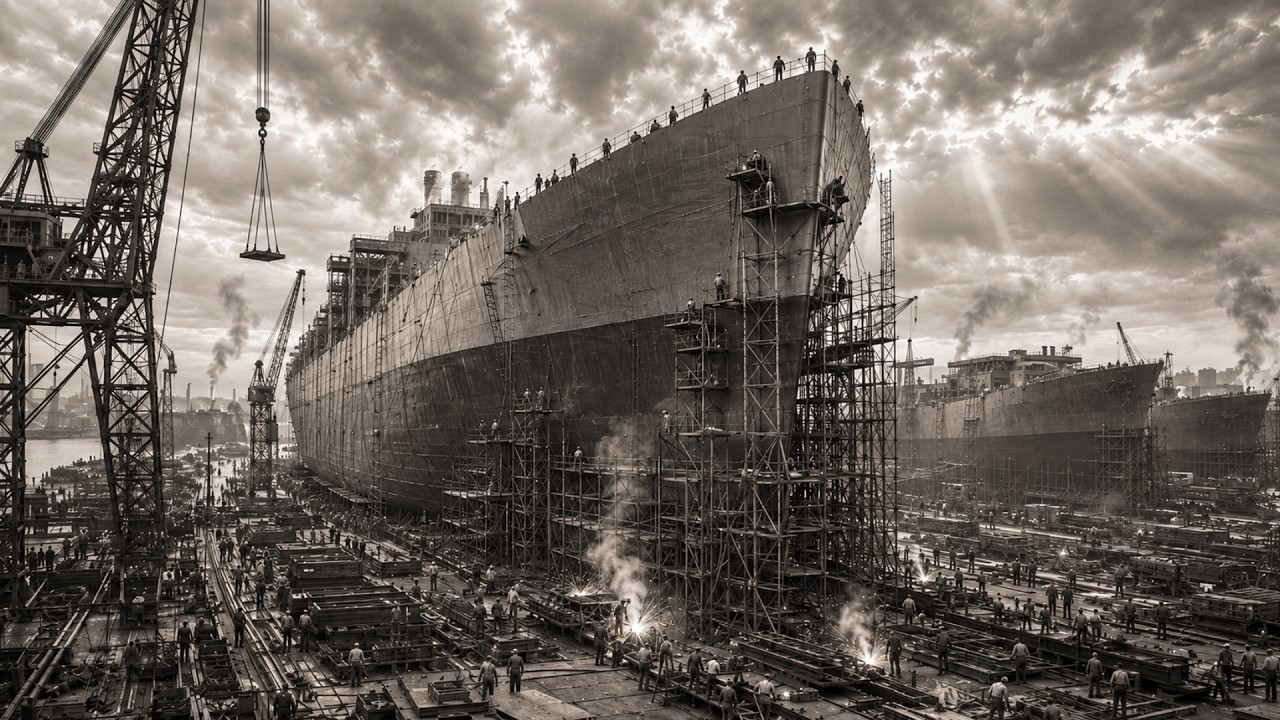
She could carry 9,000 tons of cargo. She had taken 244 days to build. Within 14 months, a yard in Richmond, California would build the same ship in 4 days, 15 hours, and 29 minutes. This is the story most people know about Liberty ships: the record, the impossible number, the industrial miracle that appeared in posters and newsreels and in the speeches of men who needed the American public to believe the war could be won by the same nation that had built Hoover Dam and the Empire State Building and the factories of Detroit.
But it is not the whole story. The whole story is what it took to build 2,710 ships in four years. It is the story of 650,000 Americans who came from inland states, from farms, from steel towns, from segregated neighborhoods, and spent the years between 1941 and 1945 learning to weld steel in the dark, in the rain, and in the cramped spaces inside a ship’s hull where ventilation was inadequate, the flash of the electric arc was constant, and the work never stopped because the ships were needed before they were finished, and men at sea were dying while waiting for them. Five out of every hundred Liberty ships that reached the sea were sunk by German submarines.
The ships that were not sunk carried everything the war required: tanks, artillery, ammunition, aviation fuel, jeeps, food, medical supplies, mules, and the ten thousand components of an industrial army that could not manufacture its own materials on the beaches it was fighting to take. Every ton of that material crossed the Atlantic or the Pacific in the belly of a ship that someone in a yard in Richmond or Portland or Savannah or Baltimore had welded together within weeks. The welders who built those ships did not attend the launching ceremonies. They were already working on the next ship.
To understand how America managed to build cargo ships faster than any nation in the history of shipbuilding, you have to understand what the war looked like from the sea in 1942. In 1942, German submarines sank 1,006 Allied ships. The number is large enough to be merely abstract, until you count what it means. Each ship carried between 5,000 and 10,000 tons of cargo.
A destroyed ship was not just a failure to deliver its cargo. It meant the loss of a hull from the Allied fleet that had taken months to build, consumed steel and labor and shipyard capacity that could not be immediately replaced, and sent its crew into waters that killed within an hour from the cold. The cargo it carried, ammunition, vehicles, fuel, food, went down with it. The German Navy called the early months of American involvement “the happy time.
” That was their term for the period when submarines operated within sight of the American coast, sinking ships in waters shallow enough that crews on shore sometimes watched the smoke rise and heard the sound of the explosions. The U. S. Navy was not prepared for the submarine war the Germans brought to the western Atlantic in 1941 and 1942.
The convoy system that would eventually reduce losses was not yet fully in operation. The air cover that would later make the submarine a hunted vessel rather than a hunter had not yet extended to the middle of the Atlantic. Ships were sinking faster than the yards could build them. The calculation was simple and catastrophic.
If Germany sank ships faster than the Allies built them, the Allied armies in North Africa and later in Europe could not be supplied. An army that cannot be supplied does not fight. Either it surrenders, or it starves, or it retreats to areas that can be supplied and digs in there while the war continues without it. The war in Europe, in its logistical essence, was a struggle between the German capacity to sink ships and the Allied capacity to build them.
The North Atlantic campaign, the longest continuous military campaign of the Second World War, was not fought by soldiers on beaches but by submarines and escort vessels and depth charges and convoys of cargo ships, whose crews knew that the route they sailed was one of the most dangerous places on earth. The United States needed to build ships faster than any country had ever built them. It had to do so immediately, with a workforce that had never built ships before, in yards that did not yet exist, using a construction method that had not been proven on a large scale. Instead of solving this problem through the established shipbuilding industry, which had been building ships the same way for fifty years, the United States gave the task to Henry Kaiser.
Kaiser was 59 years old in 1941. He had never built a ship in his life. What he had built was Hoover Dam, Grand Coulee Dam, Bonneville Dam, the sections of the Oakland Bay Bridge, along with roads and pipelines and concrete structures across the American West that required moving materials, managing workers, and coordinating complex construction operations in remote sites on schedules that allowed no delay. Kaiser understood one thing that traditional shipbuilders did not, or understood differently.
A ship is not a unique work of art. It is a factory product. A factory product can be made faster by breaking it down into components, building those components simultaneously in parallel, and assembling the final product from ready-made parts instead of building it sequentially from raw materials. This is what the automobile industry had understood since 1913.
It is what Henry Ford had applied to cars on the assembly line in Highland Park, Michigan. Kaiser applied the same principle to ships. The method was called prefabrication. Instead of building a Liberty ship the way ships had historically been built, laying the keel, erecting the frames one after another, and adding hull plates section by section in a process that kept the entire workforce concentrated on a single hull for the entire construction period, Kaiser’s yards built the ship’s parts simultaneously.
The bow was fabricated in one part of the yard while the stern was assembled in another and the midsection was fitted out in a third. When the sections were complete, a crane lifted them and assembled them on the launching ways. The same yard area that a traditional shipyard used to build one ship at a time could be used to build components for three or four ships simultaneously, with the ways occupied only during final assembly and launching. The bottleneck in traditional shipbuilding was the time a hull occupied in the graving dock.
Prefabrication reduced that time by moving most of the work away from the dock and into fabrication shops. The other change was in the way the steel was joined. Traditional shipbuilding used rivets. A rivet gang consisted of four men: the heater, who made the rivet cherry-red in a portable furnace; the thrower, who tossed the hot rivet to the catcher; the catcher, who received it in a conical cup and placed it in the drilled hole; and the riveter, who hammered it into place with a pneumatic hammer while the holder-on pressed the opposite end to hold it.
Four men to install one rivet. A large ship required hundreds of thousands of rivets. The sound of a traditional shipyard at peak production was the continuous clatter of riveting hammers on every hull in every dock at once, a sound that carried for miles in still air and left the men who worked within it with a particular kind of hearing loss by middle age. Kaiser’s yards used welding instead of riveting.
A single welder with an electric arc could join two steel plates faster than a four-man riveting gang, and the welded joint, if done properly, was watertight without needing caulking, and one man could do it instead of four. The labor savings were enormous. The speed was immense. The time required to train a competent welder was six weeks.
Training a competent riveter required years of apprenticeship. This was the combination that made building a ship in 42 days possible: not prefabrication alone, not welding alone, but both together in a yard designed from the ground up to use them, under the management of a man who had never built a ship before and therefore had never been convinced that ships had to be built the way they had always been built. The workforce that came to Kaiser’s yards did not come from the maritime trades. The Richmond, California shipyard opened in January 1941 on marshy land at the edge of San Francisco Bay that Kaiser’s company had dredged, filled, and leveled into a construction platform before the foundations of the first building were poured.
By the time the United States entered the war in December of that year, the yard was operating and had begun hiring. By 1943, the yard employed 90,000 workers in a city whose peacetime population had been only 24,000. The yard hired people who had never worked in shipbuilding. They came from Oklahoma and Arkansas and Texas, displaced by the Dust Bowl and the Great Depression and the exhaustion of farmlands that had been planted too hard for too long and had stopped producing what farm families needed.
They came from Appalachia, from the mining communities of Kentucky and West Virginia, where the coal seams had thinned or the companies had cut wages, and the work that had supported their fathers no longer supported them. They came in cars loaded with everything they owned, on roads leading west, the same routes that had carried the displaced west since the 1930s, following word that there was work in California paying more than anything they had left behind. They came from the rural South, particularly Black workers who had been systematically excluded from skilled trades in most American industries. The established shipyards in Baltimore and Newport News and Pascagoula operated under union agreements in states where unions and companies had agreed, formally or informally, that the skilled trades were for white workers only.
Kaiser’s California yards did not operate under that agreement. Kaiser hired Black workers into welding jobs that East Coast shipyards did not make available to them, partly because Kaiser was not part of the shipbuilding industry and had not inherited its labor arrangements, and partly because the need was desperate for 90,000 workers and the number of available white workers from traditional maritime communities did not come close to that figure. None of these people knew how to weld steel. The man who had grown cotton in Oklahoma or loaded coal in Kentucky had never held a welding electrode.
He had never read a structural blueprint. He had never worked in a confined space wearing a welding helmet, running the torch along a joint seam while the flash of the arc lit the space with a concentrated intensity like direct sunlight, with ventilation inside the tight interior compartments of the half-completed hull relying entirely on air leaking through the access openings. Kaiser’s yards trained them in six-week welding schools on the yard site, in continuous sessions, producing welders in numbers that the traditional apprenticeship system could not have approached in years. The training produced welders capable of making weld joints.
It produced welders who understood at a practical level how to join two pieces of steel. But it did not produce welders who had spent years developing the judgment about heat management and metal behavior that makes the difference between a sound joint and one that holds only until temperatures change or loads change, and the steel of the North Atlantic in January encountered conditions it had never seen in the Richmond welding school. That gap would become significant later. In 1942, it did not matter, because ships were sinking faster than the yards could build them, and the need for hulls that floated now outweighed the need for joints that were perfect under every condition the North Atlantic might impose over a five-year war.
The workers who came to Richmond needed somewhere to live. Richmond in 1940 was a small industrial city of 24,000 people, with a housing stock appropriate to a city of that size. By 1943, the shipyard alone employed 90,000 workers, plus their families, plus the service economy required by a city of that size. The housing did not exist.
Kaiser built it the same way it built ships: quickly, in large quantities, and to a standard that met the minimum definition of shelter without greatly exceeding it. The company’s housing projects went up on the wetlands adjacent to the yard. Wooden construction, thin walls, shared facilities in some designs, built at a pace that prioritized rapid shelter over quality. A family from Texarkana, three days’ drive from Richmond, moved into a company apartment that let in the Richmond fog, placed in cramped quarters alongside families from Louisiana, families from rural Georgia, families from small towns in the Ozarks.
They were all strangers to each other, strangers to the city, strangers to the work they had come to do. Black workers who came to Richmond found housing in different neighborhoods, because Richmond’s housing market in 1943 operated along the same racial geography that American cities generally followed. The crowding in Richmond’s Black neighborhoods in 1943 was severe, even by the standards of the overcrowded city around them. People lived in conditions that did not match the wages they were earning, because the wages were good but housing choices were constrained by limits that money could not cross.
Schools were full, roads were congested, stores and laundries and buses and medical facilities operated at capacities they were never designed for and could not be rapidly expanded. The city government of Richmond had not planned for this. It had not been given the resources to plan for it, because the federal government’s priority was ships, not the municipal infrastructure of the cities producing them. The workers coped.
They coped because the wages were better than anything they had left behind, and because the only alternative was returning to what they had fled. And because people who had lived through the Depression and the dust storms understood that coping under difficult conditions was not a crisis but a fact of life. Inside the yard, the work never stopped. Three shifts, seven days a week, around the clock.
The midnight shift started at twelve and worked until eight in the morning, then the day shift took over, followed by the evening shift, then the midnight shift again, and the cycle never paused, because a hull in the ways occupied space, and any space not occupied by a ship on its way to launching was space not producing a hull, and the Maritime Commission’s schedule allowed no slack. The yard was loud. Operating a shipyard at full capacity is one of the noisiest industrial work environments ever created. The combination of pneumatic tools, crane operations, welding equipment, cutting torches, and the constant movement of steel plates and structural parts by overhead cranes creates an acoustic environment in which ordinary conversation is impossible, and communication must happen through hand signals, body positions, and reading facial expressions rather than words.
A worker in an open space inside a hull under construction was in an enclosed volume with sound reflecting off every surface, plus the noise of any tools operating in adjacent spaces, with no sound insulation between him and the work. The flash of the electric arc was constant. A welding arc produces light at an intensity that causes permanent damage to the retina within seconds of unprotected exposure. The welder wears a helmet with a filtered lens rated for the current intensity of the arc.
Workers near the welding, the fitters adjusting joint alignment, the helpers moving materials, the inspectors walking through the hull checking completed joints, all needed eye protection too. In a shipyard operating at full production with simultaneous welding operations at dozens of locations on every hull, maintaining discipline in eye protection by every worker at every moment was a challenge that yard management could not fully achieve. Workers who caught glimpses of arcs unexpectedly suffered corneal burns, a condition known as “welder’s eye” or arc eye, causing severe light sensitivity and pain for 24 to 48 hours after exposure. The constant repetition of this caused cumulative damage.
The men welding daily in the Richmond yard and those working near them understood the risks and managed them as best they could with protective equipment and vigilance, but it was not perfect; no industrial environment at that pace is managed perfectly. Exposure to fumes inside the hull was different. Welding generates fumes from the electrode coating, the base metal, and any paints, coatings, or mill scale on the surfaces being joined. In open air, these fumes disperse.
Inside the open, confined spaces of a ship under construction, in the double-bottom tanks between the inner and outer hull, in the cofferdam spaces between watertight bulkheads, and in the tight structural voids where standing was difficult, the fumes had nowhere to go except into the breathing air of the men working there. The ventilation systems were portable electric fans pushing air through flexible hoses into access openings. They helped move the air. But they did not remove all the fumes, and the men who spent their shifts in the tight spaces of Liberty ship hulls came out into the Richmond evening smelling of their work, a smell that did not leave their clothes quickly and did not leave their lungs any faster.
The industrial accident rate in wartime shipyards was high by any standard, and it was accepted, explicitly or silently, because the alternative, reducing production to reduce accidents, was not a choice anyone was prepared to make in 1942, not the Maritime Commission, not the company, not the union, not the workers themselves. Men died when steel fell on them. Men were killed by crane failures. Men fell into partially flooded tank spaces.
Men were struck by equipment moving in the dark during the night shift. Their deaths were recorded. Their names are in the Maritime Commission accident records, in the California workers’ compensation files, in the Contra Costa County coroner’s records. They exist in those records and in no other document anyone has made broadly available to the public.
The ships themselves were deliberately simple. That was the point. The Liberty design, officially designated EC2-S-C1, was based on a British cargo ship that the British themselves had recently put into wartime production. The American Maritime Commission chose it specifically because it was not advanced.
It was a welded steel hull 441 feet 6 inches long, 56 feet 10 and three-quarter inches wide, driven by a reciprocating steam engine generating 2,500 horsepower turning a single propeller. The engine was not modern by 1941 standards. Marine diesel and steam turbine propulsion were more efficient. The Maritime Commission chose the reciprocating steam plant because American manufacturers could produce it in immediate quantity, and because the machinery could be repaired in most ports of the world with the tools and skills already available there.
The ships were designed to last five years. That was the expected duration of the war. The commission did not need a ship that would last for decades after the war. It needed immediate hull capacity in the water, to replace the tonnage the submarines were sinking.
This design philosophy, quick, disposable, fit for purpose, produced the Liberty ship and the contradiction it carried. A ship designed to last five years would be at sea in the conditions the North Atlantic creates. And the North Atlantic in winter creates conditions that the metallurgy of welding in 1941 had not fully accounted for. The problem was in the steel and in the way the steel was joined.
The hull steel used in Liberty ships had adequate strength at ordinary temperatures. At low temperatures, specifically below freezing, the behavior of the steel changed. It became less ductile. Less ductile steel does not absorb shock and stress by deforming gradually.
It absorbs them by cracking suddenly. A hull that cracks in cold water does not necessarily stop cracking when the immediate stress is removed. The crack propagates. It runs through the material along the path of least resistance, driven by the stress concentration at the crack tip.
In a riveted hull, a crack spreading through a plate meets a riveted seam at regular intervals. The riveted seam is mechanically different from the plate itself. A crack passing through a plate cannot continue directly through a riveted joint. It stops.
It may start again on the other side, but that interruption means the crack must reform itself rather than simply continuing. In a welded hull, a crack spreading through a plate can continue through the weld into the next plate without interruption because the weld is metallurgically continuous with the base metal on both sides. The crack has no reason to stop. This was known to metallurgists.
The shipbuilding industry did not know it well in 1941, and the information was not effectively communicated to the designers who adapted the British cargo ship design to Liberty specifications, and it was not properly evaluated when the decision was made to build at the scale Kaiser’s yards were operating. By 1943, ships began to crack. Not in large numbers, but enough to cause concern. Liberty ships in North Atlantic convoys in winter waters suffered hull fractures.
A few split completely in two. The SS Schenectady suffered a fracture from deck to keel in calm water at a fitting-out dock in Portland, Oregon in January 1943. The ship had not yet sailed. She was tied to a dock in protected water without significant wave action when a crack started near the corner of a cargo hatch and propagated around the hull until the midsection dropped and the bow and stern rose above the water and the ship broke into two pieces.
The SS John P. Gaines split in half in the North Pacific in November 1943. The pattern was unmistakable to the engineers studying it. The investigation board identified the contributing factors: the chemistry of the hull steel, the welding procedures, the heat-affected zone at the edge of each weld where the metallic properties had been changed by the welding process, and the design details at structural discontinuities where stress concentrates.
The remedies were gradual and practical. Crack arrestors, short riveted joints placed at intervals along the hull to interrupt the path of propagating cracks, were added to ships under construction and retrofitted to ships already in service. Steel specifications were tightened to reduce brittleness. Welding procedures were revised.
Inspection requirements were strengthened. The men who welded the joints that failed were not consulted about why they failed. They had welded to the specifications they were given, using the electrodes they were supplied, following the procedures taught in a six-week training course. If the specifications were wrong, the error was not in execution.
The error was in the engineering that had not yet figured out what happens when cold water meets stressed steel welded by a man who had learned to weld only six weeks before he did it. The record for building the SS Robert E. Peary, 4 days, 15 hours, and 29 minutes, was set in Richmond in November 1942 as a deliberate publicity event. Kaiser invited the press and organized the construction as a demonstration of American industrial capacity.
The hull sections were prefabricated and staged on the building ways before the record attempt began. The workforce was concentrated specifically on that hull for the duration of the attempt, and the work that followed was real. The sections were really assembled. The hull was really welded.
The machinery was really installed. But the conditions were not representative of normal production. Normal production did not concentrate the entire yard’s attention on a single hull. Normal production ran several hulls simultaneously at different stages of completion with the workforce distributed across all of them according to the construction schedule.
The record was real. It was also a performance. The SS Robert E. Peary sailed in January 1943.
She served in the Pacific theater. She survived the war. She was scrapped in 1963. The average Liberty ship that left Kaiser’s Richmond yards took 42 days to build from keel laying to delivery.
That number itself was a record no other shipyard in the world approached. British yards building the same design before the American program reached full capacity took months. American East Coast yards using traditional methods on similar designs took months. Kaiser’s yards, using prefabrication and welding and a workforce trained in six weeks, took 42 days.
The Maritime Commission understood what that meant and what it cost. The men who made it possible were paid at the rates set by the wartime labor market. A welder in a Kaiser yard in 1943 earned between $1. 20 and $1.
50 per hour, far more than most of them had ever earned before. These wages were the best many of them had ever seen. They were also the wages Kaiser determined it needed to offer to attract and retain the workforce required by the production schedule. They were not a calculation of what the work was worth.
They were a calculation of what the market would accept. Whether the two numbers matched is a question the payroll records do not answer. The war ended in August 1945. The last Liberty ship was delivered in October of that year.
A total of 2,710 ships had been built in four years by 18 shipyards across the United States. Of those 2,710, about 200 were lost to enemy action: torpedoes, mines, or air attack. Another 40 were lost to storms, groundings, and accidents. The 2,470 that survived the war left the Allied governments with a question they had not planned to answer.
What to do with 2,470 cargo ships designed to last five years, when the world no longer needed them to carry military cargo across war zones? Some were sold to foreign shipping companies at prices reflecting the glut on the market, and they continued operating through the 1950s and 1960s under flags with no connection to where they were built or why they existed. Some were converted to bulk carriers, grain ships, or refugee ships for the population displacements of the postwar years. The United States kept some in the reserve fleet, moored in rivers and bays of the East and Gulf Coasts, theoretically available for emergencies, but practically rusting at their moorings because maintaining them cost money, and the emergency that had built them was over.
Most were eventually sent to the scrapyard. The steel made in Richmond and Portland and Savannah was melted down and returned to the industrial economy in forms that no longer carried any trace of the ships they had been. The workers who built the ships scattered the same way the ships scattered, in different directions and for different reasons. The women who had come to the shipyards, learned welding and fitting and crane operation and truck driving and the hundreds of skilled tasks the yards had told them before the war that women could not do, found when the war ended that the yards no longer needed them.
Returning veterans had priority for available jobs under agreements the unions and companies had made when assembling the wartime workforce, agreements presented as temporary adjustments to abnormal circumstances, restoring the natural order of things once those circumstances were gone. Most of the women who spent the war years building ships did not fight to stay. The mechanisms for struggle were limited. The exhaustion they had accumulated over the previous four years was real.
The culture that briefly required their labor did not change its underlying assumptions about who work should belong to. The Black workers who came to Richmond because of Kaiser’s hiring policies found that those policies did not extend to the postwar economy. The access to skilled trades opened by the wartime emergency was available only during the emergency, not as permanent access to the trades themselves. The shipyard jobs that remained after the war went mostly to white workers through union seniority and hiring practices the wartime disruptions had bent but not broken.
Richmond’s Black population, which had grown from 270 people in 1940 to more than 30,000 by 1945, was concentrated in neighborhoods lacking adequate infrastructure, schools, and services, because the city of Richmond had not planned for 30,000 Black residents and had not made the postwar investments to make their presence in the city sustainable. The people stayed. The investments did not come. The migrants from Oklahoma and Arkansas and the mining towns of Appalachia scattered.
Some stayed in California, which had enough postwar construction and manufacturing work to absorb workers who had spent the war years developing skills. Some returned home to find that home had changed or they had changed, and neither fit the other as they remembered. Some followed the work wherever it went next. That is the nature of construction work.
Workers follow the work. When the work ends, they leave. The last Liberty ship still operating as a museum ship is the SS Jeremiah O’Brien, moored at Pier 45 in San Francisco, seven miles from the Richmond yards where Liberty ships were built 80 years ago. She is maintained by volunteers and maritime heritage organizations.
Her triple-expansion steam engines still run. On certain days the ship leaves the pier and sails in the bay. Her hull is still in the same salt water that the ships built alongside her left long ago. If you board the SS Jeremiah O’Brien and walk her main deck, the deck plates under your feet were welded into place in 1943 by someone who had been a welder for six weeks, or six months, or perhaps only a year when the work was done.
Those welds are still there. The hull is still in one piece. Someone ran a welding arc along every joint in that hull, wearing a helmet and breathing the fumes of electrode and steel, and that weld has held in seawater for 80 years. His name is not written on the deck.
If you stand at the stern and look west across the bay, you are looking toward the Richmond waterfront, seven miles away, which no longer looks anything like it did in 1943. The shipyard buildings are gone. The launching ways are gone. A park occupies part of the site, run by the National Park Service under the name Rosie the Riveter National Historical Park, telling the story of Richmond’s workers through exhibits, interpretive programs, and photographs from the government archives of the early 1940s.
The park is named for a symbol. Rosie the Riveter was a composite figure, a representative figure, an embodiment of women’s industrial work that became iconic because icons are useful. The real women who worked in welding in Richmond and Portland and Savannah were not named Rosie. Their names were their real names, in the payroll records kept by Kaiser, in county tax records, in union membership files, and in no other widely available document.
If you look at the photographs in the National Archives from the Richmond shipyard in 1943, taken by government photographers to document the war effort, you see the workers: women at welding stations, Black men in work clothes performing the skilled tasks most American industry had told them they were not qualified for, men from Oklahoma and Arkansas squinting against the light and standing on a ship hull they were building faster than any hull in shipping history. The captions identify them by what they represent. They represent American industrial capacity. They represent the home front.
They represent the miracle of production. They represent, in the captions, an abstraction. In the records, they were individuals. Each was paid a specific wage for a specific number of hours in a specific week.
Each was hired on a specific date and terminated on a specific date. Each left a mark on a specific joint in a specific hull, which either held or did not hold under the conditions of the North Atlantic. Those who died left their names in the accident records and death registries of the counties where the yards were located. The rest left their names in the payroll records, and nothing else.
The Mackinac Bridge is 5 miles wide, and the bridge that spans it is still there today. The iron ore docks at Two Harbors still stand in ruin along the shore of Lake Superior. Structures last longer than the people who built them. That is part of what makes them worth building, and part of what makes thinking about them for long difficult.
The Liberty ships were never meant to last long. Their purpose was to carry cargo across the Atlantic in 1942, 1943, and 1944. In the interval between the ship the submarine sank yesterday and the ship that came off the Richmond ways today, most of them served that purpose and then disappeared. They were cut up, or sunk, or left to corrode at moorings in rivers no one visits.
The endurance was not in the ships themselves. The ships were the expendable part. What remains is the question they answered. The question was whether American industrial capacity, applied without precedent or institutional habit to a specific production problem, could outpace the enemy’s capacity for destruction.
The answer the Liberty ships provided was yes. It was a yes with costs that wartime production reports did not track and postwar histories of American industrial achievement did not illuminate. The ships cracked in cold water because metallurgy had not fully developed. Workers inhaled fumes in confined spaces because ventilation could not keep pace with the production schedule.
Workers were killed by falling steel and crane failures and sudden fires in numbers recorded in accident ledgers and acknowledged in no ceremony of honor. 2,710 ships were built. The cargoes they carried reached the armies that needed them most. The war ended.
The people who built the ships were paid at rates set by the wartime economy, the rates companies decided were necessary to attract the workforce the Maritime Commission demanded. Whether those rates were adequate compensation for the arc flash and the cramped spaces and the fumes and the accident rate and the noise that accumulated in their ears over the years of continuous production is a question the payroll records do not answer. The payroll records were written by the people who set the wages. You can stand on the deck of the SS Jeremiah O’Brien on a November morning, when the fog creeps in from San Francisco Bay and the temperature drops and the deck plates are cold under your feet.
Those plates were welded by someone who learned to weld in six weeks and then practiced it for years, and whose name is in a payroll record somewhere that no one has made readily available. The weld held. It is still holding. The water under the hull is 55 degrees in November, and the hull is still in one piece.
Seven miles north, where the shipyard was, marsh grass grows where the building ways stood. The bay water comes in and goes out with the tide as it has for 10,000 years. The cranes are gone. The workers are gone.
Most of what they built is gone with them. One ship is still there. The welds on her are still holding. Someone made them hold, and his name is not on the ship.
She is one of the most photographed ships on the West Coast, appearing in war documentaries, in National Park Service educational materials, and in the photos of tourists who come to the waterfront on public days and stand on the deck and look at the engine and do not know whose hands made the welds under their feet. The welds are there. They have been there for 80 years.
They will still be there long after the people who come to see them are gone.






