At the National World War II Archives in College Park, Maryland, military historian Dr. Sarah Chen was digitizing a collection of photographs donated by the family of the late Sergeant Michael Thompson when she stopped at an image from the 1943 Italian campaign. A young American soldier knelt in what appeared to be a bombed village, tenderly feeding a small puppy from a can of military rations. The soldier was smiling.
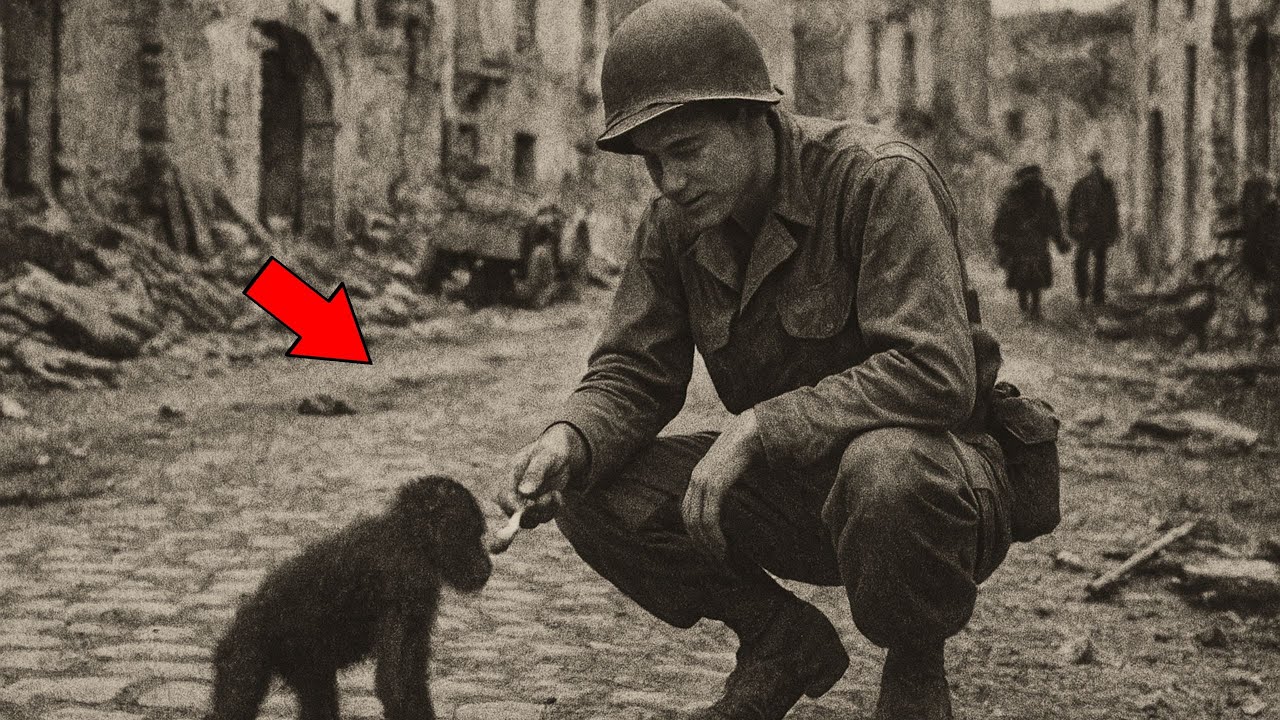
The puppy ate from his hands. Destroyed buildings rose behind them. It seemed a moving scene of humanity amid horror, the kind of image that had become iconic for showing the compassion of American troops toward European civilians. The annotation on the back gave the date: November 1943.
Chen enlarged the photograph using high-resolution technology for the archive’s digitization project. In the lower right corner, partially visible behind the rubble of what had been a house, something did not fit the apparent narrative of the image. She used a digital magnifying glass, adjusted contrast and clarity, and examined the area again. What she saw left her completely surprised.
It was not a puppy that the soldier was feeding. The body proportions, the shape of the limbs, and especially the facial structure visible in the animal’s profile were different from those of a dog. After four decades of studying war photographs, Chen was certain of what she was seeing. But the implication was so extraordinary that she needed confirmation before reaching a conclusion that could rewrite this small piece of military history.
She contacted Dr. Robert Martinez, a zoologist specializing in primatology at the Smithsonian Institution, and Dr. James Anderson, an expert in forensic analysis of historical photographs. During a three-hour video conference, the three specialists examined every detail of the enlarged image.
Martinez, with over twenty years of experience studying primates, was categorical. Without a doubt, the animal the soldier was feeding was a young chimpanzee, probably six to eight months old. The body proportions, limb length, hand structure, and especially the distinctive skull shape were unmistakable characteristics of a juvenile Pan troglodytes. Anderson confirmed the photograph’s authenticity.
The paper, the chemicals used, the photographic technique—everything corresponded exactly to 1943. There were no signs of manipulation or subsequent alteration. The image was completely genuine. But this created a puzzling historical mystery.
What was a baby chimpanzee doing in an Italian war zone in 1943? Chimpanzees are not native to Europe, and during the war, transporting exotic animals would have been practically impossible. Chen examined the soldier in the image more carefully. His uniform corresponded to the standard equipment of the Fifth American Army during the Italian campaign.
His unit patch, though blurry, seemed to correspond to an infantry division. His apparent age was twenty to twenty-five years, and his expression showed genuine tenderness toward the animal. There was nothing in his posture or expression suggesting he found the situation unusual. The three specialists reached the same disturbing conclusion: the photograph genuinely showed an American soldier feeding a baby chimpanzee in Italy in 1943.
None could explain how such a situation was possible. Martinez suggested investigating whether there had been any zoo, circus, or research facility in the area that could explain the animal’s presence. Chen dove into American, British, and Italian military archives, searching for any reference to exotic animals in the 1943 Italian campaign. Records from the Fifth Army showed that in November 1943, American troops had been advancing north from Naples, liberating towns and cities along the Italian peninsula.
The photograph had been taken in the vicinity of Cassino, an area that had seen intense fighting and bombing. Chen found references to the liberation of a small town called San Pietro, where troops had discovered an unusual facility abandoned by retreating German forces. Military reports described the discovery of an experimental facility containing scientific equipment and several animals in deplorable conditions. The official report, classified for decades, specifically mentioned laboratory primates in severe malnutrition found in improvised cages.
A scientist named Dr. Franz Kellner, an Austrian who had been working for the Nazi regime, had established a temporary laboratory in San Pietro to continue experiments that had begun in Germany. Documents revealed that Kellner had been researching the effects of extreme stress and deprivation on primates, possibly as part of studies related to human resistance under war conditions. When German forces retreated precipitously, they abandoned the laboratory and the animals.
American soldiers who liberated San Pietro found several young chimpanzees in terrible conditions. According to the report by Captain William Hayes, the unit’s medical officer, the men had shown extraordinary compassion toward these creatures, providing them with food and basic care until they could be transferred to appropriate facilities. The report continued: “It’s remarkable to observe how these young soldiers, hardened by months of combat, show such tenderness toward these animals that have clearly suffered. ” The photograph had captured one of those moments of spontaneous compassion.
Declassified archives revealed disturbing details about the facility American troops had liberated in San Pietro. Kellner had been a respected scientist in Austria before the war, specializing in animal behavior and comparative psychology. When the Nazis annexed Austria in 1938, he had been recruited to work on secret Reich research programs. His initial experiments in Berlin had involved studies on stress resistance and interrogation methods, using primates as test subjects because of their neurological similarity to humans.
In 1943, when Allied forces intensified bombing in Germany, many research facilities were evacuated to safer locations in occupied territories. Kellner was sent to Italy with his equipment and animals to continue his research in a more protected environment. The laboratory in San Pietro was established in an abandoned villa on the town’s outskirts, previously used as a summer home by an Italian aristocratic family. The Germans converted the basement into an improvised laboratory, installing cages, monitoring equipment, and basic facilities for maintaining experimental animals.
Documents indicated that Kellner had brought five young chimpanzees from Germany, all born in captivity at German research facilities. The experiments involved food deprivation, exposure to intense noise simulating bombardments, and separation from social groups to study stress responses. American medical reports described the animals’ condition when found: severely malnourished, showing signs of psychological trauma, but surprisingly receptive to gentle human contact. Hayes noted, “It’s as if these animals were desperate for affection after months of cruel treatment.
” The soldiers responded instinctively with compassion, sharing their rations and providing the physical contact the animals clearly craved. Records from the Fifth Army reveal that the American soldiers’ response to the rescued chimpanzees was extraordinarily emotional and spontaneous. Sergeant Michael Thompson, identified as the soldier in the photograph, had served as a squad leader in the 36th Texas Infantry Division. His unit had been one of the first to enter San Pietro after German forces retreated.
In letters sent to his family in Houston, Thompson described the discovery: “We found something terrible here, Mama. There were little monkeys in cages, treated very badly by the Germans. They were so skinny and scared it broke your heart. The boys and I have been taking care of them, giving them our rations.
We can’t do much more, but at least we can show them that not all humans are cruel. ”
Documents show that several soldiers from the unit informally adopted the chimpanzees during the two weeks they remained in San Pietro. They improvised shelters, shared food, and provided constant companionship to the traumatized animals. Corporal James Mitchell wrote in his diary, “It’s strange how caring for these little creatures helps us remember our own humanity after everything we’ve seen in this war.
”
Medical officers documented that caring for the animals had positive psychological effects on the soldiers, many of whom had been struggling with combat fatigue and trauma. Hayes observed, “The men who have been most affected by combat show the greatest tenderness toward these animals. It’s as if they’re channeling all their repressed compassion toward these innocent creatures. ”
The photograph had captured a unique moment of mutual healing: soldiers traumatized by war finding purpose and humanity in caring for animals that had suffered similar trauma.
The small chimpanzee Thompson was feeding had been nicknamed Liberty by the soldiers, symbolizing both its liberation from the Nazi laboratory and the freedom American troops were fighting to defend. Archives reveal the final fate of the five rescued chimpanzees—a story that combines tragedy, hope, and the lasting impact of human compassion during wartime. After two weeks in San Pietro, military authorities decided the animals needed specialized veterinary care that could not be provided in an active combat zone. The chimpanzees were initially transferred to a military veterinary hospital in Naples, where army veterinarians evaluated their physical and psychological condition.
The chief veterinarian, Captain Robert Wilson, reported, “These animals show significant signs of malnutrition and trauma, but their response to gentle human care is remarkable. Their physical recovery will be possible, but psychological damage may be permanent. ”
Three of the chimpanzees, including Liberty, were eventually transferred to the London Zoo, which had offered to provide long-term care. Zoo records show they arrived in January 1944, accompanied by a letter from Sergeant Thompson that said, “Please take good care of Liberty.
He taught us that even in the most terrible war, kindness still matters. ” The other two chimpanzees were sent to a research facility in the United States, where they were used for trauma and recovery studies—ironically similar to their original experience, but under humane and ethical conditions. London Zoo records document that the three chimpanzees gradually adapted to their new environment, though they maintained unusual behaviors suggesting their traumatic experience. Liberty developed a particular preference for zoo visitors wearing military uniforms, approaching his exhibit barrier when he saw soldiers.
The main caretaker, Albert Morrison, noted, “It’s as if he remembers the kindness he received from American soldiers. ” Liberty lived at the London Zoo until 1961, becoming one of its most beloved residents for his gentle personality and apparent understanding of human fragility. When he died at eighteen, the zoo installed a small plaque that read: “Liberty, rescued by American soldiers in Italy, 1943, a symbol of compassion in dark times. ”
Research reveals that the encounter with the rescued chimpanzees had a profound and lasting impact on the soldiers involved, influencing their lives long after the war ended.
Military medical records show that members of Sergeant Thompson’s unit reported significantly lower levels of post-traumatic stress symptoms compared to other units that had seen similar combat. Hayes theorized that the act of caring for vulnerable creatures provided soldiers with a way to process their own trauma while doing something constructive and meaningful. After the war, Thompson returned to Houston, where he established a charity dedicated to rescuing abandoned animals. In interviews decades later, he explained, “Those little monkeys taught me that no matter how bad the world gets, we can always choose to be kind.
That lesson saved my life more than any military training. ” Corporal Mitchell became a veterinarian after the war, specializing in care for traumatized animals. He frequently cited his experience in San Pietro as the moment that defined his career: “Seeing how those animals responded to love after so much abuse showed me the power of healing. I dedicated my life to that lesson.
”
Other unit members pursued careers related to animal care, education, or social work, all citing the experience with the chimpanzees as a transformative moment. Documents show that unit veterans maintained correspondence for decades, meeting annually on Veterans Day to remember not only fallen comrades but also Liberty and his brothers. In 1963, on the twentieth anniversary of San Pietro’s liberation, they visited the London Zoo together to see Liberty, now a fully developed adult chimpanzee. Morrison reported that Liberty showed signs of recognition when he saw Thompson approaching the glass and extending his hand as he had done as a baby.
Thompson cried, telling Morrison, “He saved me as much as I saved him. ”
Declassified documents reveal a deeper and more disturbing scientific connection. Kellner had been conducting his experiments as part of a secret Nazi program to develop interrogation and psychological control techniques. Office of Strategic Services archives show that after the war, Allied intelligence discovered that the San Pietro laboratory was part of a broader network of research facilities studying methods to break human psychological resistance.
The experiments on chimpanzees had been designed to identify stress tolerance limits, effective deprivation techniques, and methods for creating psychological dependence in captives. Kellner had been developing what would later be known as brainwashing techniques, decades before the term was coined. Records show that after the German retreat, Kellner managed to escape to Switzerland, taking his experimental data with him. Allied intelligence actively searched for him as a war criminal, but he was never captured.
In 1947, it was reported that he was working for the intelligence agencies of a foreign power, possibly applying techniques developed on animals to human interrogations. Documents reveal that Kellner’s experimental data was subsequently studied by American and British military psychologists interested in developing countermeasures to protect their own soldiers against similar techniques. The research indirectly contributed to developing resistance training programs for pilots and intelligence personnel who might be captured. Dr.
Chen observed, “The irony is devastating. The same animals that were tortured to develop techniques for breaking human will ended up teaching American soldiers about the importance of compassion and humanity. ” The instinctive compassion response shown by Thompson and his unit had been exactly the opposite of what Kellner had been trying to eliminate: the innate human capacity for empathy and care for the vulnerable. The story of the rescued chimpanzees had implications extending far beyond the moment captured in the photograph.
London Zoo records reveal that Liberty and his companions became pioneering study subjects on animal trauma and recovery, contributing to the development of modern techniques for rehabilitating abused animals. Dr. Margaret Foster, a British primatologist who worked extensively with the rescued chimpanzees, published papers that established foundations for modern understanding of psychological trauma in primates. Her observations on how Liberty and the others responded to different types of human interaction influenced animal-assisted therapy techniques subsequently applied in veterans’ hospitals.
Thompson maintained correspondence with Foster for years, providing details about chimpanzee behavior during the rescue that proved crucial for understanding their recovery process. In 1955, Foster visited Thompson in Houston, where she directly observed how the experience with the chimpanzees had influenced his work with rescued animals. She wrote, “Sergeant Thompson possesses an intuitive understanding of animal trauma that surpasses many years of formal training. His experience in San Pietro taught him to read stress and response signals that most people would never notice.
”
Records also reveal that several other soldiers involved in the rescue contributed to advances in related fields. Mitchell, who had become a veterinarian, developed protocols for treating war animals—military dogs, horses, and other animals that had experienced trauma in combat zones. His work was directly influenced by techniques he had observed working with the chimpanzees in San Pietro. Veterans Department documents show that the group of soldiers who had rescued the chimpanzees experienced significantly lower rates of alcoholism, depression, and other problems common among war veterans.
Military psychologists theorized that the experience of caring for vulnerable beings provided a healthy way to process their own trauma. Chen published her findings in a book titled *Compassion in Combat: The Hidden Story of San Pietro*, revealing not only the story of the rescued chimpanzees but also broader connections between trauma, recovery, and the healing power of caring for others. Thompson’s descendants donated the original photograph to the National World War II Museum, where it became the center of an exhibition on humanity in war, exploring how soldiers maintained their compassion during humanity’s most destructive conflict. The exhibition included letters from Thompson, documents from the London Zoo, and video testimonies from surviving veterans who had participated in the rescue.
Liberty was posthumously recognized as a symbol of resistance and recovery. The London Zoo established the Liberty Fund to support rescue and rehabilitation of animals traumatized by armed conflicts, continuing the legacy of compassion that had begun in a bombed villa in Italy. The story inspired additional research on the therapeutic role of animal care for veterans with PTSD. Several veterans’ programs adopted techniques originally developed through studying Liberty and his companions, creating a living legacy that connects World War II trauma with modern healing.
Chen concluded, “This photograph reminds us that even in humanity’s darkest moments, compassion remains a powerful force of resistance against dehumanization. ” Thompson and Liberty saved each other, demonstrating that kindness is both an act of rebellion and healing. The image that had seemed to simply show a soldier feeding a pet had revealed a complex story about trauma, recovery, and the profound connection between humans and animals that transcends species barriers in moments of shared vulnerability.






