The whiskey did nothing. The man in the leather-stained apron gripped the tooth with a pair of pliers, leaned his weight into it, and twisted. The patient’s jaw gave way with a crack that was more bone than tooth, and the screams that followed were drowned out, deliberately, by a traveling band striking up a loud tune. Out on the frontier, that was dentistry.
A cheap sugar habit had rotted the frontier’s teeth, and the man pulling them was rarely a doctor at all. He was the corner barber, the blacksmith on Main Street, or some stranger passing through town with a wagon and a hand-painted sign. His favorite tool was the dental key, an instrument designed to grip the tooth and wrench it out, a device known to shatter more bone than it ever saved. The patient bit down on a piece of leather, swallowed whatever whiskey was on hand, and endured.
It did not have to be that way. Anesthesia existed. Horace Wells had used nitrous oxide as early as 1844, and William Morton had demonstrated ether in Boston in 1846. But those methods took decades to reach the frontier towns, where the nearest trained dentist might be a hundred miles away.
There was, in fact, a trained dentist in the middle of it all. John Henry Holliday had graduated from dental school in Philadelphia in 1872, and his practice was ruined by tuberculosis. No one wanted to sit in the chair of a man who coughed up blood. And so Doc Holliday traded the pliers for the card table.
The grit on the frontier was not confined to the dentist’s chair. Everyday life in the Old West was dirty, monotonous, and full of details the movies never dared to show. The clean, charming cowboy of the big screen never existed. The real one slept on the ground, ate dust, and reeked of sweat because bathing was a project that took hours.
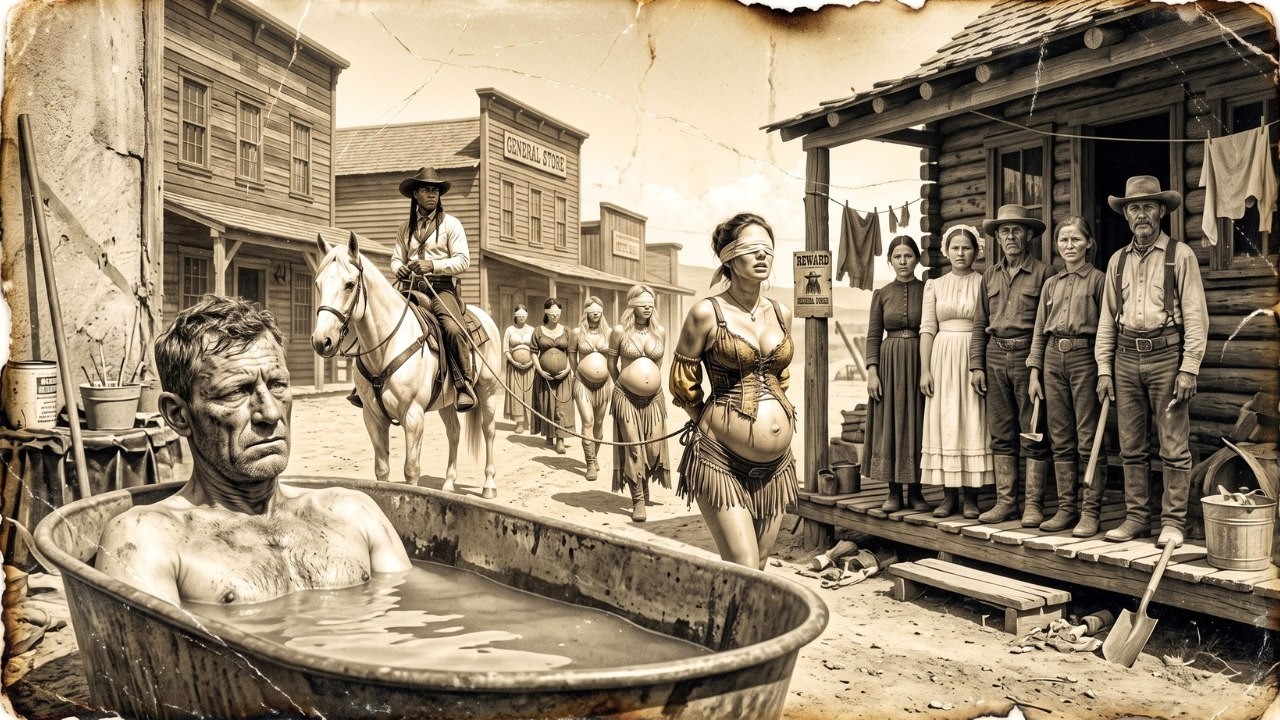
Before indoor plumbing, a full bath meant drawing water from the well, bucket by bucket, and heating it all on a wood-burning stove. It consumed a pile of firewood and most of a day. After all that labor, no one threw the water out after a single bather. The family lined up in a strict hierarchy of status.
The oldest man went first, claiming the hot, clean water. The other men and boys came next, followed by the women. The little children went near the end, and the baby went last, by which time the bath was lukewarm, gray, and flecked with everyone else’s floating grime. Full baths were therefore reserved for a few times a year, usually in the spring thaw.
For the rest of the year, a washbasin, a cloth, and homemade soap handled the face, hands, and neck. Smelling like a hardworking body was no shame. It was the norm. Nor was there any toilet paper.
Before 1900, hardly anyone in rural areas bought paper for that purpose, and it wasn’t because they were poor. People used leaves, dry grass, hay, old newspapers, and, in the Corn Belt, corncobs left over after shelling, kept dry in a bucket next to the outhouse at the back of the yard. The change came through the mail. The Sears, Roebuck catalog, launched in 1888, was delivered free to millions of homes, hundreds of pages of thin, soft paper.
After a family had chosen a new tool or a hat, the catalog was hung on a nail inside the outhouse. The habit was so universal that the Old Farmer’s Almanac began punching a hole in its cover in 1919 just so it could hang on that same nail. In the 1930s, Sears switched to glossy coated paper, and complaint letters poured in, because the new catalog was no longer useful for its old purpose. Factory-made paper had existed since 1857, invented by Joseph Gayetty, but it was expensive and considered a luxury for city folks.
It was not until 1935 that Northern advertised the first toilet paper guaranteed to be splinter-free, which said a great deal about what had come before. Water could kill a man faster than a bullet. On the journey west, the greatest danger came from the canteen. Between 1849 and 1860, cholera swept the Oregon Trail.
In 1852, the worst year, thousands died between the Missouri River and the Rocky Mountains. Journals from the time said a traveler could follow the trail by counting the wooden crosses along the roadside. There was another killer: alkali water. In parts of Wyoming and Nevada, pools shimmered beneath a white crust of salts and soda.
They looked like good water, but the soapy taste hit with the first sip, and by then it was too late. Anyone who drank it spent days in agony with diarrhea and dehydration. Cattle died bloated on the spot, and cowboys learned to watch the herd before filling their own canteens. Germ theory was not yet established, but people had figured out in practice that boiled coffee did not make them sick.
Cowboys carried Arbuckle coffee in their saddlebags and drank it strong, hot, and black from sunrise to sunset. That single habit kept countless people alive on the frontier. Whiskey worked too. The beds, meanwhile, were crawling.
In 19th-century cheap hotels, roadside boarding houses, and miners’ lodgings, bedbugs, fleas, and lice bred in the cracks of the wood, inside straw mattresses, and in the seams of blankets. When the lights went out, they came out to feed. There was another detail that sounds absurd today: the bed was not always the guest’s alone. Boarding house owners sometimes rented the same mattress to two or three men a night, and a guest could wake up next to a stranger he had never seen.
In some places, a man slept sitting up, leaning against a rope stretched wall to wall, and in the morning the owner loosened the rope to wake everyone at once. Changing clothes did not solve the problem. Lice lived in the seams of shirts and pants and traveled with their owner. The only remedy was running a hot iron over the seams, and even then the eggs survived.
Anyone who spent weeks on the road accepted it as part of the price of travel, and scratching became as automatic as tipping a hat. At camp, the menu barely changed. Beans cooked in an iron pot, salt pork, sourdough bread baked in a Dutch oven, and coffee so strong men joked it could hold a horseshoe upright. That stretched out for weeks at a time, from Texas to the stockyards in Kansas.
The cook, nicknamed Cookie, ruled over the chuck wagon, a kitchen wagon Charles Goodnight had put together in 1866. He kept the sourdough starter close to his body in cold weather, because without it there would be no bread the next day. When a calf broke a leg or could not keep up with the drive, it became dinner. That was the origin of son-of-a-bitch stew: heart, liver, tongue, kidney, bone marrow, and a piece of intestine called marrow gut, all chopped up and boiled for hours.
It was not about being fancy. It was about using the whole animal. What they truly lacked was fresh fruit and vegetables, and without vitamin C came bleeding gums, loose teeth, and wounds that would not heal. Scurvy, the same disease that plagued sailors, hit cowboys too, and many finished the drive weaker than when they had left home.
The men who did this work were poor, and many were not white. A real cowboy made between $25 and $40 a month. He slept on the ground, ate dust, and spent up to three months driving cattle over more than eight hundred miles from Texas to Kansas. Many were not even twenty years old.
Historians estimate that one out of every three cowboys on the major cattle trails was Black or Mexican. Many Black men freed after the Civil War headed west because no one there asked about their past, and almost everything about the job came from Mexican vaqueros: the lasso, the rodeo, leather chaps, even the word ranch. Nat Love, born enslaved in Tennessee, became one of the best ropers in the country. Bose Ikard rode the Goodnight-Loving Trail carrying his boss’s money because he was the man Charles Goodnight trusted most.
Bill Pickett invented a rodeo move that white cowboys copied for decades. None of it made it to the screen. Hollywood turned a dirty, low-paying, dangerous job into the adventure of a white hero in a clean hat. The era of the great cattle drives lasted just over twenty years and ended when barbed wire fenced off the prairie.
In 1873, a tailor in Reno, Nevada grew tired of hearing the same complaint. The pockets on work pants tore within a week. A lumberjack’s wife asked him to make a pair that could handle the job. Jacob Davis had a simple idea: reinforce the corners of the pockets with copper rivets, the same way horse tack was reinforced.
It worked on the first try. But Davis did not have the $68 needed for the patent fee, so he wrote to the man who sold him fabric in San Francisco, a German merchant named Levi Strauss, and offered a partnership. On May 20, 1873, patent number 139,121 was issued. The blue fabric was a type of twill made in the French city of Nîmes; de Nîmes gradually became denim in everyday speech.
And no one called them jeans. The name was waist overalls. They were clothes for miners, ranch hands, and railroad workers: tough, ugly, made to last longer than the body wearing them. It was not until the 1950s, when movies put the pants on big-screen rebels, that the word jeans caught on.
The symbol of the American West started out as the uniform of people who got up before sunrise. The Homestead Act of 1862 promised 160 acres of free land to anyone who could stick it out for five years. Thousands loaded their wagons and headed west, only to discover there was no lumber to build a house. They cut blocks of grass with the roots still attached and stacked them like bricks.
The result was the soddy, a dark dirt house that dripped mud whenever it rained. The nearest neighbor was ten or fifteen miles away. Mail came once a month, if it came at all, and the wind never stopped. It blew day and night, month after month, whistling through the tall grass.
Doctors gave a name to what came next: prairie madness. It began with insomnia and crying for no reason. Then came silence, the refusal to leave the house, and anger. Territorial asylums in Kansas, Nebraska, and the Dakotas filled up.
Women were hit hardest. The man went out to the fields or into town; she stayed inside those four dirt walls, sometimes going months without seeing another face. The writer Ole Rolvaag captured it in Giants in the Earth with a character who loses her mind from staring at a horizon where nothing ever changes. The land was free.
The bill came later. Inside the saloon, the first thing that caught the attention was not the whiskey. It was a wet, repetitive sound coming from every direction: chewing tobacco hitting the floorboards. Almost every man chewed tobacco then, cowboys, miners, poker players, even the town sheriff.
Owners placed brass spittoons around the room, some just a few feet apart. The problem was aim. After two or three drinks, hardly anyone could hit them, and the dark juice ended up on the floor, on boots, and on the cuffs of other men’s pants. Anyone sitting near a spittoon kept his legs tucked in.
The solution was sawdust, spread across the floor every day. It was cheap, hauled from nearby sawmills, and it soaked up the spit, the mud tracked in from the dirt street, the spilled beer, and the blood from fights. The next morning, an employee swept the whole mess outside and spread fresh sawdust. The habit was so common that the simplest bars earned a nickname across the United States: sawdust joints.
Gambling was far more common than gunfights. The constant noise in a frontier town was not gunfire; it was chips hitting the table. Faro was king, a fast card game that was easy to learn, and the box that held the deck bore a picture of a tiger. That was why a man said he was going to buck the tiger when he walked into the saloon.
Gambling districts were called tiger towns. Dice and roulette sat in the back of the room, waiting for anyone who still had money left. Here is the part almost no one talks about: rigged faro boxes were sold through catalogs at listed prices. Manufacturers in Chicago and San Francisco advertised them without any shame.
The gambler did not lose because of bad luck. He lost because the game was already fixed. A cowboy made about $30 a month. He brought three months of pay to the table and walked away with nothing before sunrise.
Doc Holliday, before becoming famous for something else, made his living that way. He dealt faro in Dodge City and Tombstone. The violence came afterward, not over honor or a woman, but over gambling debts settled outside the saloon, with the loser still not fully understanding how he had lost everything. For a woman, giving birth could be a death sentence.
There was no hospital within a hundred miles, no anesthesia, no antiseptics. The nearest doctor, when there was one, took two days to arrive on horseback, if he made it at all. With seven or eight children over a lifetime, the risk kept adding up. Childbirth happened in a cabin, in a wagon, or on a hard-packed dirt floor.
The person helping was a neighbor, a mother-in-law, or a midwife who had learned by watching others work. The hands that delivered the baby were almost never washed, because no one yet understood what germs were. That was how puerperal fever became a silent killer. The infection started hours after the birth, and within a week the mother was dead.
There was also hemorrhaging, which could kill within minutes, and obstructed labor, for which there was simply no solution. If the baby did not turn, mother and child died together. In cemeteries in towns like Deadwood and Tombstone, it is common to see a man’s grave surrounded by the graves of two or three wives, all dead before the age of thirty. It was not the exception.
It was the norm. If you walked into a parlor in 1880, you would see women sitting on the edge of their chairs. It was not etiquette. They simply could not bend their bodies.
Under the dress was a corset reinforced with whalebone and steel stays, laced up the back by someone else, because no one could do it alone. Girls started wearing them around age twelve, beginning with a lighter model and tightening it over time as their bodies grew inside them. The results can still be seen today. Researchers who examined skeletons from that era found lower ribs pushed inward and spines with unusual wear.
The liver and stomach were shifted out of place. The lungs could not fully expand, and breathing became shallow. That was what caused the fainting. The explanation offered at the time was that women were born fragile.
There was even a piece of furniture for it in the parlor: the fainting couch. Doctors published warnings as early as the 19th century and were ignored. What brought down the corset was not medicine. It was World War I.
With men at the front, women went to work in factories, and the steel from their corsets was turned into war material.






