In July 1997, a surgeon in Mexico City found himself standing over a patient whose real name he was never told. He knew who it was anyway. Everyone in Mexico knew. The man on the table controlled more cocaine flowing into the United States than any other person alive, was worth an estimated $25 billion, and had generals, politicians, and federal judges on his payroll.
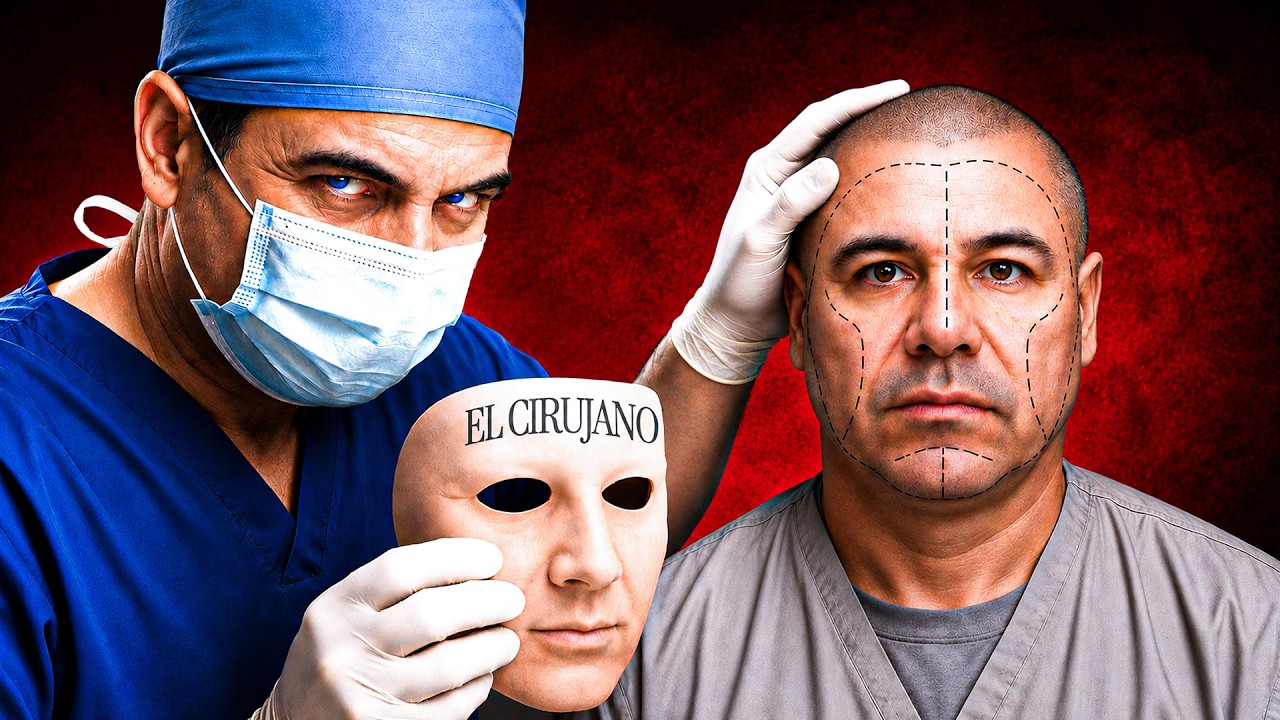
His request was simple: make me someone else. A new jawline, a new nose, new cheekbones. A face that no DEA photograph, federal warrant, or informant description would ever match. The surgeon had been paid more money than he would earn in ten years of legitimate practice.
He had been told, with the particular politeness powerful men use when they are actually making a threat, that the operation would go smoothly. Eight hours later, the most wanted man in Mexico was dead on his table. The doctor had four months left to live. This was not an isolated incident.
It was the most visible moment in a shadow medical system that ran underneath Mexico’s drug wars for decades. A network of surgeons who crossed a line that no amount of money should have convinced them to cross. Some did it for cash. Some did it because saying no was not an option.
Some did it because they had grown up in the shadow of cartel money and understood their scalpel as just another tool in a world where the cartels owned everything. To understand how this world came to exist, you have to start in Guadalajara in the early 1980s, when the entire architecture of the Mexican drug trade was being built from scratch. By the mid-1980s, the US and Mexican governments had fundamentally changed how they hunted cartel figures. The DEA had built a facial recognition and biometric intelligence infrastructure that made being known one of the most lethal liabilities a narco could have.
The moment a face appeared in a DEA file, drawn from informants, surveillance photos, airport footage, and intercepted communications, that person became a target that never stopped being hunted. A narco could change his name, his location, bribe every official between him and a prison cell. He could not change his face. At the same time, Mexico’s drug trade was undergoing a seismic transformation.
The late 1980s saw the collapse of the Colombian Medellín cartel’s direct US smuggling routes, and Mexican organizations rushed to fill the vacuum. Groups that had been marijuana middlemen were suddenly handling hundreds of tons of cocaine. The money became incomprehensible. So did the risk.
By 1990, the DEA’s most wanted list for Mexican nationals read like a who’s who of men who controlled entire states and had never appeared in a newspaper photograph by choice. Anonymity was their greatest weapon, but anonymity has a shelf life. Informants talk. Surveillance improves.
Eventually, even the most careful narco leaves a trail that leads back to a face. Someone realized that the problem of a recognizable face was a medical problem. And medical problems have medical solutions. The surgeons who ended up serving the cartels were not back-alley butchers or disgraced doctors who lost their licenses.
Many were genuinely talented, respected medical professionals. Guadalajara had developed by the 1980s and 1990s into a significant hub for plastic and reconstructive surgery, home to some of Mexico’s finest medical institutions. Its surgeons had trained in Mexico City, the United States, and Europe. The plastic surgery community was tight-knit, professional, and on paper entirely legitimate.
But Guadalajara was also the birthplace and operational center of what would become Mexico’s most powerful early cartel. That was not a coincidence. It was geography and economics. The Guadalajara cartel, operating through the early to mid-1980s, was the prototype for everything that came after.
It was the first Mexican organization to demonstrate how traffickers could operate at a genuinely national scale, combining political corruption, military protection, and business sophistication in ways the DEA had never encountered. Its key figures were men like Miguel Ángel Félix Gallardo, known as El Padrino, the Godfather, along with Rafael Caro Quintero and Ernesto Fonseca Carrillo, known as Don Neto. These were strategic operators who understood that the drug trade at its highest level was fundamentally a logistics and corruption business. It was within this organization that a young man from Sinaloa named Amado Carrillo Fuentes began his education, learning from his uncle Ernesto Fonseca Carrillo how a drug empire actually functions.
The Guadalajara cartel’s collapse in 1985, triggered by the kidnapping and murder of DEA agent Enrique “Kiki” Camarena, did not destroy the organization so much as scatter it. Félix Gallardo was eventually arrested. The cartel fractured into regional successors: the Tijuana cartel, the Sinaloa cartel, the Juárez cartel. The men who ran those organizations carried with them everything they learned in Guadalajara, including the understanding that the DEA was now permanently focused on putting faces to names.
The need for a surgical solution did not come from paranoia. It came from experience. These men had watched colleagues get arrested at airports, at border crossings, walking out of restaurants. A face in a file was a death sentence measured in years, not decades.
The system that developed was built entirely around deniability and compartmentalization. A cartel figure seeking facial reconstruction would approach a surgeon through an intermediary: a trusted lieutenant, a cartel lawyer, sometimes a corrupt official. The surgeon would be brought in under conditions designed to ensure silence. Sometimes the location was a legitimate private hospital where a patient checking in under a false name would not raise flags.
Sometimes, especially for high-profile subjects, operations were performed in entirely private settings, rented facilities, modified safe houses that could be scrubbed clean of evidence. The patient arrived with a false identity. The records, if any were kept, reflected that false identity. Everyone involved understood without it needing to be stated that what happened in that room stayed in that room.
The problem was that secrecy of that magnitude is almost impossible to maintain forever. Surgeons talk. Anesthesiologists have colleagues. Nurses have families.
The cartels knew this. The ultimate security measure for these operations was not a confidentiality agreement. It was a grave. No one demonstrated the lengths cartel figures were willing to go more dramatically than Juan Carlos Ramírez Abadía, a Colombian who rose through the ranks of the Norte del Valle cartel to become one of the most powerful cocaine traffickers in the world.
His operation moved as much as thirty tons of cocaine monthly, flooding New York, Miami, and Los Angeles. He earned the nickname Chupeta, lollipop, early in his criminal career. By his own later admission in a US federal courtroom, he was responsible for ordering 150 murders and smuggling 400,000 kilograms of cocaine into the United States. By the late 1990s, Chupeta was one of the most wanted men in Colombia.
Rather than run or fight, he decided to become someone else. Not once. Not twice. At least three or four times.
Testifying at the El Chapo trial in 2018, he described in clinical detail what he had done to his own face: altered jawbone, cheekbones, eyes, mouth, ears, nose. The jurors stared. His skin was pulled tight across a lopsided face. The features did not align the way human features are supposed to align.
Multiple rounds of reconstruction had left him less like a different person and more like a person assembled from incompatible parts. It almost worked. Chupeta relocated to Brazil, settling into a luxurious property in São Paulo under a false identity with a face that bore no meaningful resemblance to any photograph in any law enforcement database. Brazilian police knew he was probably in the country, but because of his surgeries and aliases, they could not get a positive identification.
Without a positive ID, they could not get an arrest warrant. The DEA deployed something the surgeons had not accounted for: voice recognition technology. Brazilian police had been taping Chupeta’s phone calls. Colombian authorities had recordings of his voice from years earlier.
Those recordings were passed to the DEA, which ran a vocal fingerprint analysis and matched them. Not his face. His voice. In 2007, police raided twenty-two locations across six Brazilian states and found him at his São Paulo property.
He was extradited to the United States, pleaded guilty to drug trafficking and murder charges, and forfeited one billion dollars. That brings us back to Mexico, to the most dangerous patient any doctor has ever had on their table. Amado Carrillo Fuentes was born December 17, 1954, in Guamuchilito, Navolato, Sinaloa. His uncle was Don Neto, one of the founding figures of the Guadalajara cartel.
Carrillo grew up watching how the drug trade actually worked from the inside. He was not a street criminal who climbed his way up through violence alone. He was from the beginning a student of the business. He learned to fly.
While other cartel figures used ground routes and tunnels, Carrillo recognized that the sky was essentially unpoliced. He built a fleet of jets, 727s, corporate aircraft, and modified cargo planes, moving cocaine from Colombia to Mexico in quantities that dwarfed anything previously attempted. The nickname was inevitable: El Señor de los Cielos, the Lord of the Skies. He seized control of the Juárez cartel after assassinating his predecessor in 1993.
From that point forward, he ran what DEA analysts described as the single most powerful drug trafficking organization in Mexico, with connections to Colombian cartels, corrupt officials at the highest levels of Mexican federal law enforcement, and distribution networks reaching every major American city. Despite all of that power, Carrillo Fuentes was almost pathologically terrified of his own photograph. He kept out of the public eye with obsessive discipline, cultivating a deliberate invisibility almost unprecedented for someone operating at his level. By 1997, the noose was closing.
The DEA had committed significant resources. Mexican federal agents were getting closer. Carrillo made his decision. If he could not stay invisible as himself, he would stop being himself entirely.
On July 3, 1997, Amado Carrillo Fuentes checked into Santa Mónica Hospital in the upscale Polanco neighborhood of Mexico City, not under his own name. He presented himself as Antonio Flores Montes, a private patient seeking facial reconstruction and liposuction. The surgical team was experienced and capable. The procedure was extraordinarily demanding: restructuring bone, reshaping cartilage, altering every defining characteristic that made Carrillo recognizable, combined with liposuction.
Eight hours. That is how long he spent on that operating table. When the eighth hour ended, he was not waking up. According to the autopsy, Carrillo had been administered a combination of hypnotic medication mixed with anesthesia, a combination that would have caused respiratory failure.
His heart stopped. The DEA was invited by Mexican officials to view and identify the body at a funeral home in Sinaloa. DEA administrator Thomas A. Constantine confirmed the death publicly on July 7, 1997.
The body was almost unrecognizable, not because the surgery had worked, but because death and eight hours of physical trauma had left Carrillo’s face swollen, discolored, and destroyed. The official story was surgery, tragic complications, a wrong medication combination. It was immediately questioned by everyone who knew anything about how the Juárez cartel operated. The surgical team was not selected randomly.
The hospital was not chosen by accident. Every detail would have been planned with the same precision Carrillo applied to every other aspect of his organization. Either it was a genuine medical error, an anesthesia complication on a body worn down by years of stress and excess. Or it was deliberate murder, someone somewhere deciding that the Lord of the Skies was more valuable dead than alive.
Or the surgeons themselves, operating under coercion or desperate calculation, administered the fatal dose intentionally. The honest answer is that nobody definitively knows. That ambiguity was precisely what made what happened next inevitable. In November 1997, four months after Carrillo died on that table, Mexican federal authorities came across three sealed drums on the side of a highway between Mexico City and Acapulco.
The smell gave it away first. Inside were three bodies, showing signs of torture, the kind designed purely for punishment. All three men had been part of the surgical team at Santa Mónica Hospital. All three had been in the operating room during the eight hours that ended Carrillo Fuentes’s life.
They had been encased in concrete inside sixty-six-gallon oil drums and left where they would eventually be found. Nobody was ever charged with their murders. No arrests, no prosecution. The message to every other surgeon in Mexico was not “don’t do this work.
” The message was: do this work perfectly, keep your mouth absolutely shut, and pray that your patient survives. Because the alternative had just been demonstrated in concrete on a highway. The DEA’s approach to the narco surgery phenomenon transformed after Carrillo’s death. Surgical records, when they could be found, became one of the most valuable intelligence assets the DEA could obtain.
A surgeon performing facial reconstruction documents pre-operative photographs, surgical plans, implant specifications, post-operative imaging. The paper trail of a full facial reconstruction contains the most comprehensive record of what a person’s face looked like before and after the procedure. When raids connected to cartel surgical operations occurred, what investigators were looking for was not drugs or weapons. It was photographs, measurements, the clinical record of transformation.
It told you what the target used to look like, what they probably looked like now, and the specific modifications made, which could be worked backward from new surveillance photographs to confirm identity. The cartels understood this completely, which is why the absolute first priority after any surgical procedure was the total destruction of every record that the operation had ever taken place. The surgeons who served the cartels represented a loose, informal network of medical professionals who had, for various reasons, stepped across the line between legitimate medicine and cartel service. Some were motivated primarily by money.
Some were coerced. And some were true believers, men who had grown up in the shadow of cartel money and saw their surgical skills as simply another service they could provide to the world they already moved in. The medical underground included general practitioners who treated gunshot wounds off the books, pharmacists who supplied controlled substances without prescriptions, anesthesiologists whose discretion could be purchased. But the plastic surgeons occupied a unique position.
What they provided was not just treatment. It was transformation. The three surgeons found in concrete on the highway to Acapulco have been dead for nearly thirty years, their names barely appearing in any public record, their stories reduced to footnotes in the biographies of the men they tried and failed to transform. El Señor de los Cielos is gone.
Chupeta is serving time in a federal prison, his surgically destroyed face a permanent monument to the limits of what money can buy. Technology has changed the equation. Biometric systems at borders and airports now capture multiple identifying characteristics simultaneously. A changed face means less when gait, iris, voice, and behavior patterns are all being processed at the same time.
But the underlying logic has not expired. As long as there are men wealthy enough to pay for transformation and desperate enough to need it, there will be surgeons willing to provide it. A man staring at his own face in a mirror and calculating what it is worth to make it disappear. That logic does not expire.
And the story is not done being written.






