There is an admiral buried in Arlington National Cemetery whose name almost no one remembers. He won three consecutive carrier battles against the Imperial Japanese Navy. Under his command, six enemy carriers went to the bottom of the Pacific in ninety days. No one else did that in the entire war.
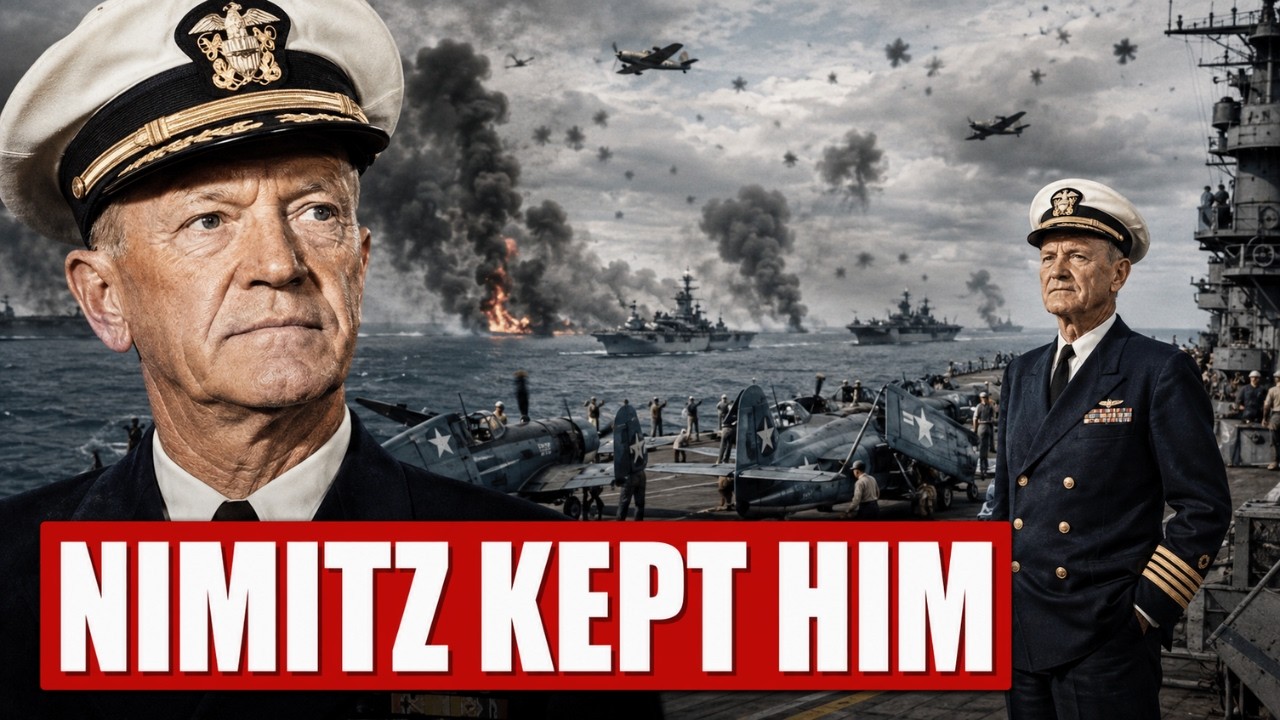
Not Halsey. Not even Nimitz himself. And when it was over, his own Navy quietly removed him from the war he was winning. This is the story of Frank Jack Fletcher.
On the morning of May 7, 1942, in the Coral Sea, a radio operator aboard an American cruiser pressed a handphone to his ear. The sea outside was flat and bright under a tropical sun. Somewhere to the north, beyond the horizon, a battle was being fought in the sky that no one on his ship could see. Then the words came through the headset, spoken by an American pilot who did not know his microphone was open to every ship in the task force.
“We hit a carrier. ” The operator wrote it down, passed the paper up the ladder, and it reached the flag bridge. Aboard a Japanese carrier three hundred miles to the north, a warship called the Shoho was finished. Eleven minutes was all it took, from the moment the first American dive bomber began its run until the Shoho rolled over and sank with more than six hundred men still aboard.
The pilots who did it had taken off from two American carriers. The man who sent them into that sky stood on the bridge of one of those carriers at that very moment. His hands were behind his back. His face was calm.
He had never flown a plane in his life. His name was Frank Jack Fletcher. Four months later, the United States Navy quietly removed Frank Jack Fletcher from the war he was winning. There was no court-martial.
There was no charge. There was no signed order. There was only silence. The phones stopped ringing.
Three thousand miles from that burning Japanese carrier, in an administrative building at Pearl Harbor, another admiral sat at his desk with a pen. Chester Nimitz, Commander in Chief of the Pacific Fleet, was writing a private letter, partly in his own hand, to Admiral Ernest Joseph King, the Commander in Chief of the United States Fleet. Cold as a blade at sixty-three, King was the man who could destroy any naval career in America with a single stroke of his pen. Nimitz was risking his own reputation to protect Fletcher, defending a record no other American admiral had come close to in the entire war.
The story begins long before carriers, before airplanes worth mentioning. In April 1914, an American fleet landed on the Mexican coast at Veracruz. A young naval lieutenant, twenty-nine years old, took command of a Mexican steamer called the Esperanza, filled it with civilians, and got it out of that harbor while hostile fire fell around it. The next morning, he went back, rode a train under a flag of truce over tracks thought to be mined, and brought out more people, wounded, women, foreign nationals, under fire, alone.
For that, the United States government gave him the Medal of Honor. That young lieutenant was Frank Jack Fletcher. There is another detail about that port. The rear admiral issuing orders on the American flagship that morning was Frank Friday Fletcher, commander of the entire American naval expedition to the Mexican coast.
He also received the Medal of Honor for those weeks. Uncle and nephew, same shore, same battle, same weeks, both awarded the nation’s highest naval honor. It never happened before or since. The Fletchers were a naval family from Marshalltown, Iowa, corn country.
When war broke out, Fletcher was given command of a carrier task force. In December 1941, after Pearl Harbor, the Pacific Fleet was shattered. What the Japanese bombers had missed was a small handful of carriers, three or four to cover an entire ocean. Two weeks after the attack, a small Marine garrison was still holding out on Wake Island.
The Navy sent a task force built around the carrier Saratoga to rescue them, commanded by Rear Admiral Frank Jack Fletcher. On December 22, one day from the atoll, an order came from Pearl Harbor: turn around and come home. It was signed by Vice Admiral William Pye, the temporary commander, who had convinced himself a Japanese fleet was waiting. The next morning, Wake fell.
Fletcher had obeyed the order of the officer he was bound to obey. In Washington, Ernest King read the reports and noted that Fletcher had turned back. King did not care that the order came from Pye. He logged it under Fletcher’s name.
That was the first cut, and Nimitz had not even taken office yet. Chester Nimitz took command of the Pacific Fleet at the end of that month. The carriers were nearly the only weapon left. If they were lost, almost nothing stood between the Japanese fleet and Hawaii, and beyond Hawaii, the coast of California.
Every time Fletcher sailed, he carried a piece of the country’s survival on two or three ships. Nimitz gave him a carrier anyway, because he had been watching Fletcher’s work for twenty years. By May 1942, the Japanese were driving toward Port Moresby on the underside of New Guinea. Nimitz sent Fletcher with two carriers to stop them in the Coral Sea.
What happened there had never happened before in the history of the world. Two fleets hunted each other across hundreds of miles of open ocean. Neither ever saw the other. No ship fired a shell at another ship.
The entire battle was fought by aircraft launched from decks that never came within sight of each other. It was the first carrier-versus-carrier battle in human history. Fletcher knew he was not an aviator. When a pilot, Rear Admiral Aubrey Fitch, joined his task force, Fletcher handed him the air battle while keeping overall command.
He gave the reins to the man who could handle them and kept his hands on the helm. That is rare in military history, a man with two stars and a Medal of Honor around his neck quietly stepping aside. The Coral Sea was a blind, padded fight that lasted two days. Fletcher opened it himself on May 4 by sending every plane on Yorktown against a small Japanese seaplane base on Tulagi, sinking a destroyer and a few auxiliaries.
His planes sent the Shoho to the bottom in eleven minutes. They left the fleet carrier Shokaku heavily damaged and wrecked the air groups of Zuikaku, which lost so many aircraft and pilots it could not participate in what came a month later. The Japanese cancelled the invasion of Port Moresby and turned their ships around. It was the first time in the entire war the Japanese Navy had been turned back anywhere.
Because Fletcher’s pilots had taken Shokaku and Zuikaku out of the battle, neither could sail to Midway four weeks later. The battle that would decide the fate of the Pacific hinged on a margin of a few carriers, and that margin had been set in the Coral Sea. But Lexington took torpedoes and bombs. At first the damage seemed controllable.
Then gasoline vapor found a spark, a second round of explosions began, and the men could not stop it. Most of the crew, nearly three thousand men, was evacuated. An American destroyer sank her with torpedoes. More than two hundred of Lexington’s men did not come home.
In Washington, Ernest King made a calculation he never erased. Fletcher had lost the Lexington, regardless of the Japanese carriers he had disabled. King recorded that loss under Fletcher’s name and held it against him for the rest of his career. On May 29, 1942, Nimitz wrote to King about the Battle of the Coral Sea and the admiral who fought it.
Fletcher did an excellent job, he wrote. He displayed superior judgment. He is a fighting, excellent naval officer in the presence of the enemy. Nimitz recommended Fletcher for promotion to vice admiral and for the Distinguished Service Medal.
He sent the letter to the one man in the Navy most inclined to distrust Frank Jack Fletcher. King read it. King said nothing. King approved neither the medal nor the promotion.
The letter went into a drawer. Meanwhile, a Japanese task force was already turning east toward a small atoll called Midway. In Washington, in the second floor of the Navy Department, Ernest King had already decided that the next time Frank Jack Fletcher made a mistake, King would be waiting. On May 27, 1942, the wounded carrier Yorktown limped into Pearl Harbor under her own power, barely.
Her flight deck was charred black. There was a hole through four decks where a Japanese bomb had penetrated in the Coral Sea. Oil trailed behind her. Shipyard officers spent a full day inspecting her and told Nimitz what he knew they would say: ninety days to repair her.
Nimitz looked at them and said, three days. They thought they had misheard. He said they had heard correctly. His codebreakers had already told him what was coming: the entire Japanese strike fleet, every carrier and cruiser that had hit Pearl Harbor, all coming east toward a coral reef the size of a farm called Midway.
The codebreakers worked in a windowless basement in the Pearl Harbor Navy Yard. Their unit was called Station Hypo, led by Commander Joseph Rochefort, forty-seven years old, a man who had taught himself Japanese in Tokyo in the 1920s and wore a red smoking jacket and carpet slippers to work because the basement was cold. By early May 1942, Rochefort’s team was reading parts of the Japanese operational code JN-25 faster than the Japanese were sending it. They saw a target the Japanese called AF.
Washington argued about what AF was. Rochefort was sure it was Midway, so he arranged a trick. He had the Midway garrison send a fake message in plain English about a breakdown of the water distillation plant. Two days later, a Japanese intercept mentioned a water problem at AF.
It was Midway. Nimitz bet the entire American war effort on Rochefort’s word. Without those men in that basement, Fletcher would never have known where to point the Yorktown. So 1,400 men boarded Yorktown in round-the-clock shifts, welding, patching holes, shoring her with wooden timbers, and in seventy-two hours they pushed her back to sea, still unable to reach full speed, held together by exhausted men and improvisation, sailing toward the most important naval battle of the century.
The officer supposed to lead the American carrier force at Midway was William Halsey, the famous aviator. Ten days before the battle, he was in a Pearl Harbor hospital bed, covered from head to foot in a violent rash, unable to sleep, scratching himself bloody, having lost twenty pounds in a week. He could not wear a uniform without unbearable burning. He was out of the battle entirely.
The man he recommended to Nimitz to take his place was Raymond Spruance, fifty years old, with no meaningful carrier experience, a quiet, thoughtful man. Nimitz took the recommendation. Spruance commanded Task Force 16 with Enterprise and Hornet. Fletcher commanded the entire battle tactically from the repaired Yorktown.
King had objected. King wanted anyone but Fletcher. Nimitz held his ground. On June 4, 1942, four Japanese carriers moved in a diamond formation under Vice Admiral Chuichi Nagumo.
He had just launched a strike on Midway itself and was clearing his decks for the next wave. He did not know where the American carriers were. He did not know they were within striking range. At 7:20 in the morning, one of his scout planes finally found them.
Nagumo had to choose: send the ready aircraft with unsuitable weapons, or strike them below to replace the bombs meant for Midway with torpedoes for ships, then relaunch. He chose rearming. That decision would destroy him. While his engineers struggled with bombs on the hangar decks, American torpedo planes were already approaching.
The first to arrive were fifteen TBD Devastators from Torpedo Squadron Eight off Hornet, led by Commander John C. Waldron, who had told his pilots the night before that if only one of them survived to drop a torpedo on the Japanese, he wanted that man to press the attack. The Japanese Zero fighters fell on them from above. The Devastators were slow, old, held together by rivets and determination, flying straight and level toward the Japanese fleet because that was the only way a torpedo plane could attack.
All fifteen were shot down. Twenty-nine men from Torpedo Eight died in the water that morning. One man survived, hidden under a floating seat cushion in the middle of the Japanese fleet, and watched what happened next. Torpedo Eight was repeated thirty minutes later by Torpedo Six from Enterprise.
Ten of fourteen planes were shot down, including their commander. Twenty minutes after that, Torpedo Three from Yorktown arrived. Ten of twelve planes went into the sea. Forty-one torpedo planes had launched from three American carriers that morning.
Thirty-five never came home. Not one torpedo hit a Japanese ship. They achieved nothing in the records except death. But every Japanese fighter that shot them down had descended to the wave tops to do it.
Every gunner on the Japanese carriers was watching targets at zero altitude. No one was looking up. That was the price of the empty sky above Nagumo’s carriers at 10:22 that morning. Thirty-five American torpedo planes, sixty-five American pilots.
Their names were not carved on memorials after the war. Most of their bodies were never recovered. But they bought five minutes. In those five minutes, three Japanese carriers burned.
The man who led the dive bombers to the Japanese fleet nearly turned back. His name was Clarence Wade McClusky, thirty-nine, leader of Enterprise’s air group. He had launched with thirty-three Dauntlesses that morning and flown to the coordinates the scouts had given, but there was nothing there, just ocean. He had been in the air nearly three hours.
His fuel was running out. He made his decision and turned north. Then, in the middle of nowhere, he saw a single white wake, a Japanese destroyer steaming at full speed toward the northeast, alone. It was the destroyer Arashi, which had lagged behind to drop depth charges on an American submarine and was now racing to catch up with its fleet.
McClusky followed it. Twelve minutes later, he saw four carriers spread out below him. He tipped his squadrons into their dives. In five minutes, Kaga, Akagi, and Soryu, the heart of the fleet that had ravaged the Pacific for six months, were burning from bow to stern.
The Yorktown dive bombers helped finish Soryu. Frank Jack Fletcher stood on the Yorktown bridge as the reports came in. He did not celebrate, because a fourth Japanese carrier was still there. Hiryu was already launching everything she had.
She found Yorktown first. Dive bombers got through the anti-aircraft fire, one bomb down the smokestack destroying her boilers. A second wave came in low with torpedoes and put two into her port side. The ship that had been repaired in three days stopped dead in the water.
Fletcher did not freeze. He did not cling to command for the honor of keeping it. His flagship could no longer launch or recover aircraft. You cannot run a carrier battle from a deck that cannot operate planes.
In mid-afternoon, after the second torpedo hit, Fletcher ordered himself lowered over the side of Yorktown by ropes to a cruiser alongside. From its signal bridge, he sent a message to Raymond Spruance, who still had two working carriers and the striking force that would decide the day: “All orders will conform to your movements. ” He handed the battle to the man who could still fight it. By the time he sent that signal, three of the four Japanese carriers were already dying.
Spruance’s dive bombers found the fourth that evening. Hiryu burned all night. By morning she was gone. Midway had been won.
Then what happened to the other man? Some official Navy histories, written while the war was still going on, told the story of Midway and dropped Frank Jack Fletcher’s name from it entirely. The senior officer at the greatest American naval victory of the war disappeared from the record of his own battle before the shooting even stopped. Nimitz did not sideline him.
Nimitz sent him south to the next fight. Yorktown did not sink that evening. Her captain ordered evacuation when she listed so far he thought she would capsize. During the night she righted herself.
In the morning, a salvage team of 170 men came aboard. They were towing her east when a Japanese submarine, the I-168, found her. Two torpedoes hit Yorktown. One hit the destroyer Hammann, tied alongside, which split in half and sank in four minutes, killing eighty of her men.
Yorktown lasted twelve more hours, then rolled onto her port side and settled in the mud at a depth of 3,000 fathoms. When she went down, she took with her Fletcher’s personal papers, his uniforms, his decorations, and most of his private records of the war. On August 7, 1942, the first American land offensive of the war began at Guadalcanal. Vice Admiral Frank Jack Fletcher commanded the whole show from the deck of Saratoga, with three carriers under him.
The transport ships full of Marines were led by Rear Admiral Richmond Kelly Turner, fifty-seven, sharp-tempered and hard. The Marines on the beach were led by Major General Alexander Vandegrift, fifty-five, calm and utterly committed to his men. Eleven days before the landing, Fletcher brought Turner and Vandegrift to the Saratoga bridge and told them something they did not want to hear. His carriers could not stay tied to the beachhead for long.
Two days, he said, was what he could give them. Vandegrift asked for four. Turner backed the Marines. Fletcher reluctantly extended it to three.
Vandegrift left the bridge with his hands in his pockets and his jaw tight. The landings fell behind schedule, as they always do. By the evening of August 8, with the work unfinished, Fletcher sent the message that would follow him for the rest of his life. He had lost twenty-one of ninety-nine fighter planes in two days of combat air patrol.
Japanese torpedo planes were prowling the area. His fuel was running low. He recommended withdrawing the carriers south to refuel. His superior, Vice Admiral Robert Ghormley, approved the withdrawal.
Ghormley had never wanted this operation at all. He had written to King and Nimitz asking for a postponement, and both had refused. When Fletcher signaled Ghormley that evening that he was pulling the carriers south, Ghormley did not say no. He did not say fight.
He did not say hold. He approved the withdrawal. For years afterward, everyone would remember that Fletcher had asked for it. No one would remember that Ghormley had approved it.
That night, in the dark hours after midnight, the worst open-water disaster in the history of the United States Navy occurred at the Guadalcanal anchorage. A Japanese cruiser force, seven ships under Vice Admiral Gunichi Mikawa, slipped through a passage between islands that would become known as the Slot, and in a moonless darkness fell on the Allied ships that were supposed to guard the transports. In about half an hour, four heavy cruisers were lost, three American and one Australian, with more than a thousand men. The story hardened quickly around a single sentence: Fletcher ran.
Fletcher took his carriers and ran, and brave men paid for it. What that story misses is that Fletcher’s carriers were more than a hundred miles south of Savo Island when Mikawa attacked. Savo was a night gun battle, ship against ship. Carrier aircraft in 1942 could not fly at night.
They could not find a target in the dark, and they could not land back aboard in the dark. The radar, the training, the equipment, none of it existed yet. Mikawa attacked at night for exactly that reason. He did his work in the dark and vanished before dawn.
Two weeks after the entire Navy agreed that Frank Jack Fletcher was a coward, he fought his third carrier battle, the Battle of the Eastern Solomons, on August 24, 1942. The Japanese were pushing a reinforcement convoy toward Guadalcanal under carrier cover, with a light carrier called Ryujo pushed forward as bait. The day before the battle, Fletcher made a decision that has been second-guessed for the rest of his life. He sent one of his three carriers, Wasp, with sixty-three aircraft, south to refuel.
Her fuel was running low. She had to go. But it meant he went into the fight the next day with two carriers instead of three. A third of his striking power was over the horizon taking on fuel when the shooting started.
His dive bombers from Saratoga found Ryujo that evening and sank her. The Japanese replied with a strike that hit Enterprise and killed men in a compartment where they had nowhere to run. Enterprise’s crew was so well trained that she recovered her aircraft within an hour of the hit. The Japanese convoy turned back north.
Japan lost seventy-five aircraft that day. America lost twenty. It was an American victory, the third in a row under the same commander. Then King, in Washington, read the reports of the Battle of the Eastern Solomons, and his complaint was that Fletcher had not pursued the beaten Japanese in the dark.
Even Chester Nimitz, for the first time, bowed. Nimitz wrote after the Eastern Solomons that the American fleet should have been used more boldly, that Saratoga should have stood and fought at night rather than withdrawing south. The shield did not break, but it lowered a little. A week after Ryujo went down, on the last day of August, a Japanese submarine was waiting under a hot, calm sea southeast of Guadalcanal.
It fired a torpedo that hit the side of Fletcher’s flagship, Saratoga. The hit flooded the boiler room, killed the ship’s electric engines, and left her dead in the water. On the bridge, Fletcher struck a piece of metal hard enough to open a gash across his forehead. A pharmacist’s mate bandaged the admiral’s wound by flashlight.
Twelve men aboard Saratoga were wounded that day. None were killed. But the flagship went to the repair yard, and the admiral returned aboard her as a wounded man who had spent nine months at sea, the hardest nine months this country’s Navy had ever known. There is a photograph of Frank Jack Fletcher taken in September 1942.
He is on the Saratoga bridge. The bandage on his forehead is still fresh. He wears a khaki shirt without a jacket, and it no longer fits him. He has lost too much weight.
His cheekbones stand out. His eyes are the eyes of a man who has not slept in a bed since before the war began. He does not look at the camera. He was fifty-seven in that picture, but he looked seventy.
The men who served with him later remembered that Fletcher aged five years in nine months. That is what the Pacific did to him, and to all of them. Halsey had lost twenty pounds in a week and been carried away from the fight. Ghormley was drinking himself unconscious at Noumea.
Nimitz’s hair was graying at Pearl Harbor. The Navy asked its men in 1942 for things that could not be borne. The men who were asked did what they could until their bodies gave out. Fletcher’s body had given out.
He did not know it yet, but he had just fought his last naval battle. On September 21, 1942, Saratoga was towed into Pearl Harbor, her hull scarred at the torpedo wound. Fletcher stepped onto the pier for the first time since before the war began. He was fifty-seven.
He had fought three carrier battles and won every one of them. He went on leave. For the first time since December 1941, Frank Jack Fletcher slept in a house. While he slept, three thousand miles away in Washington, the decision about the rest of his life was being made, not by Chester Nimitz, but by every man who had ever held a grudge against him, all at once.
There is no order that ended Frank Jack Fletcher’s career at sea. There is no signed page, no official memorandum. Historian John Lundstrom, who spent most of forty years inside Ernest King’s private files, searched for one piece of paper that said “relieve Fletcher of command. ” It does not exist.
What exists instead is colder than any military order: nine months of small cuts. It began in January 1942. On the first American carrier raid of the war, Fletcher led his striking force against the Japanese-held Marshall Islands. On the way home, he stopped to refuel his destroyers.
King, reading the dispatches from his desk three thousand miles away, replied with a message so sharp that one of Fletcher’s cruiser commanders called it the dirtiest message he had ever seen. Fletcher read it, put the paper aside, and said four words: “What damned nonsense. ” Here is what that message left out. A carrier could sail for weeks without a fuel tanker.
Her escorting destroyers could not. A striking force that let its destroyers run out of fuel in the wrong waters was a force that could lose them. Fletcher kept his ships fueled because a fleet that runs dry in front of the enemy does not get a second chance. To King, sitting in his office three thousand miles away, it looked like a man who had pulled back from a fight.
But it was a man who had already decided not to lose ships this country could not replace. King never forgot the fuel story. He never approved the medal that was recommended. He never approved the promotion.
He wanted William Halsey at Midway, not Fletcher. He complained after the Coral Sea that Fletcher had not finished off Shokaku and Zuikaku. He complained after the Eastern Solomons that Fletcher had not pressed the attack in the dark. None of those cuts was fatal by itself.
But each one stuck in the memory. Behind them was something bigger than one man’s grudge. The Navy was changing. The aviators were winning the long argument about who would run the fleet, and for good reason, because the carrier had proven itself the decisive weapon.
Fletcher was a black shoe in a brown shoe war, standing in the current on the day the current itself changed direction. There is one quiet piece to this puzzle. Immediately after Midway, Raymond Spruance was pulled from command at sea and brought to Nimitz as his chief of staff. That kept Spruance out of the Solomons, out of the grinding campaign that was devouring the reputations and careers of American commanders month after month.
He came out of Pearl Harbor as the second most important admiral in the Pacific. Fletcher stayed in the grind, and when his damaged ship brought him home in September, there was a plan for a short while to send him back out. Nimitz intended to return Fletcher to command of the Saratoga task force once she was repaired. Then, by mid-October, William Halsey recovered his health.
The Pacific was doing to the American carrier force in September what King had been angry at Fletcher for not risking in August. On September 15, 1942, a Japanese submarine fired six torpedoes at the American carrier Wasp southeast of the Solomons. Three hit. Fires spread faster than the crews could contain them.
She had to be abandoned, and a destroyer sank her that evening. One hundred ninety-three of her men did not come home. Wasp was the carrier Fletcher had sent south to refuel the day before the Eastern Solomons, a decision described as an error, a decision second-guessed for the rest of his life. Three weeks after that decision, Wasp was at the bottom of the Pacific, carrying an air group that had barely participated in the war.
The same spread of torpedoes also hit the battleship North Carolina and the destroyer O’Brien, both damaged badly enough to require months of repairs. One spread, three warships hit, the most successful torpedo salvo of any submarine in the entire war. Nimitz made the hardest decision of his war. On October 18, 1942, he relieved Robert Ghormley of command of the South Pacific area and gave it entirely to William Halsey.
Halsey was the face King wanted. Halsey was the face the newspapers wanted. Halsey was the aviator the aviators’ Navy wanted. The plan to return Fletcher to Saratoga, if it had ever really been set, simply faded away.
No one had to relieve him. They only had to not call. The phone did not ring at Fletcher’s quarters in Pearl Harbor. In November 1942, the orders finally came.
He was sent to Seattle, then farther north, to command the North Pacific Force. Fog, cold, the Aleutians, a frozen corner of the war where no Japanese carrier would ever come and no major battle would ever be fought. For a year he ran an office in Seattle, with no command of consequence and endless paperwork. He turned fifty-eight, then fifty-nine.
In November 1943, Nimitz gave him command of the North Pacific Force, everything American in the waters above the fortieth parallel. The Aleutians, the Bering Sea, the approaches to the northern Japanese islands. Attu and Kiska had already been retaken by the time he arrived. The major battles of that theater were over.
What remained was a different kind of war, long-range raids from frozen airfields against Japanese bases in the northern Kuriles. Paramushiro, Shumshu, names most Americans had never heard. Fletcher’s planes flying from Attu struck Paramushiro seventy-two times between 1943 and the end of the war. They wore down what remained of the Japanese Fifth Fleet in the north.
They kept 100,000 Japanese troops watching the north for a threat that never came while they could have been fighting the Americans at Iwo Jima and Okinawa. It was not headline war. It was not war that built careers. It was important work, done by a man who never complained about the assignment and never stopped being a professional naval officer because his country had stopped listening to him.
He did his job in the cold where no one was watching. That is a kind of honor too. But he never commanded a carrier task force again. Not for the rest of the war.
Not ever. The man who replaced him in the South Pacific was Admiral Thomas Kinkaid. A month after Kinkaid took command, at Santa Cruz on October 26, he threw his two carriers, Enterprise and Hornet, against four Japanese carriers coming from the north. The Japanese hit Hornet first.
Torpedoes, a crashed Japanese plane, she was burning from bow to stern by mid-morning. Her crew fought the fire for eight hours. In the end she could not be saved, and American destroyers sank her that night. One hundred forty American sailors died with her.
Enterprise took three direct bomb hits but stayed in the fight, the only operational American carrier in the entire Pacific. The crew painted a sign on the flight deck: “Enterprise vs. Japan. ” That was the state of the war in November 1942.
Kinkaid fought at Santa Cruz exactly that kind of close-quarters, at-any-cost offensive battle that King had wanted Fletcher to fight in August. He pushed his carriers into the heart of the fight and traded ship for ship with the Japanese. He lost Hornet as a result. If Fletcher had fought that kind of battle in the Eastern Solomons, or the Coral Sea, or Midway, he would have lost carriers the United States did not yet have replacements for.
The men who called Frank Jack Fletcher a coward were describing an admiral who understood before anyone else in the Navy that a battle you cannot afford to lose is a battle you must fight carefully. Gently. With care. King learned that lesson at Santa Cruz, the hard way.
Fletcher had known it all along. The war went on without Frank Jack Fletcher. Here are the facts. Fletcher commanded American forces in more carrier battles than any other admiral in World War II.
He lost none of them. In the battles he commanded, six Japanese carriers went to the bottom of the sea. In the first 289 days of the Pacific war, he spent all but fifty-one of them at sea, most of it in waters controlled by the enemy or fought over. No other American admiral came close to that number.
The Japanese Navy in 1942 was the best in the world at what it did. They sank his Lexington. They sank his Yorktown. They put a torpedo into his flagship, Saratoga, while he stood on her bridge.
For nine months, Japan threw everything it had at the fleets flying Frank Jack Fletcher’s flag. They lost every carrier battle he fought. The best naval air force on the planet, the one that caught this country asleep on a Sunday morning in December, faced this American admiral in three battles and came out having lost six carriers and irreplaceable men without a single victory to show for it. That is not luck.
Luck does not repeat the same way three times in a row. On September 9, 1945, at the Ominato naval base in northern Honshu, the war had been over for a week. Vice Admiral Frank Jack Fletcher, commander of the North Pacific Force, sixty years old, gray at the temples, climbed a wooden ramp to a Japanese pier. At the end of the pier, Vice Admiral Kanji Ogaki stood at attention with his staff behind him.
Fletcher accepted the surrender of Japanese forces in northern Honshu and Hokkaido. He took a pen from his aide, signed the document, returned the pen. The senior American officer present at the final moments was the same admiral who had been there at the beginning, the Coral Sea, three and a half years before. In between, he had won three consecutive carrier battles against the best navy on earth.
Almost no one in the country he served knew his name. He retired in 1947. He returned to his home in Maryland. He kept horses.
He never wrote his memoirs. Historians came after the war with notebooks, asking him to sit down and give his account, and he sent them away. He had lost most of his personal records when Yorktown sank at Midway, and more when he was evacuated wounded from Saratoga. He did not want to rebuild the story from memory.
He did not want to risk getting a single fact wrong. He never wrote the articles. He never gave the speeches. He never sought to polish his own legend.
He left it to others to tell, and others told it their own way for fifty years. Frank Jack Fletcher died on April 25, 1973, at the age of eighty-seven. He was buried in Arlington National Cemetery, with a modest headstone and a simple funeral. His obituary in the New York Times was three paragraphs long.
Twenty years later, in 1992, a civilian historian named John Lundstrom published a two-part article in a naval history journal titled “Frank Jack Fletcher Got a Raw Deal. ” Lundstrom had spent his career combing the records, the shipyard files, King’s private papers, the dispatches no one had read since the war. He assembled the account on which this story is based. He wrote the book Carrier Admiral, published in 2006.
Lundstrom died in 2021. On April 27, 2024, eighty-two years after the Battle of the Coral Sea and fifty-one years after Fletcher’s death, the United States Navy laid the keel of a new Arleigh Burke-class destroyer at Bath Iron Works in Maine. Hull number DDG-146. Her name is USS Frank Jack Fletcher.
It is the first warship in the history of the United States Navy to bear that name, and she was not christened until three years after the man who did more than anyone to restore Fletcher’s reputation had been laid to rest. The record is still there, in the deep water off the Coral Sea, off Midway, off the Eastern Solomons. Six Japanese carriers at the bottom of the Pacific, where no man in Washington can reach them, and no signature can erase them. The evidence of an American admiral’s three consecutive victories still rests where he left it eighty-four years ago.
Frank Jack Fletcher won three consecutive carrier battles against the best navy on earth, and almost no one ever told you his name. Now you know it.






