The year was 1931, and in the black water of a southern Louisiana swamp, men cut down a bald cypress tree that had been alive for roughly thirteen hundred years. Its trunk measured more than seven feet thick at the base, and when the rings were counted, that tree had been standing in the water since before the Norman conquest of England. And it was not even unusual. For about forty years, from the 1890s into the 1920s, America reached down into the flooded swamps of Louisiana and pulled out the oldest, largest trees on the eastern half of the continent.
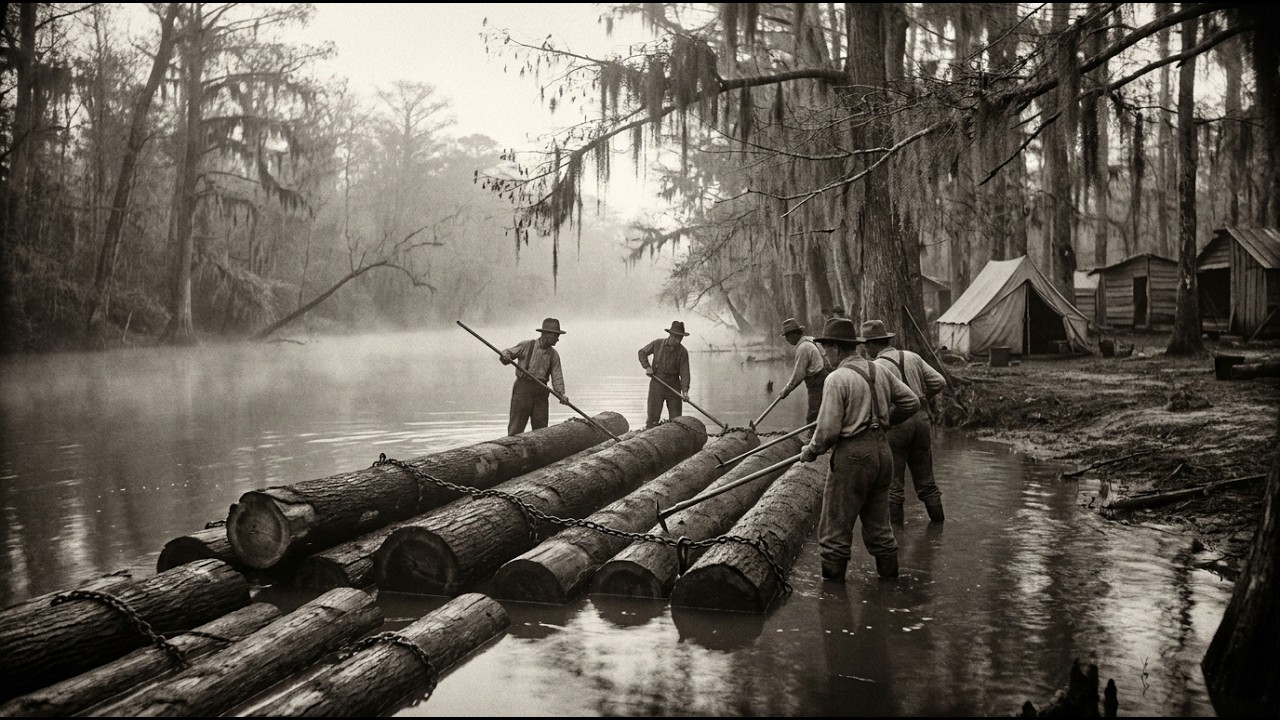
A million and a half acres of giant cypress were cut, and almost all of it was done with axes, saws, and human muscle, with men standing on narrow boards over blackwater full of snakes. And there is one detail that makes the whole enterprise seem almost unbelievable: a fresh-cut cypress does not float. It sinks. So, before the loggers could move these giants, they had to kill them while they still stood and then wait.
Two real men stood at the two ends of this strange industry, and only one of them is remembered. The first was called the Cypress King. His name was Frank Williams. Born in 1851 in Mobile, Alabama, he lost his father when he was still a boy.
He came up through the railroads and then through engineering and surveying across the South, and in the 1870s he settled in the little town of Patterson, Louisiana, and started milling cypress. In 1892, he bought out his partner for $350,000 and built the F. B. Williams Cypress Company into what the people of the day called the largest lumber mill in the world.
He came to control more than 100,000 acres of cypress swamp, some of it bought for as little as 75 cents an acre, and at his peak, his one operation cut something like 85 percent of all the cypress in Louisiana. The second man is barely a name in the record at all, and yet without him none of it could have happened. His name was William Baptist, a man out of New Orleans, and somewhere around 1891 he developed a machine that cracked the swamp open. It was called a pullboat: a steam winch mounted on a barge, able to reach a cable far out into the flooded forest and drag a giant cypress log through the muck to open water.
Before the pullboat, the deep swamp was simply unreachable. After it, the whole drowned forest was for sale. Between those two men stood thousands of others. Cajun locals and northern loggers who came south for the winter cut, whose names the company kept as a number on a payroll and nothing more.
The place itself is part of the story. Most of this happened in and around the Atchafalaya Basin in southern Louisiana, which even today is the largest river swamp in the United States: a wilderness of bayous and flooded forest covering more than 3,000 square miles. Picture a forest that is also a lake. The water moves slowly through it.
The cypress and tupelo rise straight out of it, and for much of the year there is no dry ground to stand on at all. To a farmer, it was useless. To a traveler, it was a maze. But to a lumberman who looked up at the timber instead of down at the mud, it was the richest stand of building wood in the eastern half of the country.
Hundreds of thousands of acres of giant, slow-grown, rot-proof cypress stood there in the water, waiting for anyone who could figure out how to reach it. Cypress is a strange and magnificent tree. It grows straight up out of standing water. Its base flares out into a wide buttress, with those famous knees poking up around it through the surface.
It grows slowly, which makes its wood dense, and it is naturally resistant to rot and insects in a way almost no other American timber is. People called it the wood eternal. It made the perfect material for anything that had to live in weather or water: shingles, water tanks, cisterns, greenhouse benches, docks, railroad ties, coffins, the trim and siding of houses all across the country. And the finest stands of it on Earth grew in the swamps of Louisiana.
The catch was that almost all of it grew in water. For most of American history, that water was a wall. You simply could not get a logging crew, an animal, or a wagon into a forest that was three or four feet deep in swamp most of the year. And these were not ordinary trees.
A mature bald cypress in those swamps could rise 120 feet into the air, with a trunk 25 to 40 feet around at the flared base, far too thick for a man to reach even halfway around. Many of them had been alive for 500, 800, 1,000 years or more. The giant they cut in 1931, the one with around 1,300 growth rings, had been a seedling back around the time of Charlemagne. Standing among those trees must have felt like standing inside a cathedral, with gray trunks rising like stone columns out of black water into a roof of green far overhead.
Nothing in the eastern forest of America was older or larger, and almost all of it stood in water that no ordinary crew could cross. So for a long time, the giant cypress just stood there. Too valuable to ignore, and too wet to reach. The first crack in that wall came not from a machine but from a law and a price.
The federal Timber Act of 1876 put huge tracts of this so-called worthless swamp land up for sale at 25 to 50 cents an acre. Speculators and lumbermen who could see what was standing in that water bought it up by the hundred thousand acres for almost nothing. Frank Williams was one of them. The forest had been bought.
Now somebody had to figure out how to get it out. The men who bought that land for a quarter an acre were not fools. They knew exactly what was standing in the water, and they knew that whoever solved the problem of getting it out would own one of the great timber fortunes in America. Through the 1870s and 1880s they quietly accumulated enormous holdings of cypress swamp for almost nothing.
Sometimes a billion feet of standing timber was bought for the price of a small farm. Frank Williams gathered more than 100,000 acres of it. The land had changed hands. The trees still stood in the water untouched, exactly as they had for a thousand years.
All that was missing was the machine that could pull them out. For years men had tried and failed. You could not float a fresh-cut cypress because it sank. You could not drive an ox team through four feet of standing water.
You could not lay an ordinary railroad across a bottomless swamp. The giant trees that everyone could see and nobody could touch became a kind of standing taunt, a fortune locked behind a wall of water. Whoever found the key would not just get rich. He would open the last great untouched forest in the eastern United States.
So the race was on to invent a way in. The first problem was the strangest one. A living cypress is full of water and heavy, and a freshly cut cypress log sinks like a stone. You cannot float it out the way the Maine men floated pine or the Mississippi men floated their rafts.
So the swamp loggers did something that sounds almost cruel in its patience. They went into the forest a year or more ahead of the cut and girdled the trees. Girdling means cutting a deep ring all the way around the trunk, through the bark and the living layer beneath it, which kills the tree where it stands. A girdled cypress slowly dries out over the following months, standing dead in the water until it has lost enough weight that it will float.
Only then, often a full year later, when the high water came up in the spring, did the crews come back to fell the dead giants and move them. Imagine a whole forest of enormous dead trees, killed on purpose and left standing for a season, waiting to be light enough to carry. A crew would go out by skiff into a section of swamp a full year or more before it was to be cut, and one tree at a time they would ring the trunks, killing a forest on purpose and then leaving it alone. For the next many months that stand of giant cypress stood dead and silent in the water, slowly drying, slowly shedding the weight that would otherwise have dragged it to the bottom.
The men who girdled a section often were not the men who would cut it. They were working for a harvest more than a year away, trusting that the high water would come at the right time and that the dead giants would by then float just enough to move. It is a kind of planning that feels almost like farming, except the crop had taken a thousand years to grow and would be gone in an afternoon. The felling itself was brutal handwork done in the worst possible conditions.
A bald cypress flares out into that wide buttress base, far too thick to cut at ground level. So the men drove a pair of planks called springboards into notches in the trunk several feet up, climbed onto them, and stood balanced over the blackwater swinging axes and pulling a long two-man crosscut saw above the flare. Picture it: two men on narrow boards high enough to clear the swollen base of the tree, working a saw back and forth through a trunk that might be six or eight feet across, with snakes and alligators in the water below and the Louisiana heat pressing down. When the tree finally went, it came down with a crash that threw a wave across the swamp.
The men cut 35 or 40 of these giants in a single day. They did it standing on boards. They did it by hand. The springboard was a plank maybe six inches wide, jammed into a notch chopped into the trunk several feet up.
Your boots were on it, and the blackwater was below you. A saw was in your hands, and your partner stood on his own board on the far side of the trunk. The two of you pulled the long crosscut back and forth for an hour or more on a single tree, in heat that could climb past a hundred degrees, with mosquitoes thick enough to choke a man and water moccasins and alligators somewhere in the water around you. When the cut was nearly through, you had to read the tree, judge which way the giant would fall, and get clear.
Except there was nowhere to run, because a man cannot run on a springboard or sprint through three feet of mud. When the tree finally went over, it came down with a sound like a cannon and threw a wave of swamp water across the whole crew. Then you climbed down, moved to the next one, drove in your boards, and started again. The work asked for the strength of a laborer and the balance of an acrobat, all day, every day.
Now the dead felled giants lay in the water, and the question became how to get them out. That brings the story back to William Baptist and his pullboat. The pullboat was a flat barge carrying a powerful steam engine and a great winch with a long steel cable. The crew would dredge a canal into the swamp, and the pullboat would sit in that canal and play its cable out into the flooded forest, hundreds and hundreds of feet, sometimes more than half a mile, to a fallen log.
The engine would then haul that log, ripping and sliding through the mud and brush and standing water, all the way back to the canal. Then they would move the boat a short distance, maybe 150 feet, and set up what they called a run, dragging log after log out of one fan of forest before moving on. Because the cable swung out in every direction from the boat, they scoured the swamp into patterns that can still be seen from an airplane today: long straight ditches and great wheel shapes pressed into the Louisiana wetland, like the spokes of a wheel, a hundred years after the last log came out. A single pullboat crew could drag 125 or 150 of these giant logs out of the swamp in one day.
Getting the pullboat to the trees meant cutting roads of water through the forest. Crews ran dredges into the swamp and dug canals as much as 40 feet wide and 10 feet deep, straight lines of open water punched into the wilderness so the boats and the logs could move. Those canals did something nobody fully reckoned with at the time. They drained the swamp.
Water that had stood among the cypress roots for centuries now ran out through the new ditches, and the careful balance the trees needed began to tip. The loggers were not only taking the forest; they were quietly rearranging the water that made the forest possible. That change would matter enormously once the cutting was done and people hoped the cypress would simply grow back on its own. The pullboat opened the swamp, but the industry was hungry for more.
Around 1905 came an even more dramatic machine: the overhead skidder. The skidder was a steam engine mounted on a railroad car, and rising above it stood a spar: often a tall cypress with its top cut off, rigged up to about 85 feet high and fitted with a massive pulley at the top. From that high pulley, the crew ran cables out over the swamp in a wide circle, 600 to 900 feet in every direction. Instead of just dragging the logs along the ground, the skidder could lift them clear up into the air and carry them in, swinging through the treetops, dripping mud and water, to be dropped onto the waiting rail cars.
It was faster, and it reached farther than the pullboat. It was also even more destructive, because the lifted logs and swinging cables tore the young trees and seedlings to pieces, leaving almost nothing behind to grow the forest back. To watch one work must have been a terrifying and astonishing thing: a whole drowned forest being yanked up into the sky one tree at a time. That speed came at a price the swamp would pay for a century.
Because the cables lifted the logs up into the air and swung them in over a wide circle, they smashed through everything in their path: the young cypress, the seedlings, the brush that would have become the next forest. A pullboat dragging a log along the ground at least left some of the small growth alive. A skidder working a circle 600 to 900 feet across tended to leave behind a churned and broken waste with almost nothing left standing. It got the giant logs out with remarkable efficiency, and it helped guarantee that in a great many places, no forest of any kind would follow.
The machine that pulled the trees out fastest was also the one that did the most to make sure they never came back. And the logs had to go somewhere, which meant the most unlikely railroads in America. To carry the cypress out of the swamp, the lumber companies built railroad tracks straight across the wetland on timber pilings, driving the pilings down into the mud with pile drivers and laying temporary trestle track over open water and floating muck. Trains ran out into the middle of the swamp on these spindly wooden legs, loaded up the giant logs, and hauled them back to the mills.
The scale of this railroad building is hard to believe. In 1880, Louisiana had about 650 miles of railroad. By 1910, it had more than 5,500 miles, and a huge share of that growth was track laid by the timber industry to reach the trees. They were not building railroads to carry people.
They were building them to carry the forest. This was not one company or one swamp. The cypress boom spread across the whole Gulf South, from the Atchafalaya Basin to the edges of Lake Pontchartrain, up Bayou Teche, and through the wetlands around Morgan City, Plaquemine, and Manchac. Dozens of companies ran their own pullboats, skidders, and piling railroads into every reachable stand of giant timber, and whole towns rose up around the mills to saw it.
For a few decades, the cutting of the cypress was one of the largest industries in the state, and the bayou country, which the rest of America had barely thought about, became for a moment one of the busiest timber regions on the continent. The swamp that nobody had wanted was suddenly worth a fortune, and everybody wanted in. The men who did all this lived out in the swamp itself, because there was nowhere else to live. The companies built floating camps: two-story houseboats called quarter boats, tied up near the cut.
Around them grew floating and piling-mounted villages the workers called skidder towns, complete with a cookhouse, an icehouse, a trading post, and sometimes a one-room school for the families. The workforce was a mix that tells you something about America. Local Cajun men who had lived along these bayous for generations worked alongside loggers who came down from the northern pine country every winter after the northern woods froze, to cut in the warmer Louisiana swamp. They cut, they girdled, they ran the boats and the skidders, they drove the pilings, and they lived for months at a time on water in the heat and the mosquitoes, far from any town.
The swamp worked on the men slowly, beyond the sudden dangers. The heat and the wet bred sickness; the mosquitoes carried fever; and the water was full of snakes and alligators. A man who cut himself or took a chill far from any doctor had little to fall back on. They ate well, because the companies knew a hungry crew was a slow crew, but they lived soaked and bitten and far from home for an entire season at a time.
The ones who came back north in the spring came back lean and hard, and some of them did not come back at all, lost to an accident or a fever in a forest that most of the country did not even know was being cut. The records and memories of these camps are full of the dangers. A man on a springboard could fall into the water. A cable under that much strain could snap and cut a man in half.
A falling tree could crush a crew that had nowhere to run, because you cannot sprint through three feet of mud and water. The big limbs would sometimes catch and then slingshot backward off a falling trunk, whipping through the air. And there was a sound everyone in a skidder camp knew and dreaded. When a man was killed, the steam whistle on the skidder blew six long blasts.
Six blasts meant the swamp had taken another one. The men heard that sound more often than anyone should. For a while, the money this produced was staggering, and it built real fortunes and real towns. Frank Williams, the Cypress King, ran his great mill at Patterson with two double-band saws turning out around 40 million feet of lumber a year, and a fleet of 16 schooners to carry it out to the ports of the Gulf and the Atlantic.
He became a bank president. On his 50th year in business, the story goes, he handed out $100,000 in bonuses to his employees. The cypress boom hit its absolute peak in the early 1900s, and in the single year of 1913, Louisiana cut around 1 billion feet of cypress. One billion feet of a tree that grows an inch of trunk in decades.
All of that cypress went out into the world. From his mill town of Patterson, Frank Williams ran his fleet of 16 schooners that carried the finished lumber out through the Gulf of Mexico and up the Atlantic coast to the building markets of the country. The wood eternal became the shingles on roofs, the tanks up on towers, the cisterns in yards, the siding on houses in cities that had never seen a swamp. A family far to the north might live their whole lives inside walls made of a Louisiana cypress older than the United States itself, never once knowing that men had stood on boards over black water and pulled that wood out by hand.
The fortunes the boom made were real, and the towns it built were real. But all of it rested on a forest that could be counted, and it was counting down toward nothing. Because a forest that takes a thousand years to grow cannot survive being cut at a billion feet a year. The arithmetic is merciless.
By around 1920, it was obvious to everyone in the business that the cypress was running out. Through the early 1920s, the great mills began to fall silent, one after another, as their swamps were cut clean. They called it cutting out. The biggest cypress mills in the world simply ran out of trees and closed their doors.
Frank Williams’ first mill shut down in 1929, the same year the old Cypress King died, and the company he built saw its very last cypress log in 1934. By that year, Louisiana had more than a million and a half acres of cutover swamp, stripped bare, and only about 22,000 acres of standing cypress forest left in the whole state. They had cut almost all of it in roughly forty years. And the cruelest part was that, unlike the Michigan pine or the Maine forests, the cypress could not simply grow back.
The pullboat canals and the skidder runs had drained and torn up the swamp, and in many places saltwater from the Gulf crept in through the cuts. A bald cypress seedling needs particular conditions to take hold. Its seeds need wet ground that is not under deep permanent water and not poisoned by salt: a narrow window the natural swamp used to provide on its own. But the pullboat canals had drained some areas and flooded others, and through those same cut channels, saltwater from the Gulf began to creep inland year after year into swamps that had always been fresh.
In place after place, the conditions a young cypress needed simply no longer existed. So in many of the places where thousand-year-old giants had stood in 1900, nothing of the kind ever returned. The forest that had taken since the days of the Roman Empire to grow was taken down in the span of a single human career, and a great deal of it was simply gone for good. Stand in the Atchafalaya Basin today, and you can still read the whole story in the land.
It is still the largest river swamp in the country, and it still holds the biggest remaining stretch of coastal cypress in America, around a quarter of a million acres. But almost all of that is second growth: younger trees that came up after the cut. The true ancient giants survive only in a few small remnant stands that the loggers somehow missed. And everywhere from the air you can still see the straight scars of the old pullboat canals and the faint wheel-spoke patterns pressed into the wetland: the ghost of where the cables once dragged the giants out.
There is a little more to say about what survived, because it is not all lost. In a few places the loggers missed a stand, or could not reach it, or left the smaller trees behind. Those pockets of true ancient cypress are still out there in the Atchafalaya, a scattering of giants that were already a thousand years old when the pullboats came and somehow lived through the whole boom. People go looking for them now the way you would go looking for a cathedral.
Across that quarter of a million acres, a younger cypress forest has slowly come back: not the same forest, never the same, but green and alive and full of herons and egrets. The swamp is not what it was, but it is not dead either. And the giants the cut missed still stand in the black water, older than anything else for a thousand miles. We remember Frank Williams because he made a fortune and his name is on the records of the largest mill in the world.
We can just barely name William Baptist because he built the pullboat. But the man who stood balanced on two planks over black water, swinging an axe into a tree older than his entire country, in the heat, with snakes below him and six whistle blasts always a possibility: we do not know him at all. The ledger gave him a number and a daily wage. The swamp gave him nothing but the work.
And the giant cypress he pulled out of that water is still out there, in ten thousand old houses and water tanks and barns across the South: the wood eternal, long outliving the man who cut it.






