In the sweltering maintenance tent on Bougainville, Staff Sergeant Michael “Mickey” McCarthy stared at the gun camera footage until the pattern screamed at him. Frame by frame, the tracers from the Corsair’s six heavy machine guns swirled around the Japanese Zero in a perfect, hollow cage of lead. The bullets outlined the enemy. They never struck him.
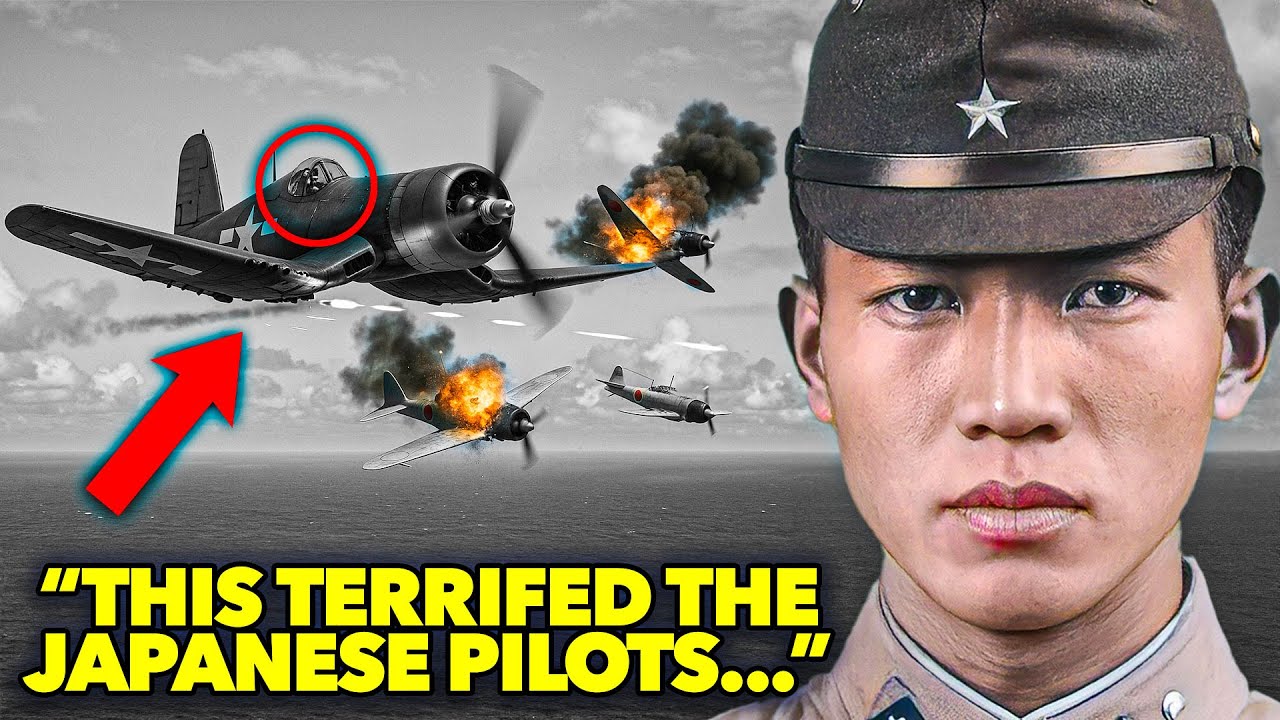
The films from every mission told the same story: pilots were not missing wildly, they were firing through a ring of fire that passed harmlessly around their targets. McCarthy, an Ordnance sergeant with grease permanently wedged under his nails, saw the flaw that officers blamed on aim and engineers blamed on nerves. The bullets were meeting too far away. Someone was going to have to break the rules, twist the steel, and pull the convergence in close.
Tonight, he would do it himself. By September 1943, Marine fighter squadrons in the Solomon Islands were losing momentum fast. On paper, the F4U Corsair was a monster. It flew faster, climbed harder, dove like a stone, and carried six Browning machine guns, each one capable of tearing an aircraft apart in seconds.
But the gun camera footage told a different truth. When pilots returned from missions, the film showed beautiful spirals of tracer fire dancing around the enemy. Every attack pass looked perfect until you slowed the reel down. Then the truth appeared.
The bullets were forming a giant ring around the enemy cockpit, with nothing striking the center. The Corsair’s deadliest zone existed where no real fight ever stayed. Officers insisted the solution was discipline: fire shorter bursts, aim better, conserve ammunition. But inside the cockpit, where engines roared and everything blurred past at hundreds of miles per hour, that advice was useless.
Accuracy was not the real problem. Something deeper was broken. The factory engineers had set the guns to converge at a long distance, based on calm test conditions. In a clean laboratory, that sounded smart.
In a frantic dogfight, it was a disaster. Most kills happened at close range, in tight spirals where the enemy flashed across the sight for less than a second. Pilots who hesitated died. Pilots who tried to fight from long range wasted half their ammunition landing only a few weak hits.
Worse, once the guns went empty, the Zeros returned like wolves. Japanese radio messages mocked them, saying American bullets spread like rain. Enemy pilots began baiting Corsairs into firing early bursts, then circling behind them once they ran dry. Back on the ground, tired pilots stared at smoked-over gun barrels and empty belts, frustrated and confused.
Their instincts said they were doing everything right. The evidence on film said something was fundamentally wrong. High-ranking officers were too focused on standard procedures to notice the obvious. But far from the briefing rooms and command tents, one quiet Ordnance sergeant paid attention.
McCarthy watched the pattern, studied the angles, and began to suspect that the real enemy was not the Zero at all. It was an idea everyone else accepted without question. McCarthy did not look like the kind of man who would change aerial warfare. He was not a decorated pilot.
He held no college degree. He spent his nights not in strategy briefings but with his hands dark with grease and his pockets rattling with loose bolts. Born in Boston during the Great Depression, he had grown up fixing cars in his father’s garage, where he learned that machines tell the truth if you know how to listen. When America went to war, McCarthy enlisted for steady pay and food.
The Corps assigned him to load ammunition, clean barrels, and repair jammed firing systems. Most Marines saw his job as simple maintenance. But McCarthy saw patterns. After each mission, helping to unload empty belts and sweep up spent casings, he noticed the same thing again and again: ammunition was vanishing faster than kills were being made.
Pilots were burning entire belts and coming home angry, talking about perfect aim and perfect positioning, yet only a handful of rounds ever hit anything important. Between missions, McCarthy studied gun camera film the way a doctor studies an X-ray. He was not looking at pilots; he was looking at bullet spread. He noticed how the streams formed two bright lines that met far ahead of the aircraft, then drifted apart again.
In real combat, that point was too distant. When enemy fighters darted around at close range, the bullets passed harmlessly around them. He measured gun mounts, angles, and spacing when nobody was watching. He scribbled notes on scrap cardboard and ran numbers in his head, just like aligning headlights in his father’s old garage.
One night, staring at film reels under dim lantern light, the realization struck him. The guns were not failing because of bad aim. They were failing because the bullet streams were meeting too far away. A tiny change, just a shift in angle, might transform a scattered spray into a focused blade.
It sounded insane, and it broke every rule. But rules were not keeping pilots alive, and McCarthy was done watching good men die over an engineering assumption. Wing-mounted guns are not aimed straight ahead. Each barrel sits several feet from the center of the aircraft, so engineers angle them inward.
At a certain distance, all bullets cross into the same small space. Hit a target at that exact point, and the enemy aircraft is torn apart in seconds. On a clean whiteboard, the concept is flawless. Factories set the Corsair’s guns to meet far out in front because engineers believed pilots would fire calm, controlled bursts at long range.
Test pilots agreed. Training manuals repeated it. Once something becomes standard, nobody questions it. But the Pacific was not a whiteboard.
Dogfights there were messy, fought in tight spirals at knife-fighting distances. At those distances, the Corsair’s guns were no longer converging; they were spreading back apart. The bullet pattern looked like a giant ring around the enemy cockpit. Pilots were not missing because they were bad.
They were missing because the geometry of their guns was built for a fantasy. Official memos warned that adjusting convergence closer than 500 feet would stress the gun mounts and crack wing panels. Engineers insisted the metal could not handle the recoil. Officers repeated those orders, and pilots accepted them because survival demanded obedience.
But McCarthy had a mechanic’s eyes. He saw extra thickness in the mount housings and available bracing points near the wing spars. He knew the aircraft could survive a steeper angle if reinforced correctly. And there was the matter of travel time.
At long range, bullets took almost a full second to reach the target. In a dogfight, one second is eternity. By the time the bullets arrived, the Zero had already turned, climbed, or twisted away. But at close range, the bullets struck almost instantly.
Less movement, less guesswork, less wasted ammunition. The flaw was not the pilot. The flaw was not the gun. The flaw was distance.
McCarthy ran the numbers and folded paper models. He watched more film until dawn. A new picture formed in his mind: all six guns crossing at 300 feet, creating a concentrated stream that could rip a fighter in half with a single one-second burst. It was madness.
It was genius. It was against orders. And there was only one way to find out if he was right. McCarthy waited until the flight line went quiet.
Engines cooled in the dark, tools clinked into drawers, and pilots limped back to their tents. Only the ordnance sheds kept their lights burning. He called over two trusted crewmen, men who had swept shell casings off the floor after too many funerals, and rolled one Corsair into the maintenance hangar. It belonged to Captain James Swett, a pilot who had watched his wingman vanish into jungle smoke days earlier.
The factory settings angled each gun gently inward, meeting far downrange. McCarthy planned something far more aggressive. He stripped damaged wing panels for thick steel, cut reinforcement plates by hand, and welded them to the gun mounts. Sparks flew across the deck, lighting the hangar like lightning inside a cave.
Sweat dripped into his eyes. Each strike of the welder echoed like defiance. Then came the adjustments. Using a wooden jig built from scrap boards, McCarthy carefully shifted the guns inward until their bullets would cross at 300 feet.
It looked wrong, almost crooked. But on paper and on film, it was perfect. Hours passed. The humid island air clung to the metal.
McCarthy tightened bolts until his knuckles bled, then sighted the barrels against a target frame positioned at the exact distance he had calculated. No manuals, no officers, just angles, instinct, and stubborn belief. At dawn, he test-fired into the ocean. The braces held.
No cracks, no bending. The guns thundered like approval. When Swett walked up later that morning, he froze at the sight of the barrels, angled inward like clenched fists. “What did you do to my guns?
” he asked. McCarthy swallowed hard. He knew one wrong sentence could end his career. “I brought the fight closer.
” If this failed, both men risked court-martial. If it worked, they might live to see tomorrow. The test came sooner than anyone expected. Late that morning, alarms rippled across the airfield as spotters reported a mixed force of Japanese fighters and dive bombers sweeping toward Allied positions.
Mechanics scrambled, engines roared awake, and pilots sprinted across the coral runway. Captain James Swett climbed into his Corsair, the only aircraft on the island with guns angled like clenched fists, and taxied out with three wingmen beside him. Nobody except McCarthy understood how different this machine really was. The patrol climbed into thick Pacific haze, sunlight flashing off the ocean far below.
As they approached Empress Augusta Bay, the dots on Swett’s canopy glass sharpened into shapes: a dozen Zeros weaving protectively around a formation of bomb-laden Betty bombers. It was the kind of engagement that usually favored the enemy. More guns, more planes, more angles of attack. But Swett did not hesitate.
He pushed the nose down and accelerated into a steep dive. His wingmen fanned out, trying to gain position. The Japanese pilots reacted instantly, peeling off to block him. At 400 yards, Swett held his fire.
His nerves screamed to open up, but McCarthy’s voice echoed in his memory: closer. At 350, he waited still. Wind howled across his canopy. At just under 300 feet, the Zero filled his sight like a bull’s-eye.
There was no time to think, only muscle memory and faith. He squeezed the trigger for exactly one second. The result was horrifying and beautiful. Instead of scattered sparks, a single solid beam of tracers slammed into the Zero’s tail.
Metal shredded. The fuselage snapped like a twig. Fuel sprayed into flame. Debris spun backward in a cloud so dense that Swett was forced to break right to avoid flying into it.
His radio crackled with disbelief from the wingmen who witnessed the explosion. He did not pause. Swett rolled, lined up on the next Zero, and struck again at the same brutal distance. Another brief burst, and the left wing of the Japanese fighter separated cleanly, flinging loose like a leaf in a storm.
A third target tried to avoid the deadly stream, but at 280 feet there was no escape. Swett tapped the trigger, and the cockpit erupted into shards of glass and smoke. All of this happened in under a minute. While his wingmen chased angles and shouted for openings, Swett was already tallying victories, each one costing only a handful of rounds.
When the last bomber fell flaming into the sea, he pulled away, startled by how quiet his guns still felt. His ammunition counters showed more than half his belt remained. Back at the airfield, tension choked the humid air. Officers, pilots, and ground crew waited by the runway, desperate to see if the modified aircraft limped home or did not return at all.
When Swett’s Corsair rolled to a stop and the canopy popped open, the crowd surged forward. No cracked wings, no broken mounts, no fire damage. Just a wide-eyed pilot who looked like he had witnessed something impossible. Swett’s voice shook as he climbed down.
“I barely touched the trigger,” he said. “They fell apart. ”
Some stared at the reinforced mounts. Others stared at McCarthy.
Rumors spread like fire in tall grass. Pilots whispered about focused death and a wall of bullets. The old arguments about regulations suddenly felt childish. For the first time in weeks, the airfield was not full of mourning.
It was full of hope. The celebration lasted only seconds before senior officers marched toward the hangar, faces tight with anger. They were not there to congratulate anyone. Major Britt pushed to the front and confronted McCarthy.
“What did you change? ” The answer was simple. “Gun convergence. ” “Pulled in to 300 feet.
” The reaction was explosive. Lieutenants gasped. A captain swore under his breath. Then Lieutenant Colonel Millington, the officer who had issued the memo against close convergence, arrived like a storm cloud.
He lectured the hangar floor with every regulation in the book, warning about cracked mounts, stressed wings, and dangerous recoil forces. McCarthy stood quietly and took the blast. Then Swett spoke, calm, steady, and brutally honest. He described watching enemy aircraft come apart in single bursts.
He showed how much ammunition he still had left. Around him, pilots nodded, the weight of recent funerals heavy on their shoulders. To them, this was not theory. It was survival.
Lieutenant Hansen stepped forward. “Sir, request permission to have my guns modified the same way. ” “Denied. ” Another pilot tried.
Denied again. The tension snapped. Voices rose. Pilots argued about wasted belts, outnumbered dogfights, and watching friends fall into jungle fire.
Millington countered with orders, procedure, and chain of command. The divide was clear: paper versus proof. Major Britt finally cut through the noise. He turned to McCarthy, not Millington.
“Sergeant, can you modify every Corsair in this squadron by morning? ” McCarthy did not hesitate. “Yes, sir. ” Millington erupted, threatening investigations and court-martial charges.
Britt did not flinch. “If it works, we live. If it doesn’t, the enemy will handle the punishment. ”
Night fell and welders lit the hangar like a forge.
Mechanics reinforced mounts, adjusted angles, and bore-sighted every barrel. Pilots stood behind them doing whatever they could, fetching tools, holding lamps, offering coffee. The roar of hammers replaced the quiet despair that had hung there for weeks. By sunrise, every flyable Corsair pointed its guns inward like sharpened claws.
The paperwork would come later. For now, the only thing that mattered was the next fight. The squadron had gambled everything on one mechanic’s math. The very next day, radar operators called out another inbound wave: fighters escorting bombers toward Allied positions.
Eight freshly modified Corsairs thundered down the strip and climbed hard into the humid blue. Normally, this meant long chases, frantic bursts, and pilots praying their last rounds counted. But at 300 feet, everything changed. Lieutenant Hansen dove first.
He waited. Closer. Closer. Until the bomber nearly filled his sight.
A two-second burst ripped through an engine, snapping the wing off like driftwood. Flames poured across the ocean. Around him, Zero fighters tried to dodge the concentrated beam of fire, but the tighter pattern bit too fast. One-second taps tore cockpits apart.
Wings separated mid-turn. In minutes, the formation unraveled. Back at base, gun camera footage stunned the briefing tents. Instead of wide halos of tracers drifting harmlessly around targets, every burst now looked like a poured stream: thick, focused, brutal.
For the first time in months, pilots returned not with empty belts but with ammunition to spare. Their voices over the radio sounded different, calm, almost relaxed. The fear was gone. Word spread beyond the island.
Soon, nearby squadrons requested the same adjustment. Japanese radio intercepts changed tone, warning pilots to avoid close engagements with Corsairs, calling their fire instant death. The enemy’s confidence cracked. American fighters suddenly held the sky like clenched fists.
When engineering officers finally inspected the reinforced mounts, the results shocked them. Instead of failing, the added braces actually reduced stress. Manuals were quietly updated. Headquarters took the credit.
McCarthy’s name stayed buried in paperwork. But the pilots knew. They toasted him in tents lit by lanterns, telling new arrivals, “If you’re still breathing, thank the man with the wrench. ”
What had started as an unauthorized gamble reshaped the air war in the Pacific.
Survival did not come from obeying every line in the manual. It came from someone willing to tighten four bolts and change everything. When the war ended, no spotlight found Staff Sergeant Mickey McCarthy. He went home, fixed cars, and raised a family.
His service record never mentioned the modification that saved lives, and headquarters never admitted that a mechanic solved what engineers would not. But the pilots remembered. In memoirs and letters, they wrote that concentrated fire turned desperation into dominance, and they credited one man for it. Modern fighter cannons still follow his principle: aim where real combat happens, not where charts say it should.
McCarthy died quietly, without medals or headlines, but every pilot who survived because of that 300-foot convergence carried his legacy into the future. Heroism does not always sit in the cockpit. Sometimes it stands in a hangar at midnight, tightening bolts no one else believed in.






