The SS generals filed the complaints in writing. These were men who ran concentration camps, who had personally overseen mass murder on an industrial scale, men building and operating the machinery of the Holocaust. They looked at what Oskar Dirlewanger was doing in occupied Poland and decided that someone needed to draw a line. That a line existed at all, even among those who had already crossed so many, tells you everything about how far beyond the boundaries of their own criminal world Dirlewanger had stepped.
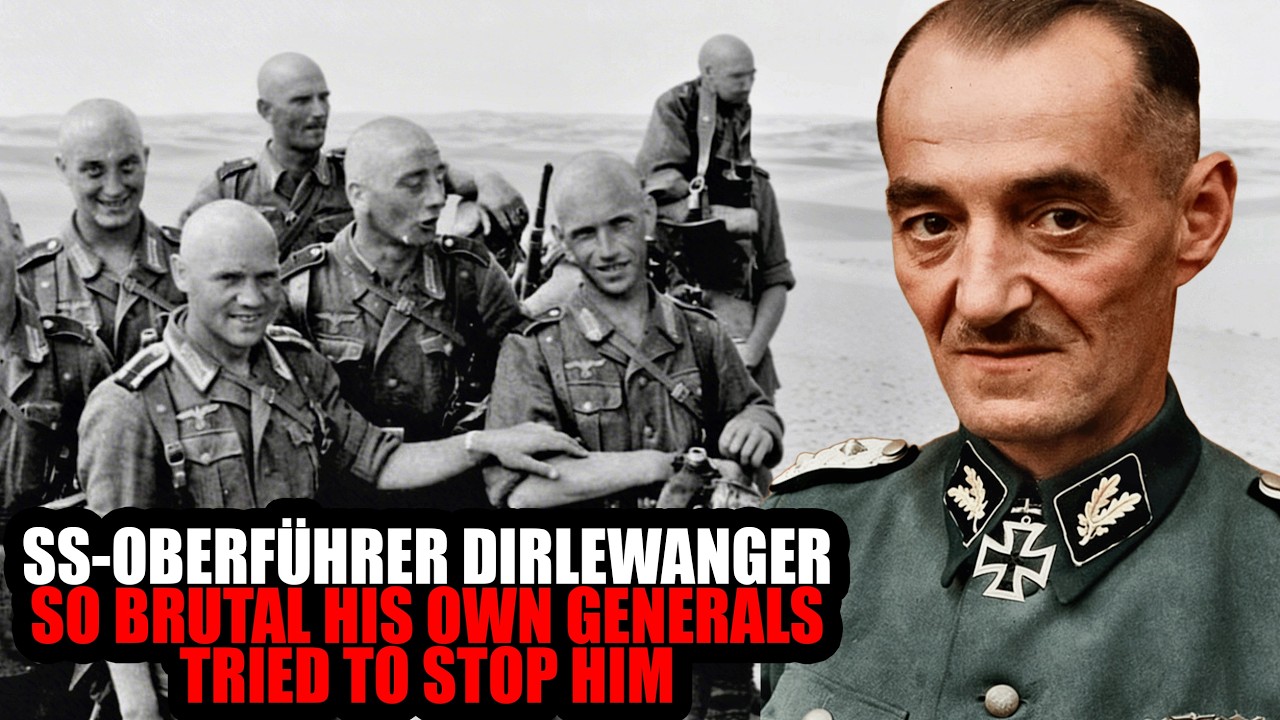
He was not a desk murderer. He was not a bureaucrat signing paperwork from a comfortable office. He was the man in the field, the man with the weapon, and by the time the war gave him the opportunity to act at scale, he had spent twenty years showing everyone around him exactly who he was. Born on September 26th, 1895, in Würzburg, Bavaria, into a middle-class family, Dirlewanger was genuinely intelligent, a man who could have pointed his life in almost any direction.
He served in the First World War as a capable and brave soldier, decorated multiple times, wounded multiple times, rising to command a machine gun company by the conflict’s end. The war did something to many young German men of his generation. It did something particularly extreme to Dirlewanger. He emerged from it having concluded that violence was not merely a tool or a necessity, but something closer to a purpose.
He joined the Freikorps, the irregular paramilitary units fighting in the chaos of post-war Germany and the Eastern Borderlands, and continued doing the only thing he seemed to genuinely enjoy. Then, remarkably, he returned to civilian life and completed a doctorate in political science in 1922. The title Dr. Oskar Dirlewanger sits alongside the rest of his biography like a piece of furniture in the wrong room, impossible to reconcile with what comes before and after it.
He joined the Nazi Party early in 1923, placing him among the true believers who had been there from the beginning. In 1934, he did something that should have ended his involvement in any position of authority permanently. He was convicted of sexually assaulting a fourteen-year-old girl. He was sentenced to two years in prison, expelled from the Nazi Party, and lost his position.
In any functional society, that would have been the end of his story. It was not the end, because the Third Reich was not a functional society, and because Dirlewanger had a friend in a very important place. That friend was Gottlob Berger, one of Himmler’s senior SS officers, who had known Dirlewanger since their time together in the Freikorps. Berger believed that whatever Dirlewanger’s personal failings, his skills as a violent and aggressive military commander were too valuable to waste.
He lobbied on Dirlewanger’s behalf, worked the system, and in 1940 secured his reinstatement into the SS and command of a unit. Not just any unit. A formation built specifically around the concept of using convicted criminals as soldiers, initially poachers, men whose tracking and fieldcraft skills were considered useful for anti-partisan operations. It was called the SS Special Unit Dirlewanger, and from its first day it was commanded by a man who had already demonstrated clearly and specifically what he was.
Deployed to occupied Poland in 1940, the unit established the pattern that would repeat itself everywhere it went for the next five years. Tasked with anti-partisan operations, hunting resistance fighters in forests and villages, Dirlewanger took the already deeply criminal framework of such operations and went somewhere else entirely. His unit did not distinguish between partisans and civilians. It did not take prisoners in any meaningful sense.
It treated the villages it operated in as environments to be destroyed and the people within them as targets rather than bystanders. Complaints arrived at SS headquarters almost immediately. Local SS and police commanders in Poland wrote to their superiors describing what the unit was doing and asking for it to be controlled or removed. These were not complaints from squeamish civilians.
These were SS officers who were themselves conducting brutal occupation policies and participating in the systematic murder of Jews and other civilians across occupied Poland. Himmler received the complaints, reviewed them, and kept Dirlewanger in command. Berger continued to protect him. Himmler continued to find uses for him.
The complaints continued to arrive and continued to be filed away without consequence. The unit expanded over time, its recruitment pool broadening from poachers to include men convicted of violent crimes, sexual offenses, and any number of crimes that in any other context would have made them permanent outcasts from any military organization. Dirlewanger actively sought out the most violent and unstable men he could find, apparently believing that the qualities that made a man dangerous and uncontrollable in civilian society were exactly the qualities he needed. He was building something deliberate, a unit whose function was to exist beyond the limits that constrained other formations, to do the things that even the SS hesitated to order through normal channels.
The Eastern Front expanded his theater and the scale of his operations. In Belarus and Ukraine, where German anti-partisan operations were conducted with a brutality that remains difficult to fully comprehend, Dirlewanger’s unit operated at a level that drew repeated formal protests from Wehrmacht commanders, other SS commanders, and civil administrators watching entire regions being depopulated in ways that served no military purpose and actively undermined the occupation’s ability to extract economic resources. General Curt von Gottberg, himself deeply implicated in the mass murder of civilians in Belarus, filed formal complaints about Dirlewanger’s methods. Friedrich Wilhelm Krüger, the higher SS and police leader in occupied Poland, tried repeatedly to have him removed or court-martialed.
These were men participating in mass murder trying to impose some kind of operational limit on someone who had gone beyond any limit they recognized. The complaints did not work. Dirlewanger had Berger, and Berger had Himmler’s ear. In 1943, Dirlewanger was promoted to SS-Oberführer, a senior rank reflecting not a judgment that he was behaving acceptably, but a judgment that he was useful.
The unit’s strength grew, absorbing Soviet prisoners of war who had agreed to fight for Germany in exchange for their lives, members of various foreign volunteer formations, and an increasingly diverse collection of men whose common characteristic was that they had nowhere else to go and nothing left to lose. The Warsaw Uprising of 1944 is where the story reaches its most documented and most horrifying point. In August 1944, the Polish Home Army rose against the German occupation of Warsaw, and among the forces sent to crush the uprising was Dirlewanger’s unit. What his men did in the Wola district in the first days of the uprising is recorded in extraordinary detail, not a remote forest village but a major European capital with witnesses, survivors, preserved records, and testimonies collected after the war.
The massacres killed between 30,000 and 60,000 civilians in a matter of days. Hospitals were entered and patients killed. Women and children were used as human shields. Buildings were set on fire with people locked inside.
The scale and deliberateness of what happened in Wola represents one of the largest single massacres of civilians in the entire European theater of the war, and Dirlewanger’s unit was at its center. Even in the context of the uprising, characterized by extreme brutality across multiple German units, Dirlewanger drew formal protests. SS-Obergruppenführer Erich von dem Bach-Zelewski, who commanded all German forces suppressing the uprising and was himself a man with a long record of involvement in mass atrocities, filed complaints about Dirlewanger’s unit and attempted to have it pulled back from operations. He looked at what Dirlewanger was doing and decided it needed to stop.
That protest, like all the others, produced limited results. The killing continued. By late 1944, Germany was desperate for any combat power it could assemble, and the unit was reorganized into a full division, the 36th Waffen Grenadier Division of the SS, and deployed to the front lines against Soviet forces. The transition from anti-partisan operations to conventional warfare did not go well.
A formation built around the principle of maximum violence against defenseless civilians did not translate into an effective fighting force against an opponent that could shoot back with tanks and artillery. The unit suffered heavy casualties, and its performance was, by German military standards, poor. Dirlewanger was wounded multiple times and spent significant time in hospitals. The end came in May 1945 in the chaos of Germany’s final collapse.
Dirlewanger was captured by French forces, specifically Moroccan soldiers serving in the French army, near the town of Althausen in southwestern Germany. He was held in a prison facility while authorities decided what to do with him. He never faced trial. On June 7th, 1945, less than a month after Germany’s surrender, he died in custody.
The official cause of death was heart failure. Accounts from survivors and witnesses suggest that the Moroccan guards, aware of who they were holding and what he had done, administered a more direct form of justice over the course of several days. The precise circumstances of his death have never been fully established. There is a historical argument made about men like Dirlewanger, that the system made him, that total war and Nazi ideology created the environment that allowed him to function.
That argument deserves to be rejected in his case because the timeline does not support it. He was convicted of sexually assaulting a child in 1934, nine years before Warsaw, before the Eastern Front, before any of the operations used to explain the behavior of men who might otherwise have lived ordinary lives. He was who he was before the war gave him the opportunity to be that person at scale. The war did not create Oskar Dirlewanger.
The war gave him an army. And the men who gave him that army, Berger, Himmler, the system that found him useful and kept promoting him despite the complaints and the formal records of what he was doing, those men share the responsibility for everything that followed. The most frightening thing about his story is not the man himself. It is the institution that looked at everything he was and decided he was an asset worth protecting.
The cost, in his case, was paid entirely by the people who had the misfortune of finding themselves in the path of his unit. They paid it in Warsaw. They paid it in Belarus. They paid it in Poland.
They paid it because a system built on the logic of violence decided that a man who had already shown everyone exactly who he was should be given a gun and a command and sent out into the world to be that person at the largest scale the circumstances allowed.






