She smiled for the cameras as she ascended the steps of the Chelsea register office on the sixth of May, 1944, leaning on her brother’s arm for support. America would later recall the image as a romance. Her church regarded what she was about to do as a mortal sin. So did her mother, who remained in Boston.
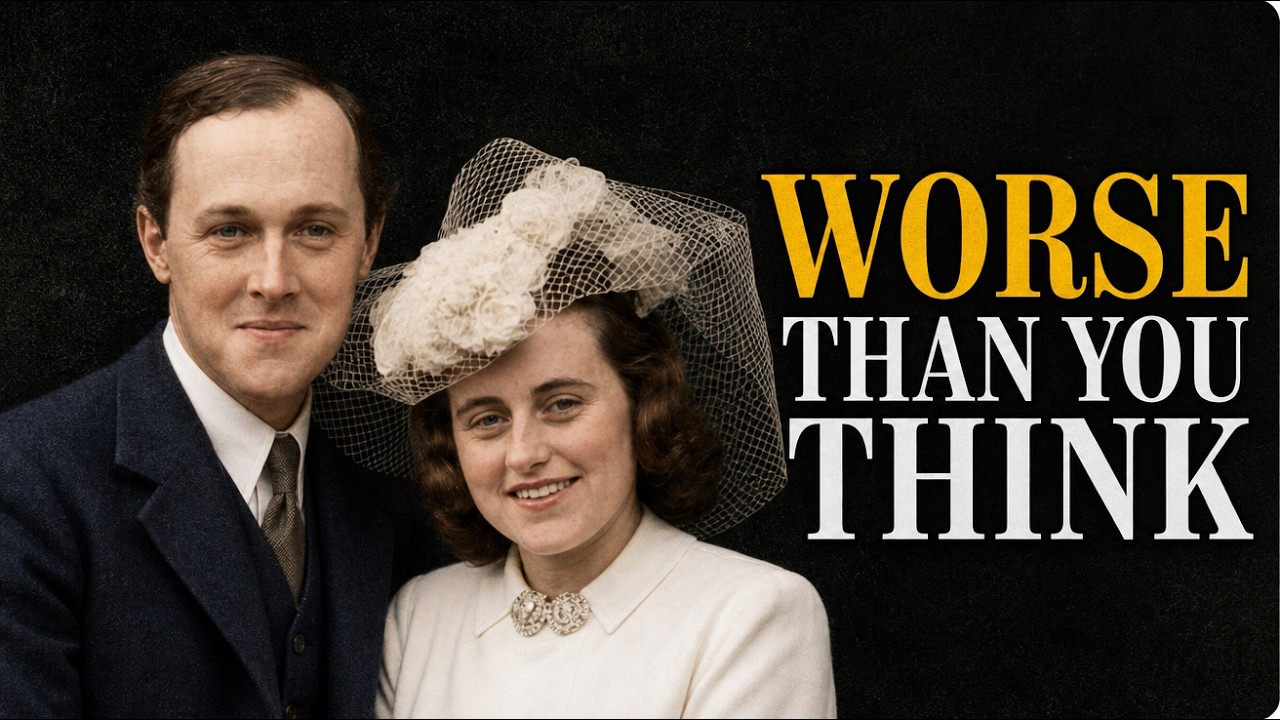
Of the nine Kennedy children, just one was inside that building beside her. Within fourteen weeks, he would be gone. The groom—the Protestant heir for whom she was risking damnation—had been handed an escape route by his anti-Catholic father, and had turned it down. Four years on, she would be a marchioness in London, and her mother would be threatening to cut her off.
A register office is nothing more than a municipal counter. It is where Britain directs you when the church turns you away, when there is no time to wait, or when somebody raises an objection. The ceremony lasted roughly ten minutes. No Mass, no priest, no nuptial blessing, no father of the bride.
For a woman brought up the way Kathleen Kennedy had been—convent schools, a daily rosary, a mother who saw faith as the family’s real inheritance—a civil marriage was no convenient wartime workaround. According to the doctrine she had absorbed since she first learned to read, it was a sin committed publicly and without end. She understood this as she walked through the door. She smiled regardless, and the photographers captured their frame.
That photograph is what endured. Notice the man holding her arm. That is Joe Junior, the eldest, the one raised for the presidency. He was the sole family member inside the building, and he had spent weeks back home arguing on her behalf.
He would be killed on a volunteer mission in August. So what the picture really asks is not whether she was in love. She was. It asks why the cost was so steep, who fixed that price, and why she chose to pay it.
Kathleen Kennedy was born in Brooklyn in February 1920, the fourth of nine children, and soon became the family’s most magnetic figure. Joe Junior had drive. Jack had a frail, mocking wit. “Kick” had something no one can manufacture: the knack of entering a room full of strangers and departing with allies.
Her nickname sprang from her relentless, fidgeting energy. Rose Kennedy governed her children through rigid systems—index cards for medical records, weigh-ins, assigned reading, Mass, confession, meatless Fridays—and a line she liked to quote from the Gospel of Luke: to whom much is given, much will be expected. Enrolled at the Convent of the Sacred Heart in Noroton, Connecticut, Kick flourished, leading her classes and befriending everyone. Then, at fifteen, she was dispatched to the Holy Child convent in Neuilly outside Paris, where the nuns handed her a nickname that ought to have been a warning: Mademoiselle Pourquoi—Miss Why.
She was no rebel. She was a negotiator, always probing where authority came from. There was a second fact of her childhood, weightier than the convents. Her older sister Rosemary had intellectual disabilities, and in 1941, when Rosemary was twenty-two, their father gave his approval for a lobotomy.
The operation went catastrophically wrong. Rosemary was committed to an institution and effectively severed from family life for decades. No clear explanation was offered to the younger children. She simply vanished, and family life carried on.
Kick was twenty-one. She had just seen what happened when a Kennedy daughter turned into a burden on the family’s ambitions. Nobody needed to spell out the lesson. Her father had been appointed United States ambassador to the Court of St.
James’s, and the family landed in the spring of 1938 in a country that regarded them as glamorous and faintly absurd. Kick was eighteen. She was presented at court. She chewed gum on the streets of Mayfair.
She gave grown dukes ridiculous nicknames. English girls schooled from birth in restraint watched her laugh at her own blunders and knew they could not compete. The press crowned her the “debutante of the season” for 1938. That summer she attended the major parties, and at one of them she met William Cavendish, called Billy, Marquess of Hartington, heir to the Duke of Devonshire and to Chatsworth.
He was reserved. She was anything but. The Cavendish family was not simply Protestant. They were Protestant institutionally, historically, constitutionally.
The family had helped seat a Protestant monarch on the English throne in 1688 and then spent two centuries on the anti-Catholic side of nearly every major controversy. Billy’s father, the tenth duke, was by most accounts the most anti-Catholic Cavendish of his era. Kick’s mother held a papal title. Both families treated religion as a family business.
Their romance was never private, and everyone grasped that within roughly a week. Then war arrived. Her father brought the family home in 1939, and Kick passed four years in America battling homesickness—the familiar version of the story. But what she actually accomplished in those four years is far more intriguing.
She landed a job at the Washington Times-Herald. She began as an assistant, writing brief items and reviews. She spent her days inside a newsroom, learning how a story gets assembled: who gets phoned, who gets flattered, which detail turns into the headline, how a person is reduced to a paragraph. It is the least romantic stretch of her life, and it would prove useful later.
She also could not get back to England, since civilians could hardly book passage into a war zone. So she found her own exit. The Red Cross was dispatching volunteers to run clubs for American soldiers in Britain. She applied.
She pulled every string she had. In June 1943, she reached London to run the recreation program at a club on Hans Crescent, distributing doughnuts and arranging dances for soldiers who had no idea their hostess was the former ambassador’s daughter. She had orchestrated her own return. Nobody sent her.
That distinction matters later. Billy was in the Coldstream Guards, and they reconnected almost at once. By autumn, both families realized this would become a procedural problem. Affection was not the obstacle.
The obstacle was a rule. Under Catholic law as it stood then, a Catholic marrying a Protestant needed a dispensation. The dispensation demanded a written pledge to raise the children as Catholics. For most couples, that is a difficult conversation.
For the heir to a dukedom whose family had built its public identity on the Protestant establishment, producing a Catholic eldest son was structurally impossible. Billy would not consent, and Kick could not consent without him. They spent months hunting for a theological loophole, consulting priests and bishops, floating compromises—sons Anglican, daughters Catholic—but were refused from Rome and from Westminster. In February 1944, the sitting MP for West Derbyshire died.
It was the Cavendish seat, the constituency adjoining Chatsworth, the sort of seat such a family had regarded as an inheritance since the eighteenth century. The duke put his son forward as the official coalition candidate. Several accounts hint that it was partly to keep him out of the fighting. Kick flung herself into the campaign.
She relished those late-night planning sessions. She knocked on doors using a false name, so that her American voice and American surname wouldn’t lose him votes. They lost him votes regardless. The independent, Charlie White, ran against inherited privilege in a nation that had endured four years of bombing and had no appetite for being represented by a marquess.
He could also trade on a Kennedy name, and in Britain in 1944 that name meant the ambassador, the man who had informed an American paper that democracy was finished in England. On the seventeenth of February, Billy went down to defeat by more than four thousand votes in a Cavendish seat. That outcome accomplished two things. It humiliated a family that had never lost there.
And it demonstrated publicly, in hard numbers, that wedding an American Catholic came with a measurable cost. If the duke was looking for a reason to close the whole business down, here it was. He did the reverse. By the account pieced together from family papers and Devonshire circles, the tenth duke—the anti-Catholic, the severe man—informed his son that if he married Kick and left her in her Catholicism, the family would not cast him off.
No disinheritance. No exile. Take the girl and accept what follows. Billy refused.
Not to her, but to the exception. The weight of the succession pressed on him too heavily for him to stake the dukedom on papal assurances about children not yet born. If the wedding went ahead, she would be the one surrendering something. What she would surrender was the sacred state of her soul.
His mother wanted her. His father handed her a way to keep her faith. It was her fiancé who shut that door. Back in Boston, Rose had already started making calls.
Her effort to halt the marriage was no handful of disapproving letters. It was a campaign, conducted with the same exactness as her index cards. She wrote to Kick about what the family had always held, what the parish, the neighbors, the church would make of it. She used the word scandal.
She arranged for priests to step in. According to biographers who studied both the Kennedy and Devonshire records, she contacted people in the American hierarchy. The Kennedys enjoyed good relations with Archbishop Spellman of New York, and an archbishop was dispatched to persuade her daughter to think again. Rose also did something quieter and more effective.
She delayed. Earlier in the war she had already managed to keep the two of them on separate continents. Now she played with time, pressing for postponement, for further consultation, insisting Kick come home to consider it. One telling of this story makes Rose out to be simply a cold woman.
That explanation is too convenient, and it shrinks the cruelty to something smaller than it was. Rose truly believed her daughter stood on the edge of an act that would cut her off from God for eternity. Seen from inside that belief, every move she made was an effort to rescue. The trouble is that rescue and siege look exactly alike from the receiving end.
Through the winter and spring of 1944 Kick was squeezed by two powerful families, each with its own spokesmen and its own theologians, and still nobody asked her what she actually wanted. The Duchess of Devonshire, known to everyone as Mou, had decided early that this American girl was an asset and behaved as though the matter were already settled, inviting her for Christmas and treating her as one of the family before any paperwork existed. The duke had made his offer, but his son turned it down. Rose worked the Boston, London, and Rome fronts.
Priests on one side, an old Protestant establishment on the other, and caught between them a twenty-four-year-old being pushed to choose which of these people she could bear to lose. She spoke with the priests. She spoke with Joe Junior, who was flying out of Suffolk and came to London just to tell her to go ahead. She picked Billy.
She never made it out to be an easy or a free decision. She didn’t persuade herself the church was wrong. She simply concluded that she wanted this man more than she wanted to hold on to her religious standing. She did it wide awake—which is harder and lonelier than plain defiance.
So on May 6, 1944, they were wed at the register office in Chelsea Town Hall on King’s Road, even though you’ll find the occasional source naming Caxton Hall—the sort of small mistake people have repeated for eighty years. The Duke and Duchess of Devonshire attended, together with Cavendish relatives, London friends, Red Cross colleagues, and a crowd outside that had to be handled. Joe Junior walked her down the aisle. He was the only Kennedy in the room, out of a family of nine with a knack for showing up.
Rose stayed away. Joe Senior stayed away. Jack stayed away. Not one of her sisters came.
Whatever the marriage was, it took ten minutes at a municipal desk before a registrar, then a reception, then the newsreels and Fleet Street photographers who knew precisely what they were capturing. Nine days afterward, Time magazine carried the story in the United States, a piece on the Cavendish and Kennedy families. That is more or less the instant the legend began. Two great families, a wartime romance, an American girl turned aristocrat.
It looked marvelous. The Kennedy family’s answer to that story was a telegram from Boston and weeks of quiet. Rose’s own words, as recorded, were that she felt upset, horrified, heartbroken—and she stopped writing. Almost two months of total silence, right when her daughter was starting married life under the bombs.
Joe Junior wired home in defense of his sister and, by most accounts, received scarcely any reply. Now tally the days the couple actually had. Five weeks. Then Billy left for France with the 5th Battalion of the Coldstream Guards, part of the Guards Armoured Division, and Kick was by herself in London beneath a new assault.
The V-1 rockets started coming in June. Londoners called them doodlebugs, and their particular terror was aural. You heard the engine, then it cut out all at once, and about twelve seconds of silence followed before the thing came down somewhere. Kick wrote in her diary about that rhythm, listening first for the rocket’s approach, then for the quiet after it.
She kept going. She kept working. She kept the club running. She kept writing to him.
In August she made her first public appearance as Lady Hartington at the Bakewell show in Derbyshire—the very constituency that had turned her husband down in February. She gave a speech, and it went well. Worth noticing who was watching. The duke’s political agent wrote about how valuable she would be to the family once the war ended.
Six months earlier she had been a liability in that constituency, canvassing under a false name. Now she was an asset with a title, being sized up for future use. Whatever the Cavendishes had first thought about taking in an American Catholic girl, they were starting to recognize the worth of what they had acquired. Four days later, on the twelfth of August, Joe Junior climbed into a B-24 Liberator loaded with explosives.
The operation was Aphrodite, a trial program that sent an explosives-packed plane toward a German launch site, the crew bailing out before radio control took command. He had already flown the missions required of him. This one he chose. The aircraft blew apart above Blythburgh in Suffolk before anyone could get out.
No trace of him was ever recovered. His name appears on the Wall of the Missing at Cambridge. He was twenty-nine. He was the man who had led her into that register office three months before, and the one member of her family who had backed her without a single condition attached.
On the sixteenth she flew home. Jack was there to meet her. One recent biography has her collapsing into his arms at the airport, though that scene traces to a later retelling rather than any document written at the time. What can be stated for certain is that she was at Hyannis Port with her family for the first time since the wedding, and that the welcome rested on the fact that her brother was dead.
Grief accomplished what the marriage could not. It carried her home. Her plan was to remain until Billy returned. On the ninth of September, Billy’s company moved into Heppen, a Belgian town held by Waffen-SS troops.
His unit had been among the first to enter Brussels six days earlier. He had written to her about it—the crowds, the flowers laid on the tanks, and his own feeling that, as he put it, he did not deserve any of it after passing the war in relative safety. He told her he had a permanent lump in his throat and wished she could have been there to see it. At Heppen he was leading his men forward when a sniper’s bullet struck him.
He was twenty-six. He was laid to rest at Leopold’s Burg in Belgium alongside the division’s other dead. The telegram arrived at the Kennedy apartment in New York on the sixteenth of September. One month and four days after the first one.
She had been a wife for four months and twelve days, only five weeks of which she had actually spent living beside her husband. Every Kennedy documentary quotes the same family rule, and her eldest niece still repeats it now: the Kennedys do not cry. Kick had been raised on that rule. She obeyed it.
She went out to dinner. She replied to the letters of condolence. She wrote to Billy’s mother. Friends that autumn described her as a young woman coping beautifully, yet somehow gone from behind her own eyes.
Her mother’s response is the hardest part to get past. The most brutal lines come from later biographers out to prove a thesis, not from anything Rose put on paper at the time. Still, the factual record cannot be argued with. For a year Rose had been telling her daughter that this marriage would cost her soul.
The marriage was finished now. Within the framework Rose genuinely held, the difficulty had resolved itself. One biographer states her position without softening: she felt no pity. And here is what nobody in that house appears to have said aloud: becoming a widow settled nothing in theological terms.
A civil marriage to a Protestant did not turn retrospectively valid because the Protestant was killed in Belgium. As her mother and her church saw it, Kick was still a woman who had wed outside the faith. She had paid the entire price and got four months of marriage without absolution. That is the cruelty the photograph conceals.
Not the sniper—the sniper was simply war, and war killed hundreds of thousands of other husbands. What was done to Kick in particular was that the terms were never renegotiated. She had bought something at a dreadful cost. It was taken from her, and the debt stayed on the books.
Through the autumn she remained at Hyannis Port. Then she made a choice that reveals precisely how she read her own position. She went back to England. Not to her mother’s house, not to Boston, not to the Kennedy compound where she had grown up and where she was now, once more, a daughter in good standing provided nobody brought up the wedding.
She went back to the country where she had no blood family, and turned toward the people who had buried her husband. The Devonshires took her in as one of their own, because by the only measure that counted to them, she was. She had been married to the heir. The heir was dead.
Mou, the duchess, had wanted her from the beginning, and now she had her for good. The surviving letters between the two women read like a correspondence between mother and daughter in a way that Rose’s letters to Kick never did. Watch what Kick made of this position, because this is where the passive-widow version falls apart. She had a title now, and in postwar Britain a title with an American accent and American money behind it was an uncommon tool.
She took a house in London and filled it. Politicians, journalists, writers, survivors of the prewar set, visiting Americans. She became a hostess in the particular English meaning of the term—not merely a woman who gave parties, but a woman whose dinner table was a place where arrangements got made. She was skilled at it because she had always been skilled with rooms, and because two years at a newspaper had taught her who to call.
She was twenty-five, running her own household, on her own money, in a foreign country. Her sisters at that age were being married in Catholic ceremonies with the whole family looking on. She also held on to her faith. That detail always gets lost.
She was not a woman who walked away from her church for a duke’s son. She was a woman shut out from a door she still longed to enter. She attended Mass and talked with priests about her predicament. She never appears to have doubted that her mother’s God was the true one.
Then, in 1946, she met Peter Wentworth-Fitzwilliam. He was the 8th Earl Fitzwilliam. He had earned the Distinguished Service Order during the war. He possessed Wentworth Woodhouse and the coal fortune beneath it.
By every account, admirers included, he was a gambler, a charmer, and a man with a past. He was also married to Olive Plunkett and drinking heavily. By the time his relationship with Kick grew serious, he was pursuing a divorce. Lynne McTaggart, who wrote the first serious Kick biography in 1983, phrased it as bluntly as any biographer has: he had a great deal of money and was great fun, and his chances of fidelity were zero.
That is her assessment, not a document, and it is best treated cautiously. What we do have is Kick’s own account of why she acted as she did: when you have seen that much death in a few years, you stop putting things off. She had watched her brother’s plane break apart over Suffolk and her husband shot down in a Belgian street within five weeks of each other. She was not going to wait for a better offer.
In early 1948 she returned home to inform her parents that she meant to marry him as soon as the divorce was finalized. To Rose, a civil ceremony with a Protestant had already been a mortal sin. A divorced Protestant was worse on every count: theologically, socially, and by 1948 politically as well, since Jack had just won a congressional seat from an Irish Catholic district in Boston and was now regarded as the family’s stand-in for everything Joe Junior had been meant to become. Rose told her she would be disowned.
This was no figure of speech. Cut off. Excommunicated. No name, no money, no family.
Consider what the threat actually exposes. It had stopped being about Kick’s soul, since Rose could hardly save a soul by withdrawing an allowance. It was about the damage a divorce scandal tied to the Kennedy name would do in Boston. The same family that spent 1944 warning her the stakes were eternal had arrived at 1948 with stakes that were electoral.
Joe Senior was another matter, and here is the moral tangle the story requires. He was a habitual adulterer who had signed off on a lobotomy for his daughter, yet he was also the parent who loved Kick most and saw her as a person with a mind of her own. He never threatened her. Instead he asked whether some arrangement with the church might be worked out.
And when she asked, he consented to meet her and Fitzwilliam in Paris, at the Ritz hotel, on Saturday, May 15, 1948, to talk it through. That meeting was everything to her. Joe’s approval meant the money would continue, the family would hold, and Rose could be handled. Kick understood this.
Two days before the appointment, she and Fitzwilliam chose to go to Cannes first. A detour, a few days on the Riviera ahead of the conversation that would settle her life. They chartered a De Havilland Dove and left Croydon on the thirteenth. There was turbulence over the Rhône valley, a thunderstorm.
Commercial flights were diverting around it. They flew directly into it. The plane came apart over the Ardèche and struck a mountainside near Saint-Bauzile above Privas. Kick, Fitzwilliam, the pilot Peter Townsend and the radio operator Arthur Freeman were all killed.
She was twenty-eight. Her father, already in Europe, went to identify the body. Now observe how the machinery behaved. Nobody else came.
Not Rose, not Jack, not one of her sisters. Joe Senior was the only Kennedy at the requiem Mass in London and the only one at the burial at Edensor, the estate village of Chatsworth, on May 20. Fitzwilliam had been buried at Wentworth the day before. The reasons offered differ, and most are excuses made afterward.
Rose was said to have suffered a breakdown. Getting to Europe in 1948 was not simple. But the outcome was plain, and it was the same outcome the family had produced in 1944 at the register office and would repeat with Rosemary for thirty years: when a Kennedy daughter turns into a problem the family cannot solve, the family simply stops appearing. So it was the Cavendishes who buried her.
It was their village, their churchyard, their sculptor. A Protestant household gave a Catholic girl a Catholic funeral and then laid her among dukes. And the family decided the wording on the stone. Read it.
Sweet is the memory of Kathleen, 1920 to 1948, widow of Major the Marquess of Hartington, killed in the service of her country. Daughter of the Honorable Joseph Kennedy, former American ambassador to Great Britain. She gave joy, and found joy. No family name is carved into the stone.
Neither Kennedy nor Cavendish. All that survived of her identity was two men—the one she had been married to for four months, and the one relative who turned up. Back home, the family sealed the file entirely. There had been a death, a plane, a tragedy.
There was no Fitzwilliam, and there would be none for decades. The story was too risky for a congressman’s district. Rose’s memoir, Times to Remember, published in 1974, is a warm and careful book, and also a deliberately built one. What it builds around Kick is the picture of the cherished daughter, a wartime marriage, an accident in France.
Rose lived past one hundred and four. She outlived nearly everyone who could have disputed her version. She gave the interviews, and the recordings went to the presidential library bearing her son’s name. That ought to have been the end of it.
It was not. The reason is the very thing Kick had quietly been good at since she was eighteen: she kept people. She kept letters. She lived her life inside the publicity machine—the newspaper job, the Red Cross posting, the by-election, the London dinner table where journalists ate—and she left behind an enormous documentary trail in the hands of people with no reason to safeguard the Kennedy narrative.
The Devonshire papers at Chatsworth. Her own letters and diaries, which went to the library in Boston. English friends who spoke to biographers in the 1980s and again in 2016, when McTaggart’s work was followed by Barbara Leaming and Paula Byrne, both drawing on those archives. Rose controlled whatever she could reach.
She could not reach Derbyshire. There was one last act of quiet restoration, and it came from her brother. On July 29, 1963, four days after the Irish trip that yielded some of the most famous footage of his presidency, the President of the United States came down by helicopter into a field behind Edensor church. Villagers emerged in their shirtsleeves and slippers to watch.
He crossed a bridge the estate workers had built for him, stood at his sister’s grave for a few minutes alongside his sister Jean and the duke and duchess, and laid down flowers he had brought from Ireland. He died four months later. Fifteen years after the family had refused to attend her funeral, the most powerful Kennedy alive crossed an ocean to stand in an English churchyard, and roughly twenty-five people clapped politely as he climbed back into the car. Return to the photograph on the register office steps.
You can still read it as a love story, and you would not be wholly mistaken, because they did love each other and the letters prove it. But notice whose arm she was holding and who was missing from the frame, and understand that the ten minutes inside that building were the costliest ten minutes of her life, and that she paid for them to both sides. To a husband who would not accept his father’s dispensation. To a mother who, through all four years that followed, never once offered to lower the price.
The Kennedys preserved the name and lost the story. Kick’s marriage lasted four months and twelve days. The family she married into still tends her grave.
