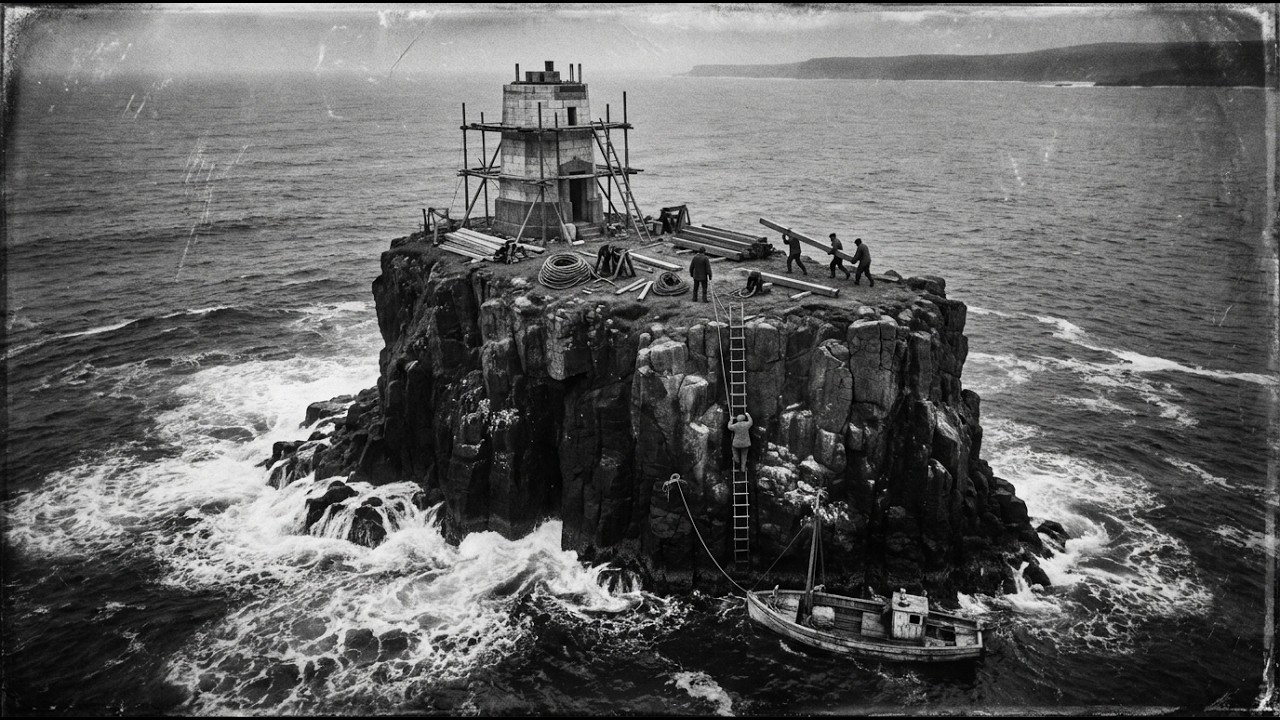
A little more than a mile off the Oregon coast, a black basalt rock rises almost one hundred feet straight out of the Pacific. It is less than an acre across, with no beach, no harbor, no landing—only sheer wet stone and the sea smashing against it day and night. In 1881, men finished building a lighthouse on top of it. They blasted the head off the rock to make a place to stand, hauled every stone, brick, beam, and drop of fresh water out through the surf, and raised a tower that threw its light one hundred and thirty feet above the sea.
The lightkeepers who lived there gave the rock a name that stuck: Terrible Tilly. Before a single stone was laid, the rock had already killed a man. The government needed a survey first, someone to land and measure the rock and judge whether a lighthouse could be built there at all. They sent John Traavis, a master mason who had worked on some of the hardest lighthouse sites in England, including the Wolf Rock Light off Cornwall.
In the autumn of 1879, the survey party came out to the rock. Traavis, the expert, reached for a handhold on the eastern face in the surging water and missed his footing. The sea took him in an instant. His body was never found.
The government did not leave the rock alone. The waters along this stretch of the Oregon coast, from the shore up past the mouth of the Columbia River, had long carried a grim name among sailors: the graveyard of the Pacific. Over the years, the coast and the terrible sandbar at the mouth of the Columbia had swallowed something like two thousand ships and more than a thousand lives. Ships came in from San Francisco, from Hawaii, from across the ocean, heavy with cargo and crowded with people, all trying to find the narrow, shifting, deadly entrance to the Columbia in weather that was foggy and wild for much of the year.
A captain with no light to steer by was gambling his ship and every soul aboard on dead reckoning and luck. The luck ran out constantly. In 1878, Congress set aside fifty thousand dollars for a first-class lighthouse to mark the approach, and the engineers chose that black rock a mile offshore. To understand why they would risk so much, you have to understand what was at stake: a good light on that rock would be the difference between a ship coming home and a ship never being heard from again.
The task fell to a construction superintendent named Charles Ballentine. He had to hire men to work on the rock that had just publicly drowned the last man who touched it, in a region where everyone had heard the story. No local man in his right mind would take the job. Ballentine did something ruthless and brilliant: he found a crew of quarrymen who had come from far enough away that they had not heard about Traavis, hired them before they could hear, and kept them cut off from the gossip of the coast until they were committed and out on the water.
Every landing was its own ordeal. There was no way to step onto the rock. They rigged a line from a ship to the rock and ran a breeches buoy along it—a life ring with canvas trousers sewn into it, hung from a pulley on a rope. A man climbed into the buoy, and then he was hauled out over the heaving sea, dangling between a pitching ship and a wet black rock.
Every man, every tool, every sack of provisions came onto the rock the same way, flying through the air on a rope over the Pacific. At the lowest point of the sagging rope, the sea reached up for him. If the line parted or the ship lurched at the wrong instant, there was nothing beneath him but the same Pacific that had killed the best mason in the business. Once on the rock, the crew had nowhere to live.
They cut a shallow niche into the northeast side, the most sheltered face, and bolted a small timber shanty into it, covered with canvas. That was home. Through the winter, the men lived in that shanty on a bare wet rock in the middle of the ocean, with the surf exploding against the stone a few feet away. When the sea was up, no boat could take them off.
They were prisoners of the rock. The first great task was to remove the top of the rock itself. They chipped, chiseled, and blasted away the upper thirty feet of solid basalt by hand and with black powder to carve out a level platform some ninety feet above the sea. In the middle of this work, in January 1880, a huge winter gale tore the crew storehouse right off the rock and flung it into the sea, along with much of the food and shelter.
The men were marooned, cut off, running out of provisions for something like sixteen days while storm after storm hammered the rock and no boat could get near them. They came very close to dying of cold and hunger before the weather broke. And when it did, they did not demand to be taken off for good. They restocked, stayed, picked up their tools, and went back to blasting.
By the first of May 1880, they had their level platform. Then they had to build the tower, and every ounce of it had to come from the mainland out through the surf. Cut stone, brick, timber, iron, cement, the great lens for the light, and every single drop of drinking water, all swinging through the air over the sea. The tower went up: a squat, immensely strong structure of stone designed to take the full fury of the Pacific.
When it was finished, the focal plane of the light stood one hundred and thirty-three feet above the sea, and the whole thing had cost more than one hundred twenty-three thousand dollars, making Terrible Tilly the most expensive lighthouse ever built on the West Coast. At the top sat the great first-order Fresnel lens, the largest and finest class of lighthouse lens ever made, a beehive of hand-ground glass prisms that gathered the flame of an oil lamp and bent it into a single powerful beam. Everything else—the blasting, the drowning, the marooning, the years of hauling stone through the surf—existed to lift that one lamp high enough that a captain lost in the fog off the Columbia might catch its flash and live. Then the sea reminded everyone exactly why the light was needed.
In the first days of January 1881, with the lighthouse nearly complete but not yet lit, a sailing ship called the Lupacia came feeling her way through the fog toward the Columbia in the dark. The men working on the rock heard voices out in the mist, shouts, the sounds of a ship in trouble, terribly close. They could do nothing. The light was not yet burning.
The Lupacia struck near the rock and went down, and all sixteen of her crew were lost. The only survivor was the ship’s dog, found alive on the beach the next day. On the twenty-first of January 1881, just after that disaster, the light of Terrible Tilly finally shone out over the graveyard of the Pacific for the first time. For the next seventy-six years, that light burned, and men lived out on the rock to keep it burning.
Duty there was considered some of the hardest in the entire lighthouse service. A team of keepers, four in the early years, lived a mile out to sea on a bare stone, cut off from the world, their only fast link to shore an underwater telegraph cable. Supplies could be delayed for days or weeks when the sea would not allow a landing. The isolation, the endless noise of the surf, and the confinement all worked on the mind.
Keepers came and went, some broken by the place. The nickname Terrible Tilly was not affectionate. It was a warning. Fresh water was caught off the roofs and stored in cisterns, guarded and rationed.
Men stood their watches through the long nights, tending the lamp and winding the heavy mechanism that turned the great lens while the storms leaned on the tower. The sea never stopped testing it. The most famous assault came on the twenty-first of October 1934, when a storm struck with winds clocked around one hundred and nine miles per hour. The waves picked up boulders, chunks of the rock itself, and hurled them one hundred feet into the air through the glass of the lantern room at the very top of the tower.
The great lens was smashed to pieces. The sea tore out iron bolts anchored three feet deep into solid rock. Water, stone, broken glass, and dead fish poured down the inside of the tower, and the keepers had to climb into the rafters to keep their heads above the water rising inside their own lighthouse. The tower survived.
Over its long life, it was struck again and again, its windows broken, its rooms flooded, every winter a siege. For seventy-six years, the tower did not lose. The light went dark at last in 1957, when the Coast Guard decided the cost and danger of keeping men on the rock were no longer worth it and replaced Terrible Tilly with an automatic buoy bobbing nearby. The keepers came off for the last time, and the lighthouse was switched off and left to the sea.
It still stands out there, empty, battered, its lantern dark, a mile off the Oregon coast. In a strange final chapter, it now serves as a columbarium, a resting place for the ashes of the dead, and for most of the year it belongs to the birds. Seabirds nest by the thousands on the ledges the workmen once blasted, and the whole rock is part of a protected wildlife refuge. From the Oregon shore on a clear day, you can see a small pale tower on a black rock out in the swell.
Almost no one looking at it has any idea what it took to put it there. A man drowned before the first stone was cut. A crew nearly starved to death on that stone rather than give it up. Men lived out there for three generations keeping a light so strangers could find their way home in the dark.
The tower they built is still standing.






