She was the most famous woman in the world, and she had just asked to go back, one film, one role. Her husband’s answer, as his nephew later recorded it, was blunt: a princess does not express her desires, she serves the crown. The film was Alfred Hitchcock’s Marnie, the role a disturbed young thief, and for thirty-five days in the spring of 1962 it looked as though Grace Kelly would act again. Then the palace announced she had withdrawn.
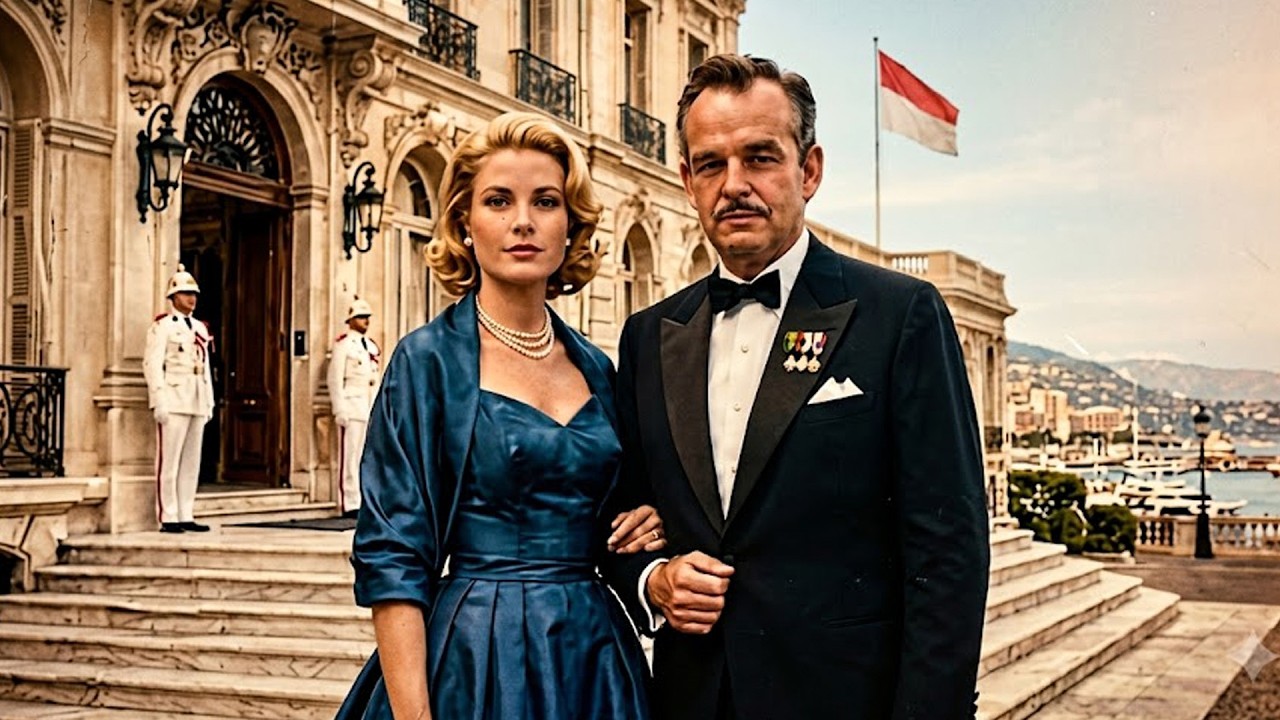
She never acted again. Most of the world believed it already knew her story. A girl from Philadelphia, a prince, a fairy-tale wedding watched by thirty million people, a palace above the Mediterranean, a life of unimaginable beauty. That was the story the world was given.
Beneath it lay another, the one lived in silence between public appearances, in letters she wrote and never sent, in the room she stood in when the cameras finally went away. She won the Academy Award for best actress at twenty-five. Hitchcock called her the perfect instrument, the woman with fire behind ice. She became the highest-paid star in Hollywood.
And at the exact moment her career crested, she packed everything she owned into a trunk, sailed across the Atlantic, and stepped into a role she had not auditioned for and could not leave. She held it for twenty-six years, and when she died alone on a mountain road above Monaco at fifty-two, her personal estate was worth $10,000. The palace had 235 rooms. None of them were ever hers.
The beginning was East Falls, Philadelphia, a neighborhood of families who had climbed out of something and intended never to go back. The house at 3901 Henry Avenue sat on a hill overlooking the Schuylkill River, solid brick, of course, because everything Jack Kelly touched was brick. Son of Irish immigrants, he had started with his hands in the mud of the riverbank and ended with three Olympic gold medals, a construction empire, and a name that meant something in the city. He ran for mayor and lost by the narrowest margin in Philadelphia’s history.
He did not take that lightly. On November 12th, 1929, Grace Patricia Kelly was born there, the third of four children, named after her father’s sister who had died young. From the beginning she was not the child Jack Kelly expected to matter. Her brother Kell was the heir, groomed to row on the river and win the medals their father had mapped out before he could walk.
Her older sister Peggy was socially accomplished and obedient. Grace was quieter, the way observant people are quiet, watching, absorbing, filing things away. She modeled at charity events with her mother and sister because it was expected. She attended the Stevens School in Germantown, where her classmates wrote in her yearbook, with the confidence only teenagers possess, that she was certain to become a stage and screen star.
Her father disagreed. When Grace was seventeen and announced she wanted to study acting in New York, Jack Kelly, the man who had rowed through war, built a fortune from nothing, and shaken hands with Franklin Roosevelt, told his daughter that acting was, in his precise words, a slim cut above a street walker. She went anyway. She arrived in New York in 1947 with almost nothing.
She paid her own tuition at the American Academy of Dramatic Arts by modeling, cigarette advertisements, magazine covers, anything that paid. She rented a small apartment on the East Side. She called home rarely. What she discovered in New York was that she was extraordinary at this, not merely talented, not merely beautiful, but possessing a quality of stillness and precision that the camera seemed to worship.
Years later Hitchcock would try to articulate it: fire behind ice, something enormous held very carefully in check. Her first film came in 1951, a minor part in a forgettable picture called Fourteen Hours. Then High Noon in 1952 opposite Gary Cooper, in a role that required her to hold a frame against one of Hollywood’s most commanding presences. She held it perfectly.
Then Mogambo, Dial M for Murder, Rear Window, To Catch a Thief. Four years, eleven films, an Oscar. She received the Academy Award for best actress on March 30th, 1955, for The Country Girl. She was twenty-five, wore a pale blue gown, and accepted the award with the same composure she brought to everything, calm on the surface, something else underneath.
She sent a photograph to her father. He wrote back that he had never thought she would amount to anything and was surprised. That letter was reportedly one of the most important things she ever received. By 1955 she was the highest-paid actress in Hollywood, with her pick of projects, directors, and leading men.
Then in May of that year, a French magazine asked her to drive from the Cannes Film Festival to a small principality on the coast, Monaco, a place most Americans could not have found on a map, a tax haven, a casino, a stretch of coastline smaller than Central Park, and a prince who needed something Grace Kelly had in abundance: the attention of the world. His name was Prince Rainier III. He was thirty-one, and he had been looking for a wife, not in the quiet way ordinary people look, but in the way a small country teetering on the edge of financial and political irrelevance looks for a symbol. The meeting was arranged, the cameras present.
Grace arrived in a dress she had brought for press photographs because, as the story goes, the clothes she had packed for Cannes were being pressed. She was polite, composed, exactly what she always was in public. Rainier showed her the palace gardens and introduced her to a baby tiger in his private zoo. She was not, by most accounts, particularly dazzled.
But the letters that followed, long, handwritten, crossing the Atlantic in both directions, apparently said something different. Six months later the prince flew to East Falls and arrived at the brick house on Henry Avenue to meet Jack Kelly. Two men who had built their worlds from the bottom, two men who understood in their separate ways that Grace Patricia Kelly was an asset. He proposed at Christmas.
She accepted. She had been with him seven months and had seen his country for one afternoon. She did not yet speak French. Somewhere in the calculation of what she was choosing, the title, the security, the escape from a Hollywood she had begun to find brittle and exhausting, the proof perhaps that she was worth more than a boy who could row, she missed something.
She had escaped one cage. She did not yet know she was walking toward another. Before she could become a princess, she had to pay for the privilege. The detail was buried in financial documents and surfaced decades later in the PBS documentary Grace Kelly: The Missing Millions.
The agreement between Grace Kelly and the House of Grimaldi was at its core a contract, and it required her to bring a dowry of $2 million to her marriage, the equivalent of roughly $20 million today. It was, in the words of wealth manager Gemma Godfrey, a shocking thing. It wiped out the entirety of Grace’s Hollywood earnings. The other half came from her family inheritance, the money Jack Kelly had spent a lifetime building from brick dust and river water.
She gave up her savings, Godfrey said, and her ability to earn as well. The world saw none of that. The world saw the dress. MGM Studios had designed it, a gift of sorts, though nothing in this arrangement was truly a gift.
In exchange for the gown and the labor of their costume department, MGM acquired the global broadcast rights to the wedding. They filmed it, edited it into a short documentary, and distributed it to thirty million viewers worldwide. It was the first royal wedding in history to be seen live by a mass audience. The machinery of spectacle was already running before Grace stepped out of the car.
On April 18th, 1956, the civil ceremony was held in the throne room of the palace. Grace wore beige lace and a close-fitting hat. She was visibly nervous; witnesses noted her hands. On April 19th, the religious ceremony took place at St.
Nicholas Cathedral before seven hundred guests, with Aristotle Onassis, Cary Grant, and Ava Gardner in the pews. Grace wore the silk taffeta gown with its high collar and fitted sleeves, a veil of antique lace that had taken three dozen seamstresses six weeks to complete. The dress would later be donated to the Philadelphia Museum of Art, where it has lived ever since behind glass. Before she put on the shoes that morning, someone had engraved them.
The right shoe bore Rainier’s name, the left hers. In the heel of the right shoe, a copper coin had been tucked for luck. She walked down the aisle and spoke her vows so quietly that witnesses nearby could not tell whether she said them in English or French. Rainier nearly dropped the ring.
Grace steadied him with a small, discreet motion of her hand. Thirty million people watched. When it was over, they drove through Monte Carlo in an open car, waving. She had given up her American citizenship that morning.
She would not act again. The MGM contract, the document that had promised her $2. 6 million across seven years, was finished. In exchange for the wedding footage, the studio agreed to let her go.
There was no negotiation on Grace’s behalf. She was not at the table where those decisions were made. She was in the car waving. The honeymoon was spent aboard Rainier’s yacht, the Deo Juvante II, cruising the Mediterranean.
It was reportedly the first time in months she had not been photographed daily. She had wanted quiet, wanted, as biographer Jay Jorgensen later put it, simply to be alone with her husband for a while. What she found instead was a world she had not been prepared for. Monaco in 1956 was a principality of barely 20,000 people, deeply conservative, proud in the particular way small places surrounded by larger ones tend to be proud.
The Monégasques had not asked for an American movie actress as their princess, and some of them made that clear. The women of the Red Cross committee, over which Grace was appointed president, reportedly grumbled beneath their breath when she spoke. In meetings, in hallways, in the coded courtesies of court life, she was made to feel the distance between where she had come from and where she now was. She did not speak French.
She would not manage it fluently for years. According to biographer Wendy Leigh, who interviewed people close to the princess, the early months of the marriage brought discoveries Grace had not anticipated. Leigh wrote that Rainier had taken mistresses within months of the wedding and that Grace, surrounded by what Leigh described as decadence and Rainier’s disreputable friends, was humiliated and deeply unhappy. These claims come from a single biographer and should be held as such.
What is less disputed, documented across multiple sources including Grace’s own rare candid remarks, was the loneliness. In Hollywood she had been surrounded by people who spoke her language, literally and otherwise, people who understood ambition and valued what she could do. In Monaco she was a symbol. Symbols do not have opinions.
Symbols do not have careers. Symbols stand at the top of palace staircases and wave, and they do not ask what comes next. She threw herself into what was available. The Red Cross, the children.
Caroline arrived in 1957, Albert in 1958, Stephanie in 1965. She made documentary narrations. She arranged flowers. She wrote poetry she did not publish.
Director Robert Dornhelm, who worked closely with Grace in the final years of her life, said later that she had developed a deep longing for a different kind of existence entirely. She wanted to be invisible, he said, and be with normal people, go to restaurants and pubs. There were occasional trips to Paris, rare evenings when no one recognized her, when she could sit somewhere ordinary and simply be a woman eating dinner. She was, he said, always very proud on those nights.
That was what thirty million people had watched her trade away. Not just the career, the ordinary evenings, the anonymity, the right to be unremarkable. In 1955, before the engagement was announced, a journalist had asked Grace Kelly what she wanted from her life. She answered without hesitation.
“I loved acting. I loved what I was doing. But I was personally unhappy. A great success is no fun if you have no one to share it with.
” She had said it as an explanation for why she was leaving. She did not yet know that loneliness is not something a palace cures. It is something a palace perfects. There is a particular kind of silence inside very large spaces, the silence of containment, of rooms that hold their breath, of corridors built to be walked through in a specific way at a specific pace with a specific expression on your face.
The Palais Princier de Monaco had 235 rooms. Grace Kelly knew every one of them. She had learned the geography of her own confinement the way prisoners learn the dimensions of their cells, not because they want to, but because there is nothing else to know. She was twenty-six when she moved in.
There was always something to do. There was never anywhere to go. She did what she had always done when the world narrowed around her. She worked.
She accepted the chairmanship of the Red Cross committee and tried to run it with the same focused energy she had brought to a film set. The results were mixed. Other committee members were not accustomed to being chaired by someone who had recently been on the cover of Life magazine. There were resentments, silences of a different kind.
The children gave her what the palace could not: texture, noise, the specific chaos of small people who did not know or care that their mother was the most photographed woman in the world. Prince Albert would later describe her as a hands-on mom, present in a way that surprised people. She read to them. She made things with them.
She brought the same attention to their lives she had once brought to a scene. In 1960, Jack Kelly died, seventy years old, a stroke on a June morning in Philadelphia. Grace flew home for the funeral and stood at the graveside in the city she had left at seventeen, among the family she had both loved and fled. She buried the man whose disapproval had shaped her more than any director’s note or critic’s review.
Whether he had ever said the thing she had spent her life trying to earn from him is not something anyone recorded. She returned to Monaco and arranged flowers. This was not, as it might sound, a small thing. Grace Kelly had developed a genuine and serious interest in flower arrangement, studied it formally, as she studied everything she committed to.
She would eventually teach classes and compile a book of pressed flowers and poetry, published in 1980 as My Book of Flowers, by most accounts a lovely and melancholy object, full of the careful beauty people produce when they have few sanctioned outlets. She narrated documentary films, one of the few ways she was permitted to work in front of a microphone. She gave poetry readings on radio. She helped found the Princess Grace Foundation, which gave scholarships to young artists in theater, dance, and film.
She built a careful infrastructure for being adjacent to the creative world she had left. Close enough to feel it. Not close enough to return. Biographer Robert Lacy described this period with precision: Grace was privately unhappy, trapped like a bird in a gilded cage, and had occasionally escaped, finding in various arms brief moments of love and acceptance.
These are claims that cannot be verified and should be understood as the assessment of a biographer, not a confession. What Grace herself said about these years, in the rare moments she spoke candidly, was more restrained and more devastating. When fairy tales do not finish happily, Lacy wrote, their ending often tends to be cruel. Then, in the spring of 1962, six years into the palace, Alfred Hitchcock came to Monaco.
He brought a script, the only offer in all those years with the power to make her say yes. The film was called Marnie, the role Margaret Edgar, a troubled young woman, a thief, a psychology fractured by something buried in her past. It was exactly the kind of role Hitchcock believed Grace Kelly had been born to play. He showed her the script.
He sat with her in the palace, 235 rooms, state dinners, flower arrangements, the whole enormous machinery of her life, and offered her the thing she had been quietly mourning for six years. She said yes. On March 19th, 1962, the Palace of Monaco issued a formal announcement. Princess Grace would return to acting.
She would star in Hitchcock’s adaptation of Marnie. The fee, $1 million, which Grace had reportedly suggested be donated to a fund for needy children and Monégasque athletes, as if to preemptively justify herself to her adopted country, was secondary. The reaction in Monaco was immediate, and it was not what she had hoped. The Monégasques were furious.
Their princess playing a criminal, their serene highness embodying psychological fracture: in the view of the principality, it was an outrage. Grace attempted to have the script adjusted, toned down. Hitchcock declined. And then the political machinery turned.
France and Monaco had been in quiet tension for years. Charles de Gaulle had been pressing Rainier on taxation, sovereignty, the awkwardness of Monaco’s status as a tax haven on French soil. The negotiations were delicate. The moment was, as Rainier judged it, precisely the wrong one for his American wife to be absent from the palace filming a psychological thriller for an English director while the French president watched.
The precise conversation between Grace and Rainier was not recorded in any primary source. What emerged from palace accounts and from the memoir of Rainier’s nephew Christian de Massy is a version in which Rainier made his position clear. A princess, he is reported to have said, is not about expressing your desires. It is about serving the crown.
On April 23rd, 1962, thirty-five days after the announcement of her return, the palace issued a second statement. Princess Grace had withdrawn from Marnie. She would not be returning to acting. The decision was final.
The role went to Tippi Hedren. The film was a critical and commercial disappointment. Grace never spoke publicly about what that month had cost her. Those who knew her in the months after the withdrawal described a woman who had gone quieter than usual, a particular quality of withdrawal different from her ordinary reserve.
Some accounts reported by Robert Lacy, drawn from sources close to the princess, suggest that in the aftermath of the Marnie decision, Grace privately consulted an American attorney about the possibility of divorce. What she was told, according to these accounts, stopped the inquiry before it started. Under the laws of the Grimaldi family, the children of the marriage would remain in Monaco in the event of a separation. Grace would leave.
The children would stay. These accounts come from limited sources and cannot be independently verified. What is not disputed is what Grace herself later said quietly to people she trusted. She stayed not because the palace had become home, not because the marriage had become what she imagined, but because the alternative, a freedom purchased at the price of her children, was not a freedom she was willing to buy.
Twenty more years. State dinners, Red Cross galas, charity functions, the long specific discipline of being someone else’s symbol. She did not stop working. She built the Princess Grace Foundation.
She taught flower arrangement. She gave poetry readings on the radio. She took small documentary narrations when they were offered. She kept herself as close to the work as the palace would permit, a woman pressing her hand against a window she was no longer allowed to open.
In 1976, Grace and Rainier purchased thirty-five acres of land in the west of Ireland. Just fields, really, and the last remaining foundation stones of a cottage that had once stood there. They planned to build something, a house, a place that was neither palace nor obligation, a place where Grace could simply exist without being observed. They never built it.
Dornhelm said she spoke often of Ireland, of wanting to disappear into it, of going to ordinary restaurants, ordinary pubs, being an ordinary woman in an ordinary room. She was always very proud, he said, when she was not recognized. That was what she wanted in the end. Not the Oscar, not the palace, not the tiara or the title or the thirty million people watching her walk down the aisle.
The freedom to be unremarkable. She had had it once, briefly, in the cheap apartment on the East Side of New York when she was seventeen and unknown and the whole world was still unwritten. In April of 1982, five months before she died, Grace Kelly sat for an interview with People magazine. She was fifty-two, dressed impeccably, sitting in the family’s Paris apartment, one of the places she was allowed to breathe a little, away from the formal machinery of the palace.
The photograph taken that day ran on the cover. She looked exactly as the world expected: serene, beautiful, untouched by time or trouble. The journalist asked whether she missed acting. “I don’t look back,” Grace said.
“I haven’t had the time. I haven’t retired, you know. ”
She said it easily. She had said versions of it for decades.
The answer was polished smooth by repetition, like a stone turned over and over in a pocket until all the edges were gone. She had not retired. She had been retired. There is a difference.
But she did not say that. Five months later she was dead. On the morning of September 13th, 1982, Grace and Stephanie, the youngest, seventeen, the most headstrong of the three children, were at Roc Agel, the family’s country house above Monaco, a place smaller and quieter than the palace, which Grace preferred for that reason. They needed to get back to Monaco; from there Stephanie would catch a train to Paris for the start of the school term.
Mother and daughter had been in an ongoing disagreement about Stephanie’s future. Stephanie wanted to marry her boyfriend. Grace did not think the timing was right. It was the argument of a mother and a daughter, ordinary in its texture, familiar in its stakes.
They were working through it. The car was a Rover 3500, metallic green, eleven years old. Grace dismissed the driver that morning. There were boxes in the back seat, dresses, luggage, the accumulated objects of a summer at Roc Agel, and no room for him.
She would drive herself. She drove this road often enough. She knew the curves. Just after 10:00 in the morning, on the winding descent of the D37 above La Turbie, something happened inside her body she could not have seen coming and could not have stopped.
A cerebral hemorrhage, the first of two. Her hands would have gone slack. The Rover crossed the center line, went through the barrier, and fell 120 feet down the cliff face. There were no skid marks on the road.
She had not had time to brake. Stephanie, in the passenger seat, survived. Broken bones, a fractured vertebra. She was conscious, seventeen years old, sitting in a destroyed car on a cliff beside her mother, who was not conscious and would not be again.
Grace was transported to the Princess Grace Hospital, the hospital that bore her name, the one she had championed. The scanner there was not large enough to provide the imaging her injury required. There were delays. By the time the full extent of the cerebral damage was understood, the outcome was already decided.
She never regained consciousness. On the evening of September 14th, 1982, twenty-four hours after the car left the road, Prince Rainier III made the decision to withdraw life support. He made it with Caroline and Albert beside him. Stephanie was still in the hospital recovering from her own injuries.
She was told about her mother’s death two days after it happened. She did not attend the funeral. Grace Kelly was pronounced dead at six in the evening. She was fifty-two.
She was buried four days later in the Grimaldi family vault at St. Nicholas Cathedral, the same cathedral where she had spoken her vows so quietly twenty-six years before that no one standing nearby could tell whether she had said them in English or French. One hundred million people watched the funeral on television. Cary Grant was in the pews.
Princess Diana was there, Nancy Reagan. The people who had loved her and the people who had consumed her gathered in one place to say goodbye to a woman most of them had never known at all. What she left behind, when the lawyers examined it, was a will of startling simplicity. $10,000 in personal assets.
A ramshackle cottage in Ireland, the property purchased in 1976, the one they had always planned to build something on, in the end just fields and foundation stones and wind. That was the private estate of the highest-paid actress in Hollywood. Prince Rainier never remarried. He lived twenty-three more years, ruling Monaco alone, and was buried in the same vault when he died in April 2005.
They are there together now in the cathedral where she said her vows too quietly to be heard. She had said once, in one of the rare moments she let the performance slip: “Fairy tales tell imaginary stories. Me, I’m a living person. I exist.
If a story of my life as a real woman were to be told one day, people would at last discover the real being that I am. ” The story was never told, not by her. She did not have time. She did not look back.
The copper coin is still in the shoe. The wedding dress lives behind glass at the Philadelphia Museum of Art, the dress MGM gave her, the dress thirty million people watched her walk down an aisle in, the dress she wore on the day she stopped being Grace Kelly and became something the world could use. Visitors stand in front of it and take photographs. The label tells them about the silk taffeta, the antique lace, the seamstresses.
It does not tell them about the copper coin. It does not tell them about the $2 million. The hospital in Monaco still bears her name, Princess Grace Hospital, the one she championed, the one that couldn’t scan her brain fast enough on the morning of September 13th, 1982, the one where Rainier turned off the machine while their youngest daughter was still unconscious in another room. People are born there every day.
People recover there. The name above the door is hers and will remain hers, and most of the people who walk beneath it have never thought about what it cost to put it there. In Ireland, the thirty-five acres are still there. The foundation stones of the cottage they never built, the fields, the Atlantic wind, the place where Grace Kelly planned to disappear into ordinary life and never managed to.
Her son, Prince Albert, purchased the house she grew up in, the brick house at 3901 Henry Avenue in East Falls, the one Jack Kelly built in 1928, the one Grace left at seventeen and never truly returned to. He had it restored from old photographs, room by room, until it looked exactly as it had when she was a child. He uses it for the Princess Grace Foundation. It hosts events for young artists, the ones she spent the last decades of her life trying to help, the ones who get to do the thing she was not permitted to finish.
What she left behind was a name on a hospital, a dress behind glass, thirty-five acres of Irish field with nothing built on them yet, and a question that tends to surface in the spaces between the official accounts. Not what she gave up. What she might have become, if anyone had asked her to stay.






