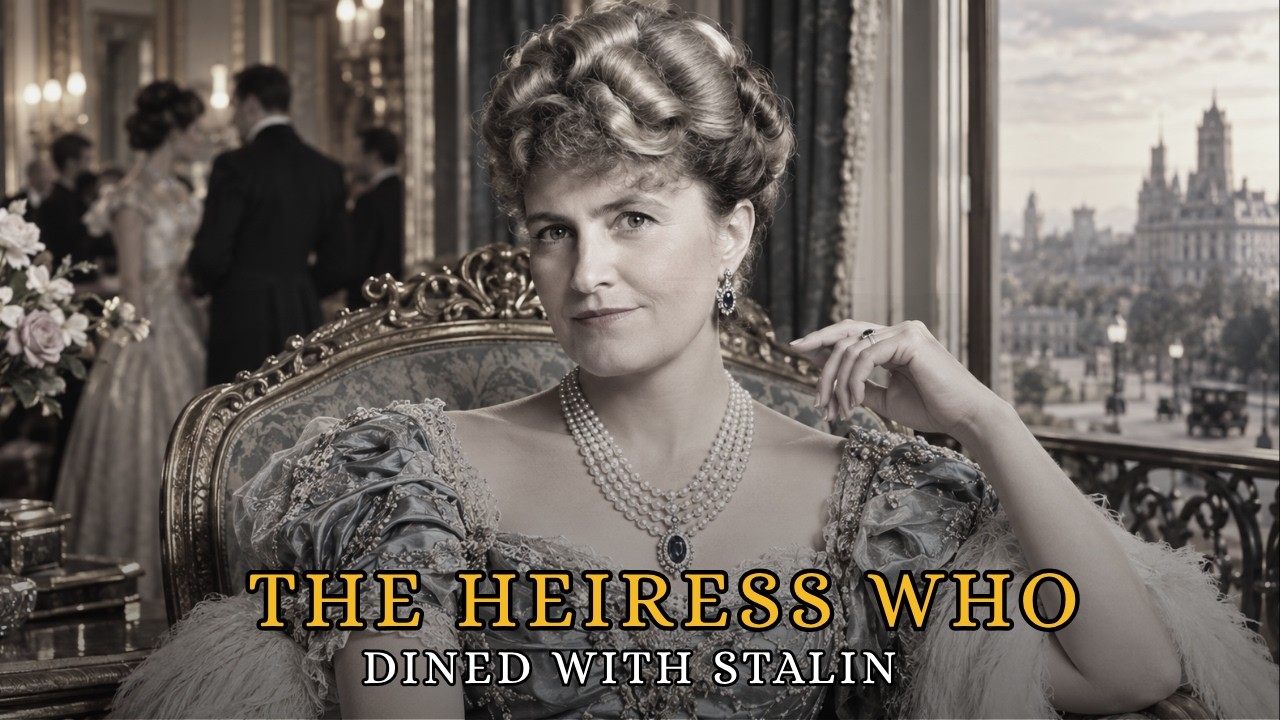
She sat across the table from Stalin himself through the winter of 1937, dressed in diamonds, smiling as his secret police executed hundreds of thousands within sight of the Kremlin walls. She was Marjorie Merriweather Post, the richest self-made woman in America and the head of an industrial empire called General Foods. Foreign diplomats in Moscow were terrified to speak above a whisper inside their own embassies, yet here she was, the wife of the American ambassador, an evening guest of the dictator whose purges were tearing the Soviet Union apart. And while the world looked away, she was quietly doing something no one else dared to attempt.
Using her fortune and the protections of diplomatic status, she was buying up the confiscated treasures of a murdered dynasty, stolen Romanov jewels, Fabergé eggs, and imperial porcelain the Soviets were selling for scrap, and she was smuggling them out from under the noses of the secret police. To understand how an American businesswoman reached Stalin’s dinner table, one must begin with her father, Charles William Post, and the fortune he built from a failing body and a secondhand stove. In the early 1890s, C. W.
Post arrived in Battle Creek, Michigan, broke and physically ruined after years of failed ventures, suffering from severe gastrointestinal illness. He checked into the famous Battle Creek Sanitarium run by Dr. John Harvey Kellogg, and there he became fascinated by the health movement and the commercial possibilities of prepared grain-based foods. Driven by relentless ambition, he began experimenting in a modest wooden barn and discovered a roasted cereal beverage he called Postum, followed by a shelf-stable wheat and barley cereal known as Grape-Nuts.
Unlike rival manufacturers who relied on local distribution, Post understood national advertising and consumer psychology. He spent millions filling newspapers with persuasive claims that his products were cures for modern exhaustion. Within a decade, the Postum Cereal Company had grown from a barn experiment into a multi-million-dollar industrial enterprise pushing out along the Battle Creek railroad tracks. Marjorie was born in 1887, C.
W. Post’s only surviving child, and her father raised her as his corporate successor rather than a delicate Victorian daughter. From the age of ten, she attended board meetings and factory inspections with him, sitting quietly and absorbing the mechanics of Gilded Age business. He personally taught her to read balance sheets, audit supply chains, evaluate machinery, and manage thousands of workers.
He introduced her to real estate and stock speculation, determined that his daughter would never need a male guardian to navigate the business world. When Marjorie turned 27 in 1914, her father took his own life after suffering unmanageable abdominal pain. He left her sole owner of a corporate empire worth over $20 million in gold-backed capital. Wall Street assumed the young heiress would sell out to a syndicate or hand management to trustees.
Instead, she stepped directly into her father’s shoes, attending every board meeting, auditing expenditures, and vetoing expansion plans proposed by seasoned male executives. Under her control the company flourished, and she established herself as the wealthiest self-made woman in America. In 1920 she married Wall Street financier Edward F. Hutton, forming a partnership that transformed the single-product cereal company into a diversified giant.
The turning point came when Marjorie attended a public demonstration of a quick-freezing process invented by a marine biologist named Clarence Birdseye. Corporate executives dismissed frozen food as a risky gimmick, but Marjorie recognized its potential to preserve freshness and nutrition indefinitely. She overruled the board and urged Hutton to acquire Birdseye’s patents for $22 million. In 1929 she reorganized the enterprise as the General Foods Corporation and absorbed iconic brands, Jell-O, Maxwell House Coffee, Baker’s Chocolate, and Swans Down Cake Flour.
With refrigerated railroad cars and commercial freezer cases, General Foods came to dominate the modern supermarket. The dividends were astronomical, making Marjorie one of the wealthiest women in history, with an income that dwarfed European monarchies. She poured her wealth into magnificent estates. In Palm Beach, Florida, architect Joseph Urban built her Mar-a-Lago, a 128-room Spanish-Moorish estate constructed from imported stone, ancient Portuguese tiles, and gold leaf, stretching across 20 acres between the Atlantic Ocean and Lake Worth.
Its grand ballroom was covered in gold leaf, and a permanent staff of over 100 servants maintained the tropical gardens. She acquired Hillwood in Washington, D. C. , and built Camp Topridge in the Adirondacks, a wilderness retreat of rustic lodges and private lakes.
Her four-masted yacht Sea Cloud, the largest private sailing vessel ever built, was a floating palace with marble baths and communication systems that let her monitor Wall Street from the Mediterranean. But behind the ballrooms lay a strategic mind. Marjorie viewed her splendor as an instrument of diplomacy and cultural influence. She audited estate balance sheets line by line, maintained personal sobriety, and poured tens of millions into hospitals, symphonies, and relief efforts during the Great Depression.
In late 1936 her life shifted dramatically. Divorced from Hutton, she married Joseph E. Davies, a prominent Washington attorney and trusted fundraiser for President Franklin D. Roosevelt.
Seeking a savvy negotiator for increasingly delicate relations with the Soviet Union, Roosevelt appointed Davies ambassador to Moscow in November 1936. For Marjorie, it meant leaving Palm Beach and Manhattan for the paranoid heart of Stalin’s state. They arrived in Moscow in January 1937 amid freezing blizzards and took up residence at Spaso House, a grand yellow neoclassical mansion built before the revolution by a sugar magnate. The building was neglected, with inadequate heating and unreliable plumbing, and was saturated with surveillance.
Every domestic servant and driver was an undercover NKVD agent. Microphones were hidden in the plaster walls, chandelier bases, and fireplace mantels. Every whisper in the American embassy was monitored. Marjorie did not surrender to fear.
Before leaving the United States, she had filled the freezer holds of her ocean liner and supply ships with 20,000 pounds of frozen prime beef, thousands of gallons of cream, fresh poultry, fruits, vegetables, and luxury canned goods from General Foods storage. She brought her own cooks and decorators to Moscow and installed commercial refrigeration units. The American embassy became self-sufficient in a starving city. Her arrival as the richest woman in America fascinated the Soviet elite.
Soviet propaganda vilified Western capitalists as blood-sucking exploiters, yet Marjorie’s unpretentious manner, administrative intelligence, and courtly grace commanded respect. She moved through Moscow draped in priceless sables, her fingers sparkling with diamonds, an image of Western supremacy that mesmerized the Bolshevik hierarchy. This was the moment Stalin’s Great Purges reached their terrible climax. The Moscow show trials unfolded in the October Hall of the House of Trade Unions, where former Bolshevik heroes and military marshals were tried on fabricated charges, forced to confess, and executed in underground firing chambers.
Diplomatic contacts vanished overnight. Foreign embassies were isolated. Despite this, Ambassador Davies and his wife were granted extraordinary access. Stalin ordered that the American couple be treated with deference, recognizing the United States as a counterweight to Nazi Germany and Imperial Japan.
They dined inside the Grand Kremlin Palace at banquets of staggering luxury, black caviar, roasted suckling pigs, Georgian wines, and endless vodka, while Bolshevik leaders who preached proletarian equality feasted like tsars. Sitting directly across from Stalin, Marjorie observed the dictator with the detachment of a corporate executive. She noted the contrast between his simple military tunic and the terror he projected over his inner circle, who trembled in his presence and hung on every word. While Foreign Minister Vyacheslav Molotov and Defense Commissar Kliment Voroshilov postured heavily, Marjorie navigated the vodka-fueled dinners with regal dignity that fascinated the Soviet leadership.
She engaged Soviet ministers in sophisticated discussions of industrial infrastructure, agriculture, and food preservation, astonishing men who expected Western women to be decorative ornaments. When Molotov’s wife, Paulina Zhemchuzhina, who ran the Soviet cosmetics and perfume industry, visited Spaso House, Marjorie treated her with professional respect and formed a rare personal friendship that bypassed ideology. Through these channels she gathered unscripted intelligence about the inner workings of the regime. Yet the human tragedy continued beyond the palace gates.
Thousands were dragged from their beds each night, interrogated in Lubyanka Prison, and executed in its cellars. Marjorie attended the Moscow show trials and watched former heroes like Nikolai Bukharin and Karl Radek deliver empty confessions before being sentenced to death. She understood that the officials who toasted her health at night could be arrested by morning. Still, she showed no fear.
She treated the NKVD agents assigned to watch her with calm amusement, occasionally sending hot tea and pastries to the frozen men sitting in cars outside her residence. Behind the political circus, a quieter economic campaign was unfolding that would prove her greatest opportunity. Stalin’s Five-Year Plan demanded massive amounts of hard foreign currency to buy Western machinery and fund rearmament. To raise dollars and gold, the Kremlin established state-run commission shops known as Torgsin, including Commission Store No.
28, designed to sell off the confiscated artistic heritage of the Romanov dynasty. Thousands of priceless treasures taken from imperial palaces and noble estates after the 1917 revolution were piled into unheated warehouses in Moscow and Leningrad, waiting for buyers with hard currency. Marjorie moved with the precision of a corporate buyer. Armed with special purchasing permits from Soviet trade commissars and accompanied by expert appraisers, she spent months exploring dusty storerooms and vaulted bank basements off-limits to the public.
While Soviet clerks saw only meltable precious metals or aristocratic trinkets, her trained eye recognized masterworks of European decorative art. She paid modest sums for priceless gold chalices, diamond-encrusted snuff boxes, imperial porcelain dinner services, and antique silk tapestries that had adorned the apartments of Tsar Nicholas II and Empress Alexandra. Among her greatest acquisitions were works from the House of Fabergé, the court jeweler who had crafted jeweled Easter eggs for the imperial family for generations. She acquired two magnificent imperial Fabergé eggs, the Catherine the Great Egg with hand-painted miniatures on pink enamel, and the Russian Imperial Easter egg presented by Nicholas II to his mother, the Dowager Empress Maria Feodorovna, along with dozens of cigarette cases, rock-crystal perfume bottles, and diamond-set picture frames.
She purchased massive multi-piece porcelain services from the Imperial Porcelain Factory in St. Petersburg, including the Orlov service and the Kremlin service with gold leaf and heraldic crests. She bought Russian religious icons dating back to the 16th and 17th centuries, encased in heavy silver-gilt and pearl-encrusted covers called oklads, treasures the Soviet authorities were preparing to melt down for bullion. Soviet commissars were often on the verge of scrapping the delicate silver altarpieces, smashing antique porcelain, or burning imperial portraits to harvest the gold frames.
Marjorie paid their full asking prices without haggling, meticulously cataloged every purchase, secured official export permits, and kept stamped receipts signed by trade commissars so her title was legally ironclad. She personally supervised the packing of every porcelain dish and icon into custom wooden crates for the long journey. As word spread, European ambassadors watched with envy and resentment as the American heiress acquired the finest collection of Tsarist art outside the Hermitage Museum. She transformed Spaso House into a temporary private museum, filling its reception rooms with Fabergé gems, imperial porcelain, and ancient icons that formed a glittering backdrop for her diplomatic dinners.
Her hospitality at Spaso House became a genuine instrument of statecraft. Understanding that formal diplomatic channels were choked by Soviet paranoia, she staged lavish banquets that brought together senior Soviet officials, foreign ambassadors, military attachés, and journalists. Her tables featured solid gold service, crystal stemware, rare European orchids, and five-course meals prepared from American ingredients. Soviet commissars accustomed to austerity found themselves captivated by the elegance.
Over wine and caviar, key figures relaxed and spoke candidly with Davies about military production and industrial capacity, while Marjorie quietly evaluated their capabilities. Her relationships with officials’ wives, especially Paulina Zhemchuzhina, gave her access to insights no intelligence officer could obtain. She noted which officials appeared in favor and which vanished from the social circuit as the purges consumed the regime. This intelligence was integrated into Davies’s official dispatches to Roosevelt, giving Washington a realistic assessment of Soviet preparedness.
Representatives from Britain, France, Germany, and Japan frequented her receptions, knowing the American embassy was the most secure environment in the city. Marjorie seated representatives of hostile nations according to strict protocol, keeping conversation civilized. By spring 1938, her soft-power offensive had established the United States as a respected player in Kremlin calculations. That summer, Davies completed his Moscow assignment and was reassigned as ambassador to Belgium.
Marjorie now faced the monumental task of evacuating her collection from a continent on the brink of war. She turned to the Sea Cloud. The 316-foot four-masted yacht with 34 hand-sewn canvas sails became a floating cargo vessel. As war clouds gathered over Germany and Eastern Europe, she ordered her captain to navigate to Baltic and North Sea ports.
Under her supervision, hundreds of custom-built wooden crates lined with oilcloth were packed with porcelain, Fabergé eggs, gold chalices, and centuries-old icons. Each item was cataloged, insured, and verified against Soviet export permits. The heavy crates were loaded into the yacht’s reinforced holds, transforming the pleasure vessel into a priceless floating museum. As Nazi Germany annexed Austria and marched into the Sudetenland, the Sea Cloud navigated increasingly dangerous waters.
Anchored off the coasts of Belgium and France, it hosted European royals and diplomats in its mahogany-paneled saloons, where they discussed the collapse of European peace. Marjorie kept the crew ready to sail at a moment’s notice, monitoring radio broadcasts and diplomatic cables. Her foresight proved decisive. When general war erupted in September 1939, her collection was already safely aboard an American-flagged vessel with full diplomatic immunity.
She ordered the Sea Cloud across the Atlantic, bringing the Romanov treasures to the United States long before Nazi occupation forces began plundering European museums. The crates were unloaded under armed guard and placed in climate-controlled storage. After Pearl Harbor in 1941, Marjorie turned her resources to the Allied war effort. She chartered the Sea Cloud to the United States Coast Guard for the symbolic sum of $1 per year.
The yacht was repainted slate gray, fitted with radar and anti-submarine armament, and deployed on weather patrol guarding convoy routes in the North Atlantic. The vessel that had carried Fabergé eggs across European seas became an instrument of national defense. In the postwar era, Marjorie began her final major project. Following her divorce from Davies in 1955, she acquired Hillwood, a 25-acre brick mansion in northwest Washington, choosing it for its scale and proximity to diplomatic circles.
She hired museum curators and restoration architects to create a space that was simultaneously a private residence and a climate-controlled public museum. She mounted dozens of silver-gilt and jewel-encrusted icons in a dedicated icon room, lit to highlight the craftsmanship of Russian masters. Glass cases displayed her Fabergé treasures, including the Catherine the Great Egg, enamel cigarette cases, and rock-crystal scent bottles. In the grand dining room, porcelain services commissioned by Empress Catherine the Great and Tsar Nicholas I sat on a long mahogany table with solid gold knives and crystal stemware, as if imperial guests might arrive at any moment.
During the tensest decades of the Cold War, Marjorie became the undisputed hostess of Washington high society. She hosted garden parties, galas, and diplomatic receptions for presidents, Supreme Court justices, foreign monarchs, and ambassadors. Her annual square dancing parties and spring garden galas became mandatory events. She inspected every room daily, wrote instructions for her staff on the care of antique textiles and fragile porcelain, and established an archive documenting the provenance of every object, including Soviet purchase receipts.
She also established a perpetual endowment so Hillwood would never rely on uncertain public funding or be forced to sell assets. As the Cold War froze official relations between the United States and the Soviet Union, Hillwood stood as a bridge between two irreconcilable worlds, preserving the artistic soul of old Russia in the heart of the American capital. As the 1960s gave way to the 1970s, Marjorie remained the last living link to the Gilded Age while most old industrial dynasties squandered their inheritances. She maintained total control over her corporate dividends, properties, and philanthropy.
In her final decade she negotiated agreements that left Mar-a-Lago to the federal government as a winter presidential retreat and established Hillwood as an endowed independent museum foundation. She worked alongside attorneys and curators, auditing trusts and cataloging every piece of imperial furniture and porcelain. She continued to host charitable galas and diplomatic luncheons, sitting at the head of her dining table in silk and diamonds. She reviewed General Foods quarterly earnings reports with the eye of a veteran board chairman.
Her staff operated under written manuals, maintaining gardens, polishing imperial silver, and preparing five-course dinners with the same precision that had impressed Soviet commissars in 1937. She passed away peacefully at Hillwood on September 12, 1973, at the age of 86. Obituaries celebrated her not merely as a wealthy heiress or hostess, but as a visionary corporate leader, a courageous diplomat, and a cultural preservationist who had rescued the artistic soul of a fallen empire. She was laid to rest in a rose garden mausoleum on the grounds of Hillwood beneath a monument bearing her coat of arms and the Latin motto, “All my hopes in God.
”
Visitors still walk through the sunlit galleries of Hillwood today, or gaze at the Moorish towers of Mar-a-Lago in Palm Beach, encountering the legacy she engineered. Soviet authorities saw only metal to melt and trinkets to liquidate; European diplomats saw only a landscape of purges and executions. Marjorie saw an irreplaceable heritage that demanded preservation, and she extracted it from the commission shops of Moscow, shipped it across the ocean on the Sea Cloud ahead of total war, and enshrined it in the public trust of the American nation.






