In November 1925, a man used a hot knife to cut through the most famous face in history, because the body beneath it was stuck to its coffin. But what that knife revealed was not the body of a god. It was a nineteen-year-old boy with a clubfoot, a rotting toe, and parents who were brother and sister. Everyone begins this story with Akhenaten.
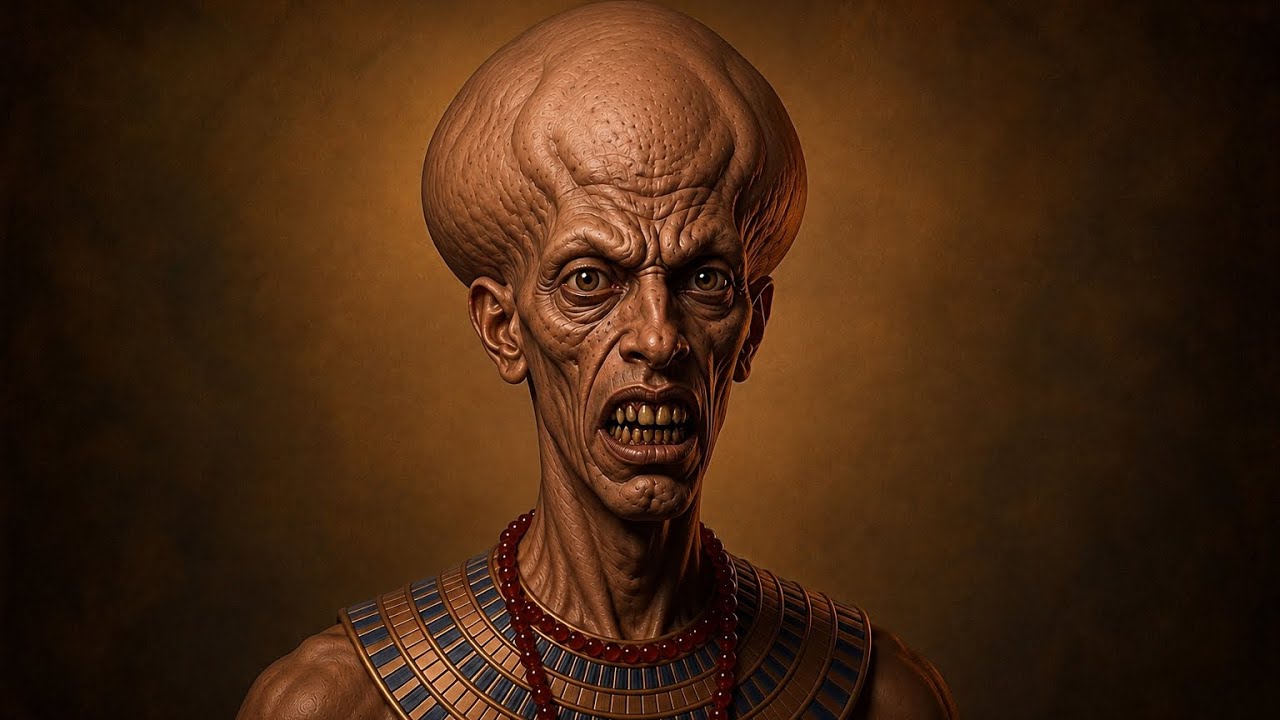
You have seen him before, even if you do not know his name. He is the pharaoh carved with a long, drooping skull, an open jaw, narrow eyes, wide hips, a soft belly, and spindly legs. The colossal statues from his temple at Karnak are so strange that people online still swear he was an alien. You can understand why they say that.
His entire family received the same treatment in stone. Nefertiti and the young princesses were carved with the same elongated skulls. Even his chief sculptor, a man named Bek, depicted himself with a sagging belly and heavy chest. In fact, that art was a real break with three thousand years of tradition.
The kings of Egypt had always been carved as flawless young athletes, with features that never aged and muscles that never weakened, regardless of how they actually looked. Akhenaten threw those rulebooks aside along with the old gods. His artists began showing the royal family stooped, aging, and embracing their children. And so the story wrote itself.
The strangest-looking king of Egypt must have been the sickest one. The art was simply showing you the truth of his body. Doctors rushed to embrace this theory over the decades, diagnosing his condition from stone images as Marfan syndrome, Klinefelter syndrome, Fröhlich syndrome, Antley–Bixler syndrome, and a rare hormonal disorder that causes male breast enlargement. Every one of those papers is real, and every one carries the same flaw.
None of those doctors ever examined his actual body. They were reading carvings in a country where kings had long ordered artists to depict them exactly as they wanted people to see them. When someone finally looked at the bones, that century-old argument collapsed in a single afternoon. Doctors had spent one hundred years diagnosing a statue.
Between 2007 and 2009, a team led by Zahi Hawass loaded a CT scanner onto a truck and drove it to the mummies. Sixteen bodies were examined through the machine. Bone samples were then sent to two separate DNA laboratories in Cairo, deliberately staffed by different people, so that each lab’s results could be tested against the other’s without prior knowledge. The scanner measured the shape of the skull first, because a long, narrow head is one of the classic signs of Marfan syndrome.
Akhenaten’s skull came out wide and short. So did Tutankhamun’s. Both fell within the range doctors call “broad-headed,” the exact opposite of the head shape in the artwork. Neither skull showed early fusion of the bones, the condition that deforms the head as it grows.
The measurement is called the cephalic index. The long, narrow shape that points to Marfan syndrome sits at 75 or below, while these two kings passed the 80 mark. Hawass and his team found no breast enlargement, no Marfan syndrome, and no trace of Antley–Bixler syndrome. Their conclusion was categorical: the Amarna appearance was a royal style imposed from above, linked to the new sun religion that Akhenaten was forcing on the country.
Do you realize what that means? Egyptologists had spent generations reading a political poster as if it were a medical record. There is clear evidence of this in Berlin as well. When scientists CT-scanned the famous painted bust of Nefertiti, they found her real carved face hidden beneath the outer layer.
That hidden face has a bump on the nose and wrinkles at the corners of the mouth. The beautiful version is just an outer shell. Egyptian royal portraits were never mirrors. They were never meant to be.
So now we face a troubling question. If the king who looks sick was not sick at all, then who was the real patient in that family? That question falls on the boy with the golden mask. Tutankhamun died in the ninth year of his reign at the age of nineteen, around 1300 BC.
He had taken the throne as a child of nine and spent his short reign undoing his father’s religious revolution and restoring the country’s old gods. In life, he stood about 168 centimeters tall. His tomb is the only royal burial in Egypt ever found nearly intact, and it is the sole reason a rather minor king became the most famous name in the ancient world. It is also why you know his face.
The mask is calm, symmetrical, and young. That mask has done more for Egypt’s tourist industry than any other building in the country. But the body beneath it does not match. His mummy had been X-rayed several times across the twentieth century, and every one of those teams had focused on the skull, looking for the killing blow that paperback books had promised them.
Hawass turned his scanner to a place no one had bothered to look before. He scanned the feet. What appeared rewrote the entire picture of the boy king. And at last it explained a detail Carter had recorded in the 1920s that no one had been able to understand at the time.
There is one more thing worth holding onto before all of that. The worst injury this body ever suffered did not happen in ancient Egypt, and no enemy caused it. It happened three thousand years later, in a stone corridor, at the hands of men who called themselves its saviors. His left foot is the part whose details are hard to hear.
The scans showed the front of that foot tilted inward and turned onto its side, the hallmark sign of a clubfoot. That is a birth defect, so he had had it since the day he was born. He did not take a single natural step in his entire life. Clubfoot itself is not rare, and modern doctors straighten it in infants with splints and braces.
No one in 1300 BC could do anything about it. Worse, the bone inside that foot was dying while he walked on it. Two of the small bones behind his toes had lost their blood supply and were rotting from the inside out, a condition doctors call Köhler disease. The scans caught one of those bone heads collapsed into a gap, with the flesh above it wearing away.
That decay did not stop on its own, and it did not heal either. Doctors can read the gaps in the joint, and those gaps show the disease was still spreading on the day he died. Then there is the toe. The second toe on his left foot is missing a bone from its middle entirely, so the tip connects straight to the base, and the whole toe looks short and pushed to the side.
His right foot, the healthy one, had flattened and lost its arch because every time his bad foot betrayed him, he threw his weight onto the good side. Think about what that really means for a moment. That healthy foot was collapsing under the extra burden of compensating for the damaged one, so the pain spread outward instead of easing. Ashraf Selim, the Egyptian radiologist on that team, described the bone death as extremely painful.
And it happened during his teenage years, exactly the age when Egypt expected its king to begin acting like a warrior. Now, the roof of his mouth takes the story in an even worse direction. He had a cleft palate, a crack running across the roof of the mouth, and his father carried the same identical cleft. His spine also had a slight sideways curvature.
A virtual reconstruction created for a 2014 documentary showed that he had a heavy overbite and hips notably broad for a young man his age. Albert Zink, who runs the Institute for Mummy Studies in Bolzano, outlined the consequences clearly. A boy in that condition could not have stood without help, and that quietly undermines the most popular theory about his death. You have certainly heard that theory before.
The story goes that a chariot crashed, the young king fell beneath its wheels, and the entire nation went into mourning. A person who cannot stand without a cane does not drive a war chariot into battle. So the crash story was ruled out completely. His blood carried one final surprise.
The laboratories extracted genetic material from a malaria parasite in his tissues, the deadliest strain, and it remains the oldest definitive genetic evidence of malaria ever found in a precisely dated body on Earth. The markers showed he had been infected on at least two separate occasions. Let us assemble the full picture now. A limping, suffering teenager with a rotting foot, a cleft palate, a curved spine, and malaria in his blood sat on the throne of the most powerful nation on the planet.
None of it was bad luck, though. All of it was inherited. And his family tree is where the story stops being sad and starts being ugly. Carter’s men counted the walking sticks.
Howard Carter’s team emptied that tomb over ten years and catalogued absolutely everything. Among the gold, the chariots, and the furniture, they recorded 130 walking sticks and canes, some intact and some fragmentary. For decades, no one paid much attention to that number. Kings carry staffs, after all, and the staff is a symbol of authority rather than a medical aid.
But a number of those sticks carry wear marks, the kind of polishing and damage that only happens when a person leans his weight on the wood again and again. Which means they were not for decoration at all. He leaned on them. That tomb also contained more than eighty pieces of footwear.
Three of those pairs have a strange horizontal strap that runs under the toes. André Veldmeijer, the footwear expert who catalogued the 81 surviving examples, says this feature does not appear in any other Egyptian footwear on record. He has suggested they were meant to support a foot that could not hold its own shape. He remains cautious about it, though, because those sandals show no other modification.
The orthopedic explanation is a strong idea rather than a proven fact. Then there are the images on the walls. Egyptian art shows Tutankhamun hunting while seated, firing arrows from a chair in scenes where any other pharaoh would have stood, poised and heroic. His artists were quietly designing the artwork around a king who could not stand.
Even that tomb contained a small pharmacy of seeds, fruits, and leaves preserved for the afterlife, which looks very different once you know what his feet were doing to him. So that burial was never just a treasure chamber. It was a medical record, left unread for eighty years while the world lined up to see the gold. But none of that explains why his body was in this condition, and the answer to that question sits in a laboratory report.
The DNA leads straight back to his parents. More than fifty-five bone samples were used to build a family tree stretching across five generations, and the result is brutal in its simplicity. The stripped body found in a tomb in the Valley of the Kings in 1907, very likely Akhenaten himself, is his father. A woman known only as “the Younger Lady” is his mother.
Their DNA confirms they were full brother and sister, born to the same mother and the same father. Now consider the rest of that family, because the pattern tells the whole story. His grandfather, Amenhotep III, had a clubfoot. Thuya, his paternal grandmother, had a spinal curvature that doctors classified as severe.
Akhenaten carried the same cleft palate his son had, plus a curvature of his own spine. Two other royal women from the same circle showed cases of clubfoot and scoliosis. It did not stop there either. In his burial chamber lay two small mummified girls, his daughters who had been stillborn, and one of those infants already had a curvature forming in her spine.
So why in the world did they keep doing it? Egyptian kings married their sisters deliberately, imitating the gods Osiris and Isis, who were brother and sister, husband and wife. A king who married within the family kept the divine blood pure, prevented the fragmentation of royal property, and cut off any rival claim to the throne in a single stroke. Geneticists know exactly what that does to a bloodline.
A child of a brother and sister inherits two copies of the same rare defects instead of one, which is why clubfoot and the identical cleft palate keep appearing generation after generation. And that is the ugly part. This family did not malfunction. The system worked exactly as designed, and the boy with the golden mask is what that system produced.
Not every scholar accepted this verdict. Marc Gabolde, who directs the French excavation at Akhenaten’s abandoned city, stood at Harvard University in 2013 and argued that the DNA had been misread. His argument is that three generations of cousin marriage accumulate genetically until the results begin to mimic those of a brother-sister union, and that Tutankhamun’s mother was in fact Nefertiti. Hawass rejected it outright.
No record mentions Nefertiti as a king’s daughter. The cause of death took an even harder blow. Christian Timmann and Christian Meyer, specialists in tropical diseases in Hamburg, published a challenge arguing that malaria kills young children, not nineteen-year-olds who had already survived all that time in a malaria-infested country. Their alternative was sickle cell anemia, which eats at the bones in a similar way.
Then a French researcher named Eric Bès argued that the sickle cell idea was no more convincing than the theory it replaced. And now it met fierce rejection from Egyptian voices as well. When that reconstruction aired on television in 2014 with protruding teeth and broad hips, archaeologists in Cairo called it speculation dressed up as science and accused the team of chasing headlines instead of evidence. But none of them argue about the one thing that matters.
The foot is bone, and bone takes no side in a debate. The clubfoot, the dead bones in the midfoot, the missing toe bone, the cleft palate, the arched spine, all of it is visible on the scans, no matter whose daughter his mother turns out to be. Another pharaoh limped into the same story. About 130 years later, Egypt repeated the whole thing.
A boy named Siptah took the throne at ten or eleven years old, and his mummy appeared in 1898, stacked in a cache with eighteen other bodies. Look at him. His left leg is clearly shorter than the right. The thigh muscle above it has withered until it nearly vanished, and the foot is stuck in that inward-curving position doctors know as clubfoot.
Researchers argued for over a century about whether polio, cerebral palsy, or a clear birth defect was the cause. A review published in 2023 favored the birth defect hypothesis. He died at about sixteen after roughly six years on the throne. During those six years, real power lay with his stepmother Tausret and an adviser named Bay, who boasted on stone that he was the man who put Siptah on the throne.
Bay was executed in the fifth year on the direct orders of the young king. When Siptah died, Tausret simply continued counting his reign years as her own and ruled Egypt in her own name. Someone scraped his name from his tomb not long afterward, and suspicion has always hung over her. Does that pattern look familiar now?
Egypt never hid its ailing kings. It propped them up, because a boy who could not walk without help also could not walk away from the people standing behind his throne. Two teenage pharaohs, two ruined left feet, and two royal courts that made the most of both. Which brings us back to the worst damage that body ever suffered, at the hands of Howard Carter’s team.
In November 1925, Tutankhamun’s mummy was stuck inside its inner coffin by black resin that had been poured over it at the funeral and hardened like tar for three thousand years. Carter wrote that no legitimate force could move it. They tried the sun first, carrying the coffin out and leaving it under its heat until it reached 65 degrees. The resin did not budge.
Then they poured hot wax over the wrappings. That failed too. So they used hot knives. One blade went between the head and the golden mask.
His arms were separated at the shoulders, elbows, and wrists. His legs were separated at the hips, knees, and ankles. The torso was cut clean away from the pelvis at the hip bone. Afterward, they glued him back together into a whole body and placed him on a tray of sand.
The official record downplayed the incident for a hundred years. Eleanor Robson of the University of Birmingham returned to the archival photographs and Carter’s personal notes and revealed how thoroughly that damage had been erased from the published accounts. Now consider this final irony, because it is the cruelest one here. The dismemberment of that boy is exactly what allowed anatomists to examine the ends of his bones and determine his true age.
The body was left disassembled enough to be slid into a scanner eighty years later. Everything you now know about his foot, his palate, his spine, and his parents exists because a group of men used a hot blade against a teenager who had already been broken by his own family. No one alive ever saw that boy’s real face.
Every image you know is a mask, a statue, or a computer’s best guess built from bone.






