The letter from Dr. Richard Harris, dated the 12th of October, 1842, was never meant to be read by anyone but an old medical school friend in Charleston. In it, the Whitfield family physician described a professional dilemma that had kept him awake for nights. Mrs.
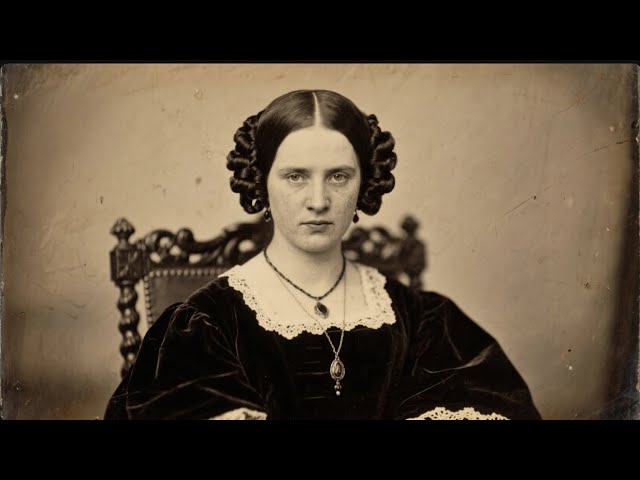
Whitfield had come to him complaining of fatigue and melancholy, and during the examination he had found evidence that she was pregnant, about four months along. This was a delicate matter, he wrote, because the lady’s husband had been away on business in Augusta for the past five months and had only returned for one weekend in July. The doctor had not yet told Mrs. Whitfield what he suspected, and he had told no one else.
He found himself caught between professional discretion and moral duty, knowing that if the truth got out, the consequences would be disastrous for everyone involved. Events would soon solve Dr. Harris’s moral problem for him. In November of that same year, while Thomas Whitfield was again away on business, his wife suffered a miscarriage.
Only two people were with her when it happened: Rebecca Turner, her ladies’ maid, and a man named Samuel, who had been Thomas Whitfield’s property since 1835. Samuel was sent to fetch the doctor only after the worst had passed, and Thomas was never told about the pregnancy or its loss. The hidden tragedy added another layer to the strange relationship that had been developing inside the Whitfield household, a relationship that would soon become the talk of Savannah. The first rumors about the Whitfield estate had begun to circulate in 1843.
The property stood about three miles from Savannah’s busy center, a two-story white colonial mansion with six large columns and a wraparound porch that overlooked nearby cotton fields. For years the name Whitfield had meant wealth, social standing, and unquestioned respectability. Thomas Whitfield had been one of the richest plantation owners in Chatham County, his family rooted in Georgia since the colonial days. But it was not his fortune that set the rumors moving through the city’s cobblestone streets.
It was the choice made by his widow after he died, a choice that would challenge the foundations of Antebellum society. Thomas Whitfield died on the 23rd of April, 1843, at the age of forty-nine. The official cause of death was apoplexy, a condition now known as a stroke. At the time of his passing he was one of the most important men in Chatham County, his opinion carrying weight in both business and politics.
More than three hundred people attended his funeral, including the mayor of Savannah and two state representatives. The procession from St. John’s Episcopal Church to Bonaventure Cemetery stretched nearly half a mile. Thomas was laid to rest in the Whitfield family mausoleum, a large structure of Georgia marble that still stands today, though the name carved into it has worn away with time and weather.
Ella Lenena Whitfield was twenty-six years old when she lost her husband. Census records show she had been married to Thomas for seven years and had borne no children. That fact alone placed her in a precarious position in the Georgia of the 1840s. A young widow of considerable property with no children was certain to attract attention, not all of it welcome.
But it was Ella Lenena’s actions in the weeks following her husband’s death that created a genuine scandal. Two weeks after the funeral, Ella Lenena summoned her husband’s lawyer, James Crawford, to the Whitfield estate. Crawford recorded in a private letter that he found the young widow calm and clear-headed, though somewhat changed in her manner. He assumed they would discuss the routine matters of probate and inheritance.
Instead, she made a request he could scarcely believe. Ella Lenena wanted to free one of her husband’s slaves, a man known only as Samuel, and name him as a beneficiary in the will. In Georgia in 1843, such a request was not merely scandalous; it was nearly revolutionary. The state possessed some of the strictest manumission laws in the South.
Under Georgia law, any freed slave had to leave the state within thirty days or risk being re-enslaved, and the legislature had passed statutes making it illegal to give property to enslaved people. What Ella Lenena proposed was not only a violation of social convention; it was against the law. Crawford was alarmed for her reputation at once. In a letter to his brother in Charleston, he wrote that he had told Mrs.
Whitfield in the strongest terms possible not to go through with her plan. He reminded her of her place in society and the damage that could never be repaired. She did not care what he said. She insisted it was her husband’s wish, even though no such provision existed in the will Crawford himself had written for Thomas the year before.
That discrepancy, between what Ella Lenena claimed and what the will actually said, was the first of many troubling questions in the case. If Thomas truly wanted to provide for Samuel, why had he not written those instructions into his own will? And if Ella Lenena had conceived the idea herself, what could possibly drive a young southern widow to risk her reputation, her inheritance, and possibly her freedom for one of her husband’s slaves? The answer, as is often the case, seemed to lie in the complicated relationships within the household itself.
Estate papers showed that Thomas Whitfield had bought Samuel in 1835, the same year he married Ella Lenena. Samuel was not a field hand. He was listed as a house servant and was worth the considerable sum of twelve hundred dollars, nearly double the going rate for an enslaved man. Such a high value suggested special skills or education, though the surviving records do not say what those were.
Samuel occupied an unusual place in the Whitfield household. Most enslaved people lived in separate quarters, but estate plans showed Samuel had a room in the carriage house, connected to the main house by a covered walkway. Household account books revealed that he received more than the usual rations of food and clothing, including tailored garments, books, and medical care from the same doctor who treated the Whitfield family, on at least three occasions, instead of the plantation physician. These details painted a picture of an enslaved man with unusual standing, but they did not explain why Ella Lenena would stake everything on his future.
The journal of Rebecca Turner, Ella Lenena’s ladies’ maid and one of the few people with close access to the family’s private affairs, offered some insight. Covering the years 1841 to 1844, Turner’s writings described day-to-day life in the Whitfield home and hinted at growing problems between Thomas and Ella Lenena. The marriage had become strained in the years before Thomas died. He was cold and often absent, frequently traveling to Savannah for work and social events, leaving his young wife alone at the plantation for weeks at a time.
During those absences, Turner recorded, Ella Lenena often sought out Samuel to read and talk with, finding him an educated person, something she did not have in her husband. This detail was significant, for literacy among enslaved people in antebellum Georgia was rare, actively discouraged, and often illegal. Samuel had somehow learned not only to read and write but had acquired enough knowledge to serve as an intellectual companion for the clearly well-educated Ella Lenena. Turner noted that her mistress would sometimes spend whole afternoons in the estate’s library with Samuel, the doors closed, discussing philosophy and literature.
Such behavior would have raised eyebrows even with a white man who was not her husband, let alone a slave. As 1842 wore on, Turner’s journal grew increasingly worried. In December of that year she recorded overhearing an argument between Thomas and Ella Lenena. Thomas allegedly threatened to sell the fellow down river, a common phrase meaning to send someone to the more brutal conditions of the Deep South.
Turner wrote that Ella Lenena’s response was unusually strong. I would rather see this house burned to the ground. The implications of these entries were hard to ignore, yet they remained frustratingly unclear. Was the relationship between Ella Lenena and Samuel merely that of intellectual friends, a lonely woman seeking conversation from a clever mind?
Or was there something more that would explain why she would risk everything to ensure his freedom and safety? The answer may lie in another document found with Turner’s journal, a letter from Dr. Harris that suggested Thomas Whitfield could not possibly have been the father of Ella Lenena’s unborn child. And if the child was not Thomas’s, there were few possibilities in the isolation of the plantation.
Circumstances intervened before Dr. Harris had to act on his discovery. The miscarriage in November 1842, witnessed only by Turner and Samuel, erased the evidence of the pregnancy. Thomas was never told.
If Samuel had been the father, Ella Lenena’s later determination to secure his future became not merely shocking defiance of social norms but an act of love and loyalty that transcended the harsh rules of her time. The story, however, was about to grow darker. When James Crawford refused to help Ella Lenena carry out her plan, she dismissed him as her lawyer. Two weeks later she retained Martin Hayes, an attorney recently arrived from Boston who was known to be sympathetic to the abolitionist cause.
Hayes agreed to draft documents for a complex legal arrangement that would technically comply with Georgia law while achieving Ella Lenena’s goals. The plan was audacious. For five dollars, Ella Lenena would sell Samuel to Hayes. Hayes would then transport him to Philadelphia and free him there.
Under Pennsylvania law, Samuel would return to Georgia not as a freed slave, which was illegal, but as a free black man from the North, a status still limited but legally recognized. Ella Lenena would establish a trust in Philadelphia, funded from the Whitfield estate, to provide Samuel with an income. It was a scheme that exploited loopholes in Georgia’s legal system, and it might have worked had it not been for the intervention of Thomas Whitfield’s brother, Charles. In May 1843, Charles Whitfield filed court records challenging both the validity of Thomas’s will and Ella Lenena’s right to sell estate assets.
He claimed she was not mentally stable and was being influenced by persons hostile to the family’s interests. He asked the court to block the sale of Samuel and any transfer of assets out of Georgia until the matter could be resolved. Judge William Parker granted the request and issued a temporary injunction. Ella Lenena was forbidden from selling any property, including slaves, or sending money outside Georgia.
The court also appointed a guardian ad litem to examine Ella Lenena’s mental fitness and determine whether she was truly capable of managing the large estate. In June 1843, the guardian, Dr. George Thompson, visited the Whitfield plantation three times. His report, still preserved in court records, painted a striking picture.
He found Mrs. Whitfield clear-headed and articulate, showing no signs of madness or mental weakness. She spoke clearly about business matters and demonstrated real command of her late husband’s affairs. Thompson noted, however, that she seemed deeply attached to her household staff, especially Samuel, whom she insisted on having present during all three interviews despite requests for privacy.
His conclusion was carefully worded. While he could not in good conscience declare Mrs. Whitfield mentally incompetent, he expressed concern about her judgment, particularly her stated intention to manumit and provide for certain enslaved persons. Such intentions, he wrote, revealed a disregard for social propriety that might indicate moral confusion, not rising to legal incompetence but nonetheless suggesting the wisdom of additional oversight of the estate’s disposition.
Judge Parker extended the injunction and appointed Charles Whitfield co-administrator of his brother’s estate. Charles would have to approve all major financial decisions, though Ella Lenena could remain in the family home with an allowance for her upkeep. Then, on the morning of the 17th of July, 1843, a house servant discovered that Samuel was missing from his room. There was no sign of him anywhere on the property.
Charles Whitfield immediately suspected that Ella Lenena had orchestrated the escape, possibly with the help of Hayes. He urged the sheriff to assemble a search party to recover the valuable property. Ella Lenena insisted she had no idea where Samuel was. Witnesses said she seemed genuinely upset by his disappearance, even offering a large reward from her own funds for information leading to his safe return.
That afternoon, the sheriff, several deputies, and a professional slave catcher with tracking dogs set out into the countryside. Three days later they returned with a grim discovery. Samuel’s body had been found hanging from a cypress tree in the swamp about two miles from the Whitfield property. The official report concluded that Samuel had attempted to escape, become lost in the swamp, and, realizing he would be captured, taken his own life rather than face punishment.
The authorities accepted this explanation without question. Samuel was buried in an unmarked grave at the edge of the Whitfield property, the custom for enslaved people. When Ella Lenena heard the news, she reportedly collapsed and remained bedridden for several days, sedated. When she recovered physically, people said she was changed: quiet, withdrawn, no longer the lively woman she had been.
She stopped contesting Charles’s control of the estate and retreated into an increasingly isolated life within the mansion. Had it not been for an entry in Turner’s journal dated the 3rd of August, 1843, the official account of Samuel’s death might never have been questioned. Turner recorded that Mrs. Whitfield had spoken to her for the first time since the bad news.
She said, They killed him, Rebecca. They killed him because he knew too much. When Turner asked what she meant, Ella Lenena went silent and would say nothing more. Turner concluded the entry with a worried observation about her mistress’s mental health and safety.
The entry raised a deeply troubling question. If Samuel had been killed rather than taking his own life, who was responsible? Charles Whitfield was the most obvious suspect, having the strongest motive to protect the family’s inheritance and social standing. But no direct evidence linked him to Samuel’s death, and many people had signed and verified the sheriff’s report.
What did Ella Lenena mean when she said Samuel knew too much? The most likely explanation concerned their relationship and her pregnancy. But Turner’s journal hinted at something else. In an entry from the 10th of June, 1843, while Dr.
Thompson was investigating Ella Lenena’s mental state, Turner wrote that Samuel had told her he did not believe Mr. Thomas had died of natural causes. He had suspicions but would not say more. He seemed scared and made Turner promise not to tell anyone, not even Ella Lenena.
This single entry introduced the most disturbing possibility of all: that Thomas Whitfield’s death might not have been from natural causes. If Samuel had reason to suspect Thomas had been killed, and if he had shared those suspicions with others besides Turner, there was a powerful motive to ensure he never spoke again. The historical record remains frustratingly silent on this point. No autopsy was performed on Thomas Whitfield’s body, common at the time when the cause of death appeared clear.
No mention of suspicious circumstances appears in any of Dr. Harris’s surviving letters, even though he signed the death certificate. If Thomas was indeed murdered, Samuel’s death took the truth with him. Ella Lenena Whitfield’s life for the next fifteen years followed a steady pattern of withdrawal.
She remained in the mansion but grew increasingly cut off from Savannah society. Charles Whitfield managed the estate until his death in 1851, after which control passed to Thomas’s younger brother, Edward. Though Ella Lenena had the legal right as a widow to reclaim control of her inheritance, she never attempted to do so. Tax records and business ledgers show the plantation continued to prosper through the 1840s and early 1850s, despite her apparent indifference to its operations.
Visitors described her as ghostlike, pale and quiet, drifting through the rooms of the big house as if searching for something lost. She rarely left the property and received few visitors. Martin Hayes, her former lawyer, was one of the few who maintained regular contact. Hayes had been removed from his formal role by the court’s injunction, but he continued to visit the estate approximately every three months, ostensibly to bring books and magazines from his frequent trips north.
Edward Whitfield grew suspicious and in 1854 filed a complaint with the Chatham County Sheriff, suggesting Hayes might be using his access for activities not beneficial to the public, a thinly veiled accusation of abolitionist organizing. The sheriff investigated but found no evidence to support Edward’s claims, and the visits continued. During these years, Ella Lenena kept a detailed private journal, writing down her thoughts and memories. No one has ever found this journal, if it still exists.
Hayes mentioned it in a letter to a colleague in Boston in March 1856. He wrote that Mrs. Whitfield continued to record the tragic events that had shaped her life, telling him the writings were not meant for people alive now, who would not believe or understand her story, but for future generations. There will come a time, she said, when the truth can be spoken without fear.
And on that day, I want my voice to be heard. If Ella Lenena hoped her journal would tell the full story of her relationship with Samuel, Thomas’s death, and everything that followed, she would be disappointed. On the night of the 12th of November, 1858, fire broke out in the east wing of the Whitfield mansion, where Ella Lenena’s private rooms were located. By the time the plantation slaves could organize to fight the flames, most of the main house was engulfed.
They found Ella Lenena’s body in her bedroom. The coroner ruled death by smoke inhalation, apparently while she slept. She was fifty-one years old. Most of her personal possessions, including her private journals and papers that might have explained the events of 1843, were lost in the fire.
Questions about the timing of the fire were never officially answered. Two weeks earlier, Edward Whitfield had died suddenly of what was called bilious fever. His son, Thomas Whitfield II, fresh from college in Virginia with modernizing ideas for the plantation, had taken charge of the estate. Plantation records show that Thomas II visited his aunt, whom he had not seen in years, on the afternoon before the fire.
What they discussed was not recorded. Without Ella Lenena’s testimony, the truth about her relationship with Samuel, the circumstances of Thomas’s death, and what really happened to Samuel may never be known. Official records and family histories say little. The Whitfield family remained prominent in Georgia until the Civil War destroyed their fortune, as it did for many Southern plantation families.
In 1872, Northern investors purchased the plantation and converted it to a timber operation. The partially rebuilt mansion served as housing for company managers until 1957, when another fire, this one caused by faulty electrical wiring, destroyed what remained of the original structure. Today the site lies within a private timber operation closed to the public. The only traces of its past are old foundation stones, hard to discern among the pines and undergrowth.
But the story refused to stay buried. In 1964, Elizabeth Montgomery, a graduate student at Emory University researching the legal status of women in antebellum Georgia, came across references to the Whitfield case in recently discovered court papers. Intrigued, she began assembling the puzzle, tracking down surviving letters, legal documents, and attempting to locate descendants of those involved who might have preserved family stories. Montgomery’s research brought her to Savannah in June 1968 to examine the original court documents found during courthouse renovations.
University records show she worked in the Chatham County Archives for three days before leaving her hotel for the site of the old Whitfield plantation. She never arrived at her meeting with the timber company manager who had agreed to take her to the property. Her rental car was found abandoned on a service road about a mile from the old plantation entrance. Local authorities searched extensively but found no trace of her.
The official conclusion was that Montgomery became lost in the dense woods, wandered into the swampy terrain surrounding the property, and likely died from exposure or an animal attack. The search was called off after several weeks. Dr. Harold Jenkins, Montgomery’s academic advisor, traveled to Savannah to collect her research materials and personal effects.
Among them was a tape recorder containing an audio diary from her research trip. On the final recording, made the night before she disappeared, Montgomery’s voice expressed growing certainty that she was dealing with a deliberate suppression of history. Someone had gone to great lengths to ensure the story would never be told. Tomorrow, she said, I will finally see the place where it all happened.
I cannot shake the feeling that the land itself might hold answers the documents do not. When Jenkins attempted to follow up on Montgomery’s research by requesting access to the same court records, county officials told him no such documents existed in their archives. He was told there must have been a misunderstanding when he insisted his student had been examining them just days earlier. The renovations had uncovered old building plans and some tax records, nothing related to the Whitfield case.
Whether the discrepancy stemmed from bureaucratic error, intentional confusion, or something worse was never established. Interest in the Whitfield case faded after Montgomery’s disappearance. Only a few scholars have attempted to investigate since, encountering unhelpful official channels and records said to be missing or destroyed by water damage. The truth about Ella Lenena Whitfield and her husband’s slave has remained obscured for more than 180 years.
Then, in the spring of 1969, nearly a year after Elizabeth Montgomery vanished, a package arrived at Dr. Jenkins’s office at Emory University. There was no return address, only a postmark from Savannah. Inside was a small leather-bound book with yellowed pages and a broken binding.
A brief note accompanied it: Found among my grandfather’s things. He was a groundskeeper at the old timber company. A young lady gave it to him to keep safe the day before she disappeared. I thought you should have it.
The book was a diary written by a woman between 1856 and 1858. Handwriting experts compared it to Ella Lenena Whitfield’s letters held in the Georgia Historical Society archives and found the script consistent. It appeared the plantation’s resident had hidden the diary and removed it just before the fire that killed her. The entries began sparsely, with notes on weather and household matters, but grew more revealing as Ella Lenena grew confident the diary was safe.
On the 12th of December, 1856, she wrote: 15 years since I lost them both, Thomas was my husband, but S was my heart’s true companion. Neither death was what the world thinks. Both haunt me equally. A passage from the 3rd of February, 1857, deepened the mystery.
Ella Lenena described a recurring dream: tea at dinner, face growing red, reaching for his throat as the poison took effect. My hand not on the decanter as memory serves, but on his shoulder, steadying him as though in concern. Whose hand then? I know, but cannot bear to write it, even here.
The implication was staggering. Thomas Whitfield may indeed have been poisoned, contrary to the official record. And Ella Lenena claimed she had been present when he died, had touched him as he fell, but had not administered the poison herself. Someone else in the household had put it in his drink, and she may have been unknowingly involved in her husband’s murder.
A later entry from the 28th of March, 1857, seemed to confirm the suspicion. MH, probably Martin Hayes, brought news that reopened old wounds. Edward had found letters. When S learned that T planned to sell him to separate us, he wrote to a man in Boston, an abolitionist with whom he had somehow established correspondence.
This man agreed to help S escape north. The plan was in motion when T died so unexpectedly. Edward believes I knew of these letters, that I conspired with S to eliminate T and free himself. He is wrong.
I knew nothing of S’s plans until after T was gone. If Ella Lenena’s private writings are to be believed, she had no part in any plot to kill her husband. The diary suggests Samuel had sought his own path to freedom, possibly because Thomas had threatened to sell him. If Samuel did poison Thomas Whitfield, he may have acted not only to prevent being sold away from Ella Lenena but to create an opportunity for escape that never came.
The diary contained another important revelation. An entry from the 17th of June, 1857: I sometimes dream of the child that never was. What would he have become? This impossible son of two worlds.
He would be 14 now had he lived. Would he have his father’s keen mind, his quiet dignity? Would he have my eyes, my restlessness? Some nights I imagine a different life entirely.
The three of us fled north to Canada or Europe, living openly as a family. A fantasy so forbidden I dare not whisper it even to these pages. The entry confirmed what had only been suspected: Ella Lenena and Samuel were in a romantic relationship, and she had carried his child. The miscarriage had ended that dream, but she had imagined a future with Samuel and their child in a world that made it impossible.
The diary’s final pages grew urgent. Edward grows suspicious of what I know. Yesterday, he questioned me about T’s final dinner. Details I have not thought of in years.
Does he suspect the truth after all this time? He watches me constantly. I fear what he might do if he confirms his suspicions. I have given my most important papers to MH for safekeeping.
But this diary I keep close. It alone contains the full truth. The last entry, dated the 10th of November, 1858, just two days before the fire, was the most chilling. Thomas II visited today.
He looks so much like his father, but there is something cold in his eyes that reminds me of Charles. He asked pointed questions about the old days, especially about S. How much has Edward told him? He looked at the east wing with unusual interest, especially my bed chamber.
I told Mary, presumably a house servant, to sleep in my dressing room tonight. I do not trust the look I saw in young Thomas’s eyes. Two nights later, the fire that began in the east wing killed Ella Lenena. The timing, along with her documented fear of Thomas Whitfield II’s interest in her bedroom, suggested her death might not have been an accident but the final step in a long campaign to suppress the truth of 1843.
Had Ella Lenena’s diary surfaced publicly, it would have altered the understanding of this antebellum drama. But Dr. Jenkins never published his findings. University records show he took an unexpected leave of absence shortly after receiving the diary.
The following year he retired early and moved to a small town in northern Minnesota, where he lived largely alone until his death in 1986. The diary was never found among his effects. Former colleagues recalled that Jenkins had grown increasingly paranoid in his final months at Emory, claiming he was being followed and that his office had been searched. Most attributed these fears to stress over Montgomery’s disappearance and his impending retirement.
In 1992, Jenkins’s daughter, Margaret Jenkins Cooper, spoke with a graduate student researching academic freedom in the 1960s. She said her father had indeed kept a small, very old diary locked in his desk drawer. He would sometimes stay up late reading it and taking notes. Once I asked him what it was, and he told me it contained a story that was still too dangerous to tell.
I thought he was being dramatic, but looking back, I wonder. After his retirement, he buried something in the backyard of our family cabin. He never told me what it was, but he made me promise that if anything happened to him, I should dig it up and take it to a historian he trusted, a woman at Columbia University. Nothing ever did happen to him.
He died peacefully in his sleep. I never did dig up whatever it was. The testimony suggests Jenkins may have hidden Ella Lenena’s diary rather than risk its destruction or suppression. If so, it might still be there, buried on the property of a cabin in rural Minnesota, one more layer of concealment in a story full of secrets.
Since the 1950s, the land where the Whitfield plantation once stood has changed hands many times. It now belongs to a private nature preserve closed to the public. Satellite images show the land has largely returned to forest, with little evidence of its plantation past. The mansion’s foundation stones, still visible in the 1960s, have been removed or sunk into the ground.
Nearby residents say the current owners, a conservation trust linked to several prominent Georgia families, have shown unusual interest in preventing archaeological research on the property. Survey permit applications are consistently denied on grounds of protecting natural habitat. Security guards patrol the boundaries and turn away historians attempting to study the site. This refusal to allow investigation, more than 180 years after the events in question, suggests the full story of Ella Lenena Whitfield, Thomas, and Samuel remains threatening to someone.
Perhaps it is merely discomfort with the complex, contradictory realities of the antebellum South, where strict racial hierarchies existed alongside relationships that crossed those boundaries. Or perhaps something more specific is at stake: family reputations, inheritance claims, or legal liabilities that could still be affected by revelations about events long past. The Whitfield name still carries weight in parts of Georgia. Descendants serve in state government, run businesses, and sit on boards of important cultural institutions.
A full disclosure of the family’s historical secrets could still have consequences today. In the summer of 2007, a group of Emory University students conducting an independent study project on historical research methods decided to visit the old Whitfield plantation site. Denied official permission, they entered the property at night seeking physical evidence of the plantation’s existence. An anonymous blog post, briefly published before being removed, described what they found.
Deep in the property, far from the road and reachable only by a nearly invisible footpath, they discovered what appeared to be the remains of a small building, like a cabin or outbuilding, deliberately concealed by vegetation. Near this structure stood a partially buried stone marker carved with the letter S. The students believed this might have been a secret memorial to Samuel, placed there by Ella Lenena or someone else who knew what had happened to him. Security guards discovered them before they could document their findings further.
No charges were filed, but university officials received a strongly worded letter from the property owner’s lawyers demanding they not trespass again. If the students’ discovery is accurate, it means someone, perhaps Ella Lenena herself, ensured Samuel would not be entirely forgotten. Some sign of his life remains on the land where he lived and died. The story of Ella Lenena Whitfield and Samuel exists in a strange space between history and legend.
The official records tell of a wealthy plantation owner who died of natural causes, a young widow who behaved strangely afterward, a valuable slave who died attempting escape, and a widow who lived alone until her death in a house fire. But the fragments that have surfaced over the years, Turner’s journal, Ella Lenena’s diary, the hidden grave marker, suggest a far different story of secret love, murder, conspiracy, and a truth so dangerous it has been suppressed for nearly two centuries. There remains a possibility that Ella Lenena’s full diary will be found, that archaeologists will gain access to the plantation site, or that a descendant of the Whitfield family will come forward with documents kept secret for generations. The complete truth remains elusive, buried under layers of time, bias, and deliberate obfuscation.
In the first entry of her recovered diary, dated January 1st, 1857, Ella Lenena may have had the last word: They will never understand what existed between S and myself. How could they? They see only categories, master and slave, white and black, proper and forbidden. They cannot imagine that two souls might recognize each other across such divides, that one might find in the most unlikely place the person who sees them truly.
For 15 years, I have carried the weight of this truth alone. I have paid for it with my freedom, my reputation, my child, and the life of the man I loved. Yet even knowing the cost, I would change nothing. To have known even briefly what it means to be fully seen and fully loved, this is worth any price.
In the world determined to keep us separate, we found each other. That is our victory. However short-lived, however tragic its end.






