In July of 1853, Amelia Stewart Knight was eight months pregnant, walking beside a wagon on the Oregon Trail in a dress that had not been washed in six weeks. The fabric was stiff with sweat and dried blood from a calf she had butchered three days earlier. It carried smoke and tallow and something deeper, something animal, something no modern nose has a name for. She kept a diary.
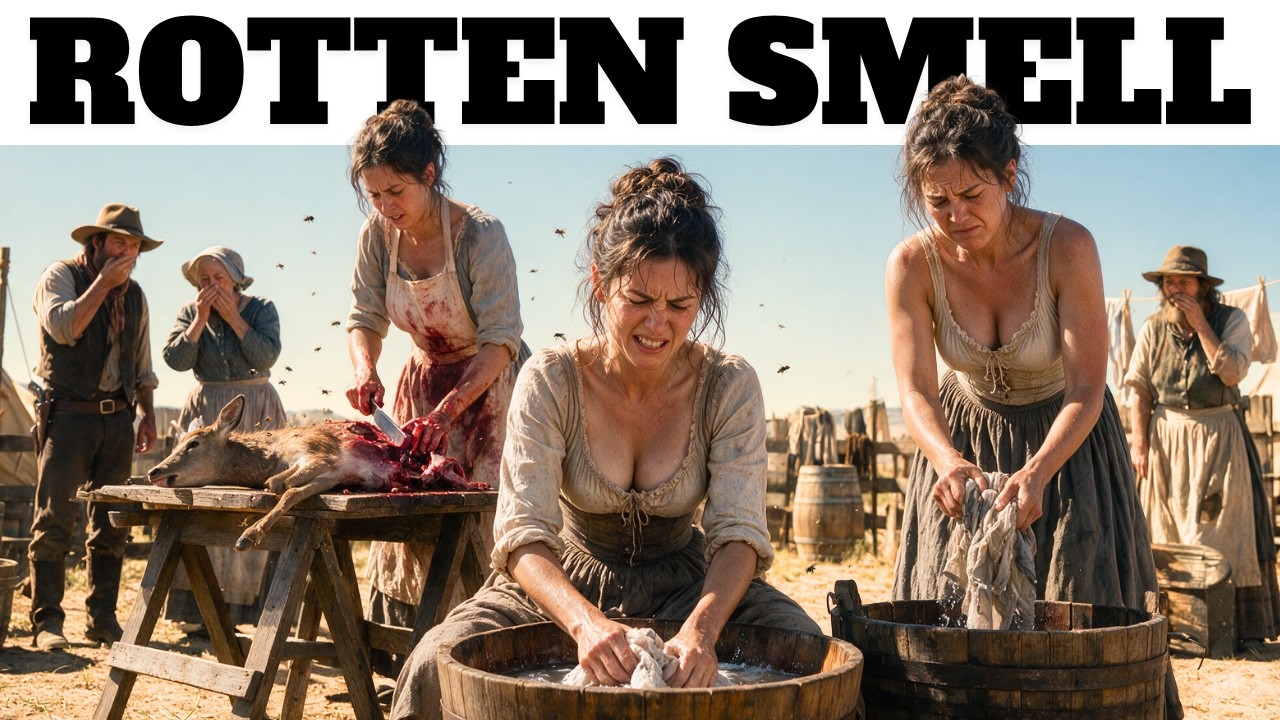
She recorded the weather, the river crossings, the graves beside the road. She never once mentioned the smell. The movies dressed women like her in pressed calico and clean bonnets. The truth is what those dresses actually carried.
To find it, you do not go to Hollywood. You go to the women who were there: the diaries they kept on the trail, the letters they mailed from sod houses a hundred miles from any town. Catherine Beecher published The American Woman’s Home in 1869. Dr.
William Buchan’s Domestic Medicine sat on cabin shelves from Missouri to Oregon, and that book, more often than not, was the doctor. Godey’s Lady’s Book printed advice on hygiene for women who could not afford better. These are the sources, not the screenwriters, not the costume departments, but the women themselves. They paint a world with no running water, no plumbing, and no privacy.
Water was hauled by hand, heated over fire, and rationed. On the trail, the animals drank first. A woman’s body came last, if it came at all. Today, the average American uses about eighty gallons of water a day without thinking.
A frontier woman was lucky to use three, and not one of those three was for bathing. Every frontier woman carried the smell of wood smoke whether she wanted to or not. An open hearth or a cast-iron stove burned all day in a cabin with poor ventilation, consuming pine, oak, cottonwood, and, on the plains, buffalo chips, whatever would burn. The smoke soaked into hair, skin, wool, cotton, everything she wore or touched, and it never washed out fully.
The Beecher sisters described it as a simple fact of domestic life, so constant it barely warranted mention. A woman who cooked three meals a day over an open fire stood in that smoke for hours. Her eyes watered, her lungs filled, and when she stepped outside, the smoke walked out with her in every thread. To a modern nose, it would be the first thing noticed on entering any pioneer home.
To the women who lived there, it was invisible. It was the air itself, and everything else sat on top of it. In winter on the plains, livestock shared the same structure as the family, or stood behind a thin partition wall. Cows, chickens, pigs, sometimes a horse if the weather turned deadly.
Homestead cabin records from land grant filings show the dimensions. One room, sometimes two. Fourteen feet by sixteen feet was common. A family of six on one side, animals on the other, and the wall between them doing nothing for the smell.
A woman milked twice a day, gathered eggs, slopped hogs, all before breakfast. Wet straw, manure, feathers, and urine soaked into a dirt floor that could not be scrubbed clean because it was not a floor at all. It was the ground. She tracked it back inside on the same boots she wore to cook supper.
In January, with the door shut and the fire burning and the cow breathing ten feet from the table, that cabin held the smell the way a jar holds water, sealed tight with nowhere for it to go. Every homestead ran on animal fat the way a modern household runs on electricity. Soap required it, candles required it, cooking required it. Rendering meant hours over an open fire boiling raw fat cut from a slaughtered hog or cow until it separated into tallow and cracklings.
The odor was thick and rancid, and it clung to hands and aprons for days. Household manuals of the period give the full recipe: lye and grease and patience. A frontier woman rendered fat several times a year, sometimes more, depending on the size of the household. Her hands smelled of tallow the way a mechanic’s hands smell of engine oil.
It was not filth. It was the residue of the work itself, and the work never stopped. Labor sweat, not exercise sweat, soaked through the layers. Twelve to sixteen hours a day hauling water, chopping wood, scrubbing floors, bending over a garden in July heat, carrying a child on one hip and a bucket in the other hand.
All of it done in layers: a cotton or linen shift against the skin, stays or a corset over that laced tight, trapping heat against the ribs, petticoats, sometimes two, a heavy dress on top. Clothing inventories from immigrant packing lists confirm it. Everything was dense, heavy, layered tight. No deodorant existed anywhere in the world, no antiperspirant.
The fabric trapped sweat and sealed it and held it close to the body all day and all night. A woman did not change out of her work clothes into something lighter. She slept in what she sweated in because she owned nothing else to change into. The only soap most frontier women had, they made themselves from scratch.
Wood ash collected from the hearth, leached with water to make lye, then boiled with rendered animal fat for hours. The result was a soft brownish soap caustic enough to strip skin raw if held too long. It did not smell like lavender. It smelled like what it was: alkali and rancid grease.
Castile soap existed in the cities, but it cost money most families did not have. A bar of store-bought soap was a luxury, something a woman might receive as a gift and hoard for special occasions. Medical guides of the era recommended washing sparingly with homemade soap because of what it did to the skin. The clean smell of the frontier was lye and ash, not what any modern person would call clean.
Leather boots, often handmade, were worn without socks or with one pair of knitted stockings rotated until they fell apart. Lodisa Frizzell’s 1852 trail diary records walking through mud and standing water for days at a stretch. Wet leather does not dry on a moving foot. The stitching loosened, the sole cracked, and the boots themselves began to rot while still being worn.
A new pair was not waiting in a closet somewhere. You wore them until they could not be repaired, and then you wore them a little longer. The smell was leather and sweat and something fungal underneath that never fully went away. These women walked miles a day, week after week, in the same shoes through dust and mud and river crossings, with no second pair and no dry ground to rest them.
The effort women made to hide the smell is itself a testimony to how bad it was. Vinegar rinses through the hair. Herb bundles of lavender and rosemary tucked into clothing and under pillows. Rosewater dabbed behind the ears, if you could find it or afford it.
Godey’s Lady’s Book printed recipes for homemade toilet water and sachets in the 1850s and sixties. Women on the homestead grew mint and sage, partly for cooking and partly because crushing the leaves between their palms was the closest thing to perfume they would ever own. These were masks, not solutions. If the smell had been bearable, no one would have tried this hard.
Hair was washed every few weeks at best, monthly on the homestead, even less on the trail. Between washes, women worked bear grease or tallow or macassar oil through it to keep it manageable and hold it in place under a bonnet. Those oils went rancid in the heat, and the hair itself absorbed every ambient smell around it: smoke, cooking fat, animal, sweat. Hair is porous.
It holds what it touches. Elizabeth Custer, writing about life on an army post in the 1870s, described grooming routines frontier women kept with the limited tools they had. The antimacassar, that cloth draped over the back of a parlor chair, existed for one reason and one reason only: hair grease stained furniture. That grease is what a pioneer woman’s head smelled like between washes.
The bonnet was not just modesty. It was containment. A full wash day was an entire day of brutal labor. Hauling water from a well or stream, heating it over fire in a heavy iron kettle, scrubbing each piece by hand on a ribbed washboard until your knuckles bled, wringing it out, hanging it to dry on a line or a fence, and praying it did not rain before the clothes were ready.
Frontier women did this weekly if they were fortunate and had water close by. Many did not. Catherine Haun’s 1849 trail diary describes going weeks without washing a single garment on the overland crossing. Amelia Stewart Knight recorded wash days as rare events worth noting, remarkable enough to write down.
Between washes, everything a woman had worn accumulated in the same fabric: smoke, grease, sweat, dust, food, blood. Layer after layer, day after day, the dress put back on and worn again and again. The shift, the thin cotton or linen garment worn against the skin, was supposed to absorb the sweat so the outer dress stayed wearable a little longer. But a woman on the trail might own two shifts and rotate them.
Trail provisioning records confirm it: one worn, one drying, washed when there was water and time, which was not often enough. The shift carried the full signature of the body underneath: sweat, skin oils, menstrual blood, urine traces. It was the garment closest to the skin, worn day and night, and it absorbed everything the body released. The most intimate garment was also the most saturated, and it was the one no one ever saw.
The dress on top told the public story. The shift underneath told the truth. Tooth decay was universal. No toothpaste, no toothbrushes a modern person would recognize, no dentist within a hundred miles.
A rag dipped in salt or baking soda was the best a woman could do, and many did not even have that. Clove oil for pain, extraction for everything else. Abscesses went untreated for weeks, sometimes months, swelling against the jaw until someone pulled the tooth with pliers or a turnkey. The pain alone was staggering, but the smell was something else entirely.
A rotting tooth gives off a sweetness that is not sweet at all, putrid and close. It came through on every breath, every word, every whisper to a child at bedtime. Period letters mentioned toothache as a constant companion on the frontier. A pioneer woman carried the smell in her mouth every time she spoke, every time she kissed her children good night.
Chamber pots sat under the bed for the long dark hours of winter, when a walk to the outhouse meant freezing wind and bare feet on frozen ground. Emptied each morning, sometimes not until midday if the morning pressed. Homestead inventories list chamber pots as standard household items, as ordinary as a skillet or a butter churn. In a closed cabin in the dead of winter, with a door sealed against the wind and the fire drawing every smell upward, that pot filled the room.
Human waste sitting open inches from where children slept. It was not an emergency and it was not a crisis. It was a Tuesday and Wednesday and every night after that until spring. No commercial menstrual products existed until the very end of the century.
Rags torn from old fabric or worn-out clothing, folded, pinned, held in place by friction and hope. Washed if water allowed, sometimes dried by the fire and reused without proper washing. On the trail, privacy was nearly gone. A woman changed her rags behind a wagon wheel if she was lucky, in a line of wagons stretching half a mile with families on every side.
Menstrual blood and layered clothing in summer heat was something every woman carried and nobody discussed, not once. The diary record is almost completely silent. Lillian Schlissel, who studied hundreds of women’s trail journals for her book Women’s Diaries of the Westward Journey, noted that silence as one of the most telling omissions in the entire archive. What is never written is often what was most deeply lived.
On the Overland Trail, weeks passed in the same dress, sometimes the only dress. Water was rationed for drinking and livestock and nothing else. Dust was so thick it caked on wet skin and turned to paste in the creases of the neck, the folds of the arms, and the corners of the eyes. Amelia Stewart Knight recorded river crossings, rainstorms, and dust storms, all endured in the same clothes day after day.
Sarah Raymond Herndon in 1865 described the grit that worked its way into everything: fabric, food, lungs. Lodisa Frizzell in 1852 wrote of mud that never dried and boots that never felt clean. A woman who had walked fifteen miles a day, cooked over buffalo chip fires, slept on the ground in a bedroll shared with children, and not bathed in six weeks did not carry one smell. She carried twenty, pressed together in one body, moving west one step at a time for months on end.
On many homesteads, tanning hides was the woman’s work. Leather did not arrive from a store. It was made by hand from a raw animal skin through a process that would make a modern person gag before they got within ten feet. The hide was soaked in a solution of water mixed with either urine or brains.
Brain tanning, the oldest method known to any civilization on Earth, combined putrefying organic matter and ammonia and wet raw skin meeting your nose all at once. It is one of the most overpowering things a human being can encounter, and the process took days. That stench stayed under her fingernails and in her hair long after the hide was finished. The leather that came out the other end was soft and strong and smelled nothing like the process that made it, but the woman who made it carried the process home on her skin.
Frontier medicine was applied to the body with consequences of its own. Sulfur paste for skin ailments, smeared on thick and left to dry. Turpentine rubbed on the chest for congestion, burning the skin underneath. Mustard plasters that raised blisters the size of a half dollar.
Poultices of onion and flaxseed and animal fat bound over wounds and infections with strips of cloth left in place for hours or days, until the poultice itself began to rot against the skin. Dr. Buchan’s Domestic Medicine prescribed every one of these remedies, and millions of frontier families followed his instructions by candlelight with no second opinion available. The smell was sharp and chemical, layered over whatever the body was already carrying underneath.
A sick frontier woman reeked of sulfur and turpentine and rotting poultice before you ever got close enough to notice anything else. She wore those poultices while she cooked, while she nursed her children, while she worked. The cure smelled worse than the illness, but the cure was all she had. Childbirth happened in blood and amniotic fluid and sweat in a cabin no bigger than a modern bedroom, in a bed that would be slept in again without changing the mattress.
A straw tick soaked through with fluid and blood could not simply be replaced. Straw was re-stuffed when available, and the old straw was often burned. A woman stayed in that bed for days or weeks afterward, a period they called lying in. The bedding absorbed everything her body released during the hardest hours of her life.
If the birth went well, the smell faded within days. If infection set in, the air in that room changed. It sharpened into something that made everyone present go quiet, because they all knew what it meant. Midwifery accounts from the period described childbed fever by its odor before its symptoms: a foul sweetish rot that told you a woman was dying before any other sign appeared.
The room was never larger than ten feet across, and the children were sleeping in it. Typhoid, cholera, and dysentery were the three killers of the trail, and each one announced itself through the nose before it showed on the skin. Cholera carried a sweet sickly odor that period doctors could identify from the doorway. They called it diagnostic.
Typhoid had its own musty fader that filled a closed room within hours of the fever setting in. Dysentery turned the air heavy with blood and bile and something worse underneath. In a one-room cabin with no ventilation, with children sleeping feet away, and no hospital to go to, and no doctor closer than two days of riding, a woman nursed the sick alone. Trail diaries record the cholera camps along the Platte River during the 1849 epidemic.
Narcissa Whitman’s letters from the Oregon mission describe nursing the dying in quarters so close you could touch both walls with your arms outstretched. A woman who tended a dying husband or child lived inside that for days. She did not leave the room. She was the room.
When someone died on the frontier, the body had to be washed, dressed, and prepared. Not by an undertaker, not by a stranger, but by the women of the household. A wife washed her husband. A mother washed her child.
In summer, decomposition began within hours; the August heat of the Kansas plains or the Nebraska prairie turned a body in the matter of a single afternoon. In winter, the ground was frozen too hard to dig, and the body might stay in the house for days while the men worked at the earth with picks and iron bars. What a human body becomes after death is something the living do not forget, no matter how many years pass. Burial records show the gap between death and burial stretching to days and sometimes weeks in the hardest weather.
A woman who lost a child in January lived with that in the same room where she cooked and slept and held her other children close. She kept going, because stopping was not something the frontier allowed. The final truth is not any single smell. It is the total: the smoke and the tallow and the sweat and the lye and the animal and the rancid grease in the hair and the menstrual blood in the rags and the chamber pot under the bed and the rot in the teeth and the sulfur on the chest and the hide stinking of brains under her fingernails, all of it on the same woman in the same dress on the same Tuesday afternoon in July.
A modern person encountering any one of these alone would recoil. A pioneer woman carried all twenty at the same time, and she carried them while hauling water, raising children, cooking meals, tanning leather, burying the dead, and walking a thousand miles beside a wagon. She did not notice, because every person within a hundred miles smelled the same. There was no clean room to step into, no shower waiting at the end of the day, no mirror to show her what the trail had done.
Just the next mile and the next chore and the next child pulling at her hem. Go back to Amelia Stewart Knight, July of 1853, eight months pregnant, walking the Oregon Trail in a dress she had worn for weeks. She wrote down the temperature. She wrote down the river crossings.
She counted the graves beside the road. She never mentioned the smell, not once. That silence is the loudest thing in the entire record. Hundreds of diaries survive from women on the trail and the homestead: letters, journals, memoirs written decades later.
Almost none describe body odor, not their own, not anyone else’s. Part of it was biology. The nose stops registering what it smells every day, a phenomenon called olfactory adaptation, the reason you cannot smell your own house. But it was more than biology.
It was decency and modesty, an unspoken agreement among women who shared the same hardship that certain things were too constant and too universal to need saying. Lillian Schlissel studied these diaries for decades and noted the systematic absence, the pattern of silence around the body and its realities. What these women chose not to write is itself the most honest testimony we have. Complaining about smell on the frontier was like complaining about gravity.
There was nothing to fix and no point in saying it. So they wrote about the weather instead. They wrote about the miles. They left the rest for us to figure out 170 years later.
The silence was replaced by a lie. Little House on the Prairie ran from 1974 to 1983 and dressed frontier women in laundered cotton every single episode. The bonnets were white, the aprons were pressed, the hair was clean and soft and caught the golden light of a Hollywood prairie that never existed. Western films from the forties and fifties put women in spotless dresses on mud streets next to men who had supposedly ridden four hundred miles without a change of clothes, and yet not a hair was out of place.
The costume departments knew what the frontier really looked like. They had historians on staff, advisers who told them the truth. They chose the lie, because the truth would have emptied the theater. A woman caked in smoke and grease and dried blood, with rancid hair pinned under a stained bonnet, walking beside a wagon in a dress so stiff with sweat it could stand on its own: that is not what sells a movie ticket in 1952.
So they erased it. Every image in your head of a pioneer woman in a clean dress on a sunny prairie was designed in a wardrobe department by people who understood exactly what they were painting over. The real women would not have recognized themselves on that screen. Amelia Stewart Knight reached Oregon.
She delivered her eighth child somewhere along the Columbia River in the fall of 1853. She never wrote down what she smelled like that day or any other day. She wrote down that the baby was healthy. She wrote down that the rain had stopped.
And then she closed the diary and got back to work.






