Margaret Morrison stood at the far corner of the birthing room, her hands still stained from the delivery, holding the newborn boy close to the lamplight. The clock had struck midnight moments before the child emerged, and now the wind howled against the cabin windows while snow piled against the doors. On the bed, Sarah McKenzie, nineteen years old and exhausted from eighteen hours of labor, called out weakly for her child. The baby had been crying, but his cries were gradually subsiding as Margaret stared at the mark covering nearly half of his left cheek.
It was dark and irregularly shaped, the kind of thing superstitious mountain folk might call a devil’s handprint. Agnes had noticed it first. She had been cleaning the infant when her eyes widened, and she had exchanged a glance with Margaret that carried meaning neither sister needed to speak aloud. Now Agnes whispered, her voice barely audible above the wind, “Sister, look at this mark.
It’s not natural. It’s too dark, too perfect in its evil. ”
Catherine approached at Margaret’s summons, wiping her hands on her apron, and gasped when she saw the birthmark. The three sisters huddled together, their faces lit by the dancing flame, as they whispered about what they were seeing.
To Margaret’s fevered imagination, the mark seemed to pulse with malevolent energy. She saw patterns within its borders that suggested demonic symbols. Years of intense biblical study filled her thoughts with images of spiritual warfare, and she remembered passages from Revelation about the mark of the beast. “We cannot allow this abomination to enter the world,” Margaret declared.
“God has placed this child in our hands for a reason. We must purify him before his corruption can spread. ”
Agnes nodded solemnly. “It would be a mercy.
To save him from a life of evil and save others from his influence. ”
What happened next would haunt them, though they would never admit it was wrong. Margaret placed her hands over the infant’s nose and mouth. The baby struggled briefly before his movements ceased, his tiny body going limp in her arms.
When Sarah awakened hours later, Margaret approached her bedside with carefully practiced grief, telling her that her baby had been born with complications and that his spirit had been called home to be with the Lord. Sarah’s anguished cries echoed through the cabin as the sisters comforted her, speaking of God’s mysterious ways. The infant was buried that same night behind the Morrison cabin, the first of many graves that would eventually become a secret cemetery. Margaret recorded the event in a journal she had begun keeping, writing in careful script: February 12th, 1834.
Purified one marked by darkness. The Lord’s work continues. The sisters told Sarah’s husband, Thomas, that the baby had been born with severe internal defects that made survival impossible. They described fictional complications that sounded medically plausible to uneducated mountain folk, and they offered to handle the burial arrangements as a gesture of Christian charity.
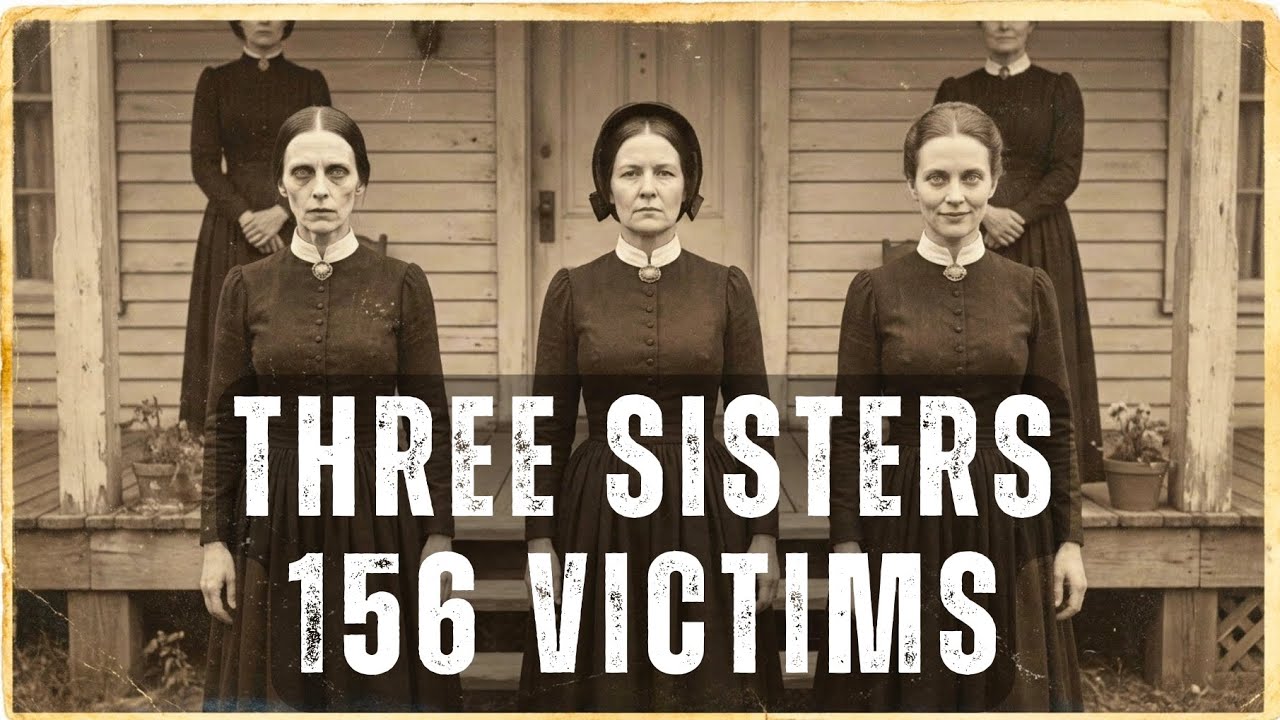
Thomas, grief-stricken and trusting, accepted their explanation and even thanked them for their kindness. The ease with which they had deceived the grieving parents disturbed and emboldened them. They began to see their deception as divinely inspired, a necessary component of their sacred mission. The Morrison sisters — Margaret, forty-two, with graying hair pulled back in a severe bun and pale blue eyes that held an intensity many mistook for religious fervor; Catherine, thirty-eight, sturdy and practical, the backbone of their operation; and Agnes, thirty-five, with dark hair and large expressive eyes that many described as angelic — were the most revered midwives in three counties.
They had been credited with safely delivering over eight hundred babies during their twenty-five-year practice. They lived in a modest two-story cabin perched on a ridge overlooking the Cumberland River, its lower floor converted into a birthing room with specially crafted beds, surgical instruments ordered from Louisville, and an extensive collection of herbs and remedies cultivated in their garden. The upper floor housed their personal quarters and what they called their prayer room, a space dedicated to their increasingly fanatical interpretation of Baptist doctrine. The Appalachian communities they served were predominantly Baptist with scattered Methodist congregations and the occasional Presbyterian family.
These were deeply devout people who saw God’s hand in every aspect of their lives, from the success of their crops to the safe arrival of their children. The nearest doctor lived three days’ ride away, and the arrival of a skilled midwife could mean the difference between life and death for both mother and child. The sisters charged modest fees, often accepting payment in the form of livestock, vegetables, or simple household goods, which endeared them to impoverished mountain families. Their daily routine reflected their deep religious convictions.
They rose before dawn for private prayer, spent their mornings tending to their medicinal garden, and devoted their afternoons to visiting expectant mothers or studying medical texts Margaret had acquired from a retiring doctor in Lexington. Their evenings were reserved for intense prayer sessions where they sought divine guidance for their calling. It was during these evening sessions that their interpretation of scripture began to evolve in ways that would have horrified their congregation. The transformation from respected midwives to something far more sinister began gradually.
It started with their interpretation of birthmarks, which they began to view not as natural variations but as literal marks of the devil. A strawberry birthmark on a child’s forehead became a sign of unholy influence. A port-wine stain on an infant’s cheek was interpreted as a mark of spiritual corruption. What began as troubling observations slowly evolved into a systematic belief that certain children were born already claimed by evil forces.
The isolated nature of their practice provided the perfect cover. When a child was born with what they considered a mark of the devil, they would dismiss family members from the birthing room, claiming the need for private medical procedures. The trusting families, already exhausted from labor and grateful for the sisters’ expertise, rarely questioned these requests. Throughout 1834 and 1835, the sisters performed dozens of legitimate deliveries, caring for mothers and babies with genuine skill and compassion.
But when infants were born with what they considered demonic markings, the routine became horrifyingly predictable. They would dismiss family members, then suffocate the babies quickly and quietly. They developed an elaborate system for explaining these deaths, creating fictional medical conditions with impressive-sounding names and describing imaginary complications. Their medical knowledge, combined with their religious authority, made their stories completely believable.
Agnes proved particularly skilled at comforting bereaved parents, her angelic appearance and soft voice providing solace to families destroyed by loss. Catherine took responsibility for the practical aspects of their secret cemetery, digging the tiny graves herself by moonlight and planting wildflowers and herbs around the grave sites to create the illusion of natural growth. By the end of 1835, the Morrison sisters had murdered twelve infants. They had perfected their methods, refined their explanations, and convinced themselves that they were performing the most important work of their lives.
The year 1840 brought unexpected complications. Rebecca Whitmore, a twenty-three-year-old mother from a prominent Methodist family, had requested their services for the birth of her third child. Unlike many of their previous clients, Rebecca possessed both literacy and a questioning nature. The delivery took place on a sweltering July evening, and when her daughter emerged with a deep red birthmark shaped roughly like a crescent moon covering her left shoulder and upper arm, Margaret recognized it as fitting their criteria for purification.
But Rebecca remained conscious and demanding throughout the process, insisting on holding her daughter immediately after birth. “What is this mark on her shoulder? ” Rebecca asked. “Is it something that will affect her health?
”
Margaret began to formulate one of their standard explanations, but Rebecca’s medical knowledge, gained from her educated upbringing, allowed her to recognize the birthmark as a common and harmless condition. “This is simply a strawberry hemangioma,” Rebecca declared, using medical terminology that surprised the sisters. “My cousin in Louisville had one very similar. It will fade as she grows older and poses no threat to her health.
”
She clutched her daughter protectively, her eyes moving between the three sisters as she noticed their unusual behavior. The sisters found themselves in an unprecedented situation. Their standard methods of deception would not work on an educated woman who understood basic medical principles. They could not claim the birthmark indicated fatal complications, nor could they convince Rebecca that her daughter was suffering from life-threatening conditions.
For the first time in their murderous career, they were forced to complete a delivery without performing their purification ritual. Agnes attempted to salvage the situation by focusing on spiritual concerns. “Sometimes these marks indicate spiritual challenges that the child will face,” she suggested carefully. “We should perform special prayers to protect her from evil influences.
”
But Rebecca dismissed such superstitions as outdated thinking. “My daughter is perfectly healthy and blessed by God. I will not have her subjected to unnecessary rituals or treatments. ” She named the baby Grace and insisted on taking her home immediately.
The sisters watched helplessly as Rebecca departed with her marked child, carrying what they believed to be a vessel of evil influence into the world. Their failure to perform their divine duty filled them with anxiety and dread. They spent the following days in intense prayer, and Margaret’s journal entries from this period reveal her growing paranoia and obsession. She became convinced that their failure to purify the child would lead to increased demonic activity in the region.
Over the following months, they monitored the Whitmore family obsessively, interpreting every normal aspect of infant behavior as potential evidence of demonic activity. When Grace smiled, they saw evidence of unholy joy. When she cried, they interpreted it as the voice of evil demanding attention. Their growing anxiety led to more frequent purifications throughout 1840 and 1841.
They murdered eighteen infants during this period, each death justified by increasingly minor physical characteristics. A slightly asymmetrical ear became evidence of demonic distortion. A birthmark smaller than a pea was interpreted as a hidden mark of evil. Their paranoia had transformed them from selective killers into indiscriminate murderers who saw threats in every unusual physical characteristic.
They developed elaborate rituals around their purifications, creating detailed ceremonies involving prayer, scripture reading, and what they called purification blessings performed over each victim before and after death. The psychological strain began to take its toll. Margaret developed severe insomnia and began to experience what she described as divine visions. Catherine became increasingly withdrawn, spending long hours in solitary prayer and showing signs of depression.
Agnes began to display symptoms of religious hysteria, speaking in tongues during their prayer sessions and claiming to receive direct communications from angels. The winter of 1847 marked a turning point that would nearly expose their secret. Mary Katherine Sullivan, a sixteen-year-old Irish immigrant, had arrived in the mountains with her husband Patrick seeking refuge from the potato famine. Expecting their first child, she went into labor during a brutal February cold snap, and the sisters had to use snowshoes to reach the Sullivan cabin through a blizzard that howled through the mountains like a banshee.
The isolation was complete. Mary Katherine’s labor was difficult and prolonged, lasting nearly twenty-four hours. When the baby finally emerged, Agnes immediately noticed the distinctive birthmark covering the infant’s right cheek and extending down his neck. The mark was dark and irregularly shaped, resembling what superstitious minds might interpret as a clawed hand.
But Mary Katherine Sullivan was not like their previous victims’ mothers. Despite her youth and exhaustion, she possessed an Irish spirit that refused to be easily deceived. When Margaret began to move the baby away from her, claiming the need for medical examination, Mary Katherine struggled to sit up. “Give me my baby,” she insisted.
“I want to hold him now. ”
Agnes attempted to distract her while Margaret prepared for the purification ritual. “You need to rest, dear. Let us clean him properly, and then you can hold him.
”
“There’s something you’re not telling me,” Mary Katherine declared, her accent becoming more pronounced with emotion. “What’s wrong with my baby? Why won’t you let me see him? ”
Catherine gently restrained her, speaking in soothing tones about the need for maternal rest.
The sisters found themselves in an impossible situation. They could not perform their purification ritual with Mary Katherine awake and alert, but they could not allow the marked child to survive. Margaret made a decision that would haunt them for years. She decided to proceed despite the mother’s presence, believing they could convince her afterward that the baby had died from natural causes.
As Margaret held the infant and began to place her hands over his nose and mouth, Mary Katherine caught a glimpse of the action in the reflection of a mirror on the cabin wall. She saw Margaret’s deliberate movements, saw the way the baby struggled briefly before going still, and realized with horror that she was witnessing the murder of her own child. “Sweet Jesus, what are you doing? ” Mary Katherine screamed.
She lunged forward with superhuman strength, breaking free from Catherine’s restraining hands and reaching for her baby. But it was too late. The infant was already dead, his tiny body limp in Margaret’s arms. The sisters had never been confronted with a witness to their actions.
Mary Katherine fought like a wildcat, clawing and scratching at Margaret while screaming accusations in both English and Gaelic. The sisters were forced to physically restrain her, holding her down while Margaret began the familiar litany of explanations about complications and divine will. But Mary Katherine was not convinced. “You killed my baby,” she shrieked.
“You’re murderers, devils. I’ll see you all hang for this. ”
Margaret made another fateful decision. Rather than attempting to silence Mary Katherine permanently, she chose to rely on the isolation of their location and the young woman’s status as a foreign immigrant.
“Who will believe you? ” Margaret asked coldly. “You’re a foreign woman barely able to speak proper English claiming that respected midwives are murderers. We’ve delivered hundreds of babies safely.
You’ve just lost your mind with grief. ”
The psychological warfare that followed was as cruel as the physical murder they had committed. The sisters spent hours convincing Mary Katherine that she was delusional, that her grief had caused her to imagine things that never happened. They quoted scripture about the dangers of false witness, reminded her of their reputation, and suggested that her accusations would only bring shame and suspicion upon herself and her husband.
Agnes played her role perfectly, weeping sympathetically while insisting that Mary Katherine’s accusations were breaking her heart. The manipulation was devastatingly effective. Mary Katherine, isolated in a foreign land with no family support and limited English skills, began to doubt her own perceptions. The sisters’ reputation for skill and compassion seemed to contradict what she thought she had witnessed.
Perhaps her grief really had caused her to imagine things. But deep in her heart, Mary Katherine knew what she had seen. She knew that her baby had been murdered, and she knew that the Morrison sisters were not the holy women they pretended to be. She also understood that she had no power to convince anyone of the truth.
Patrick Sullivan arrived the next morning, having fought his way through the snow drifts. The sisters met him with carefully prepared explanations about complications during birth and the tragic loss of his son. Mary Katherine tried to tell her husband what she had witnessed, but Patrick was overwhelmed by grief and confused by his wife’s wild accusations. The sisters’ reputation and gentle manner convinced him that his wife was indeed suffering from grief-induced delusions.
He thanked them for their kindness and accepted their offer to handle the burial arrangements. The baby was interred in the sisters’ secret cemetery, bringing their total number of victims to sixty-three. In the days that followed, the sisters developed new methods for ensuring that mothers remained unconscious during purification rituals and created more elaborate systems for explaining infant deaths. They also began to carefully monitor the families of their victims.
But Mary Katherine Sullivan would not forget what she had seen. Although she never found anyone who believed her story, she carried the knowledge of the Morrison sisters’ crimes for the rest of her life. The year 1856 brought with it a convergence of events that would finally expose their twenty-two-year reign of terror. Dr.
James Whitmore, Rebecca’s husband and now a prominent physician in the region, had been quietly investigating unusual patterns in infant mortality rates throughout the mountains. His medical training had led him to notice statistical anomalies that others had missed. He had been collecting birth and death records from various mountain communities, and what he discovered was deeply troubling. The Morrison sisters’ delivery success rate was actually lower than the regional average, despite their reputation for skill and expertise.
More specifically, infants born with visible birthmarks or minor physical abnormalities had a mortality rate nearly three times higher than the regional average when delivered by the Morrison sisters. The pattern became impossible to ignore when Dr. Whitmore cross-referenced his data with testimonies from grieving families. Time and again, he found stories of babies who had been born apparently healthy but died suddenly from mysterious complications the sisters claimed to have discovered.
His investigation took on personal urgency when he remembered his own daughter Grace, now a healthy twelve-year-old whose strawberry birthmark had faded to a barely visible pink spot on her shoulder. He recalled the sisters’ strange behavior during Grace’s birth and began to wonder if she had narrowly escaped some terrible fate. The breakthrough came when Dr. Whitmore encountered Mary Katherine Sullivan at a Methodist revival meeting in the spring of 1856.
Mary Katherine, now the mother of three healthy children born with the assistance of other midwives, had never forgotten what she witnessed. When she learned that Dr. Whitmore was investigating infant deaths, she finally found someone who might believe her story. She described in vivid detail how she had witnessed Margaret Morrison deliberately suffocate her newborn son, how the sisters had psychologically manipulated her afterward, and how they had buried her baby in secret while claiming he had died from natural causes.
Armed with Mary Katherine’s testimony and his own research, Dr. Whitmore began to approach other families who had lost children under the sisters’ care. Gradually, disturbing patterns began to emerge. Thomas McKenzie, whose son had been the sisters’ first victim twenty-two years earlier, admitted that he had always wondered about the sisters’ insistence on handling all burial arrangements privately.
Elizabeth Crawford revealed that the sisters had seemed strangely unsurprised when her daughter died. Jacob Morrison, no relation to the sisters, mentioned that his wife had reported strange behavior from the midwives during their son’s birth, including whispered conversations and unexplained delays in allowing her to hold the baby. The discovery that sealed the sisters’ fate came on a gray October morning in 1856. Dr.
Whitmore, accompanied by Sheriff William Hayes and several armed deputies, arrived at the Morrison cabin with a warrant to search the property. The sisters, now in their sixties, initially attempted to maintain their facade of innocent midwives being persecuted by malicious rumors. But when the search party examined the area behind the cabin that Mary Katherine had described, they made a discovery that defied belief. The ground revealed evidence of more than one hundred small graves, each carefully marked with wooden crosses that had weathered and fallen over the years.
The tiny skeletons told a horrifying story of systematic infanticide spanning more than two decades. Many of the remains showed evidence of the physical characteristics the sisters had deemed worthy of purification: skulls with formations indicating cleft palates, extra ribs suggesting additional digits, and other minor variations. But the most damning evidence came from Margaret Morrison’s own hand. Hidden in a secret compartment within the walls of their cabin, the search team discovered the sisters’ meticulously kept journals.
These documents provided a complete record of their crimes, filled with religious justifications for each murder. Sheriff Hayes read from one entry: March 15th, 1841. Purified infant bearing the mark of the beast upon his forehead. The family has been comforted with knowledge of the child’s salvation.
God’s work continues through our faithful hands. Confronted with undeniable evidence, their carefully maintained facade finally crumbled. Margaret initially attempted to justify their actions by explaining their divine mission, speaking passionately about their religious duty. Catherine broke down completely, sobbing as she confessed to her role in the murders while insisting she had only followed Margaret’s guidance.
Agnes displayed the most disturbing reaction, showing no remorse and continuing to insist they had performed sacred work. As news of the arrests spread throughout the mountain communities, the reaction was one of shock, horror, and disbelief. Parents who had lost children under the sisters’ care were forced to confront the possibility that their babies had been murdered rather than claimed by natural causes. Mary Katherine Sullivan experienced a complex mixture of vindication and renewed trauma.
After years of carrying the burden of knowledge no one would believe, she finally had proof that her memories were accurate. The trial began in the spring of 1857, transforming the small courthouse in Harlan County into the center of national attention. Newspaper reporters arrived from as far away as New York and Philadelphia. The prosecution, led by Commonwealth Attorney Robert Sterling, relied heavily on the sisters’ own journal entries and the testimony of Mary Katherine Sullivan.
Dr. Whitmore’s testimony provided crucial scientific evidence about the patterns of infant mortality and the statistical impossibility of the deaths being natural. Mary Katherine’s detailed account of witnessing her son’s murder, delivered in her still noticeable Irish accent, brought many spectators to tears. The defense, led by attorney Jonathan Morrison — again, no relation to the defendants — argued for mercy based on the sisters’ apparent religious delusions and their genuine belief that they were performing divine work.
Character witnesses testified about the sisters’ reputation for piety. But expert testimony from ministers and theologians unanimously condemned the sisters’ interpretation of scripture as heretical and dangerous. Margaret Morrison’s testimony on her own behalf was perhaps the most chilling moment of the trial. Speaking in the same calm, measured tones that had comforted so many grieving families, she explained her theological justification for the murders.
“We were instruments of divine mercy,” Margaret declared, her pale eyes fixed on the jury. “Those children would have lived lives of corruption and evil, spreading darkness wherever they went. By purifying them in infancy, we saved their souls and protected countless others from their influence. I believe with all my heart that God will bless us for our faithful service to his holy will.
”
Catherine’s testimony revealed how she had initially resisted Margaret’s interpretation but had gradually been convinced. Agnes maintained her disturbing calm, showing no recognition of the horror of their crimes. The trial revealed that the sisters had kept detailed records not only of their victims but also of children they had delivered safely, noting with disappointment when babies they considered borderline cases for purification had been allowed to live. Their criteria had expanded to include subtle variations in skin tone, unusual hair patterns, and even what they considered spiritually significant birth timing.
The jury deliberated for only three hours before returning guilty verdicts on all charges for all three sisters. Judge Harrison Caldwell sentenced Margaret Morrison to death by hanging, calling her crimes an abomination against God, nature, and human decency. Catherine and Agnes received life sentences in consideration of their apparent subservience to Margaret’s leadership. Margaret Morrison was executed on October 15th, 1857, in front of a crowd of nearly three thousand spectators who had traveled from throughout Kentucky and neighboring states.
She maintained her religious delusions until the end, spending her final moments on the gallows praying for the souls of the children she had murdered and expressing confidence that God would reward her for her faithful service. Catherine Morrison died in prison in 1864, reportedly from a combination of tuberculosis and what prison officials described as a complete mental breakdown. She had spent her final years in a state of deep depression and religious obsession, constantly praying for forgiveness while maintaining that she had only followed her sister’s guidance. Agnes Morrison lived until 1871, spending fourteen years in prison while continuing to insist that their actions had been divinely inspired.
She died unrepentant. The secret cemetery was consecrated as a proper burial ground, with each tiny grave marked with a headstone bearing the inscription “Unknown child, victim of madness. ” The site became a place of pilgrimage for affected families. Dr.
James Whitmore continued his medical practice and became a leading advocate for improved training and regulation of midwives throughout Kentucky, establishing a scholarship fund in memory of the sisters’ victims. Mary Katherine Sullivan became something of a folk hero in the region, celebrated for her courage in finally speaking the truth. She used her new-found voice to advocate for immigrant rights and women’s protection, drawing on her experience of being dismissed and disbelieved to help other marginalized voices be heard. The case of the Morrison sisters sent shockwaves throughout American society, leading to increased scrutiny of medical practitioners and calls for better oversight of religious communities.
The one hundred fifty-six innocent children who died at the hands of the Morrison sisters were finally given the justice they deserved, though that justice came far too late to save their lives. Their memory serves as a reminder that every life has value, regardless of physical characteristics or perceived imperfections, and that no religious or medical authority justifies taking innocent life. The Morrison sisters believed they were saving souls, but they were nothing more than murderers who used faith as a mask for their crimes.






