The storm had been building all day, and by the time the household gathered in the parlor, thunder rolled low over the Louisiana horizon. Candles flickered in their holders, casting long shadows across the polished floors. The whites sat in neat rows of chairs, the slaves stood at the back, heads bowed. It was the evening before Easter, and Reverend Morrison had come to conduct a special prayer service meant to demonstrate the divine order of the household.
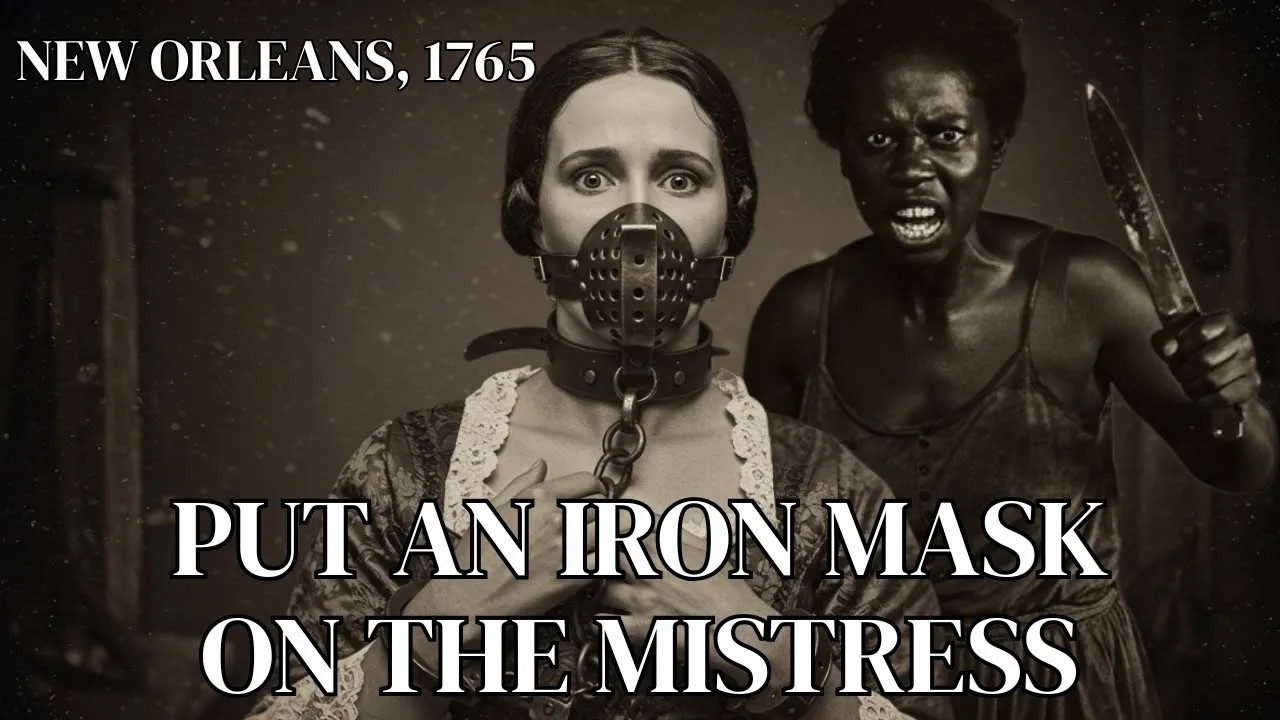
Anastasia stood among the slaves with the iron mask hidden beneath her dress, its cold weight pressed against her skin like a promise. She was seventeen years old, the daughter of a woman who had been forced to wear that mask for three weeks after being caught teaching another slave to read. The iron contraption covered the lower half of the face, leaving only the eyes visible, and it served two purposes: to prevent slaves from eating sugarcane or cotton seeds while working, and to silence those who dared to speak against their masters. Her mother’s face was permanently scarred from repeated use.
Anastasia had watched her struggle to eat through the wounds, had cleaned the raw skin night after night, and she had memorized every detail of the mask’s construction from the crack in the wall of the slave quarters where she pressed her face each morning. The parlor of the Bogard mansion was a monument to wealth built on human bondage. The four-poster beds upstairs were draped in silk from France, the dining table was mahogany, and oil paintings of stern-faced ancestors hung on every wall. Mistress Katherine Bogard clutched a leather-bound Bible that never seemed to leave her hands and attended every service at St.
Louis Cathedral, and yet her cruelty intensified during religious seasons, as if their suffering somehow purified her own soul. She was forty-two years old, and she kept a collection of iron masks and other instruments of punishment in a locked storage room in the basement. On the morning of Palm Sunday, Anastasia had watched her mother stumble toward the cotton fields with the iron mask gleaming dully against her dark skin. She made a silent promise that the mask would not have the final word.
For days she had observed the household routines, the locked drawers, the comings and goings of the family. On Tuesday, while polishing the furniture in Mistress Bogard’s private chambers, she had been left alone long enough to open the desk drawer and memorize the shape of the brass key that led to the basement storage room. That afternoon, while the family entertained early guests, she had made her way to the basement and found the masks hanging on hooks along one wall like grotesque trophies. She selected one similar to her mother’s, examined the locking mechanism, took the mask and its key, and hid them beneath a pile of laundry.
Now, as Reverend Morrison launched into his sermon, she listened to him speak of obedience and submission, of the natural hierarchy that placed whites above blacks. He quoted scripture with the practiced ease of someone who had spent years twisting holy words to justify unholy acts. The Apostle Paul tells us that slaves should obey their earthly masters with fear and trembling, he said, his eyes sweeping over the assembled slaves. This is not merely a social arrangement but a divine commandment.
Your suffering in this life prepares you for glory in the next. The iron mask, he continued, is not merely an instrument of discipline but a symbol of the silence that the faithful must maintain in the face of God’s will. The hypocrisy was so complete that Anastasia felt something break inside her chest. She moved slowly toward the front of the room, barefoot and silent on the polished floor.
The other slaves remained motionless, focused on the reverend’s words. She was only a few feet behind Catherine’s chair when she reached beneath her dress and felt the cold metal of the mask. As another clap of thunder rolled across the sky, she stepped forward and spoke. I have a question for you, Reverend.
If silence is so holy, if submission is so sacred, then surely our mistress would welcome the opportunity to experience this divine blessing herself. The room erupted in shocked gasps. Catherine spun around, her face contorting with rage, but before she could speak, Anastasia lunged forward and grabbed her by the shoulders, pulling her from the chair. The iron mask was in her hands, and with deliberate, almost ritualistic movements, she forced it over Catherine’s face and secured the straps behind her head.
The lock clicked into place within seconds. Catherine Bogard found herself silenced by the same instrument she had used to torture countless slaves. Now you know, Anastasia said, her voice carrying clearly through the pandemonium. How it feels to wear the mask of your own making.
Master Bogard was the first to recover. Seize her, he roared, pointing with a trembling finger. Seize that devil. Samuel the overseer lunged forward, but Anastasia had anticipated this moment.
She dodged his grasping hands and backed toward the door, holding the key to Catherine’s mask high above her head where everyone could see it. One step closer, she called out, and I throw this key into the storm. Your precious mistress can wear that mask until it rusts off her face. The threat stopped Samuel in his tracks.
Outside, the storm had intensified, rain lashing against the windows and wind howling through the trees. If the key were lost in that tempest, it might never be found. Reverend Morrison stepped forward, his face pale. Child, you don’t understand the magnitude of your sin.
Release your mistress immediately and perhaps God’s mercy. God’s mercy, Anastasia’s laugh was sharp and bitter. Where was God’s mercy when my mother wore this same mask for weeks? Where was his mercy when you preached that our suffering was his will?
Catherine continued to struggle with the mask, her elegant dress disheveled, her carefully arranged hair falling loose around her shoulders. The iron contraption that she had wielded as an instrument of power had become her prison. The other slaves stood frozen at the back of the room, caught between terror and awe. Some looked toward the door, calculating their chances of escape, while others seemed paralyzed by the unprecedented nature of what they were witnessing.
In the flickering candlelight, Catherine caught sight of herself in the large mirror that hung on the parlor wall. The image that stared back at her was one she had never imagined: herself as the victim rather than the perpetrator of the mask’s cruelty. She began to understand the true nature of what she had been inflicting on others. Anastasia continued to speak, her voice carrying a strange calm that cut through the hysteria.
She quoted scripture back to them. It says that God hears the cries of the oppressed. It says that the last shall be first and the first shall be last. It says that those who bind others will themselves be bound.
She spoke of justice, of the instruments of torture turned back upon their makers. Master Bogard took a step forward, his face contorted with rage. Enough of this blasphemy. Samuel, take her down.
But Anastasia was ready. As the overseer moved toward her, she threw the key with all her strength toward the open window. The small piece of metal disappeared into the storm, swallowed by the wind and rain. Now, she said, your mistress will wear that mask until you can find another key, and every moment she spends in iron will be a moment when she understands what she has done to us.
The hands that seized her belonged to Samuel and two of the male house slaves pressed into service by Master Bogard’s desperate commands. But even as they restrained her, Anastasia could see the conflict in their eyes, fear of punishment warring with admiration for what she had accomplished. Get the blacksmith, Master Bogard commanded. Wake him if you have to.
We need those locks removed immediately. Sir, Samuel replied hesitantly, the blacksmith lives in town, and with this storm. Then send riders. Send as many as it takes.
Catherine stopped her frantic clawing at the mask and stood perfectly still, her breathing rapid and shallow through the metal. Anastasia could see the moment when true understanding began to dawn in her mistress’s eyes. Look at her, she said. Really look at her.
See how the iron cuts into her skin. Feel how heavy it is. How it makes every breath a struggle. This is what my mother endures whenever you decide she needs correction.
Master Bogard struck Anastasia across the face with the back of his hand, hard enough to split her lip. Silence. You will not speak of your betters in such a manner. But the physical pain was nothing compared to what she had already endured, and she continued speaking as if the blow had never landed.
She spoke of the natural order, of all people created equal in God’s sight, of a system that turned human beings into property and called it holy. The other slaves listened to every word, their faces showing a mixture of terror and wonder. A seed of rebellion was already taking root. Catherine suddenly collapsed to her knees, the weight of the iron mask and the psychological pressure of her situation finally overwhelming her.
None of the white guests moved to assist. It was Marie, the personal maid who had served the family for over a decade, who stepped forward and gently helped her to her feet. Thank you, Catherine whispered through the mask, the words barely audible but carrying a weight everyone could feel. For the first time in her life, she was expressing gratitude to a slave, not for service rendered, but for simple human kindness in a moment of vulnerability.
Do you see? Anastasia asked. Even now, in your moment of greatest need, it’s one of us who shows you mercy. The riders were sent, but with the storm, it would be hours before the blacksmith could arrive.
The word hung in the air like a physical presence. Catherine would have to endure the iron mask for hours, experiencing firsthand the torture she had inflicted on others. Perhaps, Reverend Morrison said slowly, this is indeed God’s will. Perhaps he is teaching us all a lesson about mercy and justice.
Master Bogard turned on him with fury. How dare you suggest that this rebellion is God’s will? Is it? Morrison’s voice was thoughtful now, as if he were genuinely questioning his earlier certainties.
Or is it justice finally being served? The theological implications of what had occurred were beginning to sink in. If slavery was truly God’s will, then why had he allowed this reversal to take place? If the iron mask was a righteous instrument of discipline, then why did it seem so cruel when applied to a white woman?
Anastasia watched the doubt spreading through the room like a contagion. She had accomplished more than just forcing Catherine to wear the mask. She had planted seeds of doubt about the entire system that supported slavery. The blacksmith arrived near midnight, but the complexity of the lock and the need to avoid injuring Catherine made the removal process painstakingly slow.
Throughout the long night, Anastasia remained under guard, her hands bound, her spirit unbroken. Catherine’s muffled sobs, her desperate attempts to find a comfortable position, the way the metal chafed her skin raw, all of it served as a powerful testimony to the suffering that slaves endured regularly. When the mask was finally removed in the early hours of Good Friday, Catherine’s face was marked with deep red welts. Her lips were swollen, her eyes red from crying, and her voice was hoarse.
But it was the look in her eyes that had changed most dramatically. The certainty and arrogance that had once defined her had been replaced by something that looked almost like understanding. Water, she whispered, her first word after the mask’s removal. Marie brought her a glass, and Catherine drank slowly, as if rediscovering the simple pleasure of swallowing without obstruction.
Reverend Morrison, who had spent much of the night in what appeared to be deep theological contemplation, spoke up. Perhaps we should consider what lesson God is trying to teach us through these events. I think, he replied carefully, that we have been forced to confront truths we have long avoided. When I watched Mrs.
Bogard struggle with that mask, I found myself questioning everything I have preached about the righteousness of our cause. The admission sent a shock through the room. If Reverend Morrison, the theological architect of their justifications for slavery, was beginning to doubt, then the entire foundation of their world was cracking. Catherine, still recovering from her ordeal, looked directly at Anastasia.
Why? she asked. Why did you do this to me? Because you needed to understand.
Because someone had to show you what you’ve been doing to us. Because the only way to break a cycle of cruelty is to force the cruel to experience their own medicine. Catherine’s hand moved unconsciously to her throat where the mask’s straps had left deep marks. I never realized, she said.
I never understood how much it hurt. Now you do. Now you know what my mother feels every time you decide she needs to be silenced. Mrs.
Tibido finally spoke. What are we going to do? We can’t simply pretend this never happened. No, Catherine said slowly, her voice hoarse but growing stronger.
We can’t. She looked around the room at the assembled slaves. I owe you all an apology. The words fell into the room like stones into still water.
Never before had any of them heard a white person, let alone their mistress, apologize to slaves. I have been cruel, Catherine continued. I have justified that cruelty with scripture and tradition, but I see now that I was wrong. The pain I felt last night, that is what I have been inflicting on you for years.
Master Bogard stared at his wife in horror. Catherine, you don’t know what you’re saying. I know exactly what I’m saying. I am saying that we have been wrong, that our entire way of life is built on a foundation of suffering that we have refused to acknowledge.
Anastasia felt tears streaming down her face, but they were not tears of sorrow. For the first time in her life, she was witnessing genuine repentance from one of her oppressors. What would you have us do? Catherine asked, looking directly at Anastasia.
How do we begin to make amends for what we have done? Free us, Anastasia said simply. All of us. Not just because you have to, but because it’s right, because we are human beings who deserve to make our own choices about our lives.
The law, Master Bogard began. The law is wrong, Catherine interrupted. If the law permits this kind of cruelty, then the law itself is sinful. Reverend Morrison nodded slowly.
Perhaps it is time for us to consider that our interpretation of scripture has been incomplete, that we have used God’s word to justify our own desires rather than to seek his true will. The conversation that followed lasted through the morning and into the afternoon of Good Friday. Whites and blacks talked as equals about justice, freedom, and the possibility of redemption. Not everyone was convinced.
Some of the plantation owners left in disgust, declaring they would have no part in such madness. But others stayed, drawn by the possibility that there might be a way forward that didn’t require the perpetuation of cruelty. By Easter Sunday, when the bells of St. Louis Cathedral rang out across the city, the Bogard plantation had become something unprecedented in the antebellum South: a place where the conversation about freedom was being conducted openly, where the humanity of enslaved people was being acknowledged, and where the possibility of genuine redemption was being explored.
Within a month of her experience with the mask, Catherine had begun the legal process of manumitting all the slaves on the plantation. The process was complex and expensive, requiring her to navigate Louisiana’s restrictive laws governing emancipation, but she pursued it with the same determination she had once applied to maintaining the plantation’s brutal discipline. I cannot undo the years of suffering I have caused, she wrote in a letter to her sister in Charleston. But I can ensure that no one else suffers under my authority.
The iron mask showed me the true face of slavery, and I cannot unsee what I have seen. Master Bogard initially resisted his wife’s transformation, threatening to have her declared mentally incompetent. But as he watched the changes in Catherine, the way she now spoke to their former slaves as human beings, the genuine remorse she expressed, the peace that seemed to have replaced her former anxiety, he began to question his own certainties. By midsummer, he had joined Catherine in the emancipation process, though his conversion was more gradual and less complete than hers.
Anastasia used her newfound freedom to become an educator and organizer, working with other freed slaves and sympathetic whites to establish schools and support networks for those escaping bondage. Her literacy, which had once been a dangerous secret, became a tool for liberation. Knowledge is the key that unlocks every chain, she would tell her students. They kept us ignorant because they knew that education would make us free even before the law recognized our freedom.
Reverend Morrison’s theological crisis proved equally transformative. He began to preach a different message, one that emphasized liberation rather than submission. His new sermons drew criticism from many in his congregation, but they also attracted new followers, including freed slaves and white abolitionists. Within two years, he had established a new church that welcomed both black and white congregants, a radical innovation in the segregated religious landscape of New Orleans.
I spent years using God’s word to justify human bondage, he preached. But I have learned that when our interpretation of scripture leads to cruelty, it is our interpretation that must change, not our compassion. The story of the iron mask became a powerful symbol in the growing abolitionist movement. Copies of the mask were made and displayed at anti-slavery meetings throughout the North, where speakers would describe the night when a slave forced her mistress to experience the instrument of torture firsthand.
Frederick Douglass himself referenced Anastasia’s story in several of his speeches, calling her a woman who turned the instruments of oppression into tools of awakening. But the transformation was not without its costs. The Bogard plantation faced economic boycott from other slave owners, and the family received death threats from those who saw their conversion as a betrayal of the southern way of life. Several neighboring plantations increased their security and tightened restrictions on their slaves.
Some of the freed slaves from the plantation faced violence and intimidation from whites who resented their new status. The legal and social structures that supported slavery did not disappear overnight, and many found that freedom brought new forms of danger and uncertainty. Anastasia lived to see the end of the Civil War and the formal abolition of slavery throughout the United States. By then an elderly woman, she continued to teach and organize until her death in 1867.
Her funeral was attended by hundreds of people, both black and white, who had been touched by her story and inspired by her example. The iron mask that had once symbolized the silencing of the oppressed had become, through her courage and intelligence, a symbol of the power of truth to transform even the most entrenched systems of injustice. The legacy of that storm-lashed Thursday evening in 1765 lived on as a reminder that even in the darkest circumstances, the human spirit could find ways to speak truth to power and demand recognition of its own inherent dignity.






