The sod walls pressed in close, and the roof would not let her rise. Six feet below the grass on a Nebraska hillside, the dugout smelled of turned earth and tallow and something that never left. There was no window. Wind pressed against the high door and never stopped.
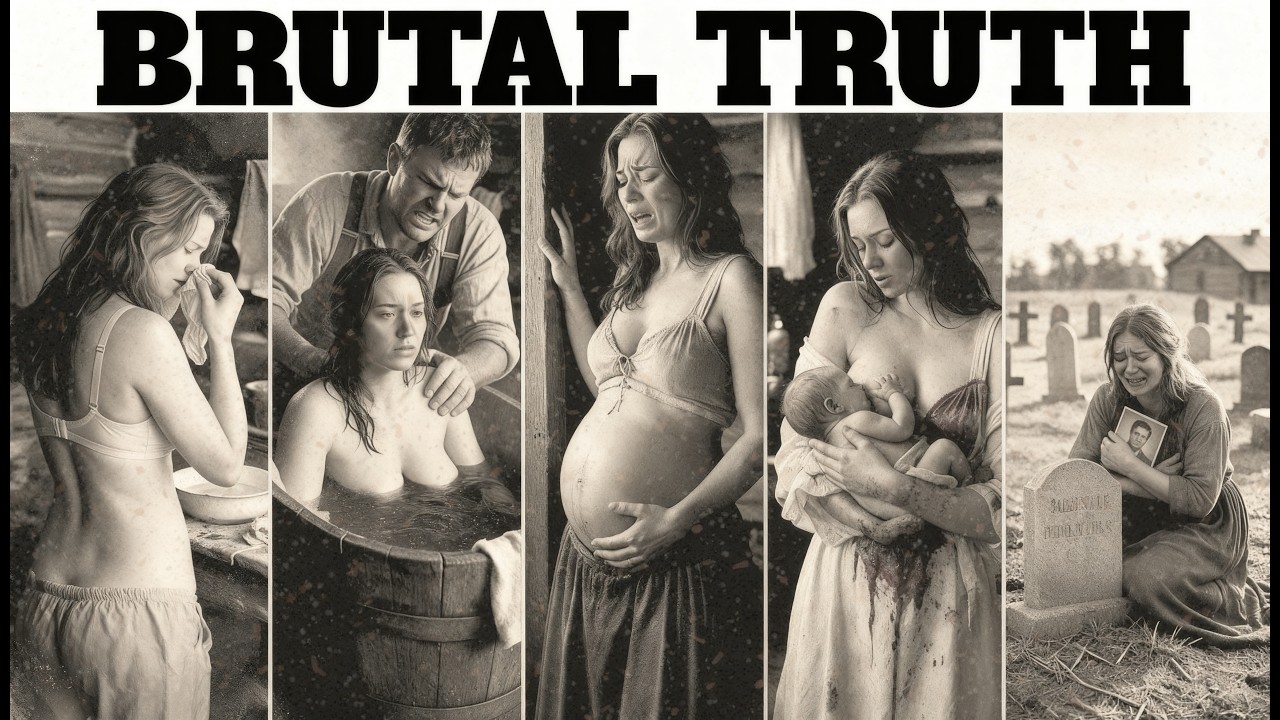
Her hands were cracked to the knuckle. This woman is not a character and not a metaphor. She lived here, and what it cost her to stay alive on the American frontier began with what she carried on her skin every single day. Not what she chose to wear or how she pinned her hair, but what her body held in its wool and its warmth when the work was done and the water was a quarter mile east and there was not a place on that prairie private enough to wash.
Start with the base layer, the smell every frontier woman carried whether she wanted to or not: wood smoke. An open hearth or a cast iron stove burned all day in a cabin with poor ventilation. Pine, oak, cottonwood, buffalo chips on the plains, whatever burned. The smoke soaked into hair, skin, wool, cotton, everything a woman wore or touched, and it never washed out fully.
The Beecher sisters described it as a simple fact of domestic life, something so constant it barely warranted mention. A woman who cooked three meals a day over an open fire stood in smoke for hours. Her eyes watered, her lungs filled, and when she stepped outside, the smoke walked out with her in every thread. To a modern nose, it would be the first thing noticed walking into any pioneer home.
To the women who lived there, it was invisible. It was the air itself, and everything else sat on top of it. Number 19: livestock in the house. Not near the house, in it.
Winter on the plains meant animals shared the same structure or stood behind a thin partition wall. Cows, chickens, pigs, sometimes a horse if the weather turned deadly. Homestead cabin records from land grant filings show the dimensions. One room, sometimes two.
Fourteen feet by sixteen feet was common. A family of six on one side, animals on the other, and the wall between them doing nothing for the smell. A woman milked twice a day, gathered eggs, slopped hogs, all before breakfast. Wet straw, manure, feathers, urine soaking into a dirt floor that could not be scrubbed clean because it was not a floor at all.
It was the ground. She tracked it back inside on the same boots she wore to cook supper. In January, with the door shut and the fire burning and the cow breathing ten feet from the table, that cabin held the smell the way a jar holds water, sealed tight with nowhere for it to go. Rendered fat and tallow came next.
Soap required it. Candles required it. Cooking required it. Every homestead ran on animal fat the way a modern household runs on electricity.
The process meant hours over an open fire boiling raw fat cut from a slaughtered hog or cow until it separated into tallow and cracklings. The odor was thick and rancid and it clung to hands and aprons for days. Household manuals of the period give the full recipe: lye and grease and patience. A frontier woman rendered fat several times a year, sometimes more depending on the size of the household.
Her hands smelled of tallow the way a mechanic’s hands smell of engine oil. It was not filth. It was the residue of the work itself, and the work never stopped. Then sweat under layers.
Not exercise sweat, labor sweat. Twelve to sixteen hours a day hauling water, chopping wood, scrubbing floors, bending over a garden in July heat, carrying a child on one hip and a bucket in the other hand. All of it done in layers: a cotton or linen shift against the skin, stays or a corset over that laced tight, trapping heat against the ribs, petticoats, sometimes two, a heavy dress on top. Clothing inventories from immigrant packing lists confirm it.
Everything was dense, heavy, layered tight. No deodorant existed anywhere in the world, no antiperspirant. The fabric trapped sweat and sealed it and held it close to the body all day and all night. A woman did not change out of her work clothes into something lighter.
She slept in what she sweated in because she owned nothing else to change into. The only soap most frontier women had, they made themselves from scratch. Wood ash collected from the hearth, leeched with water to make lye, then boiled with rendered animal fat for hours. The result was a soft brownish soap caustic enough to strip skin raw if you held it too long.
It did not smell like lavender. It smelled like what it was: alkali and rancid grease. Castile soap existed in the cities, but cost money most families did not have. A bar of store-bought soap was a luxury item, something a woman might receive as a gift and hoard for special occasions.
Medical guides of the era recommended washing sparingly with homemade soap because of what it did to the skin. The clean smell of the frontier was lye and ash, not what any modern person alive would call clean. Feet carried their own burden. Leather boots, often handmade, worn without socks or with one pair of knitted stockings rotated until they fell apart.
Lodisa Frizzell’s 1852 trail diary records walking through mud and standing water for days at a stretch. Wet leather does not dry on a moving foot. The stitching loosened, the sole cracked, the boots themselves began to rot while still being worn. A new pair was not waiting in a closet somewhere.
You wore them until they could not be repaired, and then you wore them a little longer. The smell was leather and sweat and something fungal underneath that never fully went away. These women walked miles a day, week after week, in the same shoes through dust and mud and river crossings with no second pair and no dry ground to rest them. And here is where you see how desperate the problem was.
Vinegar rinses through the hair. Herb bundles of lavender and rosemary tucked into clothing and under pillows. Rosewater dabbed behind the ears if you could find it or afford it. Godey’s Lady’s Book printed recipes for homemade toilet water and sachets.
In the 1850s and 60s, women on the homestead grew mint and sage partly for cooking and partly because crushing the leaves between their palms was the closest thing to perfume they would ever own. These were masks, not solutions. They worked the way a single candle works in a dark field. The effort itself is the testimony.
If the smell were bearable, no one would have tried this hard. Hair was washed every few weeks at best, monthly on the homestead, even less on the trail. Between washes, women worked bear grease or tallow or Macassar oil through it to keep it manageable and hold it in place under a bonnet. Those oils went rancid in the heat.
The hair itself absorbed every ambient smell around it: smoke, cooking fat, animal, sweat. Hair is porous. It holds what it touches. Elizabeth Custer, writing about life on an army post in the 1870s, described the grooming routines frontier women kept with the limited tools they had.
The antimacassar cloth draped over the back of a parlor chair existed for one reason and one reason only: hair grease stained furniture. That grease is what a pioneer woman’s head smelled like between washes. The bonnet was not just modesty. It was containment.
A full wash day was an entire day of brutal labor. Hauling water from a well or a stream. Heating it over fire in a heavy iron kettle. Scrubbing each piece by hand on a ribbed washboard until your knuckles bled.
Ringing it out, hanging it to dry on a line or a fence, and praying it did not rain before the clothes were ready. Frontier women did this weekly if they were fortunate and had water close by. Many did not. Catherine Haun’s 1849 trail diary describes going weeks without washing a single garment on the overland crossing.
Amelia Stewart Knight recorded wash days as rare events worth noting, remarkable enough to write down. Between washes, everything a woman had worn accumulated in the same fabric: smoke, grease, sweat, dust, food, blood. Layer after layer, day after day, and then the dress was put back on and worn again and again. The shift, the thin cotton or linen garment worn against the skin, was the first line of defense.
It was supposed to absorb the sweat so the outer dress stayed wearable a little longer. But a woman on the trail might own two shifts and rotate them. One worn, one drying, washed when there was water and time, which was not often enough. The shift carried the full signature of the body underneath: sweat, skin oils, menstrual blood, urine traces.
It was the garment closest to the skin, worn day and night, and it absorbed everything the body released. The most intimate garment was also the most saturated, and it was the one no one ever saw. The dress on top told the public story. The shift underneath told the truth.
No toothpaste. No toothbrush as we would recognize one. No dentist within a hundred miles. A rag dipped in salt or baking soda was the best a woman could do, and many did not even have that.
Clove oil for pain, extraction for everything else. Tooth decay was universal. Abscesses went untreated for weeks, sometimes months, swelling against the jaw until someone pulled the tooth with pliers or a turnkey. The pain alone was staggering, but the smell was something else entirely.
A rotting tooth gives off a sweetness that is not sweet at all, putrid and close. It came through on every breath, every word, every whisper to a child at bedtime. Period letters mentioned toothache as a constant companion on the frontier. A pioneer woman did not just carry the smell on her body.
She carried it in her mouth every time she spoke, every time she kissed her children goodnight. No indoor plumbing. Outhouses baking in summer heat and buried under snow in winter. At night in December, during illness, during the long dark hours when a walk to the outhouse meant freezing wind and bare feet on frozen ground, a ceramic pot under the bed, emptied each morning, sometimes not until midday if the morning pressed.
Homestead inventories list chamber pots as standard household items, as ordinary as a skillet or a butter churn. In a closed cabin in the dead of winter, with the door sealed against the wind and the fire drawing every smell upward, that pot filled the room. Human waste sitting open inches from where children slept. It was not an emergency.
It was not a crisis. It was a Tuesday and a Wednesday and every night after that until spring. No commercial products existed for menstruation until the very end of the century. Rags torn from old fabric or worn-out clothing.
Folded, pinned, held in place by friction and hope. Washed if water allowed, sometimes dried by the fire and reused without proper washing. On the trail, privacy was nearly gone. A woman changed her rags behind a wagon wheel if she was lucky, in a line of wagons stretching half a mile with families on every side.
Menstrual blood and layered clothing in summer heat was something every woman carried and nobody discussed. The diary record is almost completely silent. Lillian Schlissel, who studied hundreds of women’s trail journals for her book Women’s Diaries of the Westward Journey, noted that silence is one of the most telling omissions in the entire archive. What is never written is often what was most deeply lived.
The Overland Trail itself was weeks in the same dress, sometimes the only dress. Water rationed for drinking and livestock and nothing else. Dust so thick it caked on wet skin and turned to paste in the creases of the neck, the folds of the arms, and the corners of the eyes. Amelia Stewart Knight recorded river crossings, rainstorms, dust storms, all endured in the same clothes day after day.
Sarah Raymond Herndon in 1865 described the grit that worked its way into everything: fabric, food, lungs. Lodisa Frizzell in 1852 wrote of mud that never dried and boots that never felt clean. A woman who had walked fifteen miles a day, cooked over buffalo chip fires, slept on the ground in a bedroll shared with children, and not bathed in six weeks did not carry one smell. She carried twenty pressed together in one body, moving west one step at a time for months on end.
On many homesteads, tanning hides was the woman’s work. Leather did not arrive from a store. It was made by hand from a raw animal skin through a process that would make a modern person gag before they got within ten feet. The hide was soaked in a solution of water mixed with either urine or brains.
Brain tanning, the oldest method known to any civilization on Earth. Putrefying organic matter and ammonia and wet raw skin meeting your nose all at once. It is one of the most overpowering things a human being can encounter, and the process took days. That stench stayed under her fingernails and in her hair long after the hide was finished.
The leather that came out the other end was soft and strong and smelled nothing like the process that made it, but the woman who made it carried the process home on her skin. Frontier medicine applied to the body added another layer. Sulfur paste for skin ailments smeared on thick and left to dry. Turpentine rubbed on the chest for congestion, burning the skin underneath.
Mustard plasters that raised blisters the size of a half dollar. Poultices of onion and flaxseed and animal fat bound over wounds and infections with strips of cloth left in place for hours or days until the pus itself began to rot against the skin. Dr. John Gunn’s Domestic Medicine prescribed every one of these remedies.
Millions of frontier families followed his instructions by candlelight with no second opinion available. The smell was sharp and chemical layered over whatever her body was already carrying underneath. A sick frontier woman reeked of sulfur and turpentine and rotting pus before you ever got close enough to notice anything else, and she wore those poultices while she cooked, while she nursed her children, while she worked. The cure smelled worse than the illness, but the cure was all she had.
Childbirth filled a cabin no bigger than a modern bedroom with blood and amniotic fluid and sweat in a bed that would be slept in again without changing the mattress. A straw tick soaked through with fluid and blood that could not simply be replaced. Straw was refreshed when available. The old straw was often burned.
A woman stayed in that bed for days or weeks afterward. They called it lying in. The bedding absorbed everything her body released during the hardest hours of her life. If the birth went well, the smell faded within days.
If infection set in, the air in that room changed. It sharpened into something that made everyone present go quiet because they all knew what it meant. Midwifery accounts from the period described childbed fever by its odor before its symptoms, a foul, sweetish rot that told you a woman was dying before any other sign appeared. A difficult birth turned that small room into a warning, and the room was never larger than ten feet across, and the children were sleeping in it.
Typhoid, cholera, dysentery. The three killers of the trail, and each one announced itself through the nose before it showed on the skin. Cholera carried a sweet, sickly odor that period doctors could identify from the doorway. They called it diagnostic.
Typhoid had its own musty, faded smell that filled a closed room within hours of the fever setting in. Dysentery turned the air heavy with blood and bile and something worse underneath. In a one-room cabin with no ventilation, children sleeping feet away, no hospital to go to, and no doctor closer than two days of riding, a woman nursed the sick alone. Trail diaries record the cholera camps along the Platte River during the 1849 epidemic.
Narcissa Whitman’s letters from the Oregon Mission describe nursing the dying in quarters so close you could touch both walls with your arms outstretched. A woman who tended a dying husband or child lived inside that for days. She did not leave the room. She was the room.
When someone died, and on the frontier someone always died, the body had to be washed, dressed, and prepared. Not by an undertaker, not by a stranger, by the women of the household. A wife washed her husband. A mother washed her child.
In summer, decomposition began within hours. The August heat of the Kansas plains or the Nebraska prairie turned a body in a matter of a single afternoon. In winter, the ground was frozen too hard to dig, and the body might stay in the house for days while the men worked at the earth with picks and iron bars. What a human body becomes after death is something the living do not forget, no matter how many years pass.
Burial records show the gap between death and burial stretching to days and sometimes weeks in the hardest weather. A woman who lost a child in January lived with that in the same room where she cooked and slept and held her other children close, and she kept going because stopping was not something the frontier allowed. And then all of it at once. Not a single smell but the total: the smoke and the tallow and the sweat and the lye and the animal and the rancid grease in the hair and the menstrual blood in the rags and the chamber pot under the bed and the rot in the teeth and the sulfur on the chest and the hide stinking of brains under her fingernails.
All of it on the same woman in the same dress on the same Tuesday afternoon in July. A modern person encountering any one of these alone would recoil. A pioneer woman carried all twenty at the same time, and she carried them while hauling water, raising children, cooking meals, tanning leather, burying the dead, and walking a thousand miles beside a wagon. She did not notice because every person within a hundred miles smelled the same.
There was no clean room to step into, no shower waiting at the end of the day, no mirror to show her what the trail had done. Just the next mile and the next chore and the next child pulling at her hem. Go back to Amelia Stewart Knight, July of 1853, eight months pregnant, walking the Oregon Trail in a dress she had worn for weeks. She wrote down the temperature.
She wrote down the river crossings. She counted the graves beside the road. She never mentioned the smell, not once. And that silence is the loudest thing in the entire record.
So why do we not know this? Hundreds of diaries survive from women on the trail and the homestead. Letters, journals, memoirs written decades later, and almost none describe body odor. Not their own, not anyone else’s.
The nose stops registering what it smells every day. That is called olfactory adaptation, and it is why you cannot smell your own house. But it was more than biology. It was decency, modesty.
It was the unspoken agreement among women who shared the same hardship that certain things were too constant and too universal to need saying. Lillian Schlissel studied these diaries for decades and noted the systematic absence, the pattern of silence around the body and its realities. What these women chose not to write is itself the most honest testimony we have. Complaining about smell on the frontier was like complaining about gravity.
There was nothing to fix and no point in saying it. The smell was only the surface, though. What she actually did to keep that body clean, the war she fought against the dirt and the sweat and the blood with almost nothing to fight it with, is the truth Hollywood spent a century making sure you never saw. What did a frontier woman’s smile actually look like by the time she was thirty-five?
Martha Ballard, a midwife in rural Maine, recorded tooth extractions in her diary. No anesthetic, a pair of common pliers, the patient held down by her own family. Catherine Beecher’s 1841 manual recommends salt and charcoal rubbed on teeth with a rag or a chewed twig. Nothing else.
Tooth decay was nearly universal. Abscesses went untreated until they burst or killed. The daguerreotypes that survive show women barely past twenty with teeth already missing. Hollywood casts them with full white smiles.
The camera is lying before the first frame rolls. The real reason pioneer women wore their hair pulled tight and covered was not modesty. It was containment. Lydia Maria Child’s 1832 manual and Catherine Beecher’s 1841 guide both recommend kerosene combed through the hair to kill lice.
Lard smeared on the scalp and wrapped overnight to suffocate them. Narcissa Whitman wrote about the difficulty of even basic hair care on the overland journey. Hair washing with water happened once a month or less. That tight braid under a bonnet was not a fashion choice.
It was a woman holding a losing line against creatures that never stopped coming. In January, a woman in the dark walked thirty yards to a hole in the frozen ground. That was the outhouse. On the trail, there was no outhouse at all.
Amelia Stewart Knight wrote about it in her 1853 diary, describing the humiliation of finding privacy on open prairie with hundreds of wagons in the train. Women formed circles with their skirts to shield each other. Chamber pots served in winter. Open ground served in summer.
When dysentery struck, even those small dignities collapsed. Every western grants its frontier women a closed door and a moment alone. Most of them never had either. You may have heard the old saying, do not throw the baby out with the bathwater.
That was not a joke. It was a real warning. Catherine Haun crossing the plains in 1849 described bathing in rivers when the train stopped, no privacy, livestock upstream. On the homestead, Saturday night meant one tub, one pot of heated water.
Father first, mother second, children oldest to youngest. By the last child, the water was gray. In 1870, not a single homestead on the Kansas plains had running water. Lice did not visit.
They moved in. They lived in the bedding, in the seams of every garment, in the children’s hair. Lydia Allen Rudd’s 1852 trail diary mentions them so often they become background noise. Mattresses stuffed with prairie grass were breeding grounds.
Frontier hotels were notorious. Period newspapers carried complaints from travelers who woke covered in bites. Women fought this war every single day with boiling water and kerosene. They never fully won.
The clean bedrolls you see in westerns are a lie the set dresser tells. Monday was wash day, and wash day was the most dangerous day of a frontier woman’s week. Catherine Beecher documented the full ordeal. Water hauled and heated over an open fire.
Lye soap that ate the skin raw. Clothes beaten on rocks and rung by hand for hours. A full wash for a family of eight ran from sunup to sundown. Burns were common and serious.
On the trail, women sometimes washed in alkali water that blistered their hands down to raw flesh. Laundry was not a chore. It was a daylong physical ordeal with real injury risk. And the clothes in westerns are always clean.
That silence erases the most grueling labor of frontier womanhood. A frontier woman wore a chemise, the only layer that touched the body, and over that a corset, petticoats, a dress, an apron. Drawers as we know them did not become common for women until the middle of the century. The outer dress might go weeks between washings.
Sweat, blood, food, dirt, smoke, all soaked into fabric that could not easily be cleaned. Susan Magoffin, crossing the Santa Fe Trail in 1846, described her clothing falling apart on her body. Most frontier women owned two dresses. Some owned one.
The movies dressed them like they had a wardrobe. They did not. The soap that cleaned your clothes took your skin with it. Lydia Maria Child published the recipe in 1832.
Hardwood ash lye mixed with rendered animal fat. The process itself could scar you. Lye is caustic. Rendering fat over an open fire is a burn waiting to happen.
The resulting soap stripped every oil from the skin and cracked the hands that used it. It was the only soap most frontier women ever touched. Imported Castile soap existed, but on the frontier it was expensive and almost never available. There is not one scene in any western where a woman makes soap.
The foundational act of frontier cleanliness is invisible in the myth. The deepest silence of all concerned menstruation. Every pioneer woman of childbearing age dealt with it every single month, and it appears in almost no diary, no letter, no novel, and not one frame of film ever made. The taboo was that complete.
What survives are scattered references to being unwell in private letters, instructions in domestic manuals for making rags. On the trail, there was no running water, no privacy, no reliable way to wash those rags. Women bled through their clothing and kept walking. Staining patterns on surviving period garments confirm it.
Hollywood never acknowledged it, not once. The deepest cut Hollywood made was not a lie. It was a silence. They pretended half the human body did not exist.
Contaminated water was the single deadliest hygiene failure on the American frontier. The Oregon-California Trails Association estimates that 20,000 to 30,000 immigrants died on the overland trails between 1840 and 1860. Cholera, a waterborne disease, was the leading killer. One in ten who started the trail did not finish it.
John Snow proved in London in 1854 that cholera spread through water, but the immigrants had no way to know. They drank from streams where dead oxen lay upstream. They filled cooking pots from creeks where hundreds of camps had dumped their waste. Lydia Allen Rudd in 1852 recorded passing grave after grave along the Platte, cholera dead buried shallow or not at all.
The living drank from the same water that ran past the dead. Cholera could kill in hours. A woman healthy at breakfast could be gone by nightfall. And the movies show pioneers scooping water from every sparkling stream.
When the knife slipped or the child fell, a frontier woman reached for turpentine poured straight into the wound, spiderwebs pressed into cuts to slow the bleeding, poultices of bread and milk, poultices of cow dung which introduced infection directly. Burns treated with lard, which trapped the heat and made the damage worse. These women were not foolish. They used what they had and what they had been taught.
But germ theory did not exist in common knowledge. The cure was often the killer, and no one alive could have told them why. Home canning spread across the frontier in the second half of the 1800s, but the science of safe preservation lagged far behind the practice. Botulism from improperly sealed jars appeared in period medical records.
Meat went bad in salt brine. Milk soured within hours during summer. Spoiled and badly stored grain poisoned entire households. The woman who stocked the pantry bore the blame when something went wrong.
She was working without a map. One bad seal on a canning jar, one warm afternoon in the root cellar, and the food she had worked all harvest to preserve became the thing that killed her family. The Oregon Trail was not an adventure. It was a graveyard with a direction.
By some trail historians’ calculations, there was a grave every eighty yards from the Missouri River to the Willamette Valley. Cholera, dysentery, typhoid, all hygiene driven. Amelia Stewart Knight wrote in 1853 of passing seven new-made graves in a single day. Lodisa Frizzell in 1852 described the smell of decay streaming from shallow graves along the trail.
The women did the nursing. They wiped fevered children with dirty rags. They buried them in graves they dug with their own blistered hands. And then they walked on.
Frontier child mortality was staggering. In some regions and trail years, between 25 and nearly 50 percent of children died before the age of five. The causes were overwhelmingly tied to hygiene. Diarrheal disease from contaminated water, infant dysentery, what they called the summer complaint, measles and whooping cough ripping through crowded trail camps, diaper cloths washed in the same compromised water.
Amelia Stewart Knight, eight months pregnant on the trail, recorded one child’s illness after another in a steady, quiet hand. Today, fewer than seven children in a thousand die before age five in the United States. On the frontier, it could be 250 or more. The woman who buried her child and walked on the next morning is the toughest human being in any western ever made, and she is never in the frame.
And the hands that delivered her baby could kill her. Childbed fever, puerperal fever, a bacterial infection carried into the birth by unwashed hands, unsterilized instruments, contaminated rags. In 1847, Ignaz Semmelweis proved it at the Vienna General Hospital. Doctors walking from autopsy rooms straight to the delivery ward without washing their hands were killing mothers at rates reaching one in three.
Oliver Wendell Holmes argued the same thing in America in 1843. The medical establishment attacked him for it. On the frontier, conditions were worse. Deliveries on dirt floors attended by neighbors whose hands had just come from the barn or the field.
No antiseptic, no understanding of germ theory for decades to come. Martha Ballard, the midwife, documented hundreds of deliveries and maternal deaths in her diary. The timeline was always the same. She fought that fight every single day she was alive out here, with creek water and lye and rags she boiled when she had the time and the fuel and the hours to spare.
Some days she won, some days she did not. Either way, the next morning started the whole thing over again. But there were seasons when that body was no longer hers alone. There were months when she felt new life pressing low against her spine and settling heavier with every week, and there was no one within a day’s ride who had ever been taught what to do if something went wrong.
What her body carried next, it carried without help and without promise that either of them would make it through. In the middle of the nineteenth century, pregnancy was socially unspeakable. A woman did not say she was pregnant. She was in a family way.
She was in confinement. She was indisposed. Medical guides of the era were written for physicians, not mothers. Dr.
William Dewees published his treatise on the diseases of females and instructed doctors to examine pregnant women by touch alone, never by sight. Even the physical examination was conducted through a bed sheet. A woman could be seven months along and her own neighbors would not mention it in her presence. Newspapers would not print the word.
Polite conversation could not hold it. The result was that a woman going through the most physically demanding experience of her life could not ask a direct question about it in public, could not name what was happening to her body, and could not seek help without first finding a way around the shame of admitting she needed it. Before the danger even began, the shame was already in place. Prenatal care did not exist.
No scheduled visits, no monitoring. Blood pressure measurement itself did not become routine medical practice until the early 1900s. A woman learned she was expecting and then simply waited. What she had was whatever her mother told her, whatever an older neighbor remembered, and whatever she could find in a home medical guide, if she was lucky enough to own one.
Gunn’s Domestic Medicine, one of the most popular household references of the era, offered advice on pregnancy that ranged from the sensible to the dangerous, and most women had no way to tell the difference. The first trained person she might see was whoever showed up when labor began. Everything between conception and delivery she managed alone. The first prenatal clinic in the United States did not open until 1911.
For every woman on this list, that clinic came too late by decades. Social expectation did not bend for pregnancy. Maternity corsets existed, designed to hold the silhouette while the belly grew, and women laced into them through the middle and even the late months. The stays were made of whalebone or steel stitched into heavy cotton, pressing against the ribs and the abdomen while the child grew beneath them.
Dr. Elizabeth Blackwell, the first woman to earn a medical degree in the United States in 1849, argued publicly that tight lacing endangered mother and child. Most women kept lacing. The alternative was a visible pregnancy, which carried its own punishment.
The corset was not vanity. It was armor against a world that demanded women endure this and then pretend it was not happening. On a working homestead, rest was a word that belonged to someone else’s life. Women hauled water from wells or streams, sometimes carrying two buckets at a time across uneven ground.
They split wood for the stove. They fed chickens and milked cows and worked the garden through every month, bending and lifting with a belly that made every task harder than the last. Amelia Stewart Knight was pregnant with her eighth child on the Oregon Trail in 1853. Her diary records walking beside the wagon, fording rivers, cooking for a family of nine day after day.
In one entry she writes of the dust so thick she could not see the wagon ahead. In another, a river crossing where the water reached the wagon bed and the children screamed. She never once wrote the word pregnant. We only know because the baby appears in a September entry near the end of the trail, born somewhere in Oregon Territory.
The child’s name was Chatfield. She rode around the pregnancy the way all of them did. The work did not pause and neither did she. In the final weeks, confinement meant exactly what it said.
A woman was expected to withdraw from public life entirely. In eastern towns, this was a social ritual. On a Nebraska homestead, it was closer to solitary. She might not see another adult face for weeks.
Mollie Dorsey Sanford, who homesteaded near Nebraska City in the late 1850s, wrote in her diary about the weight of the silence around her. The wind against the sod walls and nothing else, no footsteps on the road, no voice at the door. Her husband, if he was present at all, had likely never witnessed a birth. Many men were away working claims or hired out for wages during the months their wives carried.
And even when a husband was home, the culture of the time meant he stayed outside the room when labor came. A woman behind a closed door alone with the pain was the standard arrangement. When something went wrong, the nearest help could be a full day’s ride or simply not there. Everything depended on who was available.
Martha Ballard, a midwife in Hallowell, Maine, delivered 816 babies between 1785 and 1812. Her diary is the most detailed obstetric record from the period. Nearly a thousand deliveries scratched into a logbook by candlelight. She crossed frozen rivers at night to reach a woman in labor.
She was extraordinary. She was also in settled New England, where the next house was a short walk, not a half day’s ride. On the plains and in the mountain territories, the midwife might be a neighbor woman who had given birth twice herself and nothing more. She might arrive with a bundle of clean rags and her own experience, and that was the full extent of the medical team.
In the worst cases, a woman delivered entirely alone or with only her oldest child beside her. The hands that caught your baby were a matter of pure geography. Nothing else. And the doctor could be worse than no doctor at all.
Before germ theory, physicians moved from patient to patient without washing their hands. Some walked to a delivery straight from the autopsy table. They wore the same coats they operated in, stiff with dried blood, and considered it a mark of experience. In 1843, Oliver Wendell Holmes published a paper called “The Contagiousness of Puerperal Fever,” arguing that doctors themselves were carrying death to women in labor.
Dr. Charles Meigs of Philadelphia attacked him for it. Meigs declared that a gentleman’s hands could not possibly carry disease. He called the idea an insult to the profession.
The women kept dying, and the gentlemen kept delivering babies with blood still under their fingernails. In some lying-in hospitals of the period, the maternal death rate topped one in ten. The safest place to give birth was often the poorest home attended by a midwife who had never set foot in a medical school. Patent medicines were the prenatal care of the era.
Women dosed themselves with whatever was sold or handed down. Mrs. Winslow’s Soothing Syrup, marketed to mothers and infants, contained morphine. Laudanum, opium dissolved in alcohol, was sold over the counter and routinely taken for the aches of pregnancy.
A woman could walk into any general store from Missouri to California and buy it without a question asked. Lydia Pinkham’s Vegetable Compound, marketed directly to women and sold by the millions, was roughly 18 percent alcohol. Dr. Pierce’s Favorite Prescription promised to cure every female complaint known to medicine and delivered little more than alcohol and hope.
No regulation, no ingredient labels, no warning of any kind. A woman trying to take care of herself was walking blind through a marketplace of poisons. And the men who sold those poisons never had to answer for a single death they caused. Labor pain was considered God’s punishment.
Genesis 3:16, in sorrow thou shalt bring forth children. For much of the nineteenth century, segments of the clergy and the medical profession argued that relieving labor pain was an offense against the will of the Almighty. When James Young Simpson introduced chloroform for obstetric use in Edinburgh in 1847, the backlash was fierce. Queen Victoria accepted it for the birth of Prince Leopold in 1853, and that helped turn the tide in England.
But west of the Mississippi, the entire argument was beside the point. No chloroform ever reached those cabins. What women had was what the land provided. Blue cohosh tea to speed labor.
Raspberry leaf to strengthen the contractions. Whiskey if there was any in the house. A wooden spoon clenched between the teeth. A rag twisted around the bedpost.
And whatever sound the walls could hold. That was all there was. On the overland trails, labor arrived on the schedule of the company, not the mother. Women delivered in the back of a moving wagon beside the road while the line waited, or in a canvas tent staked into mud.
Catherine Haun recorded in her 1849 diary that a woman in her company gave birth and was walking again within hours. Lillian Schlissel, who studied hundreds of overland diaries, found that women’s accounts of the trail are dominated by birth and death in ways the men’s diaries barely mention. A man might note the weather and the miles covered. His wife in the same wagon wrote about the woman three wagons back who delivered a stillborn child and buried it under a cottonwood tree before noon.
The trail could not wait for recovery. Delays meant missing the mountain passes before snow closed them. A woman delivered, wrapped the child, and stood, because the alternative was being left behind, and no one was coming back. Miscarriage was treated as ordinary.
The rate was far higher than it is today. Poor nutrition, relentless physical work, no help of any kind. And the response was silence. Women recorded miscarriages in their diaries the way they recorded the weather.
A line or two, a date. Then the next entry about chores or the road ahead. One woman in Schlissel’s collection of trail diaries noted a miscarriage in a single sentence and wrote about mending a wagon cover in the next. Nobody understood why it happened.
No one could tell a woman whether it was the heavy lifting that caused it, or the fall from the wagon step, or nothing she did at all. The guilt had nowhere to go, so it went underground, carried in silence alongside the grief. Nobody came to check on you. Nobody named what had happened.
You bled. You cleaned up with whatever rags you had. You rested if the day allowed it, and the morning came whether you were ready or not. A breech birth with no surgeon could kill them both.
The procedures that could correct the position required a skilled practitioner and calm conditions. A trained doctor would reach inside the womb and attempt to turn the child by hand. It was agonizing for the mother and dangerous for both. In a dirt-floor cabin with a neighbor for a midwife and one tallow candle for light, the skill was rarely there.
Sometimes the only option was to wait and pray the child would shift on its own. The outcomes were brutal. Some women survived but never walked without pain again. Some did not survive at all, and the vast majority of their names were never written down.
Eclampsia struck without warning. A woman who appeared perfectly healthy could suddenly convulse, lose consciousness, and die within hours. Today, a routine prenatal visit catches the early signs: rising blood pressure, protein in the urine, swelling that does not go down. In those cabins and trail camps, nobody could measure blood pressure.
Nobody could test for the signs we watch for today. The only treatment that worked then and works now is delivery under controlled conditions, and nothing resembling controlled conditions could be found west of the settlements. Eclampsia was the invisible killer. No wound, no fever, no warning at all.
A healthy delivery could turn fatal within the hour. Postpartum hemorrhage took lives in minutes, and nothing in a homesteader’s cabin could stop it. No transfusion, no intravenous fluid, no drug to contract the uterus. The blood soaked through the straw mattress and pooled on the floor.
And nobody in that room could do a thing but watch. The standard remedy was ergot, a fungal extract that could force a contraction. It came from a dark growth on rye grain, and women had used it for centuries. In the right dose, it could save a life.
In the wrong dose, it caused convulsions, gangrene, and a death of its own. The line between the remedy and the poison was a guess made by whoever was in the room, often a woman with no medical training at all. And the woman bleeding on that mattress had no say in which side of that guess she fell on. Childbed fever was the great killer.
It killed more women in the eighteenth and nineteenth centuries than any other complication of pregnancy. The onset was cruel. A woman who seemed fine after delivery would begin to shiver within a day or two. Then the fever climbed.
The abdomen swelled and hardened with infection. The pain was relentless. Death came within a week in most cases, sometimes sooner. And the woman spent those last days fully aware of what was happening, watching it take her while her newborn cried in the next room.
Ignaz Semmelweis demonstrated in Vienna in 1847 that washing hands with chlorinated lime solution could cut the maternal death rate from over 10 percent to under 2 percent. He was ridiculed. He was driven from his post. He died in an asylum.
Across the American West, no one had heard his name, and the fever kept burning through homes that never made it into any official record. Repeated childbirth without surgical repair left women with chronic and disabling conditions they carried in total silence for the rest of their lives. A fistula meant constant leaking that no amount of washing could manage. It meant isolation within isolation.
A prolapse meant the uterus itself descending, sometimes visibly, and every hour of standing made it worse. These injuries did not kill. They simply took away every scrap of dignity a woman had left and asked her to keep working anyway. Dr.
J. Marion Sims developed his repair techniques in Montgomery, Alabama in the 1840s, operating on enslaved women named Anarcha, Betsey, and Lucy without anesthesia, sometimes performing thirty operations on the same woman. He is still called the father of modern gynecology. The women in those cabins and camps had no access to any surgeon at all.
They lived with it. They worked with it. They bore the next child with it. And they told no one.
Before antiseptic surgery, a cesarean section was performed only when the mother was already expected to die. The aim was to save the child, not the woman. The incision was made with whatever blade was available through skin and muscle and uterine wall without anesthesia in many cases, and with no reliable way to stop the bleeding or prevent infection afterward. Maternal mortality after a cesarean in this era exceeded 85 percent in most documented cases.
In the territories, it was almost never attempted. No surgeon, no clean field, no way to close the wound. If the baby could not come on its own, both were lost. And the husband buried his wife and his child on the same afternoon in the same plot, and then stood in a kitchen he did not know how to use in a house that no longer made sense.
Today, nearly one in three American births is a cesarean. In the 1850s, it was a death sentence spoken out loud. Writing a will before the birth was common enough to be unremarkable. Women made legal and spiritual preparations before each delivery the way a soldier prepares before a march he may not return from.
They wrote letters to be opened only if they died. They named who would raise the children. They listed which belongings should go to which child, the quilt to the oldest daughter, the Bible to the son. They said goodbye to their husbands on paper in case the spoken version never came.
These letters survive in archives across the country. Some of them were folded and sealed and never opened because the woman lived. She would take the letter back, tuck it away, and write a new one before the next birth. Some of them were read by lantern light by a man left alone with children he did not know how to raise.
Infant mortality in the territories was staggering. Best estimates place it between 15 and 25 percent of all babies dead before their first birthday, depending on the region and the decade. Stillbirth shadowed every pregnancy. Nine months of carrying, hours of labor, and then a child that never drew breath.
The mother would wrap the small body in whatever clean cloth she had. If there was time, and the ground was not frozen, the father dug a grave that afternoon. If the ground was frozen, the body was kept in the cold until spring. Some women buried three children before the age of thirty.
Some buried more. The grief was real, but the language for it barely existed, and the community around them expected silence, not mourning. By dawn, the cow still needed milking. The fire still needed building.
The land offered no pause for grief. It simply handed you the next day, identical to the last, minus a child. An estimated 20,000 people died on the overland trails between 1840 and 1860. A staggering number of them were infants and small children.
Cholera, dysentery, accidents, and the sheer exhaustion of the crossing took them by the hundreds. Women gave birth on the trail and buried babies on the trail, sometimes in the same journey, sometimes in the same week. Lodisa Frizzell, crossing in 1852, wrote of passing grave after grave along the Platte River, many of them small. The wooden markers were already leaning by the time the next year’s wagons passed.
Some had names. Most did not. Graves were left unmarked or deliberately driven over with wagon wheels to stop the wolves and coyotes from digging. A mother could not mark the spot.
She could not go back. She walked away from a patch of earth that looked like every other patch for a thousand miles, and she kept walking west. The trail behind her erased the only place her child had ever been. Each pregnancy weakened the body further.
Each delivery carried the harm of the last. By the fifth or sixth or seventh birth, a woman had absorbed years of injury that was never repaired. Pelvic bones loosened and never fully tightened again. Teeth fell out from the calcium the body gave to the child it was building.
A woman of thirty-five moved like a woman of sixty. And no one thought it strange. These women did not age the way their eastern counterparts did. They wore out.
The photographs from the 1860s and 70s show women in their early forties who look decades older. Their hands are thick, their backs are bent, their eyes are clear, and their faces are set, and they are looking straight into the camera as if daring it to flinch. The camera caught what the diaries never said. The body kept a record no pen ever matched.
The best available research puts a woman’s lifetime risk at roughly 1 in 8 across all her pregnancies combined. In the middle of the 1800s, maternal mortality ran between 600 and 900 deaths for every 100,000 live births. Today, that number is roughly 22 per 100,000. That gap is the full distance between their world and ours.
A small settlement of forty families might have five or six women pregnant in any given year. Within a decade, at least one of those women would be dead from it. Everyone in that settlement knew someone. Everyone had stood at a grave.
Eight children meant eight separate turns against those odds. The math was simple and the math was merciless. Most of them were never counted. Before vital registration reached the territories, and in most areas it did not arrive until the late nineteenth century or later, maternal deaths simply went unrecorded.
A mother who bled out on a Nebraska homestead in 1862 might appear in no official document at all. No death certificate, no coroner’s report, no column in a county ledger. Her husband might note it in a family Bible if they owned one. A neighbor might mention it in a letter.
But the state did not count her. The territory did not count her. If she was buried on the property, the marker was wood. Within ten years, it rotted.
Within a generation, the grave was gone. The plow turned the earth over and the grass grew back and the place where she lay became just another stretch of prairie. Today, researchers who try to reconstruct the true maternal death toll work with fragments: a diary here, a church record there, a census that lists a man as widowed with no explanation why. The true scale of what happened is by definition an undercount.
We will never have the real number. We only know it was worse than anything the surviving records show. Pioneer women were not innocent of the danger ahead. They had watched their mothers go through this, their sisters, their neighbors.
They had stood beside beds where the woman never got up. They had washed the blood from the sheets and dug the small graves with their own hands. Every pregnancy was entered with open eyes. You can hear it in the diaries.
The tone is not dramatic. It is plain and flat and steady, the way a person writes when she is preparing for something she understands completely. One woman wrote to her sister before a birth and asked only that her children be told she loved them if the worst should come. No fear in the letter, no self-pity, just a practical arrangement made by a woman who understood probability better than most men who claim to.
They knew the odds and they faced them anyway. And the most brutal truth: they chose it again. The average frontier woman bore between seven and eight children. Some bore ten, some bore twelve.
Each pregnancy was a fresh walk into every single truth on this list: the isolation, the silence, the pain without relief, the fever, the hemorrhage, the chance of dying that never got smaller no matter how many times you survived it. And they chose it. Not out of ignorance. The frontier demanded children.
It demanded hands for the fields, for the livestock, for the breaking of new ground. A homestead without children was a homestead without a future. And so these women did the calculation that no one ever wrote down, the one that weighed their own lives against the survival of everything they had built. And they chose the risk.
They looked at the odds. They looked at the graves. And they got up the next morning and did the work. Trail families even named their newborns for the ground where they arrived.
There are settlement records in Oregon showing children christened Platte, Laramie, and Independence. A boy born near Chimney Rock carried that name into old age. It seems charming until you sit with what it means. Birth on the trail was so routine it became geography, not a crisis, not even a surprise.
The child wore the name of a river or a fort because that was all its mother could see through the canvas. Long halts were rarely granted, and the journey continued as planned. Families marked the birth the same way they marked a river crossing. It was not the frantic single terrifying scene Hollywood always presented.
It was an ordinary Tuesday on the Platte. A child was born, a name was chosen from the nearest landmark, and the wagons kept rolling before the sun went down. The wagon bed was four feet wide and ten feet long. That was the delivery room.
Inside it sat 1,600 to 2,000 pounds of supplies. Flour, salt, pork, tools, a plow, a rifle, a butter churn, and whatever children were too small to walk. The canvas cover leaked in rain and held heat in summer until the air inside could pass 100 degrees by midday. The bed was bare wooden boards with no springs of any kind.
Every stone, every rut, every dried creek bed came straight through the frame and into the body of whoever lay there. A woman in labor could not stretch flat. She could not stand. She lay wedged among sacks and crates in a space smaller than a modern bathroom, with the whole wagon pitching under her.
Today, the average delivery room in an American hospital measures 200 square feet with adjustable lighting and a call button for a nurse. A prairie schooner offered forty. You shared every inch with everything your family owned on Earth, and the wagon did not stop moving while you were in it. Most wagon companies operated under written constitutions drafted before departure.
Officers were elected. Rules were binding. And when a woman went into labor, the company voted on whether to halt. Her body was subject to majority rule.
If the train was behind schedule, if water ahead was uncertain, if the captain judged the delay too dangerous, the vote went against stopping. The woman labored in a rolling wagon or was left behind with one or two neighbor women while the rest of the train pressed forward. A small camp of women and children alone on the open prairie, unprotected, waiting for a birth to finish so they could walk fast enough to catch up before dark. This was not cruelty.
It was arithmetic. The calendar said you had to clear the Blue Mountains and reach the Columbia before the first November snow or the entire company risked starvation and death. One woman’s labor was measured against the survival of sixty people. The sixty usually won the vote.
The nearest physician was occasionally an army surgeon at Fort Laramie or a trader with basic medical skills at Fort Hall. A military man with limited medicines who treated soldiers and trappers and had no obstetric training. Most wagon trains of forty to one hundred souls carried no medical professional of any kind. Not a doctor, not a trained midwife, not even a pharmacist.
A woman in obstructed labor on the open prairie in 1850 faced the same odds she would have faced in 1750. A full century of medical progress counted for nothing out beyond the Missouri. There was no surgery available, no forceps unless someone had packed a pair from their parlor back east, no understanding of why a baby would not come or what to do when it would not. Only the waiting, the prayers, and the hands of whatever neighbor woman was brave enough to climb into that wagon and try.
Social convention followed women two thousand miles into the wilderness and would not let go. Daguerreotypes of immigrant women and surviving trail garments in museum collections confirm that many women wore bone stays and laced corsets deep into pregnancy on the march. Restrictive garments pressing against the abdomen and ribs during months of hard walking over ground that had never seen a wheel. This was not vanity.
A woman who abandoned her corset on the trail was announcing her condition to every person in the company, and 1850 propriety did not permit that announcement. So she laced it looser month by month and adjusted it above the belly as best she could, and she walked fifteen miles a day with whalebone pressing against a body already doing the hardest work it would ever do. The diet made everything worse. Salt pork, flour, dried beans, coffee if you were lucky.
For five to six months, that was everything a pregnant woman had. No fresh fruit after the first week out. No vegetables after the greens ran out somewhere east of the Platte. Women developed scurvy, loose teeth, bleeding gums, a fatigue that settled into the bones and refused to leave.
The baby took whatever nutrition it could from a body running on almost nothing, and the mother’s body gave it because the body does not negotiate. It gives until it cannot. By the time the wagons reached the Blue Mountains, the flour was full of weevils. The bacon had gone so rancid the dogs would not touch it.
West of Fort Laramie, the water itself became an enemy. Alkali springs along the Platte and the Sweetwater poisoned cattle and people without distinction. The oxen drank and dropped dead within hours. Lodisa Frizzell described it in her diary of 1852.
Amelia Stewart Knight warned her family away from certain springs in 1853. A pregnant woman who drank alkali water suffered violent cramping, diarrhea lasting for days, and dehydration in country where the next clean water might be thirty miles ahead. A body already weakened by months of walking and a diet of salt and flour had no reserve left when the water turned against it. The trail gave you two choices.
Drink what was in front of you or walk thirsty until the next clean stream. Neither choice was safe. Both could kill. The wagons had no springs.
The ground had no road. The vibration was constant and brutal, and there was no way to escape it for even an hour. Multiple immigrant journals reference women losing pregnancies to the shaking of the wagon. It did not stop for twelve to fifteen hours a day, six days a week for five straight months.
Miscarriage on the trail was not rare. It was expected. A woman miscarried, bled, was tended by the neighbor women, cleaned herself as best she could, and walked the next morning. The wagon that was supposed to carry her family to a new life shook the child out of her body.
And there was no medical response to offer her, no treatment, no rest, no acknowledgment beyond a few words in a diary if the woman kept one at all. The trail drew no line between a woman who had just lost a pregnancy and a woman who had not. Both walked the same miles. Both cooked the same supper over the same fire.
There was no midwife on the Oregon Trail. There was whoever stepped forward when the screaming started. Sometimes that meant a woman from Indiana who had borne six children herself and helped deliver a few others back in the settlement. Sometimes it meant a girl of sixteen who had watched once from the doorway and remembered enough to try.
She carried no instruments. She owned no manual she trusted. She had her own two hands and whatever nerve remained after her own day of walking twenty miles through dust and heat. The lives she saved, she saved with nothing but experience and willingness.
Most of their names are gone now. The diaries rarely recorded who helped at a birth, just that someone came, that the woman and child lived or did not. These unnamed neighbor women delivered more babies on the frontier than any physician in any eastern city. They asked for nothing in return.
They did it because no one else would. And not one of them is remembered by name in any history book or any film. The herbal remedies available could kill. Ergot of rye to speed contractions.
Blue cohosh to bring on labor. Pennyroyal to force a stalled delivery forward. Tansy brewed into a tea strong enough to burn the throat on the way down. These were the only medicines available to a woman in labor on the trail, carried in cloth bags or traded at outposts along the route.
Every one of them was dangerous. Ergot in the wrong dose caused violent convulsions and gangrene of the extremities. Pennyroyal in excess could stop a woman’s heart cold. Gunn’s Domestic Medicine, one of the most popular health guides carried west, listed these remedies without dosages anyone could trust.
The line between medicine and poison was a guess, a guess made by a frightened woman in a moving wagon, measuring with her fingers in poor light, praying that the amount in her palm was close enough to be right and knowing that if she guessed wrong, there was no second chance. Canvas walls hid nothing from anyone. Other families camped ten feet away. Cookfires close enough to hear a conversation at a whisper.
Children sharing the wagon bed. Men standing just beyond the tailgate. Birth on the trail was a public event, whether the mother wanted it that way or not. Some diaries mention hanging extra blankets as a screen.
Most do not mention any barrier at all. A woman’s most vulnerable hour happened in a space where privacy was a physical impossibility, surrounded by people she may have known for only a few weeks since leaving a staging town in Missouri. And the silence in the diaries about this is deafening. These women wrote freely about weather, rivers, the cost of flour at Fort Bridger, the condition of the grass.
They did not write about what it felt like to have no wall between their body and the world at the moment that body opened. In the 1840s and 50s, a pregnancy could not be confirmed until the mother felt the baby move inside her. That usually came around four or five months in. A woman could leave Independence, Missouri in early April without suspecting anything.
She might not learn the truth about her own body until she was deep into present-day Nebraska with no possibility of turning back. Six hundred miles from home. The trail behind her already filled with wagons, the grass eaten down to dirt, and no eastbound company willing to take a pregnant woman aboard. Her body delivered the news at the worst possible time, in the middle of the hardest physical journey of her life.
And she could do nothing with that knowledge except absorb it in silence, tell the neighbor women when she was ready, and keep walking west into whatever was waiting. No doctor to consult. No way to measure how far along she was. No way to guess whether the child would come in the mountains, at a river crossing, or in the desert beyond the Snake.
She walked into the unknown, carrying the unknown inside her. A woman who had given birth the day before was expected to breastfeed while walking beside the wagon. No chair, no shade, no moment to sit and hold the baby still. Milk production requires calories and hydration.
The trail provided almost none of either. Women nursed while dehydrated, malnourished, sunburned, and exhausted past anything they had ever known in their former lives. Their milk failed within days or weeks. When it failed, there was no formula, no substitute except raw cow’s milk from the trail herd.
If a cow had survived the alkali and the desert crossings, many newborns had no milk source at all. A woman’s body was being asked to do two impossible things at the same time: walk fifteen or twenty miles through dust and heat with cracked lips and an empty stomach, and somehow manufacture enough food inside her own starving body to keep a newborn alive until the next morning. South Pass, the great crossing of the Continental Divide, sits at 7,500 feet above the sea. The trail climbed through mountain terrain, plunged into desert basins, and forded ice-cold rivers in rapid, punishing succession for weeks at a stretch.
The physical toll of altitude, exhaustion, dehydration, thin air, and relentless fear triggered premature labor in women who still had weeks or months left to carry. A premature infant born on the trail in 1850 had no chance of surviving. There was no warming box, no incubator, no oxygen to give those tiny unfinished lungs. There was only a canvas-covered wagon and a mother who could do nothing at all except hold the child against her bare chest.
She wrapped it in every scrap of cloth she owned. And she walked, hoping that her heartbeat and her warmth and her prayers might somehow substitute for the weeks of growing the child still needed. In most cases, they could not. The child lived for hours or a day or two, and then it did not.
The best estimates put trail-born infant mortality somewhere between one in five and one in three. Babies who did not survive the journey west to Oregon or California. Dysentery took them. Exposure took them.
Contaminated water and starvation when the mother’s milk ran dry. For every child named for a fort or a river crossing, another was buried beside the wagon ruts in an unmarked hole before its parents had chosen a name. Today, the infant mortality rate in the United States stands at roughly five deaths per thousand live births. On the Oregon Trail, that figure may have reached 200 per thousand, or 300, or worse.
Nobody was keeping records. There were no birth certificates filed along the Platte River, no death notices written in the Sweetwater Valley. There was only the ground and the small grave scraped into it with a shovel or a bare hand. The wagons pulled away before the turned earth had time to settle.
The ruts you can still walk today in parts of Wyoming and Oregon run past ground where babies were buried by mothers who never came back to visit. Born dead, wrapped in a piece of cloth torn from a spare shirt, placed in a shallow hole dug beside the wagon ruts by a father who had been walking since dawn. The grave sometimes driven over deliberately so the packed earth would discourage wolves from digging it open in the night. And the mother, still bleeding, still shaking, climbed back into the wagon or walked beside it on legs that could barely carry her weight, still in the first raw hours of a grief she had no time to feel because the train was already moving.
The captain had given the order. There was water to reach before dark. Some diaries record the burial and the departure in the same entry, the same sentence. The distance between the moment of birth, the moment of burial, and the morning march could be measured in hours, not days.
A woman buried her child beside the trail and walked over the grave with the rest of the company before the dirt had settled flat. The Platte, the Snake, the Columbia. Every major crossing was a drowning risk, and drowning was one of the leading causes of death on the entire trail. Now place a woman eight months pregnant inside a wagon being floated across a swollen river on a raft of lashed logs, the current pulling hard, the raft tilting as the water surged underneath.
Or see her wading chest-deep through fast, cold water with a toddler on her hip and mud sucking at her boots. The rivers did not pause for labor. They did not hold still for fear. At Three Island Crossing on the Snake River, the bottom was uneven volcanic rock, slippery and invisible beneath dark water.
A woman too heavy with child to move quickly through current moved slowly instead, fighting the river with a body already fighting something else entirely. Some of them made it to the far bank on their own feet. Some were pulled across by the hands of other women. And some of them went under the water and did not come back up.
In the epidemic years of 1849 through 1852, cholera swept down the trail faster than the wagons could move. It killed a healthy man standing upright in the morning and put him in the ground before sunset. A pregnant woman, already dehydrated and nutritionally gutted by months of salt pork and bad water, was among the most vulnerable human beings on the continent. The disease caused violent purging that could trigger premature labor hours before the mother’s own body gave out.
Some women delivered while dying of cholera. Some delivered a living child and died within hours of the birth, never holding what they had carried two thousand miles. Historian John Unruh, in his study of the overland trails, estimated a grave every eighty yards along the worst stretches of the Platte River Road in those years. The cholera did not ask whether a woman was carrying a child.
It moved through a wagon camp the way a fire moves through dry grass. In the summer of 1844, the seven Sager children walked beside their parents’ wagon heading west. They watched their father Henry die of camp fever near the Green River in late August. Then they watched their mother Naomi weaken over the following days and weeks.
Naomi had given birth to a daughter, Henrietta, on the trail shortly before Henry died. The birth left her deeply depleted. The grief finished what the birth had started. Catherine Sager was nine years old.
She would write about it decades later in a memoir that still survives. She remembered the sound of her mother breathing inside the wagon while the oxen pulled forward. She remembered when the breathing stopped. Catherine carried that sound for sixty years.
She put it down on paper with the careful stillness of a woman who learned at nine that the world does not pause for grief. It keeps moving. The way the oxen kept moving, the way the trail kept moving, the way everything kept moving except the people it left behind. Amelia Stewart Knight left one of the most detailed immigrant diaries in existence.
From April to September of 1853, she recorded every creek crossing, every broken wheel, every child’s fever, every thunderstorm, every mile of dust and mud and river water and heat. She wrote almost every day without fail. She was pregnant the entire five months of that journey. She knew it from the beginning.
Her diary never once mentions the pregnancy. Not one word in five months of daily entries. On September 17th, 1853, somewhere near the end of the trail in Oregon Territory, she gave birth to her eighth child. The entry for that day is almost nothing.
A few bare words after five months of faithful recording. The birth of a human being barely left a mark on the page. Childbed fever waited until after the birth was over and everything seemed safe. Germ theory did not exist on the frontier.
Nobody understood what caused infection. Hands were not washed before delivery. The same hands that dug in trail mud, dressed raw and rancid meat, cleaned the infected hooves of lame oxen, reached inside the mother to help deliver her child. Infection crept in within two or three days.
Fever that climbed until the woman could not recognize her own children standing over her. Swelling, delirium, then death. In the lying-in wards of eastern hospitals, childbed fever killed roughly one woman in every six to eight. On the trail, with no clean water, no sterile cloth, and no medical care of any kind, the odds were grimmer still.
Ignaz Semmelweis had instituted handwashing in Vienna in 1847, though his findings were not formally published until 1861. Not a single soul on the Oregon Trail had heard his name. When Henry Sager died of camp fever in late August of 1844 somewhere west of the Green River, his wife Naomi, already weakened by giving birth to Henrietta on the trail weeks earlier, failed steadily as the wagon pushed on. She died near what is now Boise, Idaho.
Seven children left without a parent anywhere in the world. The oldest, John, was thirteen years old. The youngest, Henrietta, was a newborn who had never known anything but the inside of a moving wagon. The company captain, William Shaw, kept the children together and brought them to the Whitman mission at Waiilatpu in October of 1844.
For three years, the Sager orphans lived under the care of Marcus and Narcissa Whitman. Then, on the morning of November 29th, 1847, the Whitman massacre killed Marcus, Narcissa, and eleven others. Two of the Sager boys died in the violence. The survivors carried the weight of that story for the rest of their lives.
A single American family destroyed in chapters. The trail took the parents. History came back and took the children. A broken axle on a slope, a lame ox that slowed the wagon to a crawl, falling behind the rest of the train by half a day then a full day.
Trail separations happened more often than anyone planned for. And when labor came during one, a woman could find herself with no help whatsoever, attended only by a husband who had never seen a birth and did not know what to do, or by children too small to understand what was happening to their mother. There are documented accounts of women delivering their own babies on the open prairie without another adult present. Cutting the cord with whatever blade was close at hand, wrapping the child in cloth, resting as long as they dared, then standing up and walking to rejoin the wagon company before nightfall.
No witness, no diary entry, no record at all. Only the child who survived or the child who did not, and a woman who kept walking because the only other option was to stop. And to stop on the Oregon Trail was to die alone. In the settled states east of the Missouri, every physician in America prescribed two to four weeks of absolute bed rest after delivery.
Gunn’s Domestic Medicine called for rest, warmth, quiet rooms, and nourishing broth. It prescribed a full month before the slow resumption of daily tasks. The trail offered nothing on that list. Nothing.
The morning after giving birth, the wagon moved. If the woman could not sit up, she sat up anyway and gripped the sideboards. If she could not walk, she rode on the bare wooden planks. The medical wisdom of her own era and the reality of her daily life existed in two separate worlds that never once touched each other.
She walked because the alternative was to be left behind. And to be left behind on the Oregon Trail was to die. Women walked ten, fifteen, twenty miles the day after giving birth. They cooked the evening meal over a fire built from dried buffalo chips with a newborn bound against their chest and blood still drying on their skirts.
They carried water from the creek. They loaded the wagon. They called the children to supper and folded the blankets and slept on the ground and rose before dawn to do it again. She survived the birth.
She survived the months that came before it and the bleeding that came after. She stood up again because there was no one else to stand. The child needed feeding and the fire needed wood. And the sod walls did not care what she had just been through.
But some women on this frontier woke one morning to find that the man who had shared that dugout was gone and never coming back. Fever took some of them. A horse took others. Some walked toward the river one afternoon and the prairie swallowed them whole and never gave an answer.
What happened to her body and her life after that is the truth no one wanted to tell. On a remote homestead, there was no undertaker within a day’s ride. There was no ice. There was no one to call.
When a man died on the open prairie, his wife washed the body, wrapped it in whatever cloth she could spare, and prepared it for the ground with her own hands. In summer, she had hours before the heat made it unbearable. In winter, the body froze, and the ground froze with it. Women across Kansas and Nebraska broke hardpan for days with mattocks and hoes, digging graves deep enough that the animals would not find them.
No minister, no mourners, just a woman, a spade, and the sound of dirt on wood. The first reality of frontier widowhood was not grief. It was labor. When the soil would not break, the dead waited.
Across the Dakota Territory and the Northern Plains, homestead women stored bodies through the winter because the earth was locked solid as iron from November through March. Wrapped in canvas, laid in root cellars or storage sheds, a husband could wait four months beside the seed stores until the April thaw. Children helped dig when the time finally came. There was no scandal in this.
It was simply what the land demanded. A man could die in December and not be buried until the prairie softened in April. Back east, Queen Victoria had turned grief into a dress code. After Prince Albert died in 1861, proper mourning demanded black crepe, jet jewelry, and a year of near total seclusion.
That code crossed the Atlantic and hardened into social law. A widow who appeared in public too soon or in the wrong color was judged on sight. On the frontier, a woman owned two dresses if she was fortunate. She could not order black crepe from a general store that stocked flour and ammunition.
She wore what she had and went back to the livestock the next morning because nothing else would feed her children. The social rules and the survival rules pulled in opposite directions from day one. In regions where men outnumbered women five or six to one, suitors showed up within days. In some accounts, they came to the funeral itself.
This was not romance. It was economics. A widow represented a proved claim, a standing cabin, and a pair of working hands. Proposals came in the form of offers, not courtship.
What she needed was time. What the territory gave her was pressure. County records from Montana and Colorado show remarriages within weeks of a death, sometimes with the ink on the burial record still drying. These women were not heartless.
The frontier simply did not leave room for grief to finish. Under the legal doctrine of coverture, a married woman had no separate legal existence. Sir William Blackstone, the English jurist whose commentaries shaped American law for over a century, put it plainly. In marriage, husband and wife are one person in law, and that person is the husband.
When a frontier husband died, his widow did not automatically become a legal person again. In many territories, she could not sign a contract, file a land claim, or appear in court without a male representative. The man who had served that role was in the ground behind the house. Getting the courts to recognize her standing took months of petitions, witnesses, and fees she did not have.
She existed in the world. She did not yet exist in the law. The Homestead Act of 1862 allowed any head of household to claim 160 acres of public land. A married woman was not a head of household.
The claim belonged to her husband. If he died before proving up, meaning five years of continuous residence and improvement, the claim could be challenged or revert to the government. She had to petition the local land office to continue it. The burden of proof was on her.
She needed witnesses to testify she had lived on the land, improved it, and intended to stay. In a territory where neighbors lived miles apart, finding those witnesses was its own ordeal. Today, property passes to a surviving spouse almost automatically. Back then, the land she had worked for years could vanish because the name on the filing was never hers.
Common law entitled a widow to one-third of her late husband’s estate. On the frontier, one-third of a half-finished sod house, six head of cattle, and a breaking plow was not a livelihood. It was a slow walk toward destitution. And even that third was not guaranteed.
Creditors had legal priority: the man who sold him seed, the merchant who extended store credit, the neighbor who loaned a team of horses. They all stood in line ahead of her. Probate filings from Iowa and the Nebraska Territory in the 1870s show estates where the debts exceeded the assets entirely. The widow’s third of those estates was zero.
The law promised her a share. The arithmetic left her with a hole. The creditors did not wait for the mourning to end. In a territory where cash was scarce and credit was survival, a dead man’s accounts came due the week he was buried.
Widows lost homes, livestock, and stored grain to satisfy debts they had no voice in taking on. She had no legal standing when the debt was incurred, but the estate was liable for every cent. And the estate was everything she had. Today, a surviving spouse has legal protections against many forms of inherited debt.
On the frontier, the merchant with the ledger book had more claim to that homestead than the woman living in it. Life insurance did not exist for the men who needed it most. It was an urban invention. Metropolitan Life began offering industrial policies to factory workers around 1879, but those served eastern cities.
The men dying on the frontier carried nothing. His death was financially the same as a fire with no policy. There was no payout, no safety net, no letter in the mail. The moment his heart stopped, everything she could not earn, grow, or trade for herself was gone.
Thousands of Civil War veterans went west after the war, and thousands of them died there. Their widows were entitled to federal pensions, eight dollars a month in the years just after the fighting ended. But getting that money required proof: proof of his service, proof of marriage, proof of death, proof she had not remarried. These documents had to be filed with the Bureau of Pensions in Washington, and the backlog was enormous.
A widow on a Montana homestead had to navigate a federal bureaucracy by mail from a post office thirty miles away. Some waited years, some waited decades, some never received a single payment. By 1890, the Bureau of Pensions was the largest administrative agency in the federal government, and still the letters kept coming back marked incomplete. In 1854, Charles Loring Brace founded the Children’s Aid Society in New York.
His idea was to take children from destitute families in the east and send them by rail to new homes in the West. They called them the orphan trains. But many of those children were not orphans at all. They had living mothers who had been judged unable to provide.
Widowhood alone was sometimes considered evidence enough. A county official or a neighbor’s complaint could start the process. Between 1854 and 1929, an estimated 200,000 children were relocated this way. Some found good homes.
Many did not. For the widows who watched their children carried out of sight on a westbound train, the loss was not death. It was something the law dressed up as mercy. A widow with an empty room in a mining town had one obvious source of income.
She rented it. The only available tenants were single men. This was an economic decision. The community treated it as a moral one.
The line between a boarding house and a disreputable house was drawn not by her but by the neighbors watching from across the road. A widow in Virginia City or Deadwood who housed miners to feed her children could find herself shut out of the church, the socials, and the good opinion of the town for doing exactly what survival demanded. Her respectability was the cost of her solvency. And in a world where reputation was the only asset a woman carried that could not be seized by a creditor, that cost was enormous.
Washing clothes for miners and ranch hands was one of the few paying occupations open to a woman with no trade and no capital. In the California gold camps of the 1850s, a washerwoman could earn more per week than a miner pulling color from a creek. But the work was punishing. Boiling water hauled from a well or a river.
Lye soap that cracked the skin on her hands wide open. Fourteen- and sixteen-hour days bent over a washboard in the heat. Women who took in laundry developed chronic back injuries, burns from lye, and hands so raw they bled through the cold months. It paid, and their bodies paid more.
The path from widowhood to the brothel had steps you could count. This is not a story told for shock. It is told because the math was visible and the records confirm it. Husband dies.
Claim seized for debt. No trade. No family within reach. No town willing to hire a woman for wages.
The boarding house failed. The laundry dried up. In the cattle towns and mining camps of Montana, Colorado, and the Texas trail towns, the documented path followed a sequence so consistent that reformers of the era described it in plain terms. It was not a choice made in freedom.
It was a corridor of closed doors with one left open at the end. The women who walked through it were not fallen. They were pushed. And the towns that profited from their labor knew what built the supply.
Many frontier widows were fully capable of managing livestock, breaking horses, directing hired men, and keeping an operation solvent. The obstacle was never physical. It was the law that had made her invisible inside her marriage and did not rush to restore her afterward. She often needed a male representative to sign contracts, negotiate sales, and deal with the bank.
Some used a grown son. Some hired a foreman who served as the public face. Some lied about having a husband away on business. Territorial land records show female-run operations that thrived for years under a convenient fiction.
The woman drove the enterprise. A borrowed name carried the paper. And when the story of the region was written, the name on the paper was the only one that made it into the book. The pressure to remarry was economic, legal, and constant.
A widow with children and a proved claim was a package deal, and both sides understood the terms. Written marriage contracts from the era survive in territorial archives. Livestock counts, acreage, tools, household goods listed and signed like a bill of sale. The woman needed legal standing and a second pair of hands.
The man needed land, a roof, and someone to run the household. Today, we call this a prenuptial agreement and treat it as unusual. On the frontier, it was simply the honest version of what every remarriage already was. Love was a thing that might grow later if the arrangement held.
It was never the opening offer. When a miner died underground, the company needed his house for the next man down the shaft. In Butte, Montana, after the Speculator Mine fire of June 8th, 1917, 168 men died in a single night. The bodies were still being brought up when the company began issuing notices to the families.
Some widows were given forty-eight hours to vacate. Families who had lived in those houses for years were told to clear out so a replacement worker could move in. The house had never been theirs. It belonged to the Anaconda Copper Mining Company.
This was not unique to Butte. It was standard practice in company towns from Pennsylvania to Arizona. The widow of a miner did not just lose her husband. She lost her home the same week.
The company ledger did not have a column for that. A proved-up homestead had real value. One hundred sixty acres with five years of improvements on it. A widow sitting alone on that ground was a target.
Men who wanted the claim could try to marry her. If that failed, they could forge documents. If that failed, there was always the quiet option. Newspapers across Kansas, the Indian Territory, and the Texas panhandle reported cases of widows found dead on their own claims under circumstances the local coroner called suspicious and the sheriff never resolved.
In some cases, a new filing appeared at the land office within weeks of the burial. The motive was not passion. It was acreage. The Homestead Act that was meant to build a nation of small landholders also built a world where a woman alone on good ground was worth more to certain men gone than alive.
In some frontier communities, a single small cabin was set aside for the destitute widow and her children. It was called the widow’s cabin, and living in it told the whole town exactly what you would expect. She was alive. She was fed barely.
And she was no longer part of the economy or the social fabric of the settlement. It was the frontier’s version of a poorhouse without walls, but just as confining. Women who entered the widow’s cabin rarely left it for anything better. Their children grew up marked by the address, and the town that provided it congratulated itself on its charity without ever asking how the woman arrived there in the first place.
Across the northern plains from the Dakotas to Montana to Wyoming, isolated homestead widows were found dead when the spring thaw came. Frozen, starved, or both. Sometimes the children were beside them. There was no rescue, no neighbor breaking through the door at the last minute.
The distances were real, the storms were lethal, and the people who might have helped did not come. After the blizzard of January 1888, the one they called the School Children’s Blizzard, search parties found homesteads where entire families had perished. Some of those households were headed by widows holding a claim through a Dakota winter alone. There is no official count.
Nobody was tallying the women who disappeared between November and April. Nobody was there to write them down. The territorial rolls of Montana, Wyoming, Colorado, and the Dakotas show that female-headed households made up a striking share of the families raising children west of the Mississippi after 1870. The people who grew up to build the towns, run the ranches, teach in the one-room schools, and populate the territories that became states were raised in large numbers by widows.
Women who held claims alone. Women who ran wash lines and boarding houses and did every job a homestead demanded while raising children on their own. Today, when someone traces their family back to a frontier line, there is a real chance the person who kept it standing was a widow. The record lists her as head of household.
It does not mention what that cost. Consider the sequence. A woman is widowed. She holds the claim.
She works the land, manages the cattle, pays off the debts, and builds the place back from ruin over years of solitary effort. Then she remarries because the pressure and the economics and the community all demanded. And the moment she signs her name on that marriage record, the legal doctrine that erased her identity inside her first marriage does it again. Everything she accumulated as a free woman transfers to her new husband by operation of law.
The livestock she raised, the fences she strung, the debts she cleared alone. Property records from Wyoming and the Oklahoma Territory show this transfer repeating across decades. She spent years earning back what the frontier took. One signature gave it away.
In 1869, Wyoming Territory became the first government in the modern world to grant women the right to vote and hold property in their own names. Utah followed in 1870. Washington Territory passed similar laws in 1883, then revoked them in 1887. This was not philosophy.
It was desperation. The territories needed women to stay. They needed widows to hold claims rather than abandon them. They needed female labor to keep the economy running.
And the old legal fictions were collapsing under the weight of daily reality. But every one of these gains was contested, fragile, and in some cases stripped away by the next legislature. The rights the frontier extended were not gifts. They were concessions made under pressure and withdrawn the moment the pressure eased.
Open any dime novel printed in the 1880s. Watch any western made between 1930 and 1970. The widow is there. She is standing in a doorway in a dark dress.
She is the reason the hero rides into town, the excuse for the gunfight, the silent figure behind the glass who watches the showdown and says nothing. She is never the one the camera follows. John Wayne rescued her. Clint Eastwood avenged her.
Jimmy Stewart married her. Not one of them asked what she had been doing for the five years before they showed up. The women who ran ranches, held homesteads, raised children alone, and rebuilt towns after every disaster were reduced to scenery by the same country they had stitched together with their own hands. The dime novelists started it.
Hollywood finished the job. And we, their grandchildren, watched those films and never once saw our own grandmothers in the frame. This is the truth at the center of every entry on this list. Under coverture, a married woman had no separate legal existence.
She could not own property in her own name. She could not sign a contract. She could not keep her own wages. She could not speak in court.
She was, in the eyes of the law, not a person. And then her husband died. And for the first time in her adult life, the law could see her. She could file a claim, sign a deed, appear before a judge, and speak.
Widowhood did not only take her husband. It handed her something she had never been permitted to hold: legal personhood. Every one of these truths lived in the same body on the same day. The woman who carried the smell of her own labor on her skin was the same woman who scrubbed herself raw in a creek and carried a child for nine months without help and delivered it on a dirt floor and buried a husband before the frost broke.
What we just separated into chapters was, for her, a single life lived in a body the myth could not afford to show. The West she knew did not come in chapters. It came in mornings that started before light and ended in the same room where everything else happened. She was not many stories but one woman, whole and unfinished.
And no one ever asked what it felt like. The dugout is still there if you know where to look. The sod roof caved in decades ago, and the timber went back to the earth. The woman who bent beneath it is gone, and no studio ever filmed what she carried inside those walls.
The prairie remembers what the myth would not. She was real.






