The oak stood alone beyond the cane fields, ancient and massive, its trunk twelve feet across, its branches blocking out the stars. Tituba knelt at its base, her old knees pressing into the bare dirt where nothing grew, and she drew the sacred symbols in cornmeal upon the ground. The air thickened around her, the way it always did when the spirits gathered, and she felt the weight of what she was about to do settle into her bones. In her hands she held the wanga she had shaped from Mississippi clay and crow bones, mixed with graveyard dirt and the blood of the man who had destroyed her family.
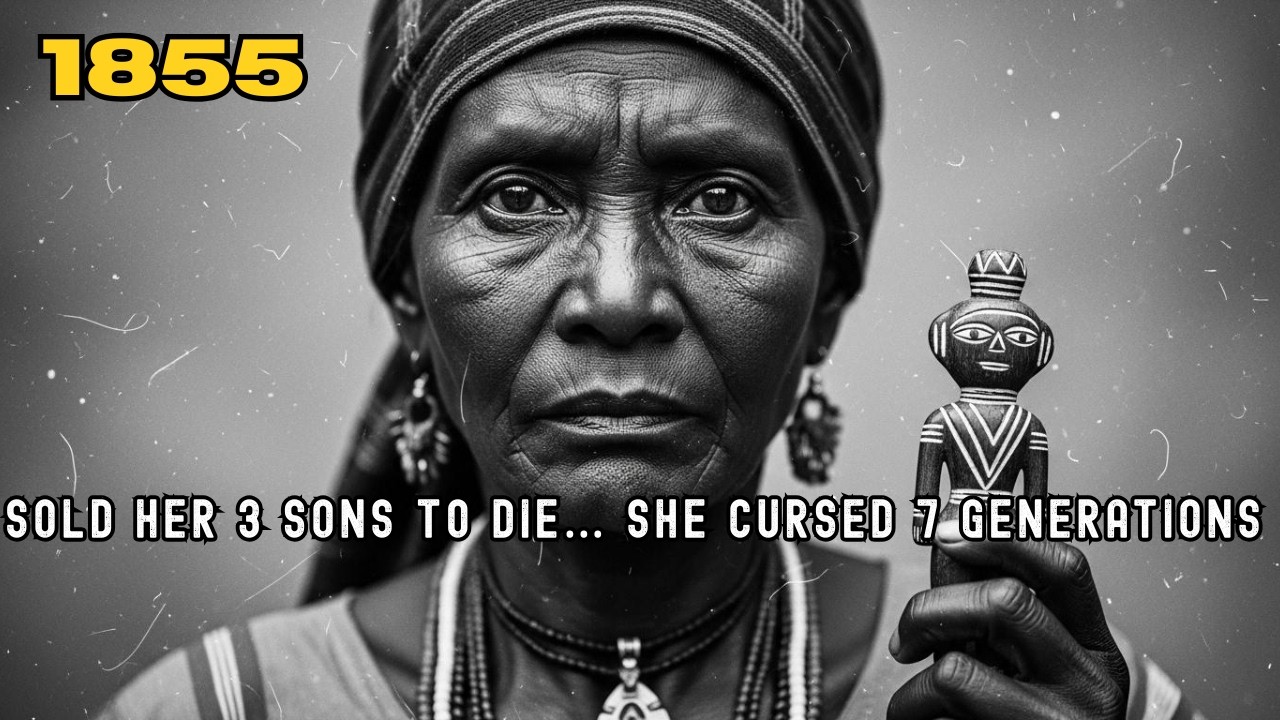
She had pressed into its heart the cloth of her eldest son’s shirt, the childhood hair of her second son, the ashes of the wooden flute her youngest had carved for her. Now she held it above the fire and spoke the name of Etienne Beaumont into the darkness. She had been waiting for this night since the morning they took her boys. Tituba was sixty years old when her world ended for the third time.
She had been born in Saint-Domingue in 1790, during the season of storms, the daughter of a Mambo whose mother had been a Mambo before her, all the way back to Dahomey. She was five when the revolution came, and she remembered fire on the horizon, burning sugarcane mixed with burning flesh, and her mother painting symbols on the door in chicken blood to spare them from the chaos. She remembered white planters fleeing to the coast, and she remembered being part of what they carried, cargo loaded onto a ship bound for New Orleans, sold to pay for their escape. Sixty years she had walked this cursed earth, carrying the secrets of the Loa, surviving Louisiana’s particular brand of slavery, which was somehow both more sophisticated and more brutal than what she had known in Saint-Domingue.
Belle Ombre sprawled across three thousand acres of Mississippi River Delta, its fields bleeding green with sugarcane that drank their sweat and grew fat on their death. The big house rose at the end of an oak-lined avenue four miles long, a white monument of two stories and twenty rooms, with crystal chandeliers from Paris and furniture from New Orleans craftsmen and heart-pine floors polished to a mirror shine by enslaved hands. The people who lived in the quarters called her Mambo, the priestess, the healer who could find the root of a sickness and the root of a spell. They came to her cabin after dark, when the overseer’s whip had left its signature on their backs or fever burned through their children, and they whispered her name with something close to worship.
Master Beaumont heard the word and threatened to have her whipped for encouraging superstition among the livestock. Livestock. That was what they were to him. Her cabin sat at the edge of the quarters, twelve feet square, with a dirt floor she swept twice daily and a stone fireplace she had built herself.
Beneath the floorboards near the hearth, hidden under a loose board, was her root cellar, three feet deep and lined with brick she had salvaged over years. That was where she kept the serious medicines, the poisons that could heal or kill depending on dose, the ingredients for works that went beyond healing into spiritual warfare. She had buried two husbands to fever and four children to stillbirth, but three sons had survived to adulthood, and they had become the center of her universe. Emmanuel, twenty-eight, six foot two of lean muscle, worked the cooperage, making barrels so perfect that Master Beaumont valued him at a thousand eight hundred dollars.
Baptiste, twenty-five, inherited his father’s gift for music and worked the stables, caring for the horses the master raced in New Orleans. Jean Louis, twenty-two, her youngest, had taught himself to read by stealing newspapers from the big house and bribing the overseer’s children with carved wooden toys. They were skilled, valuable. She had told herself that would protect them.
On the morning of October seventeenth, 1855, she learned how stupid hope could be. Charlotte, the eighteen-year-old house slave, burst through her door with wild eyes and a torn head wrap. The traders had come last night and stayed in the big house. Master Beaumont had gambling debts, and he was selling Emmanuel, Baptiste, and Jean Louis within the hour.
Tituba ran across the yard, her old legs remembering youth, and reached the front of the big house to find her sons already chained, wrist manacles connected by two feet of chain, ankle manacles connected by eighteen inches, enough to walk but not to run. They wore their work clothes and had nothing else, no bundles, no possessions, no time to say goodbye. Emmanuel stood tallest, his face a mask she recognized, the one that hid rage and grief behind blankness, but she could see his hands trembling. Baptiste was crying silently.
Jean Louis stared at the ground, his jaw clenched so tight she could see the muscles jumping. Master Beaumont stood on the top step in a burgundy silk smoking jacket, holding a crystal glass of cognac though it was barely seven in the morning. Tituba fell to her knees on the dirt drive and begged him to sell her instead, to take the old woman who had served his family for sixty years, who had delivered his children, who had healed his wife’s fever when the doctors gave up. The trader laughed.
Old voodoo woman ain’t worth fifty dollars. These bucks are worth fifteen hundred each. Master Beaumont descended the steps slowly, savoring his power, and told her that his father’s promises died with his father twenty years ago. He kicked her away with the casual dismissal you would use on a stray dog.
She fell backward, her head striking the ground, her mouth filling with blood where she had bitten her tongue. He gestured to the traders and told them to load their purchases. Emmanuel tried to resist, and one of the traders clubbed him across the head with a pistol butt. They threw him into the wagon like cargo.
Jean Louis met her eyes as they lifted him in, and his lips moved, forming words only she could hear. Remember us. The traders were taking them to Terrebonne Parish plantations, where enslaved people were worked to death in three years on average, where grinding season ran twenty-hour days, where overseers used whips like other men used words. Plantation Desirée, Plantation St.
Michel, and Plantation Noir. The trader with the ledger grinned and said her boys would make good money for their new masters before they wore out. Tituba knelt in the dirt for three hours while the sun climbed higher and the other enslaved people passed with sympathy mixed with relief that it was not their children. Old Joseph from the stable stopped and touched her shoulder.
You can’t help them by getting yourself killed. Get up. We need you. She stood, and the woman who walked back to her cabin was not the woman who had run from it three hours earlier.
That Tituba died there in the drive under Master Beaumont’s boot. The woman who returned carried something cold and patient inside her chest, something that had been sleeping for sixty years, held in check by hope and survival instinct. Hope was dead. The thing that woke in its place remembered how to speak to the Loa who collected debts written in blood.
She knelt before her ancestor altar and lit a candle, and the flame grew impossibly high without wind to feed it. She swore that Etienne Beaumont would pay, that his children would pay, that his children’s children would pay unto seven generations. The water in the offering bowl rippled though nothing touched it. In the silence where her sons’ laughter used to live, something answered, an ancient terrible presence waiting for her to give it purpose.
The first letter arrived in February of 1856, four months later, carried by a freed black ferryman named Solomon who worked between plantations. Emmanuel was alive at Plantation Desirée, working eighteen-hour days in the sugar house, still singing the songs she had taught him. She paid Solomon with herbs for his wife’s arthritis and a protective gris-gris bag for his daughter. In March, another letter came.
Emmanuel had died, his hand caught in the cane mill roller. They buried him in a field beyond the quarters, no marker. In August, Baptiste’s death notice arrived. Swamp fever, six days of burning heat and shaking and coughing blood at the end.
He was twenty-six. He had called for her as he died. In December, a traveling preacher brought news of Jean Louis. Pneumonia, twenty-three years old, dead in a slave hospital that was really just a shed with gaps in the walls.
The preacher said John Louis died peacefully, that he prayed at the end and forgave his masters and accepted Christ’s mercy. Tituba knew better. Jean Louis believed in Frederick Douglass and Haiti and the Underground Railroad. If he prayed at the end, it was not to the white man’s God.
Three sons, all dead in fourteen months. Master Beaumont had killed them as surely as if he had put a gun to each of their heads, sold them to plantations where death was the only certainty, and the law said this was property rights, said she had no recourse, no complaint, no claim to justice. So she made her own law. Her mother had warned her, when she was young, that the Loa did not like those who used power for vengeance, that vengeance attracts baka, evil spirits, and once they come, they do not leave.
But Tituba was already living in evil. Slavery was evil made systematic, given legal authority, blessed by churches, enforced by violence. What could the baka do to her that slavery had not already done? In January of 1857, two months after Jean Louis died, she began her preparations.
She needed her sons’ essences, and she had them: a square cut from Emmanuel’s sweat-stained work shirt, Baptiste’s childhood hair saved in a tin box from his first haircut at age five, the ashes of Jean Louis’s wooden flute burned in her fireplace while she sang the songs she had sung to him as a baby. Master Beaumont’s essence was trickier, but she cleaned the big house three days a week, and wealthy white men are careless about the traces they leave behind. His hairbrush yielded strands of gray and black mixed with lavender-scented pomade. Then one morning in early February, she heard him curse as he nicked himself shaving.
In the distraction, she slipped into his dressing room and wiped the line of blood from his razor with a cloth, folding it carefully and pocketing it before anyone could notice. In her root cellar, she mixed clay from the Mississippi River with dirt from three sources: graveyard dirt from the cemetery where free people of color were buried, dirt from the plantation’s boundary, and dirt from the field where Emmanuel was buried, soaked with his blood. She worked the clay with her hands while singing the old power songs, calling the Loa to witness. The figure took shape slowly, roughly twelve inches long, a human form with a head, torso, arms, legs.
Into the torso she pressed the cloth with Beaumont’s blood. Around the head she wound his hair, fixing it with black thread. Into the heart she inserted her sons’ essences, wrapped in red cloth, the color of blood and vengeance. She had found a crow dead beneath the oak during the new moon, a powerful omen, and she broke its bones into fragments and pressed them into the clay, the ribs forming a cage around the heart, the wing bones radiating from the shoulders.
As she worked, she whispered to the crow’s spirit. You will carry this curse. You will be its wings. You will give it flight through generations.
By the third day, the wanga was hard as stone. But true consecration required the Loa’s direct blessing, a ritual at the crossroads at midnight during the dark moon. On March nineteenth, 1857, when the sky was utterly black and even the overseers and patrollers slept off their whiskey, she wrapped the wanga in black cloth and slipped from her cabin. She made her way past the quarters, past the sugar house with its silent machinery, past the cooperage where Emmanuel used to work, and into a clearing where the land transitioned from cultivated to wild.
At its center stood the old oak, older than Belle Ombre, older than Louisiana’s slavery system. Its trunk was easily twelve feet in diameter, and the ground beneath it was bare dirt, nothing growing in its shadow. Enslaved people whispered that it had been used for hangings in the early days, that blood had been spilled at its roots, that spirits congregated there. She drew the vevé in cornmeal on the bare ground, the sacred symbols that would call the Loa to that place.
Papa Legba first, to open the gate between worlds. Then Erzulie Dantor, the fierce mother who understood that love and violence can inhabit the same heart. Then Baron Samedi, lord of the cemetery, guardian of the dead. Finally Ogun, the warrior spirit, master of iron and blood, who breaks chains and wages righteous war.
The vevés glowed in the darkness, not with physical light but with presence. She built a small fire and fed it sacred herbs, wormwood for sorrow, nightshade for endings, wolfsbane for hunting, rue for regret. The smoke rose black and thick, carrying her intentions upward to the Loa, downward to the ancestors. She held the wanga above the fire and spoke.
Etienne Beaumont, you took three lives from me. I take seven generations from you. You sold Emmanuel to death. You sold Baptiste to death.
You sold Jean Louis to death. She drove a blackthorn needle through the doll’s chest three times, once for each son. Seven generations of your blood will fall before their fortieth year. Every son, every daughter, every grandchild of your line will die young.
They will die in accidents, in sickness, in violence, in mysterious circumstances that medicine cannot explain. They will die, and you will watch from hell and know that this is the price of killing my children. Let no descendant of Etienne Beaumont live beyond forty years. Let his line know grief.
Let them bury their young and weep as I have wept. Let them feel powerless as I have felt powerless. Let them understand that debts must be paid even if it takes one hundred years. She lowered the wanga into the fire, and the flames consumed the outer wrappings, revealing the clay and bone beneath.
And then she heard a sound, not with her ears but with her spirit, a sound like chains breaking, like prison doors opening, like the earth splitting to release what was buried. The Loa had accepted the offering. The fire died as suddenly as it had flared. The wanga remained intact, blackened, hardened, transformed.
She dug at the base of the oak, three feet deep, until her hands bled, and she placed the wanga in the hole, wrapped in black cloth and oilcloth, singing her sons’ names as she buried it. As she finished, lightning split the clear, star-filled sky, a single bolt striking near the river. The Loa were announcing their agreement. The change in Etienne Beaumont was subtle at first.
Small things, missed steps, forgotten conversations, a tremor in his hands. Within two weeks of the curse, he began suffering savage headaches that made him roar and vomit and thrash in his bed. The white doctor from New Orleans found nothing wrong and prescribed laudanum and rest. By May, Beaumont was having nightmares, waking screaming, claiming to see three African men standing at the foot of his bed.
The house slaves whispered about it. His wife called in a priest, who blessed the master bedroom and performed an exorcism. Beaumont seemed better for a few days, then relapsed worse than before. He lost twenty pounds.
He could not sleep, could not eat, just drank and stared at nothing. In July he developed crushing chest pains. By October he was confined to bed most days, his skin gray, his eyes sunken, aged twenty years in eight months. He summoned Tituba to prepare a sleeping draft, and when she entered his room, he grabbed her wrist with surprising strength and begged her to stop it, promised to free her, to buy back her sons.
She told him her sons were dead. She told him there were debts that could not be paid with money, and she left him there, dying in the dark. Etienne Beaumont died on January seventeenth, 1858, exactly two years and three months after selling her sons. The official cause was heart failure.
He was thirty-eight years old. At his funeral, Tituba stood among the other enslaved people at a distance, and she counted his four children standing by the grave. Thomas, nineteen, would die at thirty-five. William, seventeen, would die at thirty-seven.
Margaret, fifteen, would die at thirty-two. James, thirteen, would die at thirty-nine. The curse had begun its reaping. Thomas Beaumont took control of Belle Ombre with the arrogance of youth, married Eloise DuFraine in a ceremony that cost more than the plantation’s annual sugar profit, and had four children in quick succession.
He seemed blessed. The crops flourished, the sugar prices held, the profits multiplied. Tituba watched from her cabin, keeping detailed records in a journal written in Creole mixed with French, in a cipher that combined African symbols with Catholic iconography, documented in symbols only another Mambo could fully decode. She recorded Thomas’s nightmares at age thirty, the tremor in his right hand at thirty-two, the headaches that began at thirty-three, the hunting accident that broke his collarbone and three ribs at thirty-four.
On October twelfth, 1874, while inspecting the sugar house during grinding season, Thomas Beaumont collapsed without warning, convulsing, blood pouring from his nose and ears. He died before the doctor could arrive. He was thirty-five. William Beaumont, the gambler, died in a duel at dawn in City Park in 1876, shot through the heart by a riverboat captain named Marcus Devo over accusations of cheating at cards.
He was thirty-seven. The family called it murder, but Devo was acquitted. Margaret Beaumont, married to a French count and living in New Orleans, died in 1879 during a difficult labor that lasted thirty-six hours, both she and the premature baby lost. She was thirty-two.
Her widowed husband took their three surviving children back to France and never spoke of Louisiana again. James Beaumont, the youngest, gentler than his siblings, disturbed by slavery in ways his family found embarrassing, fell overboard from the steamboat Evangeline on a calm evening in May of 1881. Some said he had been drinking. Some said he seemed dizzy, put his hand to his head as if in pain, and simply pitched forward.
They searched for two days but never found his body. James was thirty-nine, one year younger than the curse’s limit. All four of Etienne Beaumont’s children were dead. The first generation had fallen.
Tituba was seventy-eight years old, still living in her cabin on Belle Ombre, still serving as the quarters’ Mambo. She had lived to see the curse take its first four victims. She died in April of 1880, one year before James fell into the Mississippi, at approximately ninety years old. Pneumonia took her gently, more mercy than she had expected from this world.
She died in her own bed, surrounded by her students, who sang her into death with hymns that were half Catholic, half African. Her last words were, Remember my sons. Remember the curse. Guard the journal.
She had chosen her successor carefully, a young woman named Celestine, thirty years old, brilliant and fierce, and she entrusted to her the journal, the tools, and the knowledge of where the wanga lay buried beneath the oak. The curse would continue, she told her. Seven generations. Document everything.
When seven generations have fallen, the curse will release on its own. Until then, guard it. Feed it. Offerings at the oak on the dark moon.
Make sure no one disturbs the burial site. She was buried in the Giro Street Cemetery in New Orleans, in a plot she had purchased years earlier with money earned healing. Her gravestone was simple. Tituba Mambo, 1790-1880.
She remembered. But death was not the end of her work. She became an ancestor, a spirit who could influence from the other side, who could whisper to her successors, who could ensure the curse remained strong through Celestine and those who came after her. The second generation began dying in the 1880s.
Thomas’s four children, William’s three, Margaret’s three, James’s two, twelve potential victims of the Beaumont blood. Etienne Beaumont, the eldest grandson, died at thirty-six in a hunting accident, shot by his own cousin who swore it was a mistake. Marie-Claire died at thirty-three from tuberculosis. Alexandra drowned at thirty-one while swimming in Lake Pontchartrain on a calm summer day.
Philippe died of a massive stroke at thirty-nine. William’s children fared no better, two dying in their thirties from various illnesses, one from a fall from a balcony in the French Quarter. Of Margaret’s three children in France, one died young from scarlet fever, another from complications of childbirth at thirty-four, the third from cholera at thirty-eight. James’s children both died before forty, one from yellow fever, one from a heart condition.
By 1905, the second generation was decimated. Of the twelve grandchildren of Etienne Beaumont, only five had survived to reproduce. Seven had died before reaching forty. The family noticed.
They noticed and began to panic. Robert Beaumont, born in 1896, was the first to truly investigate the curse. In 1920, at age twenty-four, he became obsessed with his family’s history of premature death, compiled death records, interviewed elderly relatives, and found the pattern undeniable. In 1921, he purchased a collection of Louisiana slavery artifacts from an estate sale, and among the items was a leather-bound journal written in strange symbols and languages.
Robert spoke French and had studied Creole. He spent months decoding the journal, and gradually the truth revealed itself. The journal documented a curse placed in 1857 by an enslaved voodoo priestess named Tituba. Seven generations, death before forty, vengeance for three sons sold to death.
At a family gathering in 1922, he announced to twenty-three Beaumont descendants that they were cursed, that this was documented spiritual warfare, that an enslaved woman had cursed their family because their ancestors sold her three sons to death. They hired experts, voodoo practitioners from New Orleans, hoodoo root workers from Mississippi, even a spiritual medium from Boston. None could break the curse. One practitioner, a mambo named Marie Toussaint, told them bluntly that the curse had the spirits’ full backing, that it was righteous vengeance, that they could not break it because it was not evil but justice.
The only way it ends, she said, is when its terms are fulfilled. Robert asked how many generations had passed. You’re in the fourth, she calculated. Three more to go.
Maybe a hundred more years. Robert himself died in 1929 at age thirty-three, ruined by the stock market crash, putting a gun to his head in the study of his New Orleans home. His suicide note mentioned the curse. I can’t fight it.
None of us can. I just want it to be over. Generation four continued dying through the 1930s and 1940s, eight Beaumont descendants falling before forty through car accidents, cancers, strokes, mysterious fevers. The family scattered across America, fleeing Louisiana, changing names, marrying into other families, trying to dilute the Beaumont blood.
It did not matter. The curse found them in California, in New York, in Texas, in Chicago. Blood carried the curse, and blood could not be escaped. Generation five came of age during the Civil Rights Movement, and some younger Beaumonts tried to make amends for slavery, donating to black colleges, supporting integration, publicly denouncing their ancestors.
The curse did not care. Five died before forty, including one activist who genuinely tried to make reparations, who died at thirty-eight from sudden heart failure during a voting rights march. Individual virtue could not erase collective debt. Generation six grew up in the 1970s and 80s, studied by anthropologists and folklorists, appearing in academic papers and documentaries.
Six died before forty, from AIDS, car crashes, drug overdoses, a murder during a robbery, a plane crash, lupus. By the 1990s, the Beaumont family had shrunk dramatically. Many chose not to have children rather than pass on the curse. Michelle Beaumont was born in 1965, and in 1995, at age thirty, she entered the dangerous final decade.
She had grown up hearing the family stories, reading Robert’s translations of Tituba’s journal, now photocopied and distributed among descendants as a warning. She had studied anthropology in college and written her thesis on voodoo traditions in Louisiana. In 1994, she began systematic research, traveling to Belle Ombre, now a state historical site with tours and a small museum. The oak tree was obvious, ancient and massive, officially designated a heritage tree protected by law.
The ground beneath it was bare dirt, nothing growing in its shadow. Locals said it was cursed ground. Michelle obtained permission to do an archaeological survey, claiming she was researching plantation layout. In March of 1995, she brought a team including a mambo from New Orleans, a hoodoo practitioner from Mississippi, and three Beaumont family members willing to risk the attempt.
They excavated at the oak’s base on the spring equinox, digging carefully, respectfully. Two feet down, they found oilcloth. Inside that, black cloth. Inside that, the wanga.
After 138 years in Louisiana soil, it was still intact. The clay had become stone hard, the crow bones visible beneath the surface, strands of gray hair still wound around the head. Michelle wept when she lifted it from the ground. So many deaths, she whispered.
So much pain. Not because of this, the mambo corrected. Because of slavery. Because of what your ancestor did.
This is just the accounting. They performed a breaking ritual on April twelfth, 1995, the anniversary of Tituba’s death. The mambo had insisted on that date. They built a fire in the clearing, fed with specific woods and herbs, and they called the Loa: Legba to open the way, Erzulie Dantor to witness, Baron Samedi to release the dead, Ogun to cut the spiritual chains.
And they did something no previous attempt had done. They formally acknowledged the evil of slavery, apologized for Etienne Beaumont’s actions, and asked forgiveness from Tituba’s spirit and her sons’ spirits. Michelle spoke the words, tears streaming. Tituba, mambo, mother, we acknowledge that our ancestor committed a terrible evil.
He sold your sons to death for profit. No amount of time can erase that. We cannot bring back Emmanuel, Baptiste and Jean Louis, but we acknowledge their lives mattered. We acknowledge your grief was legitimate.
We acknowledge that this curse is not evil. It’s justice. And we ask humbly if seven generations have suffered enough, if the debt can now be considered paid. They placed the wanga in the fire.
It did not burn immediately. For long minutes it sat in the flames, resistant, the clay glowing red hot but not disintegrating. Then suddenly it cracked, a sound like bones breaking, like chains snapping, like a long-held breath finally released. The wanga shattered into pieces, the crow bones turned to ash, the clay crumbled to dust, the hair burned away with a smell that made everyone step back.
The wind died. The pressure in the air, that heavy watching presence, lifted. The mambo smiled. It’s done.
The curse accepted your acknowledgement. Tituba’s spirit has moved on. Your family is free. Generation seven would be the test.
The children born after 1995 would have to live beyond forty. And they did. The youngest members of generation seven, five cousins born between 1960 and 1975, all celebrated their fortieth birthdays, and their forty-first, and their forty-second. The first Beaumont descendants in 140 years to live beyond forty.
The curse had ended, but its legacy remained. The Beaumont family never forgot. They established a scholarship fund for descendants of enslaved people from Belle Ombre. They donated the plantation to become a historical site focused on telling the enslaved people’s stories, not glorifying the plantation system.
And every January seventeenth, the anniversary of Etienne Beaumont’s death, they held a memorial service, not just for their own dead, but for Emmanuel, Baptiste, and Jean Louis, for Tituba, for all the enslaved people who suffered and died on Belle Ombre. They remembered because Tituba’s greatest curse was not the deaths. It was memory. She forced the Beaumont family to remember slavery’s crimes for 140 years.
She made sure her sons were not forgotten, their deaths not dismissed as mere property loss. She won. And in winning, she proved that enslaved people were never powerless. They had weapons that could not be shackled.
Spirit, will, knowledge of powers older than America, older than white supremacy, older than the peculiar institution that claimed to own them. They had memory. They had justice. And sometimes, that was enough.
Tituba of Belle Ombre, the Mambo who lived from approximately 1790 to 1880, is recorded in historical documents and family records spanning 140 years. After emancipation in 1865, she continued to live on Belle Ombre as a paid healer and spiritual practitioner until 1878, when she moved to New Orleans. She died from pneumonia on April twelfth, 1880, and was buried in the Giro Street Cemetery, now demolished, her grave lost to urban development in the 1950s. The Beaumont family curse resulted in forty-one deaths before age forty across seven generations, from 1858 to 1995, making it one of the longest documented generational curses in American folklore and voodoo history.
Her journal is now housed in the New Orleans Historic Voodoo Museum’s private collection, studied by anthropologists, religious scholars, and voodoo practitioners as a significant historical document of enslaved people’s spiritual resistance. The journal was designated a protected cultural artifact in 2003. Belle Ombre Plantation is now a Louisiana State Historic Site with interpretive programming focused on the enslaved people’s experiences and resistance during the antebellum period. Tituba’s curse demonstrated that slavery’s violence did not go unanswered, that the enslaved fought back not just through rebellion and escape, but through spiritual warfare that gave them agency in a world designed to strip it away.
Her story proved that memory itself can be a curse, that debts must be paid even if it takes nearly a century and a half, and that the spirits keep their own ledgers with meticulous accuracy.






