In the spring of 1536, a seventeen-year-old boy lay dying, and with him died the only son Henry VIII had ever publicly acknowledged. The king had poured titles, estates, and quiet hope into this young man, the living proof that Henry could father healthy boys. Now that proof was slipping away, struck down by an illness that none of the physicians could name. When the end came, the king did not order a state funeral.
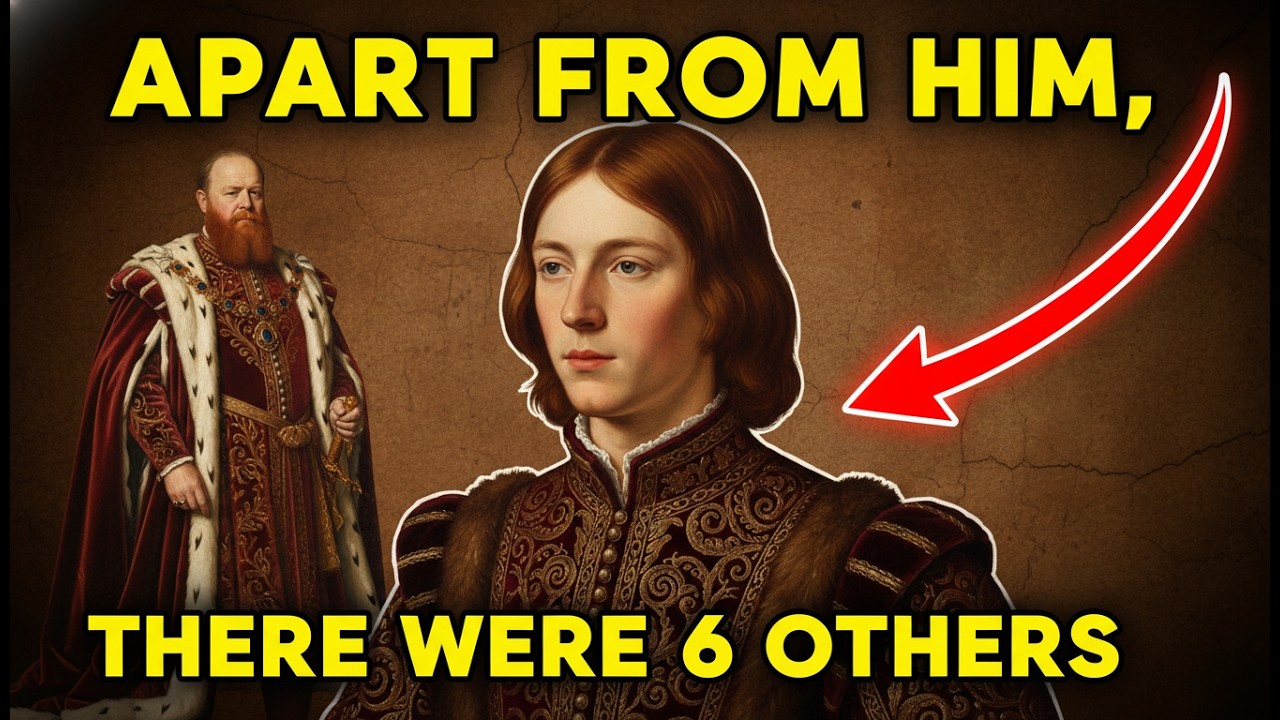
He did not command a grand monument. Instead, Henry VIII had the boy buried quietly, almost secretly, and the court understood that some grief was best left unspoken. This was Henry Fitzroy, Duke of Richmond and Somerset, Earl of Nottingham, the son born to Bessie Blount, and his death would close a door that king had spent his entire reign trying to force open. To understand what Henry buried with Fitzroy that year, one has to go back to the world that shaped him.
Tudor England did not treat legitimacy as a matter of paperwork. It was divine, sacred, mystical. Royal blood was believed to carry God’s blessing, and the survival of the monarchy depended on an unbroken, unquestionable line of succession. Henry had grown up in the shadow of the Wars of the Roses, that brutal decades-long civil war that had torn England apart because rival factions could not agree on who had the true claim to the crown.
Cousin had fought cousin. The country had been drenched in blood. That war had ended little more than thirty years before Henry took the throne, and its warning was still fresh. To Henry, an illegitimate son was not a gift.
It was a danger. Royal blood, yes, but blood tainted by the church, born outside the sanctity of marriage, a claim that could never be fully, legally, undisputedly inherited. An illegitimate heir was an invitation to chaos, to another war of the roses, and Henry would do anything to avoid that. Yet he had already taken the risk once.
He had acknowledged Henry Fitzroy, and he had done so spectacularly. Fitzroy’s mother was Bessie Blount, a lady-in-waiting to Catherine of Aragon, Henry’s first wife. She caught the king’s eye, and their affair produced a son in 1519. Henry was thrilled, and not only for the boy.
At that point Catherine had given him one surviving child, a daughter named Mary, and no sons. Fitzroy was proof that the problem was not the king. It was the queen. So Henry did not hide the boy.
When Fitzroy was six years old, he was showered with some of the highest titles in the land: Duke of Richmond and Somerset, Earl of Nottingham. The title of Richmond carried special weight, for it had been held by Henry VII before he became king. The message was unmistakable. This boy mattered.
Fitzroy was raised in a royal household, given his own estates, his own court. There was serious talk that Henry might legitimize him and name him heir to the throne, and some historians believe the king even considered marrying Fitzroy to his half-sister Mary to create a joint claim. It sounds shocking now, but in Tudor England, stranger things had happened in the pursuit of securing the succession. Then, in 1536, everything changed.
Fitzroy died at seventeen, the cause still debated, possibly tuberculosis, possibly some other rapid illness. Henry was devastated, but he buried the boy quietly, almost secretly. Some historians believe that by then, the king no longer needed him. Jane Seymour was pregnant with the legitimate son Henry had craved for so long.
Edward was born a year later, and Fitzroy’s death became inconvenient, a reminder of failure rather than hope. So Henry buried him and moved on. But Fitzroy’s existence proved something crucial: Henry could acknowledge his bastard children. He had done it before.
So why did he never do it again? Rumors swirled around at least six others, perhaps more. Some of these rumors came from the Tudor court itself, whispered in corridors, recorded in letters. Others came from the children themselves, who later claimed royal blood.
And a few came from evidence that is difficult to ignore. The most famous and most compelling case begins with the Boleyn family, a family so complicated that historians still untangle its threads. Before Anne Boleyn ever caught Henry’s eye, he was involved with her older sister, Mary. That Mary was Henry’s mistress is confirmed.
What is not confirmed is exactly when the affair began and ended, and most critically, whether the two children Mary had during that period were his. Katherine Carey was born in 1524. Her official father was William Carey, a gentleman of the king’s privy chamber and Mary’s husband. But the timing is suspicious.
Mary was Henry’s mistress around this period, and Katherine’s birth falls right in the middle of it. Two years later, in 1526, Mary gave birth to a son, and she named him Henry Carey. Perhaps that was coincidence. Perhaps William Carey was a devoted admirer of the king and chose the name out of loyalty.
Or perhaps it meant something else entirely. After Mary’s affair with the king ended, both Katherine and Henry Carey received unusually favorable treatment at court, not the kind of treatment expected for the children of a minor courtier, but the kind expected for someone with royal blood. Henry Carey in particular had a remarkable career. Queen Elizabeth, who would have been either his cousin or his half-sister depending on which theory one believes, made him Baron Hunsdon.
And when he lay on his deathbed, Elizabeth offered him the title of Ormond, a title connected to the Boleyn family. Why would a queen go out of her way to honor the son of her aunt’s husband unless there was something more to the story? Then there is the physical resemblance. Multiple contemporary sources noted that both Katherine and Henry Carey looked remarkably like Henry VIII: strong features, reddish hair, that distinct Tudor look.
And Katherine’s daughter, Elizabeth Knollys, looked so much like Queen Elizabeth I that people at court would sometimes mistake one for the other. One would think that with all this evidence Henry would have acknowledged the Careys. He acknowledged Henry Fitzroy after all. But by the time the Carey children were old enough to matter, the situation had shifted.
Their mother Mary had been cast aside. Their aunt Anne had become queen, and then had been executed. The Boleyn family was toxic. Acknowledging royal bastards connected to them would have been a political disaster.
So Henry stayed silent. The whispers never stopped. There is no DNA evidence, no definitive proof, but the circumstantial case is hard to ignore. Another rumored child was Thomas Stucley, whose story reads like an adventure novel.
Stucley was an English mercenary who fought in France, in Ireland, and at the legendary battle of Lepanto. He eventually died fighting at the battle of Alcazar in Morocco, leading troops against an army in North Africa. But beyond his military exploits, Stucley was a Roman Catholic rebel who actively worked against Queen Elizabeth, a bold move for someone supposedly the half-brother of the queen. His mother was Jane Pollard of a prominent Devon family, and according to rumors that Stucley himself spread, she had a relationship with Henry VIII before her marriage.
Stucley claimed to be the king’s son. He boasted about his royal blood to anyone who would listen, threw it around like a title, used it to gain favor, to raise armies, to make himself seem more important than he was. There is no concrete evidence, no letters from Henry, no royal acknowledgement, just Stucley’s word and his audacious personality, which did mirror the young Henry VIII rather well: bold, reckless, charismatic, convinced of his own greatness. Some historians think Stucley was a con man who invented a royal lineage to boost his status.
Others think there may have been truth buried under layers of embellishment. One thing is certain: Thomas Stucley believed he was a son of a king, and he lived and died like one. Richard Edwards took a very different path. He was not a soldier or a rebel, but an artist: a poet, playwright, and composer who became a gentleman of the Chapel Royal and eventually master of the singing boys, essentially the man who trained the royal choir.
His mother was Agnes Edwards. No dramatic affair is documented, but rumors about Richard’s parentage persisted throughout his life. Why? Because of how quickly he rose at court and because of his talent.
Edwards was known for his comedies, his interludes, his music. He received significant royal patronage, more than one would expect for someone of his supposed background. And his artistic abilities mirrored those of Henry VIII, who was himself a talented musician and composer in his youth. Some contemporary sources hint at a possible connection between Edwards and the king, but it is all vague, nothing explicit, just suggestions and implications.
The fact that he was given such prominent roles in the royal household raises questions. Was he genuinely that talented, or was there another reason the crown favored him? There is no proof, but a pattern emerges: Henry VIII had a habit of elevating certain people to positions beyond what their official parentage would suggest, and Richard Edwards was one of them. Then there is the case of Etheldreda Malte, also known as Audrey.
Her official father was John Malte, Henry VIII’s tailor. Not a nobleman, not a courtier, but a tailor. One would expect her to have a modest life. That is not what happened.
When John Malte died, he left behind a will that raises eyebrows. First, he left Audrey a significant amount of money, far more than one would expect a tailor to possess. And in the will, he specifically stated that this money had been given to him by Henry VIII. But the really interesting part is that he referred to Audrey as being reputed to be his daughter.
Reputed. A very careful, very specific word choice. It suggests that while John Malte raised Audrey as his daughter and publicly acknowledged her, there was an understanding, perhaps an open secret, that she was not actually his biological child. Then there is the land.
Henry VIII granted John Malte properties historically connected to royal estates, properties that came with income and status. Why would a king do that for his tailor unless he was not just paying for clothes? Audrey’s mother was Joan Dingley. Little is known about her relationship with Henry, but the evidence in John Malte’s will strongly suggests someone at the highest level, someone royal, was ensuring this child was taken care of.
Henry VIII may never have publicly acknowledged Audrey Malte, but he made sure she was provided for, and that speaks volumes. The most disputed and most dramatic potential child was Sir John Perrot. He was a larger-than-life figure, literally. Physically huge, with a booming voice, a fierce temper, and a personality that filled every room.
He served as Lord Deputy of Ireland, commanded troops, and had a long, tumultuous career that ended with him imprisoned for treason. His mother was Mary Berkeley, wife of Sir Thomas Perrot. From the moment John was born, people whispered that Sir Thomas was not actually his father. The reason was simple: John Perrot looked exactly like Henry VIII.
Not a passing resemblance. Multiple contemporary sources described Perrot as a virtual copy of the king, same build, same features, same reddish coloring. Even his personality mirrored Henry’s: proud, stubborn, explosive. Sir Robert Naunton, in his work Fragmenta Regalia, flat out suggested that Perrot was the king’s son, pointing to both his physical appearance and his behavior as evidence.
Perrot himself never explicitly claimed to be Henry’s son, but he did not exactly deny it either. He carried himself with a kind of royal arrogance, and some historians believe he genuinely thought he had royal blood. Modern scholarship, however, throws cold water on the whole thing. Most historians today reject the idea that John Perrot was Henry VIII’s son, because when one digs into the timeline, it does not quite work.
Mary Berkeley was married to Sir Thomas Perrot, and there is no documented evidence of an affair with Henry. No letters, no court records, nothing. The resemblance could have been coincidental. The personality similarities could have been exaggerated over time.
The rumors could have started simply because Perrot looked like the king, and people love a good scandal. Throughout most of history, though, people believed the connection was real. The rumors were so persistent, so widespread, that they became part of Perrot’s identity. Whether he was truly Henry’s son or not, he lived his life under that shadow.
In Tudor England, the rumor of royal blood could be just as powerful, and just as dangerous, as the reality. So where does that leave us? There are six potential illegitimate children beyond Henry Fitzroy. Katherine and Henry Carey, with their striking resemblance and favorable treatment.
Thomas Stucley, the adventurer who claimed royal blood. Richard Edwards, the artist who rose impossibly fast at court. Etheldreda Malte, whose father left a will that strongly hints at a royal connection. And John Perrot, who looked so much like Henry VIII that people could not help but whisper.
Some claims are stronger than others. The Careys have the most circumstantial evidence. Audrey Malte has the tantalizing will. The others are mostly rumor and speculation.
Henry’s personality suggests that if he truly believed these children were his, he probably would have acknowledged them, at least privately. He publicly acknowledged Henry Fitzroy. He was not shy about it. So why not the others?
Perhaps he genuinely did not believe they were his. Affairs were common in the Tudor court. Mistresses had children. That did not automatically mean those children were the king’s.
Or perhaps the political situation made acknowledgement impossible. By the time some of these children were born, the line of succession was a minefield. Acknowledging more illegitimate heirs could have destabilized everything Henry was trying to build. Or perhaps, the most cynical possibility, he simply did not care.
If they were not legitimate, they were not useful. They could not inherit. They could not secure the Tudor dynasty. So why bother?
What is certain is that Henry VIII’s obsession with a legitimate heir shaped English history in ways still felt today. It gave England the Church of England. It gave England Queen Elizabeth I. It gave centuries of religious conflict and political upheaval.
And it left behind a handful of people who lived their entire lives wondering if they carried the blood of a king, and what that might have meant if the world had been just a little bit different. There is no DNA testing, no definitive proof, just whispers, circumstantial evidence, and centuries of speculation. But these stories matter because they reveal the truth about Henry VIII: a king so obsessed with legacy, with legitimacy, with control, that he was willing to destroy lives, institutions, and even his own marriages to get what he wanted. And yet, despite all that control, despite all that power, he could not control the whispers.
He could not silence the rumors. He could not erase the children who may or may not have carried his blood.






