On October 26, 2022, police arrested Richard Allen at his home in Delphi, Indiana. He was fifty years old, a married father, a pharmacy technician who had spent years working behind the counter at a local CVS. His neighbors described him as unremarkable. He was the kind of man you nodded to in a parking lot and forgot by the time you reached your car.
He had lived in Delphi for about sixteen years and never left. His only criminal record was a speeding ticket and a seatbelt violation. The police had searched his home thirteen days earlier and found a Sig Sauer P226 . 40 caliber pistol.
That detail mattered more than anything else in the case. Five years before that arrest, on the afternoon of February 13, 2017, two friends asked for a ride to a walking trail in a small Indiana town most of the country had never heard of. They wanted to spend the last afternoon outside before the weekend ended. A walk across an old railroad bridge, some photos for social media.
It was not more complicated than that. Abigail Williams, thirteen, and Liberty German, fourteen, never returned to the car. By noon the next day their bodies were found less than half a mile from that trail, and a case that should have been solved in days turned into five years of silence, false leads, and a killer who told police to their faces that he was standing on that very trail when the girls walked past him. No one connected the dots, not for half a decade.
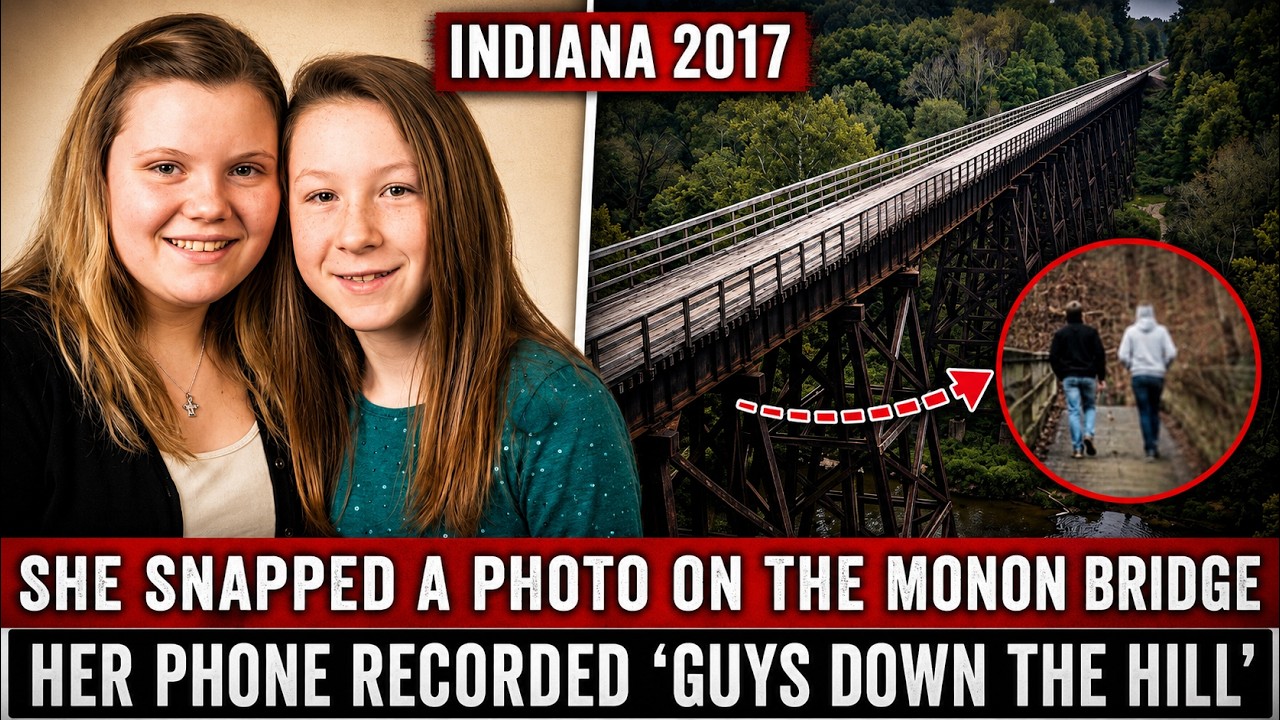
Delphi sits in Carroll County, an agricultural community built around a courthouse square and a network of walking trails the locals are proud of. The Delphi Historic Trails wind along Deer Creek and pass over the Monon High Bridge, an old railroad trestle that rises high above the water. Families roam it constantly. Teenagers use it as a shortcut and a place to hang out.
By all accounts it was the kind of place where nothing ever happens. Libby German was in eighth grade, cheerful and social, the type who documented everything on her phone. Abby Williams was a year older, an artist with a close bond to Libby going back to childhood, the kind of lifelong friendship small towns produce almost by accident. On the morning of February 13 they had a day off from school.
Libby’s older sister dropped them at the trailhead early in the afternoon so they could hike, take photos, and post on social media before being picked up a few hours later. They never made it to the meeting point. When Libby’s family could not reach either girl by phone, and when neither answered messages that remained unread, panic set in quickly. It was still winter in Indiana, one of those February days where daylight disappears by early evening and temperatures drop hard once the sun goes down.
Still, search teams gathered that same evening. Volunteers, police, and family combed the trail network in the pitch dark with flashlights and tracking dogs, searching the ravines and the creek bed below the bridge as the temperature kept falling. One of those volunteers made the discovery no parent should ever face. On February 14, the bodies of both girls were found in rugged wooded terrain near the creek, not far from the base of the bridge where they had posed for photos.
They were formally identified the next day. Both had been murdered less than a day after going out for what was supposed to be an ordinary walk. The community response was immediate and immense. A reward fund of $41,000 was announced the same week the girls were found, and it kept growing as the case dragged on without an arrest.
By March 1 of that year, donations from prominent Indianapolis figures, including Indianapolis Colts owner Jim Irsay and broadcaster Pat McAfee, pushed the total past $200,000. It kept rising for years, eventually reaching $325,000 after an anonymous donor added $100,000 more in the spring of 2021. A town of a few thousand people turned itself into the center of one of the largest unsolved murder investigations in the country, and the reward money was proof of how badly everyone wanted it solved. What made this case different from the start was that Libby had been recording what was happening.
In the final minutes before the girls disappeared, her phone captured video of a man walking across the bridge behind them, and it captured audio too. A man’s voice cuts through the video giving an instruction: “Down the hill. ” Those three words, despite their poor quality and clarity, became the most replayed thirteen seconds in the history of American true crime. Investigators released the recording to the public alongside a grainy still image of the man himself.
A jacket described variously as blue or black, a hood up, or in some versions of the image, a beanie. The internet nicknamed him “Bridge Guy” before police had even finished processing the crime scene. You would think a recorded voice and a photograph would solve a case like this within days. It did not.
Delphi is a small town, and small towns like to talk, but no one recognized the man in blue jeans and a dark jacket walking across a bridge hundreds of local men had crossed hundreds of times. The tip line blazed with thousands of calls. Investigators chased ghost suspects, followed leads from psychics and amateur sleuths, and worked through the sex offender registry in adjacent counties. After two years with no significant arrests, Indiana State Police tried something new.
In the spring of 2019 they released an enhanced version of the audio recording along with an entirely new sketch of the suspect, hoping better technology might jog the memory of someone who had not yet connected the dots. It generated more than 2,700 additional tips within a few weeks. None of them came anywhere close to the truth. One lead investigators pursued hard during those years involved a predator who had been messaging Libby German online in the months before her death, using a fake social media account under the name Anthony Shots.
That account belonged to a man named Kegan Kline, and his home was raided just eleven days after the murders. He took a polygraph test, his electronics were seized, and for a long stretch of the investigation he stayed near the top of the public suspect list, partly because he deleted the messages he had exchanged with Libby on the same day she disappeared. But investigators never found evidence linking him to what happened on the trail, and the FBI stated publicly, even in 2017, that they did not believe he was connected to the murders. Kline was eventually prosecuted on entirely separate charges involving child exploitation and obstruction of justice.
In the spring of 2022 he pleaded guilty to twenty-five felony counts. By December of that year he was sentenced to forty years in prison. It was a real conviction for real crimes against children, but they were not the Delphi murders. The man in the photo on the bridge remained, as far as the public knew, a complete stranger.
Here is the detail that still stuns people when they learn it. Three days after the murders, a man named Richard Allen got into a conversation with his wife and mentioned that he had been on the Monon High Bridge trail that very afternoon. Then he called investigators himself and told them the same thing. According to the account later provided in the probable cause affidavit, Allen said he had been on the trail for about two hours that day, placing himself there originally between 1:30 and 3:30 in the afternoon, a time window he would later adjust to between noon and 1:30.
He told police he saw three girls walking past him on the trail. He was interviewed. A note was written in the file. Then, for reasons that would only become clear years later, he was not treated as a serious suspect.
He went home. He went back to work. He kept living a few miles from where two teenagers were killed, and the investigation proceeded without him, chasing online predators and digital tips, while the man who committed the crime filled prescriptions at a pharmacy in the middle of town. That is the detail that haunts this case more than any other in modern true crime.
The man who did it told police he had been there. He said it to their faces within seventy-two hours of the murders, and it took investigators five more years to connect the dots he had practically drawn for them. For five years the Delphi case sat in that painful space between unsolved and forgotten. Investigators never closed the file.
Indiana State Police maintained a dedicated tip line the whole time, kept following leads, kept receiving new theories from a public that turned into amateur investigators overnight. True crime forums and online communities treated the case like a full-time job, comparing sketches to yearbook photos, arguing over the exact wording of the audio recording, and building timelines down to the minute. Suspects rose and fell in the court of online opinion over and over. None of it led to the killer.
This online obsession was a double-edged sword, and it matters because it shaped the way the entire case ended up in court. On forums like WebSleuths, volunteers spent thousands of hours transcribing police scanner recordings from the days around the murders and indexing every interview investigators gave to the press, building an archive researchers still cite today. But the same amateur energy produced years of baseless speculation, harassment campaigns targeting people with no connection to the crime, and a steady stream of conspiracy theories that treated rumors as evidence. One of those theories, built on claims about a white nationalist ritual cult operating in rural Indiana, circulated online for years before Richard Allen’s defense team adopted a version of it as their official courtroom strategy.
The gag order issued after Allen’s arrest in 2022 was meant to quiet the noise. Instead, it created a vacuum that online commentators filled with wilder theories, and it took a judge’s ruling, not public consensus, to decide which version of events would finally reach a jury. The breakthrough that ultimately broke the case came from a completely different direction than facial recognition or informants. It came from genetic genealogy, the same technique that had already cracked decades-old cold cases across the country by then, most famously identifying the Golden State Killer years earlier.
The method works by taking DNA evidence collected from the crime scene and matching it not against a criminal database but against consumer ancestry databases full of people who voluntarily submitted their DNA to learn their origins. Investigators build a family tree from distant genetic matches, cousins of varying degrees who have no idea they are part of an investigation, and narrow it down generation by generation until a name emerges. A single case can take months of painstaking archival work, tracing marriages and births through public records, triangulating census data, and eliminating entire branches of the family tree, relative after relative, before the pool of possible suspects shrinks to a handful of names and then, finally, to one. It is slow.
It is painstaking. It requires patience that much traditional investigative work does not. In 2022 that method led Indiana State Police to a name that had already been sitting quietly in their own case file since the week of the crime. Richard Matthew Allen, fifty years old, married and a father, a man who had moved to Delphi about sixteen years earlier and never left.
He had no criminal record to speak of except a speeding violation and a seatbelt violation, the kind of clean record that makes background checks feel reassuring. He earned a pharmacy technician license and spent years working behind the counter at CVS branches around Carroll County, including the Delphi store itself, until the year of his arrest. Neighbors described him as ordinary. He was hiding, as investigators would later say, in plain sight the whole time.
On October 13, 2022, police searched Allen’s home. Inside they found a Sig Sauer P226 . 40 caliber pistol. That detail mattered more than anything else in the case, because at the 2017 crime scene investigators had found a .
40 caliber cartridge that had never been fired, a Winchester round that had clearly been loaded into a weapon and then ejected from it. Forensic experts at Indiana State Police compared the extraction and ejection markings on that unfired round with test rounds fired from Allen’s pistol and found a match. A firearms expert would later testify that the quality and quantity of those markings allowed her to identify Allen’s gun as the weapon that had cycled the cartridge found near the girls’ bodies. On October 26, 2022, Richard Allen was arrested at his home in Delphi.
He was officially charged with two counts of murder a few days later, and he pleaded not guilty. The community reaction was a mix of relief and disbelief. This was not a drifter or a stranger who passed through town once and vanished. It was a man who had lived in Delphi the whole time, who filled prescriptions from behind the pharmacy counter, who told police himself that he had been on the trail that day and was simply let go.
It is worth pausing on that. Rarely in true crime do you find a case where the investigative failure and the eventual breakthrough trace back to the exact same piece of information. Allen was not a name investigators stumbled upon by chance. He was a name they already had.
Forensic science had finally caught up with what he had already told them. National media descended on Delphi within hours of the arrest announcement. Reporters camped outside the pharmacy where Allen worked, outside the modest home he shared with his wife, and outside the courthouse that had spent five years taking tips about strangers and drifters, anyone except the man standing behind the counter. People who had been Allen’s customers, coworkers, or acquaintances spoke to journalists in stunned tones, describing a man who never stood out, never aroused suspicion, never gave anyone a reason to look twice.
That disbelief became a story of its own, as unsettling as the crime itself, because it forced a small town to confront the fact that the person they had spent five years fearing as a stranger had been shopping beside them all along. One point worth noting about how this case played out in court: forensic scientist Stacy Bozinowski made clear that no DNA from the crime scene was directly matched to Richard Allen. Genetic genealogy helped investigators identify him as someone worth revisiting, but the case that eventually went to trial rested on two pillars that had nothing to do with a DNA swab. The ballistic match between that unfired cartridge and his pistol, and, as would later emerge, a mountain of his own words.
The road to trial took far longer than anyone expected. A pretrial conference was held in January 2023, and from there the case stumbled for nearly two years. Allen’s defense team changed, and legal filings piled up. At one point case evidence leaked to the public in a way that forced the court to address contamination concerns before the trial could proceed at all.
What was originally scheduled to begin in the spring of 2023 kept getting postponed again and again. In March 2024 the presiding judge dismissed two kidnapping charges against Allen, and he waived a hearing on the amended murder charges that remained. The trial finally began in October 2024, nearly two full years after the arrest and almost eight years after the murders themselves. During that period Allen’s defense team built what would become one of the most unsuccessful and controversial legal strategies in recent true crime history.
In a 136-page filing submitted in September 2023, the defense claimed Abby and Libby were victims of a ritual sacrifice carried out by a group associated with Odinism, a Norse pagan belief system that has been co-opted in some fringe circles by white nationalist groups. The defense pointed to the positioning of the bodies and to markings at the crime scene they claimed resembled runic symbols, and they named specific men from neighboring counties as the actual killers. Special Judge Frances Gull, who was presiding over the case, eventually barred the entire theory from reaching the jury. She ruled that the defense had presented no admissible evidence linking Odinism or any of the named men to the murders, and that whatever minimal probative value the theory might have was vastly outweighed by the likelihood of confusing and misleading the jurors.
Prosecutors, led by Carroll County Prosecutor Nicholas McLeland, called the claim baseless. A professor from Purdue University who studies the belief system publicly debunked the idea that child sacrifice is part of it. The jury never heard the word “Odinism” at all. What they heard instead was the voice of Richard Allen himself.
When the trial finally began in October 2024, prosecutor Nicholas McLeland used his opening statement to lay out the case in stark terms, telling jurors that Richard Allen was the last person Abby Williams and Libby German ever saw, that he used a gun to force them toward the creek where he overpowered two children who had no means of resistance, and that he had, in McLeland’s words, hidden in plain sight for five years while the town searched for a stranger who was never a stranger at all. When the video and audio recording were played for the jury, courtroom observers noticed Allen bow his head and appear to pray, something journalists said they had never seen him do at any previous court appearance. Later in the trial, when the recording was replayed during a witness’s testimony, Libby German’s mother was seen weeping in the courtroom, hearing her daughter’s voice in what was, for many in that room, an unbearable reminder of exactly what had been taken. While Allen sat in Westville Correctional Facility awaiting trial, prison phone calls were recorded with his wife, Kathy, and his mother, Janis.
The prosecution said Allen confessed to the murders more than sixty times while in custody, to guards, to his family, and to anyone within earshot during his periods in solitary confinement. At trial, jurors heard about seven of those calls, five to his wife and two to his mother. In one call from April 2023 Allen told Kathy plainly: “I did it. I killed Abby and Libby.
” In a later call with his mother, he asked whether Kathy had told her he had done it, and wondered aloud whether his family would still love him now that he had confessed. His defense team, led by attorneys Brad Rozzi and Andrew Baldwin, argued that he had been in a psychotic state during those calls, medicated and deteriorating under the stress of isolation, and that nothing he said should be trusted as a genuine admission of guilt. Rozzi and Baldwin called about twenty-five witnesses of their own during the trial, including mental health and forensic experts, to undermine the credibility of both the confessions and the forensic testimony. Allen himself chose not to testify.
Still, the jury heard the recordings. They heard the forensic evidence linking his gun to the cartridge found beside the girls’ bodies. They heard the fact, disputed by no one including Allen himself, that he had been on that trail the same afternoon the girls disappeared, wearing blue jeans and a jacket matching the description of the man in the video. After four days of deliberation, the jury returned its verdict on November 4, 2024.
Richard Allen was convicted on all four counts against him: two counts of felony murder and two counts of intentional murder. There was no ambiguity left in the outcome. The man who told police in 2017 that he had been on the trail, who spent years free in the same small town where he had committed the murders, was finally and formally held to account. On December 20, 2024, Judge Fran Gull imposed the sentence: sixty-five years for each murder, to be served consecutively rather than concurrently, for a total of 130 years in prison.
Before sentencing, the families of Abby Williams and Libby German addressed the courtroom directly with victim impact statements, describing eight years of grief that had never been allowed to truly break while the case remained unsolved. Prosecutors noted that Allen himself had expressed, through his attorneys, a desire to apologize to both families, even as his legal team continued to argue that his mental state during confinement should be weighed in his favor. The story does not end there. Allen’s lawyers filed a lengthy appeal in late 2025, exceeding one hundred pages, arguing that the trial had been marred by errors ranging from how the Bridge Guy video was handled as evidence to a conflict of interest involving Judge Gull herself.
The Indiana Attorney General’s office responded with its counter-brief in the spring of 2026, arguing that any errors were harmless and that the conviction should stand exactly as it was. Oral arguments before the Indiana Court of Appeals are scheduled for fall 2026, and legal observers expect the losing side in that round to try to take the fight to the Indiana Supreme Court. None of that changes where Richard Allen sleeps at night. He remains incarcerated out of state while the appeal proceeds, and unless three appellate judges find something in that filing substantial enough to overturn the jury’s unanimous verdict, he will spend the rest of his life behind bars for what happened to Abby Williams and Libby German on that trail in February 2017.
What lingers in people’s minds about this case is not only the horror of what happened to two teenagers on an ordinary afternoon. It is the five years that followed. Five years in which the man responsible lived openly in Delphi, worked behind a pharmacy counter, and had already handed investigators the single most important piece of information. The simple fact that he had been there.
The genetic genealogy breakthrough that finally led police back to his door did not uncover a hidden stranger. It confirmed a name that had been in the file since the week of the crimes, waiting for science and patience to catch up. There is a broader pattern here that extends far beyond Delphi. Genetic genealogy has now quietly solved dozens of cases investigators had considered permanently unsolvable, cases where physical evidence sat in storage for decades waiting for technology and databases to catch up.
What makes Delphi stand out even among those cases is how short the distance actually was between the killer and the investigation the whole time. This was not a needle hidden in a national haystack. It was a name in a local file, a face that walked into the sheriff’s office voluntarily, a neighbor who kept going to work at the pharmacy every day while a task force searched for him using a completely different description. Abby Williams was thirteen.
Libby German was fourteen. They wanted one more afternoon in the sun before winter fully released Indiana. Their families spent five years in confusion, then two more years watching a trial crawl toward a verdict the families had waited nearly eight years to hear. That kind of waiting does not end cleanly even with a conviction and a sentence ensuring Richard Allen will die in prison.
It becomes something the community learns to live with, just as Delphi learned to live with the Monon High Bridge trail itself, a place people still walk, still love, and will never look at as merely ordinary again. The trail was reopened to the public long before Allen was caught, and people kept walking it anyway, year after year, through every anniversary of the crime and every investigative dead end. Locals still gather near the bridge every February to remember Abby and Libby, a quiet tradition that continued for years before the perpetrator was captured. That persistence says something about Delphi that the crime never managed to erase.
A small town can absorb an unimaginable tragedy and still deliberately choose to keep walking the same paths, repeating the same two names, insisting the girls be remembered as they were, rather than the way their story ended.






