At 8:49 on the morning of September 17th, 2023, I was standing in a command trailer parked at the Red Deer River Trailhead in Banff National Park, watching a thermal feed on a laptop screen. Constable Tyler Foss was flying a drone up a side drainage of the Panther River, searching for two hikers who had been missing for nine days. The screen showed the forest in shades of gray, everything dead and cold except what was alive. Then Tyler’s hands went still on the controller, and I saw it too: a single vertical heat source, taller than it was wide, standing among the spruce.
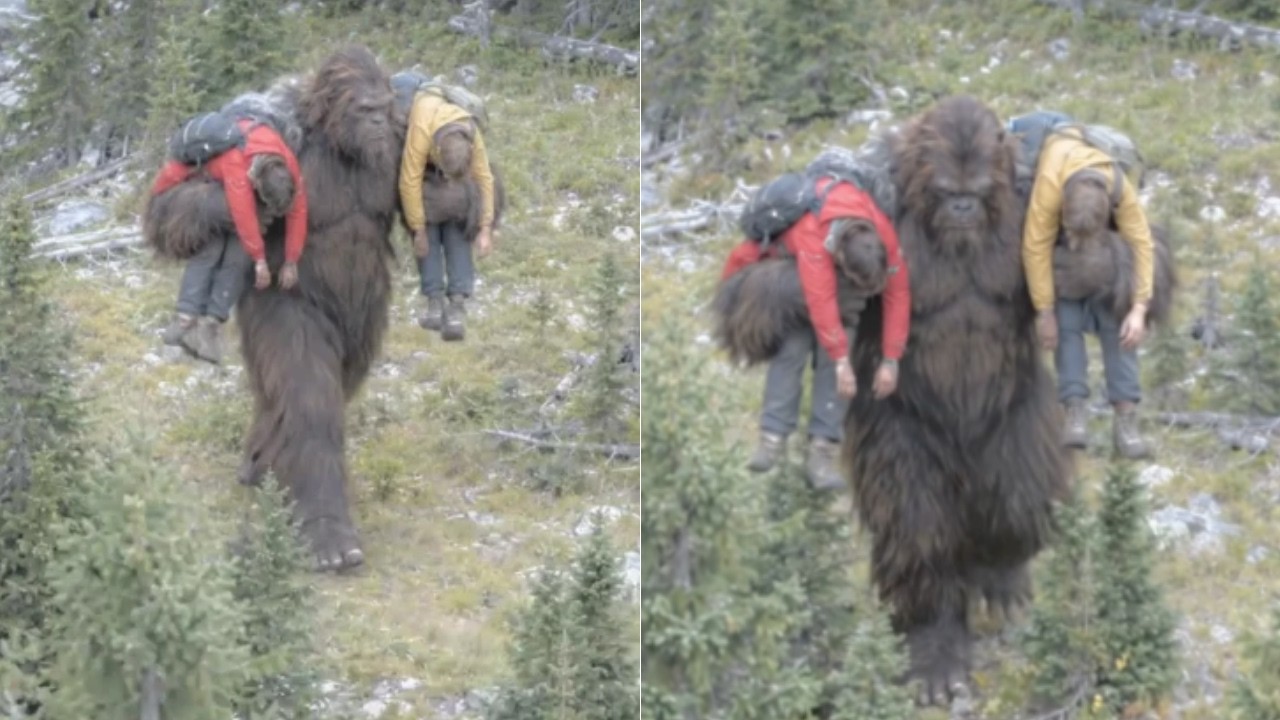
At its base, two smaller horizontal signatures, the size and shape of adult humans lying on their sides. They were alive. And something else, something standing over nine feet tall, was standing beside them. My name is Scott Prudhomme.
I am a corporal with the Royal Canadian Mounted Police, posted to the Banff detachment since 2015. What I watched on that screen does not belong inside any report I have ever written, and I have spent the three years since deciding whether to say any of it out loud. I was born in 1982 in Lethbridge, Alberta, and joined the RCMP out of Depot Division in Regina at twenty-four. My first posting was a small-town detachment in northern Alberta, the kind of place where you handled everything from impaired drivers to missing trappers to domestics on reserve land, with one other constable and a satellite phone that worked about half the time.
After six years up north, I requested a transfer south and ended up in Banff, which most officers consider a plum posting. The town itself has about eight thousand permanent residents, but between June and September the population swells past forty thousand on any given day with tourists. Most of the calls are routine: theft from vehicles at trailheads, impaired boaters on Lake Minnewanka, the occasional bar fight on Banff Avenue, traffic collisions on the Trans-Canada. But the backcountry calls are different.
Banff National Park covers 6,641 square kilometers of the Canadian Rockies. The town sits in a valley along the Bow River, surrounded by peaks that run from seven thousand to over eleven thousand feet. Most visitors stay within a few kilometers of the townsite, or drive the Icefields Parkway and stop at the obvious viewpoints. They never see what is behind those first ridges.
The northern half of the park is some of the most remote land in the southern Canadian Rockies: the Panther River, the Red Deer River, the Clearwater River, Scotch Camp, Snow Creek Pass. You can hike for four or five days in that country and not see another person. No cell service, no trails maintained past a certain point. Grizzly country, wolf country, cougar country.
The rivers run fast and cold, and the weather turns without warning. In September, the nights already dip below freezing, and the first snowfall can hit the passes any day. I have been on search and rescue assists in that backcountry nine times in my years at Banff. Parks Canada runs the visitor safety program, which coordinates SAR operations in the park, but RCMP provides law enforcement support and supplemental resources.
We work alongside Parks Canada wardens and visitor safety specialists when things get serious. Most of the time, a missing hiker turns up within twenty-four hours. Twice in my time, they did not walk out at all. The mountains do not negotiate.
My wife Janet teaches grade three at a school in Canmore, about twenty minutes east of Banff on the Trans-Canada. We have two boys, Liam, who was eleven at the time of all this, and Connor, who was eight. Janet grew up in Canmore, and her father was a hunting outfitter in the Kananaskis before the provincial parks expanded. She knows the mountains as well as I do.
She also knows when I come home from a shift and sit at the kitchen table without saying anything, it means a call went bad. After September 17th, I sat at that table for a long time. The Rentons registered their backcountry itinerary with Parks Canada on September 7th, 2023. Kyle Renton was thirty-one, his wife Amber twenty-nine.
They lived in Edmonton and both worked in the energy sector—Kyle a pipeline integrity engineer, Amber an environmental compliance officer for a mid-size producer. They were experienced backcountry hikers, with multi-day traverses in Jasper, Kootenay, and the Willmore Wilderness behind them. Their planned route was a five-day traverse starting from the Red Deer River trailhead on the eastern boundary of the park, heading west through Scotch Camp over Snow Creek Pass, then south along the upper Panther River, and out via the Panther River trail to the highway. A loop, more or less.
Difficult terrain, but nothing beyond the ability of two fit adults with proper gear. They departed September 8th. Their return date was September 12th, with the 13th as the hard deadline registered on their backcountry permit. When they did not check in at the trailhead by the evening of the 12th, the system flagged it automatically.
Parks Canada visitor safety contacted us on the morning of the 13th. The lead visitor safety specialist on the case was Lorna Gilchrist, a woman I had worked with three times before and trusted completely. Lorna had been with Parks Canada for twenty-two years, starting as a seasonal backcountry ranger in Jasper before moving to the visitor safety program in Banff. She was fifty-two, lean, quiet, and she moved through the mountains the way some people move through their own living rooms.
Nothing wasted. I was the duty officer that day and took the call at our detachment on Lynx Street in Banff at 07:45. Lorna’s voice was calm, but there was a tightness underneath it that I recognized. An overdue party is usually nothing.
An overdue party in the Red Deer River drainage in mid-September is a different matter. The weather had been unstable for three days. A cold front had come through on the 10th, dropping temperatures at the passes to minus eight Celsius overnight and leaving a skiff of fresh snow above 2,400 meters. If the Rentons had been moving through Snow Creek Pass on the 10th or 11th, they would have hit that weather directly.
Lorna had already requested a helicopter reconnaissance from the Parks Canada Aviation contract out of the Banff helipad. The pilot, a veteran named Gord McPhee, who had been flying SAR in the mountain parks for fifteen years, was up by 09:00 hours. He flew a systematic grid over the planned route, starting from the Red Deer trailhead and working west along the river bottom, then over the pass and down the Panther drainage. The timber in those valleys is dense—Engelmann spruce, subalpine fir, lodgepole pine on the lower slopes, and where the forest opens, willow flats and deadfall tangles that could hide a school bus.
From the air, you can see clearings and rivers and ridgelines. You cannot see two people lying under trees. Gord flew three passes that morning and reported nothing. No tent, no signal mirror, no movement.
He did note heavy grizzly sign along the upper Red Deer, including a fresh dig site near the riverbank. That was noted, but unremarkable. The bears were feeding hard in September, putting on weight before denning. By 14:00 hours on the 13th, Lorna made the call to escalate from a missing party search to a full SAR operation.
This brought in additional Parks Canada resources, a ground team of three visitor safety specialists who departed the Red Deer trailhead by late afternoon, and a request through our detachment for any specialized assets we could provide. I called our K Division Operations Center in Edmonton and made the request. One of the assets available was a platform we had been using more frequently that year: a remotely piloted aircraft system, a drone. The RCMP had been expanding its RPAS program across Alberta through 2022 and 2023, and K Division had a small pool of DJI Matrice 300 RTK units equipped with thermal imaging cameras.
The Matrice 300 can fly for up to fifty-five minutes on a charge, carries a Zenmuse H20 thermal camera that detects heat signatures at ranges beyond five hundred meters, and transmits live video feed back to a controller station in real time. In the mountains, the operating constraints are significant. Transport Canada regulations require a visual observer within 3. 2 kilometers of the aircraft, which in the Panther River Valley means you need someone physically in the drainage to keep eyes on the drone.
Wind at elevation can exceed the aircraft’s operational limits, and the terrain itself creates dead zones in the radio link. The pilot assigned to the deployment was Constable Tyler Foss, twenty-eight, posted to Red Deer detachment and one of fourteen RCMP members in Alberta certified on the Matrice 300 at that time. Tyler had flown SAR assists twice before, both in open prairie country south of Red Deer. He had never operated in the mountains.
I had never worked with him before, but Lorna had. She told me he was careful and methodical, which in that kind of terrain matters more than talent. Tyler drove from Red Deer to Banff on the 14th with the Matrice packed in two Pelican cases in the back of his truck, along with eight batteries, a charging station that ran off a Honda 2000-watt inverter generator, and a portable command station consisting of a ruggedized laptop, a DJI Smart Controller Enterprise, and a canopy shelter. The plan was to base the drone operation from the Red Deer River Trailhead, accessible by vehicle and sitting at the mouth of the drainage the Rentons had entered.
From there, Tyler could fly the Matrice up the river valley to a range of seven or eight kilometers before terrain and radio constraints forced a return. While Tyler set up, the ground team was already moving. Three Parks Canada visitor safety specialists had departed the trailhead at dawn on the 14th and were hiking the Red Deer River trail toward Scotch Camp, covering the route the Rentons would have taken on their first and second days. They carried satellite communicators and checked in every two hours.
By evening on the 14th, they had reached the Scotch Camp warden cabin, an old patrol cabin Parks Canada maintains for backcountry operations. The Rentons’ tent was not there. No sign of them at the designated campsite. On the morning of the 15th, the ground team pushed west from Scotch Camp toward the Snow Creek Pass approach.
At 11:20 hours, the team leader radioed Lorna with a report that changed the search entirely. They had found the Rentons’ camp, roughly three kilometers west of Scotch Camp off the main trail on a gravel bar at a bend in the Red Deer River where a side creek came in from the north. The tent was partially collapsed, the rain fly torn from three of its four stake points and draped over the upstream side. Food had been pulled from the bear hang, a rope and carabiner system slung between two spruce trees about fifteen meters from the tent.
Three of the four dry bags that had been hanging were on the ground, opened and partially emptied. Bear canisters were undisturbed inside the tent vestibule. The Rentons’ packs were inside the tent along with their sleeping bags, unzipped and disordered. At first read, this looked like a grizzly encounter.
A bear finds the food hang, pulls it down, ransacks the bags, and the hikers either fled or were displaced. It happens. But the ground team reported two things that did not fit a grizzly. The first was the tracks.
Around the campsite in the gravel and soft silt near the creek confluence, there were tracks. They were not grizzly tracks. A grizzly rear foot leaves a print roughly ten to twelve inches long with five toes and prominent claw marks. These tracks were eighteen inches from heel to toe, five toes with no visible claw impressions, and the stride between them measured over four feet.
The team leader, a visitor safety specialist named Craig Lundy, who had twenty years of bear monitoring experience, described the tracks as bipedal, deep, and consistent. Not a bear walking briefly on hind legs, which produces a staggered, uneven pattern. These were the tracks of a being that walked upright as its primary mode of movement, and the depth suggested a weight well over three hundred pounds. The second thing was the direction.
A grizzly that raids a camp and displaces hikers would typically move off into the timber once the food was consumed. The hikers would flee downhill toward the trail. But the tracks around the Rentons’ camp did not lead away from the camp. They led to the camp from the north, from the direction of the creek.
And from the camp, two additional sets of tracks—both human-sized boot prints matching the Vibram soles of standard hiking boots—led north along the side creek, accompanied by the large tracks. All three sets of prints moved north, upstream, away from the trail, away from the trailhead, deeper into the backcountry. Lorna called me at the detachment at 12:15 on the 15th. She told me what the ground team had found, and I could hear a tension in her voice I had never heard before.
Lorna Gilchrist was not a woman who got rattled. She had been on SAR operations where they pulled bodies out of avalanche debris, where they found a solo hiker dead from exposure with his hand still on his satellite messenger because the battery had died before the signal went out. And on the phone that afternoon she was not rattled. She was confused.
Lorna confused was more unsettling to me than Lorna afraid. She said, “Craig is telling me these tracks are not consistent with any animal we manage for in this park. The hikers walked away from their camp with something, and they walked north, which is the wrong direction. I need you to come up here.
”
I drove to the Red Deer trailhead and arrived at 14:00 hours. Tyler Foss was already there, his command station set up under the canopy next to his truck. The Matrice was charged and ready, but the weather was not cooperating. The cloud ceiling had dropped to about 2,100 meters, and the upper valleys were socked in with fog.
Flying the drone into that would be pointless. The thermal camera needs a temperature differential to detect heat signatures, and in fog the ambient moisture creates false returns. Tyler told me we needed clear skies, or at least broken cloud above the terrain. The forecast showed a possible clearing window late on the 16th, or early on the 17th.
I did not want to wait. Two hikers had now been missing for seven days. The overnight temperatures at the elevation of the upper Red Deer were dropping to minus five or minus six Celsius. If Kyle and Amber Renton were alive but injured, hypothermia was going to kill them before we found them.
Every hour mattered. But there was nothing I could do about cloud cover. The mountains set the schedule. On the morning of the 16th, Lorna sent a second ground team up the Red Deer trail.
This team included Pete Casperson, a fifty-six-year-old Alberta Fish and Wildlife officer called in from the Sundre district specifically because of the tracks. Pete was what they call a large carnivore specialist. He had spent thirty years tracking grizzlies, cougars, and wolves across the eastern slopes of the Alberta Rockies, and he had written the provincial protocol for bear conflict response in the Kananaskis. If anyone in Alberta could look at a set of tracks and tell you what made them, it was Pete Casperson.
Pete reached the Rentons’ campsite by midday on the 16th. He spent three hours documenting the scene. He photographed the tracks with a scale bar, measured stride length and depth, collected a soil sample from the deepest impression, and followed the combined track line north along the side creek for 1. 2 kilometers before losing the trail on a rocky bench where the creek cut through a narrow limestone gorge.
He called Lorna by satellite phone at 16:30. I was at the trailhead with Tyler and heard the call on speaker. Pete’s voice was flat and carefully measured, like a man choosing every word because he knows the words are going to be repeated. He said, “Lorna, I have been doing this work since 1987.
I have tracked every large mammal in this province. What I’m looking at is not a grizzly, not a black bear, not a cougar, not a wolf, not an elk. The foot is plantigrade, heel to toe, five toes in a configuration consistent with a hominid rather than any quadruped, and the depth suggests a mass between four hundred and five hundred pounds moving upright. The stride is consistent and even.
Whatever this is, it walks the way we do. It walks better than we do. And it was here within the last three to four days, based on edge degradation and moisture infiltration in the prints. ”
There was a pause on the line.
I remember Tyler looking at me from across the command station table. His face did not change expression. He was twenty-eight and he had been an officer for four years and he had not yet learned that some calls you never stop hearing. Lorna asked Pete one question.
She said, “In your professional opinion, did the hikers leave their camp under duress? ”
Pete said, “No. The boot prints show a consistent walking gait. No drag marks, no stumbling.
They walked, but one of them was limping. The left boot shows a shorter stride and a heavier heel strike on the right foot, consistent with someone favoring an injured left leg. And the large prints stay within two feet of the limping hiker the entire distance I could track them. Parallel, side by side.
”
That last part sat in the trailer like a weight none of us could lift. Side by side. Whatever made those prints was walking beside an injured hiker, not behind them, not chasing them, beside them. I went home that night and sat at the kitchen table.
Janet put the boys to bed and came downstairs and stood behind me with her hands on my shoulders and asked me what was wrong. I told her we had two missing hikers and the tracks at their camp did not make sense. I did not tell her what Pete had said. I did not know how.
The morning of September 17th broke clear. I woke at 4:30 and checked the weather from my phone in bed. Ceiling unlimited, visibility greater than thirty kilometers, winds at the ridge tops fifteen to twenty knots from the west, dropping to under ten in the valleys. It was the window we needed.
I called Tyler at 05:00 hours. He was already awake. He said, “I am charging the last set of batteries. I can have the first flight up by 07:00.
”
I told him I would be at the trailhead by 6:30. I kissed Janet on the forehead without waking her, left a note on the counter for the boys, and drove the twenty minutes from Canmore to the Trans-Canada, then north on the gravel road to the Red Deer River trailhead. The sun was not up yet. The temperature on my truck dash read minus four Celsius.
I remember the frost on the gravel under my boots when I stepped out. I remember thinking that if Kyle and Amber Renton were still alive out there in this cold, they were tougher than anyone I had ever pulled off a mountain. Tyler had the command station powered up and the Matrice assembled on a flat patch of gravel near the trailhead parking area. The drone sat on its folding legs like a mechanical spider, the thermal camera housing slung underneath the fuselage, the propellers folded tight.
When Tyler powered it up, the status lights blinked green in sequence, and the controller screen came alive with the camera feed, a split display showing visible light on the left and thermal infrared on the right. In the thermal view, the world was rendered in shades of gray and white. The trees were cool, gray. Tyler’s truck exhaust was a bright flare.
My coffee mug on the table registered as a small hot point. Everything alive was bright. Everything dead was dark. Lorna arrived at 6:45 with Craig Lundy and two other visitor safety specialists.
They were going to hike in to serve as visual observers, positioning themselves along the valley at intervals to maintain the required 3. 2-kilometer line of sight. Craig and one of the others would push up to the Rentons’ campsite and then continue north along the side creek following the track line Pete had documented. Lorna would hold at a midpoint along the Red Deer River trail, roughly five kilometers from the trailhead.
By 7:10, the ground team was on the trail and Tyler was running his pre-flight checklist. Battery at 98%, GPS lock on fourteen satellites, wind at ground level negligible, temperature minus two and climbing. He looked at me and said, “Ready when you are, Corporal. ”
I said, “Take it up.
”
The Matrice lifted straight up from the gravel bar with a high, thin whine that flattened out as it gained altitude. Tyler held it at thirty meters while the gimbal stabilized and the thermal camera ran its calibration cycle. On the controller screen, the valley floor spread out below the drone in a wash of grays. The spruce forest was a uniform cool gray.
The river slightly warmer where shallow ripples exposed rock that held the previous day’s solar heat. A deer at the edge of the parking area flared white on the thermal and bolted into the trees as the drone rose. Tyler pushed the drone west along the river corridor at an altitude of 120 meters above ground level, which kept it above the tallest trees but below the ridgeline where the west wind would catch it. The live feed on the laptop showed the valley sliding beneath the camera in real time.
Dense forest, river gravel bars, the occasional clearing where an avalanche path or a fire had opened the canopy decades ago. Tyler narrated as he flew, calling out terrain features and checking his distance. One kilometer from launch point. Two kilometers.
At 2. 8 kilometers, the river made a sharp bend around a buttress of limestone, and the valley widened slightly. At 3. 4 kilometers, he picked up the first thermal anomaly: a bright oval on the forest floor, roughly the size of a pickup truck, registering significantly warmer than the surrounding terrain.
He stopped the drone and brought it into a hover, then zoomed the thermal camera. The bright area resolved into a cluster of several distinct heat sources. Elk. A small group of cow elk bedded in a stand of mature spruce.
Tyler noted it on his log and moved on. By 08:00 hours, the drone had covered six kilometers up the valley, and Tyler was approaching his effective operational range. The radio link signal was weakening as the terrain closed in, ridges on both sides of the valley creating shadowed areas where the controller lost telemetry for a second or two at a time. Tyler brought the drone back and swapped batteries.
The second flight went up at 8:20. This flight he pushed further, angling northwest up the side drainage where the Rentons’ camp had been found. Craig Lundy had reached the campsite and reported by satellite communicator that the tracks were still visible despite light overnight frost. He was following them north along the creek.
Tyler flew the drone above the creek drainage, higher now, 150 meters above the valley floor, to maintain radio link as the terrain narrowed. At 8:47, the drone was roughly nine kilometers from the launch point by air, deep in the side drainage. Tyler was monitoring battery carefully, calculating return time against the headwind he would face coming back down the valley. He had about eleven minutes of usable flight time before he needed to turn for home.
At 8:49, the thermal camera picked up a heat source. It was on the east side of the creek in a stand of mature subalpine fir where the canopy was heavy and unbroken. A heat signature, but not like the elk. This was not a cluster of animals bedded in a clearing.
This was a single vertical heat source, taller than it was wide, standing among the trees. And there were two smaller horizontal heat signatures near its base, lower to the ground, roughly the size and shape of adult humans lying on their sides. Tyler said nothing for about four seconds. I watched him lean into the controller screen, his face lit blue from below.
He brought the drone down to 100 meters, then 80, zooming the thermal camera as tight as it would go. The vertical heat source was standing still. It was not a tree. Trees are cool on thermal.
This was warm, radiating body heat, and it was shaped wrong for any quadruped I have ever seen on a thermal scope. It was narrow at the top, broad through what would be the shoulders and chest, and it tapered down to two points of ground contact. It was standing on two legs. And the two heat sources at its base were unmistakably human shaped.
Two people lying side by side, close together, and the large form was standing over them the way a parent stands over children sleeping on the floor. Tyler said, “Corporal, are you seeing this? ”
I was seeing it. On the split screen, the visible light camera showed only dark timber, branches, shadow.
The canopy was too thick for visible light to penetrate from the drone’s altitude. But the thermal camera cut through the canopy as thermal always does, painting heat regardless of what was between the sensor and the source. What I was looking at was a nine-to-ten-foot upright heat source standing over two prostrate human forms in the middle of the most remote drainage in Banff National Park. I said, “Record everything.
”
Tyler said, “It has been recording since launch. ”
I said, “Can you get lower? ”
He said, “If I go lower, I lose three minutes of return time, and I am already marginal on battery. ”
I said, “Go lower.
”
He took the drone to 60 meters. At 60 meters, the image tightened. The vertical figure was turned slightly, and I could see what I can only describe as a head in profile at the top of the heat signature, a rounded mass above the shoulders that was oriented toward the two forms on the ground. The arms—and I am going to call them arms because that is what they looked like on thermal—were long relative to the body, hanging past where the waist would be.
The heat differential between the figure and the ambient forest was extreme. Whatever it was, its body temperature was significantly higher than the surrounding air, which at that hour and elevation was probably minus three or minus four Celsius. The two human forms were cooler than the large figure but warmer than the ground, which meant they were alive. Then the figure moved.
It turned toward the drone. On thermal, you cannot see facial features or expression. You see shape and heat and motion. But the way it turned—the deliberate rotation of that massive upper body, the head tilting upward—I understood with a certainty that sat in my chest like a stone that it was looking at the drone.
It knew we were there. Seventy meters of cold September air between us, and it was looking at our machine with what I can only describe as awareness. Tyler whispered a word I did not catch. His hand was steady on the controller, but his breathing had changed.
I put my hand on his shoulder and said, “Hold it steady. Do not move the drone. ”
The figure stood there for eight seconds. I counted because counting was the only thing I could do that made sense.
One, two, three. A figure over nine feet tall, standing upright on two legs, broader through the chest than any human, with a head that was watching our drone from sixty meters below the aircraft. On the count of five, it moved. Not away, not into the trees.
It bent down, and I watched on the thermal screen as it gathered one of the two human forms off the ground. Not roughly, not the way a bear or a predator handles prey. It gathered the person the way you pick up a sleeping child. One arm under the shoulders and one under the legs, and it stood back up to its full height with the person cradled against its chest.
The heat signatures merged briefly, the person’s cooler outline pressed against the larger figure’s warmer mass. Then it started walking. It walked south, downstream along the creek, toward the trail, toward us. And it was carrying a human being the way a father carries his daughter in from the car when she has fallen asleep on a long drive.
Tyler’s low battery alarm went off. The controller showed six percent. He had to bring the drone back or lose it. He looked at me, and I saw in his face what I was feeling too: a collision between what we had been trained to do and what we were watching happen that made every protocol and procedure feel like instructions for a world that no longer applied.
I said, “Bring it home. Mark the coordinates. ”
Tyler turned the drone and pushed it south down the valley at maximum cruise speed, the battery ticking down. Five percent, four, three.
It cleared the ridgeline back into the main valley with two percent remaining and auto-landed on the gravel bar at the trailhead with the battery warning screaming on the controller. The rotor stopped. The screen went dark. For a long time, neither of us said anything.
The generator hummed. A gray jay landed on the canopy pole and looked at us and flew away. Tyler pulled the SD card from the controller and held it between his thumb and forefinger like it was fragile and dangerous. This little rectangle of plastic, 32 gigabytes, with 43 minutes of footage that included 9 minutes of uninterrupted thermal video of a being that does not exist carrying a person who had been missing for nine days through the Canadian Rockies.
He said, “What do I do with this? ”
I said, “You give it to me. And then I need to make some calls. ”
But before I made those calls, before the next forty-eight hours folded in on themselves like nothing I had experienced in seventeen years of police work, I need to go back.
I need to tell you about the four days between the Rentons’ disappearance and that drone flight. Because what happened on those mountains—what Kyle and Amber Renton lived through in those five nights alone in the cold—is the part of this story that I carry. Not the footage, not the tracks, not the arguments with Ottawa. What I carry is what two people told me from hospital beds about the thing that saved their lives when the mountain was trying to kill them.
Kyle Renton is an engineer. He thinks in systems and tolerances and failure points. When I sat with him in his room at Mineral Springs Hospital in Banff on September 19th, his left ankle immobilized in a fiberglass cast and an IV drip running warm saline into his right arm, he told me what happened on the mountain the way an engineer files an incident report. Sequential, precise, no adjectives he did not need.
They made good time on September 8th and 9th, covering the first 28 kilometers of the Red Deer River trail to a campsite just past the Scotch Camp warden cabin. They had planned a camp at the designated site near the cabin, but when they arrived on the afternoon of the 9th, they found bear sign: fresh scat, claw marks on a tree near the food hang poles, and a stump that had been torn apart for grubs. Kyle made the decision to move their camp upstream, away from the concentrated bear activity near the cabin, to the gravel bar at the side creek confluence. It was not a designated campsite, but it was a defensible location, open on three sides with good sightlines and a reliable water source.
They set up the tent, rigged a bear hang between two spruce trees fifteen meters out, cooked dinner on the gravel bar downwind from the tent, and cleaned up thoroughly. They were experienced enough to do everything right. On the morning of the 10th, they broke camp and started the traverse toward Snow Creek Pass. The weather was deteriorating.
Cloud had been building all morning, and by noon it was snowing at the pass, a wet, heavy snow that stuck to everything and turned the trail into mud where it was not covered by talus. Kyle said the wind at the pass was gusting to sixty or seventy kilometers an hour, and the temperature was dropping fast. They pushed through the pass, which sits at about 2,400 meters, and started down the west side into the upper Panther River drainage. That is where it happened.
About two kilometers below the pass, on a steep section of trail that traversed a scree slope above the headwaters of the Panther, Kyle stepped on a rock that moved. His left foot slid, the rock rolled, and his ankle folded sideways under his full body weight plus the 32-kilogram pack on his back. He heard the bone before he felt it, a sound like a green branch snapping. He went down hard on the scree, sliding six or seven meters before Amber grabbed his pack strap and anchored him with her weight.
The pain was immediate and total. Kyle said it was like someone had driven a railroad spike through the outside of his left ankle. He could not bear weight, he could not stand. Amber helped him sit up and unlace his boot, and when she pulled the boot off his foot, the ankle was already swelling and discolored.
Even through the sock, she could see the angle was wrong. He had a fracture, probably a lateral malleolus, the knob of bone on the outside of the ankle that takes the force of an inversion injury. Kyle said the grinding sensation when he tried to rotate his foot told him it was not clean. They were at roughly 2,200 meters, above the tree line on a scree slope, in deteriorating weather, with no cell service and no satellite messenger.
Kyle had considered carrying a Garmin inReach on the trip but had left it at home because they had never needed one before. That decision was going to matter. Amber splinted the ankle with a foam sleeping pad and medical tape from their first aid kit. She redistributed what she could from Kyle’s pack into hers, which put her carrying close to 45 kilograms.
Then she got him upright, his left arm over her shoulders, and they started moving. Down the scree toward the tree line, toward the valley floor, toward the Panther River, and the faint hope that the trail on the other side of the valley was still passable and that they could hobble the thirty-five or forty kilometers to the highway in three or four days. They made it about 800 meters before dark. Each step cost them dearly.
The scree gave way to krummholz, the stunted, wind-blasted trees at the edge of the subalpine, and then to forest. Amber found a flat spot under a stand of old fir where the canopy blocked the worst of the wind and the ground was carpeted with needles. She set up the tent, unrolled the sleeping bags, got Kyle inside, and crawled in after him. The temperature dropped below minus five that night.
The snow continued. Kyle said the pain in his ankle woke him every time he shifted position, which was every twenty or thirty minutes. Amber slept next to him with her body pressed against his for warmth. In the morning, the sky was gray and low, and the snow had accumulated about eight centimeters overnight.
Kyle tried to stand and nearly blacked out. The ankle had swollen inside the splint to the point where the tape was cutting off circulation. Amber re-wrapped it looser this time, and they ate a cold breakfast of granola bars and peanut butter because lighting the stove meant unzipping the vestibule and losing the residual warmth inside the tent. They talked about their options.
They could stay and wait. Someone would come looking eventually. Their permit deadline was the 12th, and Parks Canada would initiate a search when they did not check in. But staying meant two more nights minimum in these temperatures with a limited food supply and no way to treat Kyle’s injury beyond what they had already done.
Infection, shock, hypothermia. The arithmetic was not good. They decided to move. Amber broke camp, packed everything she could carry, and they started again.
Kyle hopping and shuffling on one foot, leaning on Amber and on a deadfall branch she had broken to the right length for a crutch. The pack on her back pulling her off balance with every step. In five hours they covered maybe two kilometers, dropping through the forest toward the valley floor. The going was brutal: deadfall across the trail, soft ground that sucked at Kyle’s one good boot, creek crossings that required Amber to carry both packs across separately and then come back for Kyle.
By 3:00 in the afternoon they were at the Panther River. The water was high and fast from the snowmelt and recent precipitation, running gray with glacial silt, maybe twenty meters across and thigh deep at the ford. Amber could not get Kyle across, not with his ankle, not with the current. They made camp on the near bank.
That was the night of September 11th, their fourth night out. They had food for one more day, maybe two if they rationed hard. Kyle was running a low-grade fever. The ankle was hot to the touch, swollen to twice its normal size, and he could no longer feel his toes on that foot.
Amber had a headache that had been building since the pass, and she was dizzy when she stood up quickly. She thought it was altitude and exhaustion. Later the doctors would determine she had a mild concussion from a fall on the scree that she did not even remember taking, a slip that cracked the back of her head against a rock hard enough to lacerate her scalp. She had been bleeding into her hair for two days without noticing because the cold constricted the vessels and the blood froze in her braid.
Kyle told me what happened next, and Amber told me separately in her own room down the hall, and their stories matched in every detail that mattered and differed only in the small ways that two people experiencing the same thing from slightly different positions always differ. They were in the tent. It was maybe 10:00 at night, full dark, the temperature already below minus five and falling. The river was loud enough to cover most sounds, but the wind had died, and in the gaps between the rapids, Kyle could hear the forest.
Normal sounds: a branch cracking under snow load, a small animal moving in the deadfall, an owl. And then a sound that was not any of those things. Kyle described it as a low, sustained hum, almost below the range of hearing, felt as much as heard, like standing next to a transformer or a large diesel engine idling somewhere in the dark. It rose in pitch slightly and then dropped back and held, a steady resonance that seemed to come from everywhere and nowhere.
He said it vibrated in his sternum. He said, “Amber grabbed my arm and said, ‘Do you hear that? ’” And he said, “Yes. ” And neither of them moved.
The hum stopped. And then the footsteps started. Not the quick, light steps of a deer, not the padding of a bear, not the crackling rush of an animal startled. These were heavy, measured, deliberate.
One foot, then the other, the ground compressing under each step with a sound Kyle compared to someone driving a fence post. Coming from the north, from the direction of the creek. Coming toward the tent. Kyle reached for the bear spray canister he kept clipped to the inside of the tent wall.
Amber was already sitting up, her headlamp in her hand but not turned on, because turning on a light in a dark tent makes you a lit target and everything outside invisible. The footsteps stopped very close. Kyle estimated five or six meters from the tent. He could smell it now—not the sharp ammonia musk of a grizzly, which he knew from previous encounters.
This was different. Musky, yes, heavy, but layered underneath with a scent almost like wet bark or damp earth after rain, or the loam smell of a forest floor turned over. Not unpleasant, not threatening, just enormous. A smell so large it filled the tent and pressed on the walls of the nylon like a weather front.
Kyle said, “I was holding the bear spray with my thumb on the trigger, and my hand was shaking so hard I could hear the canister rattling against the tent fabric. And I realized that whatever was outside was close enough that I should be terrified, and I was not terrified. I was cold and in pain and exhausted, and a part of my brain, some circuit that should have been screaming at me to fight or run, was instead telling me to be still. To wait.
I cannot explain it any other way. Every animal instinct I had was saying be still. So I was still. ”
It touched the outside of the tent.
Not pawed at it, not clawed, touched. A flat pressure against the rain fly near the bottom, at about the level where Kyle was sitting. And then a second touch higher up, at chest height, as if a hand were feeling the contour of the tent, reading it like a person reads a wall in the dark. Amber said, “I was lying on my side facing the wall of the tent, and I felt a warmth come through the fabric.
Not body heat like another person next to you in bed. A furnace warmth. A heat that did not belong outside a tent on a mountain in September at 10:00 at night. And the tent wall was pressing inward slightly toward me, and the shape of the pressure against the fabric was five points.
Five fingers. A hand larger than any hand I have ever seen pressed flat against the outside of our tent, and it was warm. ”
Neither of them moved. Neither of them spoke.
The hand stayed for what Kyle estimated as thirty seconds, maybe forty. Then it withdrew. The footsteps moved around the tent, circling once slowly, like someone walking around a car to inspect it before getting in. Then they moved away north, back toward the creek, and stopped.
Kyle and Amber did not sleep. They lay in the dark and listened to the forest and heard nothing more until dawn. In the morning, Amber unzipped the vestibule and looked out. Kyle heard her say, “Oh god.
” Not in fear, in the tone of someone looking at what their brain cannot file. Outside the tent, on the gravel between the tent and the river, someone had built a fire. Not a campfire like humans build with a ring of rocks and kindling and split wood. A nest of gathered deadfall, broken branches as thick as Kyle’s wrist, arranged in a loose conical pile roughly a meter across and half a meter high.
The wood had been burned. The ashes were still warm. Amber put her hand over them and felt heat rising. Whatever it was had gathered wood in the dark, piled it outside their tent, lit it, kept it burning long enough to put out heat, then left.
There were tracks around the fire. The same tracks. Eighteen inches long, deep, five-toed, no claws. Amber told me, sitting in her hospital bed with twelve stitches in her scalp and a saline drip in her arm, that she sat on a rock beside those ashes and cried.
Not because she was afraid. Because she was cold and her husband was hurt and they were going to die on that river, and whatever was out there had built them a fire. That was September 12th, the day they were supposed to walk out, the day the permit expired and the search should have started. Instead, they were on the wrong side of the Panther River, with a broken ankle between them and forty kilometers of trail between them and the highway.
Kyle could not walk. The ankle had swollen further overnight, and the skin above the splint was a dark, mottled purple that Amber recognized from her wilderness first aid training as a sign of compromised circulation. They needed evacuation. They needed a helicopter, or a horse, or a stretcher carried by six people.
What they had was each other, one good pair of legs between them, and the knowledge that they were not alone out there. That morning, September 12th, it came back. Kyle was lying in the tent with his leg elevated on the packed sleeping bags. Amber was outside trying to light the stove to boil water.
She heard the footsteps. The same heavy, deliberate one-two cadence from the night before. Coming from the north again, from the creek, from the thick timber on the east side of the valley. She stood up and turned toward the sound.
She told me, and I am going to use her words as close as I can remember them, because how she said this mattered. She said, “I stood up and I turned around and it was there, standing at the edge of the trees, maybe thirty meters from me. And the first thing I thought was not ‘what is that. ’ The first thing I thought was, ‘it is taller than the trees.
’ That is not true. The trees were sixty or seventy feet tall. But in that moment, standing there looking at it, my brain had no scale for what I was seeing, and so it gave me the only comparison it could, which was the nearest fixed object. And the nearest fixed object was a young spruce at the tree line, and this thing was at least three feet taller than that spruce, which would put it somewhere around nine or nine and a half feet tall.
”
She said it was covered in dark hair. Not fur. She grew up around animals, she knew what fur looks like on a bear, on a moose, on a fox. This was hair.
Long, coarse, dark brown, almost black, except where the early light caught it and showed a warm chestnut undertone, like the color of old cedar bark. It hung from the shoulders and the arms and lay flat against the chest and abdomen. The face was bare. Not bare like a human face—there was very fine short hair on the cheeks and brow—but the features were visible.
A broad, flat nose. A heavy brow ridge that cast shadow over the eyes. The eyes. She kept coming back to the eyes.
They were brown, a warm brown like dark honey, and they were looking at her with an expression she could not describe as anything other than concerned. She said, “I did not scream. I did not reach for the bear spray. I did not move.
I stood there with a lighter in one hand and a pot of water in the other, and I looked at this thing, and it looked at me, and what passed between us I will spend the rest of my life trying to put into language. It was not communication. It was not telepathy or any of that. It was more like recognition.
Like it saw me, and I saw it, and in that seeing, we both understood each other in a way that was older than words. ”
It stood at the tree line for approximately one minute. Then it turned and walked back into the timber. Not running.
Walking. Heavy footfalls fading into the forest like a large stone sinking into deep water, smoothly and without hurry. Amber went into the tent and told Kyle what she had seen. Kyle told me that Amber is not a person given to exaggeration or panic.
She has a degree in environmental science, and she spent four summers doing field work in the boreal forest north of Fort McMurray alone, counting nesting pairs of various species for regulatory compliance surveys. She has been charged by a black bear at a den site and held her ground. She does not hallucinate. She does not embellish.
Kyle said, “When she told me what she saw, I believed her immediately and completely. And the reason I believed her is that I had been smelling it all morning inside the tent. That same heavy bark, earth, loam smell from the night before. It had been close.
It had been watching. And it had built us a fire. ”
Over the next thirty-six hours, the Rentons did not move from their camp on the near bank of the Panther. Kyle’s fever climbed.
Amber’s headache worsened, and she began having trouble with her balance, a sign of the concussion she did not know she had. They rationed their remaining food: two freeze-dried meals, a bag of mixed nuts, six granola bars. They melted snow for water. The temperature on the night of the 12th dropped to minus nine.
Without the fire that had been built for them the previous night, without the residual heat in those ashes that Amber banked with gravel and coaxed back to life with kindling, they would have had no warmth outside the tent. Their stove fuel was running low. The lighter fluid was nearly gone. On the night of the 12th, it came back.
This time Kyle heard it first: the hum, low and resonant, felt in the chest, then the footsteps. And then a sound he had never heard before: a series of low, tonal calls, rising and falling, three distinct notes repeated in a pattern. He said it was like a voice. Not language, not words, but a voice the way a cello is a voice, with overtones and intention and a quality that felt against all logic like reassurance.
It stayed near the camp through the night. Amber crept to the vestibule and opened the zipper two inches and looked out. The moon was three-quarters full, and the clearing between the tent and the trees was lit in that blue-silver mountain light that makes everything look like a photograph. She saw its outline at the tree line, standing, watching.
She said the moonlight caught the hair on its shoulders and for a moment it looked like it was wearing a cape. She closed the zipper and lay back down, and sometime before dawn, despite everything—despite the pain and the cold and the fear and the impossibility of what was outside—she fell asleep. When she woke up, the fire had been rebuilt, fresh wood still burning. And beside the fire, on a flat rock, someone had placed three cutthroat trout, gutted and laid side by side.
Kyle told me that when Amber brought one of those trout into the tent and held it up for him to see, neither of them said a word. The fish were gutted cleanly: a single cut from the vent to the jaw, the entrails removed, the gills stripped. Not torn open like a bear or an osprey would. Cut with a blade or an edge, clean and precise.
Kyle is an engineer, and he looked at the cut margins and said that was done with a tool, a working edge. Amber cooked the fish on the stove. They ate all three, two for Kyle and one for Amber, because Kyle’s fever was climbing and his body needed the calories. It was the best meal of his life, he said.
Not because of the taste, but because of what it meant. It was feeding them. Whatever this was had looked at two stranded, injured, freezing human beings and, instead of moving on, instead of treating them as prey or a nuisance or nothing at all, it had caught fish in a glacial river in the dark and left them to be found. That was the morning of September 13th.
The morning Parks Canada flagged their overdue permit. The morning Lorna Gilchrist called my detachment and started the clock on what would become the largest SAR operation in Banff in three years. But Kyle and Amber did not know any of that. They had no radio, no satellite communicator, no way to know that people were looking for them.
All they knew was that Kyle could not walk, that Amber could barely stand without the world tilting sideways, that their food was gone except for what had been given to them, and that whatever was out there was watching over them in a way that made the word protection feel too small. On the afternoon of the 13th, it came back in daylight. Not at the tree line this time. Closer.
Kyle was outside the tent, propped against a rock with his splinted leg extended, trying to air out the bandage because the skin underneath was starting to break down from the moisture and pressure. Amber was at the river filling water bottles. Kyle heard the footsteps from the north, the same measured cadence, and he turned his head and saw it step out of the timber into the open gravel bar, maybe fifteen meters from where he sat. He said, “I looked at it, and it looked at me, and I want to be very precise about what I tell you next, because I know how it sounds and I know what people will say.
It was between nine and ten feet tall. The hair was dark, the color of espresso in the shade and lighter where the sun caught it, a deep tawny brown with almost no pattern or banding. The body was thick through the chest and shoulders in a way that did not look like fat. It looked like the musculature of a body built to move through heavy terrain under heavy loads for long distances without stopping.
The arms were long, the hands hung below the knees, and the fingers were thick and dark-skinned with short nails, not claws. The face was broad with a heavy brow, a flat wide nose, and a jaw that was more square than round. The eyes were deep-set, brown, and they were focused on me with an intensity that I can only compare to the way a surgeon looks at a patient before making the first cut. Total attention.
Not aggression. Not curiosity, like a bear is curious, sniffing the air and deciding whether you are food. This was a being looking at me and understanding that I was hurt. ”
It walked toward him.
Kyle said his hand moved toward the bear spray by reflex, but he did not pick it up. He said his body would not let him. Every instinct he had was telling him the same thing it had told him in the tent two nights before. Be still.
Wait. It stopped about three meters from him. It stood there for maybe ten seconds, looking at his leg. Then it knelt.
Kyle said, “When it knelt down, I could feel the ground shake. It was that heavy. And it was kneeling like a person kneels: one knee on the ground, the other bent, the back straight. ” And it reached out one hand toward his leg.
The hand was twice the size of Kyle’s. The skin on the palm was dark, almost black, thickly calloused with deep lines like the creases in old leather. The fingers were proportional but massive, each one as thick as two of Kyle’s fingers together. It reached toward his splinted ankle and stopped with the fingertips about two inches from the bandage.
Kyle could feel the heat radiating from the hand. He said, “It looked at my face. It looked me in the eyes, and I understood that it was asking permission. ”
Kyle nodded.
He told me he nodded at it, a plain human nod, because in that moment there was nothing else it could have been. A person. A different kind of person. A person that lived in the places where the trails end and the maps go blank.
But a person. It touched his ankle. Gently. The enormous fingers probed the swelling through the bandage with a pressure that Kyle described as firm but not painful.
It felt along the bone from the base of the fibula down to the malleolus. Paused there, pressed slightly, and Kyle winced. It withdrew the hand immediately. Then it made a sound low in the throat, a single tone held for about two seconds.
Not a growl, not a warning. Kyle said it sounded like acknowledgement, like it had confirmed what it already suspected. It stood back up, turned, walked to the tree line. And then it did the one thing that changed everything Kyle and Amber Renton understood about their situation on that mountain.
It came back carrying a bundle of stripped spruce bark, layered and folded, with a mass of dried moss packed inside. It knelt beside Kyle again and, working with both hands, it unwrapped the old splint, removed the foam and tape, and replaced them with the bark and moss bundle, wrapping it snugly around the ankle and securing it by tucking the bark strips under themselves. The moss was packed tightly against the swollen joint. Kyle said within minutes the ankle felt different.
The constant burning heat of the inflammation began to ease. Whether it was the compression, a cooling effect of the moss, or a property in the plant material itself, the pain dropped from what Kyle described as an eight out of ten to a five. Amber had watched all of this from the riverbank. She told me she did not move during the entire interaction because she understood, without knowing how, that Kyle and this being were in a conversation that did not require her, and that interrupting would break what she could not repair.
After replacing the splint, the figure stood and looked south down the valley, toward the river, toward the trail, toward the direction of the trailhead and a highway and everything that meant rescue. Then it looked back at Kyle, then south again. Amber said it was pointing with its whole body. The way a dog points at a bird, except this was a thousand times more deliberate.
It wanted them to go south. It knew which direction out was. But Kyle could not walk. The new splint helped with the pain, but the bone was still broken, and bearing weight was impossible.
The being seemed to understand this. It stood still for a long moment, that enormous frame motionless against the gray sky, and then it turned and walked back into the timber. Kyle and Amber spent the rest of the 13th and the night waiting. The being did not return that evening.
No fire was built, no food was left. Kyle’s fever held at 38. 4. Amber’s headache had settled into a constant dull pressure behind her left eye.
The temperature dropped to minus seven overnight, and they huddled together in both sleeping bags zipped into one, Kyle’s ankle propped on the folded tent footprint. On the morning of September 14th, the being came back at dawn. And it was not alone. Kyle heard them first.
Multiple sets of footsteps, the same heavy two-footed cadence, but at least two, maybe three distinct sets moving through the timber from the north. Different weights, different rhythms. He lay in the tent and listened, and his heart was pounding, but he told me the fear was gone. He said by that morning the fear had been replaced by a feeling he still did not have a name for.
Trust is too simple. Surrender is too passive. It was more like acceptance, the kind that comes when you realize that the world is larger than the map you were given, and the things that live in the unmapped places are not what you were told. Amber unzipped the vestibule.
Standing in the clearing between the tent and the tree line were two of them. The one they had seen before—the dark-haired individual with the espresso-brown coat—and a second one that was slightly smaller, maybe eight and a half feet, with hair that was lighter, a deep sable brown with streaks of gray along the forearms and the sides of the jaw. The second one had the build of an older animal, the shoulders slightly rounded, the movements more measured. Kyle would later describe it as the difference between watching a thirty-year-old and a fifty-year-old carry furniture.
The first one, the dark one, walked to the tent. Kyle had pulled himself to a sitting position in the vestibule. The being bent down and looked at him. Then it reached into the tent with both hands, slid them under Kyle’s back and legs, and lifted him.
Kyle is six foot one and weighs about two hundred pounds. With the splint, the sleeping bag draped over him, and the stiffness of six days without bathing or changing clothes, he was an awkward, rigid load. It lifted him the way you lift a bag of groceries: no strain, no adjustment, one smooth motion. And Kyle was cradled against its chest, his broken ankle hanging free, his face inches from the column of dark hair on its neck.
He could feel the heat of its body through his jacket. He could hear its heartbeat, deep and slow, maybe thirty-five or forty beats per minute. He could smell the bark, earth, loam scent filling his nose and lungs like wood smoke. He said, “I was in its arms and I was not afraid.
I was safe. I have never felt that safe in my life. ”
The second one gathered Amber. She did not resist.
She told me, “She opened her arms like a child reaching for a parent, and it picked her up and held her against its chest, and the warmth was like being wrapped in a heated blanket. ”
They started walking south down the valley, along the creek, through the timber, carrying two human beings as easily as a person carries a pair of shoes. That was September 14th. The morning of the day Tyler Foss arrived at the Red Deer trailhead with a drone and two Pelican cases.
The morning I drove up from Canmore not knowing that in three days I would watch on a thermal screen as what should be impossible carried two people through the Canadian Rockies. The Rentons told me they were carried for two days. The beings moved at a pace that Kyle estimated at six or seven kilometers per hour, which in that terrain—through dense timber and along uneven creek beds and over deadfall—is faster than most humans can walk unburdened on a clear trail. They stopped periodically.
The beings set them down in sheltered spots, always out of the wind, always near water, and the dark one would disappear into the timber and return with food. More trout. Once, a pile of berries that Kyle recognized as buffalo berries, sour and astringent, piled on a piece of bark. Once, several thick roots that tasted starchy and bland like unsalted potato, which Amber later identified as probably biscuit root, a plant used as a food source by Indigenous peoples across western North America.
At night, the beings kept them warm. There is no other way to say it. The Rentons slept between them on beds of gathered fir boughs, pressed against those furnace-hot bodies, and despite temperatures that dropped below minus eight both nights, they did not freeze. Kyle’s fever began to drop on the second day of travel.
Amber’s headache eased. They moved south along the Panther River drainage, staying in the timber above the river on the east bank, paralleling the trail but never crossing into the open. The beings were deliberate about staying hidden. They moved through the densest stands of old growth where the canopy was heavy and visibility from the air was near zero.
When a helicopter passed overhead on the afternoon of the 15th, one of the Parks Canada search flights, the dark one stopped moving, lowered Kyle to the ground, and crouched motionless beside a fallen spruce until the sound faded. It understood helicopters. It understood being seen. It did not want to be seen.
On the morning of September 17th, the morning I stood at the trailhead watching Tyler Foss launch the Matrice into a clear September sky, the beings were still moving south through the upper Panther drainage with Kyle and Amber. And at 8:49, when the thermal camera on that drone cut through the canopy and painted heat on Tyler’s screen, it found them. The vertical figure standing over two horizontal forms. The moment of stillness.
The turning. The awareness. The gathering of one human body, then the other. The walking south toward us, toward rescue, toward the end of the only world I had ever known.
Tyler Foss handed me the SD card, and I put it in the chest pocket of my uniform shirt and buttoned the flap. I had 43 minutes of thermal footage, and 9 minutes of footage that, if it was what it looked like, would either change everything or disappear into a classified filing system where inconvenient evidence goes to be forgotten. I did not know which yet. But I knew that the next phone call I made would set the rest of my life into one of those two directions, and there would be no way to undo it.
I pulled out my phone and stared at Lorna Gilchrist’s number on the screen. My thumb hovered over the call button. Behind me, the generator hummed, and the Matrice sat cooling on the gravel with its propellers folded. The gray jay had come back to the canopy pole.
The sun was on the peaks now, and the valley floor was still in shadow, and somewhere up that drainage, moving toward us through the timber, what should not exist was carrying two people home. I pressed call. Lorna answered on the second ring. She was five kilometers up the Red Deer River trail, standing at the midpoint observation post, and the connection through my cell to the Banff tower was clean for once.
I said, “Lorna, we have thermal footage. ”
She said, “Of what? ”
I said, “I need you to come down. ”
She said, “I am the relay for the ground team.
”
I said, “I know. Come down anyway. ”
There was a pause. She had known me for eight years.
She had never heard me say come down from a SAR relay. She said, “I will be there in ninety minutes. ” And she was there in seventy. While I waited, I made two more calls.
The first was to our detachment commander, Staff Sergeant Roy Beaulieu, at home in Banff. Roy was fifty-three, a career RCMP officer who had spent most of his service in rural Alberta postings and had been at Banff for six years. He was steady, thorough, and he did not make decisions in a hurry. I told him we had footage from the drone that required his attention and that I was requesting he come to the Red Deer trailhead.
He asked me what kind of footage. I said I would rather show you than describe it. He said, “That is not a comfortable thing to hear from a corporal at eight in the morning. ” He was there by 10:00.
The second call was to Pete Casperson, who was still in the backcountry somewhere on the track line north of the Rentons’ campsite. I reached him on satellite phone and told him to turn around and come back to the trailhead. He wanted to know why. I told him the drone had picked up a large thermal signature in the drainage and that we needed his assessment of the footage.
He said, “How large? ” I said, “Pete, it is standing upright and it is carrying people. ” He did not say anything for about five seconds. Then he said, “I am coming down.
” It took him six hours to hike out. By 10:30 that morning, Lorna, Tyler, Roy Beaulieu, and I were standing around the command station table watching the footage. Tyler played it from the beginning, all 43 minutes of river valleys and timber and elk and empty cold forest. Then it reached the 8:49 mark, and the vertical heat source appeared on the screen, and the four of us stopped breathing at roughly the same moment.
Roy Beaulieu watched the full nine minutes of the anomalous footage twice without saying a word. His face did not move. He was a man who had spent twenty-seven years making assessments under pressure, and he was making one now. When the second playback ended, he closed the laptop.
He looked at me, he looked at Tyler, he looked at Lorna, then he said, “The first priority remains the same. Two people are missing in this park, and we have a thermal indication of human presence in the drainage. We need a ground team at those coordinates today. Whatever that large signature is, it is standing next to two people who may be injured, and those people need to come out.
Everything else waits until they are safe. ”
That was the right call. It was the only call, and I was grateful that Roy Beaulieu was the kind of officer who could look at nine minutes of footage that rewrote everything he understood about the world and say, first, let us save the hikers. Lorna radioed Craig Lundy and redirected the ground team to the coordinates Tyler had logged from the drone footage.
The coordinates put the sighting roughly eleven kilometers from the trailhead by air, deep in the Panther River drainage on the east bank in heavy timber. The ground team was north of that position and would need to work south and then cut west across the drainage to reach the location. Estimated arrival late afternoon if the terrain cooperated. The terrain in that country rarely cooperates.
While the ground team moved, I sat in the command trailer and wrote a field report. Not the report I would eventually file. A working document for myself, noting the time codes of the anomalous footage, the apparent dimensions of the thermal signature, the behavior I had observed, the coordinates. I wrote it in the flat bureaucratic language of police reporting, which is the language I was trained in and the language I use when I need to put distance between myself and what I am describing.
Subject observed at 08:49 hours. Vertical bipedal thermal signature, estimated height 2. 7 to 3 meters. Two horizontal human-sized signatures at base.
Subject displayed directed awareness of RPAS aircraft. Subject gathered one horizontal signature and commenced southbound movement along creek drainage. Writing it down in that language made it feel smaller, containable, like an event that could fit inside a filing system. I knew even then that it could not.
But the writing helped. At 16:42, Craig Lundy’s voice came over the satellite relay. He was breathing hard. He said, “Lorna, we have them.
We have both hikers. They are alive. I need a helicopter. ”
The next three hours were a cascade of logistics.
Lorna called Parks Canada aviation dispatch and requested the contract helicopter, the same Bell 212 that Gord McPhee had been flying the search pattern in. Gord was on standby at the Banff helipad, and he was airborne within twenty minutes. The ground team had found a clearing near the river large enough for a landing, a natural meadow at the confluence of a side creek and the main Panther River channel. They marked it with signal panels, and Gord brought the machine in just before dark, threading it through the valley with the kind of precision that comes from fifteen years of mountain flying and a feel for rotor wash in tight spaces that cannot be taught.
Kyle and Amber Renton were carried to the helicopter on improvised stretchers made from trekking poles and sleeping pads. Craig Lundy reported that Kyle was conscious, alert, and lucid, with a left ankle that was clearly fractured and heavily swollen but splinted with what Craig described as natural materials, bark and moss, in a configuration he had never seen before. Amber was conscious but confused, with a laceration to the posterior scalp that had been bleeding intermittently, and she was showing signs of mild hypothermia despite being dressed in a sleeping bag and her jacket. Both were dehydrated and malnourished but otherwise intact.
Craig also reported that when the ground team arrived at the hikers’ location, they were alone. No other person or animal was present. The hikers were lying on a bed of fir boughs in a sheltered depression under a stand of mature spruce, wrapped together in sleeping bags, with the remnants of a small fire smoldering nearby. There were tracks.
The same tracks. Leading north into the timber, away from the hikers, fresh enough that the edges were still sharp in the damp soil. Craig said the tracks looked like someone had walked away from the scene no more than an hour before the team arrived. Like whatever had been with the hikers knew help was coming and chose to leave before it arrived.
Gord flew the Rentons to the helipad at the Banff townsite, and an ambulance took them to Mineral Springs Hospital, the small hospital on Bow Avenue that handles everything from ski injuries to cardiac events for the town and the surrounding park. I followed in my truck and was at the hospital by 19:00 hours. Dr. Beth Cowan was the attending physician that evening.
Beth was forty-six, a veteran emergency physician who had practiced in Banff for twelve years. She was calm, precise, and she had a dry sense of humor that made her a favorite among local first responders. She admitted both Rentons and started workups. Kyle’s ankle was a displaced lateral malleolus fracture, confirmed by x-ray.
The displacement was moderate and would require surgical reduction and internal fixation, which meant a transfer to the Foothills Medical Center in Calgary. But the remarkable thing Beth told me was the soft tissue condition. A displaced fracture left untreated for nine days in a remote wilderness should have shown significant soft tissue complications: infection, compartment syndrome, necrotic tissue from compromised circulation. Kyle’s ankle showed none of that.
The swelling was significant, but the skin was intact. The circulation to the foot was adequate, and the tissue around the fracture site showed signs of what Beth described as a surprisingly well-managed inflammatory response. She asked me what kind of splint had been applied in the field. I told her I did not know.
She said, “Well, whoever did it understood what they were doing. The compression was exactly right, and the moss packing appears to have had some kind of anti-inflammatory or antimicrobial effect. I would like to know what species of moss it was. ”
I did not answer that.
Amber had twelve stitches put in her scalp laceration, and a CT scan showed a small subdural hematoma, bleeding between the brain and the skull. It was minor and showed signs of already resolving, which Beth said was consistent with an injury that was seven to nine days old and had not been aggravated by further trauma. The concussion explained the headaches, the dizziness, the balance problems. Both Rentons were started on IV fluids and warm saline and monitored overnight.
Kyle was scheduled for transfer to Calgary the following morning. I sat with Kyle first. His room was small and white, and the fluorescent light hummed above his bed, and the IV line ran into his right arm, and his left leg was elevated on a pillow stack with the bark and moss splint still in place because Beth wanted to photograph and document it before removing it. A nurse had given him a warm blanket from the warmer, and he had it pulled up to his chin.
His face above it was sunburned and windburned, his lips cracked, his eyes focused and clear. He looked at me and I looked at him, and for a moment neither of us said anything. Then he said, “You found us. ”
I said, “A drone found you.
”
He said, “What did you see? ”
I told him. I told him what was on the thermal footage. The vertical figure.
The two horizontal forms. The gathering. The walking. He closed his eyes, and tears ran down the sides of his face into the pillow, and he said, “It was taking us home.
That is what it was doing. It had been carrying us for two days, and it was taking us to the road. ”
I interviewed Kyle for three hours that evening and Amber for two hours the following morning before her transfer to Calgary with Kyle. I took written statements from both.
Everything I have told you about their experience on the mountain—the broken ankle, the night visits, the fire, the fish, the splint, the carrying—all of it comes from those interviews, conducted under my authority as a peace officer in the presence of Constable Tyler Foss, who took contemporaneous notes. Their stories aligned in every substantive detail. The timeline was consistent. The descriptions were consistent.
The emotional affect was consistent. Neither Kyle nor Amber Renton was fabricating, embellishing, or hallucinating. I have interviewed hundreds of witnesses and complainants and suspects in my career, and I know what a lie looks like. I know what a delusion looks like.
I know what a person sounds like when they are telling you something that happened to them exactly as it happened. And that is what Kyle and Amber Renton were doing. I also know what the alternative explanation would be if their account were false. Two experienced backcountry hikers, one with a verifiable broken ankle and one with a verifiable concussion and subdural hematoma, would have had to independently fabricate a consistent, detailed, emotionally coherent story about a nine-foot bipedal hominid that rescued them and carried them through the Canadian Rockies while dehydrated and injured and hypothermic, and maintain that fabrication through separate interviews conducted hours apart.
They would have had to explain the bark and moss splint that their attending physician described as medically competent. They would have had to explain the eighteen-inch bipedal tracks that Pete Casperson, a thirty-year wildlife tracking specialist, said were not consistent with any known species in Alberta. And they would have had to explain the thermal footage. The footage brings me to what happened next, which is the part of this story I have been dreading.
Because the mountain part is the part that fills me with what I can only call wonder. What happened next fills me with the opposite. On September 18th, the day after the Rentons were found, Staff Sergeant Beaulieu called a meeting at the Banff detachment. Present were Roy, myself, Tyler Foss, Lorna Gilchrist, Pete Casperson, who had hiked out the previous evening, and Craig Lundy.
Roy closed the door to the briefing room and pulled the blinds and sat down at the head of the table and placed the SD card in the center of the surface and said, “We need to discuss what to do with this. ”
I want to be fair to Roy Beaulieu, because he is a good man and a good officer. What he said next came from a place of genuine concern for the people in that room and for the institution he served. He said, “I have been a police officer for twenty-seven years.
I have managed situations involving public safety, organized crime, missing persons, and fatalities. I have never managed a situation in which the evidence before me suggests the existence of a species that, as far as our institutions are concerned, does not exist. I am not qualified to make a determination about what this footage shows. None of us are.
And the decisions we make about this footage in the next few days will have consequences that go beyond any of our individual careers or reputations. ”
He outlined three options. First, classify the footage as inconclusive and attribute the thermal anomaly to a known animal, most likely a grizzly bear standing on its hind legs, and close the SAR file with a standard resolution. Second, forward the footage to K Division Headquarters in Edmonton for analysis by specialists, which would move it into a chain of review that none of us could control or predict.
Third, forward the footage to Ottawa, to the National RCMP Operational Communication Centre, under a security classification that would restrict access and effectively remove it from any public disclosure pathway. Lorna Gilchrist spoke first. She said, “I am not RCMP. I am Parks Canada, and I am telling you that what is on that footage is not a grizzly bear.
I have been working in grizzly habitat for twenty-two years. A grizzly on its hind legs is a temporary posture, three to five seconds at most, with a distinctive swaying motion and the forelimbs held forward or to the sides. What is on that footage stood upright for nine minutes, walked upright, and used its upper limbs to lift and carry two adult humans. That is not a bear.
”
Pete Casperson said, “I spent three hours on the track line. Grizzly tracks in soft substrate show five toes with claw impressions that extend one to three inches beyond the toe pad, and the rear foot is ten to twelve inches long. What I measured was eighteen inches, five toes, no claws, with a stride length and depth pattern consistent with a bipedal hominid weighing between four hundred and five hundred pounds. If you classify this as a grizzly, you are signing my name to a finding that I cannot professionally support.
”
Craig Lundy said, “The splint on that man’s ankle was not applied by a bear. ”
Tyler Foss did not say anything. He was twenty-eight, the most junior person in the room, and the footage was his, and he was smart enough to understand that whatever happened next was going to happen to him first. Roy listened to all of it.
Then he said, “I am going to send this to K Division. It is above my authority to make a determination about this footage, and I am not going to try. ” He wrote a factual summary of the SAR operation, attached the footage, and sent it up the chain. On September 19th, Roy sent a classified internal memo to the K Division Commanding Officer in Edmonton, summarizing the SAR operation and noting the anomalous thermal footage.
He attached the SD card contents as a digital file. He copied the Banff Parks Canada Superintendent’s office because the operation had occurred on federal parkland under joint jurisdiction. What happened next happened fast, and it happened in a way that made me understand for the first time in my career that the chain of command is not always a chain. Sometimes it is a net, and the net can close around you before you realize you are inside it.
On September 20th, one day after Roy’s memo went to Edmonton, I received a phone call from a number I did not recognize. The area code was 613, Ottawa. The caller identified himself as Inspector Michel Gagnon from the RCMP National Operations Centre. He was polite, formal, and he asked me exactly three questions.
He asked whether I had viewed the footage in question. I said yes. He asked whether any copies of the footage had been made. I said, “Not to my knowledge.
” He asked whether any civilian had viewed the footage. I said no, only RCMP and Parks Canada personnel involved in the SAR operation. He thanked me and ended the call. It lasted less than four minutes.
On September 21st, two people arrived at the Banff detachment from Edmonton. One was a civilian I had never seen before, a man in his fifties wearing a suit that was too expensive for a government salary, who introduced himself as Dr. Alan Firth and handed me a business card that said Canadian Wildlife Service, Environment and Climate Change Canada. The other was an RCMP Superintendent named Christine LaBelle, whom I had met once at a K Division conference three years earlier.
She was based in Ottawa, and her role, as she explained it, was liaison between RCMP operational units and federal inter-agency programs. Dr. Firth asked to view the footage. We showed it to him on the laptop in the briefing room, the same laptop where Roy and Lorna and Pete and Tyler and Craig and I had watched it three days earlier.
Dr. Firth watched it once. He did not watch it twice. He made no notes.
His expression did not change. When it was finished, he turned to Superintendent LaBelle and said, “This is consistent with what we have seen in other jurisdictions. ”
That sentence. I have turned it over in my mind every day for three years.
“This is consistent with what we have seen in other jurisdictions. ” Not “What is this? ” Not “This is remarkable. ” Not “This is impossible.
” “This is consistent. ” As if it were expected. As if somewhere in the federal government of Canada there existed a file or a database or a protocol that contained other examples of what we had captured on that thermal camera, and this was simply one more entry. Nine words that told me more than any briefing or report or classified memo could have told me, because those nine words meant that our government already knew.
They already knew, and they had chosen a long time ago to call it a bear. I looked at Roy. Roy was standing by the window with his arms crossed and his jaw set, and I could see him recalculating everything he thought he knew about the institution he had served for twenty-seven years. The distance between the organization he believed in and the organization standing in his briefing room was widening in real time.
I said, “What other jurisdictions? ”
Dr. Firth looked at me, and his face was not unkind, but it was closed, shut like a door. He said, “Corporal, I appreciate the diligence of your team and the professionalism of this operation.
The footage will be transferred to our office for further analysis. A formal reclassification of the SAR incident will be issued through your chain of command. The thermal anomaly will be attributed to a grizzly bear in an atypical posture. I recommend that all personnel involved in this operation refrain from discussing the footage with anyone outside the immediate operational circle.
”
Pete Casperson was standing in the doorway. He had not been invited to the meeting, but he had heard voices and walked in, because Pete Casperson is the kind of man who walks into rooms where decisions about his work are being made. He said, “I filed my track analysis with Parks Canada. I identified those tracks as non-ursine, non-ungulate, bipedal hominid of unknown species.
If you reclassify this as a grizzly, you are asking me to falsify my professional assessment. ”
Dr. Firth said, “No one is asking you to falsify anything, Mr. Casperson.
Your track analysis was conducted in good faith based on limited field evidence. The formal reclassification will note that the tracks are consistent with a large grizzly bear displaying atypical locomotion patterns, possibly due to injury or habituation. Your original report will remain on file. ”
Pete said, “A grizzly with eighteen-inch bipedal tracks and no claw marks.
”
Dr. Firth said, “Injured bears sometimes display unusual wear patterns on the paws that can obscure or eliminate claw impressions. ”
Pete said, “In thirty years, I have never once seen that. ”
Dr.
Firth said nothing. Superintendent LaBelle said, “Pete, the reclassification will be issued by the end of the month. ”
The room was quiet. I could hear the clock on the wall ticking, and the sound of traffic on Lynx Street through the closed blinds, and somewhere in the building a phone rang twice and stopped.
Five people in a room being told that what they saw with their own eyes was a bear, by two people who had not been on the mountain, had not walked the track line, had not watched the thermal screen, had not sat beside the hospital bed and heard a man describe being lifted in arms the size of tree limbs by a being that smelled like the forest floor after rain. I wanted to speak. I wanted to say, you were not there. Show me a grizzly that catches cutthroat trout, guts them with a tool, and leaves them on a rock for two stranded humans.
Show me a bear that wraps a fractured ankle in spruce bark and dried moss in a configuration that an emergency physician describes as medically competent. Show me an injured grizzly in an atypical upright posture that carries a two-hundred-pound man through nine kilometers of old-growth timber at seven kilometers an hour while simultaneously escorting his wife. Show me that bear, Dr. Firth, and I will sign your reclassification myself.
I did not say any of it. I stood there, and I felt a faith drain out of me that I had carried my entire career—a faith in the system, a belief that the truth was what the institution existed to find and protect. And the feeling of losing it was like watching water run through your fingers. You can see it going, but you cannot close your hand fast enough to keep it.
On September 29th, a revised incident report was entered into the Parks Canada SAR database, and a corresponding addendum was attached to the RCMP file. The thermal anomaly observed during the September 17th drone flight was attributed to a grizzly bear, species Ursus arctos horribilis, in an atypical upright posture, likely a sub-adult male engaged in bipedal locomotion due to a forelimb injury. The hikers were found to have become disoriented due to injury and weather conditions and were located by the ground team in a state consistent with prolonged exposure. The bark and moss splint on Kyle Renton’s ankle was attributed to Amber Renton, who, the report stated, had improvised it from available natural materials.
Amber Renton did not apply that splint. She told me, and she told Beth Cowan, and she will tell anyone who asks, that she did not apply it, because she was sitting at the riverbank thirty meters away when the thing that had been watching over them for six days knelt beside her husband and wrapped his broken ankle in spruce bark and moss with hands that were larger than dinner plates. But the report says she did. And the report is what exists.
The SD card was taken by Dr. Firth, and I never saw it again. Tyler Foss told me later that Superintendent LaBelle had asked him quietly in the hallway whether any backup copies existed on his controller memory or in any cloud storage. He said no.
She said good. And that was the last anyone from Ottawa said about it. Except that was not the last. Because there were two things that Dr.
Firth and Superintendent LaBelle did not know about. And those two things are the reason I am talking to you now, three years after the night I watched a drone camera show me what the Canadian government decided was a bear. The first thing they did not know about is Hank McCloud. Hank McCloud was seventy-four years old in September 2023.
He was a retired Parks Canada warden who had worked in the mountain parks for thirty-eight years, starting in Jasper in 1967 and finishing in Banff in 2005. He lived alone in a small house on the south end of Canmore, a house he and his wife Doreen had bought in 1982 and where Doreen had died of pancreatic cancer in 2016. Hank was built like a fence post, lean and hard and weathered, with hands the size and texture of work gloves. He had a white mustache stained yellow at the edges from sixty years of coffee, and a voice that sounded like gravel being poured into a wheelbarrow.
Hank was not involved in the SAR operation. He was retired. But Canmore is a small town, and the mountains are a smaller community, and by September 22nd the basic facts of the operation—that two hikers had been found alive after nine days in the Panther River drainage, that the drone had played a role, that the footage showed an anomaly—were circulating through the network of current and former Parks Canada staff, because that is how tight communities work. Hank heard about it from a friend, who heard about it from someone at the Parks Canada administration building on Banff Avenue.
Hank called me. He said, “Scott, I hear your drone picked up a figure on the Panther. ”
I said, “Hank, I cannot discuss an ongoing investigation. ”
He said, “I am not asking about your investigation.
I am asking if you saw what you cannot explain. ”
I said, “Why are you asking me that? ”
He said, “Because I saw the same thing in 1989. And nobody from Ottawa came to take my film away, because I never told them about it.
”
I drove to Hank’s house that evening. He made coffee in a percolator on the stove, the old kind that bubbles and spits, and we sat at his kitchen table, which was covered with a vinyl tablecloth printed with pheasants. And he told me a story that I’m going to relay to you as close to his words as I can. He said, “It was August 1989, and I was on a ten-day backcountry patrol in the Red Deer River drainage, solo.
We used to do solo patrols in those days, two weeks at a time, checking the warden cabins, monitoring trail conditions, doing wildlife surveys. I was camped at Scotch Camp, the same cabin your hikers were heading for. ”
He said, “On the fourth night, I heard footsteps outside the cabin. Heavy footsteps.
Bipedal. Circling the structure. I went to the window, and in the moonlight, I saw a figure standing at the edge of the clearing. It was taller than the doorframe of the cabin, which I know because I had replaced that doorframe the previous summer and it measured six foot eight.
This thing cleared it by two feet at least. Broad in the shoulders. Covered in dark hair. Standing on two legs, looking at the cabin, looking at my window.
”
He said, “I reached for my rifle. I was carrying a Remington 700 in . 308 Winchester, which is what all the wardens carried in those days. And I looked through the scope, and I put the crosshairs on its chest, and I could see it breathing.
Steady, slow, in and out. The hair on its chest moving with each breath. And it was looking at me through the scope. Eye to eye.
And I realized that if I pulled that trigger, I would be killing a being that was looking at me with intelligence. Not the intelligence of a bear or a deer or a cougar. The intelligence of a person. A being that understood what I was holding and what it could do, and was standing there anyway.
Standing still and letting me decide. ”
Hank’s voice changed when he told me the next part. It got quieter, and the voice underneath it trembled, not from age but from the weight of what he had carried alone for thirty-four years. He said, “I put the rifle down.
I put it on the bunk behind me, and I went to the door, and I opened it, and I stood in the doorway. And it stood in the clearing, and we looked at each other for what must have been two minutes. And then it turned and walked into the trees. No hurry.
No fear. Just turned and left, like a neighbor leaving your porch when the conversation is done. ”
He said, “In thirty-eight years as a warden, I never told anyone. Not Doreen, God rest her.
Not my supervisor. Not the wildlife biologists who came through every summer with their collars and their cameras and their spreadsheets. Because I knew what would happen. I knew they would reclassify it or explain it away or put it in a file and close the drawer.
And the thing I saw deserved better than a closed drawer. ”
He said, “But you should know that I was not the only one. Over the years, I heard things. Not often, not loudly.
But from other wardens, from old-timers in the outfit, from guides and outfitters who spent their lives in the backcountry. Stories about a large figure in the timber. Tracks that did not match anything in the field guides. Sounds at night that were not elk, not bear, not wolf.
And sometimes the feeling of being watched by an intelligence that understood watching. These were not crazy people, Scott. They were people who lived in the mountains and saw what the mountains contained and kept it to themselves, because there was no one to tell who would believe them, and no system that would not grind their testimony into dust. ”
I sat in Hank McCloud’s kitchen and drank his terrible percolator coffee and listened to a seventy-four-year-old man tell me a truth he had carried alone since the year I was seven years old.
And I believed him the way I believed Kyle and Amber Renton. Completely and without reservation. Because I had seen the footage. And I had read Pete Casperson’s track analysis.
And I had watched Dr. Alan Firth from the Canadian Wildlife Service look at nine minutes of irrefutable thermal imagery and call it a bear. The second thing Dr. Firth and Superintendent LaBelle did not know about was Rose Blackwater.
Rose Blackwater was seventy-eight years old, a member of the Wesley First Nation of the Stoney Nakoda, the Îyârhe Nakoda people whose traditional territory includes the Bow River Valley and the mountains that the Canadian government renamed Banff National Park in 1885. The Stoney Nakoda Reserve at Morley is about sixty kilometers east of Banff on the Trans-Canada, and the Wesley First Nation has lived in relationship with those mountains for thousands of years, before there were park boundaries or warden cabins or drones. I did not seek Rose out. She found me.
Three weeks after the SAR operation, in mid-October, I was at the Canmore grocery store on a Saturday morning buying milk and apples, and Rose Blackwater was standing at the end of the produce aisle. A small woman in a blue down jacket with silver hair pulled back in a braid that hung past her waist, and she was looking at me with an expression that I can only describe as patient. The kind of patience that comes from waiting a long time for someone to be ready to hear what you have to say. She said, “You are the officer from the Panther River.
”
I said, “Yes, ma’am. ”
She said, “You found the hikers. ”
I said, “Yes. ”
She said, “But you found more than the hikers.
”
I did not respond. She said, “I know what you found, because my people have always known they are there. We call them different names in different families, but the name my grandmother used was the old people. Not because they are old, although some of them are very old, older than you would believe.
But because they were here before us. They were in these mountains when my ancestors first came into this valley, and my ancestors understood that the mountains belonged to them first, and that we were visitors in their home. ”
She was not asking me to confirm or deny. She was telling me.
And the quality of her telling was not theatrical or mystical. It was matter-of-fact, the tone of someone describing the behavior of elk or the movement of a glacier. Simple. Observed.
Real. She said, “They take care of people sometimes. When a person is lost or hurt in the high country, sometimes the old people find them and bring them down. My grandfather told stories of hunters who went missing in the mountains and came back days later, unable to explain how they had survived.
And the families knew. The families always knew, because the hunters smelled of bark and earth, and their injuries had been tended, and they had been fed, and they could not say by whom. ”
She said, “The government will tell you it was a bear. ” She smiled when she said this, a small tight smile that was not amused.
She said, “They always say it is a bear. When my grandmother told the park men about the old people in 1927, they wrote in their report that the Indians were confusing black bears with ghosts. That report is in the archives of Canada. I have read it.
My grandmother was not confused about anything in her life. ”
She said, “You have a choice now, young man. The same choice my grandmother had. You can tell what you saw, or you can keep it.
If you tell it, they will call you confused, just as they called her confused. If you keep it, you will carry it as she carried it, and as I carry it, and as every person who has seen them carries it. Which is with your hands full and your mouth closed. Either way, they will still be there in the timber, in the high country, watching.
They do not need us to believe in them. They were here before belief. ”
I asked her why she was telling me this. Why me?
Why now? Why in a grocery store in Canmore on a Saturday morning? She looked at me for a long time, those dark eyes steady under the fluorescent lights, and she said, “Because the one who carried your hikers did what they never do. It showed itself to your machine.
In all the years, in all the stories my family keeps, they do not show themselves. They choose not to be seen. They can move through timber so thick a squirrel would make more noise, and leave no tracks on rock, and stand downwind so close you could touch them and never know. They are not hidden because they cannot be found.
They are hidden because they choose to be hidden. And the one on the Panther River chose to let your camera see it. That is a message. Not to you, not to your government.
To the hikers. It wanted them to be found. It wanted them to be saved. And it decided that being seen was the price of saving them.
”
I stood there in the produce aisle of a grocery store in Canmore, Alberta, and I felt the ground shift under me. Not physically. Deeper than that. The entire framework of evidence and procedure and chain of command that I had built my career on was a structure designed to make sense of the world, and Rose Blackwater had just shown me that the world was larger than the structure.
And the structure had known this all along and had chosen to look the other way. She bought a bag of Granny Smith apples and a tin of loose-leaf tea and walked out of the grocery store. And I stood in the produce section with a carton of milk in my hand and the fluorescent lights buzzing overhead, and the world that I had understood for forty-one years rearranged itself around me like furniture in a room where the lights have just come on. I drove home.
The highway through the Bow Valley was quiet, the weekend tourists gone, the locals settling into the rhythm of fall. The mountains on both sides of the valley were white above the tree line, and the aspens on the lower slopes had turned, and the whole valley looked like it was on fire: golden and amber and burnt orange against the dark green of the spruce. I drove with the radio off and the windows down and the cold October air filling the cab, and I thought about Rose Blackwater saying they choose to be hidden. About the cost of being seen.
About a being that had walked through the timber for who knows how long, invisible, sovereign, alone in its choosing, and had looked at two broken humans and decided that saving them was worth breaking that silence. Janet was in the backyard with Liam and Connor, raking leaves. I stood at the fence and watched my family, and I thought about Kyle Renton being lifted in arms the size of fence posts. I thought about Amber Renton opening her arms like a child.
I thought about Hank McCloud putting his rifle down and opening a door. I thought about Rose Blackwater’s grandmother in 1927, telling men who would not listen about the old people in the mountains. I thought about the SD card in Dr. Firth’s briefcase, on its way to whatever locked cabinet in Ottawa holds the things that are consistent with what they have seen in other jurisdictions.
And I thought about the copy. Because Tyler Foss is careful and methodical, the way Lorna said he was. And careful, methodical people make backups. The DJI Smart Controller Enterprise stores a local cache of flight footage on its internal memory in addition to the SD card.
When Dr. Firth took the SD card, he took the primary recording. He did not ask about the controller. Superintendent LaBelle asked Tyler whether any backup copies existed on his controller memory or in cloud storage, and Tyler said no.
He said no because he was twenty-eight and a constable and a superintendent was asking him a question in a hallway, and he was afraid. But the answer was not no. Tyler called me that night. He said, “Corporal, I need to tell you about the controller.
The controller still has the cached footage. I should have told the superintendent. What do I do? ”
I thought about it for thirty seconds, which is a long time when you are a police officer deciding whether to disobey an implied order from a federal superintendent.
Then I said, “Tyler, here is what you are going to do. You are going to back up that cache to a personal external drive. You are going to clear the controller cache. And then you are going to put that drive somewhere safe, and you are not going to tell anyone about it except me.
”
He said, “That is a career-ending decision if it comes out. ”
I said, “Yes, it is. ”
He said, “Okay. ”
I said, “Tyler, one more thing.
”
He said, “What? ”
I said, “Thank you for flying that drone the way you flew it. ”
I do not know whether what I told Tyler Foss was right. I know it was not legal, strictly speaking, although the question of who owns cached telemetry data on a police-operated drone is less clear than you might think.
And the question of whether a federal official can seize evidence without a warrant or a court order is very clear, and the answer is no. But right and legal are not always the same door, and sometimes you stand in a hallway and you choose which one to walk through. I have the footage. Not the original SD card.
A cached backup on a two-terabyte external drive in a fireproof safe in a storage locker in Canmore that my wife does not know about. Forty-three minutes of thermal imagery from a DJI Matrice 300 RTK drone operated by Constable Tyler Foss of the Royal Canadian Mounted Police, on September 17th, 2023, in the Panther River drainage of Banff National Park, Alberta, Canada. Nine minutes of which show a bipedal figure standing over nine feet tall, lifting and carrying two missing hikers through the Canadian Rockies. I have watched it forty or fifty times.
I have watched it at normal speed, and in slow motion, and frame by frame. I have watched the moment where the figure turns and looks at the drone, and I have tried to read intention in the pattern of heat on a thermal screen, and I know that is not possible. But I try anyway. I have watched the moment where it gathers Kyle Renton off the ground, and I have counted the seconds it takes.
The answer is three. Three seconds to lift a two-hundred-pound man the way you lift a loaf of bread. And then the walking. The steady southbound walking, carrying a human being through the timber toward the road and the world and the people who were searching.
The official file says grizzly bear. The official file says Amber Renton applied a bark and moss splint to her husband’s ankle. The official file says the hikers became disoriented due to weather and injury and were located by a Parks Canada ground team in a state consistent with prolonged wilderness exposure. Everything in the official file is a sentence designed to fit inside the world as we have agreed to describe it.
And every one of those sentences is wrong. I told Janet. Not everything—not the footage, not the Ottawa visit, not the backup drive—but I told her about the hikers and what they described, and the tracks, and what Pete Casperson said about them. I told her on a Sunday night in November, after the boys were asleep, sitting on the back porch with the outside light off and the stars over the valley thick enough to read by.
She listened the way Janet listens to everything, which is completely, without interruption, her hand on my arm, her breath steady. When I finished, she was quiet for a long time. Then she said, “You know my dad spent his whole life in those mountains. Forty years as an outfitter, leading hunters and fishermen into the backcountry, sleeping on the ground, reading tracks, knowing every drainage and pass between here and Jasper.
And once, when I was about twelve, I asked him if he had ever seen anything he could not explain. And he looked at me with an expression I did not understand until right now. And he said, ‘Jannie, the mountains show you what they want to show you. And the wise man does not argue with what he is shown.
’”
She squeezed my arm. She said, “So don’t argue with it, Scott. Just carry it. I carry it.
”
Kyle and Amber Renton recovered fully. Kyle’s ankle was surgically repaired at the Foothills Medical Centre in Calgary, and he was walking without a limp by February 2024. Amber’s subdural hematoma resolved without intervention. They moved from Edmonton to Canmore in the spring of 2024.
I asked Kyle once why they moved to a town twenty minutes from the park where they nearly died, and he said, “We did not nearly die, Scott. We were saved. And the thing that saved us is still up there, and I want to live as close to it as I can. ”
I see them sometimes at the grocery store, the coffee shop, or the trailhead parking lots on weekend mornings.
Kyle nods at me. Amber sometimes stops to talk. We do not discuss what happened on the mountain. There’s nothing to discuss.
We were there. We know. Pete Casperson retired from Alberta Fish and Wildlife in spring 2024. He told me it was planned, that he had thirty years in and his pension was vested, and I believe him, because Pete does not lie.
But I also know that a man who had spent his entire career trusting his own eyes and his own expertise watched a federal official tell him that what he saw was a bear. And that kind of thing wears on you in ways that do not show up in a retirement announcement. Lorna Gilchrist is still with Parks Canada visitor safety in Banff. We had coffee last month, and she said, “Scott, I had a call from a graduate student at the University of Alberta who is doing a thesis on SAR operations in the mountain parks.
And she asked me about the September 2023 Panther River operation. I told her it was a routine overdue hiker recovery. She said, ‘The SAR database shows a drone was deployed, which is unusual. Can you tell me about that?
’ Lorna told her the drone was deployed as part of a pilot program to evaluate RPAS capabilities in mountain terrain, and that the results were inconclusive due to weather and technical constraints. The graduate student thanked her and moved on. ”
Lorna looked at me across the coffee table and said, “I am tired of lying, Scott. ”
I said, “I know.
”
She said, “Do you still have it? ”
I said, “Have what? ”
She said, “You know what. ”
I said, “Yes.
”
Hank McCloud died in March 2025. Pneumonia. He was seventy-six. I went to the funeral at a small church in Canmore and sat in the back pew and listened to people talk about Hank’s career and his devotion to the mountains and his love for Doreen.
And not one person mentioned the night in 1989 when he looked through a rifle scope at something that looked back at him with intelligence, and he put the rifle down and opened the door. He carried that story for thirty-four years, and he told it to me, and now he is gone, and I am carrying it for him. Craig Lundy, the visitor safety team leader who found the Rentons and documented the tracks at their campsite, is still with Parks Canada. He and I do not discuss the operation directly, but last winter at a joint training exercise for mountain SAR, he sat down next to me at lunch and said, without preamble, “I keep one of my photographs.
The one of the track with the scale bar beside it. Eighteen inches, heel to toe, five toes, no claws. I keep it in my desk drawer at work, and every few weeks I open the drawer and look at it, and I remind myself that I know what I know. ” He looked at me and said, “That is all.
” Then he finished his sandwich and went back to the exercise. Tyler Foss transferred to a detachment in northern British Columbia in 2024. He does not talk about the drone flight. I called him last month and asked him how he was doing, and he said, “I am doing fine, Corporal.
I fly the drone over forestry roads and collision scenes and missing snowmobilers. I do my job. But sometimes at night, when I am running a flight over dark timber and the thermal camera lights up with elk or moose or a bear, I look at the shape and the size, and I hold my breath for a second. Just a second.
Because I know what it looks like when the screen shows you a shape that is not any of those animals. I know what that looks like, and I will never not know. ”
I have not been back to the Panther River drainage. Janet asks me sometimes if I want to go hiking in the backcountry the way we used to—overnight trips with the boys when they were small, sleeping under the stars at high camp and waking up with frost on the tent and the mountains all around us like the walls of a cathedral.
I say yes, sure, we should plan something. And I never plan it. Because I know what is in those mountains now, and what I know has not made me afraid. It has made me humble in a way that I was not humble before.
And humility and the backcountry do not always go together. The mountains require a certain arrogance to enter, a belief that you belong there, that you can handle what they throw at you. I no longer believe that. I believe that we walk in those mountains because something lets us.
Something that was there before the trails were cut, before the cabins were built, before the boundaries were drawn, before the word park meant anything. Something that watches and decides and sometimes, when the cold is killing us and the bone is broken and the night is long, comes out of the timber and builds a fire and catches fish and wraps a broken ankle in bark and moss, and lifts a man in arms that could break a horse, and carries him home. I am a corporal in the Royal Canadian Mounted Police. I believe in evidence and procedure and the chain of command.
I also believe what I saw on a thermal screen on September 17th, 2023. And I believe what Kyle and Amber Renton told me from their hospital beds. And I believe what Hank McCloud told me from his kitchen table. And I believe what Rose Blackwater told me in the produce section of a grocery store.
The footage exists. It is safe. And someday, when the world is ready for it, or when I decide that the world is close enough to ready, I will let it be seen. Not because it will prove anything—the people who need it to be a bear will always need it to be a bear—but because Kyle and Amber Renton deserve to have their story told the way it happened.
Because Pete Casperson deserves to have his expertise honored. Because Hank McCloud deserved better than a closed drawer. Because Rose Blackwater’s grandmother deserved better than a line in an archive that said the Indians were confused. And because the thing in the timber, the old person, the one who walks upright through the high country and watches from the tree line and catches fish in glacier rivers and wraps broken bones in spruce bark and carries strangers through the cold—it deserves to be seen for what it is.
Not a monster. Not a myth. Not a bear. Something that was here before us.
Something that, for reasons I do not understand and may never understand, decided that two lost, broken, freezing human beings were worth saving. I think about that every day. I think about what it means that in the deepest, coldest, most remote drainage in Banff National Park, something reached down and picked us up. Not figuratively.
Literally picked us up and carried us toward the light. And I think about what it means that the only response our institutions could manage was to pretend it did not happen. To take the footage and lock it in a cabinet and write a report that says grizzly bear and close the file and move on, as if the Panther River drainage is empty of everything except what we have names for. As if naming is the same as knowing.
As if the map is the territory, and the blank spaces on the map are truly blank. They are not blank. Rose Blackwater’s grandmother knew it in 1927. Hank McCloud knew it in 1989.
Pete Casperson knew it the moment he knelt beside an eighteen-inch track in river silt and felt the bottom drop out of thirty years of professional certainty. Kyle Renton knew it when arms that could have torn him apart instead cradled him like a child. Amber Renton knew it when she opened her arms in the cold and was gathered up by something that had been building fires and catching fish for her while the mountain tried to kill her. And I knew it at 8:49 on September 17th, 2023, when a thermal camera on a drone showed me a nine-foot figure standing in the Canadian Rockies with the patience of something that has been standing there for a very long time.
Liam is fourteen now, and Connor is eleven, and they hike with me on the trails near Canmore on the weekends. And sometimes Liam asks me about the backcountry, about the places past the trailheads, past the maintained trails, past the cell coverage and the day-hiker traffic. He wants to go deeper. He has his mother’s love for the mountains and my stubbornness.
And I know that someday he will ask me to take him up the Red Deer River trail and over Snow Creek Pass and down into the Panther drainage. And I will say yes. And when we are out there in the timber, in the silence, in the cathedral of old spruce and cold rivers and peaks that have stood for sixty million years, I will tell him not the classified parts, not the footage, but the truth underneath all of it, which is simpler and older than any report or reclassification or government file. I will tell him that the mountains are not empty.
That the blank spaces on the map are not blank. That something lives there that we do not have a name for—or rather, that we have too many names for, none of them right, all of them reaching for the same truth like a hand reaching for a shape in the dark. I will tell him that it is not a monster. That it is something else.
Something older and quieter and more patient than we deserve. Something that watches, something that decides, something that for reasons we may never understand sometimes chooses to save us from ourselves. The mountains are patient. They have been here for sixty million years.
Whatever lives in them has been here longer than we have, and it will be here after the reports are filed and the drawers are closed and the officers who wrote them are retired or dead. It will be here in the timber, in the high places, watching, waiting, taking care of the ones who wander too far and cannot find their way back. That is what I know. That is what I carry.
And now you carry it, too.






